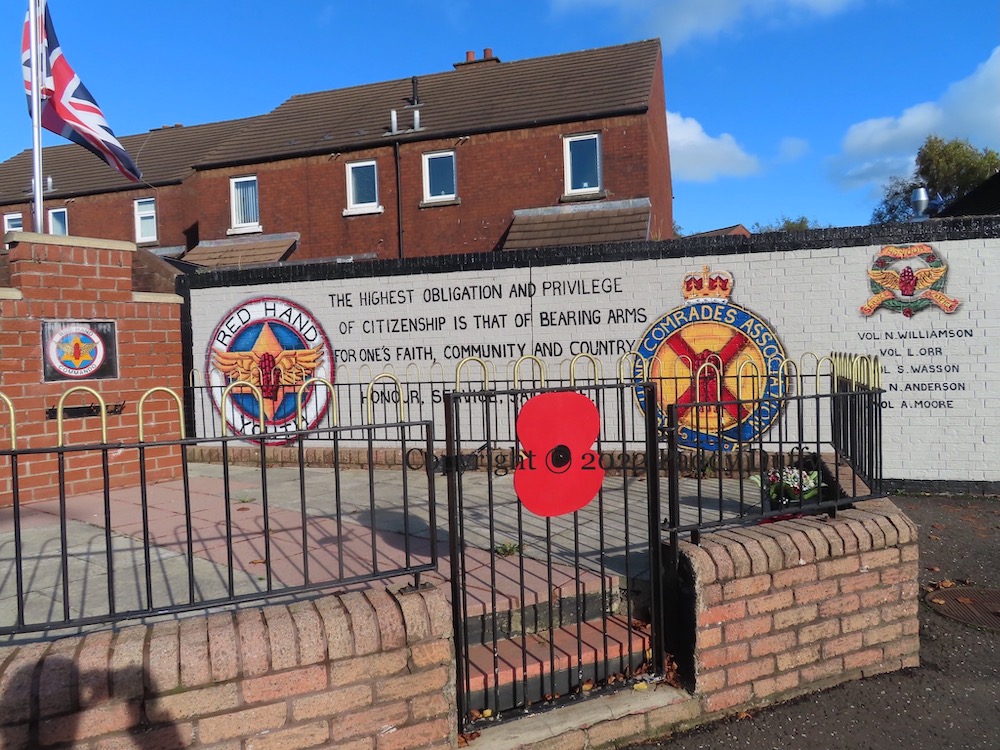
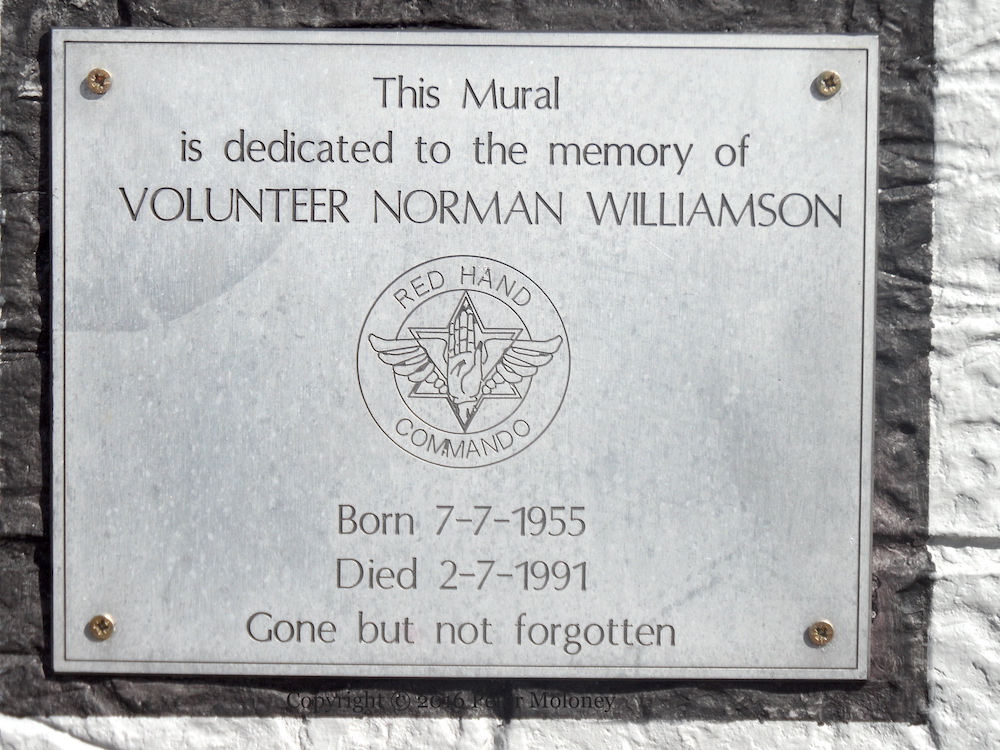
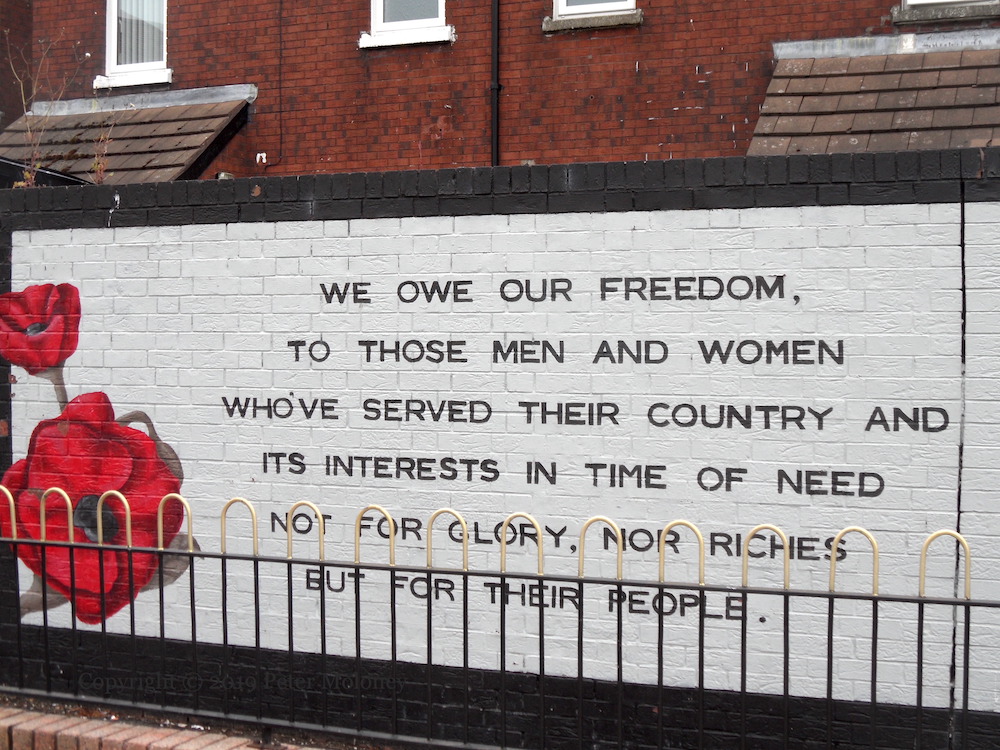
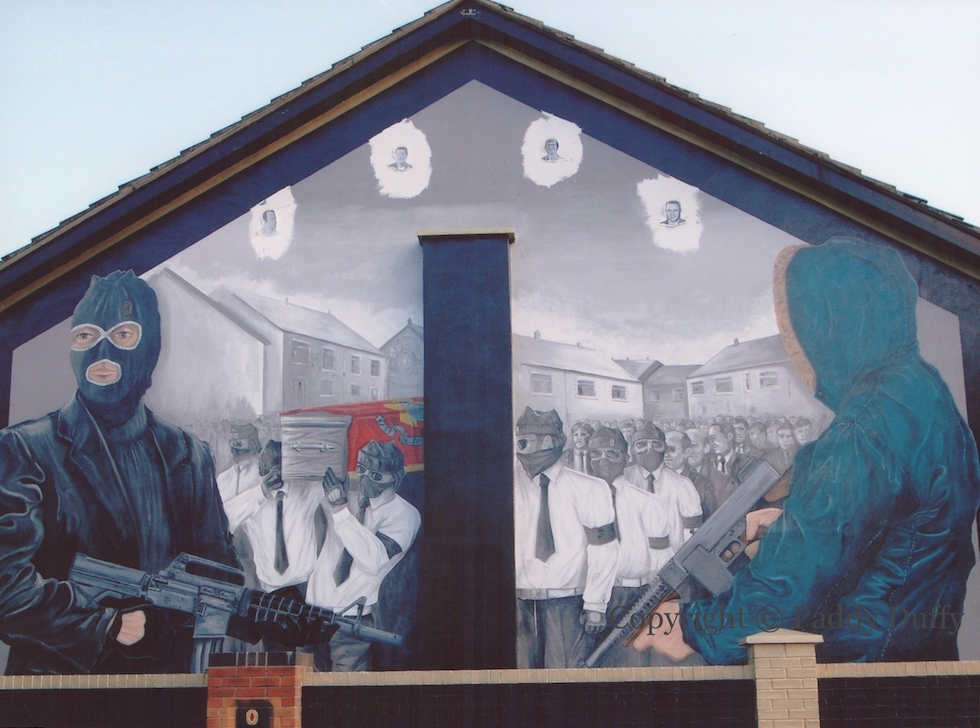
The backdrop to the Red Hand Commando memorial garden in Rathcoole has been repainted with the emblem of the “Red Hand Comrades Association” (for background on the see We Await In The Shadows). “The highest obligation and privilege of citizenship is that of bearing arms for one’s faith, community and country. [George S. Patton, Jr.] Honour, service, sacrifice.” With the names “N[orman]. Williamson, L. Orr, S. Wasson, N. Anderson, A. Moore.” (Anderson and Moore are new additions, compared to M16237 and M16236, below; also included is M13106 for the plaque in the main mural.)
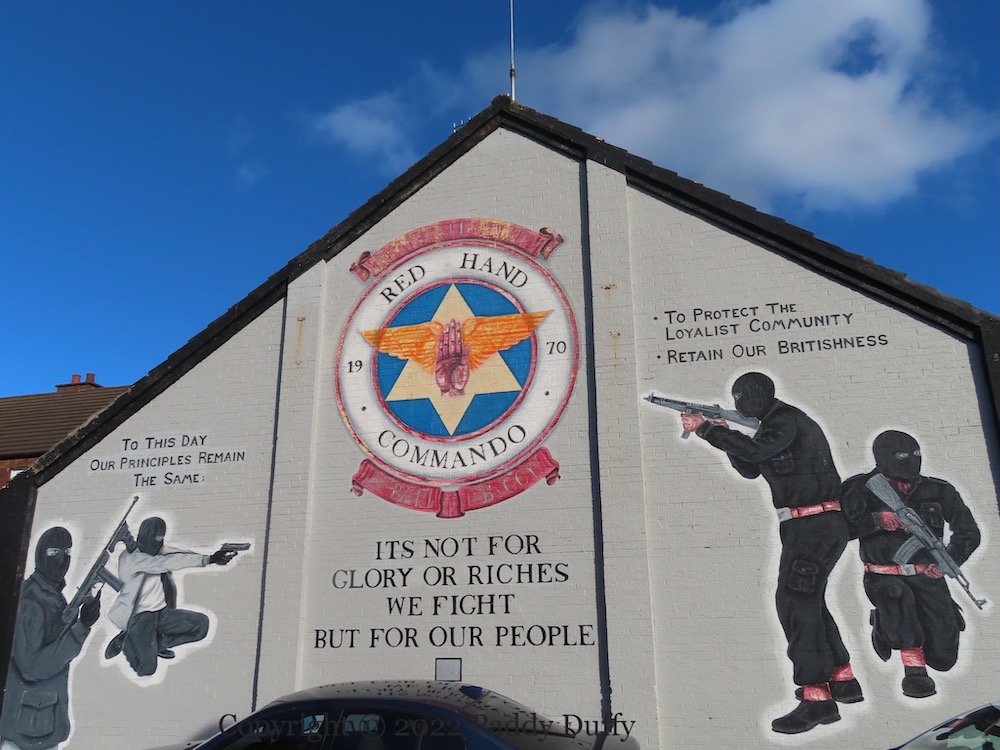
It is in the same colour-scheme as the main wall, which is now fading somewhat: Founded in 1970, “To this day our principles remain the same: to protect the loyalist community, to retain our Britishness.” The mural shows the “Rathcoole Elite” unit (1st Batt., B. Coy) of the Red Hand Commando, complete with four masked men each bearing weapons.
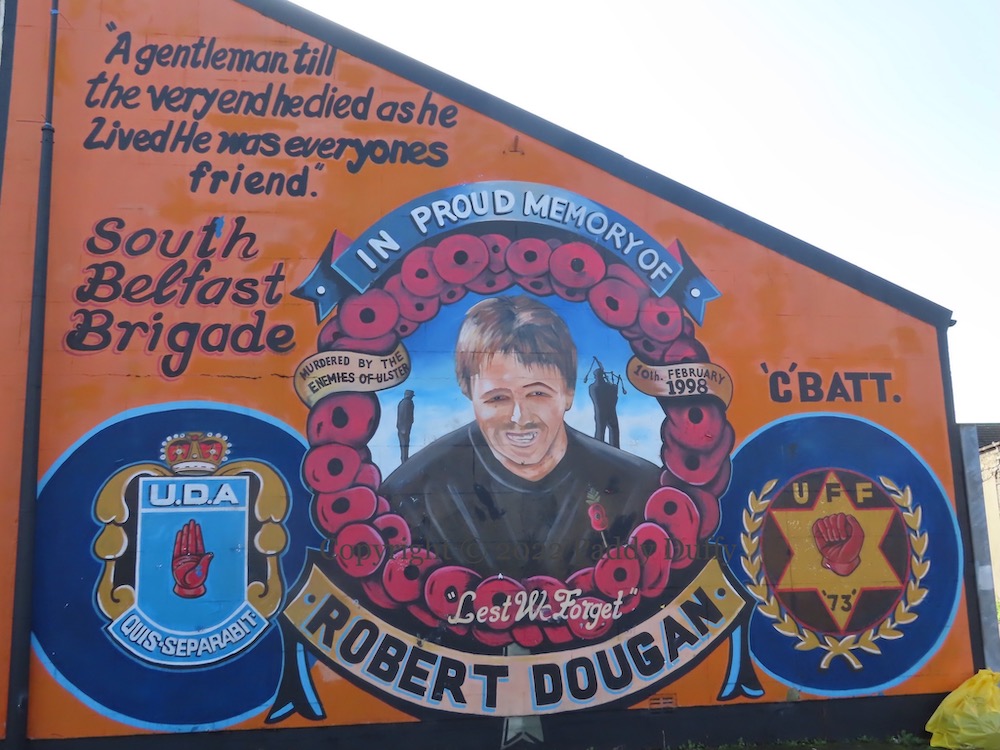
South Belfast UDA commander Robert Dougan killed by the IRA on February 10th, 1998 while sitting in a car outside Balmoral Textiles in Dunmurry, two months before the Good Friday Agreement was signed. Ed Maloney summed up the situation at the time in a Sunday Tribune article. “A gentleman till the very end, he died as he lived, he was everyone’s friend.”
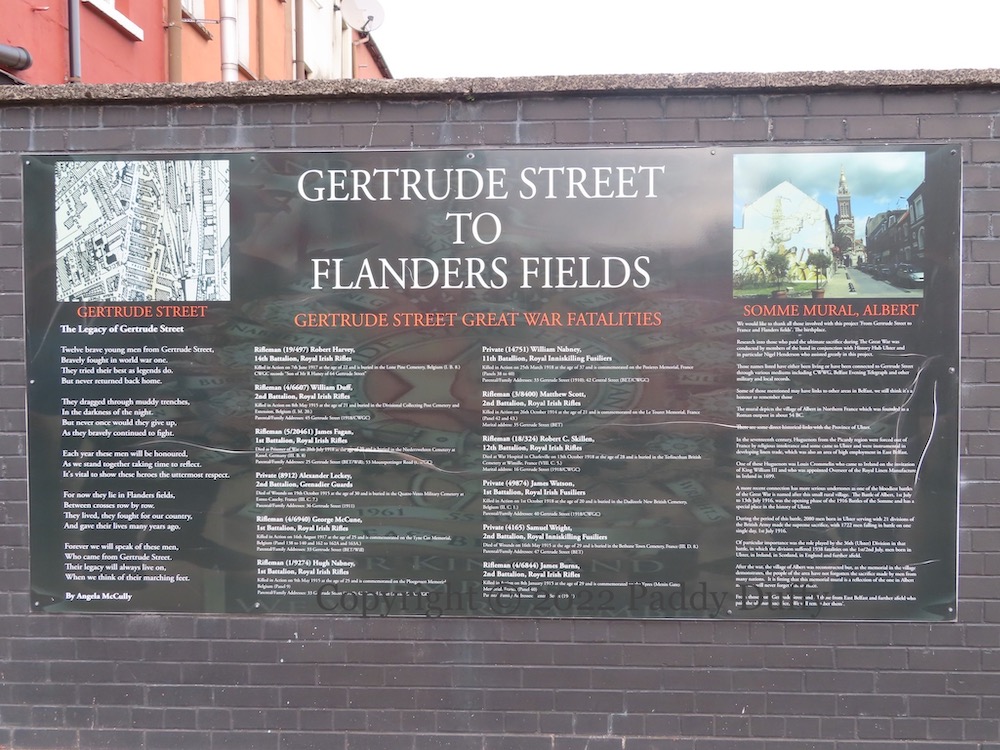
The twelve “Gertrude Street Great War Fatalities” are: Robert Harvey; William Duff; James Fagan; Alexander Leckey; George McCune; Hugh Nabney; William Nabney; Matthew Scott; Robert C. Skillen; James Watson; Samuel Wright; James Burns.
This board was originally next to the To France And Flanders mural on the adjacent wall; the mural also named these twelve but which only lasted a year. That mural depicted the damaged basilica tower in the village of Albert and there is a similar mural in the village itself – a photograph of the mural and the rebuilt tower can be seen in the top right of the board; the mural can be seen in full here.
As the map in the top left shows, Gertrude Street was where Wolff Close now is, running north from the Newtownards Road; the original Gertrude Star mural (circa 1989) was on the first gable of what is now called “Freedom Corner” – see D00388.
The emblem of the Gertrude Star flute band serves as a background. The band’s 50th/60th anniversary mural is across the street.
“‘The Legacy Of Gertrude Street. Twelve brave young men from Gertrude Street,/Bravely fought in world war one./They tried their best as legends do./But never returned back home.//They dragged through muddy trenches,/In the darkness of the night./But never once would they give up,/As they bravely continued to fight.//Each year these men will be honoured,/As we stand together taking time to reflect./It’s vital to show these heroes the uttermost respect.//For now they lie in Flanders fields,/Between crosses row by row./They lived, they fought for our country,/And gave their lives many years ago.//Forever we will speak of these men,/Who came from Gertrude Street./Their legacy will always live on,/When we think of their marching feet.’ By Angela McCully”
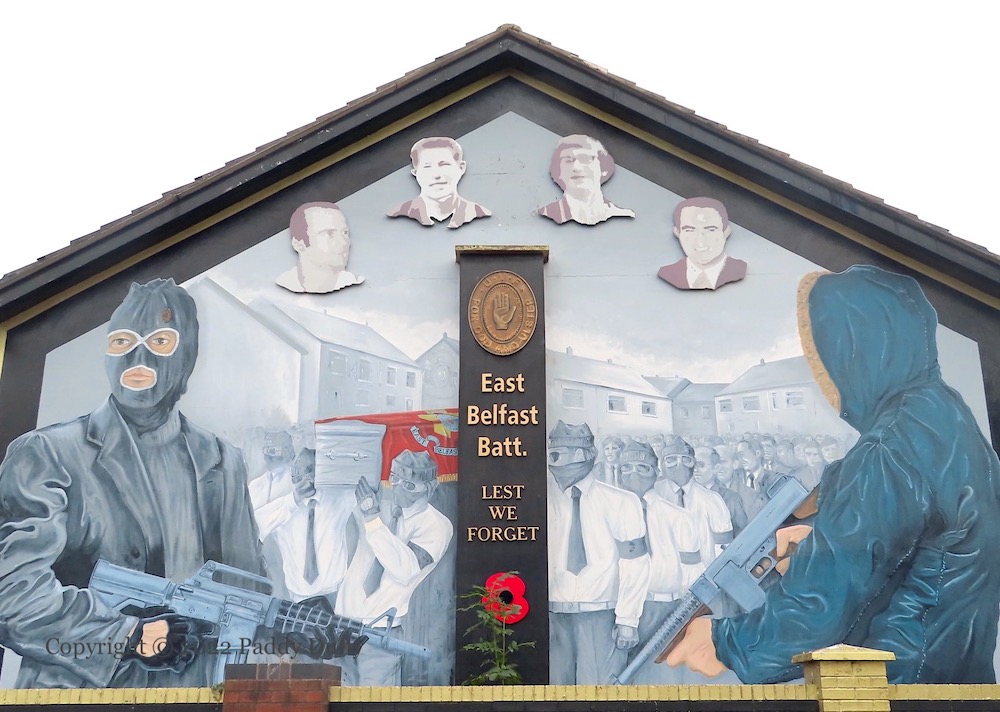
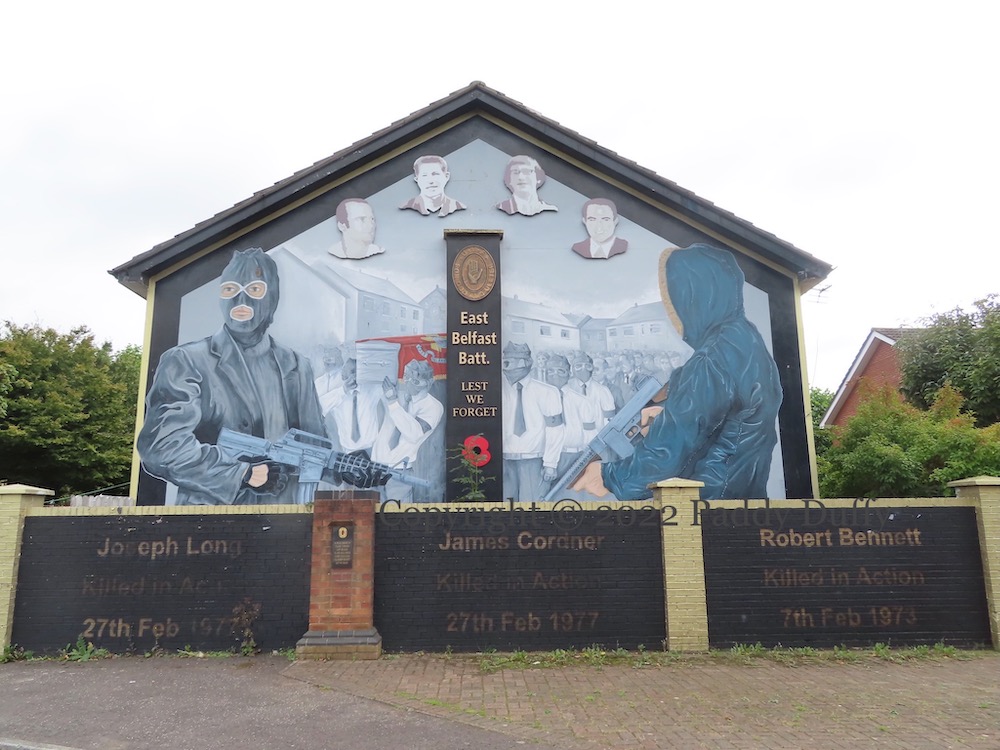
Four members of the East Belfast UVF are commemorated by a new mural in Fraser Pass, Ballymacarrett. The four named are: Robert Seymour, shot dead by the PIRA in 1988; James Cordner and Joseph Long, who were killed in a premature explosion in 1977; Robert Bennett, killed by the British Army during a riot in 1973.
In a previous version of the mural, Seymour and Long were featured alongside Crawford and Craig (of the Home Rule era) – see God, Give Us Men! (which also includes a close-up of the small plaque embedded in the front wall).
These same four are commemorated in the controversial 2013 mural featured in Years Of Sacrifice.
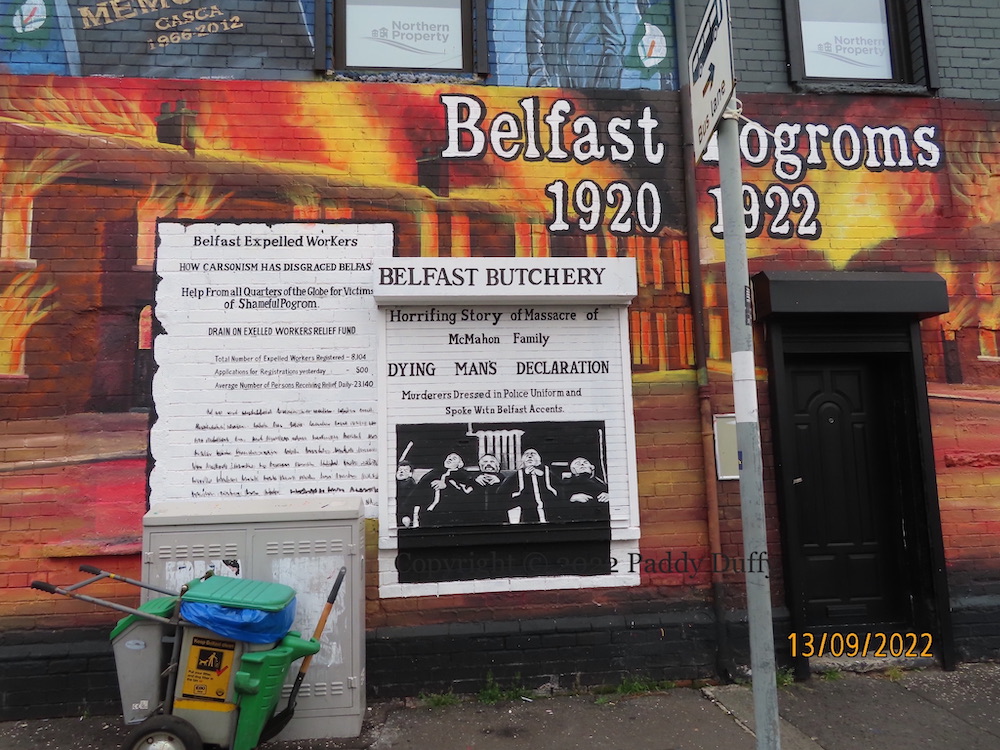
“Belfast Pogroms 1920-1922.” Against the backdrop of the first Dáıl, the War Of Independence, and the debate in Westminster over the fourth Home Rule bill (it would be passed in November 1920), northern Protestants began to assert their de facto independence from the rest of Ireland – both in economic and in military terms.
On July 12th, 1920, Edward Carson spoke to a crowd in Derry and, addressing the government in Westminster, said “if you are yourself unable to protect us from the machinations of Sınn Féın, and you won’t take our help; well, then, we tell you we will take the matter into our own hands.” (Treason Felony). Nine days later, the “clearings” of Catholics from Belfast shipyards and mills began, with about 5,700 Catholics and 1,850 socialists (“rotten Prods“) being expelled from Workman Clark and Harland & Wolff yards, and in total 10,000 workers from yards and mills over the next two weeks (History Ireland). In combination with the straitened economic circumstances of the time (post WWI) thousands (23,140 according to this mural, which reproduces a flyer derived from the Irish News of October 6th, 1920 – via The Irish Story’s account of the start of the “Belfast Pogrom”) were on relief.
Militarily, in October, 1920, the Ulster Special Constabulary was established (drawing on members of the Ulster Volunteers, which had been reconstituted in June 1920, and the 21,000 members of the Ulster Imperial Guards (WP)) as an alternative to the Royal Irish Constabulary in fighting actions by the IRA in Belfast, Derry, and elsewhere in the north. On March 23rd, 1922, two officers of the Specials were killed in Belfast city centre by the IRA. In reprisal, two Catholic civilians were killed in the Short Strand, and in the early hours of March 24th, a party of five men, four dressed in RIC uniforms, burst into the home of Catholic businessman Owen McMahon and shot McMahon, his six sons, and one of his employees – only two of the sons survived. District Inspector John Nixon of the RIC was suspected of leading the attack on the McMahon household – see The RIC Murder Gang and Pat And Dan Duffin. (The headlines are from the Freeman’s Journal of March 25th, 1922 – see Joe Baker’s 80-page account of the murders of summer 1922; the photograph of the McMahon corpses that is reproduced in the mural can be seen at Slugger.)
This is the first half a new mural in Ascaıll Ard Na bhFeá; the “1922” part can be seen in Executed.
“Belfast Expelled Workers – How Carsonism has disgraced Belfast – Help from all quarters of the globe for victims of sh[a]meful pogrom – Drain on Ex[p]elled Workers[‘] Relief Fund. Total number of expelled workers registered – 8,104; Applications for registrations yesterday – 500; Average number of persons receiving relief daily – 23,140.”
“Belfast Butchery – Horrif[y]ing story of massacre of McMahon family – Dying man[‘]s declaration – Murderers dressed in police uniform and spoke with Belfast accents.”
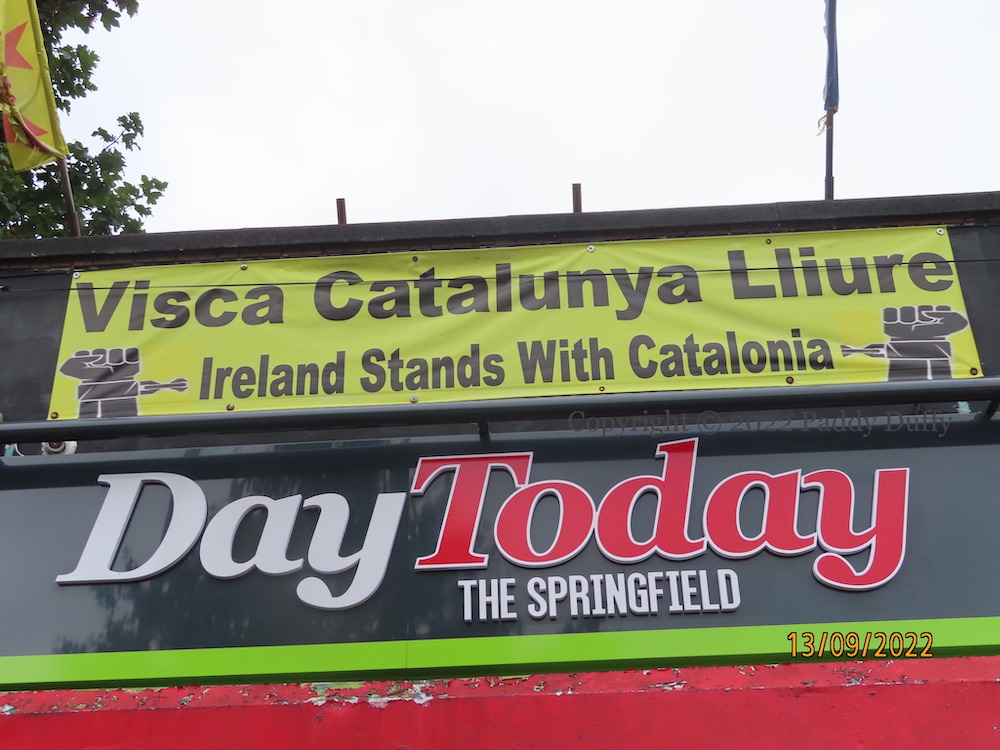
Visca Catalunya Lliure – Ireland stands with Catalonia” – tarp above the newsagents at the junction of Springfield Drive and Springfield Road, west Belfast.
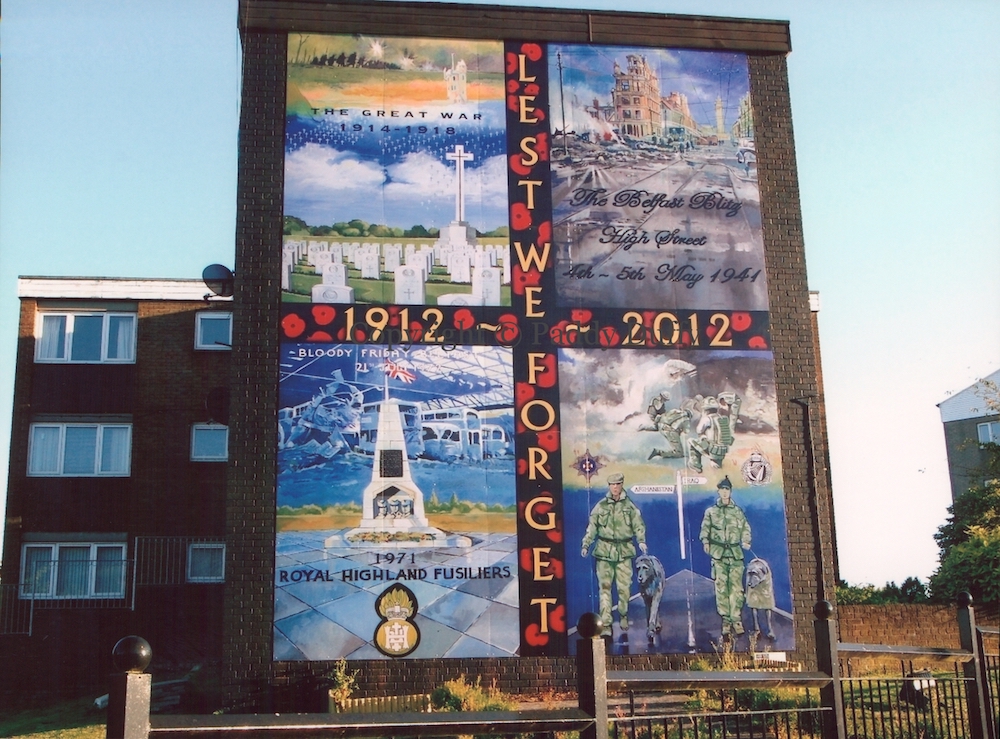
The three-storey mural above is in Ballysillan and replaced a UVF mural when it was added in 2011. The mural is the work of Jim Russell while artist-in-residence at Arts For All. The information below was provided by Arts For All.
The Great War: The first panel commemorates the Great War that ravaged Europe from 1914 to 1918 and shows troops advancing into battle, the Ulster Tower at Thiepval commemorating the sacrifice at the Somme and an image showing one of the war cemeteries and highlighting the true cost of war.
Second World War: The second panel features some of the devastation visited upon Belfast during a series of Luftwaffe raids during the early years of the Second World War. Belfast suffered greatly with over 1,000 people dying in four nights of bombing in April and May of 1941.
The Troubles: In the third panel highlight the dark history known as the Troubles. It features two events from the years of that time – the murder of the three young off-duty Scottish soldiers in 1971 [the monument depicted was featured in The Highland] and the Bloody Friday bombings of July 1972. In the midst of the horror that accompanied the early years of the Troubles these events still caused many to struggle to understand how people could carry out such atrocities.
Present Day Conflict: Panel four brings us up to the present day. Military service is a tradition for many in Northern Ireland and for many their first overseas trip came on the back of an overseas posting whilst serving in one of the Armed Forces. From times past, through the World Wars, the Korean War, to more recent conflicts in Iraq and Afghanistan soldiers and regiments drawn from Norther Ireland continue to play a role.
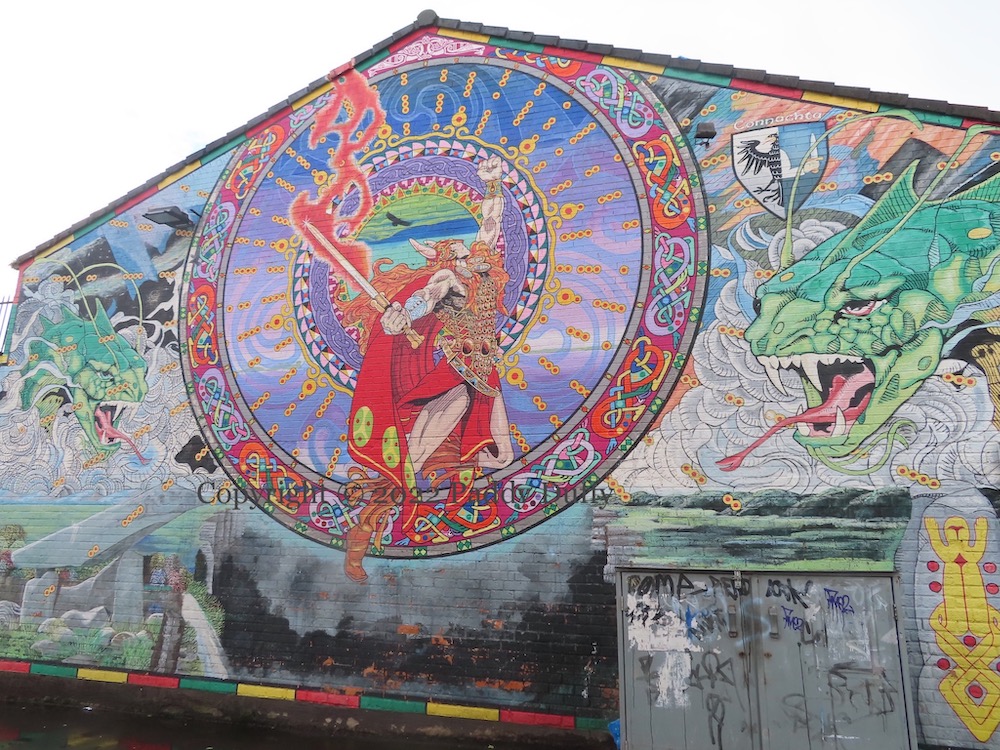
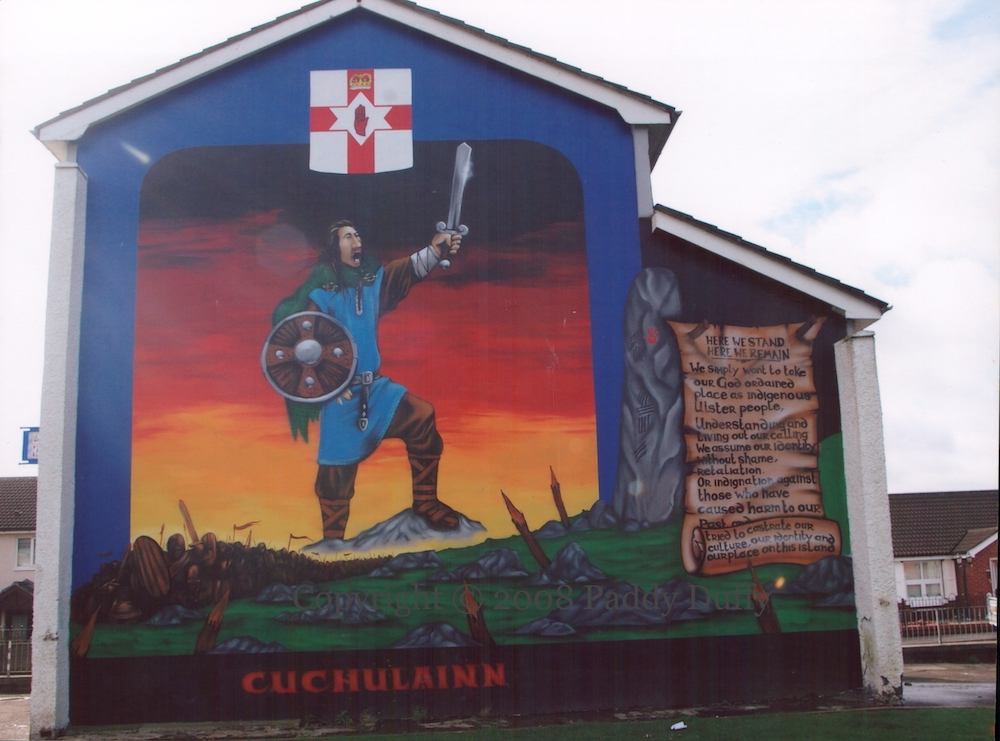
The mythological hero Cuchulainn, defender of Ulster against the forces of Queen Medb of Connacht, is placed below the flag of Northern Ireland. “Here we stand, here we remain. We simply want to take our God ordained place as indigenous Ulster people, understanding and living out our calling. We assume our identity without shame, retaliation or indignation against those who have caused harm to our past and tried to castrate our culture, our identity and our place on this island.”
Cú Chulaınn has his own Visual History page. This is the most active depiction of the hero; he is usually depicted in his death throes.
St James’s supports the hunger strikes – in Long Kesh and Armagh and (on the right) in Turkey.
Various images and posters from 1980 and 1981 are reproduced. Along the top, we see (l-r) a soldier is confronted at the top of Springhill (image at Irish Times), “Wanted for murder [and torture of Irish prisoners]” (image at MSU), “Mothers hunger”, “Blessed are those who hunger for justice“, “Where there is oppression there is resistance”, Armagh hunger-striker Mary Doyle.
Along the bottom: “Stop strip searches“, “Save our children from plastic death”, “Support the hunger strike demands”, and portraits of 1981 hunger-strikers Bernard Fox and Pat Sheehan, both from the Falls Road.








 Paddy Duffy Collection