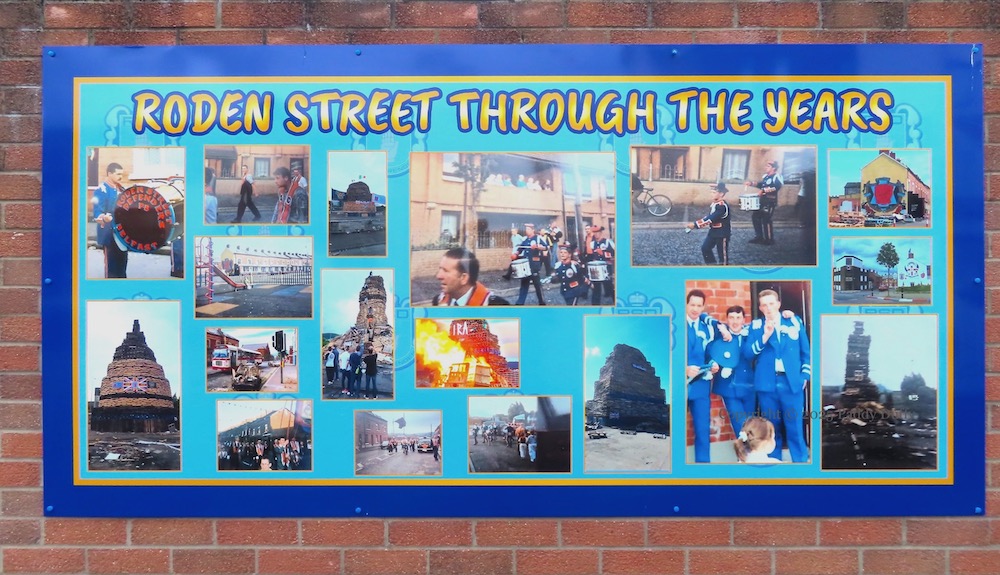
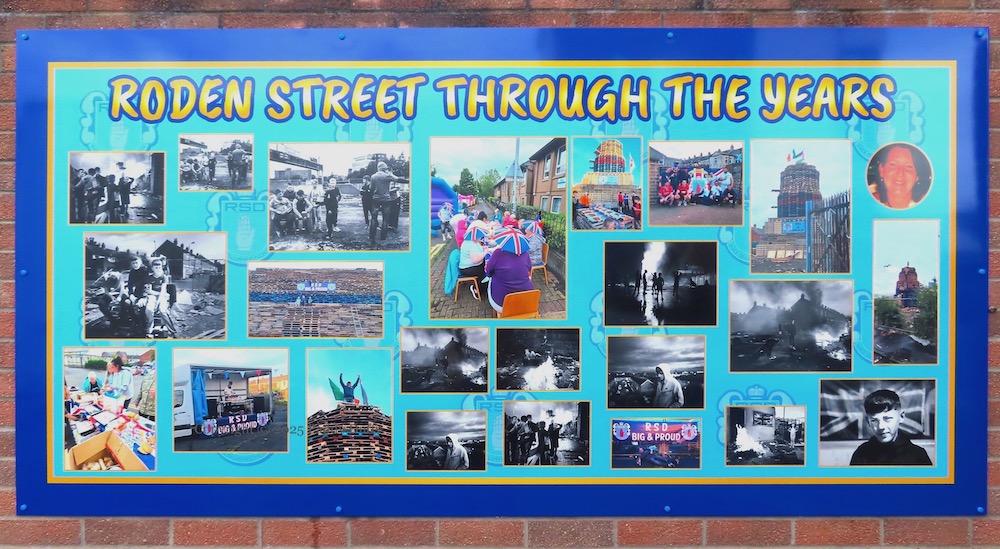
Roden Street was divided in two when the Westlink was built along the path of the Blackstaff to join the M1 at Broadway with the Grosvenor Road. (This portion of the Westlink opened in 1981; a Klaus Fröhlich photograph of a blocked-off Roden Street on the CNR side, looking towards Divis, is included at the end of the post.) The vintage mural in the top left of the first board (above) was in Clifford Street and is now on the Grosvenor Road (CNR) side of the motorway. (The mural can be seen in Visual History 01.)
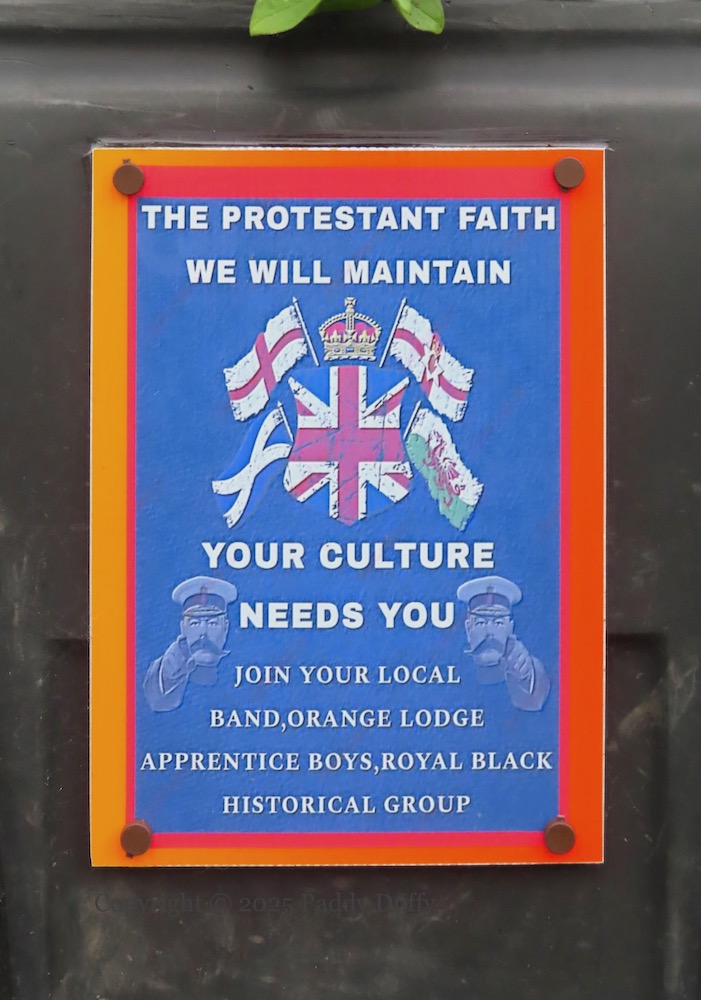
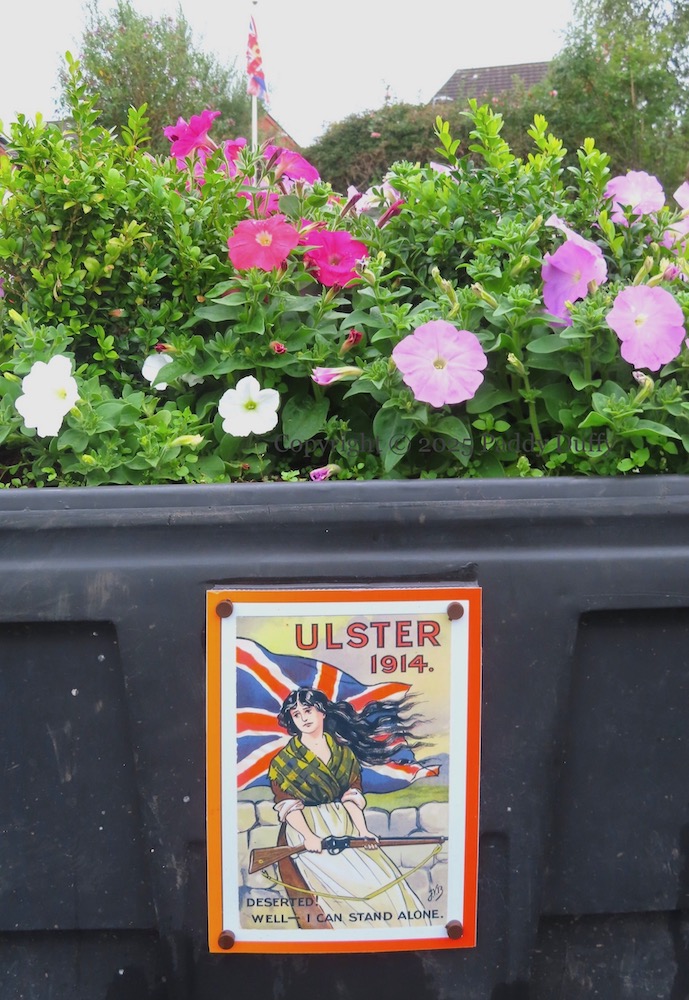
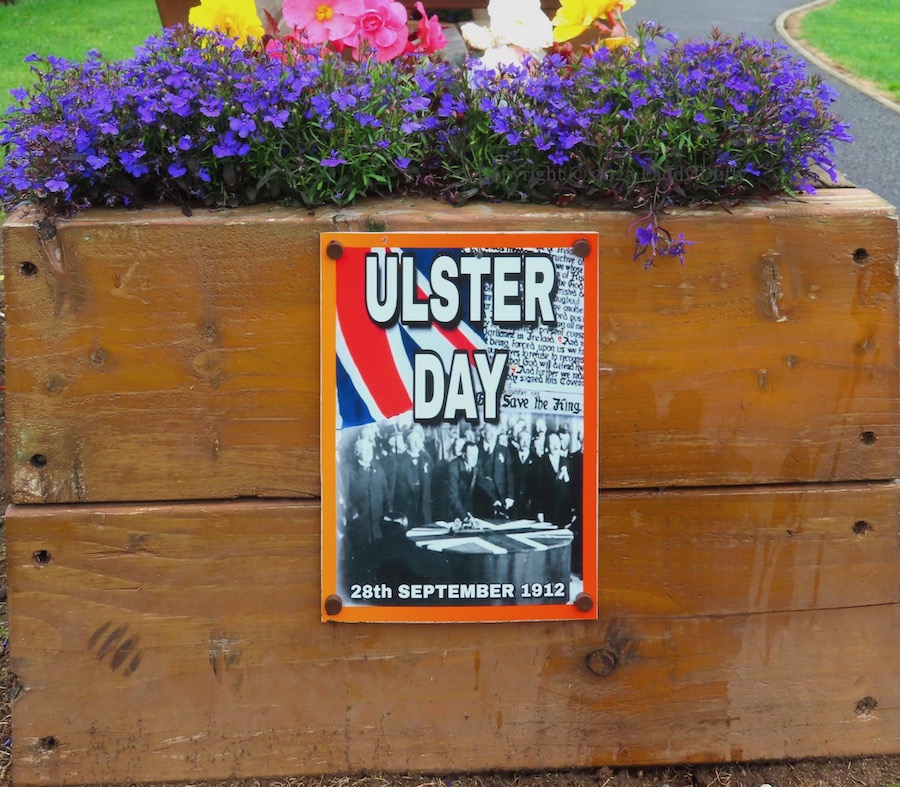
Here is a gallery of small boards on flower boxes in “the Village Green community park of remembrance”: “The Protestant faith we will maintain. Your culture needs you. Join your local band, Orange lodge, Apprentice Boys, Royal Black historical group”, with Kitchener pointing at the viewer; “Deserted – Well, I can stand alone!“; “Ulster Day, 28th September, 1912“; “No Home Rule. Let our flag run out straight in the wind. The old red shall be floated again. When the ranks that are thinned shall be thinned. When the names that are twenty are ten“; – Edward Carson and the formation of the Ulster Volunteers in 1913; – All nine counties of Ulster are “Hands up!” “against Home Rule”.
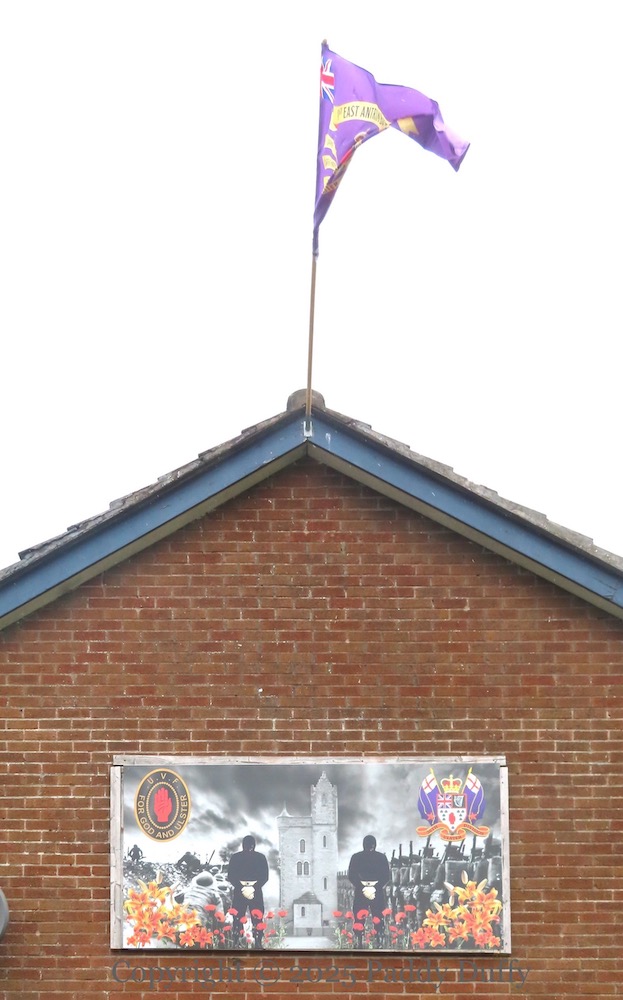
Modern UVF volunteers in balaclavas stand with heads bowed on either side of the Ulster Tower in Thiepval, standing among orange lilies and red poppies.
On the left the 10th Scottish Rifles (AWM) commence a raid, below the emblem of the Ulster Volunteer Force, and on the right, the Royal Fusiliers appear to march off to war in a press photograph (Flickr), below the emblem of the 36th (Ulster) Division.
In Grange Drive, Ballyclare, on the same as wall, and using part of the frame from, a previous UDA board: Young Guns.
The memorial wall in Erskine Park, Ballyclare, marked the 80th anniversary of VE Day – May 8th, 2025 – with a pair of printed boards wrapping around the corner of the low wall.
For views of the gable and the low wall with armed-forces emblems and plaques to Girvan and Erskine, see The Men From Ballyclare.
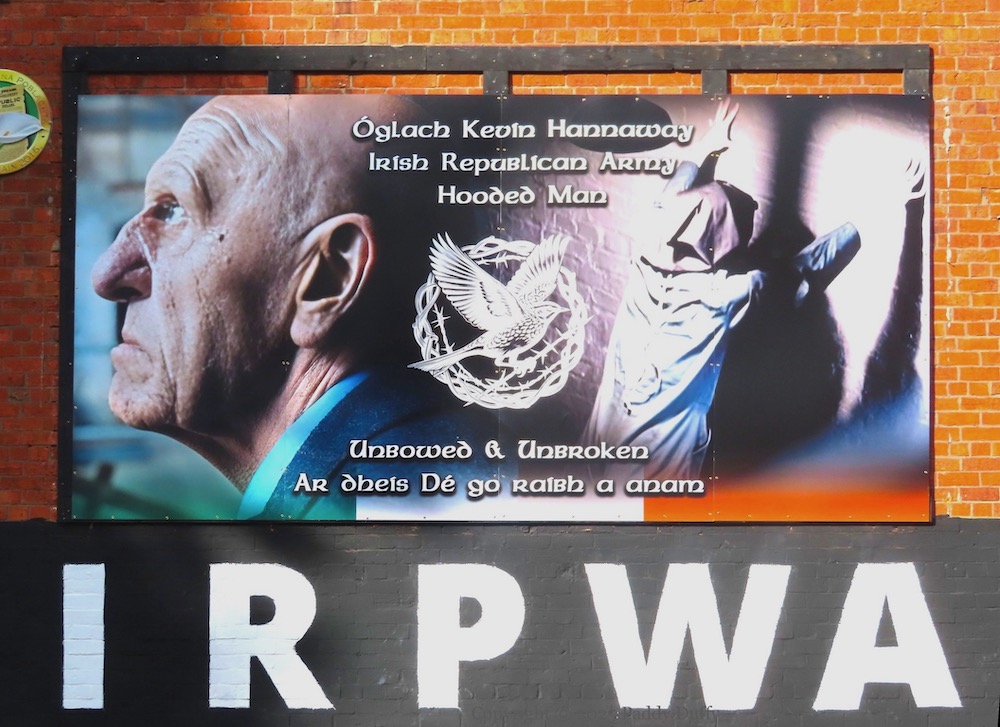
“Óglach Kevin Hannaway, Irish Republican Army, hooded man. Unbowed & unbroken. Ar dheıs Dé go raıbh a anam.”
Kevin Hannaway died in January (2025), aged 77. In 1971 he was interned (Belfast Media) and subjected, along with thirteen others, to the “five techniques” – deprivation of food/drink and of sleep, subjection to noise, prolonged stress positions, and hooding (WP) – as well as being beaten and dropped out of a helicopter (Irish Times). The ‘five techniques’ were found to constitute torture in 2021 (RTÉ) and the PSNI apologised to the victims in 2023 (BBC | Irish Legal News).
Hannaway remained a republican throughout his life and was anti-Agreement in recent years (BBC). The board in Hannaway’s honour was launched on Sunday July 13th (Fb video). The panels of the board were siezed by the PSNI during a drug raid on a home in St James’s on the 11th but returned the next day (BelTel).
“IRPWA [web]. Republican prisoners still exist! Unfinished revolution. Unbowed, unbroken.”
Hugo Street, west Belfast. For a close-up of the Pearse Jordan plaque on the left, see the Peter Moloney Collection.
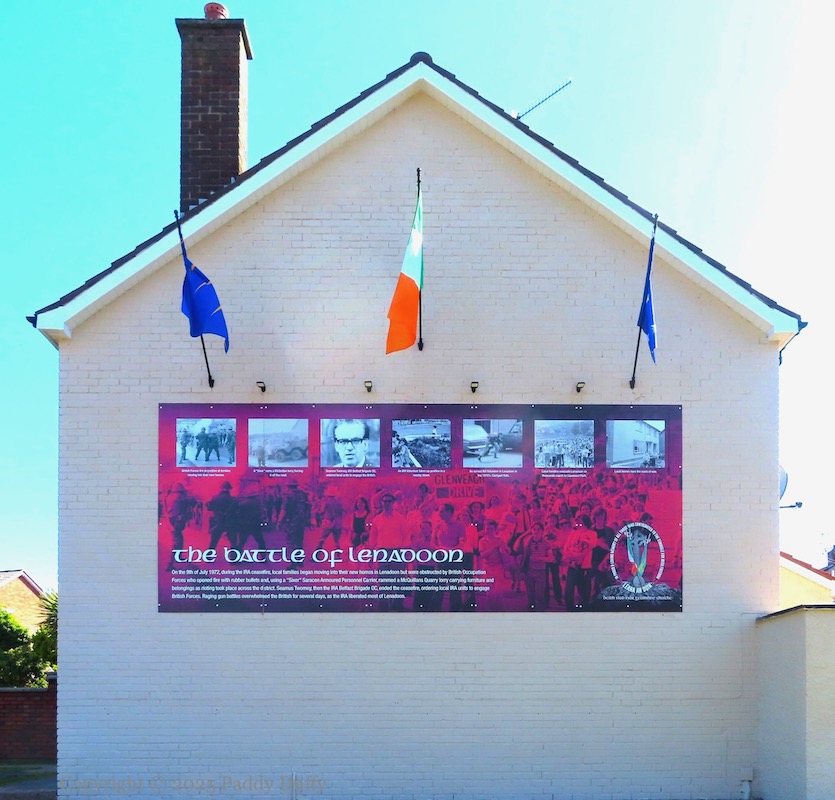
“On the 9th of July 1972, during the IRA ceasefire, local families began moving into their new homes in Lenadoon but were obstructed by British Occupation Forces who opened fire with rubber bullets and, using a “Sixer” Saracen Armoured Personnel Carrier, rammed a McQuillan’s Quarry lorry carrying furniture and belongings as rioting took place across the district. Seamus Twomey, then the IRA Belfast Brigade OC, ended the ceasefire, ordering local IRA units to engage British Forces. Raging gun battles overwhelmed the British for several days, as the IRA liberated most of Lenadoon.”
The captions to the photographs along the top read (l-r): “British Forces fire projectiles at families moving into their new homes”, “A “Sixer” rams a McQuillan lorry, forcing it off the road”, “Seamus Twomey, IRA Belfast Brigade OC, ordered local units to engage the British”, “An IRA Volunteer takes up position in a nearby street”, “An armed IRA volunteer in Lenadoon in the 1970s, Carrigart flats”, “Local families evacuate Lenadoon as thousands march to Casement Park”, “Local homes bare [bear] the scars of war”.
For background, see this 24 minute Thames TV report (on youtube) about the dispute over houses in Lenadoon; RTÉ also has footage (one | two) of the evacuation.
“In proud & loving memory of all those who contributed to the struggle for Irish freedom – Léana An Dúın – Beıdh sıad ınár gcuımhne choíche”
Lenadoon Avenue, west Belfast, replacing the 1995 Gorta Mór mural. Launched Sunday July 12th.
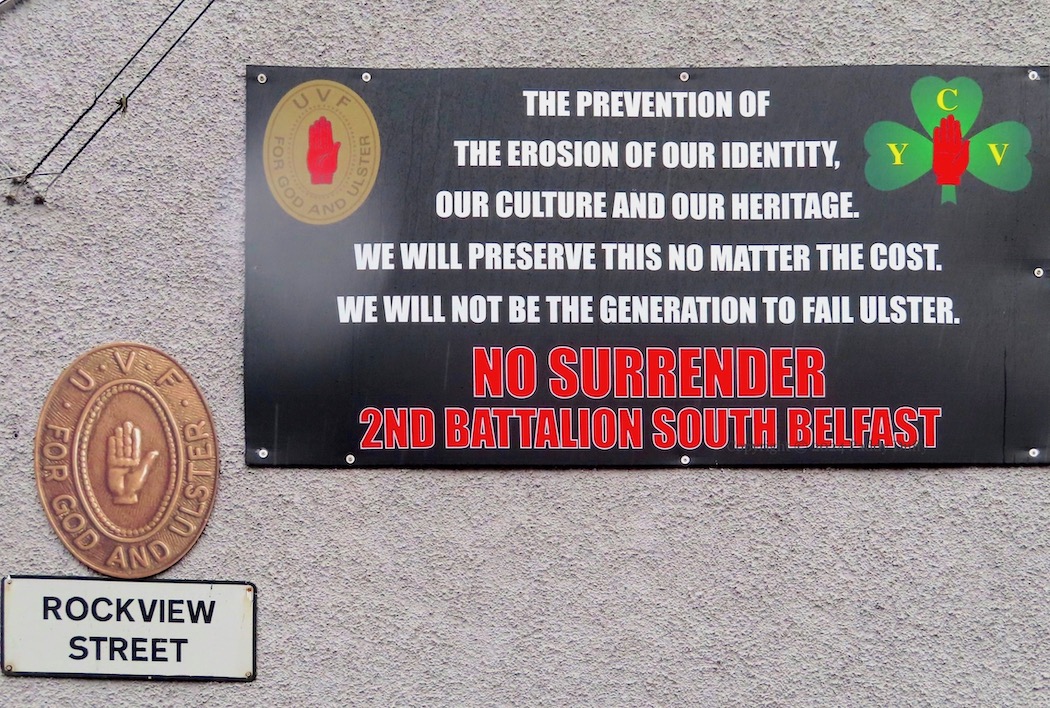
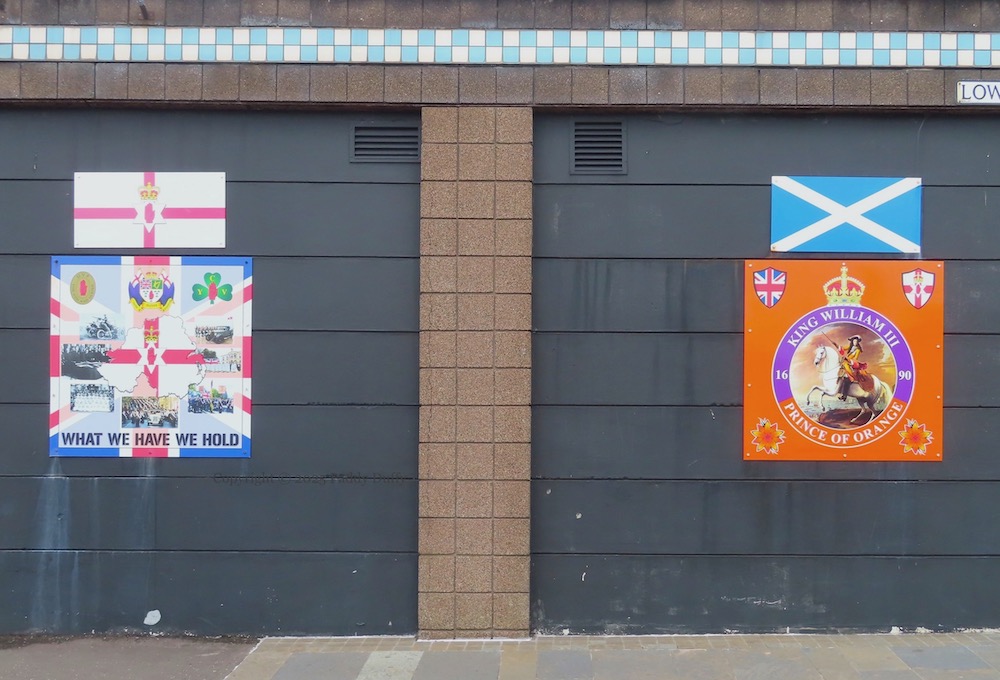
“Loyalist Village, south Belfast.” UVF markings in the Village continue to proliferate with the recently-added board shown above (from the top of Tavanagh Street) alongside a slew of other boards, some of which are included below.
The “Village team” is not Linfield FC but the UVF (the phrase was also used by the Village UDA); “VTOT” (standing for “Village team on tour”) has previously been used as graffiti – see Welcome To Hell!!!
The purple hoarding below gives “1913” as a creation-date for the battalion. The Ulster Unionist Council organised the signing of the Covenant in September, 1912, and in January 1913 voted to bring together the militias that had been formed in various places into an Ulster Volunteer Force. One of these was a South Belfast battalion that had formed in 1912 (History Ireland). Hence, both “1912” and “1913” are given as dates for the creation of the battalion. When the Volunteers were integrated into the Ulster Division for the Great War, the South Belfast Volunteers joined the 10th battalion of the Royal Irish Rifles.
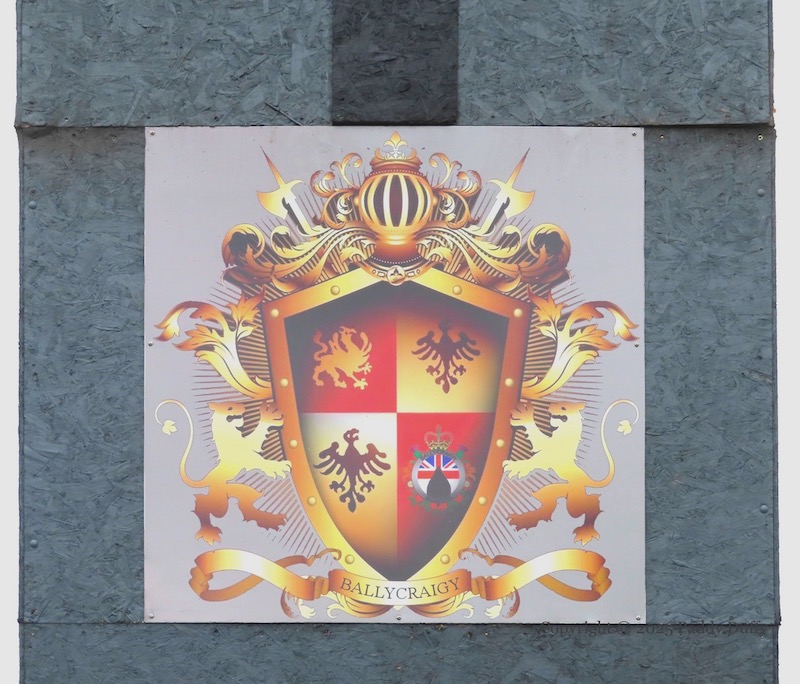
Preparations for Eleventh Night bonfires are underway in many estates, including Ballycraigy in Antrim which is getting help from an AI-generated Popeye. Ballycraigy used to boast the biggest Bonfire (see Lead The Way); you can keep track of this year’s build on the bonfire’s Facebook page.
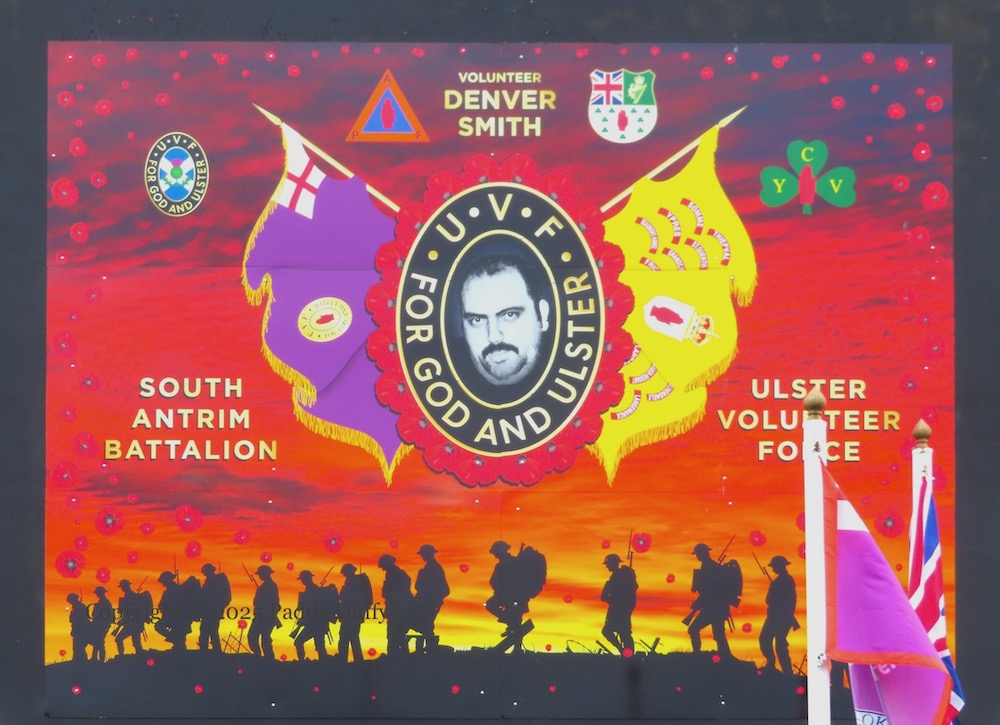
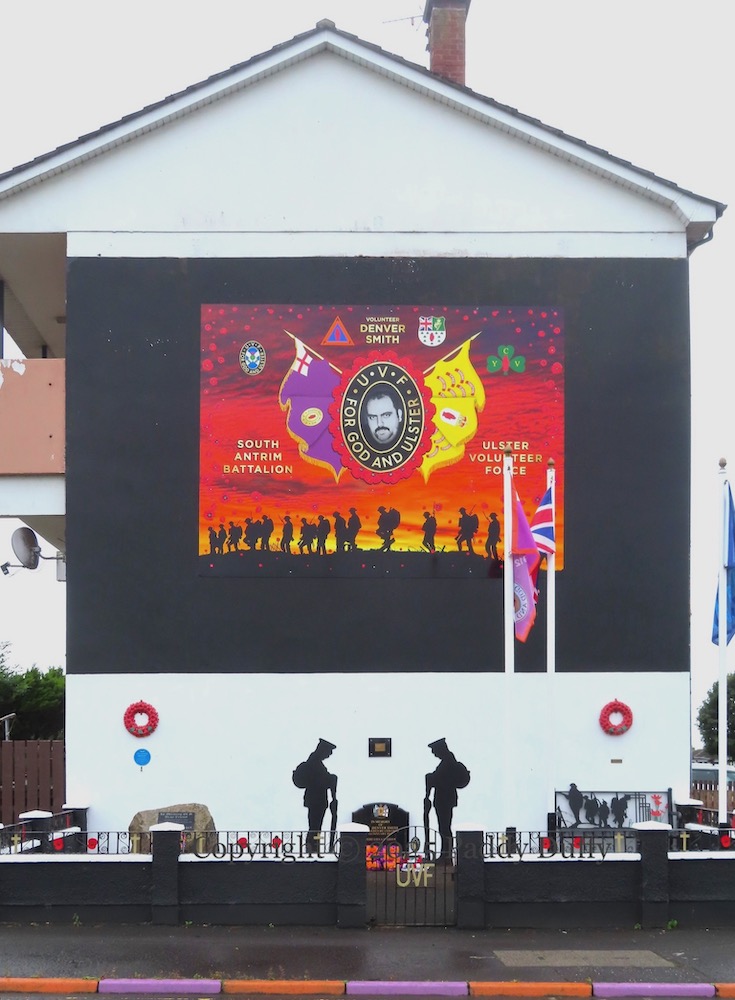
The Denver Smith mural in the Steeple, Antrim, has been replaced with the printed board (shown above and immediately below) which retains the same elements of the mural, including the WWI soldiers and the emblem of the 36th (Ulster) Division. (For information about Smith, see Here Lies A Soldier.)
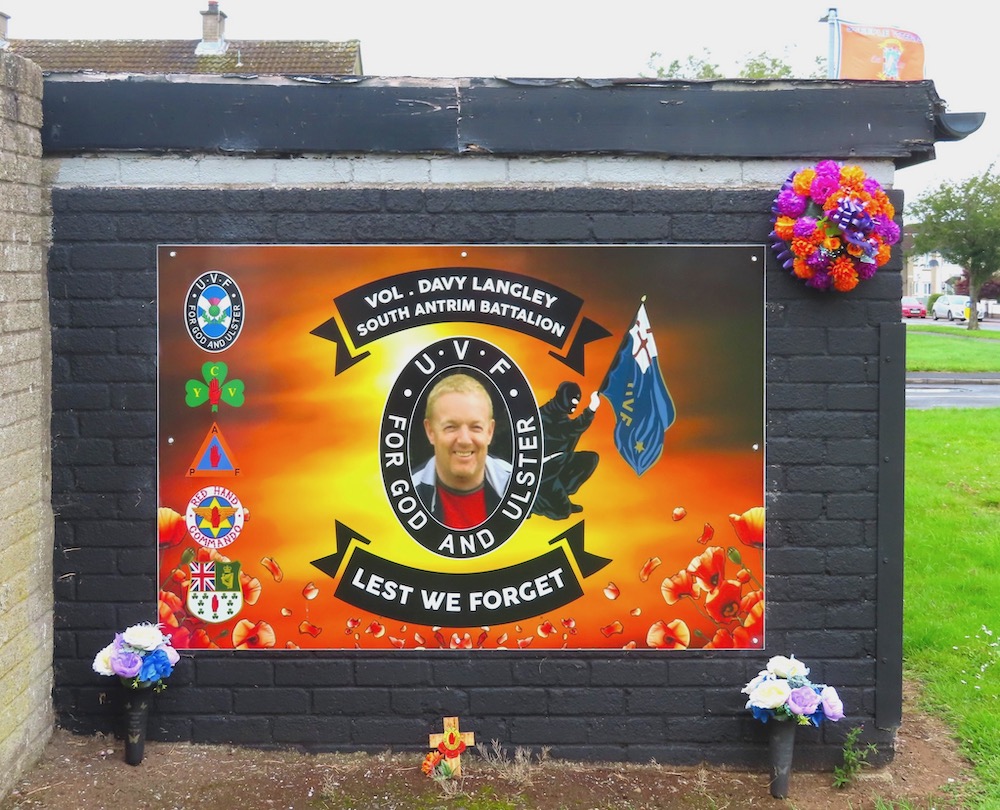
Memorial boards in the same style and palette have also been mounted on adjacent walls to two members of the modern Ulster Volunteer Force. To the left, Mark McCausland, who died in 2024 (Wray’s); the board in his memory replaces a UVF flag (seen in Pass Not This Spot In Sorrow). To the right, Davy Langley, who died in 2018 (Funeral Times); there was previously a mural to his memory in the same spot (see Ulster Volunteer Forces)
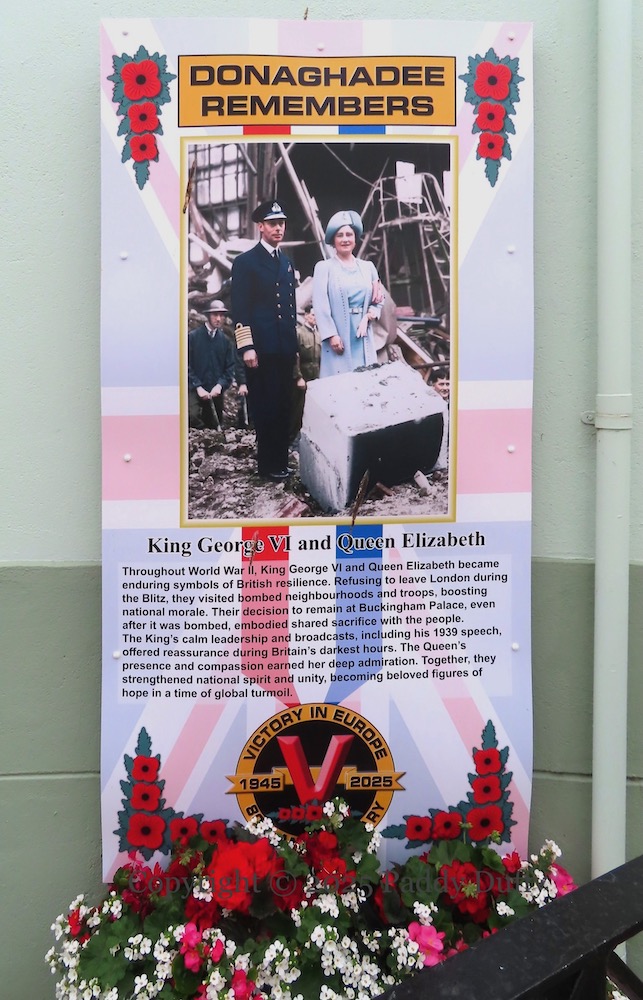
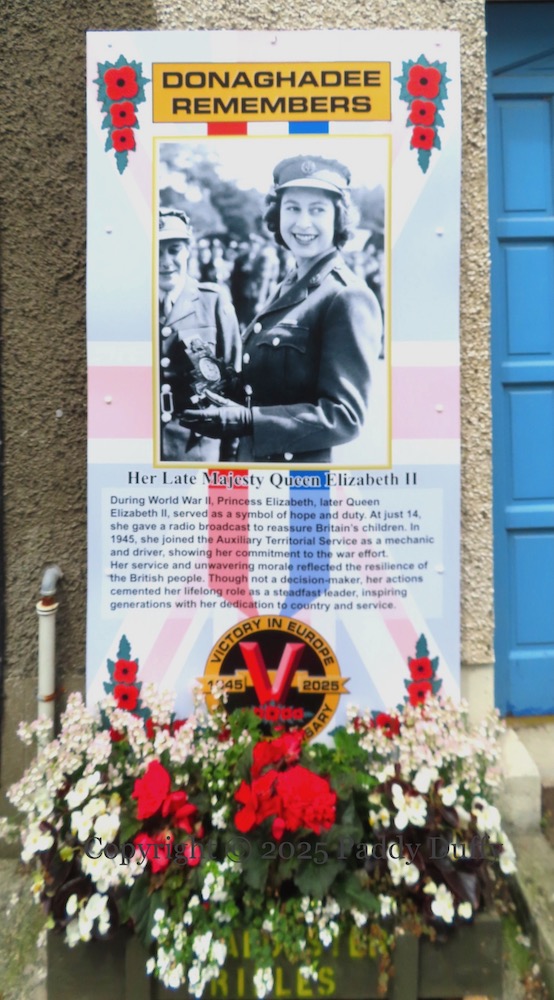
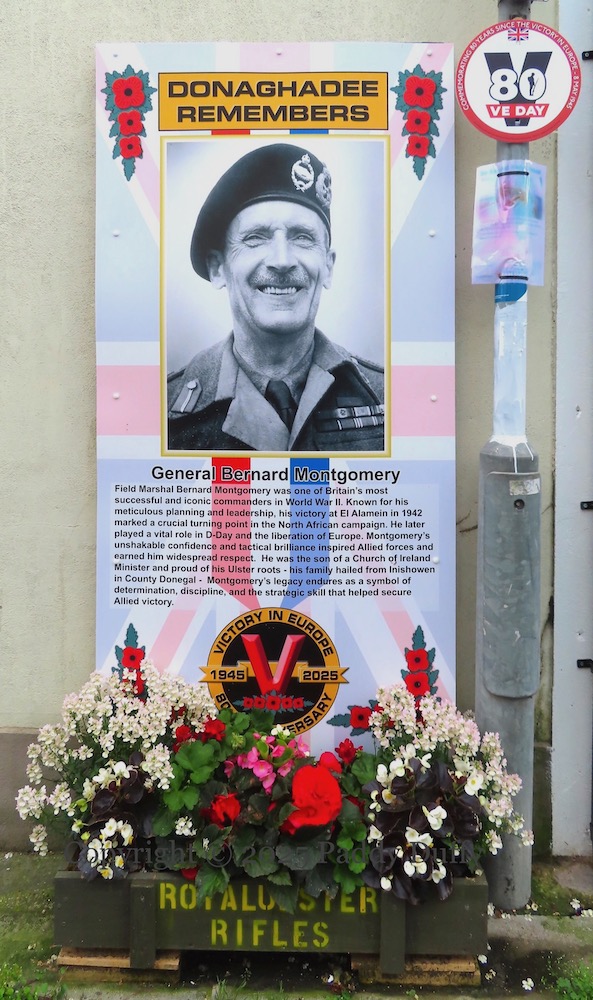
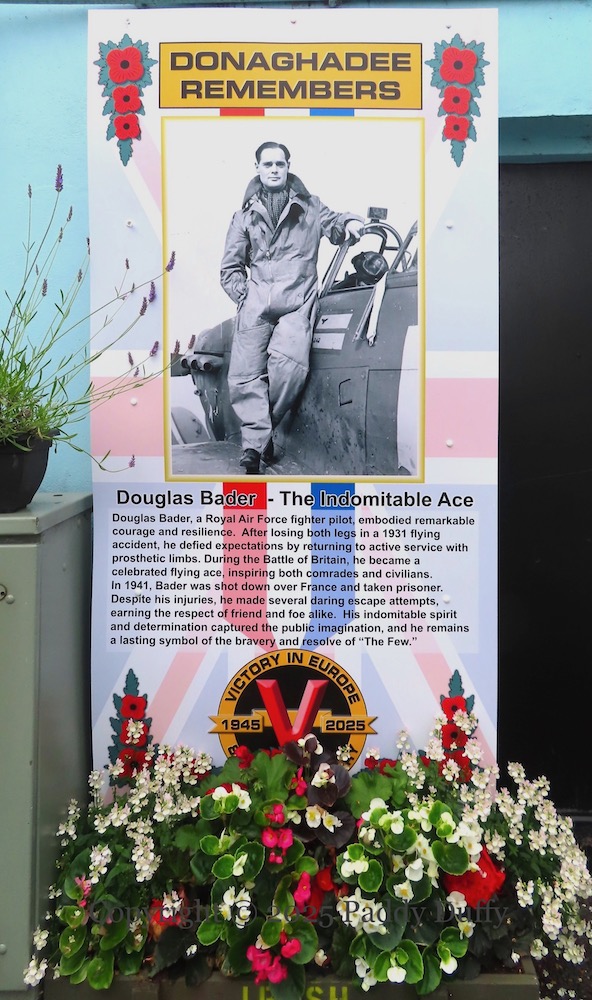
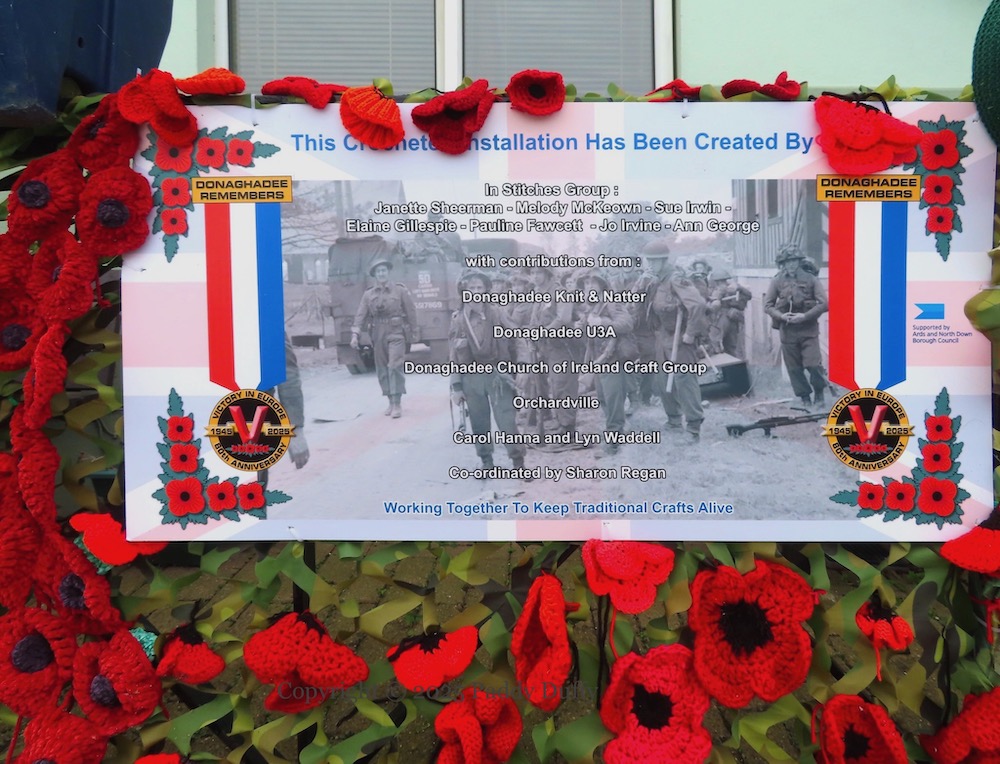
As part of the town’s VE Day celebrations, Donaghadee mounted a series of flower boxes, information boards, and crocheted poppies, along Hunter’s Lane (which runs between High Street and the Parade). Also included are small panels to twenty-three local soldiers who died during the War.
“Donaghadee Community Development Association [Fb], in collaboration with Donaghadee Community Partnership, Donaghadee Historical Society [Fb] and the In Stitches Group, is proud to present this floral and educational display in commemoration of the 80th anniversary of Victory in Europe. With support from Ards and North Down Borough Council, First Presbyterian Church, Abbeyfield, Wesley Housing and local residents, this project brings history to life in the heart of our town. / On 8th May 1945, the guns across Europe fell silent. After six years of devastating conflict, Nazi Germany surrendered unconditionally, marking the end of the Second World War in Europe. VE Day – Victory in Europe Day – was met with celebration, relief, and solemn reflection. Across the United Kingdom and the Commonwealth, crowds rejoiced, even as they grieved for the fallen and the irrevocable loss left in war’s wake. This display honours the 23 men and women from Donaghadee who gave their lives in service during World War II. We remember them with pride, gratitude, and sorrow. Through a series of commemorative panels, we also highlight the stories of eight wartime figures – from global leaders to everyday heroes – whose courage shaped history. / This is more than an remembrance. It is a space to reflect, to learn, and to give thanks. As we mark this significant anniversary, we commit ourselves anew to the values of peace, unity, and understanding. Let us remember – not only what was lost, but also what was won: the enduring freedom we enjoy today.”
The eight notable figures are: “Winston Churchill, the voice of defiance”, “King George VI and Queen Elizabeth”, “Her late majesty Queen Elizabeth II”, “Dame Vera Lynn, the forces’ sweetheart”, “Lt Col Blair Mayne, SAS trailblazer”, “Violette Szabo, the courageous spy”, “General Bernard Montgomery”, “Douglas Bader, the indomitable ace”.

























 Paddy Duffy Collection