“In memory of the men and women from the Orangefield area, who have made the ultimate sacrifice in the defence of our freedom in all theatres of conflict, both foreign and at home.” These boards are memorials to the members of the 8th battalion 36th (Ulster) Division, formed from men from Avoniel and Strandtown.
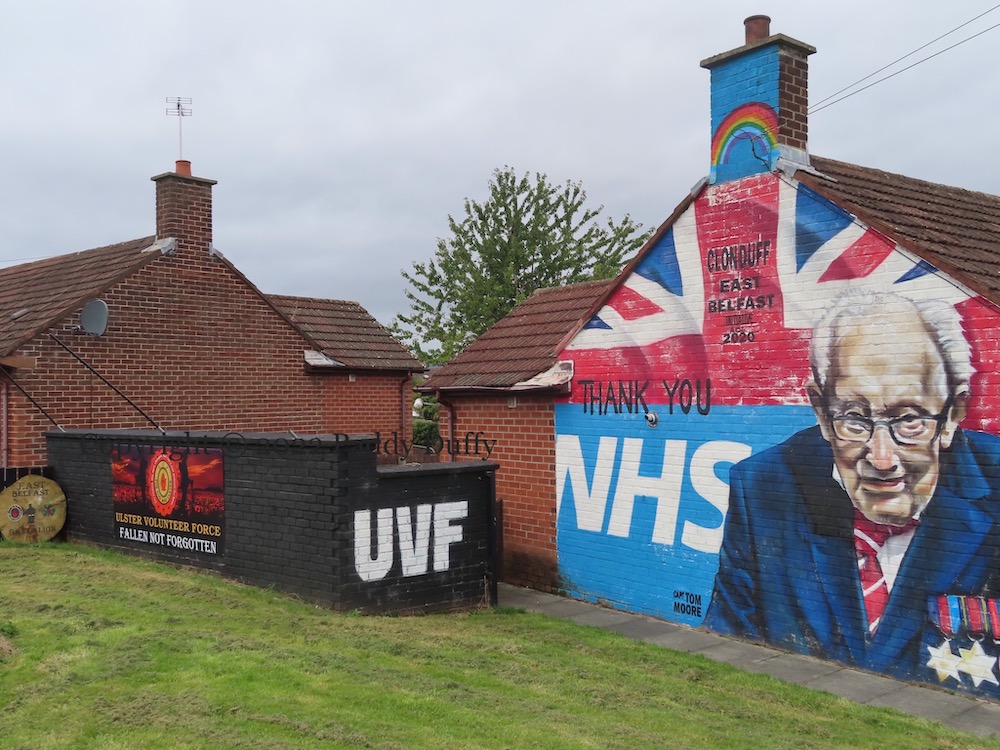
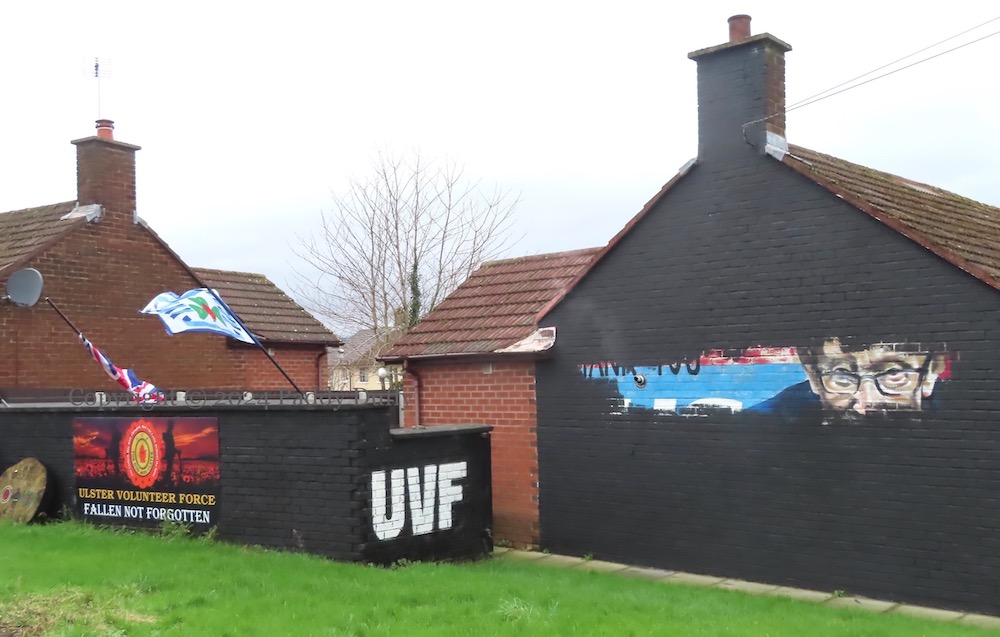
The civic spirit of Bedfordshire’s Captain Tom Moore has been celebrated in murals across the UK, including this one by Blaze FX in Clonduff. Moore attempted to raise funds for the NHS during covid by doing laps around his garden with his walker in advance of his hundredth birthday. He originally aimed at raising 1,000 pounds but ended up raising 30 million after the effort went viral.
On the left is a tree cross-section (or “tree disk”) (on the left) that has been decorated with a hooded gunman and the insignia of the (east Belfast) UVF and YCV, along with a printed board with “The uniform may have changed but the cause remains the same. Ulster Volunteer Force” around the UVF emblem and “Fallen, not forgotten” below. There is a very close variant of this wording on a mural in Bowtown (Newtownards).
Tullyard Way, Castlereagh
Update, 2024: the mural has been – mostly – blacked out
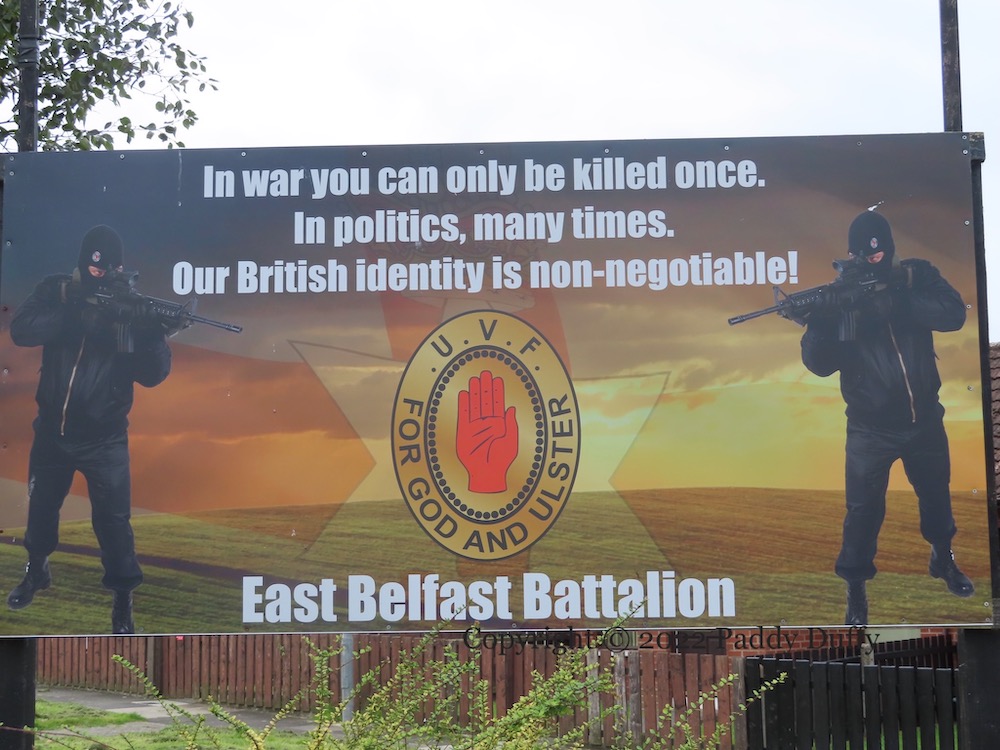
“[Politics is almost as exciting as war, and quite as dangerous.] In war you can only be killed once. In politics, many times. [ – Winston Churchill, 1903] Our British identity is non-negotiable! UVF East Belfast Battalion.” Hooded UVF volunteers are shown in active poses (as compared to the cradled rifles in The Erosion Of Our Identity) ready to resist any compromise in the still-unresolved tension between Brexit and the Belfast (Good Friday) Agreement of 1998.
The second board, on a similar theme, is in Belvoir Street, in east Belfast: “The prevention of the erosion of our identity is now our priority”.
Left: “The Annals of the Four Masters record that in 665 AD, the Battle of Farset (Belfast) took place between the County Down Dal Fiatach, self styled Ulaid, and the Pretani or Cruthin where Cathasach, son of Laircine, was slain. This was an attempt by the Dal Fiatach to encroach on the Curtain territory of Trian Congail. The “third of Congal”, which encompassed territory on both sides of the Lagan, corresponding more to less to Uppers and Lower Clandeboye, including modern Belfast. Cathasach was Congal’s grandson. The battle was the first mention of Belfast in Irish history.”
The battle scene shown is Jim Fitzpatrick’s vision of the battle of Moira (in 637), rather than “Bellum Fertsi”. The salience of this description of intra-Ulster fighting is that there is a contention that the Cruthin were Scots (Picts) thus allowing for the idea (employed especially by the UDA – see Ulster’s Defenders and Defender Of Ulster From Irish Attacks) that present-day northern Protestants have a heritage, and a history of fighting for what is roughly Co. Antrim, that pre-dates the plantations. For more information and a similar board, featuring the tower blocks of Rathcoole rather than Cuchulainn and the Battle of Moira, see Kingdom Of The Pretani. For the debate over a connection to the Picts, see WP.
The Annals date back to the 1630s though they mostly comprise a variety of earlier sources.
The image of the gentleman with the sword appears to be a stock fantasy image, used for at least two characters in Game Of Thrones fandom (Rhaegon Targaryen and Lord Cameron Umber).
Middle: 2021 was the centenary of the creation of Northern Ireland and the year in which Scottish football club Glasgow Rangers won their 55th league title. Support for the club is widespread among the PUL community in Northern Ireland; local soccer and the international team is overseen by the IFA.
Right: “Centenary of cultural expression 1921-2021. Sons Of Belfast LOL 743. Castleton Temperance LOL 867. The Memorial LOL 1197. Belfast Harbour LOL 1883. The Coote Memorial LOL 1921. Cave Hill Temperance LOL 1956.”
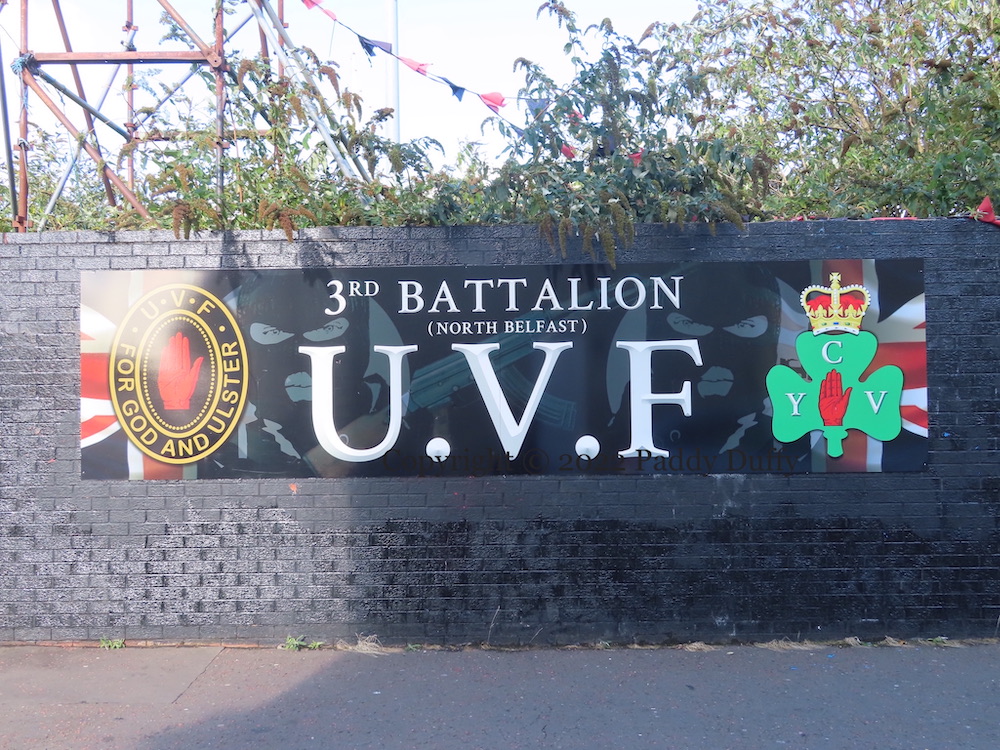
Here are two boards outside the north Belfast Orange hall in Alexandra Park Avenue, north Belfast.
Above: sporting heroes Joey Dunlop, Alan Campbell, Darren Clarke, Alex Higgins, George Best, and Carl Frampton.
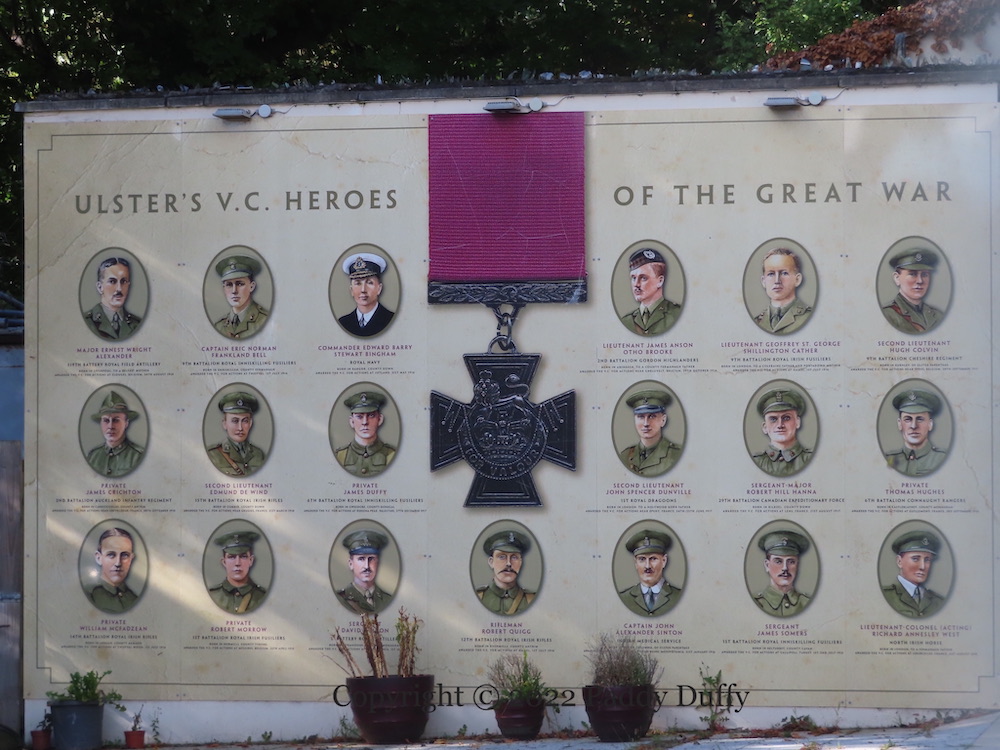
Below: nineteen winners of the Victoria Cross: (left) Major Ernest Wright Alexander, Captain Eric Norman Frankland Bell, Commander Edward Barry Stewart Bingham, Private James Crichton, Second Lieutenant Edmund De Wind, Private James Duffy, Private William McFadzean, Private Robert Morrow, Sergeant David Nelson, (centre) Rifleman Robert Quigg, (right) Lieutenant James Anson Ortho Brooke, Lieutenant Geoffrey St. George Shillington Cather, Second Lieutenant Hugh Colvin, Second Lieutenant John Spencer Dunville, Sergeant-Majjor Robert Hill Hanna, Private Thomas Hughes, Captain John Alexander Sinton, Sergeant James Somers, Lieutenant-Colonel (Acting) Richard Annesley West.
“In memory of our fallen INLA volunteers, upper Springfield area: Hugh Ferguson, Ronnie Bunting, Noel Little, Hugh O’Neill, Micky Kearney, John McColgan, Paddy “Paddybo” Campbell. Comrades: Barry “Baz” McMullan, Sean “Shanto” fleming, Harry O’Hara, Paul Collins, Bernado Brownlee, Emmanuel Kelly, Michael Conlon, Billy Lynch, James “Harpo” Murray, John Kennaway. Saoırse go deo [freedom forever].” Ferguson was the first member of the INLA to die, in 1975 in the feud with the OIRA. Bunting and Little/Lyttle (both Protestants) were shot dead in 1980 in Bunting’s Andersonstown home by masked gunmen from the UDA or SAS with RUC complicity.
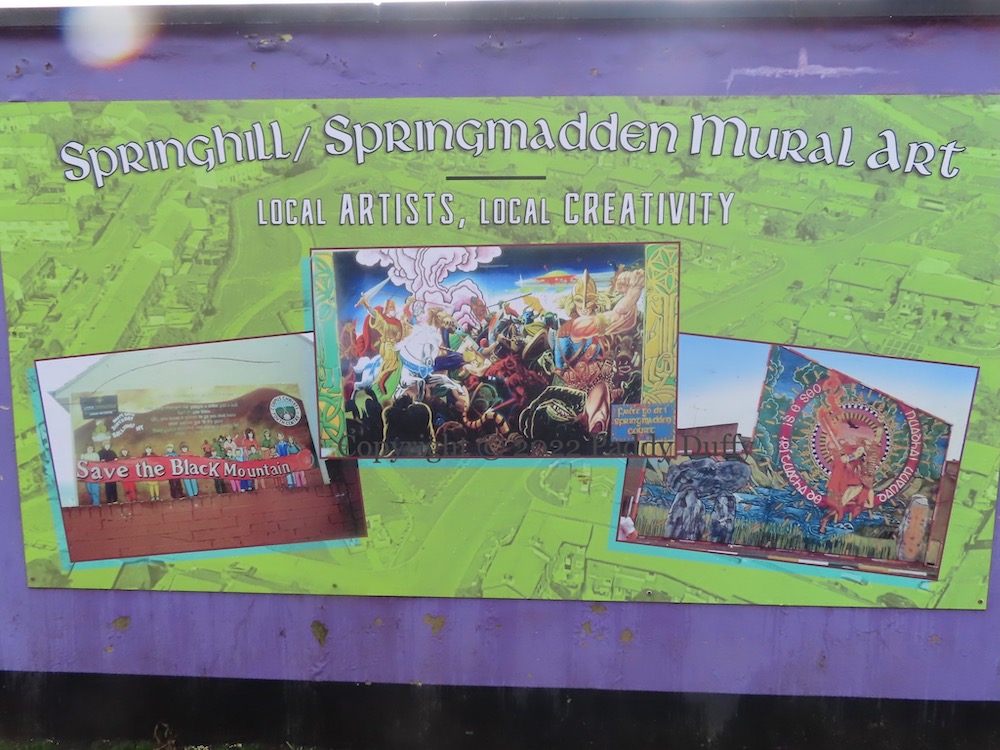
“Fáılte go Cnoc na Foınse – Welcome to Springhill.” There are a dozen boards on either side of the Ballymurphy entrance to Springhill, highlighting positive aspects of the community, such as the work of Mother Teresa and four Missionary Sisters Of Charity from 1971-1973, the Upper Springfield Festival of 1973 (later revived in 1988 and years following as the Springhill Festival), Tara Stores and The Craft Centre, set up as a form of local enterprise in an area of mass unemployment, and the Springhill Community House, still in operation today but going back to Des Wilson and Noelle Ryan. There is no explicit mention of the 1972 Springhill-Westrock Massacre. The murals in the image above were in Divismore, Springmadden, and in the old Springhill.
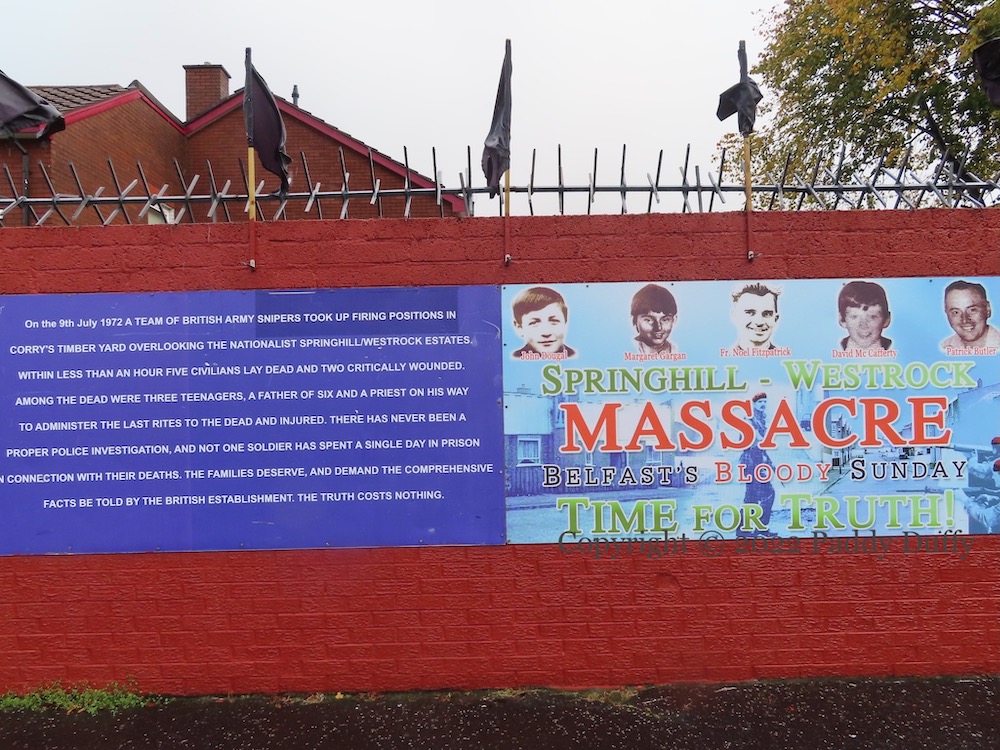
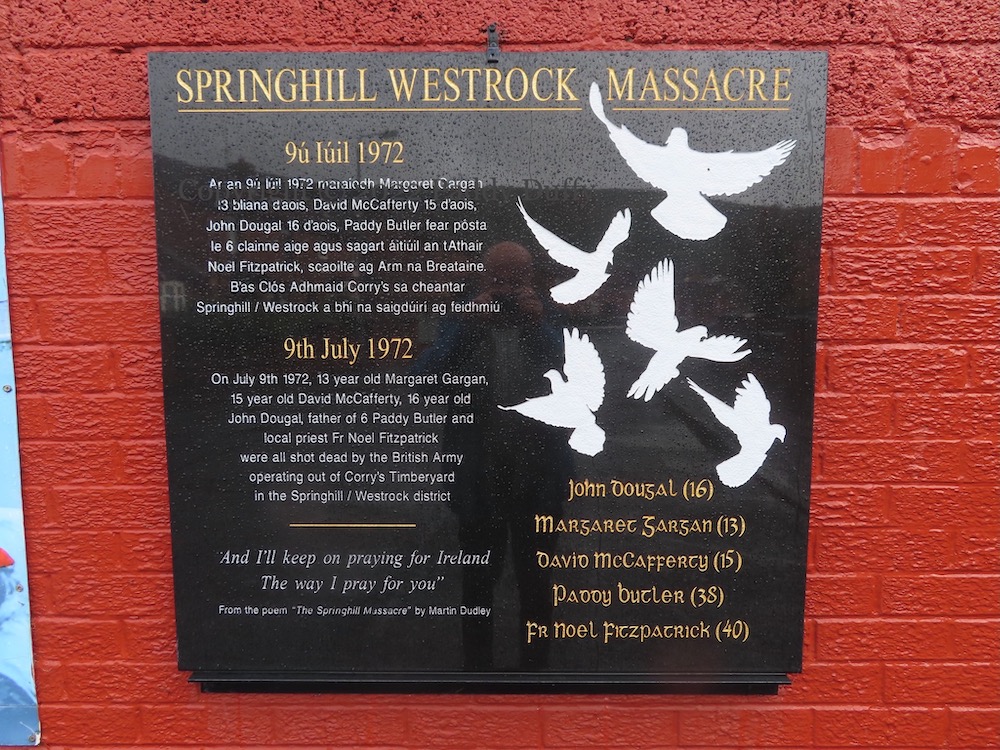
“Springhill-Westock Massacre: Ar an 9ú Iúıl 1972 maraíodh Margaret Gargan 13 blıana d’aoıs, David McCafferty 15 d’aoıs, John Dougal 16 d’aoıs, Paddy Butler fear pósta le 6 claınne aıge agus sagaırt áıtiúıl an tAthaır Noel Fitzpatrick, scaoılt ag Arm na Breataıne. B’as Clós Adhmaıd Corry’s sa cheantar Springhill/Westrock a bhí na saıghdıúrí ag feıdhmıú.”
“‘And I’ll keep on praying for Ireland/The way I pray for you’ – from the poem “The Springhill Massacre” by Martin Dudley”. The new plaque was launched on July 9th, 2019 by Dudley and Brian Pettigrew, both of whom were wounded in the attack. Here is a gallery of images from the launch from Relatives For Justice.
The board, above, was originally in Beechmount Avenue/Ascaıll Ard Na bhFeá, but had to be moved due to the “re-imaging” of the brick wall at the back of St Mary’s University College into a fence by the Department For Communities (web).
The wall at the top of Springhill Avenue was knocked down to great acclaim in 2017 (Guardian) but the impact was merely cosmetic as a wire fence and substantial shrubbery continued to block the way. The removal of the wall also meant the removal of the pro-Palestinian murals painted on it: Palestine Abú | Man Against Machine | Hellfire. In its place a large board was put in place celebrating the history of the area and especially the contribution made by Des Wilson and Noelle Ryan who worked in Springhill House for over forty years. Both Des and Noelle were interviewed by NVTv in 2012. Noelle died in 2014 (An Phoblacht) and Des in November 2019
The left hand side of the mural shows Mother Teresa, who lived and worked in the area with four nuns from 1971 to 1973 before being put out (allegedly) by the Catholic church (TripleVision documentary).
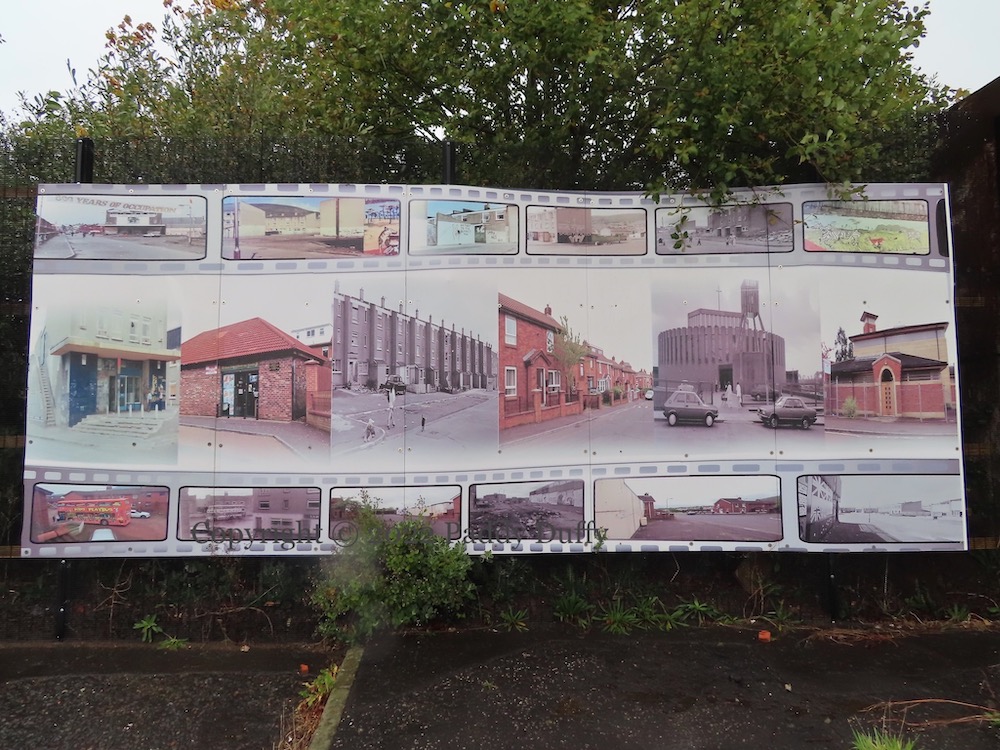
On the right, the old and new Springhills are contrasted, with images taken from the same spot approximately 30 years apart.







 Paddy Duffy Collection