… to the state opening of the first parliament of Northern Ireland – with new prime minister James Craig – at Belfast City Hall on June 22nd, 1921. The monarchs in question are King George V and Queen Mary. Pathé has video of the royal arrival and travel to City Hall. In his speech, George appealed “to all Irishmen to pause, to stretch out the hand of forbearance and conciliation, to forgive and to forget, and to join in making for the land which they love a new era of peace, contentment, and goodwill.”
For the coat of arms, see previously The Lion And The Elk. It is not clear whom the twelve framed portraits depict. The six gentlemen in the background are the members of the original Executive Committee, which served as a cabinet to the Commons and Senate – for a full list, with offices, and the original photograph, see WP. Carson’s statue at the entrance to Stormont is on the left. The photograph of spectators at the parade (on the far left) can be seen in this News Letter article. The photograph of the royals in their carriage can be seen here and of the King inspecting the guard here.
The project was undertaken by Rathcoole Friends of the Somme (Fb), with support from the Housing Executive’s Community Cohesion unit.
The UVF 1st East Antrim Battalion is “Still ready & willing to defend the people of Ulster against all foes” including the British government that – even as Northern Ireland marks its centenary – has “deserted” it over the NI Protocol that involves checks on goods moving between Britain and Ireland (whether north or south) but no (new) checks on goods moving between north and south (gov.uk). The “still” goes all the way back to 1912, when the British government of the day proposed (for a third time) “Home Rule” for Ireland and the Ulster Volunteers were formed – though the original “deserted” postcard and previous murals show the date as 1914.
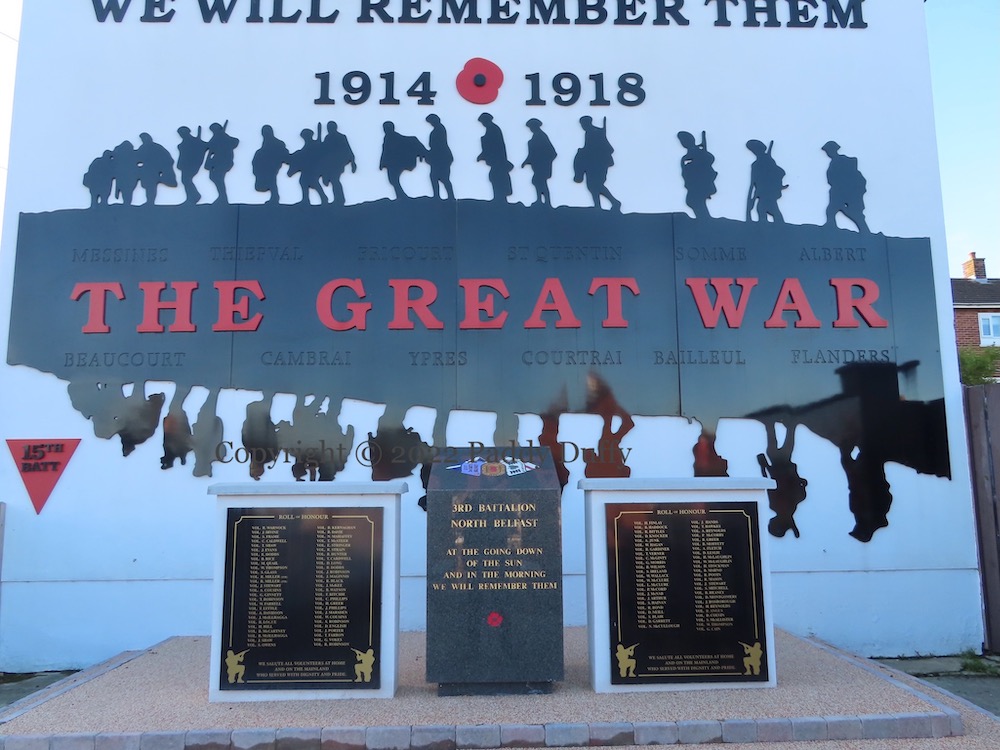
The memorial garden in Mount Vernon, has a “cut-out” mural to the 36th (Ulster) Division and memorial plaques to six UVF members who died between 1974 and 2000, including (lhs of the final image) Joe Shaw, who was shot by the UDA during the 1974-1975 feud. (For details of the killings and its aftermath, see this Balaclava Street article.) The stone in the centre is dedicated to the “3rd battalion North Belfast” Ulster Volunteer Force.
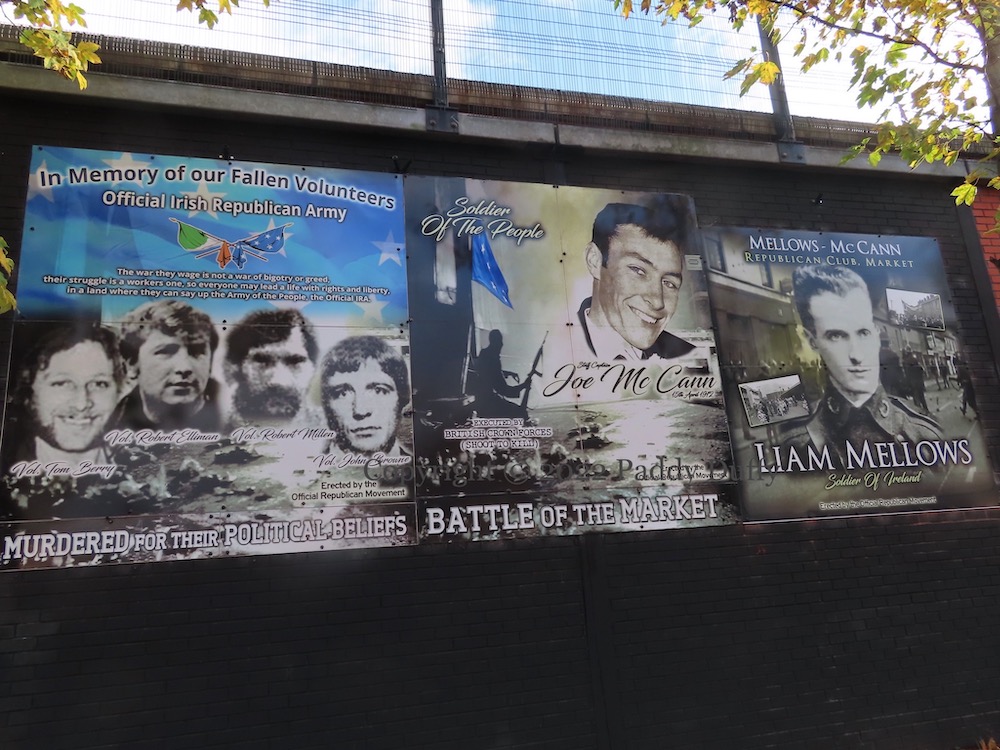
Left: “Murdered for their political beliefs: Tom Berry, Robert Elliman, Robert Millen, John Browne”. All four had a connection Markets or Ormeau area of south Belfast. Millen, from the Ormeau area, was shot in 1973 by the UVF; he played on the same soccer team (Bankmore Star) as Thomas Berry, who was shot in a Short Strand GAA club; Elliman was shot in a Markets pub; John Brown (without the “e”) was shot in his Cooke Street home in front of his family. The first three were all Protestants; the latter three were among 11 people who died in the 1975 feud between the Officials and the Provisionals. (Lost Lives)
“The war they wage is not a war of bigotry or greed, their struggle is a workers one, so everyone may lead a life with rights and liberty, in a land where they can say “Up the Army of the people, the Official IRA”.” “Erected by the Official Republican Movement.”
Centre: Internment (imprisonment without trial) was introduced on August 9th, 1971 by NI Prime Minister Brian Faulkner, with 342 people arrested on the first day. The Bogside was “hysterical with hated”, according to Eamonn McCann (History Ireland) and of Belfast Kevin Myers wrote “Insanity seized the city.” Two dozen people would die in the rioting and gun-battles that followed, leading to the suspension of Stormont rule (WP). In the Markets area, OC Joe McCann and other (Official) IRA volunteers took over the Inglis bakery and reportedly prevented 600 British troops from entering the area – the image to the left of the board above is a Ciaran Donnelly photograph showing McCann during the battle, kneeling beneath a Starry Plough and holding an M1.
Right: After serving in the IRA in the War Of Independence, Liam Mellows was elected to the First Dáil and as a member of the second Dáil voted against the Treaty in January 1922 (his speech is recorded in Oireachtas.ie under the name “Liam Mellowes”). In the Civil War that followed, he served as IRA quartermaster in the force in the Four Courts that surrendered to Free State forces on June 30th, 1922. He was imprisoned in Mountjoy and executed in December, in reprisal for the killing of Seán Hayes (see Executed). (WP | An Phoblacht) His proposals for government were published posthumously as ‘Mellows Testament’ (NLI) and include state ownership of heavy industry, large estates, the transport system, and the banks. The sticker below quotes from that document: “Ireland, if her industries and banks were controlled by foreign capital, would be at the mercy of every breeze that ruffled the surface of the world’s money-markets.”
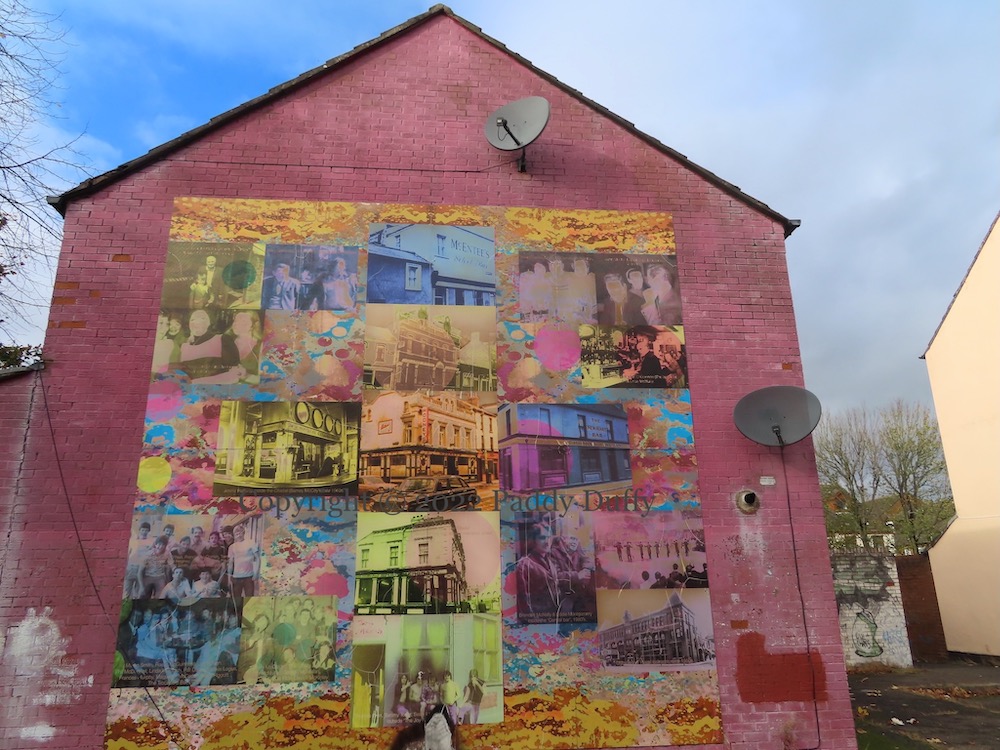
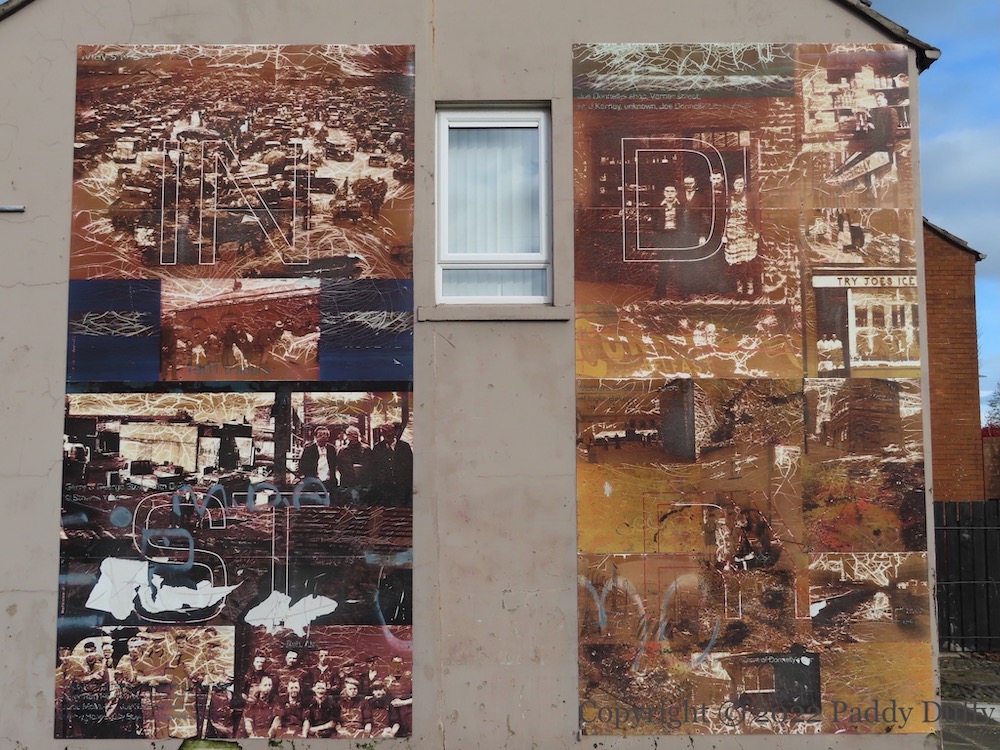
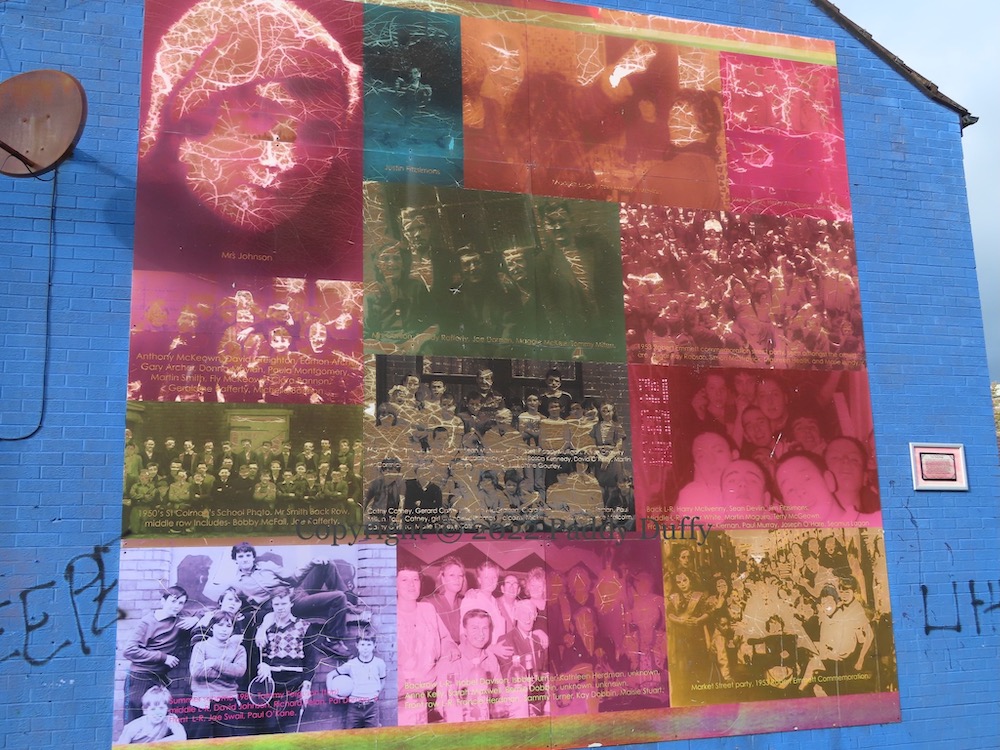
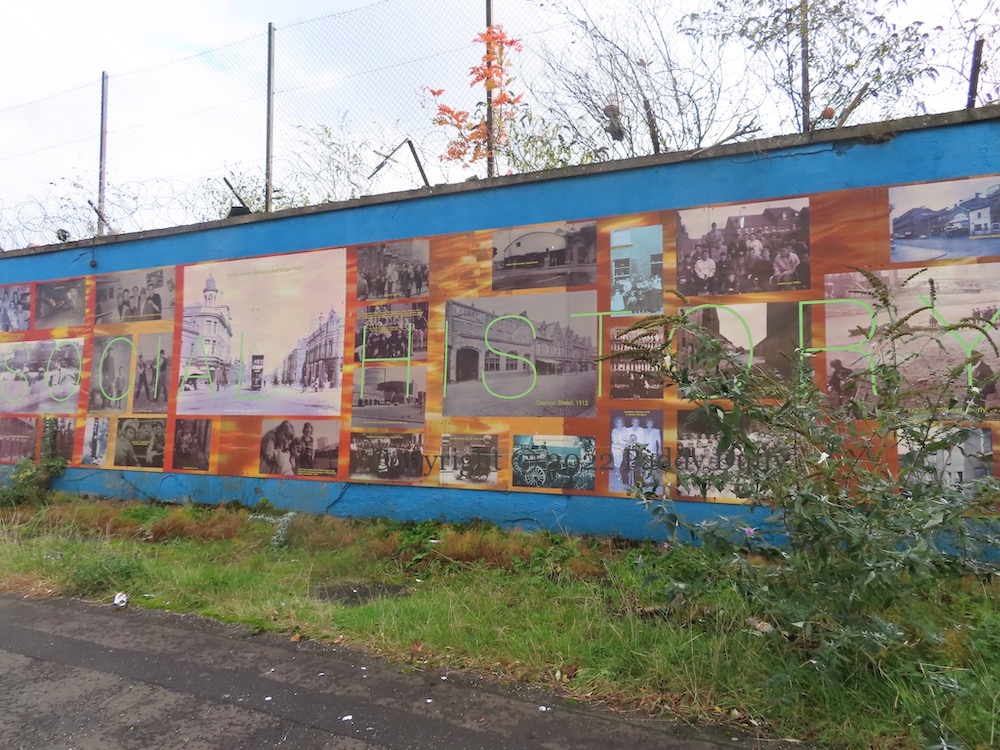
Artist Raymond Henshaw produced a series of boards in 2008 and 2009, with support from the Arts Council, depicting the Markets area in the good old (i.e. pre-Troubles) days. Above are the bars of the Markets and below ‘industry’, ‘social’ and ‘social history.
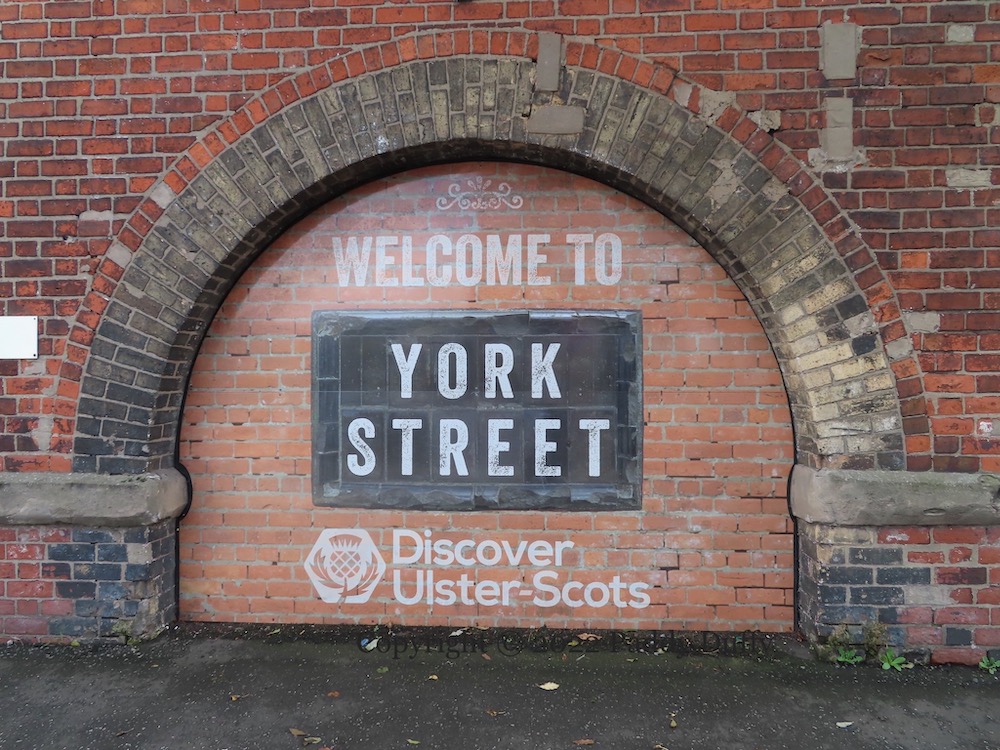
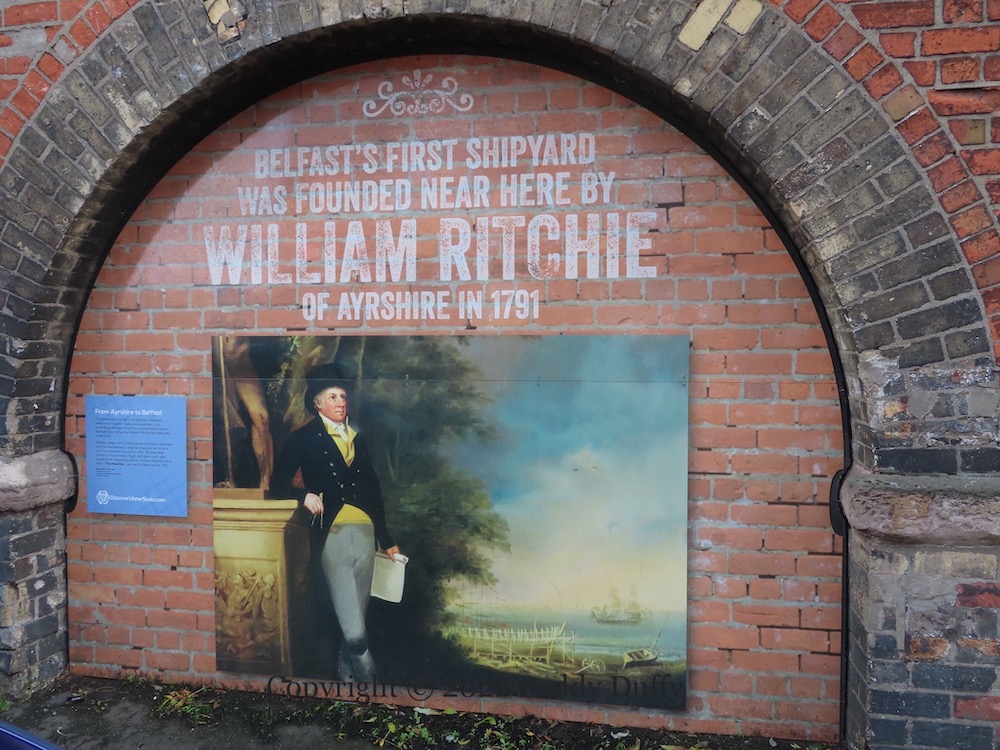
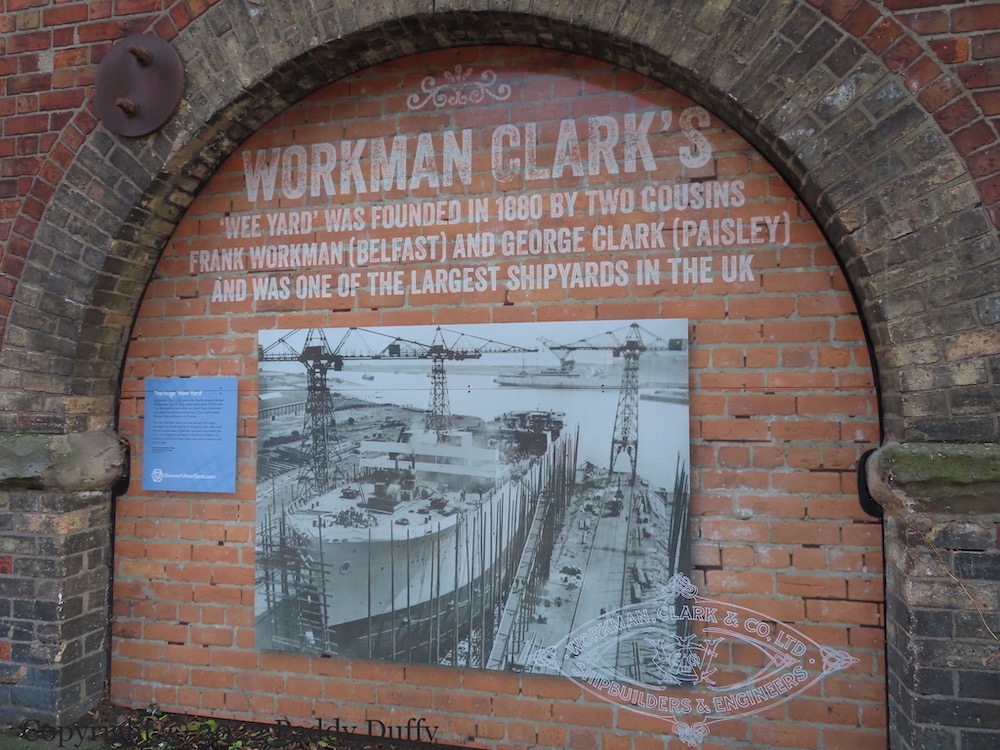
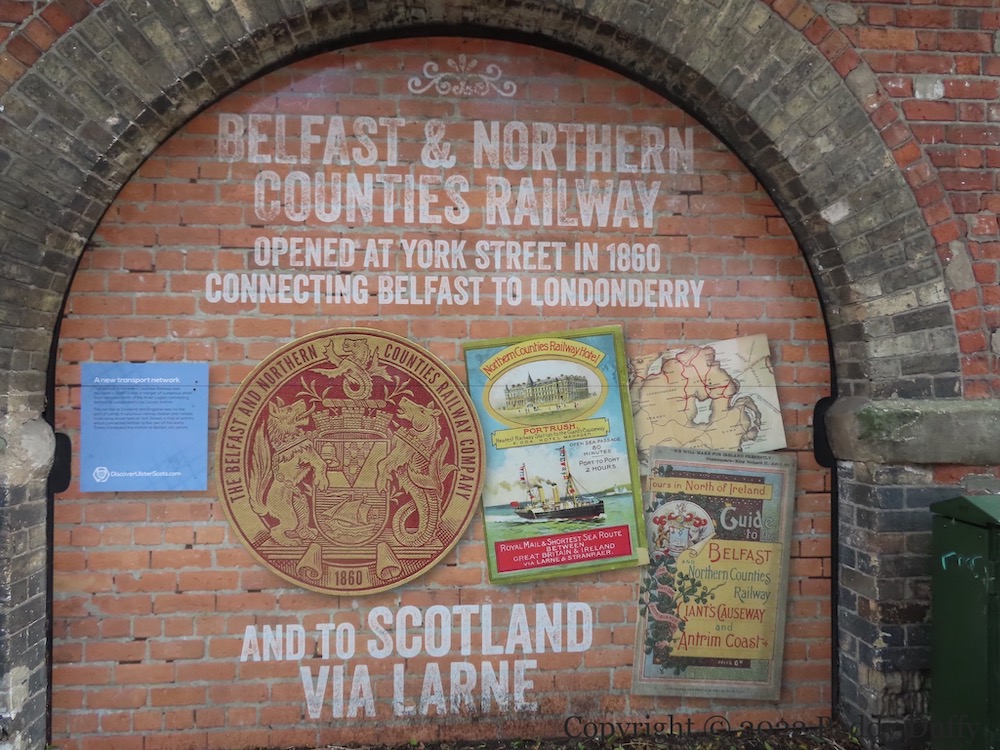
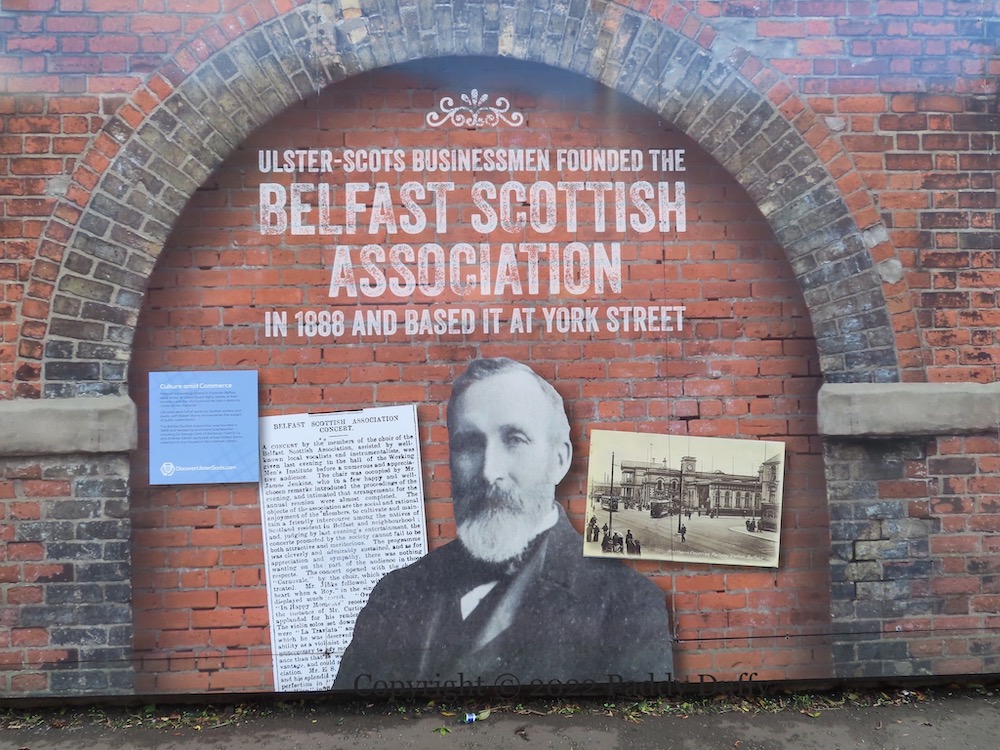
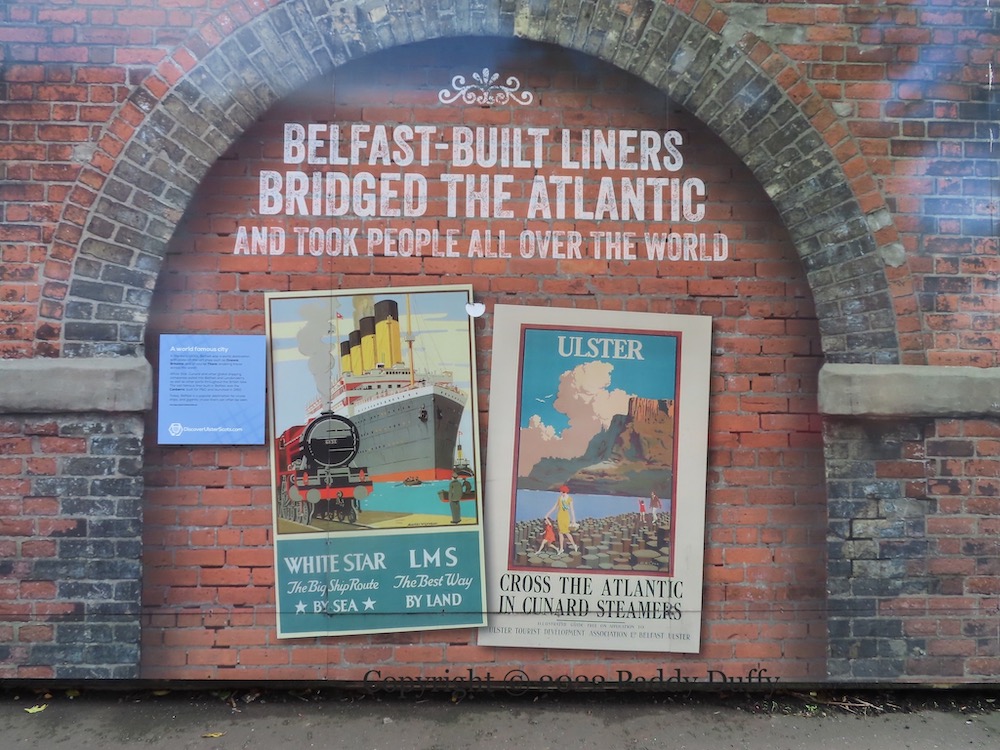
This is a 13-panel installation along York Road from discoverulsterscots.com about York Street businesses and Ulster Scots businessmen. It begins by telling a history of shipbuilding and its role in Belfast’s industrial life (“The harbour made York Street Belfast’s global gateway”) and in particular its connection with Scotland.
Two Scots, William Ritchie (whose 1802 portrait by Thomas Robinson is shown) and Charles Connell (who oversaw the construction of the first wooden steamboat in Belfast – Aurora, pictured below) along with another Scot, Alexander MacLaine, were the leading shipbuilders in Belfast from 1791 until the 1860s, when Englishman Edward Harland (soon joined by German Gustav Wolff, and then in 1874 by William Pirrie and Wilson brothers Walter and Alexander) took over the rival Hickson yard (which included land on Queen’s Island and on the south side of the Lagan) and became dominant. Their connection to York Street is that all of them except Pirrie lived on or near York Street.
Workman & Clark’s was a Belfast shipyard existing from 1880 to 1935. During the first world war it took over the construction of two monitor ships (specifically, M29 and M31) for the Royal Navy that H&W did not have space to build. For more, see Grace’s Guide | BBC audio on monitor ships and their construction, including a record for number of rivets hammered in by one John Moore at Workman Clark’s.
Among the Belfast goods “exported around the world from York Street by rail and sea” were Gallaher’s Blues (cigarettes), Irish linens, Davidson & Co (Samuel Davidson, born in County Down to an Ulster-Scots family, was the inventor of the Sirocco centrifugal fan “for mine ventilation, dust removal, induced draft, forge fires”), and linen carpet thread from York Street (Threads) Ltd. Robinson & Cleaver’s department store is now out of business. Gallaher’s is now the multinational Gallaher Group, but its factories in Belfast and Ballymena have closed. And Davidson’s company was bought by Howden UK in 1988.
“The Belfast Scottish Association was founded in 1888 and headed by prominent businessmen, including Sir George Clark of Workman Clark and Andrew Gibson (pictured) whose Robert Burns collection is now housed in the Linenhall Library.”
In addition to the famous trans-Atlantic ships (image below), Belfast was part of the travel network in the UK and Ireland (image above). Before there was British Railways, there were the Big 4: the Southern, Great Western, London and Northeastern, and London, Midland, and Scottish (LMS) railways. The latter included the railways in the Northern Counties. In addition to railways, the company owned canals, ships (including the Princess Victoria which sank on the Larne-Stranraer route), and hotels. “Belfast-built liners bridged the Atlantic and took people all over the world.” “Railway-owned ships ensured a seamless journey throughout the British Isles.”
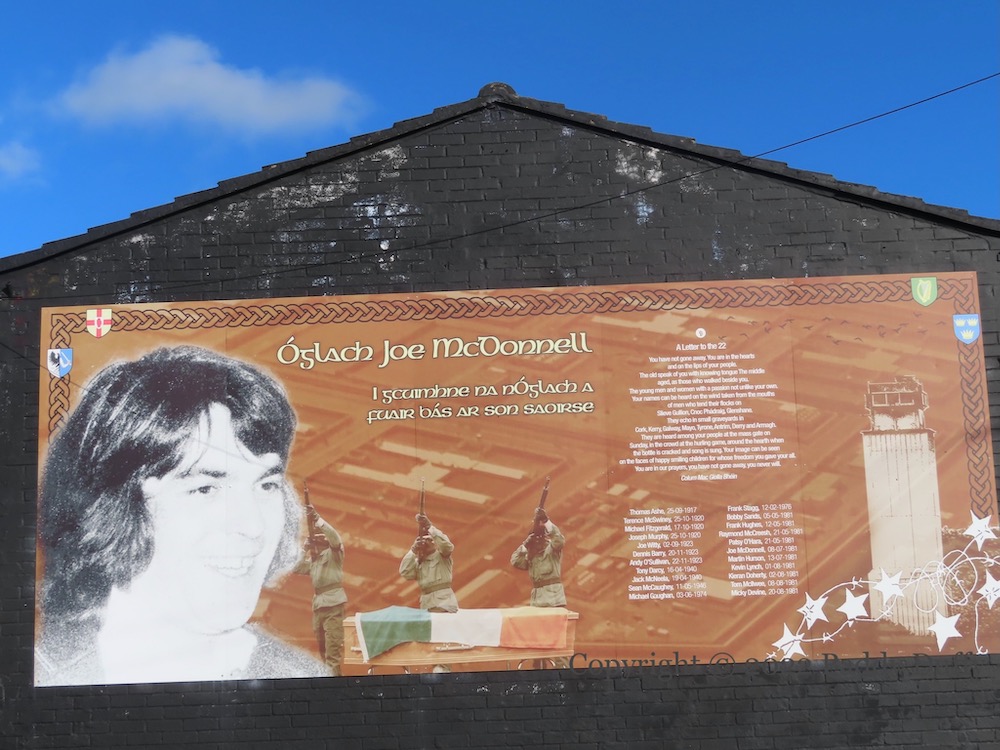
“I gcuımhne na nÓglach a fuaır bás ar son saoırse [in memory of the volunteers who died for freedom].” The “22” are the familiar 12 deceased Troubles-era hunger-strikers, plus 10 from 1917 to 1946: Thomas Ashe, Terence McSwiney, Michael Fitzgerald, Joseph Murphy, Joe Witty, Dennis Barry, Andy O’Sullivan, Tony Darcy, Jack McNeela, Sean McCaughey.
“‘A Letter To The 22: You have not gone away. You are in the hearts/and on the lips of your people./The old speak of you with knowing tongue. The middle/aged, as those who walked beside you./The young men and women with a passion not unlike your own./Your names can be heard on the wind taken from the mouths/of men who tend their flocks on Slieve Gullion, Cnoc Phádraıg, Glenshane./They echo in small graveyards in/Cork, Kerry, Galway, Mayo, Tyrone, Antrim, Derry and Armagh./They are heard among your people at the mass gate on/Sunday, in the crowd at the hurling game, around the hearth when/the bottle is cracked and song in sung. Your image can be seen/on the faces of happy smiling children for whose freedom you gave your all./You are in our prayers, you have not gone away, you never will’ – Colum Mac Gıolla Bhéın (youtube)“
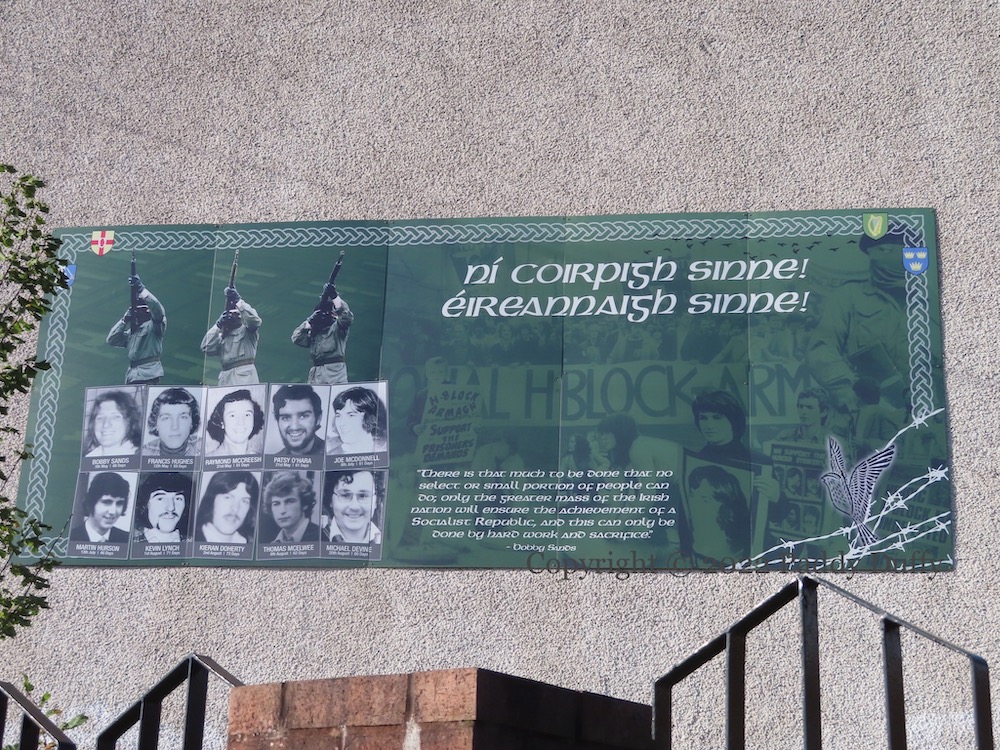
“Ní coırpıgh sınne! Éıreannaıgh sınne! [we are not criminals; we are Irish people] “There is that much to be done that no select or small portion of people can do; only the greater mass of the Irish nation will ensure the achievement of a socialist republic, and this can only be done by hard work and sacrifice.” – Bobby Sands [Hunger strike diary, March 14th, 1981]” With photographs of the ten deceased 1981 hunger strikers.
“The people of Rathcoole send their sincere and heartfelt congratulations to Her Majesty Queen Elizabeth II on the historic occasion of Her Platinum Jubilee.” The Monday at the end of May is usually a bank holiday in the UK, but this year it is being postponed until the end of the week and combined with an additional one to create a four-day weekend beginning this Thursday in celebration of the 70th (“platinum”) anniversary of the accession of Elizabeth on February 6th, 1952 (the coronation was on June 2nd, 1953).
The mural centrally shows an official portrait from 1992, wearing the orders of George VI and George V; the four medallions show Elizabeth at her birth, her coronation, “trooping the colour” on her birthday, and 70th wedding anniversary in 2017.
With support from RATH (Rathcoole Achieving, Transforming, Helping each other) (Fb) and Dalaradia (web). For another Dalaradia board in Rathcoole, see Dalaradia; for a Cú Chulaınn version of the Dalaradia board, see Defending Ulster From Gaelic Attacks.
“Where so ever, how so ever or whenever we are called upon to make our exit, we will do as proud men.” This is quite a different message from the one produced within the Rathcoole estate for the 50th anniversary of the Red Hand Commandos, which stated that despite its venerable age, the four Rathcoole companies of the RHC “Await In The Shadows“. (That mural also depicted the kneeling men with sticks (on the left of today’s mural) and the linked post also contains the original photograph.)
It’s not clear who or what within loyalism might call upon the RHC to stand down; loyalist rhetoric at the moment is full of anger at the protocol and warnings/threats about of a return to violence (e.g. BelTel | BBC).
For the use of “Lamh Dear Abu” as the slogan, see Ulster Says “Tá”.