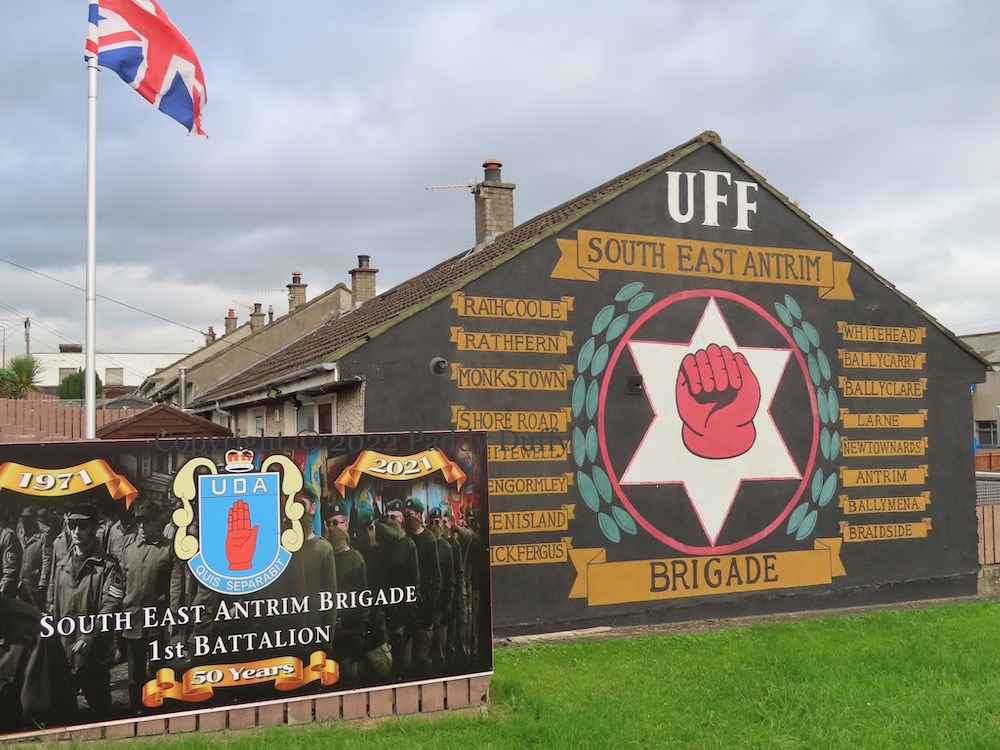
Fifty years of the UDA South East Antrim brigade is marked at the Rathfern shops, replacing a WWI commemoration (see Rathfern Remembers).
Click image to enlarge
Copyright © 2022 Paddy Duffy
T01232 [T01233]
Fifty years of the UDA South East Antrim brigade is marked at the Rathfern shops, replacing a WWI commemoration (see Rathfern Remembers).
Click image to enlarge
Copyright © 2022 Paddy Duffy
T01232 [T01233]
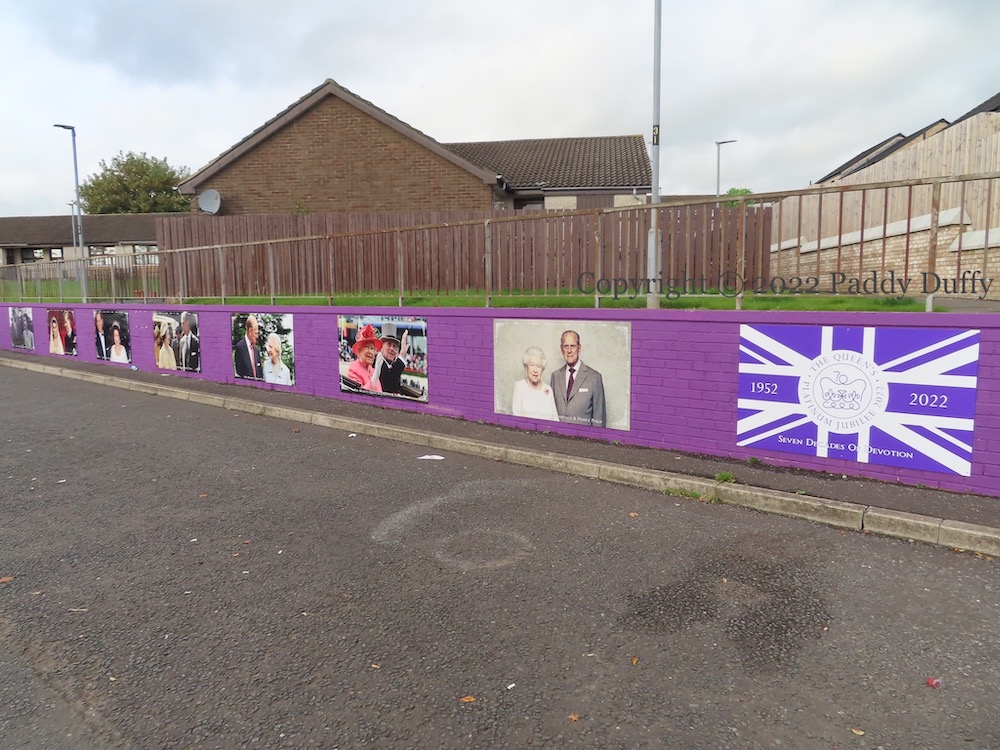
‘Monkstown DELTA [Drugs, Engaging communities, Lifeskills, Tackling anti-social behaviour, Alcohol] project’ has been replaced with a gallery of images of Queen Elizabeth and Prince Philip, for the platinum jubilee of Elizabeth’s reign.
Cashel Drive, Monkstown
Click image to enlarge
Copyright © 2022 Paddy Duffy
T01230

This is the third version of a memorial for the fallen from the 36th Division “1914-1919”. For the previous (painted, not printed) mural see Memorial To The Missing (and before that In Remembrance of The 36th (Ulster) Division).
Cashel Close, Monkstown, Newtownabbey.
Click image to enlarge
Copyright © 2022 Paddy Duffy
T01228 [T01229]

Sons Of Kai flute band (ig) re-formed in 2006 (youtube | Coin Talk) but here claims as its origin date “1972”. IWM gives the founding year as 1970, and quotes one of the founders, Bo Kerr, saying that the band was named after Danish soccer player Kai Johansen (WP), who played for Rangers from 1965-1970, and that the “tartan” gang (History Ireland) ‘Rathcoole KAI’ subsequently took its named from the band. Then (BelTel) and now (Irish News | Slugger) “KAI” is understood to stand for “Kill All Irish”. A 1982 image of the Rathcoole KAI “red devils” mural can be seen in the Ciaran McGowan collection at IWM.
See also: Kai Johansen’s Bar.
Abbot’s Cross and Rathmullin Way, Newtownabbey

Click image to enlarge
Copyright © 2022 Paddy Duffy
T01219 T01315
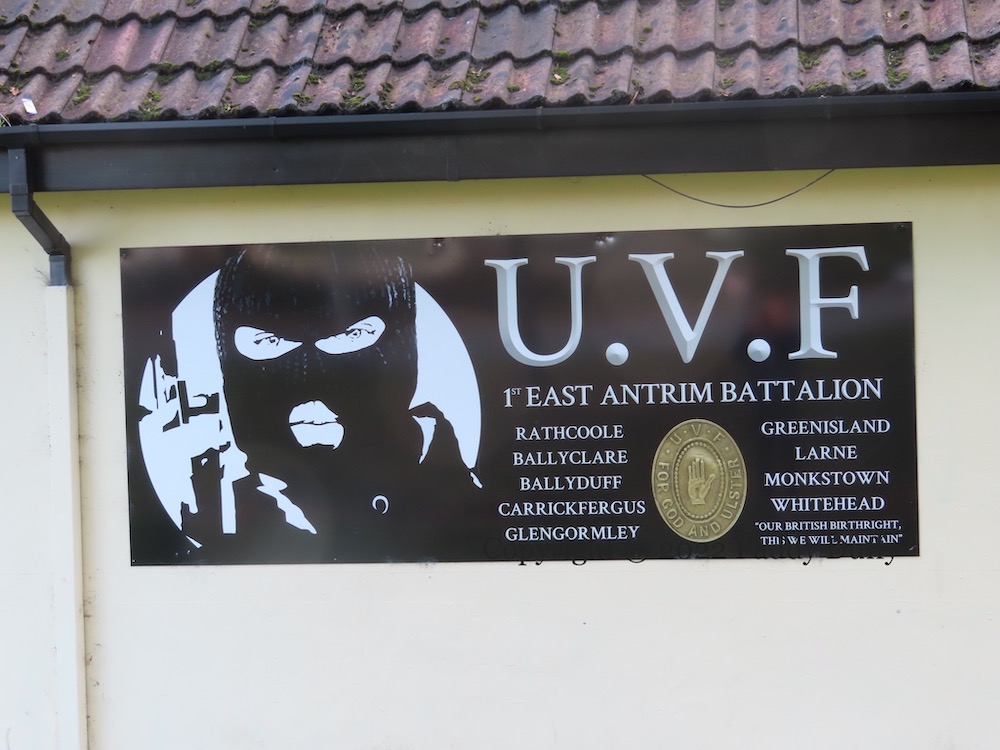
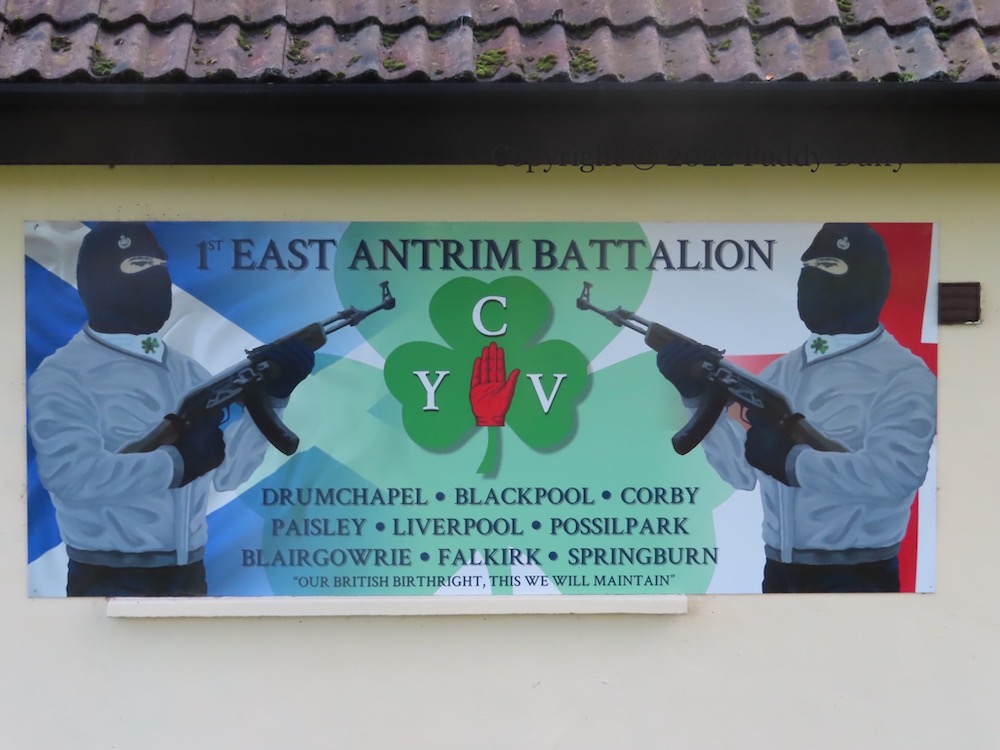
This pair of UVF boards are on the wall of the Fern in Rathcoole and right next to the UDA markings seen in Rathcoole UDA. Included in the 1st East Antrim are both local areas (Carrickfergus, Ballyduff, Ballyclare, Greenisland, Glengormley, Monkstown, Rathcoole, Larne, Whitehead) and affiliated British units (Drumchapel (Glasgow, Scotland), Blackpool (England), Corby (England), Paisley (Scotland), Liverpool (England), Possilpark (Glasgow), Blairgowrie (Scotland), Falkirk (Scotland), and Springburn (Glasgow)) of the 1st East Antrim Battalion, “The people’s army”.
Click image to enlarge
Copyright © 2022 Paddy Duffy
[T01216] T01217 T01218

“Pretani” is the Brittonic version of the Greek term “Prettanoi”, possibly borrowed from the Gauls (WP), for the inhabitants of the two islands now known as Ireland and Britain, and “Cruthin” the Gaelic term. According to the eponymous web site, Dalaradia was “was a kingdom of the Cruthin in the north-east of Ireland and parts of Scotland in the first millennium” with the Cruthin being (more narrowly than above) a people in Antrim and Down with (in the middle of the mural) “the field of Crewe Hill, with the Ancient Crowning Stone of Ulster Kings” (REACH) in Glenavy (pretani.co.uk).
The WP page on the Cruthin notes, “The name Cruthin survives in the placenames Duncrun (Dún Cruithean, “fort of the Cruthin”) and Drumcroon (Droim Cruithean, “ridge of the Cruthin”) in County Londonderry, and Ballycrune (Bealach Cruithean, “pass of the Cruthin”) and Crown Mound (Áth Cruithean, “ford of the Cruthin”) in County Down. These placenames are believed to mark the edges of Cruthin territory.”
The towers of Rathcoole can be seen underneath the slogan “Respect, heritage, culture.” They also famously appear behind a trio of hooded gunmen in a Rathcoole mural.
Carmeen Drive, Rathcoole, Newtownabbey
Click image to enlarge
Copyright © 2022 Paddy Duffy
T01210 [T01211]

These two boards in Owenreagh Drive, Rathcoole, were mounted to celebrate the seventieth (platinum) jubilee of Queen Elizabeth in June 2022. Similar paintings were produced by schoolchildren in west Belfast – see The People’s Monarch.
“This artwork was designed and created by pupils from Abbots Cross Primary School in partnership with the local children from Rathcoole Community Hub to commemorate the platinum jubilee of Her Majesty Queen Elizabeth II.”
“From Rathcoole to the house of Windsor – happy platinum jubilee 1952-2022. God save the Queen.”
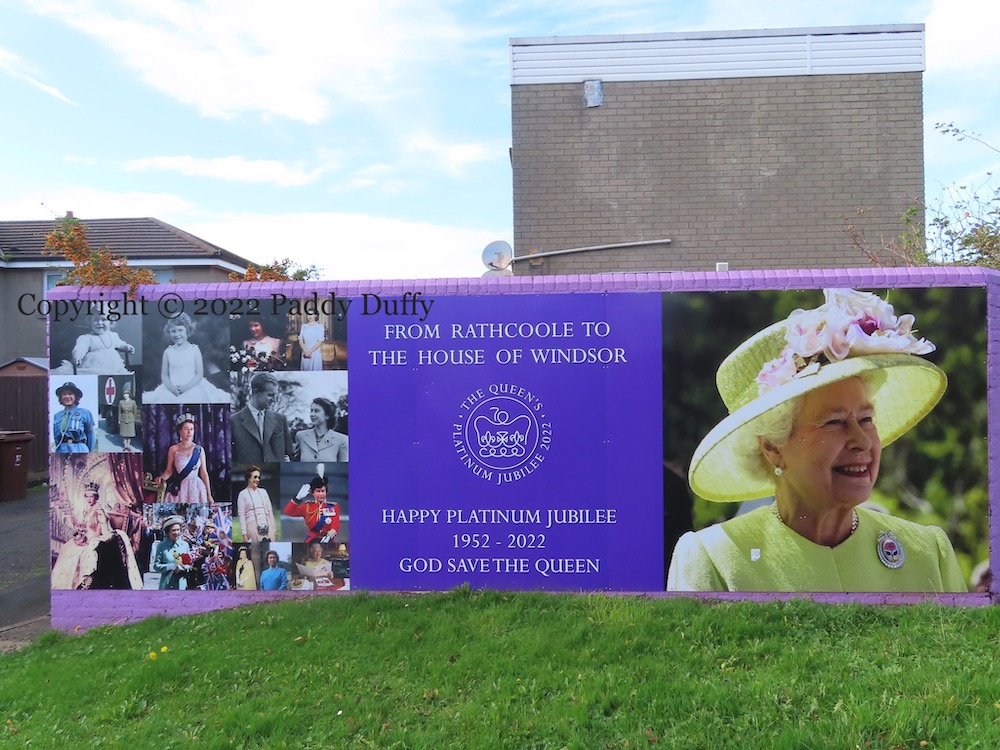
Click image to enlarge
Copyright © 2022 Paddy Duffy
T01220 T01221
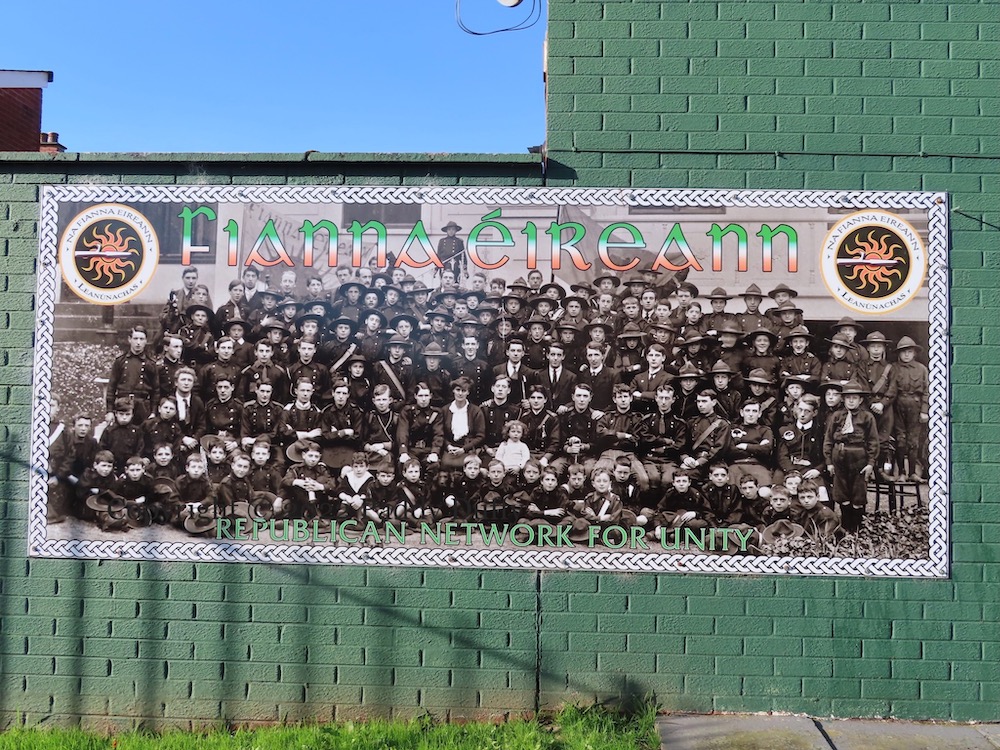
The emblems in the corners read “Na Fıanna Éıreann Leanúnachas” or “The Continuity Fıanna”. The Irish National Boy Scouts or “junior IRA” were founded in 1909 by Bulmer Hobson and Countess Markievicz, who is at the centre of the photograph above. The Fıanna followed the Provisionals in 1969 and Republican Sınn Féın (and the Continuity IRA) in 1986 (Fianna History blog | Irish Examiner), while Provisional Fianna became Ógra Shınn Féın and then Sınn Féın Republican Youth (An Sionnach Fionn).
For the previous stencilling in this spot, see In The Cause Of Irish Freedom.
The tarp commemorates four teenaged members of Na Fıanna Éıreann who died in 1972 – Davy McAuley, Josh Campbell, Josie McComiskey and Bernard Fox – all four from Ardoyne/Ard Eoın. “Purity in our hearts, Strength in our arms, Truth in our lips.”
The painted emblem is on the other side of the Berwick Road.


Click image to enlarge
Copyright © 2022 Paddy Duffy
T01158 T01159 T01160
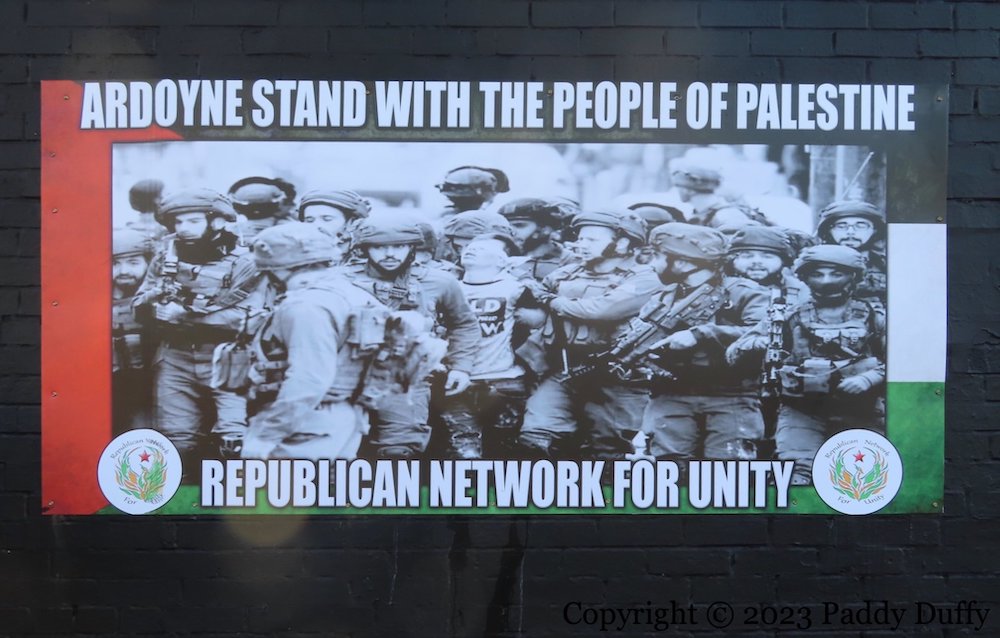
“Ardoyne Stand With The People Of Palestine.” The central photograph is of 16-year-old Fawzi al-Junaidi, blindfolded and being marched away by 22 Israeli soldiers. Al-Junaidi was arrested for throwing stones in Hebron (West Bank) in December, 2017 (Independent).
This RNU (youtube) board is next to an Óglach Sean McCaughey board at the top of Berwick Road, Ardoyne, north Belfast.
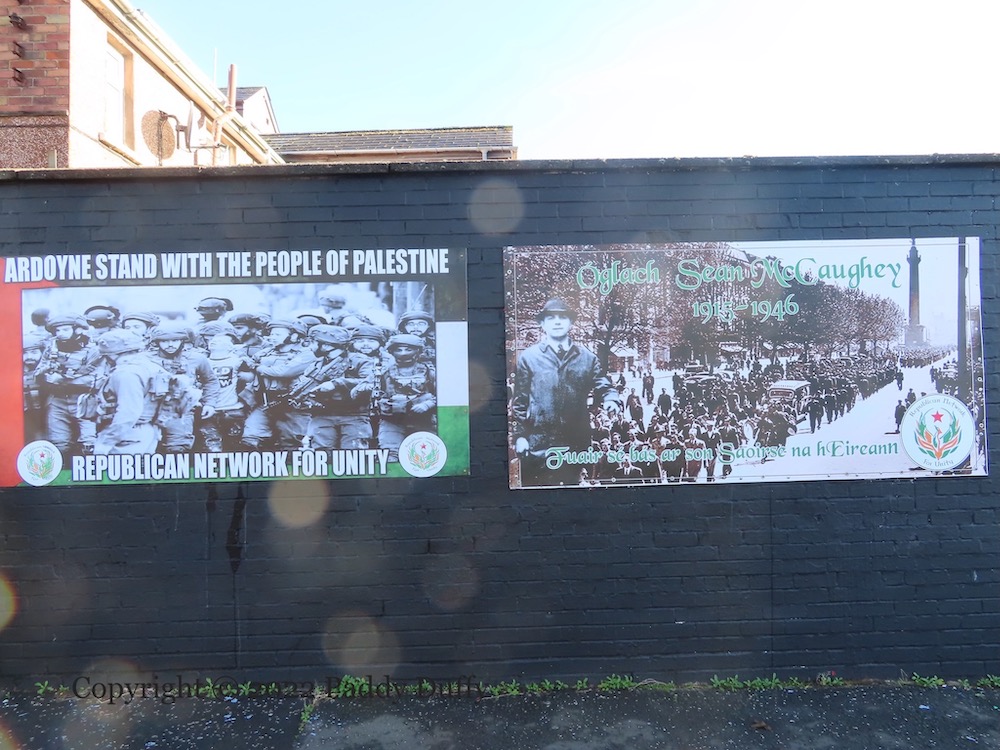
Click image to enlarge
Copyright © 2022 Paddy Duffy
T01162r T01161

Here is a gallery of images from the Falls Road/Glen Road junction (site of the old Andersonstown RUC barracks). The images top to bottom follow the wall from right (Glen Road) to left (Falls Road).
Above: a call for the release of Basque prisoners.
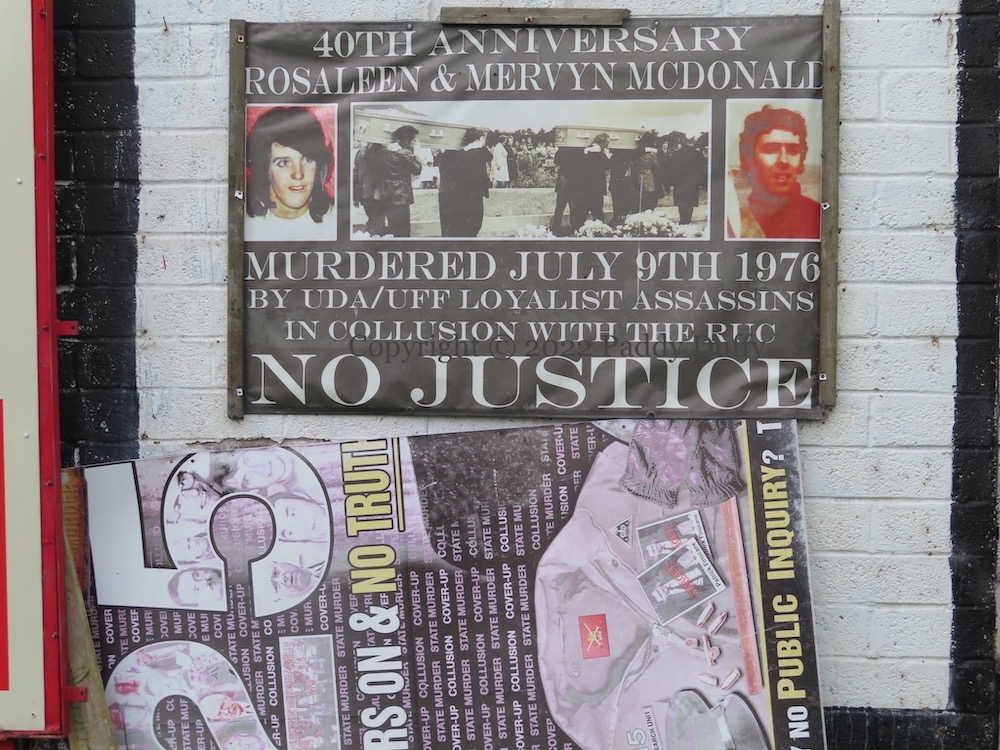
Below: Mervyn and Rosaleen McDonald were Catholics living in the mixed Longlands area of Newtownabbey when they were visited by “UFF loyalist assassins” and shot dead in front of their two young children. The killings are described in most detail in Jack Holland’s Too Long A Sacrifice, which contains an interview with the gunman and the claim that the unit had access to RUC files (p. 94).
Seamus Costello fought for the IRA during the Border Campaign and was interned in the Curragh for two years. He stayed with the Officials during the split, but was driven out in 1974 and formed the Irish Republican Socialist Party (IRSP) and the INLA. He was shot in 1977. (WP)
A large Fıanna banner.
Metalwork commemorating the deceased 1981 hunger strikers.
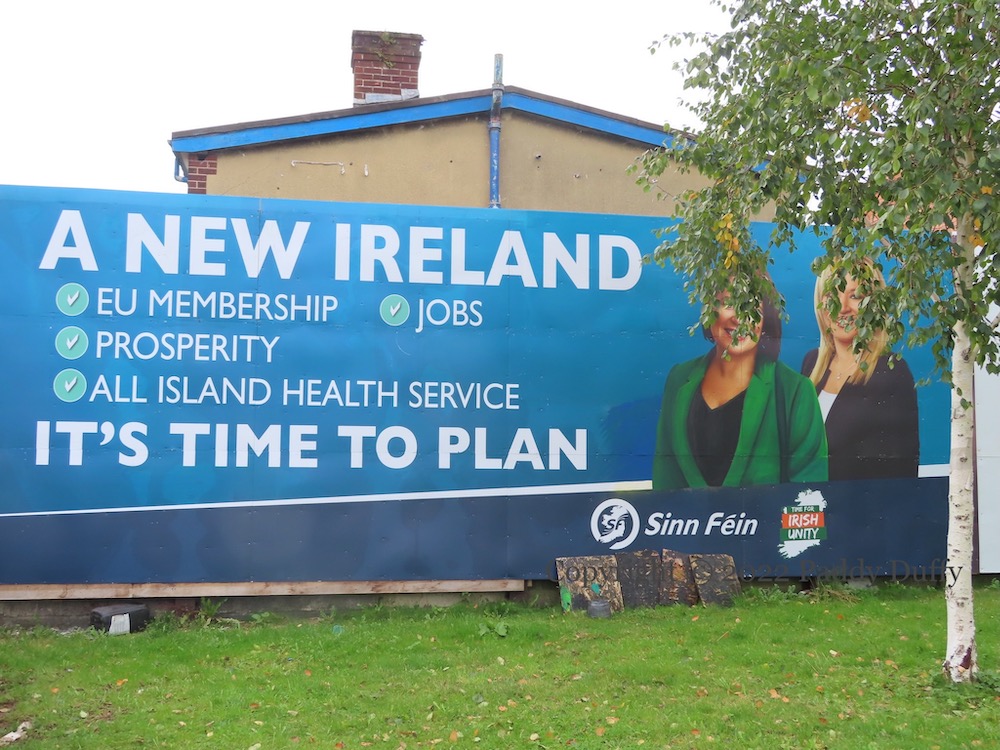
A Sınn Féın electoral banner.


Click image to enlarge
Copyright © 2022 Paddy Duffy
T01146 T01147 T01148 [T01149] T01152 T01151 T01150

