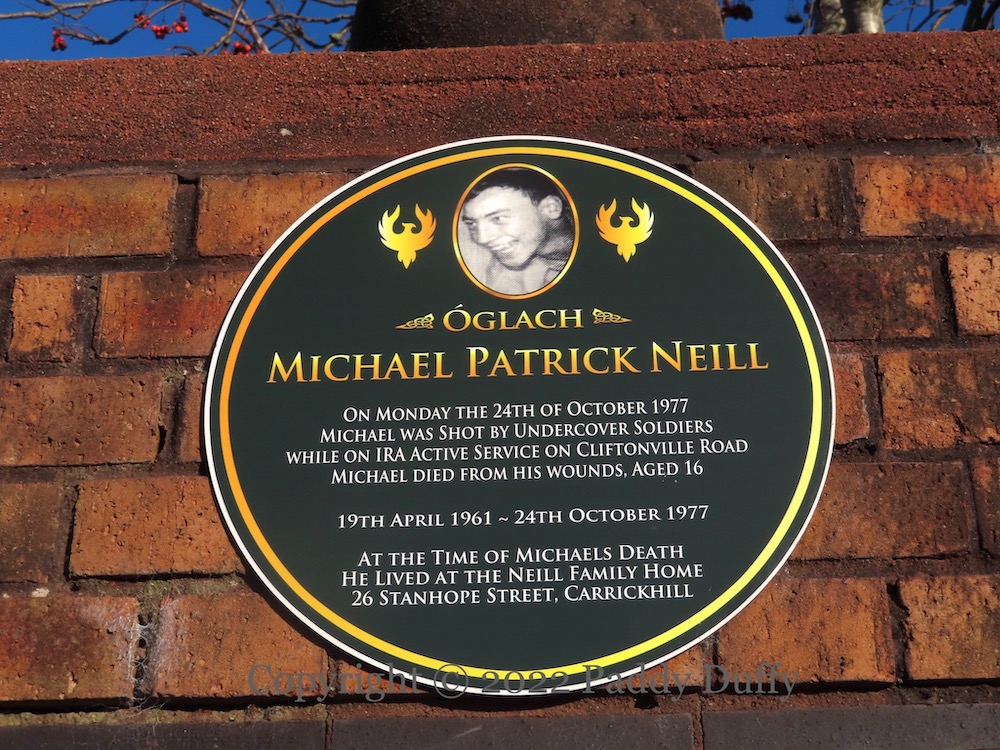
These two plaques are on the “gateposts” at the entrance to Alton Street in Carrick Hill. Neill (above) is on the right; Scullion (below) is on the left.
Neill: “Óglach Michael Patrick Neill. On Monday the 24th of October 1977 Michael was shot by undercover soldiers while on IRA active service on Cliftonville Road. Michael died from his wounds, aged 16. At the time of Michael’s death he lived at the Neill family home 26 Stanhope Street, Carrickhill.”
Scullion: “Óglach Louis Scullion. At 1:45 a.m. on the 14th of July 1972 Louis was shot four times by the British Army as he walked to his home in Unity flats. Louis was unarmed and died as a result of his injuries. 5th June 1945 – 14th July 1972. Louis lived at 51H Unity Walk.”
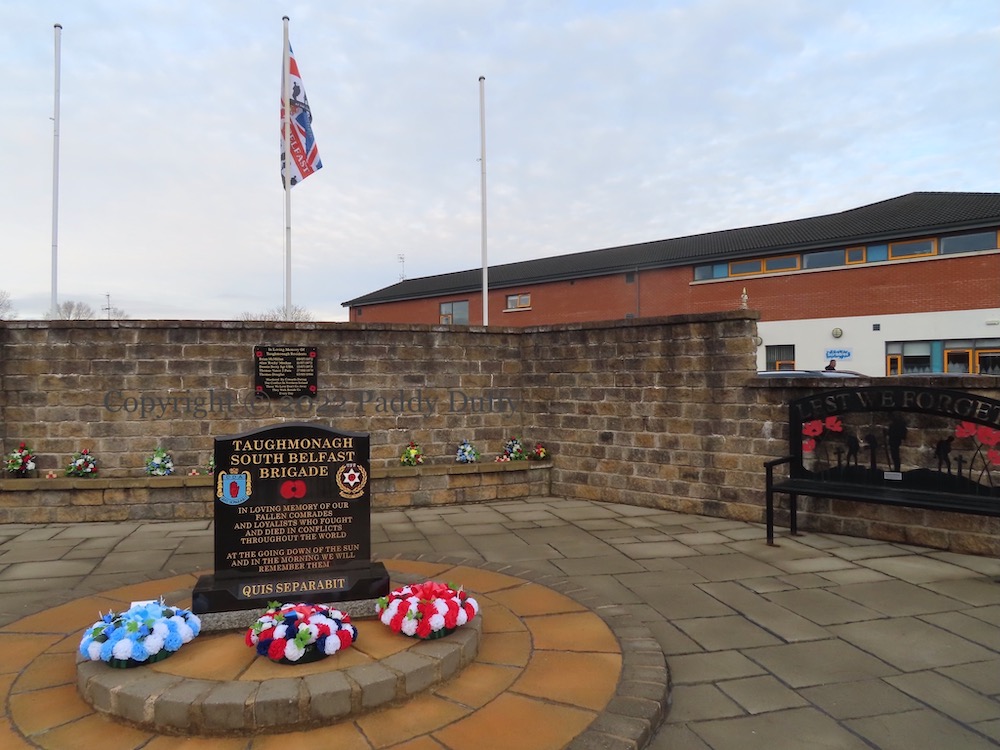
“In loving memory of Taughmonagh residents Brian McMillan, Alan ‘Rocky’ Meehan, Dennis Berrty (Sgt UDA), Thomas Vance (2 Para), Thomas Douglas. Murdered by cowards during the conflict in Northern Ireland. Those we love don’t go away, they walk beside us every day.”
McMillan and Meehan were civilians shot along with TA staff sergeant (and English Catholic) Joseph Flemming on July 9th, 1972.
Dennis Berry was shot by the UVF after leaving the UDA social club in Taughmonagh. According to Lost lives, “Reliable loyalist sources said the shooting was the result of a personal row rather than having any political or organisational basis.” (p. 441)
Thomas Vance died in the IRA’s 1979 ambush of the British Army at Narrow Water Castle, near Warrenpoint (WP), on the same day that Louis Mounbatten was killed. (Republican mural)
Thomas Douglas was shot while walking along the street. His family denied he was a leading loyalist and simply a member of the Orange Order (CAIN | Fb).
This plaque is in the UDA memorial garden in Taughmonagh at the corner of Finbank Gardens & Malfin Drive.
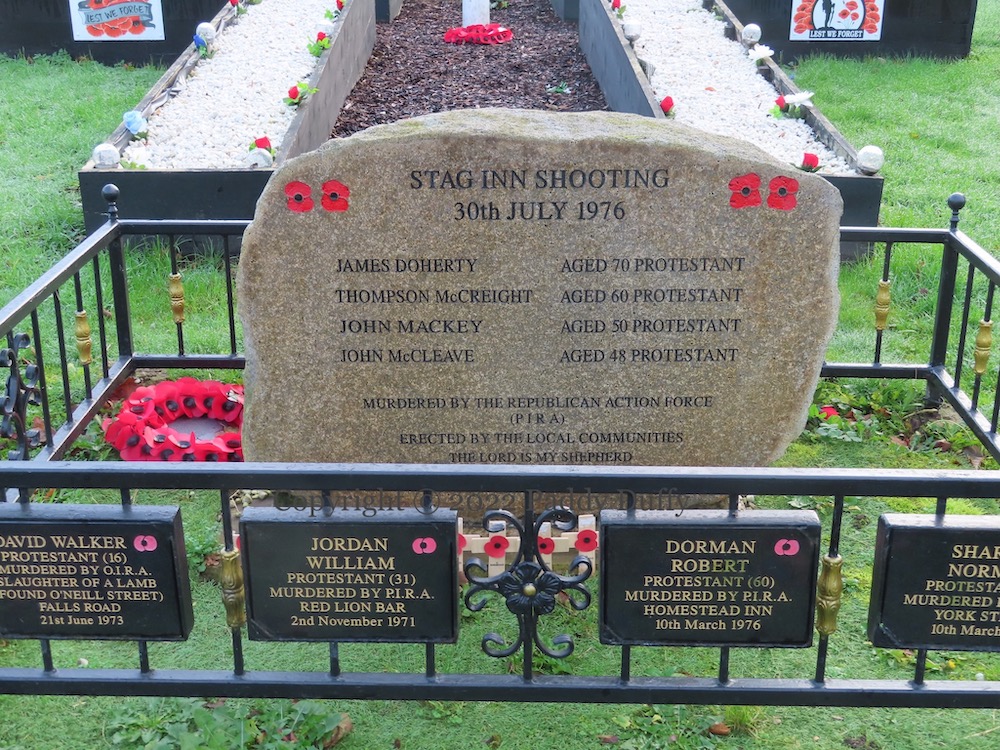
A long series of tit-for-tat shootings of pubs and clubs continued into the summer of 1976, with attacks on the Chlorane (June 5th), Walkers (June 25th), the Ramble (July 2nd), the Whitefort (July 29th), and then, on the 30th, The Stag at Shaws Bridge, Belfast, by the Republican Action Force (PIRA) (Sutton). John McCleave, John McKay, and James “Jimmy” Doherty died on the night of the attack, and Thompson McCreight died of his wounds nine days later. The memorial to them – “erected by the local communities” – is on Milltown Road, next to the Dreamscheme (web) mural.
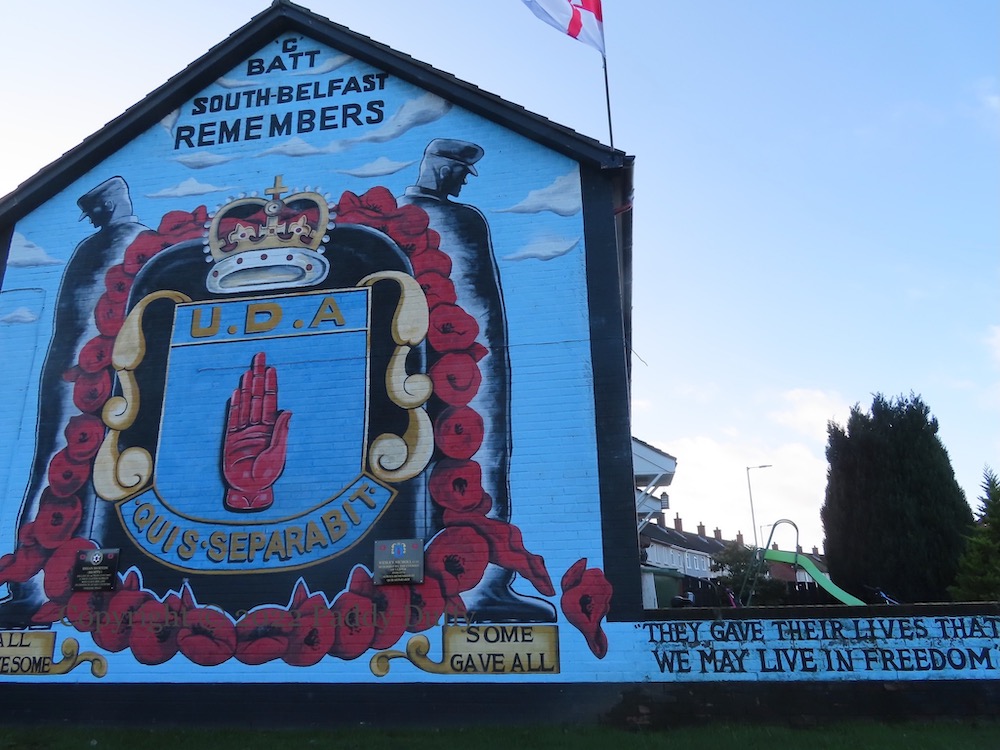
The old C Batt mural further up Hornbeam Road has long been painted over. It used the same line – “They gave their lives that we may live in freedom” – to remember Wesley Nicholl and Brian Morton. A plaque to Morton is now included on top of the new mural. “Brian Morton (Morty) killed in action 07/07/1997, a true Ulster patriot who gave his life in defence of his country. Feriens tego.” As with republican memorials, “active service” means that Morton was killed by a premature bomb exploding.
The mural in Cluan Place goes back to (at least) 2002. It used to include the words “5 people shot, houses burned, houses bombed” but these have been painted out in this repainted version.
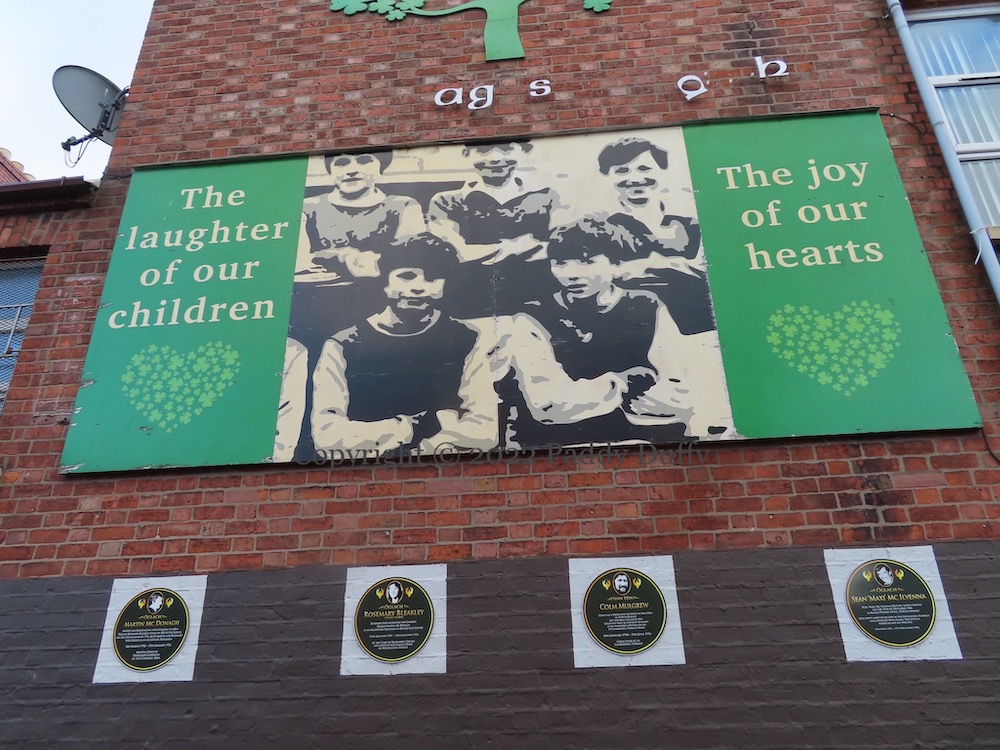
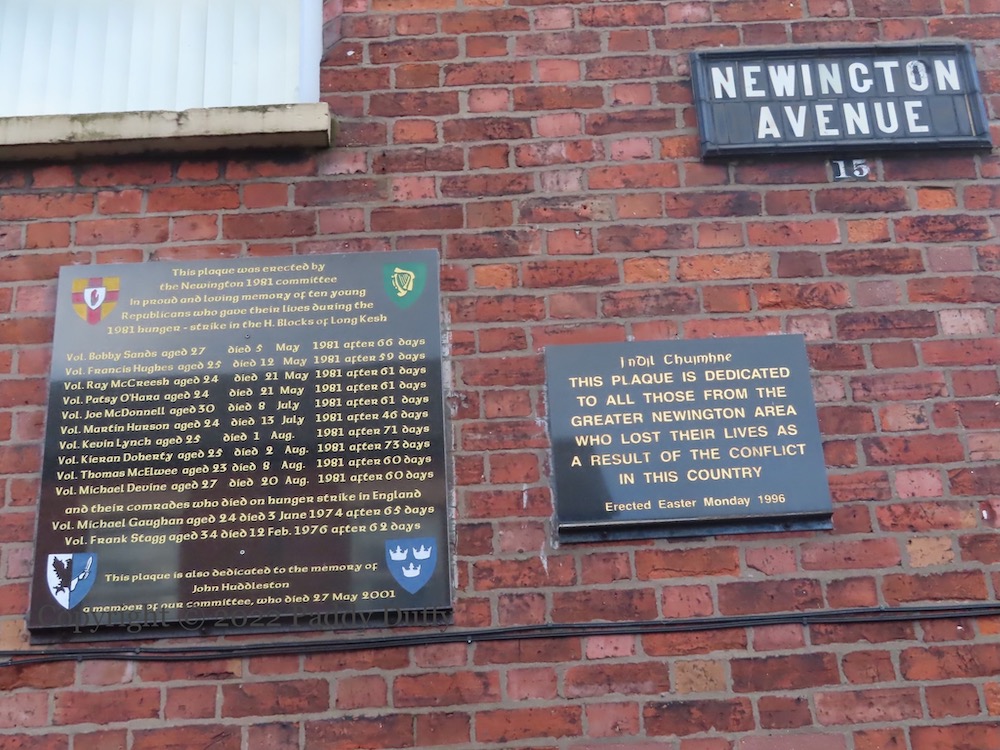
The Newington tribute to Bobby Sands and the other deceased hunger strikers of the 1970s and 80s (see previously: Mol An Óıge Agus Tıocfaıdh Sí) has been augmented with four plaques to republicans from the area who died in the Troubles: (l-r) Martin McDonagh, Rosemary Bleakley, Colm Mulgrew, and Sean ‘Maxi’ McIvenna.
Unbeknowst to her parents (Lost Lives), Bleakley had joined Cumann Na mBan at 18 and was four days short of her nineteenth birthday when she and McDonagh were killed in a premature bomb explosion in the North Street arcade (Victor Patterson image of the blast), along with civilians Ian Gallagher and Mary Dornan (Sutton); 20 others were injured (Fortnight). Bleakley was not buried in the republican plot (in Milltown) but coincidentally in the plot adjacent to Dornan (BBC).
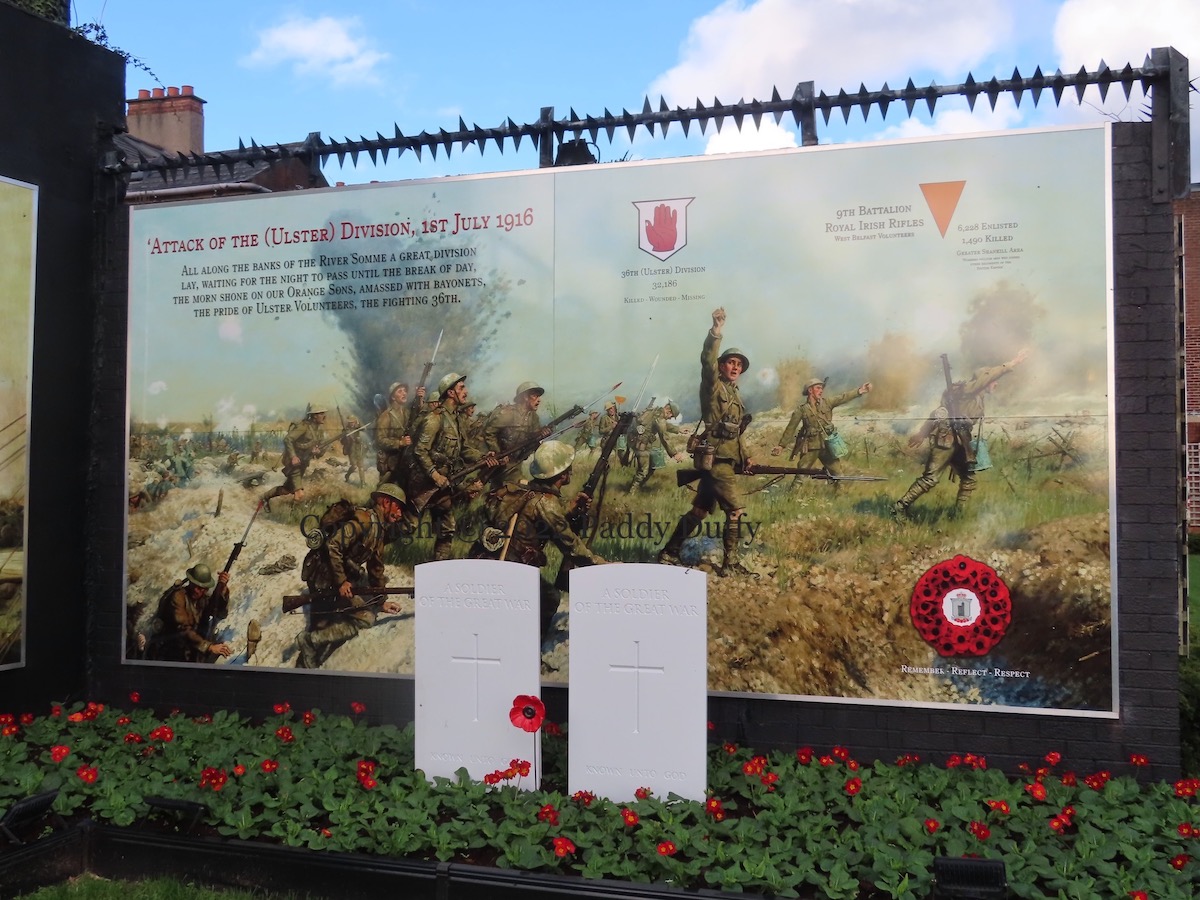
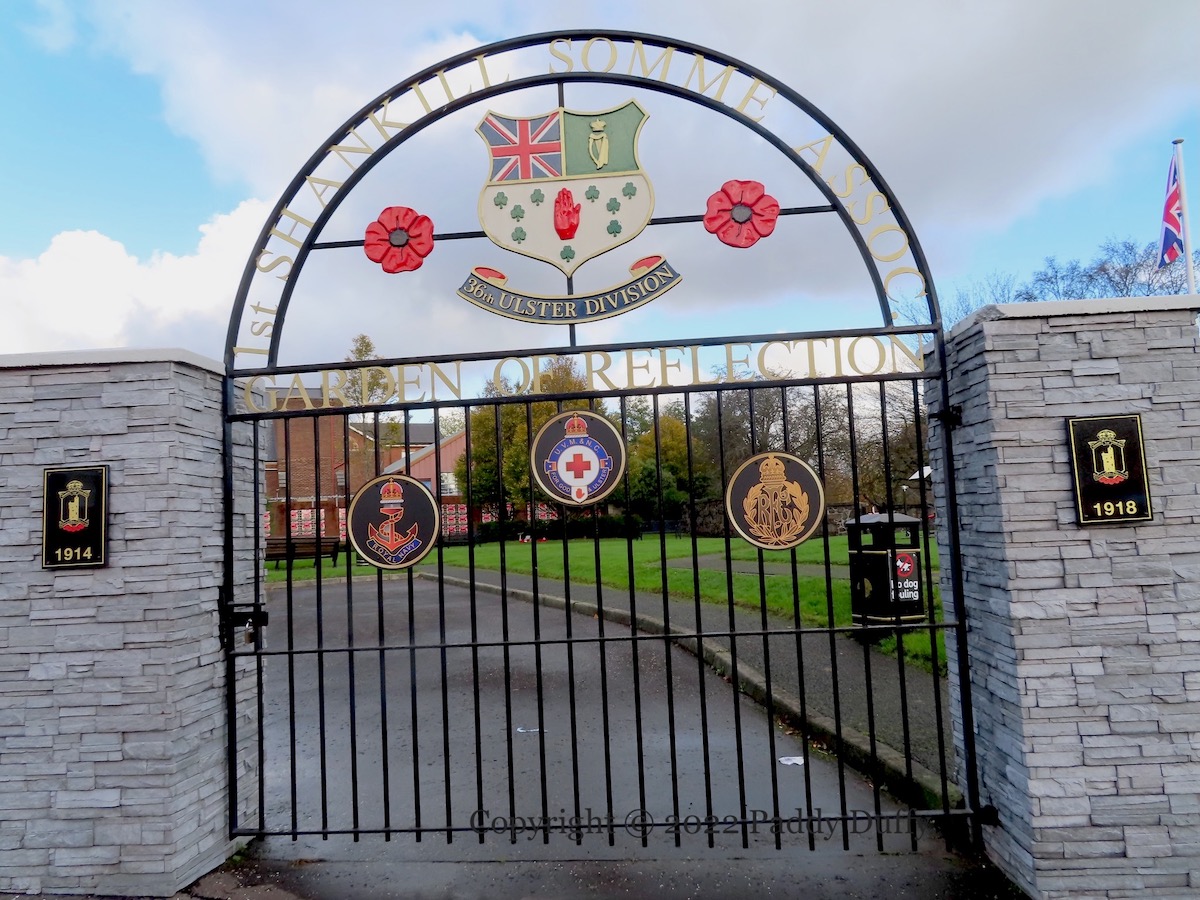
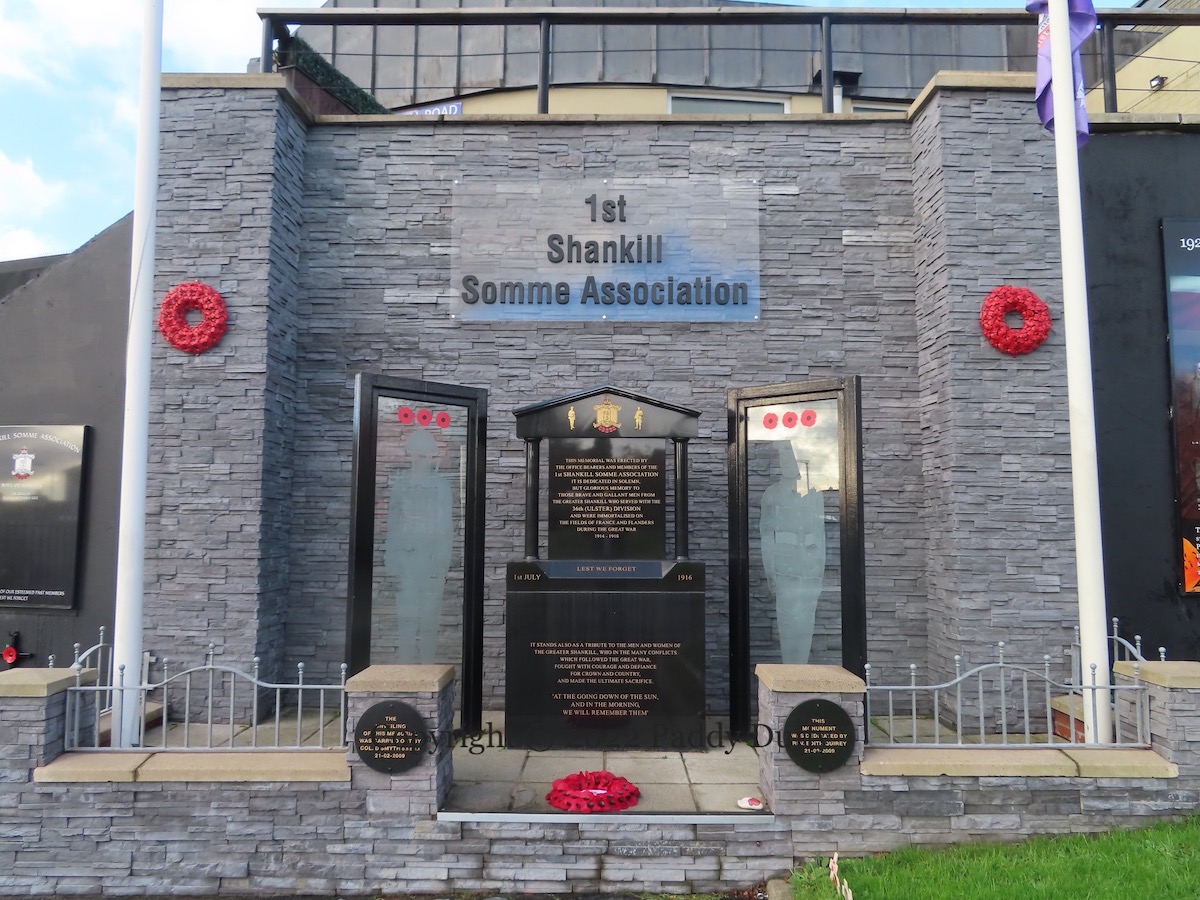
The Shankill Somme Association’s garden of reflection has added a number of new boards.
The board shown above is JP Beadle’s painting “Battle of the Somme: Attack of the Ulster Division”, which hangs in Belfast City Hall (militaryprints.com). It replaces a painting of a soldier in a field of poppies, seen in The Great War.
To its left is John Singer Sargent’s painting “Gassed”, showing the “aftermath of an indiscriminate mustard gas attack on British forces during the Battle of Arras 21st August 1918” (which also forms a part of a memorial in east Belfast) with the GK Chesterton quote “The true soldier fights not because he hates what is front of him, but because he loves what is behind him”.
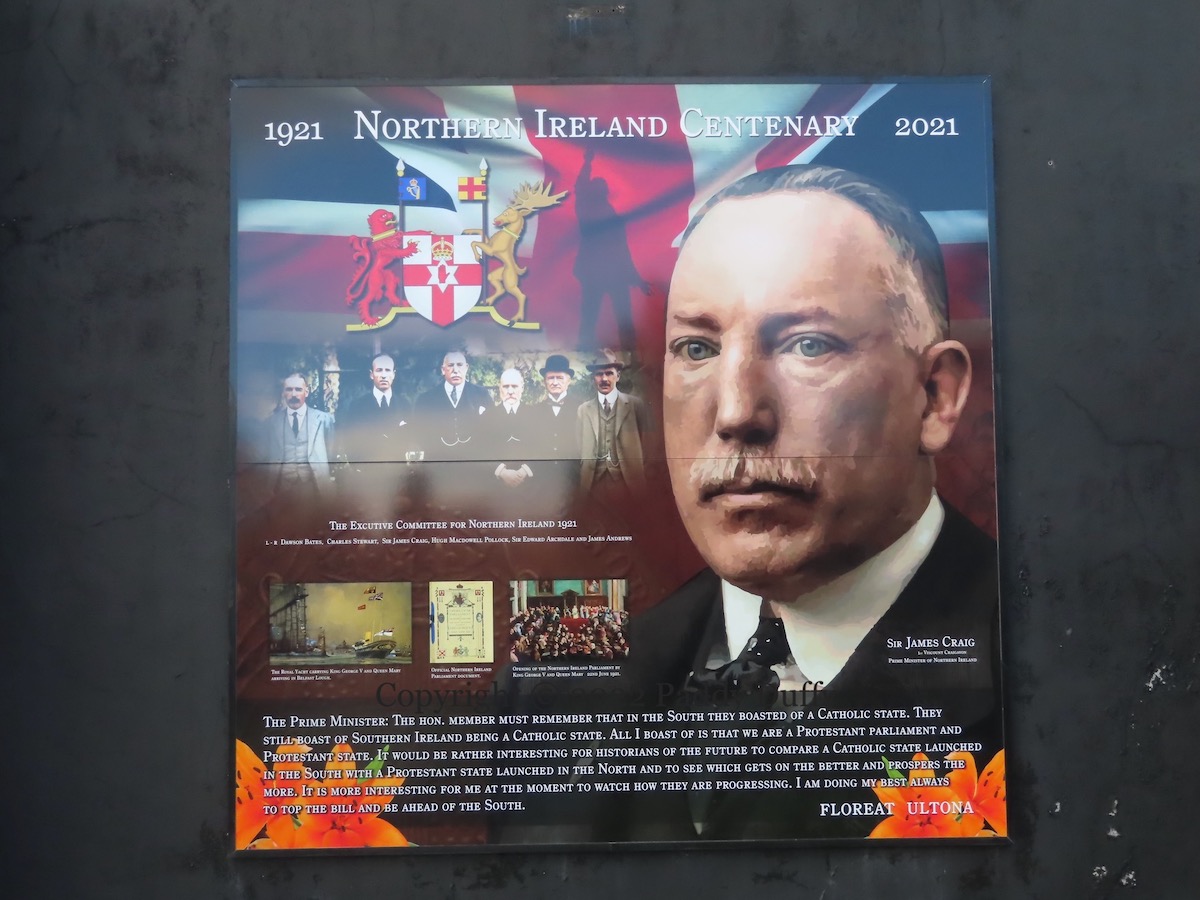
Also new – and somewhat out of place – is the Northern Ireland Centenary board featuring James Craig: “It would be rather interesting for historians of the future to compare a Catholic state launched in the south with a Protestant state launched in the north and to see which gets on the better and prospers the more”. There are other “floreat Ultona” boards/murals in the Village (focusing on the B Specials and UDR) and in Rathcoole (where “Ulster welcomes her King and Queen”).
There are also three insignia on the gates (compare with M05717), to the Royal Navy, the Ulster Volunteer Medical & Nursing Corps, and the Royal Flying Corp.
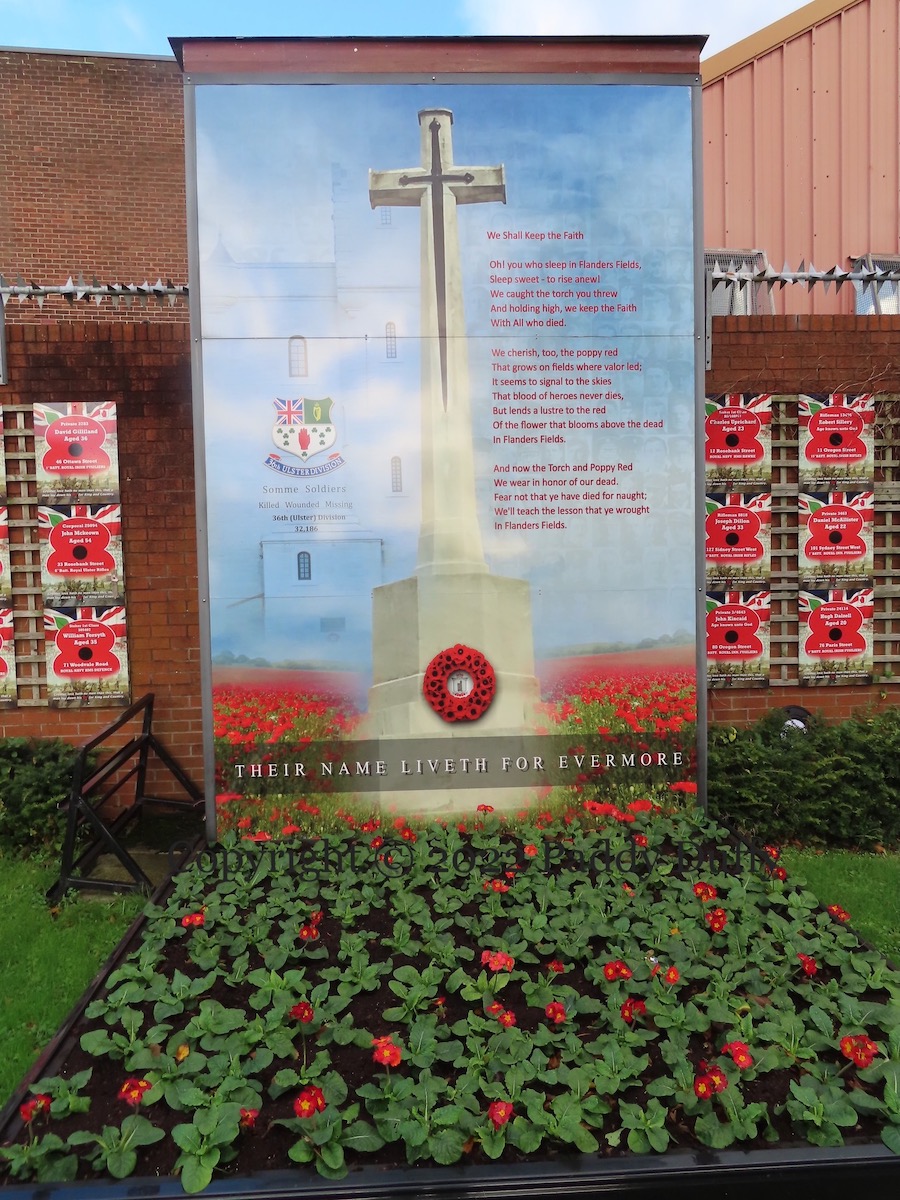
Previously (c. 2017), the undead soldiers of We Shall Not Sleep were replaced with an image of the Cross Of Sacrifice memorial – the original is in Ypres, Belgium but there is also one in the City Cemetery – see One In Design And Intention. At the same time, the poppy plaques for individual local soldiers and the image of the Menin Gate were also added.
The Flanders Field board appears to have survived since 2012 – see Somme Memorial.
The final image below shows the new stone surround for the main memorial. See (again) Somme Memorial.
“In proud and loving memory of all local volunteers, prisoners of war, republican activists and the unsung heroes who died of natural causes having served the cause of Irish republicanism [“sean óglach” on the individual plaques]. Together in unity you formed a bond which gave true meaning to the undefeated risen people. Your deeds of bravery and resistance will never be forgotten by the people of greater St. James’s. In your honour the quest for Irish freedom continues.” With the famous “our steps will be onward” quote from Máıre Drumm at an anti-internment rally in Dunville Park on 10th August, 1975 (RN). Coıste Cuımhneacháın Lár Na bhFál/Ard Na bhFeá [Memorial committee of mid-Falls/Beechmount]. For some more of the plaques, see The Unsung Heroes.
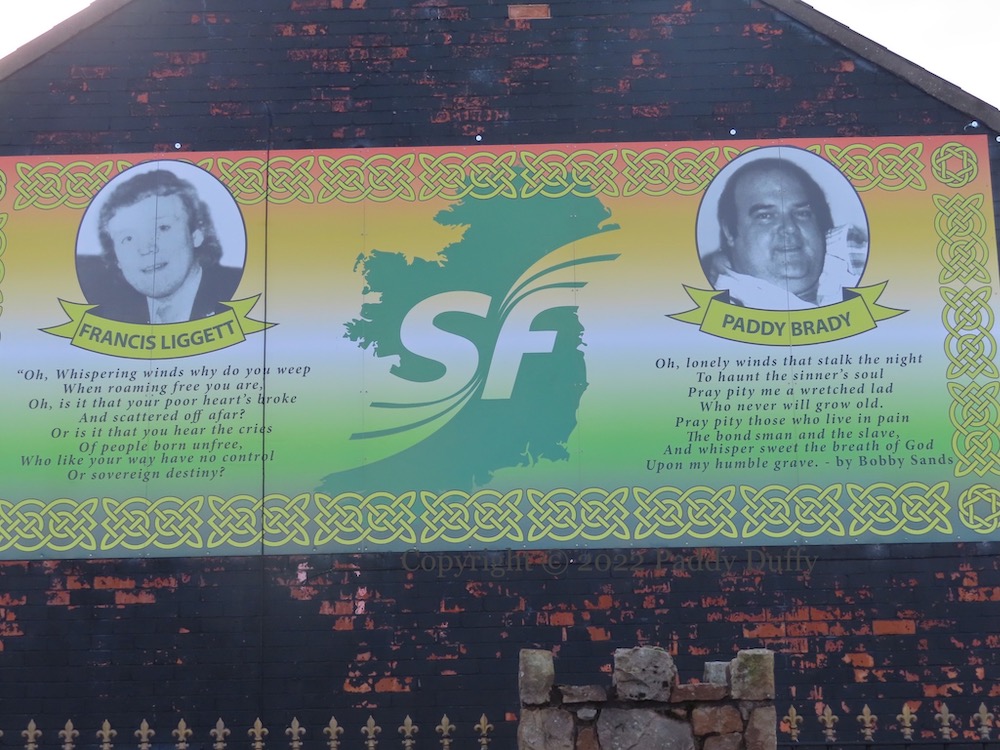
The board on the gable to the side shows Francis Liggett and Paddy Brady. IRA volunteer Francis Liggett was shot dead by the British Army during an attempted armed robbery at Royal Victoria Hospital, Falls Road in 1973 (Sutton) while local Sınn Féın member Paddy Brady was shot by the UFF while at work in 1984 (Sutton | An Phoblacht). They are commemorated in the St James memorial garden with the board shown above, featuring two verses from Bobby Sands’s poem Weeping Winds: Oh, Whispering [Whistling, in the original] winds why do you weep/When roaming free you are, Oh! Is it that your poor heart’s broke/And scattered off afar? Or is it that you bear the cries/Of people born unfree, Who like your way have no control/Or sovereign destiny? Oh! Lonely winds that stalk [walk] the night/To haunt the sinner’s soul/ Pray pity me a wretched lad/Who never will grow old. Pray pity those who lie in pain/The bondsman and the slave And whisper sweet the breath of God/Upon my humble grave.
The board is similar in design to the painted one it replaces, except that Éıre was at the centre rather than the “SF” logo.
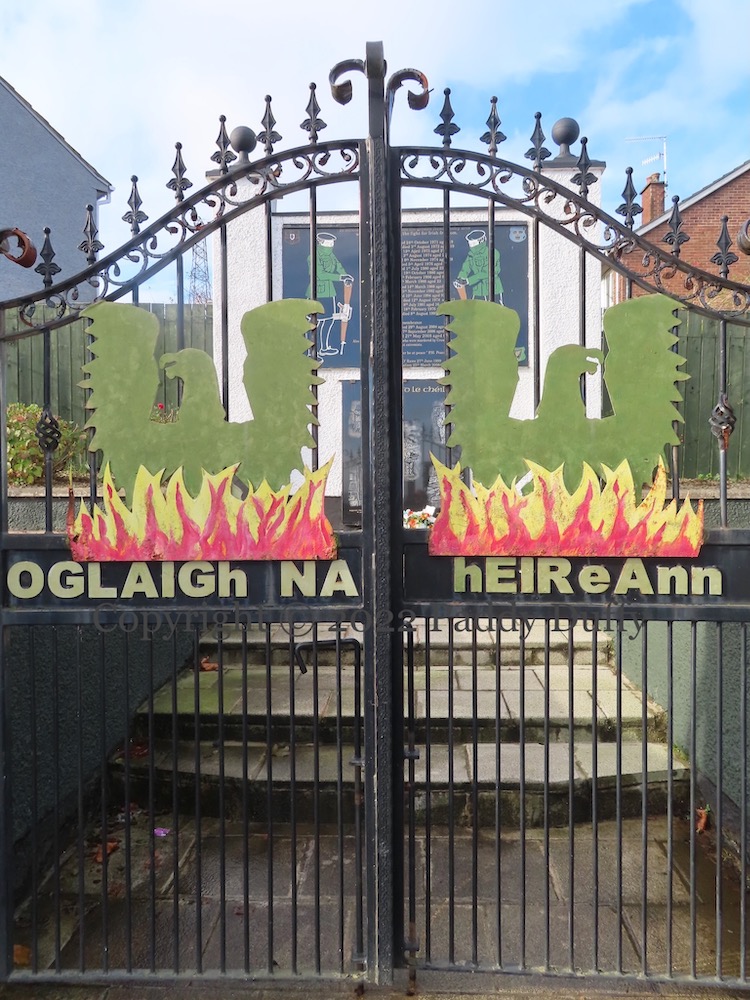
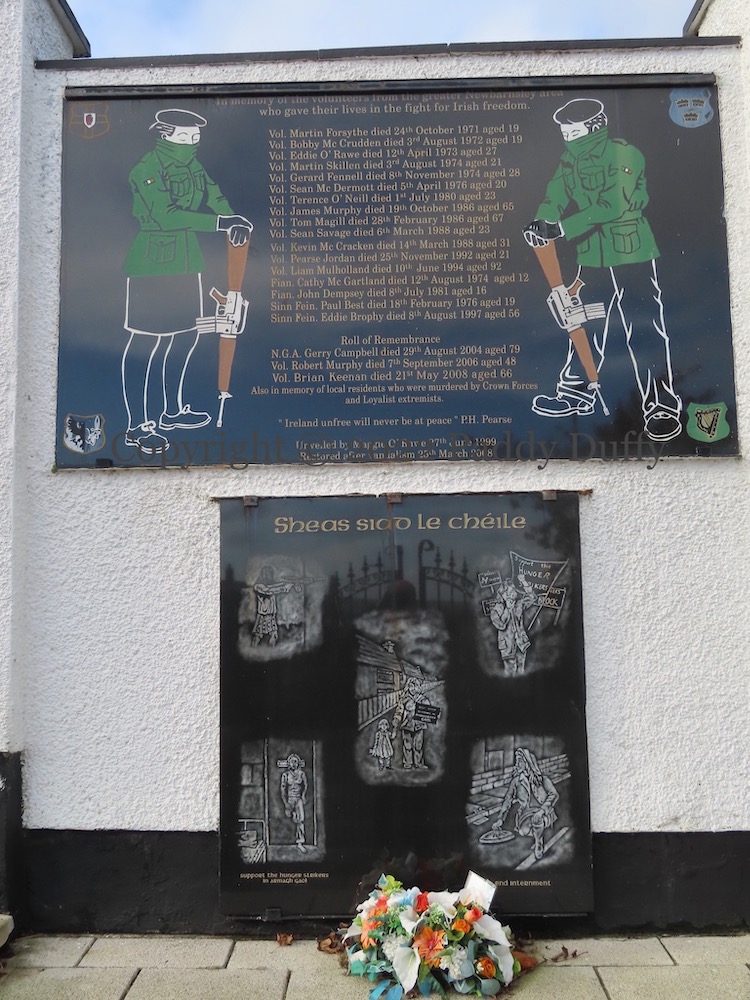
“Sheas sıad le chéıle” [They stood together] – the New Barnsley memorial garden commemorates (on the large plaque) “Volunteers From The Greater New Barnsley Area” and (on the smaller one) commemorating support from the community.
The wrought-iron gates depict a phoenix and “Óglaıgh Na hÉıreann”.
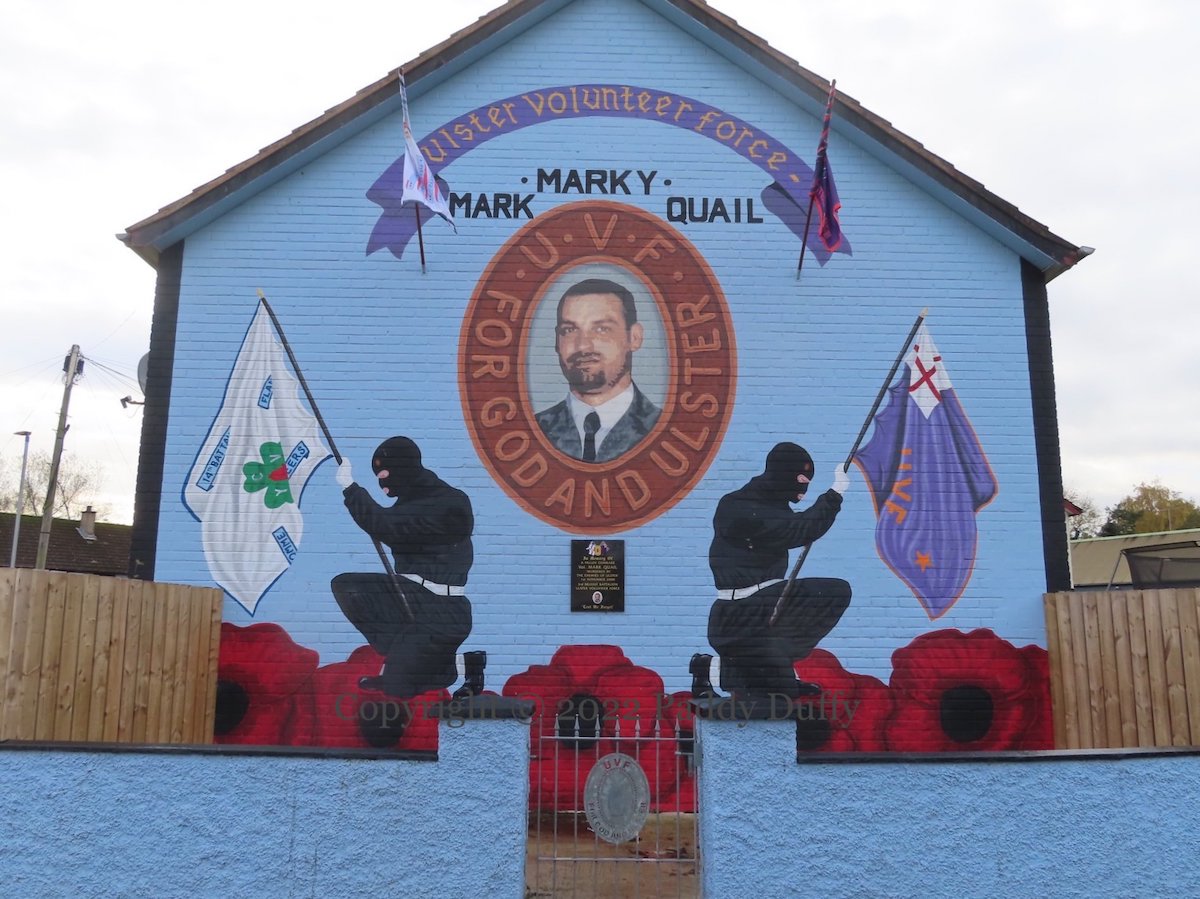
Mark Quail, of the UVF, was “murdered by the enemies of Ulster” – that is, shot by the UDA – at his Rathcoole home on November 1st, 2000. His was the fourth death in four days (after David Greer, Bertie Rice, Tommy English) (Irish Times) as the UVF-UDA feud that began in the Shankill with the infamous “loyalist day of culture” in August 2000 spread to north Belfast and Newtownabbey (though the BBC says they are unrelated). There were also attacks in east Belfast (BelTel) before the feud ended in mid-December (BBC | Guardian).












 Paddy Duffy Collection