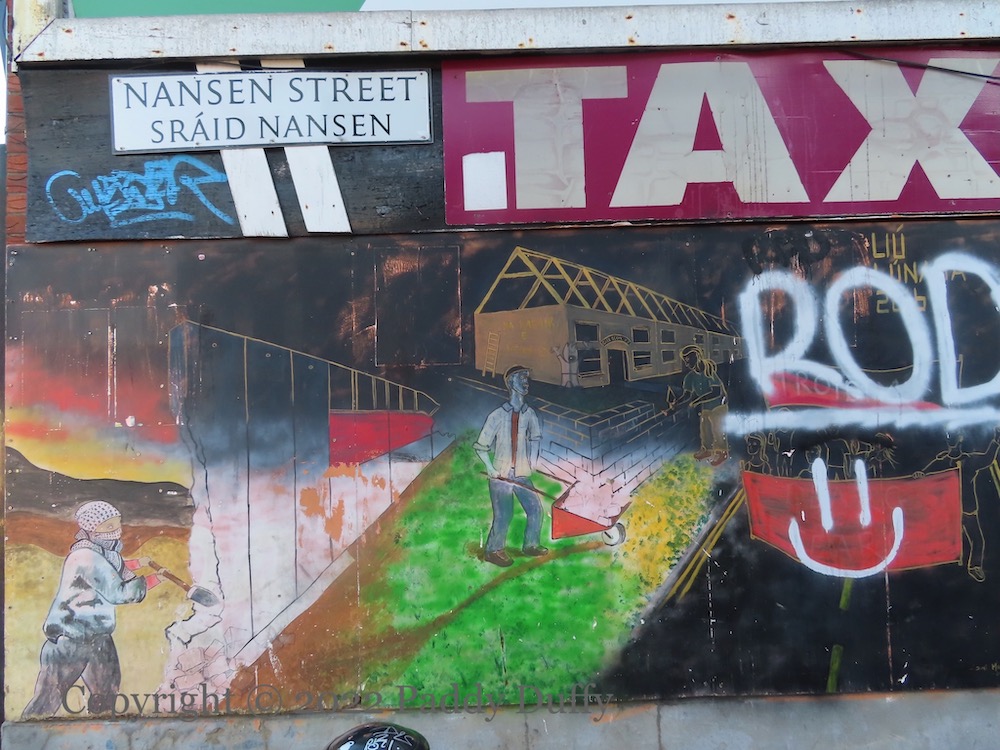
Lıú Lúnasa is an Irish language festival. The board above shows rocks taken from the wall separating Palestine and Israel being used to build a gaelscoıl (an Irish-language school). The mural was painted by Jımí Mac Fhlannchadha.
Above, a “Welcome to loyalist Seymour Hill” board with flags and poppies, and a (2021) tarp “Seymour Hill says no to the Irish Sea border”.
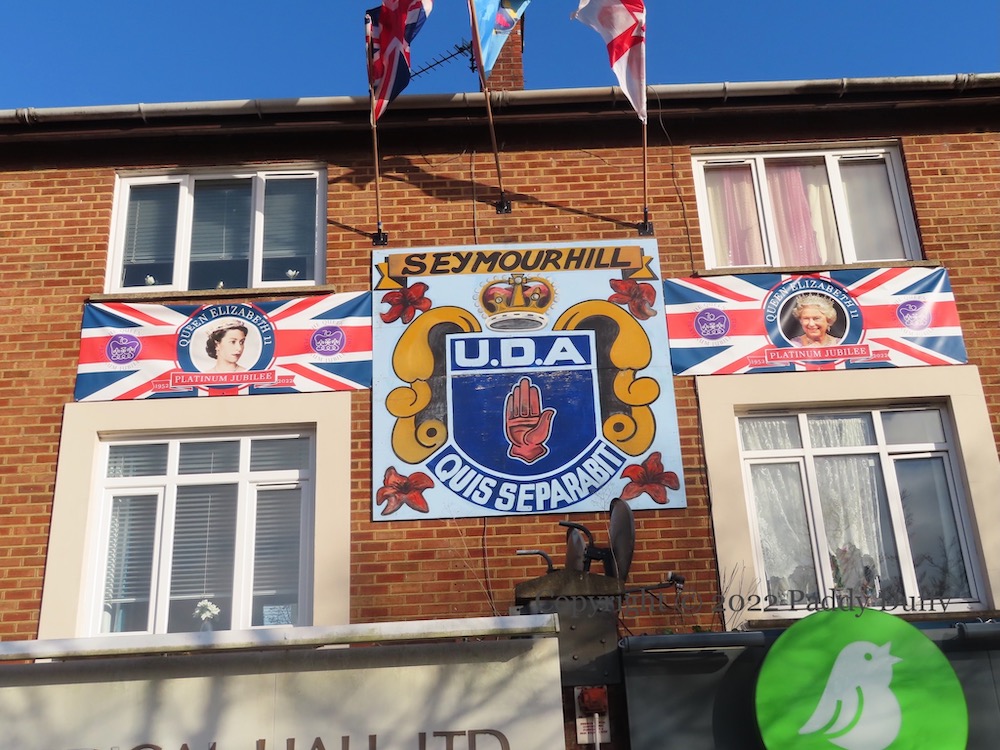
Below, Queen Elizabeth II 70th/platinum Jubilee banners remain on either side of the UDA board above the Seymour Hill shops, even after her death in September (previously there were two NI Centenary banners). There are orange lilies at the four corners of the UDA emblem.
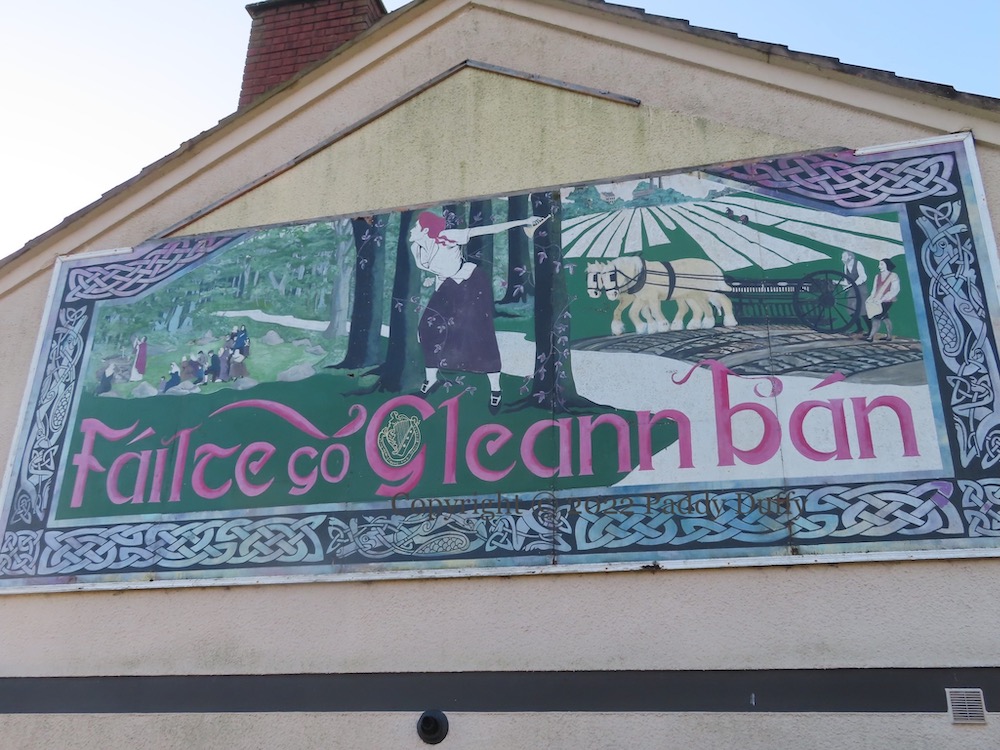
“Were you at the rock?” A red-headed lass with a horn stands watch for others at a mass rock – a stone in a remote location for Catholic worship, made necessary by a Penal law of 1695 which forbade the religious practice of Catholicism and “dissenter” forms of Protestantism (that is, anything other than Anglicism) (source). The harp, with a “cap of liberty” rather than a crown (WP), together the slogan “Equality – It is new strung and it shall be heard” is the emblem of the Society of United Irishmen (WP). On the other side of the mural (seen below) linen lies in the fields bleaching and a farmer and wife plough the land with a team of horses and distribute seed.
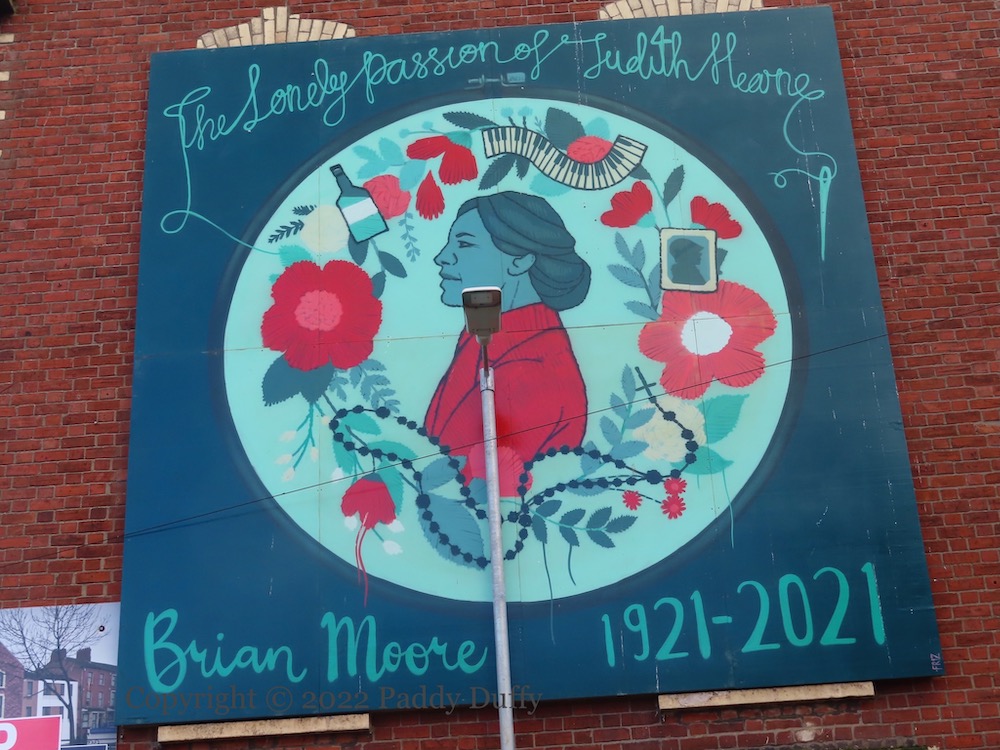
Novelist Brian Moore grew up on the Antrim Road and went to St Malachy’s, before emigrating to Canada in 1948. For the centenary of his birth in 1921, Paradosso Theatre adapted Moore’s best-known novel, (The Lonely Passion Of) Judith Hearne, for the stage and mounted this board in Duncairn Avenue, showing the elements of Judith’s life: the bottle, the beads, the aunt who raised her, the piano used for lessons, and her red coat.
The board by Friz (ig) replaces the anti-joy-riding mural “Where’s The Joy?”, the last to go of the three, the others having been in CNR west Belfast and PUL west Belfast.
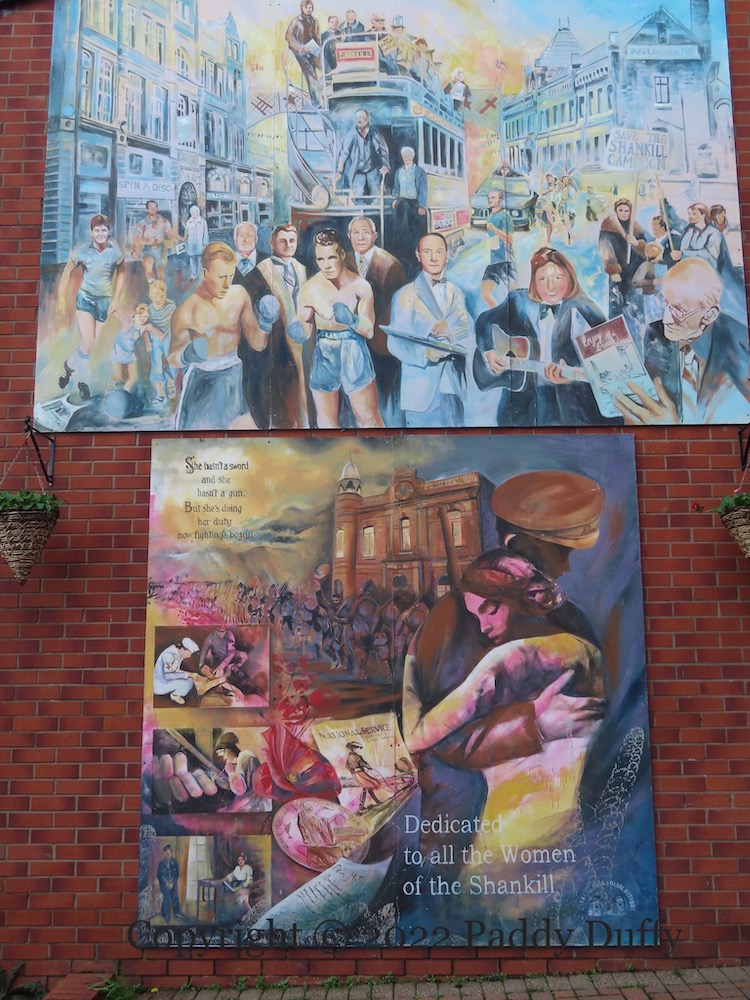
Here are two boards outside the Ulster Rangers Supporters Club (Fb) on the Shankill Road.
The upper one features a tram going under an Orange arch between the public baths on one side an Spin-A-Disc records on the other, surrounded by notable figures from the Shankill area.
Many thanks to Johnny Dougan of Shankill Area Social History (Fb) for the information below! Please e-mail or add a comment with additions or corrections.
Front, from left to right: Manchester United and Northern Ireland Soccer player Norman Whiteside (WP) and behind him boxer Davy Larmour and community worker Saidie Patterson (see WRDA), boxer Sammy (Cisco) Cosgrove, Senator Charlie McCullough (WP), Tommy Henderson, boxer Jimmy Warnock (original photograph here), Hugh Smyth (see previously Third Class Citizens), artist William Conor (see previously Conor’s Corner, Jack Henning (running), musician Belter Bell, writer Albert Haslett (Northern Visions interview).
Atop the tram: on the left is Jackie Redpath of the Save the Shankill Campaign (note other members of the group with placard on right; Northern Visions has a documentary about the Save The Shankill campaign) and Jack Higgins holding his book The Eagle Has Landed (WP). Up there too is Miss Sands, the music teacher in the Girls Model School, and historian Bobby Foster (Northern Visions interview). On the stairs are May Blood MBE and above her D.I. Nixon.
The lower board highlights the roles played by women during WWI as nurses and welders and in the Land Army. “She hasn’t a sword and she hasn’t a gun. But she’s doing her duty now fighting’s begun.” The forces are shown gathered outside the West Belfast Orange Hall, on the Shankill at Brookmount Street.
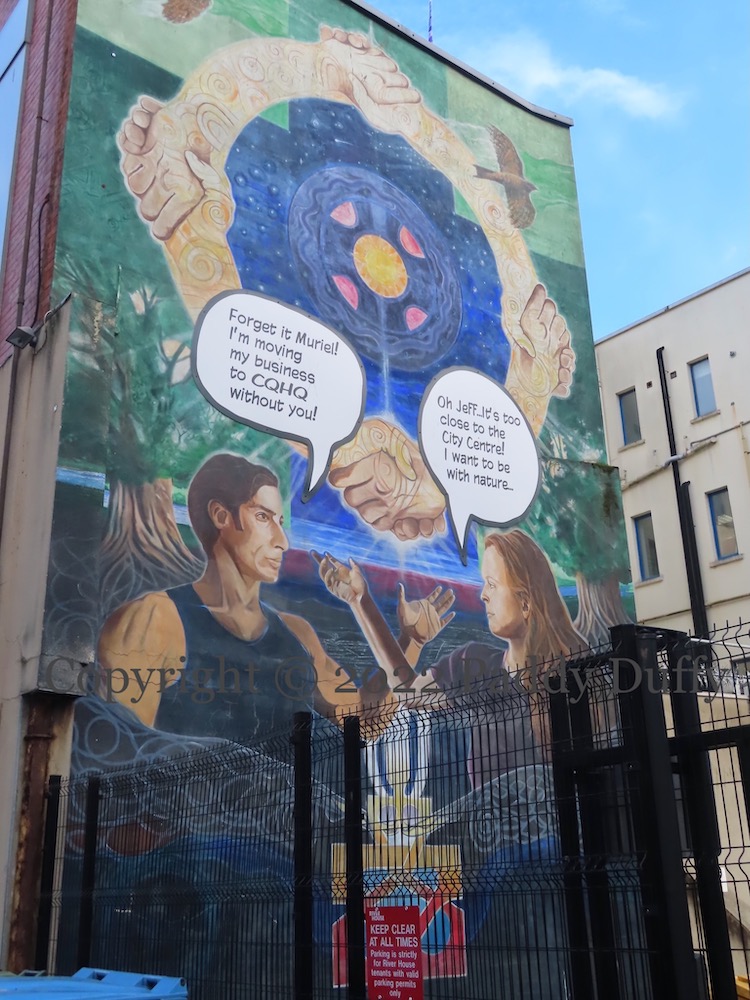
The speech balloons that were added to the Ring Of Peace mural in Waring Street to advertise office space are still there, seven years later.
The bubbles read “Forget it, Muriel. I’m moving my business to CQHQ without you!” “Oh Jeff … It’s too close to the City Centre! I want to be with nature …”.
Érıu/Éıre of the Tuatha Dé Danann, queen of Ireland, (as depicted by Richard J King) is at the centre of various representations of republican women. Along the top are Ann Devlin, Betsy Gray, Mary Ann McCracken, Countess Markievicz, Nora Connolly?, and Winifred Carney. Suffragettes, the modern IRA, and Cumman Na mBan are depicted, as are Máıre Drumm at the Falls Curfew, Tom McElwee’s sisters carrying his coffin, and Molly Childers and Mary Spring Rice running guns on the Asgard. There is also an unusual ‘four provinces’ in the corners.
The wide shot (below) shows the James Connolly mural below and the 1916 centenary board above – also seen in South Link: Ag fíorú na poblachta/“Realising the republic”.
Londoner Stephen Lawrence was murdered by stabbing in 1993 and, although arrests were made, no charges were brought. A 1998 public inquiry found that the Metropolitan Police Service was “institutionally racist”. In 2012, two of the original suspects were found guilty of the murder (WP). Catholic Robert Hamill was beaten to death by loyalists in Portadown in 1997 while police in an RUC land-rover looked on (WP).
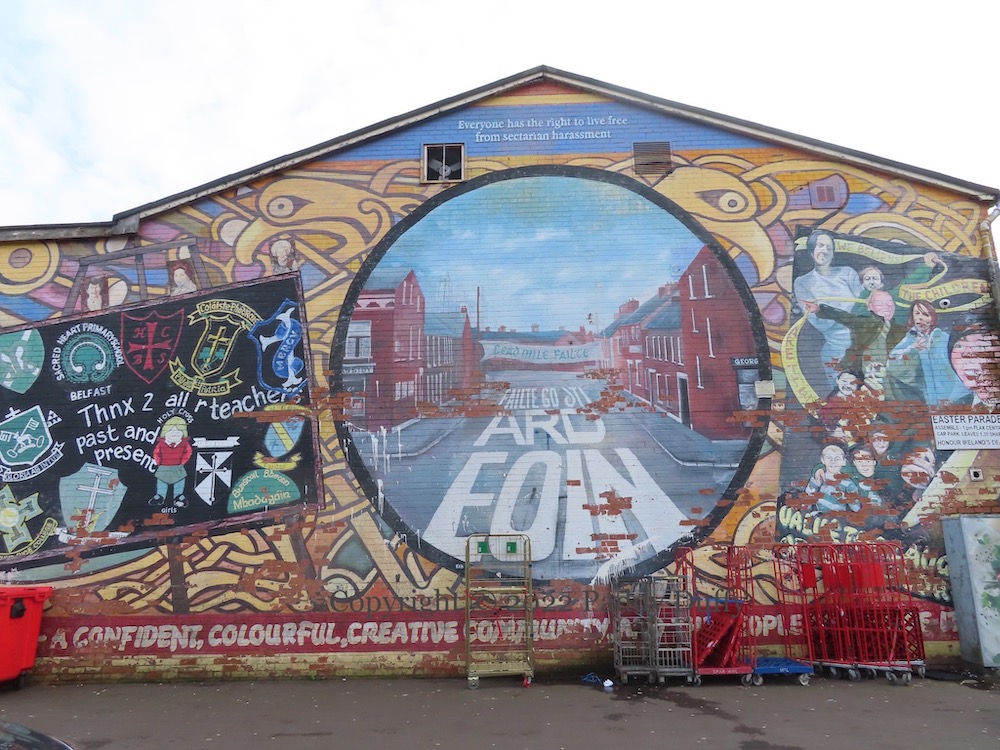
“Fáılte Go Dtí Ard Eoın. Ardoyne – a confident, colourful, creative community, and the people who made it so” particularly the local schools, whose insignia are shown on the left: “Thnx 2 all r teachers past and present.” The previous mural in this spot (M01783) is invoked by the banner across the top: “Everyone has the right to live free from sectarian harassment” and the inclusion of Holy Cross Girls among the schools.
Whitney Houston and Bobby Sands are invoked on the right “We believe the children are the future – value the laughter of our children“.




 Paddy Duffy Collection