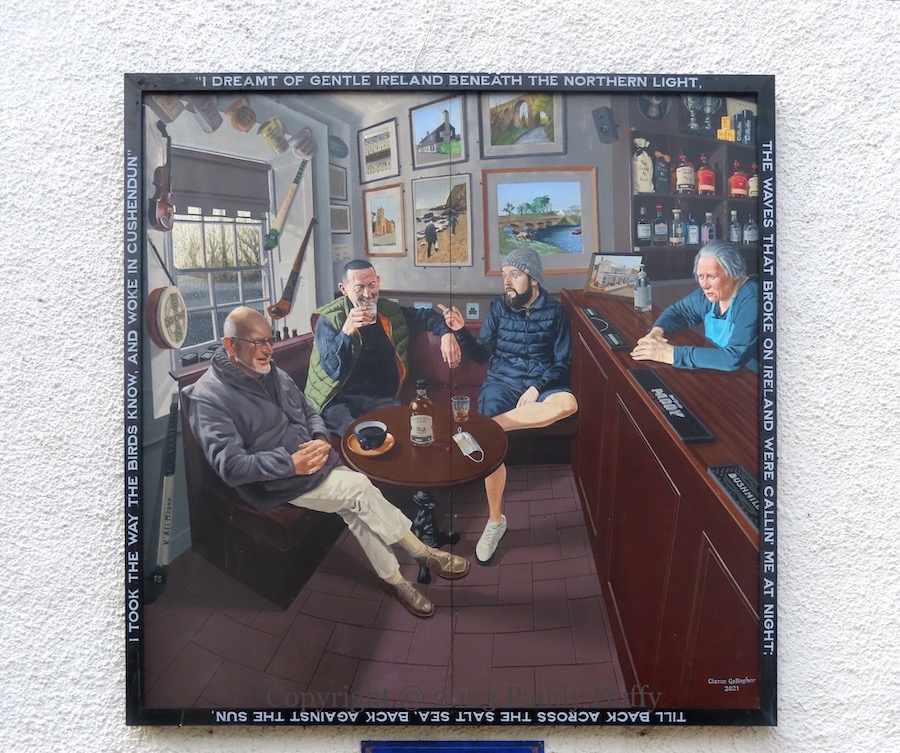
This is Ciaran Gallagher’s (ig) take on McBride’s pub in Cushendun. Around the outside are a verse from Moira O’Neill’s ‘To W.C.S.’ in More Songs Of The Glens Of Antrim (pdf at Google Books): “I dreamt of gentle Ireland beneath the northern light/The waves that broke on Ireland were callin’ me at night/Till back across the salt sea, back against the sun/I took the way the birds know, and woke in Cushendun.”
For the exterior of the pub, surrounded by famous individuals, see Kathryn Bannister’s painting from the Dark Horse pub, Belfast.
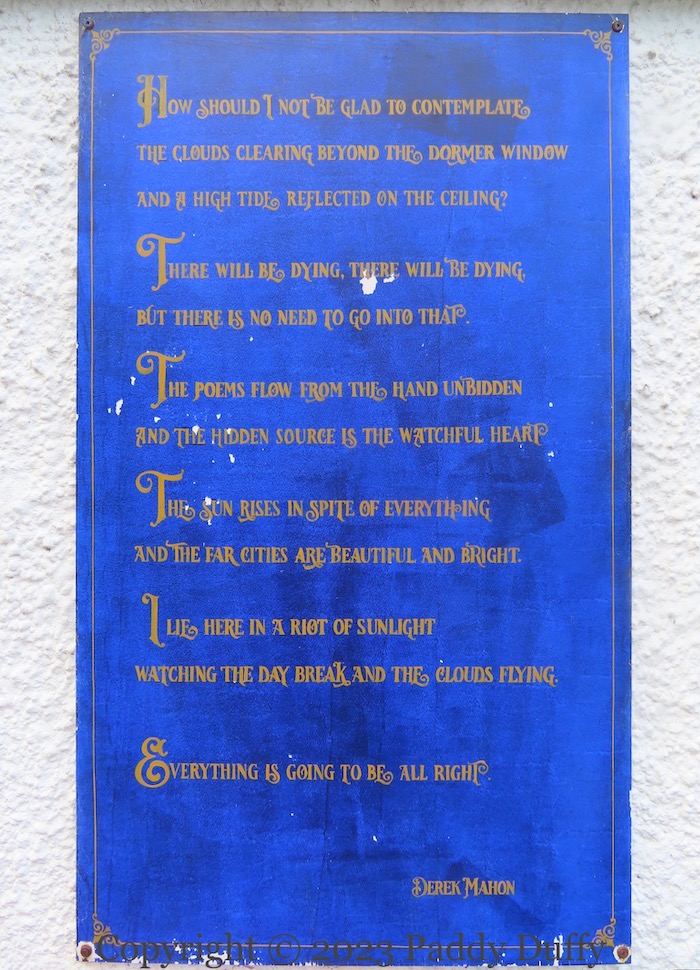
Below the painting (and shown below) is Derek Mahon’s poem ‘Everything Is Going To Be All Right’: “How should I not be glad to contemplate/The clouds clearing beyond the dormer window/And a high tide reflected on the ceiling?/There will be dying, there will be dying/But there is no need to go into that./The poems flow from the hand unbidden/And the hidden source is the watchful heart/The sun rises in spite of everything/And the far cities are beautiful and bright/I lie here in a riot of sunlight/Watching the day break and the clouds flying/Everything is going to be all right.”
This is the third version (at least) of the circular King Billy in the centre of Ballymena. The first goes back to 1989 (D00471) and the second to 2000 (X00158 | M00711).
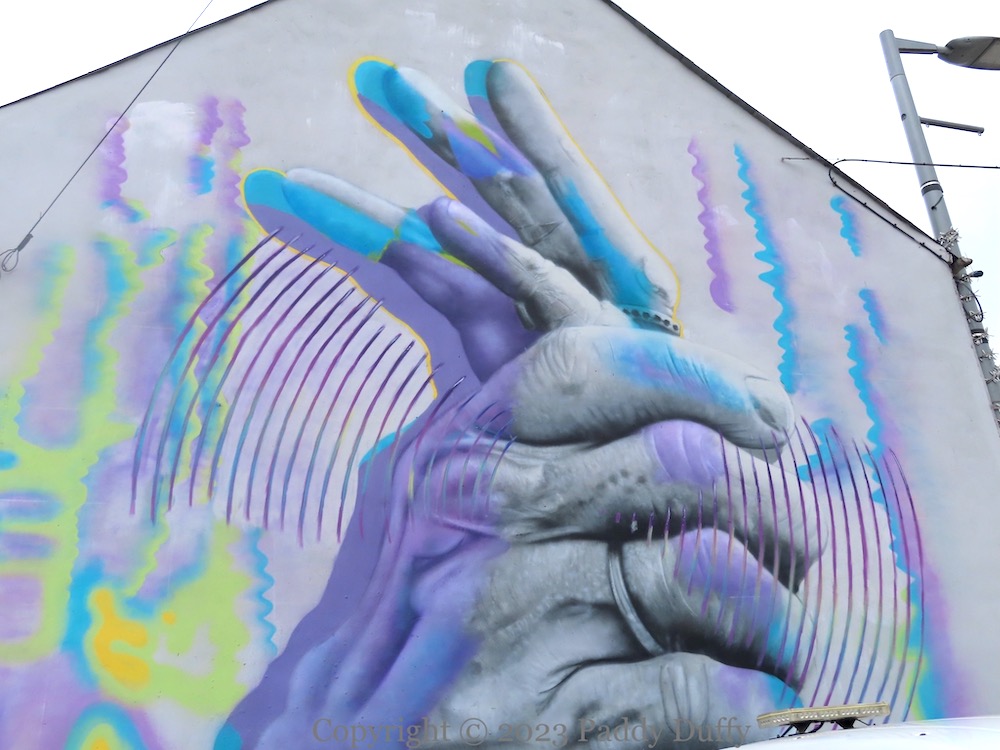
Good Morning Ballymena (Fb) is a telephone helpline for the elderly. Emic has drawn a pair of wrinkled hands radiating a signal for the organisation in the Alexander Street car park.
The first printing press in Belfast belonged to James Blow and his brother-in-law Patrick Neil in 1694 (DIB | Dublin Penny Journal gives 1696 | Mary Lowry Story Of Belfast gives 1690); a run of 8,000 Bibles is said to have been printed in 1751, one of which is part of the Linen Hall Library’s collection on Early Ulster Printing (RASCAL).
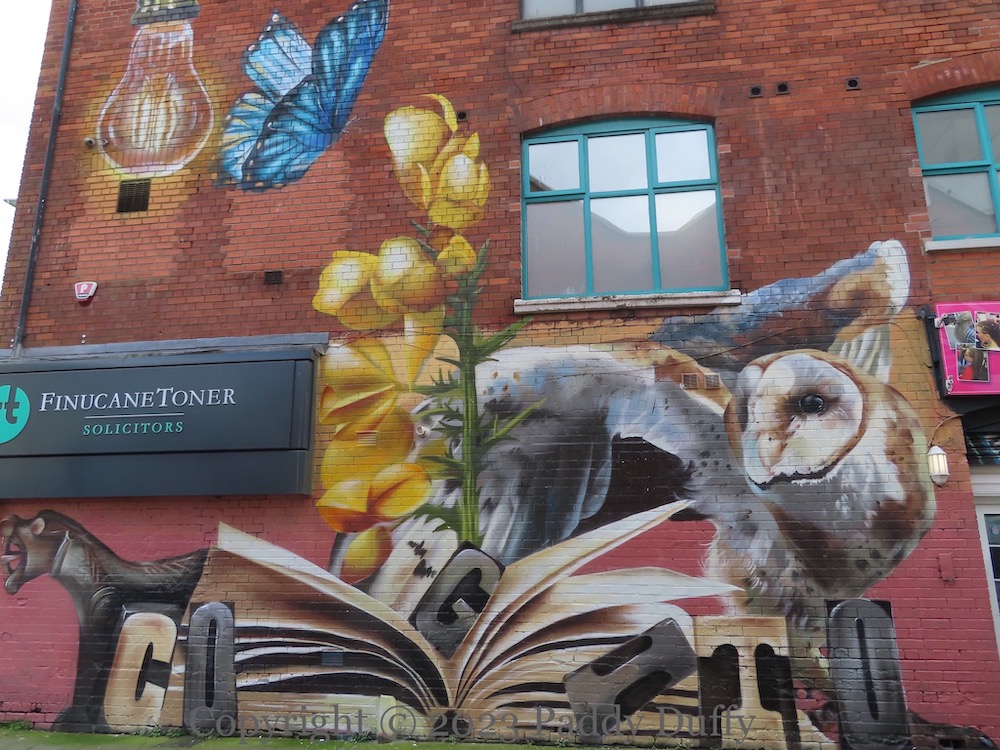
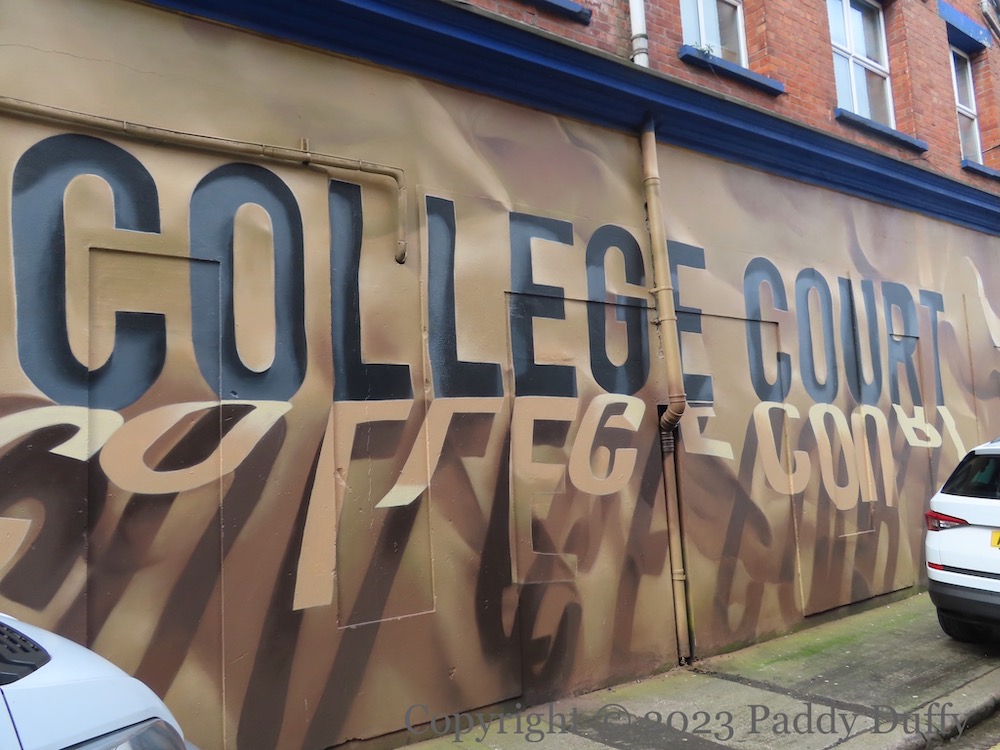
In 1895, Carswell & Sons opened a print-works and book-binders in a warehouse running with frontage in Queen Street and a rear in College Court (the building is now a bingo hall – see Kelly’s Eyes) which is currently being renovated as an office block (Bel Tel) – some of the scaffolding in College Cour can be seen in the later images in We Built This, the street art festival for International Women’s Day, 2023.
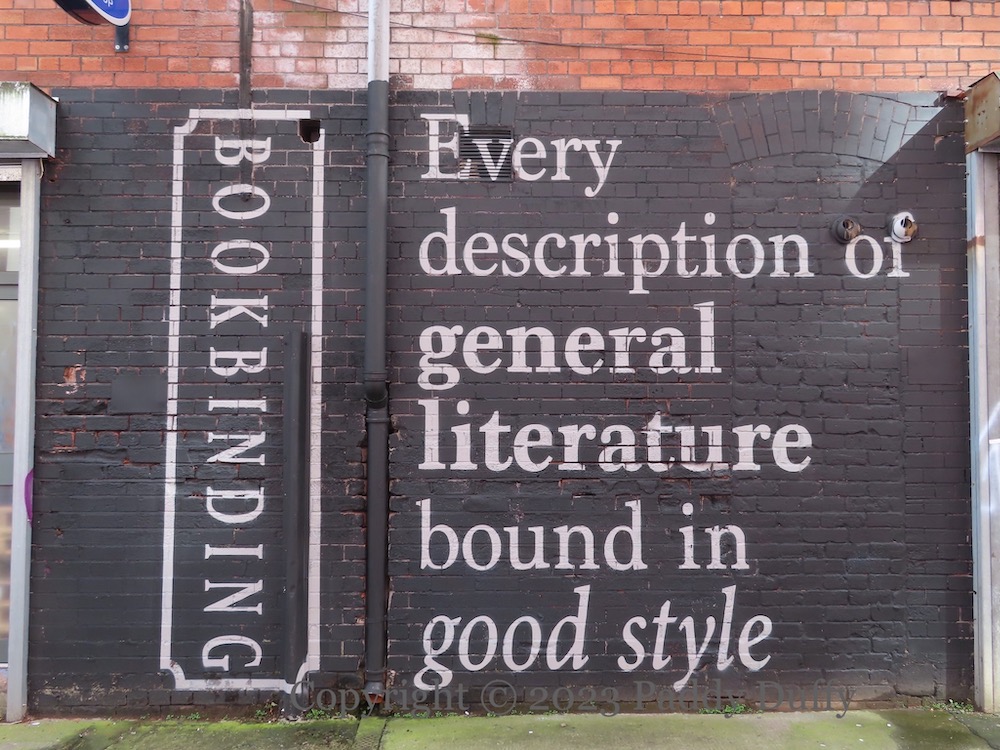
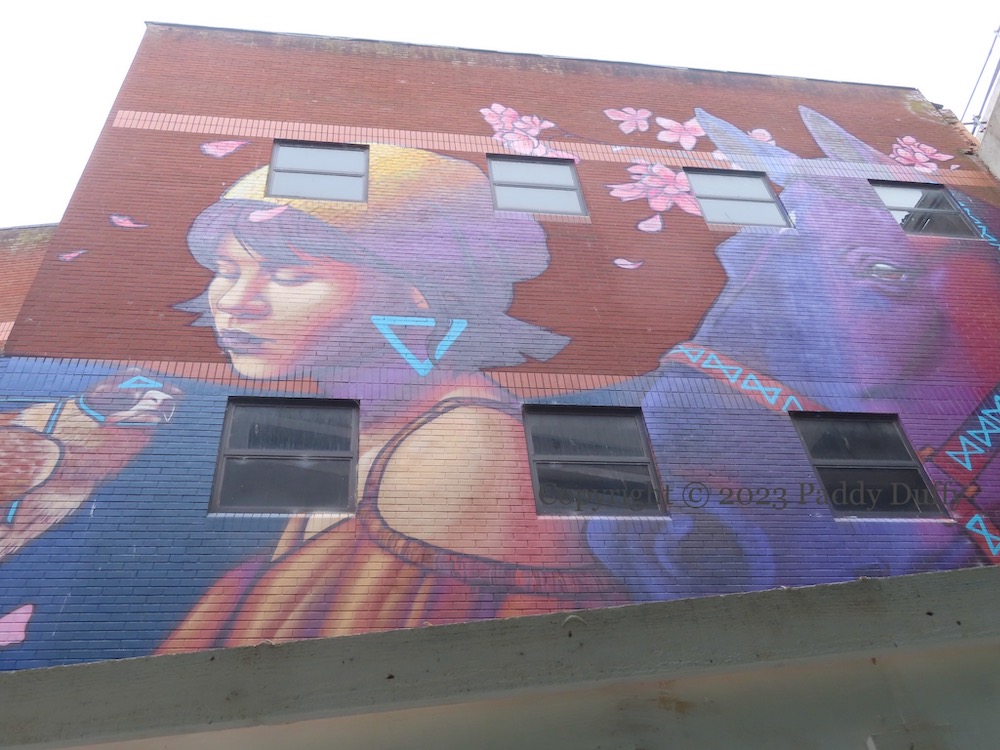
To complement those festival pieces, the mouth of College Court has been given a make-over, with work by Peachzz (ig) (above) and lettering by Woskerski (ig) that both draw on the street’s association with printing. If you know who did the “bookbinding” piece, please get in touch.
Previously on either side of College Court there were two pieces by Friz: Fox and Hare.
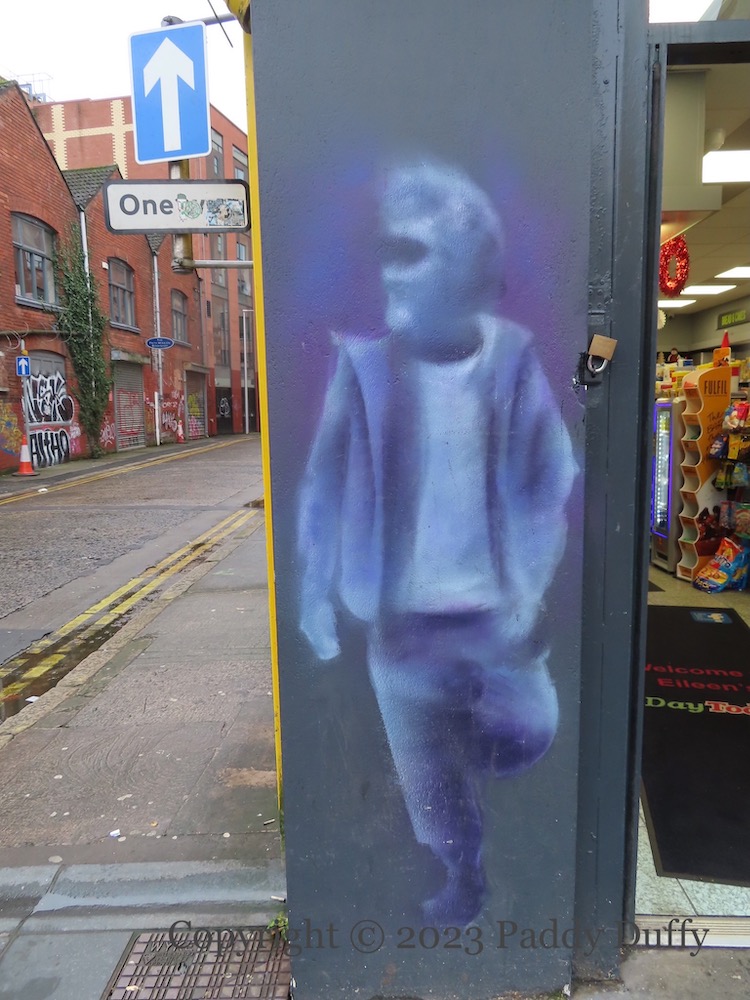
The bonus image, of a man leaning against the newsagent’s wall, is on the corner with Castle Street.
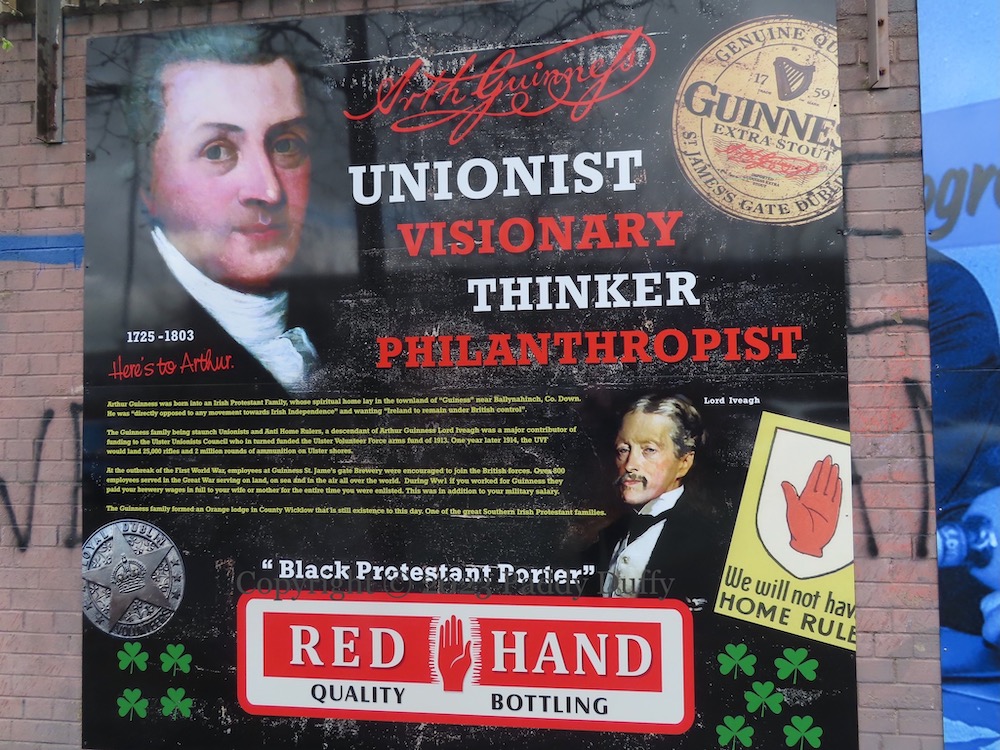
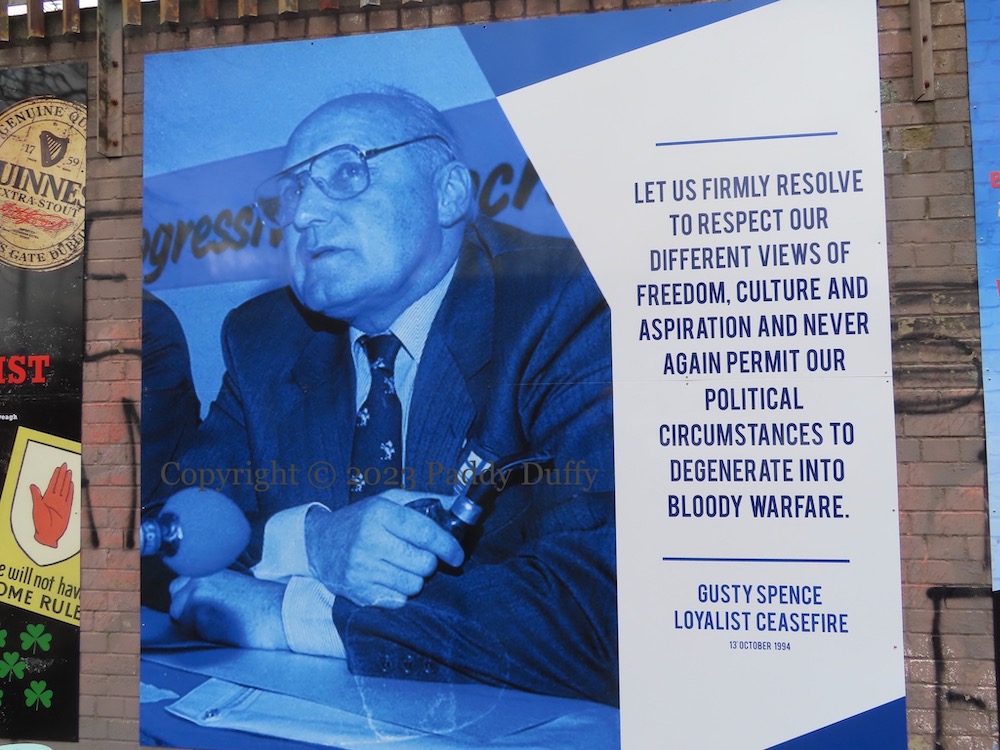
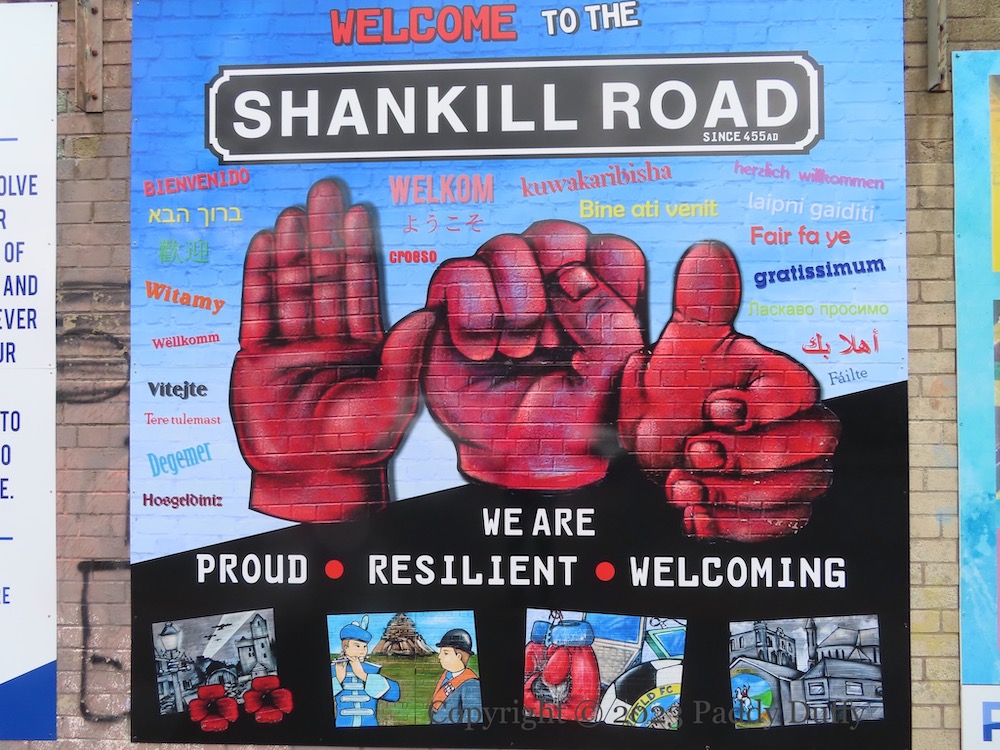
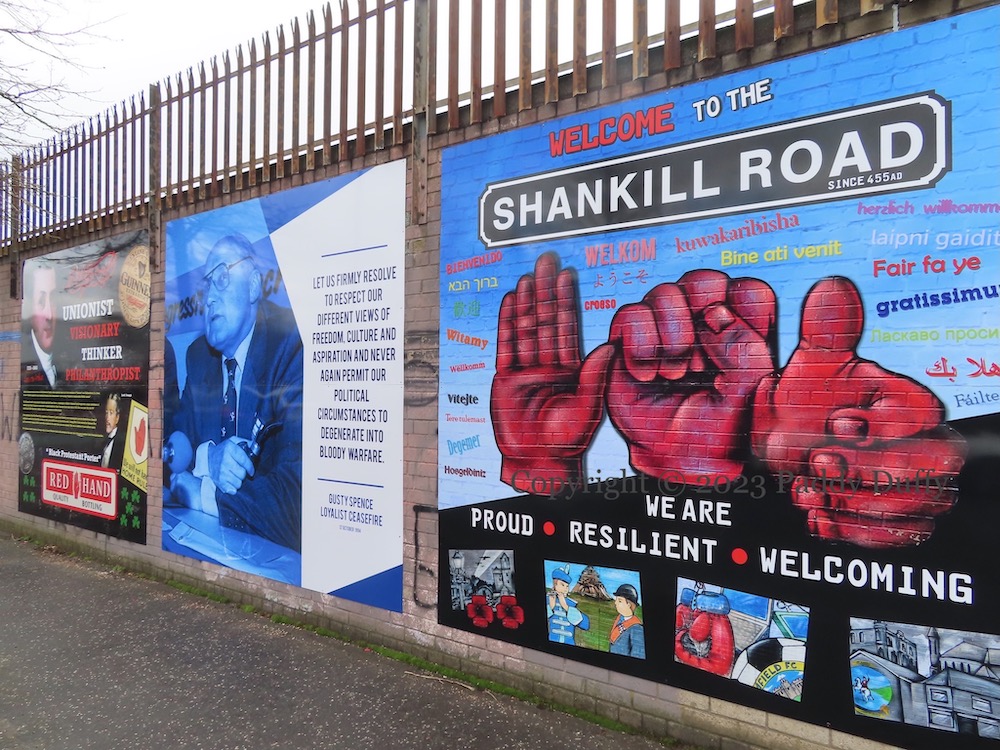
Here are three new pieces above the security gates on Northumberland Street, coving over the “Deserted! Well, We Can Stand Alone” graffiti in the last remaining spot on the wall without a mural. From left to right:
Arthur Guinness: “Black Protestant Porter” as a description of Guinness stems from Arthur Guinness’s opposition to the 1798 rebellion (Indo). The Union Star (newspaper in Belfast – A Planet Of Light And Heat) called Guinness a spy and advised that “United Irishmen will be cautious of dealing with any publican who sells his drink.” (An Phoblacht).
Gusty Spence, a former commander of the UVF, read out the ceasefire statement of the “Combined Loyalist Military Command” (UVF, RHC, and UDA): “Let us firmly resolve to respect our different views of freedom, culture and aspiration and never again permit our political circumstances to degenerate into bloody warfare – Gusty Spence, loyalist ceasefire [statement in full], 13 October, 1994.”
“Welcome To The Shankill Road – we are proud, resilient, welcoming”: The original ‘three hands’ was on Northumberland Street, just above this spot – see Proud, Defiant, Welcoming – which was then reproduced in reduced form in Gardiner Street – see Welcome To The Shankill Road.
This is the most conciliatory statement ever made by loyalism and the decision to put it on Northumberland Street, especially in the context of the internationally famous and associated-with-Ireland Guinness and the “welcome” mural, suggests that the trio is directed at tourists rather than locals.
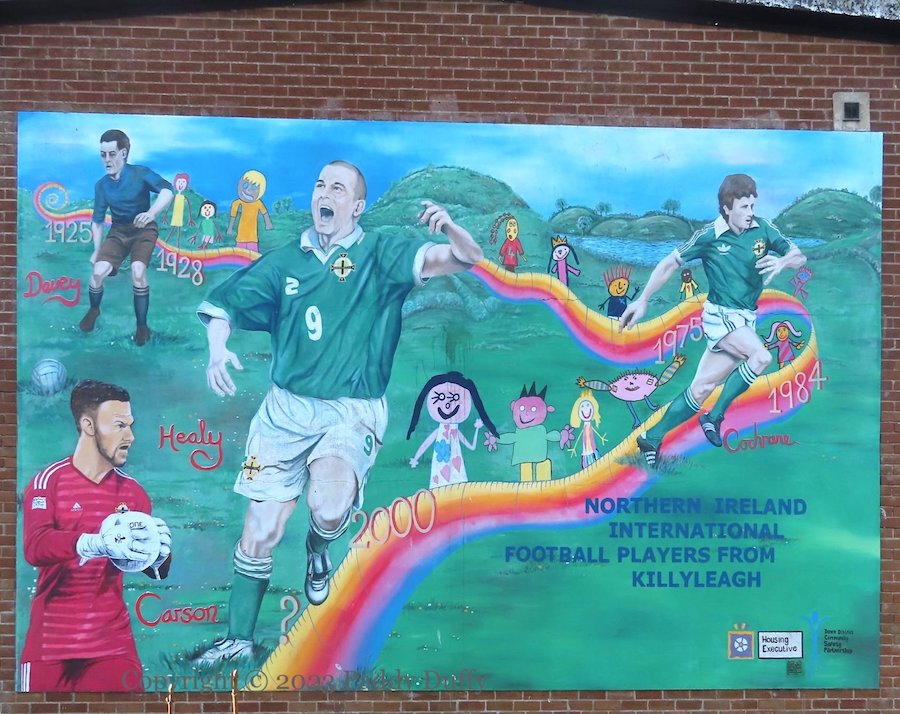
When this mural of Northern Ireland players from Killyleagh was originally painted in 2006 it featured only three players:
– Hugh Davey, from Shrigley, five caps for “Ireland” (that is, for the IFA team) from “1925-1928” (NI Football)
– Terry Cochrane, 26 caps for Nothern Ireland from “1975-1984”; he played in the ’82 World Cup qualifiers but was injured for the tournament itself (NI Football)
A space and a question-mark were left at the bottom of the rainbow for future stars, in particular for then-seventeen-year-old up-and-comer Trevor Carson (Glasgow Times) who indeed went on to win his first (senior) cap in 2018 and currently has eight in total. He was added to the mural in 2021 (tw).
Braeside Gardens/Frederick Street, Killyleagh. Carson’s mother lives in the estate (Sunderland Echo).
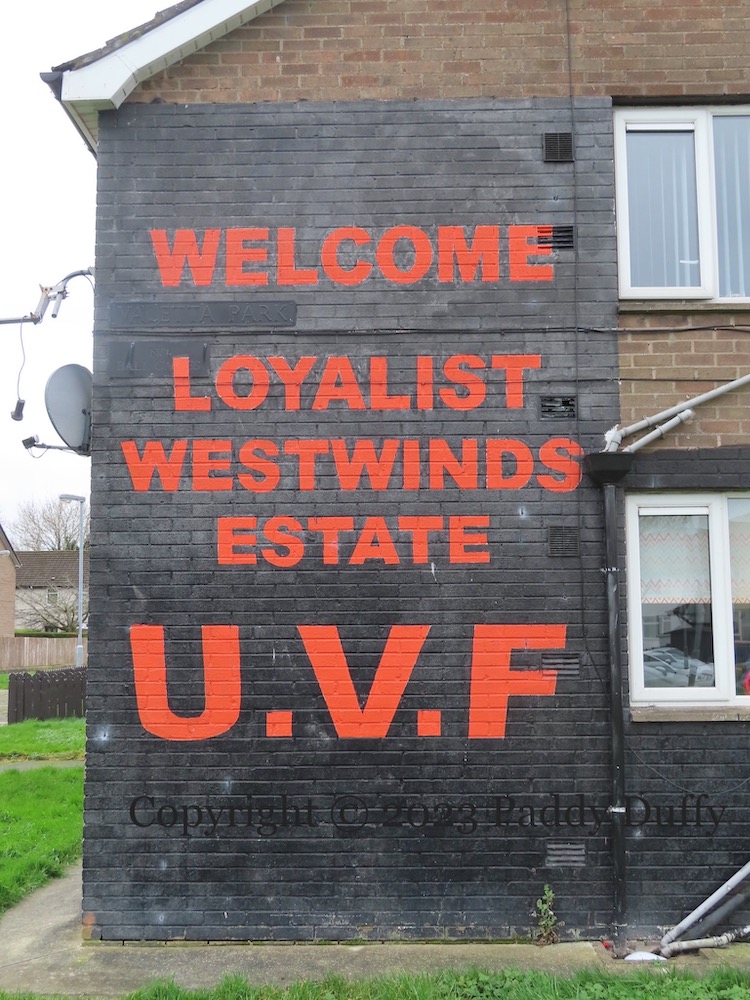
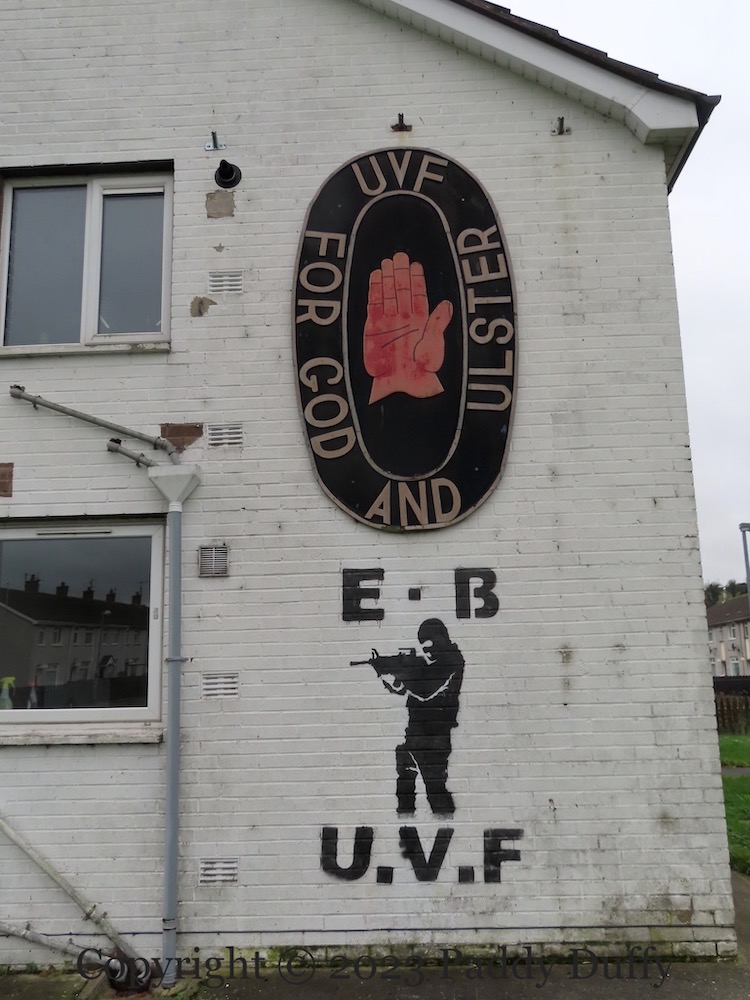
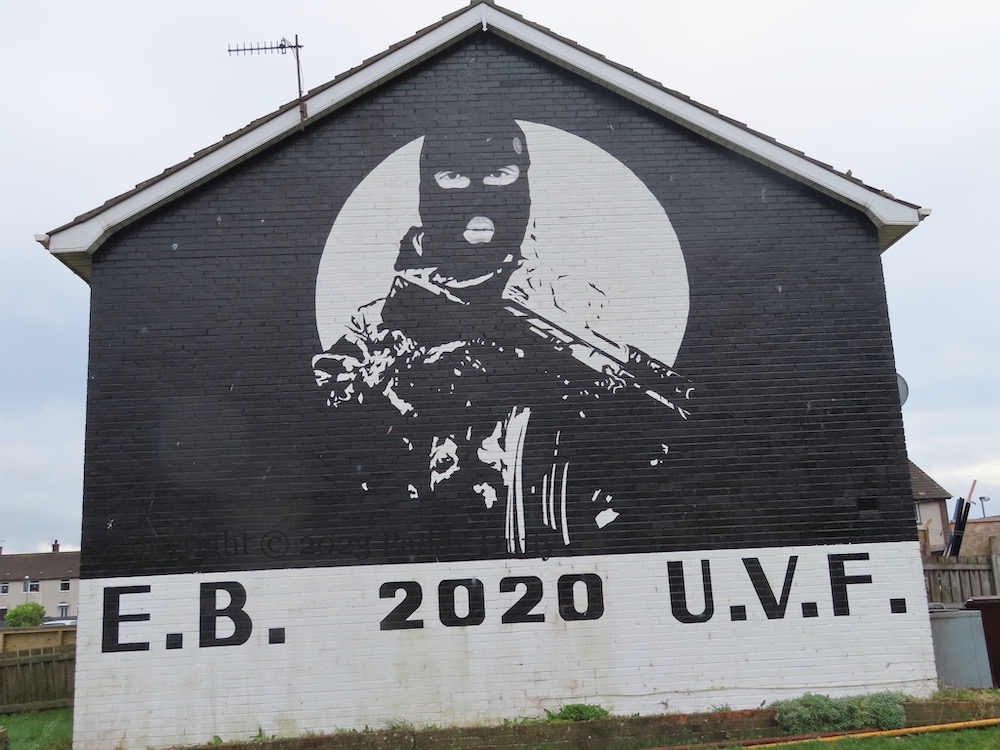
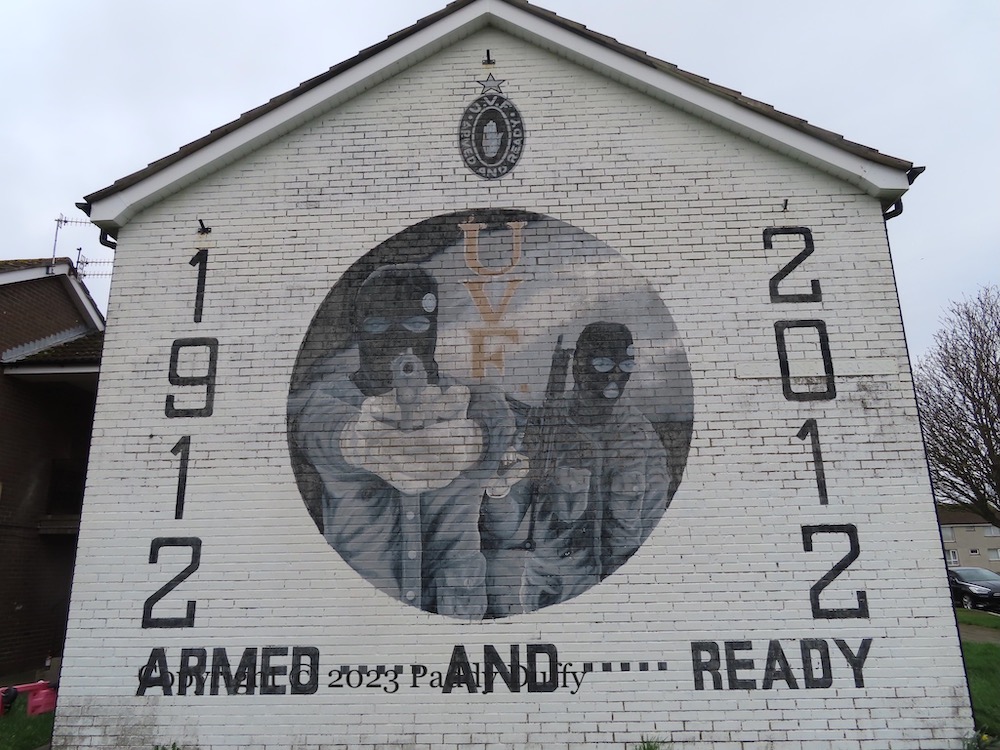
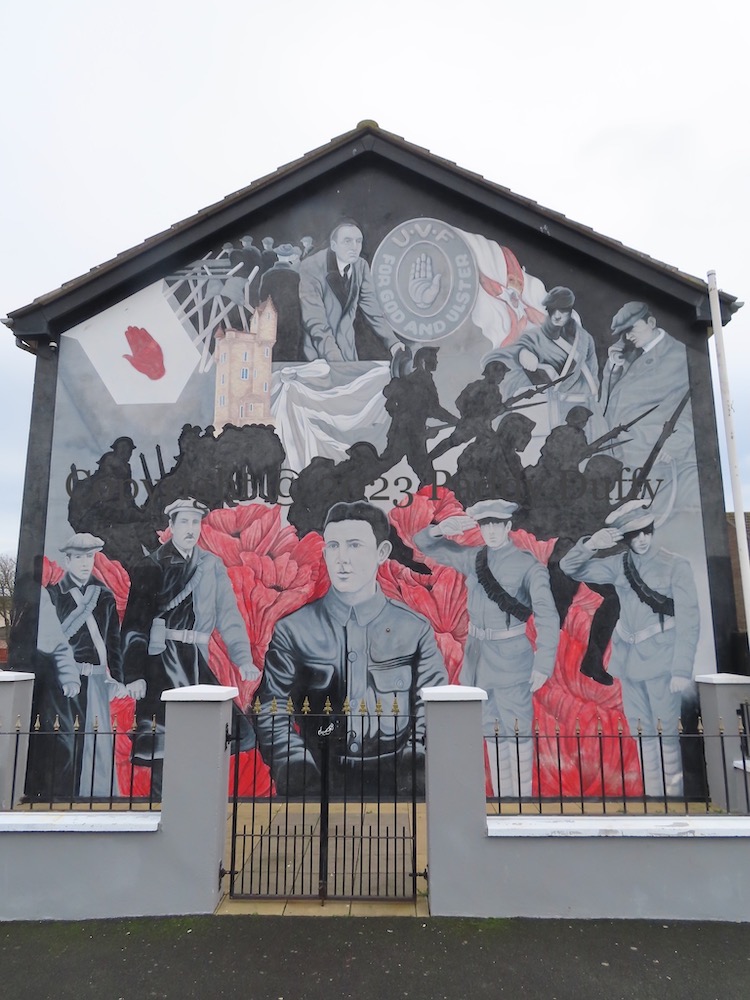
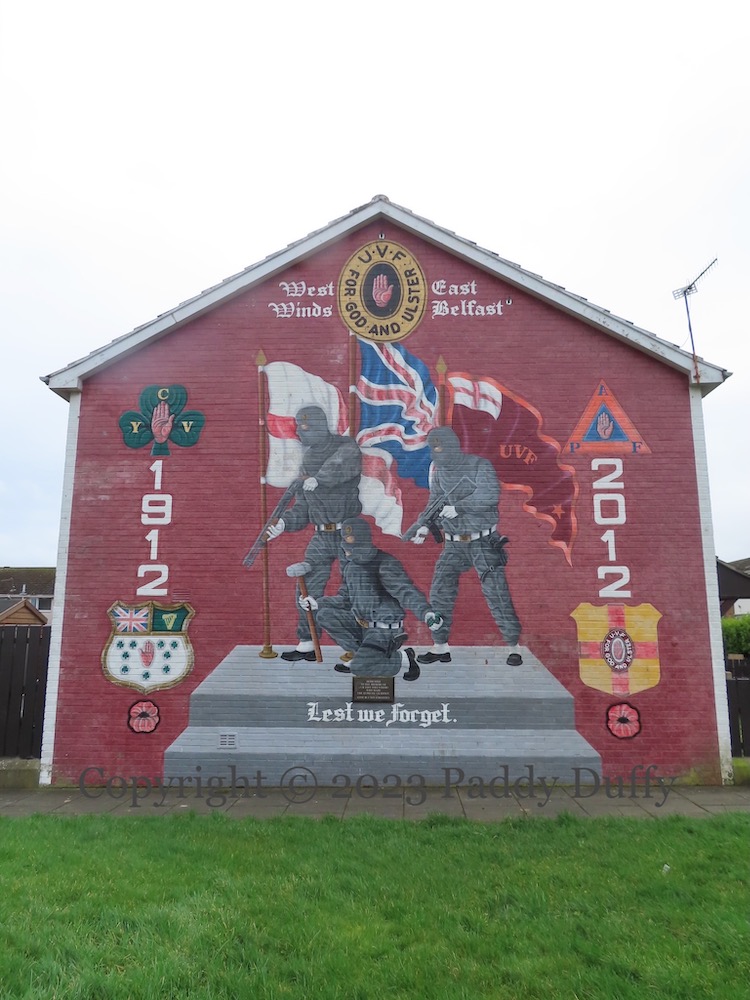
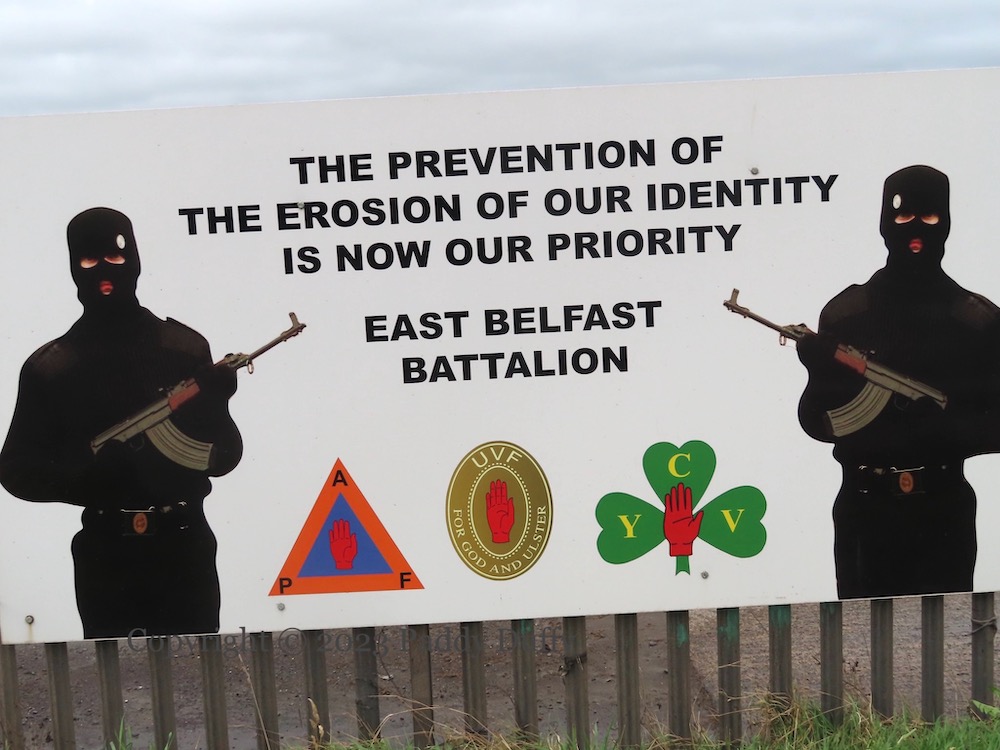
Here is a gallery of UVF stencils and boards in the Westwinds estate. Despite being in Newtownards, the UVF here is allied with the East Belfast brigade, rather than the North Down brigade – see Belfast Live for background.
Jon “Ugg” Clifford died in 2011, having founded Tristar Boys FC (web) in 1974. Bull Park in Creggan has been renamed in his honour and this portrait on boards has been mounted next to the park.
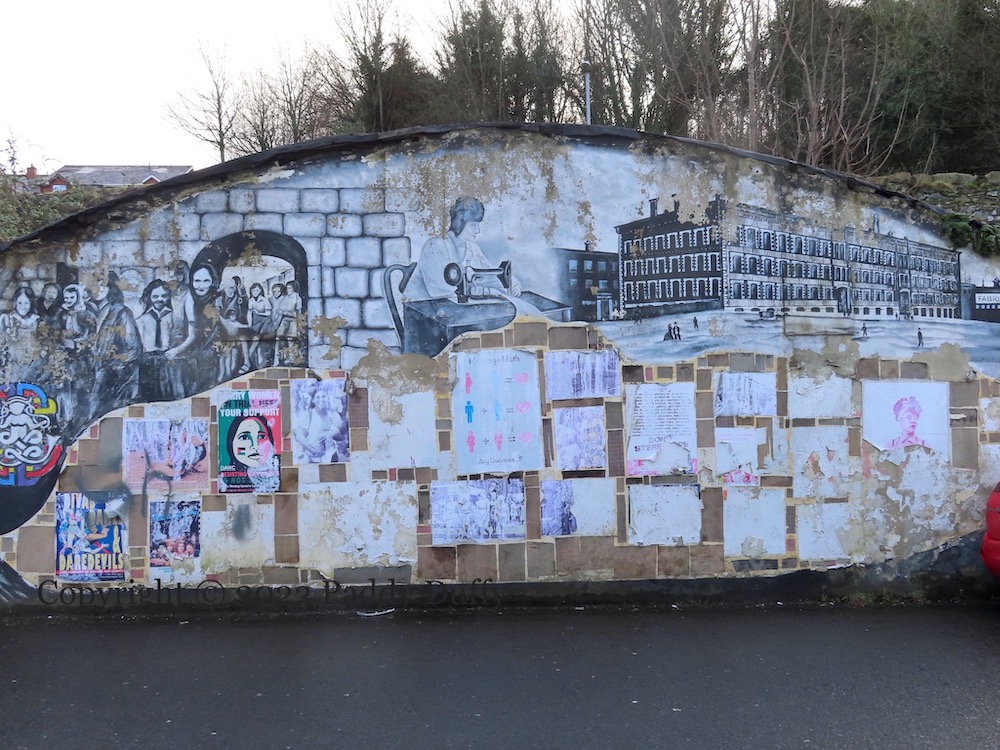
This piece was originally launched in 2014 and is now much the worse for wear. It celebrates the role of women in the cultural and economic life of Derry.
Castle Arcade is so-called because it is the site of both the original castle of Belfast, built by the Normans in the late 12th century and then rebuilt by Arthur Chichester in 1611. Chichester’s castle had “spacious gardens which extended from the river along to Cromac Woods and near Stranmillis” with “orchards, bowling greens and cherry gardens … fish ponds,” for “hunting, hawking, and other sports”. It was destroyed by fire in 1708 after which the area became commercialised as a market (ArchiSeek | Mary Lowry | BBC | Belfast Entries).


 Paddy Duffy Collection