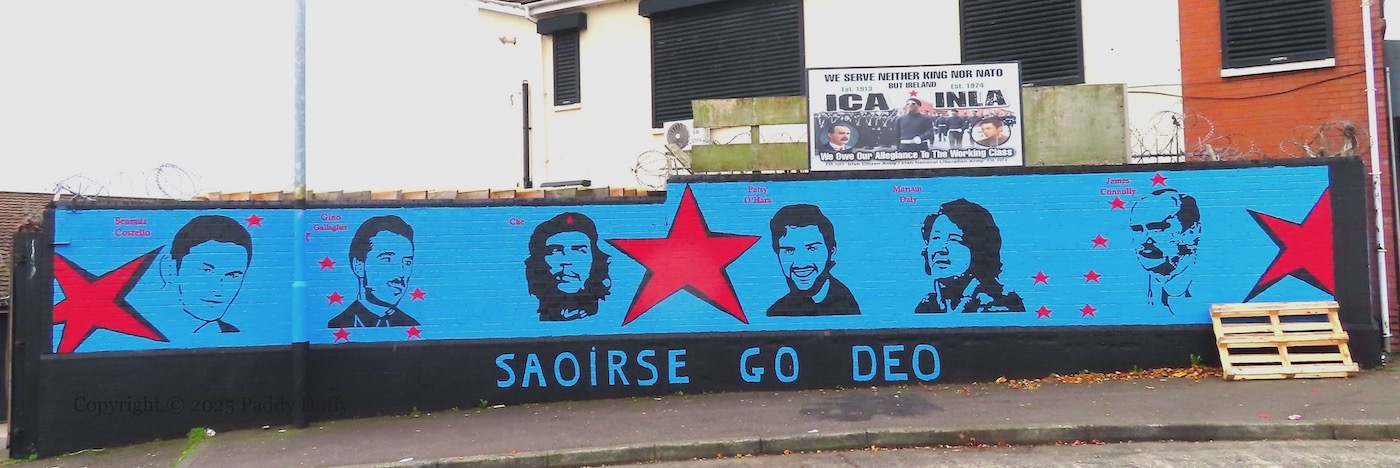
Jim McCabe, “life-long campaigner for truth and justice” after his wife Norah was killed by a plastic bullet in 1981, returns to the “International Wall” (Visual History) on Divis Street. The original mural – from a few months after his death in January 2023 – was replaced by A Window To A Free Country, one of the Palestinian-inspired murals. This new version replaces The Land Is Ours.
“In memory of all the innocent victims murdered and seriously injured by British Crown forces.”
The image above is from August 2nd; the images below are from July.
“Óglach Kevin Hannaway, Irish Republican Army, hooded man. Unbowed & unbroken. Ar dheıs Dé go raıbh a anam.”
Kevin Hannaway died in January (2025), aged 77. In 1971 he was interned (Belfast Media) and subjected, along with thirteen others, to the “five techniques” – deprivation of food/drink and of sleep, subjection to noise, prolonged stress positions, and hooding (WP) – as well as being beaten and dropped out of a helicopter (Irish Times). The ‘five techniques’ were found to constitute torture in 2021 (RTÉ) and the PSNI apologised to the victims in 2023 (BBC | Irish Legal News).
Hannaway remained a republican throughout his life and was anti-Agreement in recent years (BBC). The board in Hannaway’s honour was launched on Sunday July 13th (Fb video). The panels of the board were siezed by the PSNI during a drug raid on a home in St James’s on the 11th but returned the next day (BelTel).
“IRPWA [web]. Republican prisoners still exist! Unfinished revolution. Unbowed, unbroken.”
Hugo Street, west Belfast. For a close-up of the Pearse Jordan plaque on the left, see the Peter Moloney Collection.
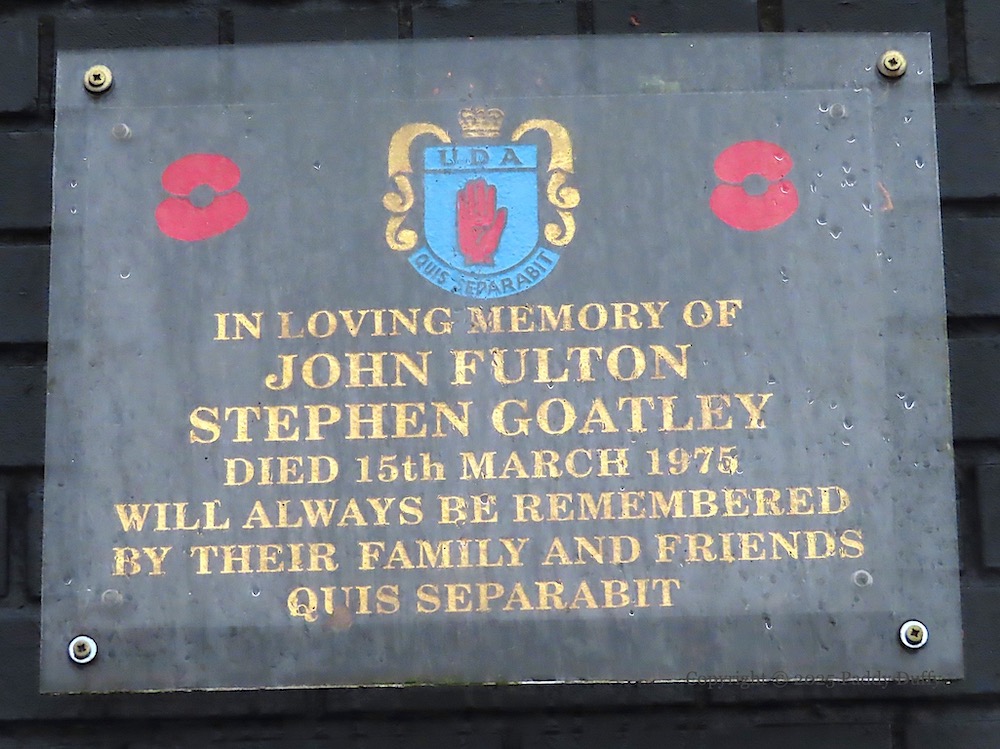
Six memorial plaques to members of the UVF’s 1st battalion (West Belfast), D company (Ballysillan) have been re-instated and two new one added alongside the 100 Years Of Conflict boards at Carr’s Glen. The plaques to Bingham, Phillips, McEvoy, the “officers and volunteers”, Stewart, and Taylor were on the old UVF mural on this wall (see the Peter Moloney Collection); the two new ones are to Kenny Howie and to Scottish supporters.
Left: “Lt Col John Dowey Bingham killed by the enemies of Ulster 14th September 1986. Remembered by officers and members of the 1st Batt D Coy Ballysillan. Lest we forget” [(WP)] “In memory of Major Patrick McEvoy. Lest we forget” “In memory of Kenny Howie 21.4.1977 – 8.4.2013. Lest we forget” “In proud memory of the officers and volunteers of D Company 1st Battalion Ulster Volunteer Force. For God and Ulster”.
Right: “In memory of Major Thomas Stewart. Lest we forget” [d. 1996 in a dispute over money (Irish Times | BelTel) “In memory of Martin Chin Taylor. Lest we forget” [d. 2000 killed by the LVF (BBC)] “In proud memory of Volunteer David (Davey) Phillips, taken by cowards Sunday 12th July 1998. Sadly missed by his friends and comrades of ‘D’ Company Ballysillan. Lest we forget” [possibly d. 1998 (BelTel)] “In memory of fallen volunteers 1st Battalion D. Company Ulster Volunteer Force Scotland”
“On the 9th of July 1972, during the IRA ceasefire, local families began moving into their new homes in Lenadoon but were obstructed by British Occupation Forces who opened fire with rubber bullets and, using a “Sixer” Saracen Armoured Personnel Carrier, rammed a McQuillan’s Quarry lorry carrying furniture and belongings as rioting took place across the district. Seamus Twomey, then the IRA Belfast Brigade OC, ended the ceasefire, ordering local IRA units to engage British Forces. Raging gun battles overwhelmed the British for several days, as the IRA liberated most of Lenadoon.”
The captions to the photographs along the top read (l-r): “British Forces fire projectiles at families moving into their new homes”, “A “Sixer” rams a McQuillan lorry, forcing it off the road”, “Seamus Twomey, IRA Belfast Brigade OC, ordered local units to engage the British”, “An IRA Volunteer takes up position in a nearby street”, “An armed IRA volunteer in Lenadoon in the 1970s, Carrigart flats”, “Local families evacuate Lenadoon as thousands march to Casement Park”, “Local homes bare [bear] the scars of war”.
For background, see this 24 minute Thames TV report (on youtube) about the dispute over houses in Lenadoon; RTÉ also has footage (one | two) of the evacuation.
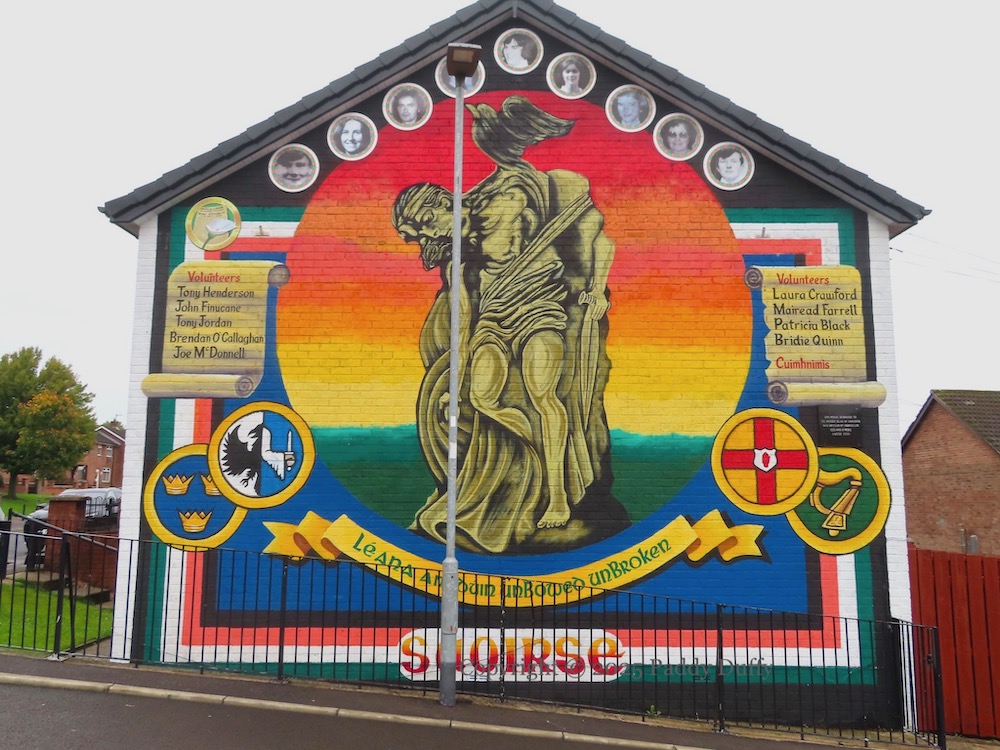
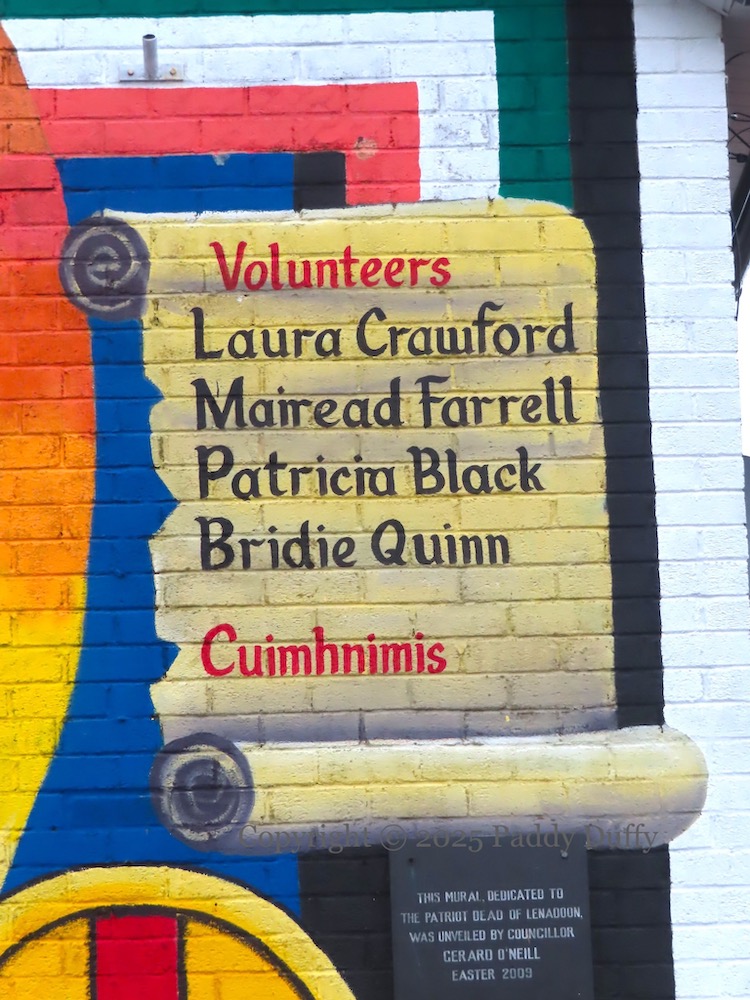
“In proud & loving memory of all those who contributed to the struggle for Irish freedom – Léana An Dúın – Beıdh sıad ınár gcuımhne choíche”
Lenadoon Avenue, west Belfast, replacing the 1995 Gorta Mór mural. Launched Sunday July 12th.
“Loyalist Village, south Belfast.” UVF markings in the Village continue to proliferate with the recently-added board shown above (from the top of Tavanagh Street) alongside a slew of other boards, some of which are included below.
The “Village team” is not Linfield FC but the UVF (the phrase was also used by the Village UDA); “VTOT” (standing for “Village team on tour”) has previously been used as graffiti – see Welcome To Hell!!!
The purple hoarding below gives “1913” as a creation-date for the battalion. The Ulster Unionist Council organised the signing of the Covenant in September, 1912, and in January 1913 voted to bring together the militias that had been formed in various places into an Ulster Volunteer Force. One of these was a South Belfast battalion that had formed in 1912 (History Ireland). Hence, both “1912” and “1913” are given as dates for the creation of the battalion. When the Volunteers were integrated into the Ulster Division for the Great War, the South Belfast Volunteers joined the 10th battalion of the Royal Irish Rifles.
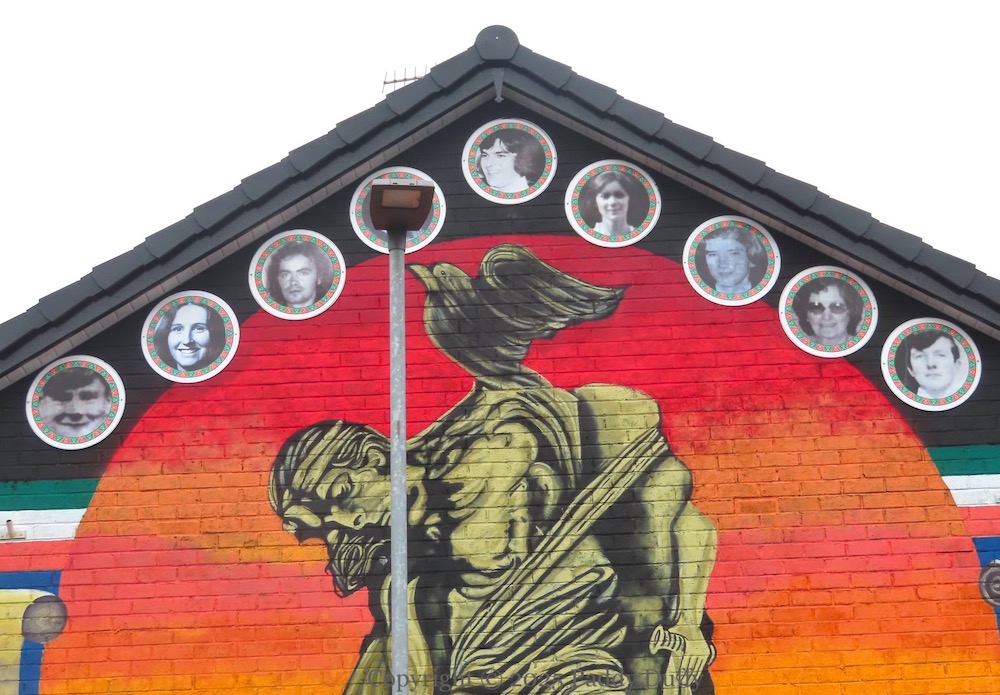
“Bullets do not only travel distance, but also through time.” Five people – Jack Duffin, Willie McManus, Christy Doherty, Peter Magee, and James Kennedy – were shot dead by the UDA in Graham’s betting parlour in February 1992. Their portraits, along with portraits of five others who are “injured, now deceased” – Vincent Armstrong, Jimmy Doran, Mark Hazard, Joe McNally, and Jim McManus – have been (permanently) added to the memorial in Hatfield Street.
The plaque on the far left is to Charles Joseph McGrillen, shot by the UDA/UFF in 1988 at his work in Dunne’s on the Annadale embankment (Sutton). (For a close-up, see the Seosamh Mac Coılle collection.)
This notice is on the outside of the Belvoir Bar in east Belfast: “Property of east Belfast Ulster Volunteer Force – Not for sale” alongside a plaque to “fallen comrades” Robert Bennett, Roy Walker, Joseph Long, James Cordner, and Robert Seymour. It seems that the bar has been shuttered since 2011 (Belfast Telegraph | Irish Times).
The UVF mural overlooking the entrance to Mount Vernon has been repainted after Storm Darragh back in December (2024) knocked down part of the wall it was painted on (see Taken By Storm) and the remainder of the wall was subsequently knocked down (see Prepared For Space, Ready For Wall).
There were local voices against the repainting of the mural (Sunday World) but after the wall (which is owned by the Housing Executive) was rebuilt, scaffolding went up at the end of March (BelTel) and painting began in June.
The mural will be officially launched at the Twelfth celebrations. The repainting has been criticised by the father of one UVF victim (BelTel). One (very) small mercy is that neither of the gunmen – from the North Belfast UVF – is directly confronting the viewer (including the drivers coming off the M2 at Fortwilliam.
Images of the completed mural are from June 26th; the in-progress images are as dated below.
“Mr George Walker, Minister of Dungannon and Gouernour of London Derrie in Ireland when besieged in 1689.” Walker evacuated from Dungannon after Lundy’s troops pulled out and became joint governor of Derry after Lundy’s authority collapsed, first with Henry Baker and later with John Mitchelburne.
Walker put himself at the centre of his own “True Account Of The Siege Of London-Derry” (which can be read at archive.org) and drew criticism for minimising the role of Presbyterians (Walker was Anglican/CoI).
After the siege, Walker went on a victory tour of Scotland and England; while in London, he argued against a Derry trial for Lundy, on the ground that Lundy still had support there. He returned to Ireland in time to greet William III in June 1690 when William travelled from Carrickfergus to Belfast (see June 14th, 1690) and he went south with William to the Boyne, where he was shot and killed. (DIB | DIB | WP)
“The Walker Club was formed in 1844 in Londonderry to perpetuate the memory of siege governor, Rev. George Walker, who was a[n] inspirational great clergyman and soldier. He fought with King William at the Battle of the Boyne, where he was killed on 1st July 1690.”
The image of Walker is a line-engraving by John Savage, viewable at Sinclair Genealogy. “Life, truth, victory” is a translation of Londonderry’s Latin motto “Vita, veritas, victoria”.
These new boards are at the Rangers Supporters’ Club (Fb) in Boyne Square/Greenland, Larne.
A few changes have been made to the Sam Rockett mural (compared to the 2023 original): Rockett’s hair has been lightened, the “Prods out” graffiti on the row of burned-out houses has been brightened, a simple “B Company” has replaced the smaller “1st Belfast Brigade, B Company”, and “Murdered by cowards 21.06.79 – 23.08.00” has been added on the left.