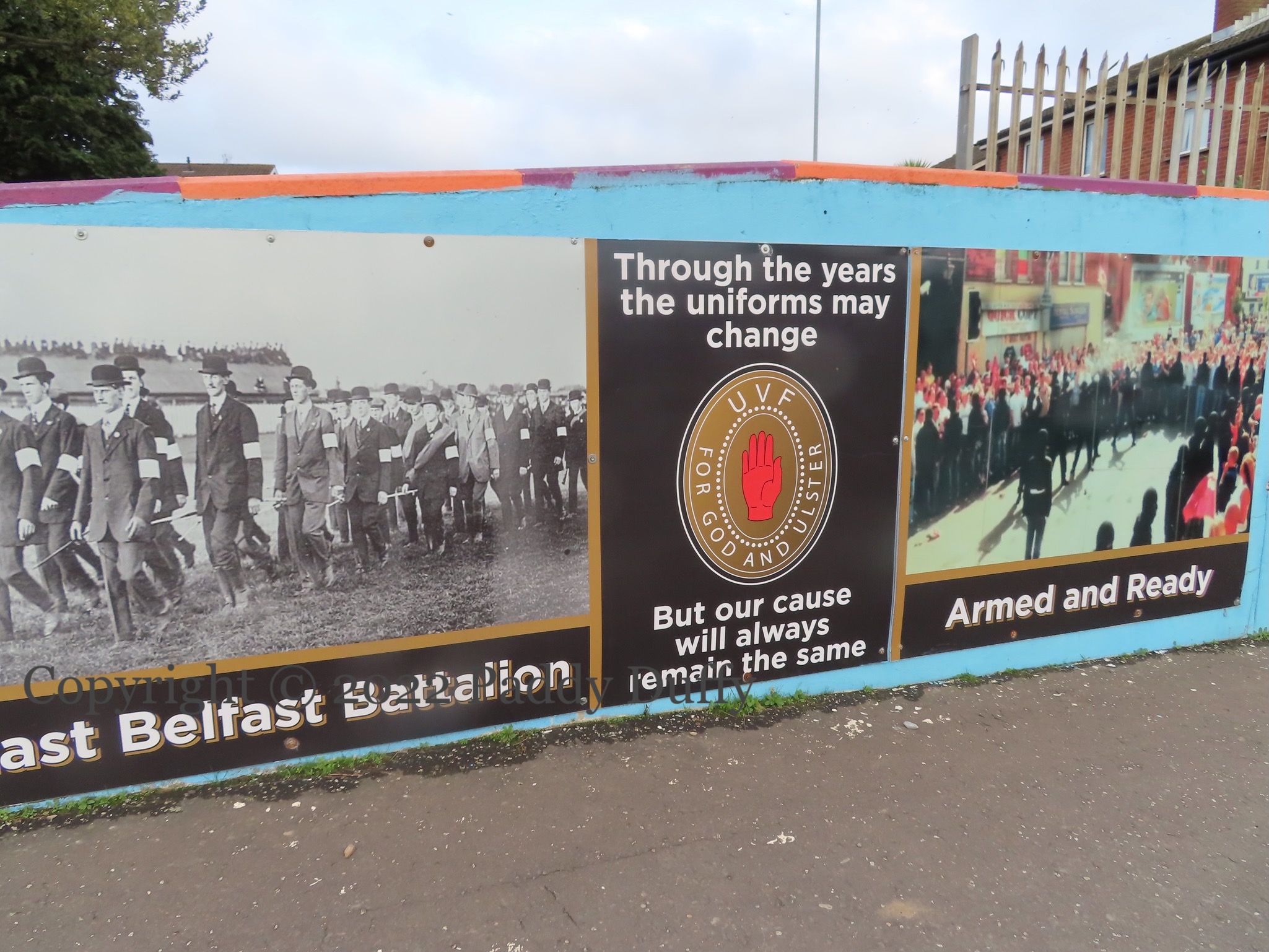
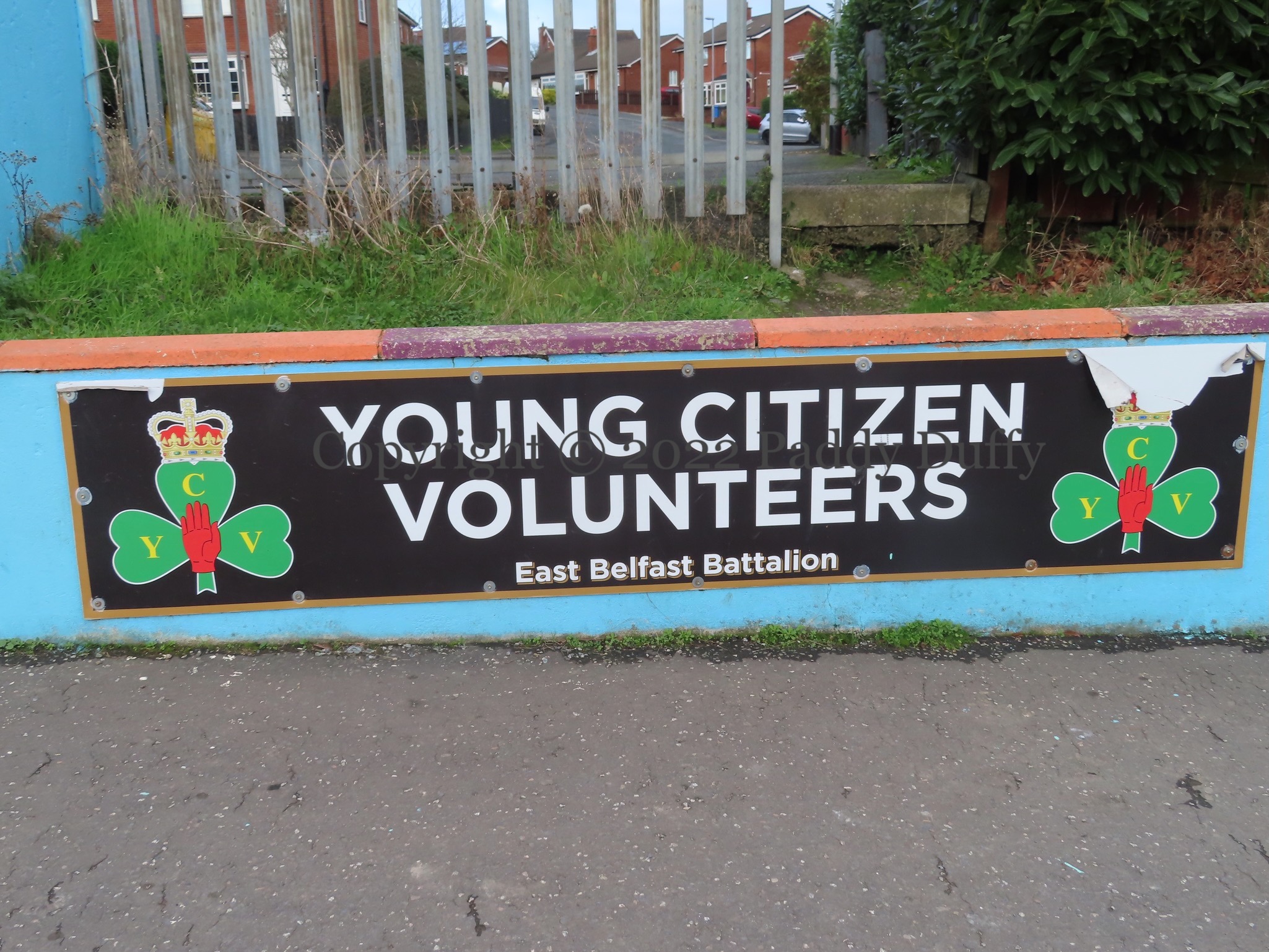
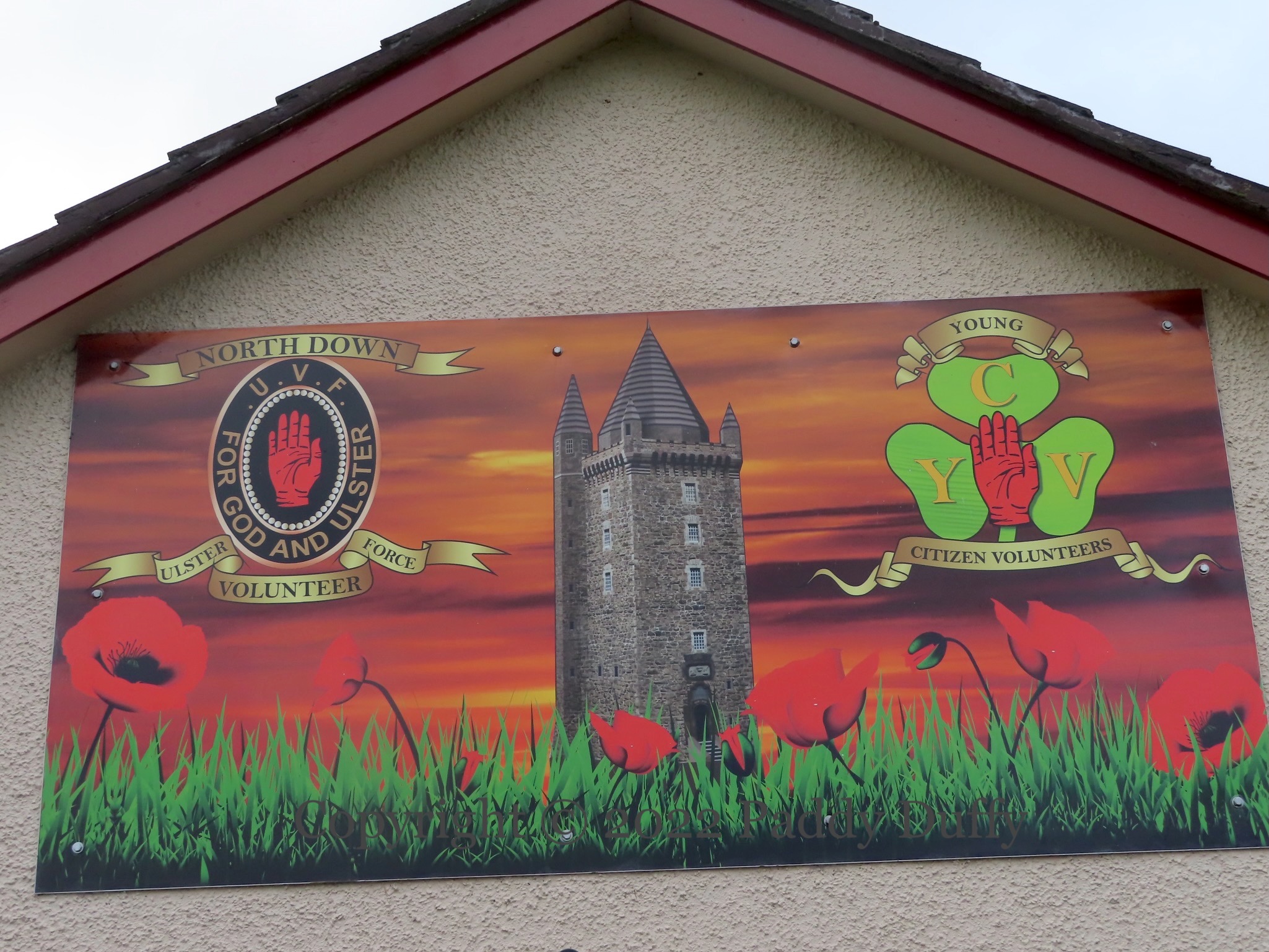
Here is a gallery of UVF boards along Abbot Drive, in Bowtown, Newtownards, mixing North Down with East Belfast brigades (see East East Belfast), and mixing UVF/PAF with the Ulster Volunteers and 36th Division – “Through the years the uniforms may change but our cause will always remain the same”. “The prevention of the erosion of our identity is now our priority.”
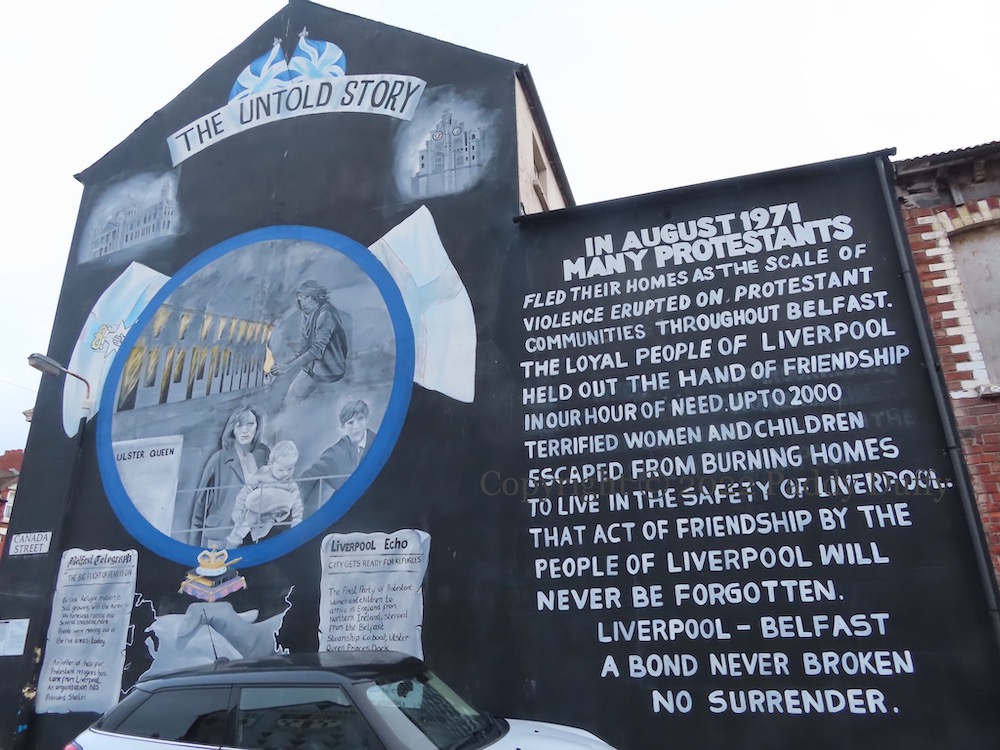
This mural depicts Protestant women and children on-board a steamer, the Ulster Queen, leaving Belfast because of rioting, and headed for Liverpool, where they were to be hosted by local Orange families. On the far left is a laminated letter of thanks to Elsie (Allen) Doyle, one of the organisers in Liverpool.
A very similar mural was in this spot several years ago (though not immediately prior to this one – the wall was blank), featuring three youngsters on the boat, rather than a mother and children. The panel to the right began “In August 1971 many Protestants fled their homes as the IRA launched a bitter sectarian attack on Protestant communities throughout Belfast.” (See M04069.)
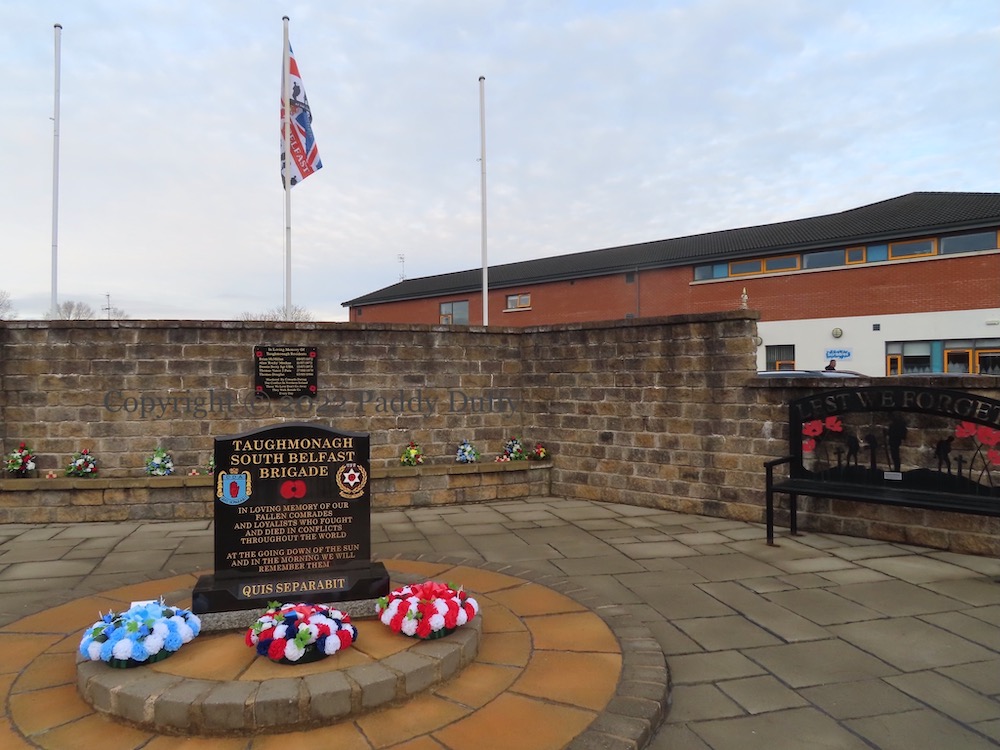
“In loving memory of Taughmonagh residents Brian McMillan, Alan ‘Rocky’ Meehan, Dennis Berrty (Sgt UDA), Thomas Vance (2 Para), Thomas Douglas. Murdered by cowards during the conflict in Northern Ireland. Those we love don’t go away, they walk beside us every day.”
McMillan and Meehan were civilians shot along with TA staff sergeant (and English Catholic) Joseph Flemming on July 9th, 1972.
Dennis Berry was shot by the UVF after leaving the UDA social club in Taughmonagh. According to Lost lives, “Reliable loyalist sources said the shooting was the result of a personal row rather than having any political or organisational basis.” (p. 441)
Thomas Vance died in the IRA’s 1979 ambush of the British Army at Narrow Water Castle, near Warrenpoint (WP), on the same day that Louis Mounbatten was killed. (Republican mural)
Thomas Douglas was shot while walking along the street. His family denied he was a leading loyalist and simply a member of the Orange Order (CAIN | Fb).
This plaque is in the UDA memorial garden in Taughmonagh at the corner of Finbank Gardens & Malfin Drive.
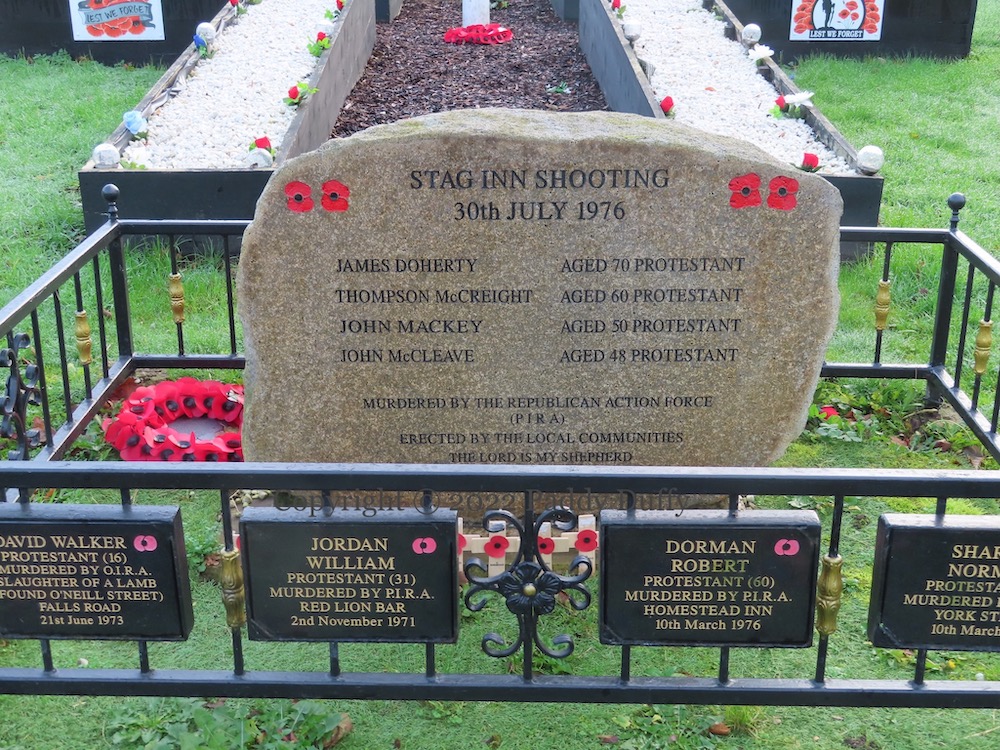
A long series of tit-for-tat shootings of pubs and clubs continued into the summer of 1976, with attacks on the Chlorane (June 5th), Walkers (June 25th), the Ramble (July 2nd), the Whitefort (July 29th), and then, on the 30th, The Stag at Shaws Bridge, Belfast, by the Republican Action Force (PIRA) (Sutton). John McCleave, John McKay, and James “Jimmy” Doherty died on the night of the attack, and Thompson McCreight died of his wounds nine days later. The memorial to them – “erected by the local communities” – is on Milltown Road, next to the Dreamscheme (web) mural.
“Cogús supports the republican prisoners”. Cogús (Fb) is (was?) the prisoners’ welfare arm of the RNU. The board above — using a vintage illustration going back to 1981’s I’ll Wear No Convict’s Uniform — replaced More Blacks, More Gays, More Irish on Pantridge Road, Dunmurry, joining the “Join RNU” and mental health boards shown below.
Above, a “Welcome to loyalist Seymour Hill” board with flags and poppies, and a (2021) tarp “Seymour Hill says no to the Irish Sea border”.
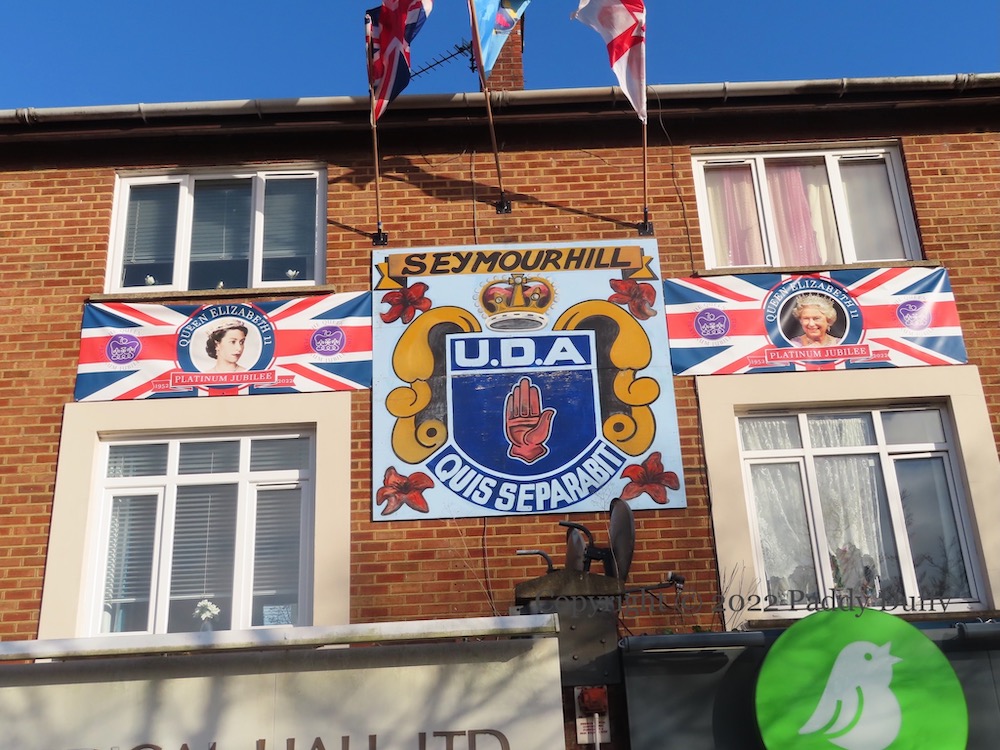
Below, Queen Elizabeth II 70th/platinum Jubilee banners remain on either side of the UDA board above the Seymour Hill shops, even after her death in September (previously there were two NI Centenary banners). There are orange lilies at the four corners of the UDA emblem.
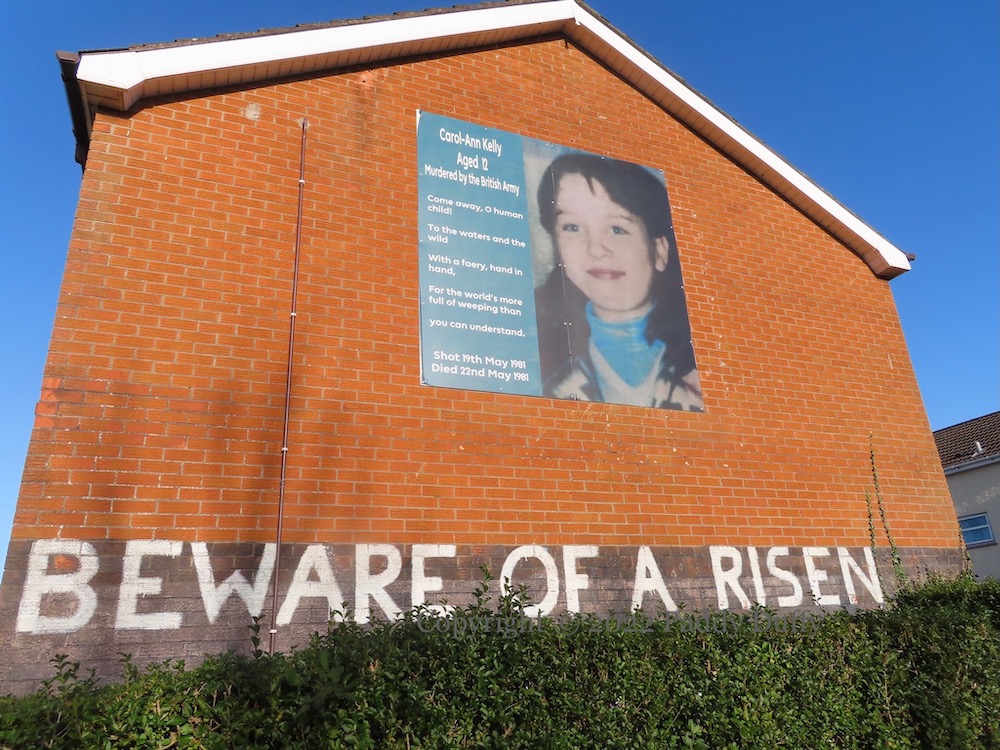
“Beware of a risen people” (or “beware the risen people”) comes from Patrick Pearse’s The Rebel: “And I say to my people’s masters: Beware/Beware of the thing that is coming, beware of the risen people/Who shall take what ye would not give.” The slogan dates back to at least 1987 on this wall (see M00511 and M00600 from 1998).
Carol Ann Kelly, aged 12, was hit by a plastic bullet fired by the Royal Fusiliers on May 19th, 1981, in Twinbrook, and died on the 22nd – one of seven people to die in the summer of 1981 (They Kill Children).
There was previously a mural to Carol Ann in Twinbrook: M01630.
Nell (l) and Elizabeth (r) Corr from 107 Ormeau Road joined Cumann Na mBan in 1915 and travelled to Dublin in 1916 (with Nora Connolly, Ina Connolly, Bridie Farrell, Lizie Allen, Kathleen Murphy, and another girl called O’Neill (Treason Felony)) to serve as messengers in the preparations for April’s Easter Rising. They were in Liberty Hall (shown in the detail above) on the morning of the rising before heading north. Brother George, on the other hand, died at the Somme as a soldier in the Australian infantry, while another brother, Charles, fought in WWI with the Canadian Expeditionary Force. They are pictured on the left-hand side of the mural. (BBC | BBC video)
The mural in Cluan Place goes back to (at least) 2002. It used to include the words “5 people shot, houses burned, houses bombed” but these have been painted out in this repainted version.
Photographs of a dozen atrocities are included on the right of this Derwent Street mural, ranging in time from the 1970 gun-battle around the nearby St Matthew’s church in 1970, in which Jimmy McCurrie and Bobby Neill were killed, to the October 1993 IRA bombing of Frizzell’s fish shop on the Shankill Road, in which Leanne Murray (shown on the left) was one of ten people, two of them children, to die. The others incidents portrayed are Bloody Friday, Darkley, Coleraine, Abercorn, Balmoral, Claudy, La Mon, Kingsmill, and Teebane.
This new computer-generated mural replaces the painted East Belfast Remembers, which had peeled away to a great extent.
“The slaughter of the innocent by the blood soaked hands of Sinn Fein/IRA never to be forgotten. The dead cannot cry out for justice. It is a duty of the living to do so for them. Is this the equality Sinn Fein/IRA asks for? No economic targets, no legitimate targets, no enquiries, no truth, no justice. Hold dear the memory of all the innocents murdered in our country in support of the Sinn Fein electorate. This memory extends to those not mentioned here who were murdered going about their daily lives at work, at prayer and in remembrance. Nothing was sacred in the futile question for a united Ireland.”