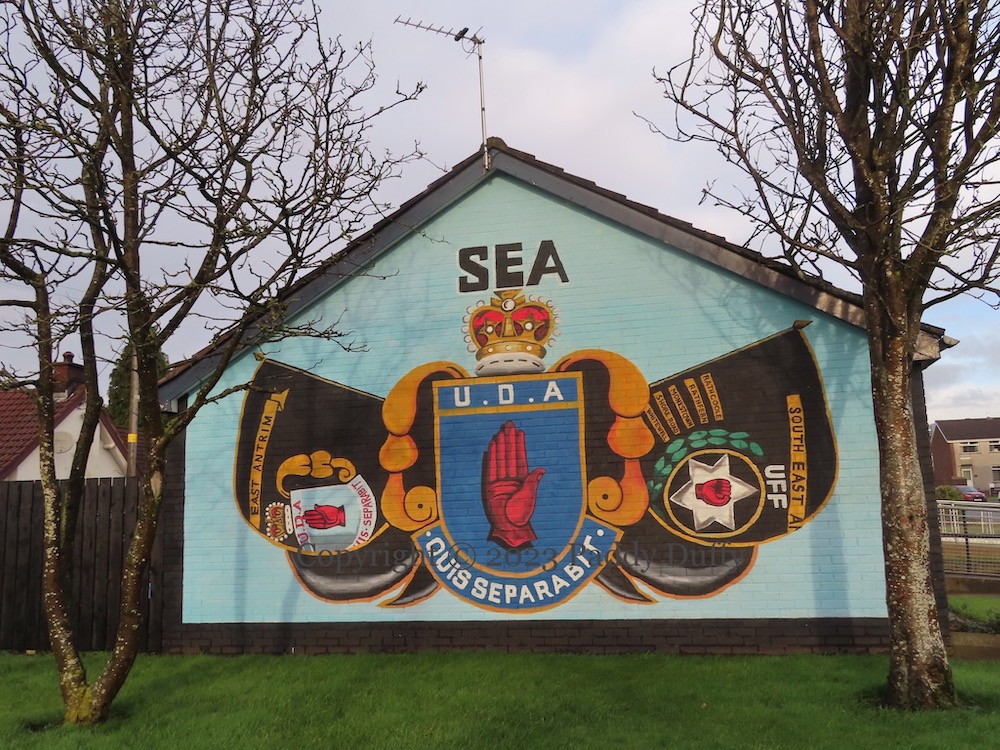
An explicitly UDA mural returns to the Grange estate (Ballyclare); the previous Young Guns board fell down. Two men were imprisoned in October (2022) (Belfast Live) and November (4NI), the former from the estate, in connection with investigations into the Ballyclare UDA in February, 2021. Two others were arrested in Larne and Ballyclare in September (BelTel).
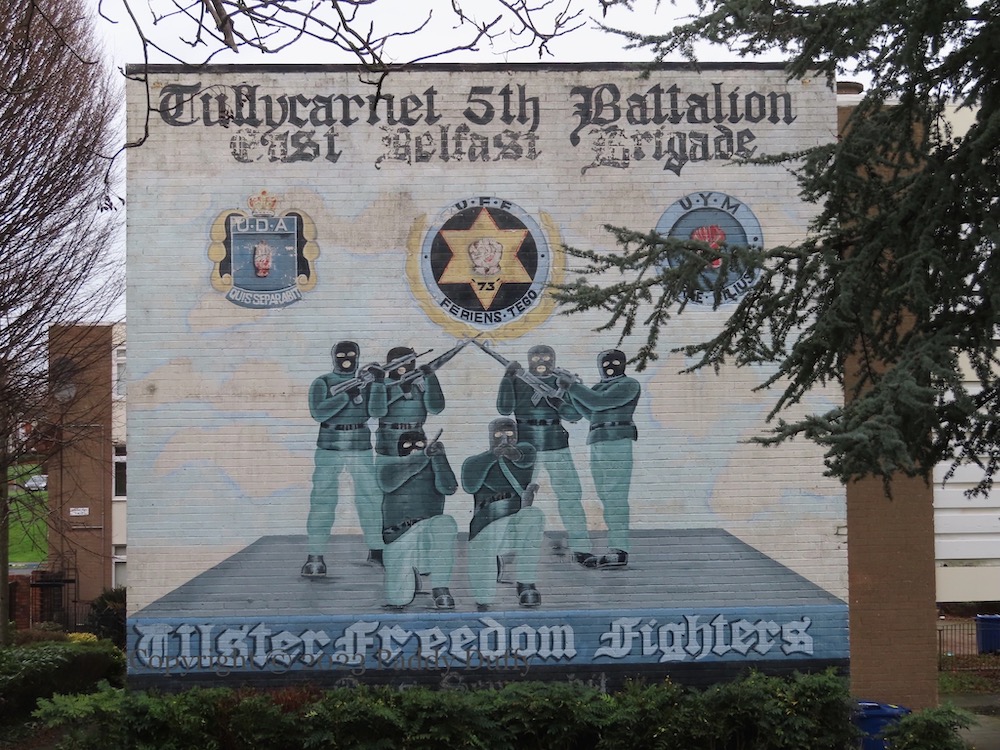
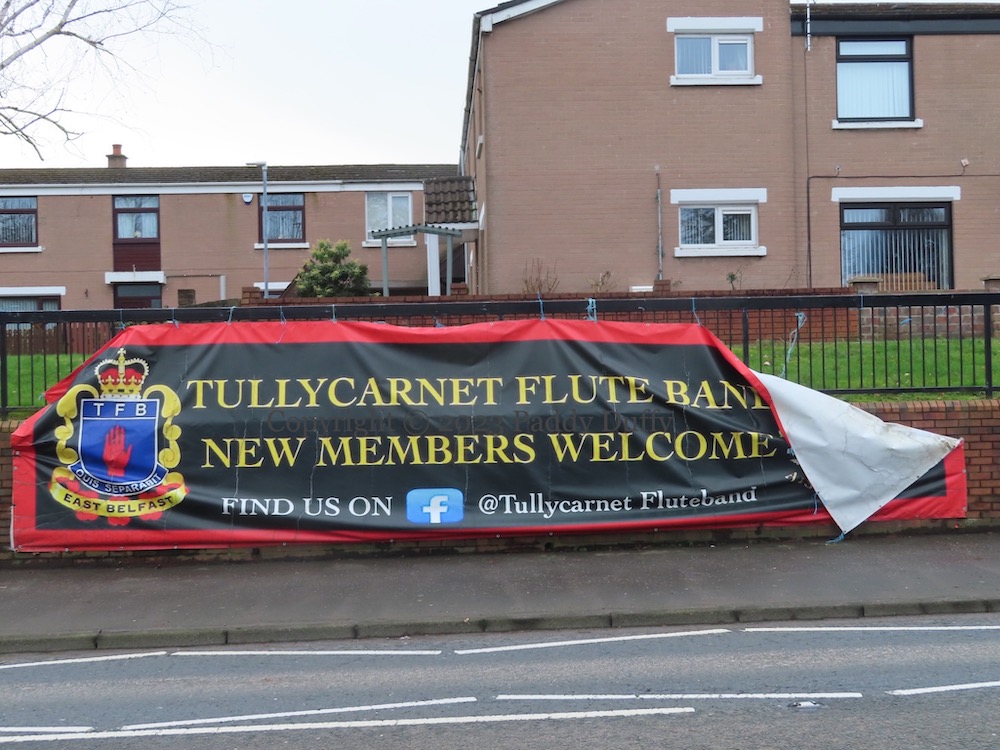
UFF, UDA, and UYM mural in Tullycarnet: Tullycarnet 5th Battalion, East Belfast Brigade. The mural dates back to 2006 at least. Also included (below) is a large Tullycarnet flute band tarp on the railings.
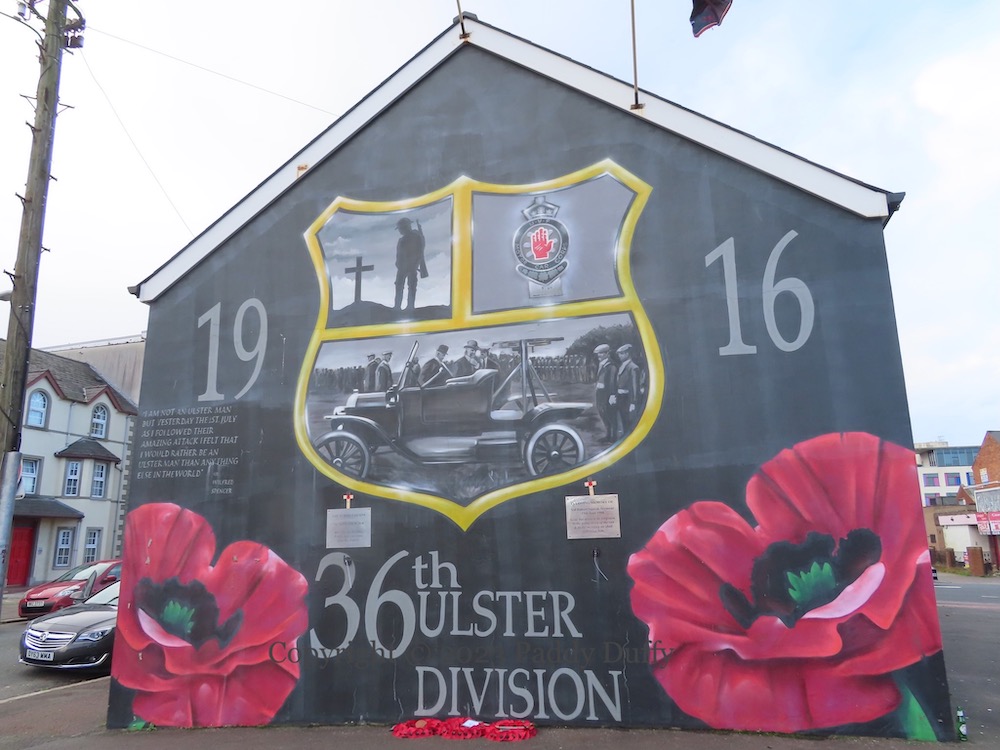
The first time that the horseless carriage was used in a military operation was the Ulster Volunteers’ “Larne Gunrunning” of April 1914. By this time, there are thought to have been 350 vehicles in the Corps (Angelsey). It’s not clear whether the cars were later used by the 36th (Ulster) Division – please comment/get in touch if you can shed light on this. (For Spencer’s quote on the left, see I am not an Ulsterman.) The plaque is to (modern) UVF volunteer ‘Squeak’ Seymour.
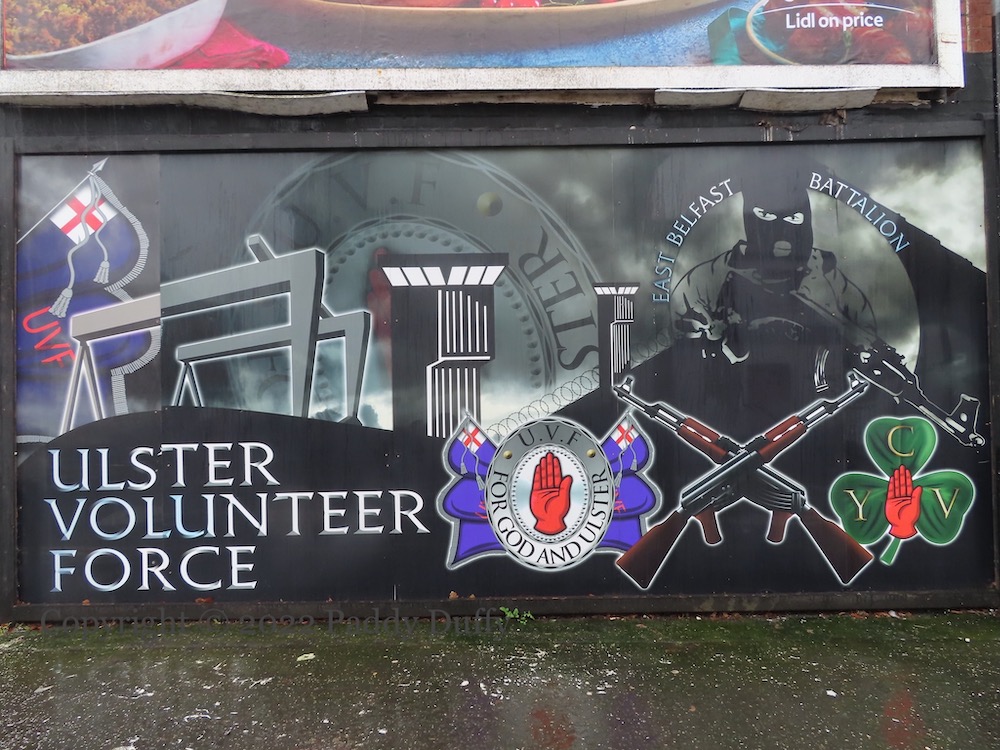
The previous UVF mural in Carrington Street (Volunteering | On Your Side) was paint-bombed in October, 2020, (Keep It Local) but was quickly replaced by this computer-generated board showing the Harland & Wolff cranes, a Long Kesh watch-tower, and a hooded gunman from the UVF’s East Belfast Battalion.
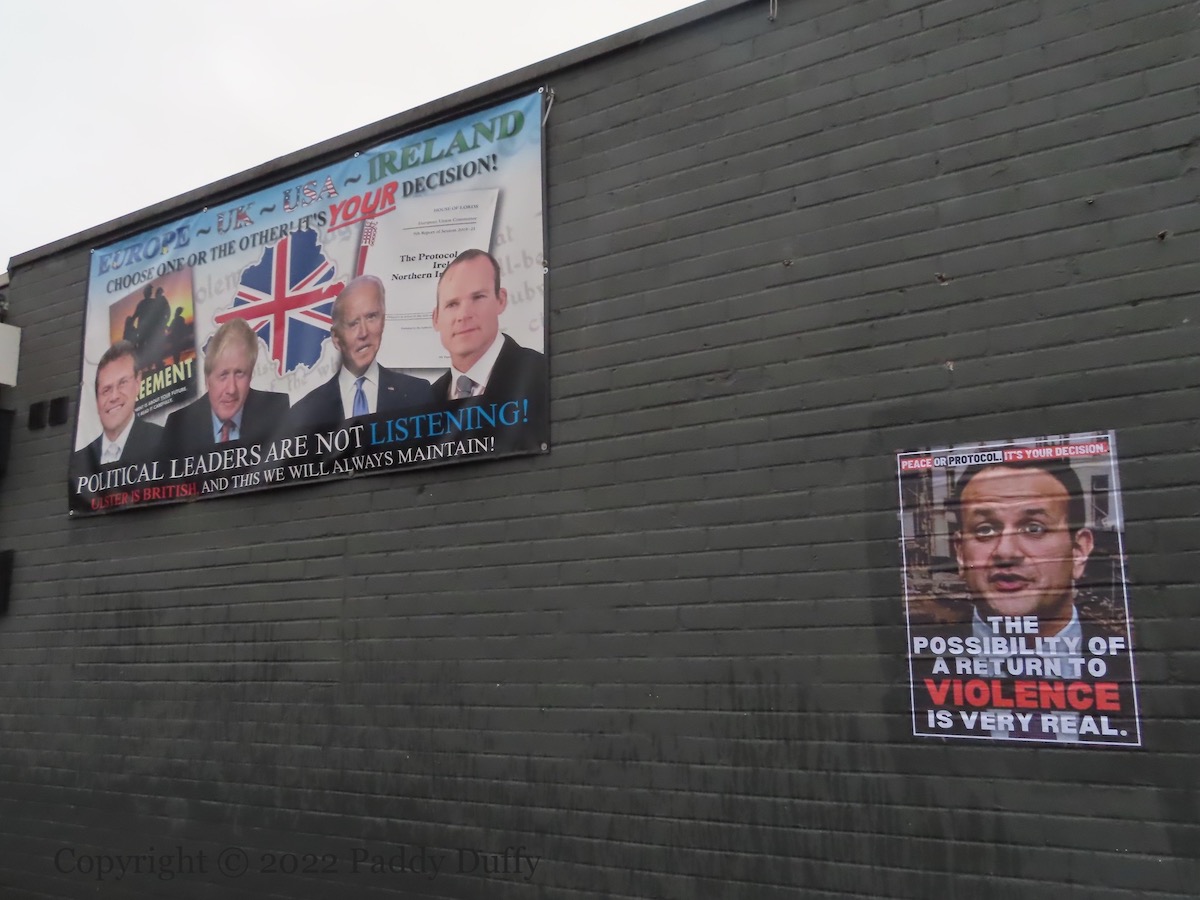
Left: After a break for the funeral of the Duke Of Edinburgh, the Loyalist Communities Council has resumed its protest of Brexit with a banner campaign (Irish News). The banner seems to be offering viewers the choice of one of four affiliations (“Europe – UK – USA – Ireland – choose one or the other! It’s your decision!) but the “correct” answer is at the bottom (and in the faded background of the Covenant): “Ulster is British and this we will always maintain!” even though “Political leaders are not listening!” (including, perhaps, Arlene Foster and the DUP.) The Belfast Agreement (Good Friday Agreement) allows people in Northern Ireland to identify themselves as Irish, British, or both.
Right: “Peace or protocol – it’s your decision”, aimed at Leo Varadkar on the day that he again became Taoiseach (Irish Times) and repeating his words back to him from a speech in 2018: “The possibility of a return to violence is very real”. At that meeting, Varadkar was anticipating violence by anti-Agreement republicans in response to customs posts on the Ireland-Northern Ireland border, and brought a newspaper describing the death of four customs officials, two lorry drivers, and three IRA volunteers at a Monaghan post in 1972 (BelTel).
The authors of this poster are not known, but the parallel statement (mutatis mutandis) would be that anti-Protocol agents – perhaps the “young loyalists” that the UVF “can no longer contain” (UK Daily; see also RTÉ from November) – might return to acts of violence such as the 1974 “Dublin & Monaghan Bombings” that killed 33 people – in the background of the poster is part of a photograph (included below) of bomb damage in Talbot Street – if the Protocol’s “Irish Sea border” is not removed.
Ballysillan Road and (below) Oakmount Drive (near Mount Vernon), north Belfast.
As can seen above, there were originally three framed republican boards here but the Cogús (POWs) one has gone entirely and the other two – Belfast Brigade ONH, 1981 hunger strikers – are in bad shape. Compare with the image from 2012.
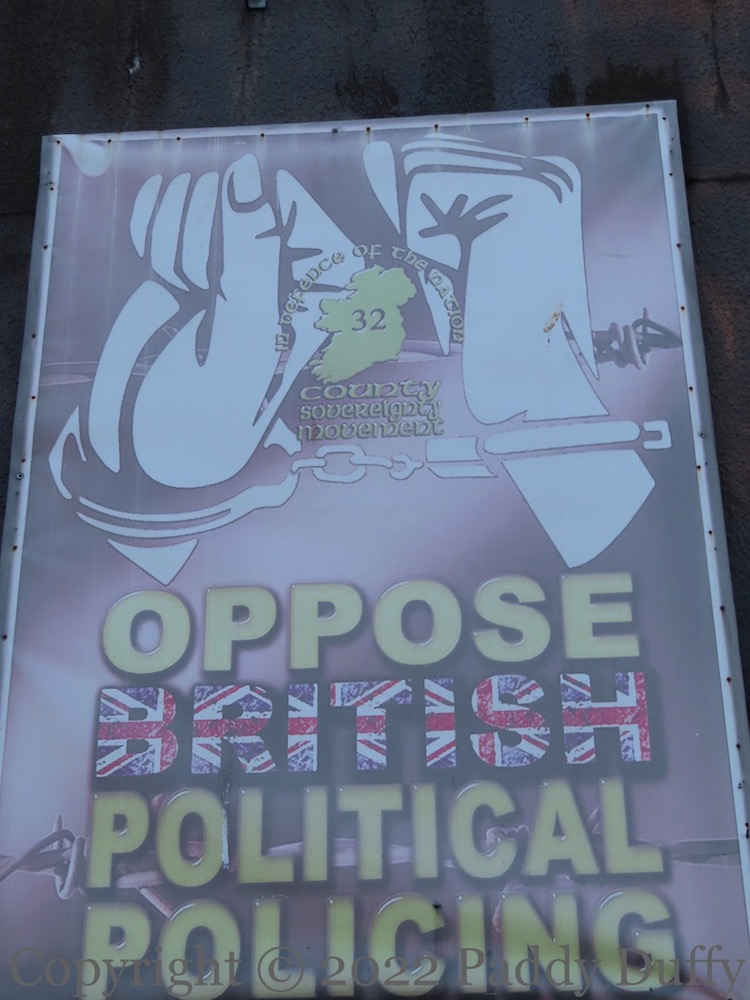
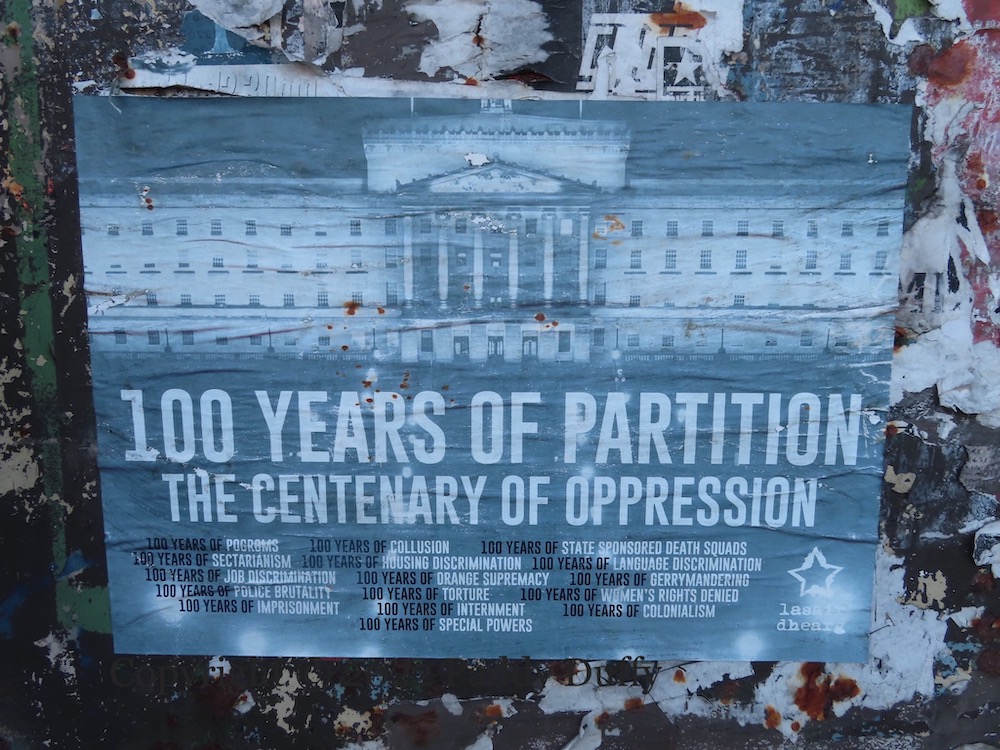
Here is a gallery of the smaller piece on the building below Divis tower (except for the Welcome mural – see Gateway To West Belfast). From right to left (top to bottom in this post) we see a 32 County Sovereignty Movement mural, with the island of Ireland in green, white, and orange, and (representing prisoners) barbed wire and a candle; “Black lives matter” from People Before Profit; 32CSM tarp opposing “British political policing”; IRPWA board declaring the PSNI/MI5/British Army unwelcome; a 32CSM tarp against joy-riding; a Lasair Dhearg poster marking 100 years of … “pogroms, sectarianism, job discrimination, police brutality, imprisonment, collusion, housing discrimination, Orange supremacy, torture, internment, special powers, state sponsored death squads, language discrimination, gerrymandering, women’s rights denied, colonialism.”
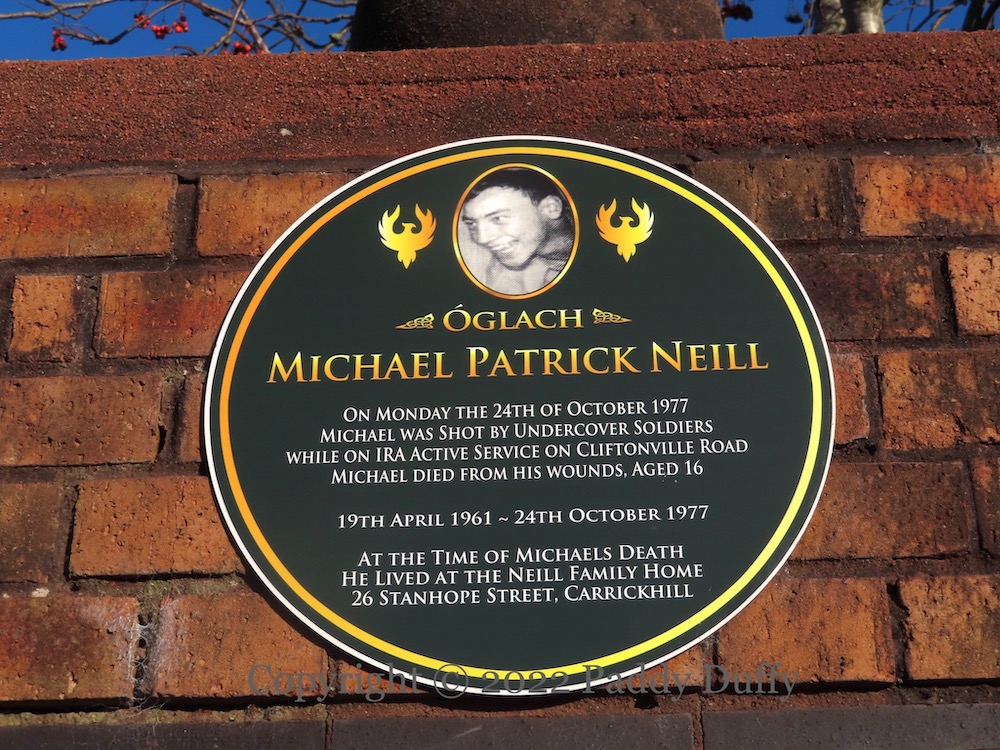
These two plaques are on the “gateposts” at the entrance to Alton Street in Carrick Hill. Neill (above) is on the right; Scullion (below) is on the left.
Neill: “Óglach Michael Patrick Neill. On Monday the 24th of October 1977 Michael was shot by undercover soldiers while on IRA active service on Cliftonville Road. Michael died from his wounds, aged 16. At the time of Michael’s death he lived at the Neill family home 26 Stanhope Street, Carrickhill.”
Scullion: “Óglach Louis Scullion. At 1:45 a.m. on the 14th of July 1972 Louis was shot four times by the British Army as he walked to his home in Unity flats. Louis was unarmed and died as a result of his injuries. 5th June 1945 – 14th July 1972. Louis lived at 51H Unity Walk.”
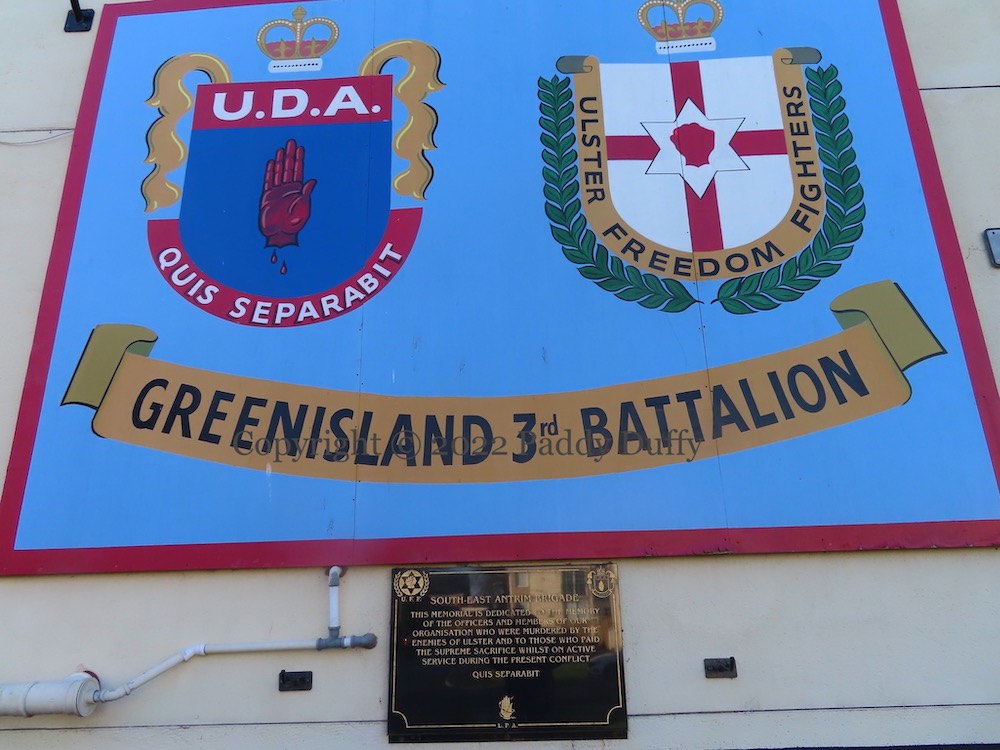
“Greenisland 3rd Battalion, South-East Antrim Brigade [UDA]. This memorial is dedicated to the memory of the officers and members of our organisation who were murdered by the enemies of Ulster and to those who paid the extreme sacrifice whilst on active service during the present conflict. Quis separabit. UFF. UDA, LPA”