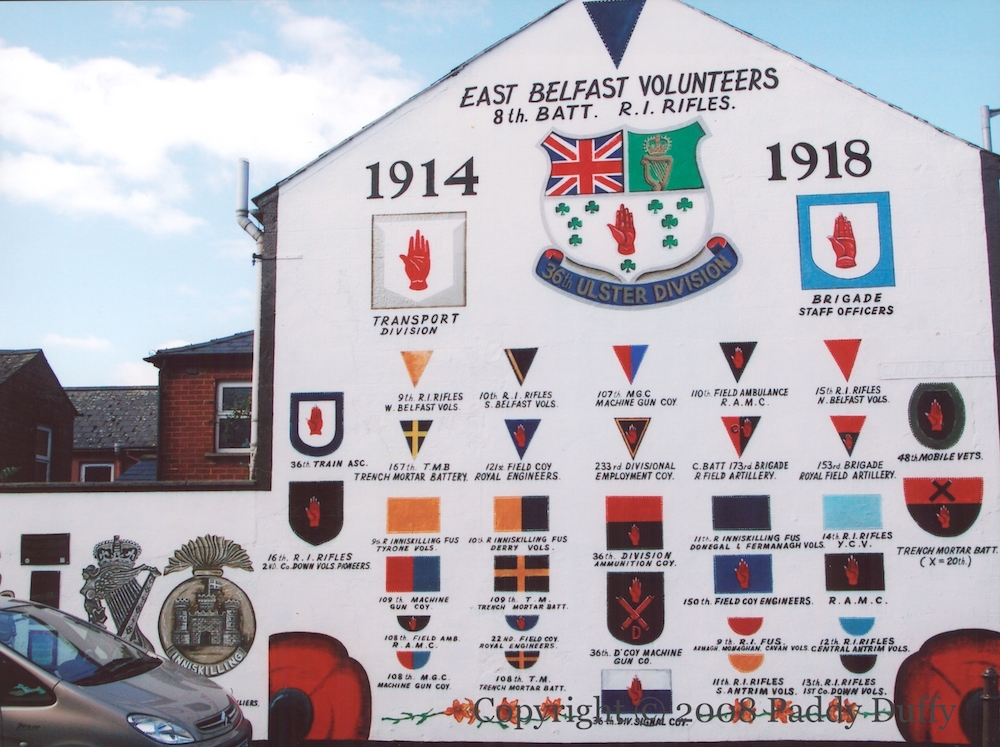
This mural at the mouth of Canada Street commemorates The main mural features insignia of more than thirty units of types from the 8th Batt. RIR, ranging from machine gunners to vets.
The plaques on the wall to the left celebrate the nine Victoria Crosses won by members of the 36th (Ulster) Division “For valour”: Cather, McFadzean, Bell, Quigg, Emerson, De Wind, Seaman, Knox, and Harvey; the final plaque is McCrae’s In Flanders’ Fields.
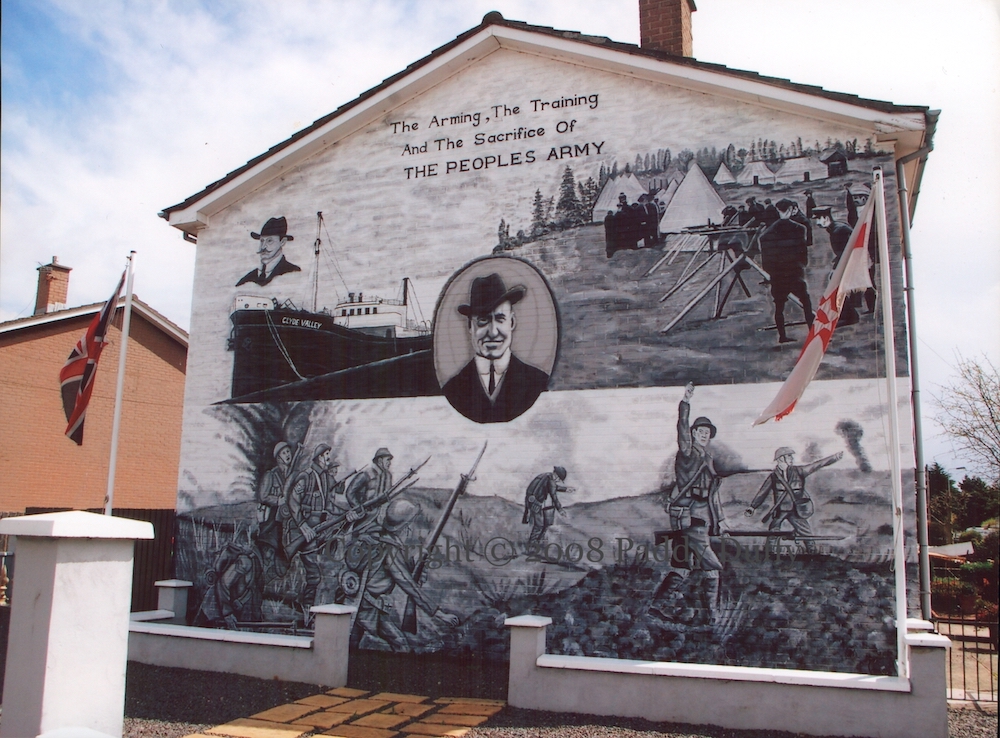
“The arming, the training, and the sacrifice of The People’s Army.” The arming of the Ulster Volunteers (top left) comes from the guns smuggled into Larne on the Clyde Valley. The training of the Ulster Volunteers shown (top right) is probably at Ballywalter. The sacrifice (bottom) is the 36th (Ulster) Division going over the top in James Beadle’s painting ‘Charge of the 36th (Ulster) Division, Somme, 1st July 1916’.
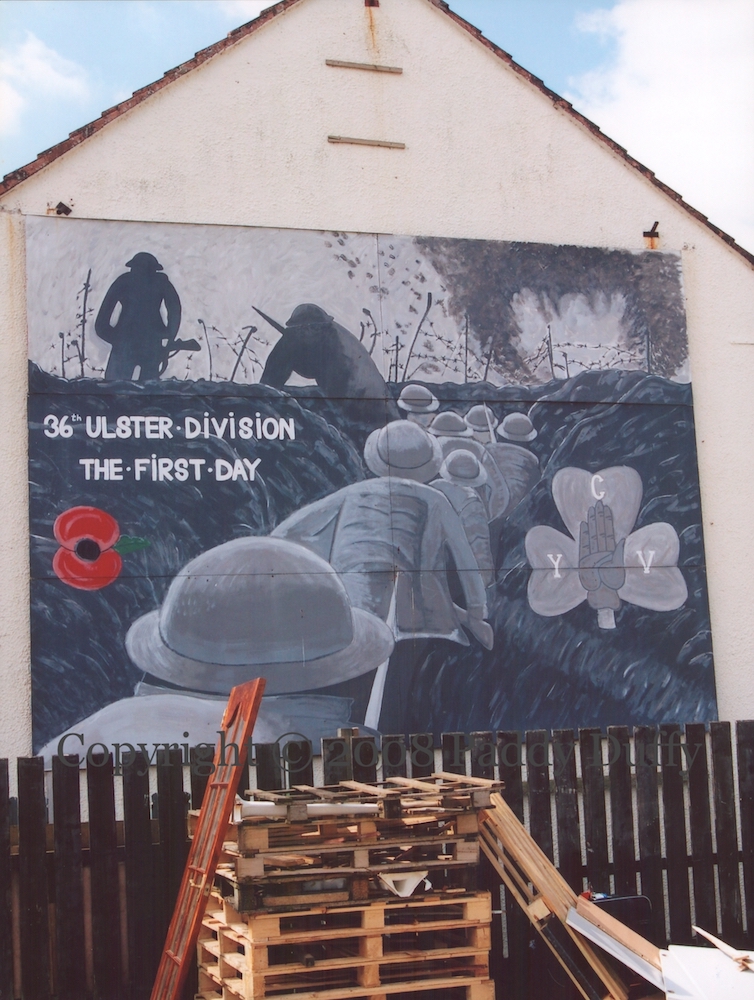
British soldiers from the 36th (Ulster) Division go over the top on the first day of the Battle Of The Somme, July 1st, 1916. The mural is a reproduction of a famous photo by Paul Popper.
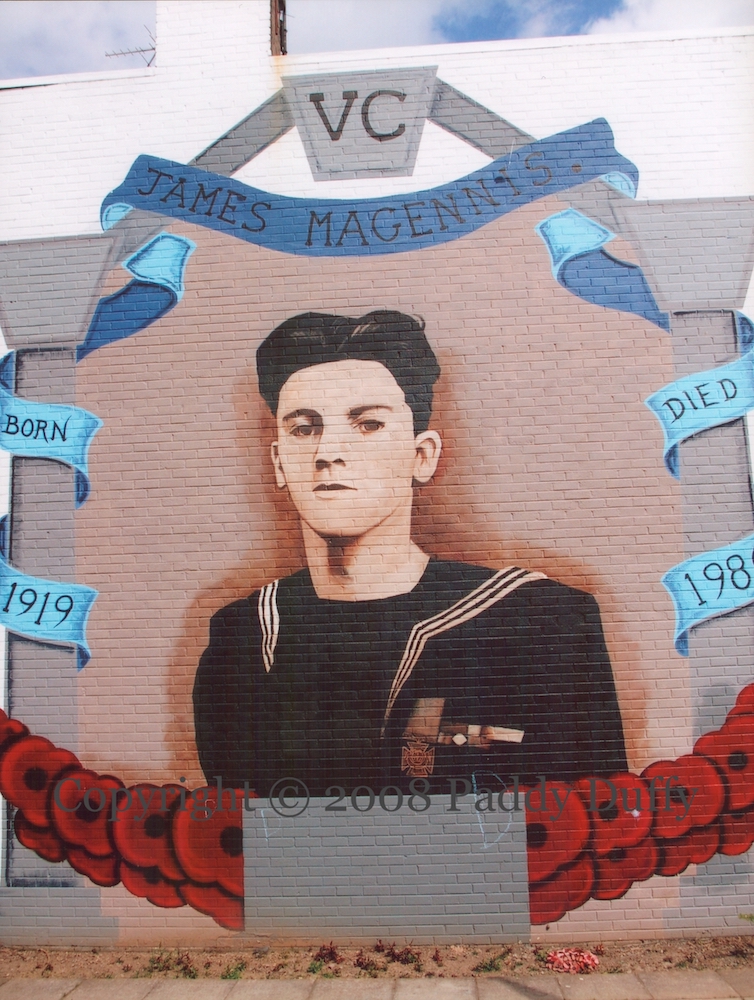
VC (Victoria Cross) recipient James Magennis was the only person from Northern Ireland awarded the VC for action during WWII (WP). Although the mural is in loyalist Tullycarnet, Magennis was a Catholic, born in west Belfast, though he lived for a time in Castlereagh.
The mural takes the place of an Eddie The Trooper mural (see Eddie’s Visual History page). There is a large memorial to Magennis in the grounds of Belfast City Hall.
Painted by Kenny Blair and produced with help from the Tullycarnet Action Group Initiative Trust (TAGIT).
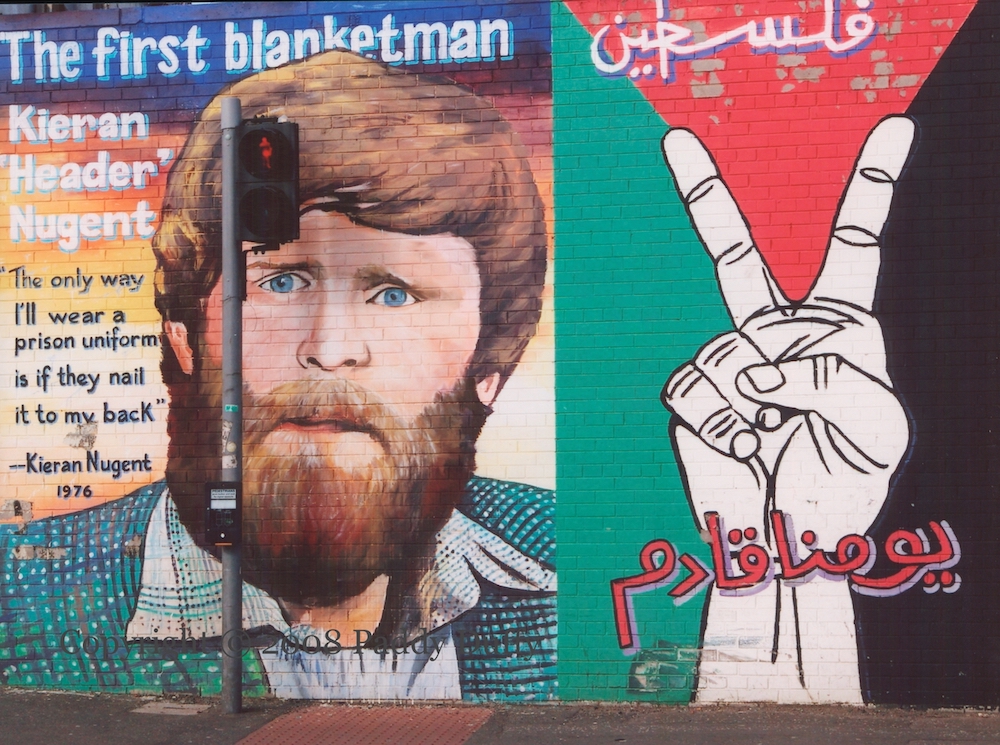
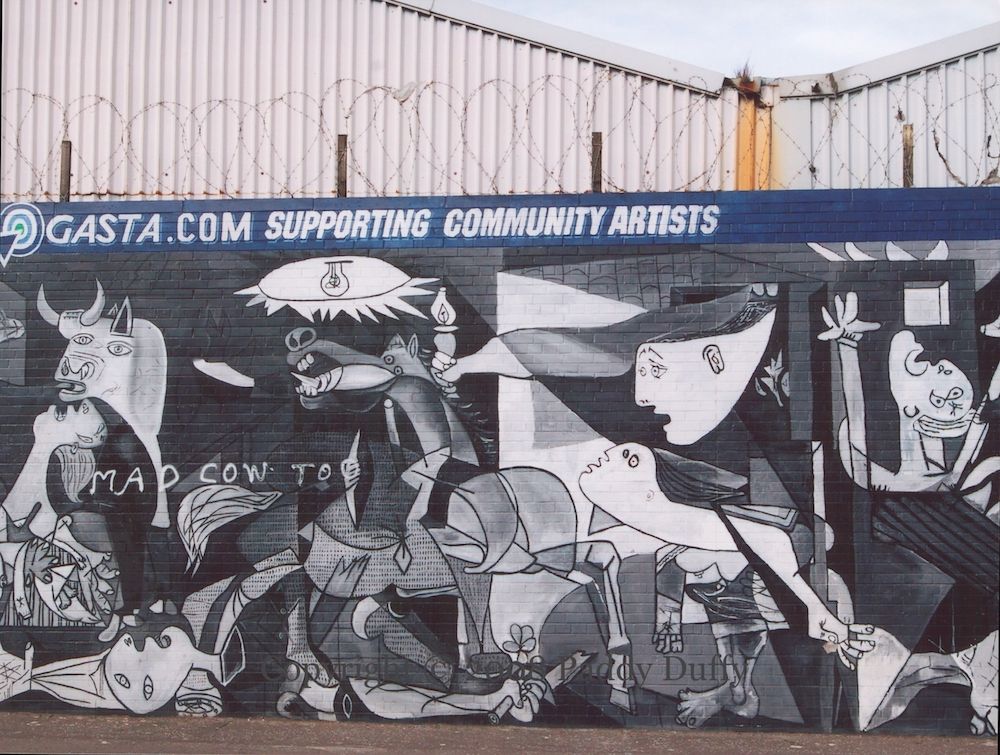
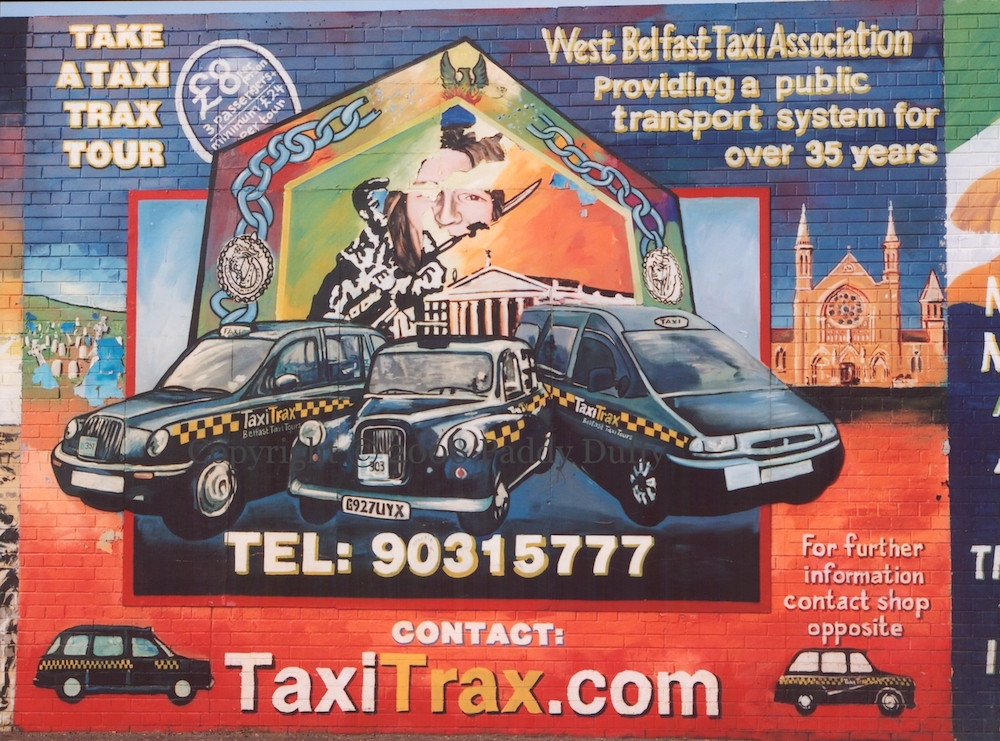
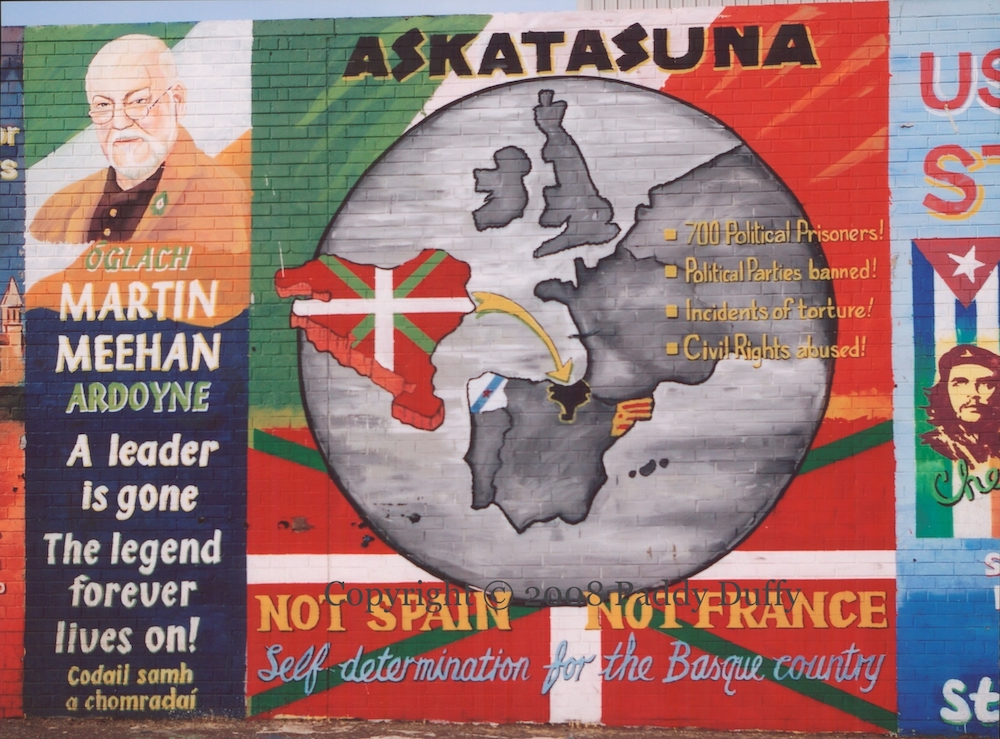
Here is a complete set of images of the International Wall (Visual History) some time in the first half of 2008 (the Nugent mural and the WBTA mural had been changed by July). From left to right:
“The first blanketman” Kieran ‘Header’ Nugent Solidarity with Palestine “the largest concentration camp in the world!!! 33 million innocent people tortured, denied their freedom! Maghaberry POWs “Not forgotten – segregation for Irish POWs” Frederick Douglass Guernica The Manchester Martyrs American’s Greatest Failure, with a “British support hook” Taxi Trax, with a central image of the GPO, and with an internet address for the first time Martin Meehan “A leader is gone, the legend forever lives on” + Askatasuna “not Spain, not France – self-determination for the Basque country” Stop Plan Bush “Stop the crazy son of a Bush” Liam MacCarthy “Ireland’s forgotten son”
These paintings are on boards on the wall around the Cathedral Youth Club in the Fountain.
Above are two boards (on the side) showing the Apprentice Boys crying “No surrender!” and the breaking of the boom that ended the siege. A 2007 entry in the Peter Moloney Collection shows three additional panels to the right, also relating to Londonderry.
“‘My forefathers were … the men who had followed Cromwell and who shared in the defence of Derry, and in the victories of Aughrim and the Boyne.’ – President Theodore Roosevelt, 20th US president, 1901-1904.” The “shutting of the gates” of Derry is represented in the bottom left.
The quote is derived from Volume 1, Chapter 5, of Roosevelt’s The Winning Of The West (available at Project Gutenberg). Roosevelt, however, is describing the forefathers of the Scotch-Irish, rather than his own forefathers, who, as the name suggests, were Dutch.
He writes, “The Presbyterian Irish were themselves already a mixed people. Though mainly descended from Scotch ancestors—who came originally from both lowlands and highlands, from among both the Scotch Saxons and the Scotch Celts—many of them were of English, a few of French Huguenot, and quite a number of true old Milesian Irish extraction. They were the Protestants of the Protestants; they detested and despised the Catholics, whom their ancestors had conquered, and regarded the Episcopalians by whom they themselves had been oppressed, with a more sullen, but scarcely less intense, hatred. They were a truculent and obstinate people, and gloried in the warlike renown of their forefathers, the men who had followed Cromwell, and who had shared in the defence of Derry and in the victories of the Boyne and Aughrim.”
Some sources claim that an ancestor(s) on his mother’s side emigrated from Gleno, Co Antrim in 1729, but this seems to be her great-great-grandfather James, who was a Scot (WP) and appears to have emigrated directly from Scotland, specifically Baldernock, in 1728 or 1729 (WikiTree | Friends Of Bulloch). The search for a connection continues, according to Irish Central.
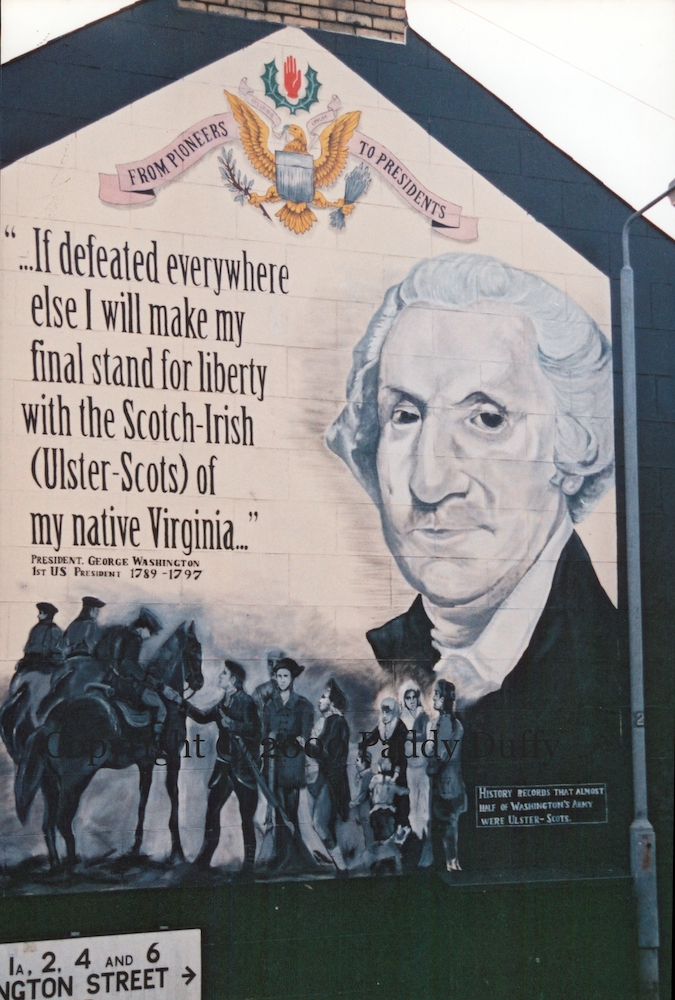
This mural is one (and perhaps the first to be painted) in the series “From pioneers to presidents”. For more such murals, see the Visual History page about Ulster-Scots murals.
These are two of the first three murals painted in the series “From Pioneers To Presidents”, to Washington and Buchanan, in Ebrington Street Lower and Ebrington Street in the Waterside, Londonderry, along with one to Roosevelt in the Fountain.
George Washington commanded the Continental Army during the revolution and served as the first president of the United States beginning in 1789. His ancestry was English. The quote – “If defeated everywhere else I will make my final stand for liberty with the Scotch-Irish (Ulster-Scots) of my native Virginia” – is undocumented, the closest being this statement from McKinley.
The note in the corner reads “History records that almost half of Washington’s army were Ulster-Scots”; the basis for this claim might be General (Charles?) Lee’s report that “half the rebel Continental Army were from Ireland.” (See Chapter 2 of Bagenal, The American Irish and their Influence on Irish Politics.)
James Buchanan was “15th US president 1857-1861.” Buchanan’s father, also called James, was born in Ramelton, Co Donegal, and was living in Co Tyrone when he emigrated to the United States from Derry in 1783, (one of the “250,000 Ulster-Scots [who] emigrated to America in the 1700s”). James junior was born in 1791, the second of eleven children.
The confusion over the wording of the quote – “My Ulster blood is my most priceless [or simply: a priceless] heritage … [and I can never be too grateful to my grandparents from whom I derived it.]” – is matched by confusion over who said it (Buchanan junior or senior?); the source of the quote is unknown. Likewise we do not know where in Scotland the grandparents might have come from and perhaps the move to Ireland happened much earlier.
This mural is (probably) a companion to the Nelson McCausland book Patrick, Apostle Of Ulster: A Protestant View Of Patrick (Amazon), published in 1997. Here is a 2013 blog post by McCausland that perhaps gives a précis of the book and is in keep with the text in the panel out of shot to the left, which reads, “”All the exciting and glamourous features that tradition has added to Patrick must be removed if we wish to know what he was really like. And yet the historical Saint Patrick is more interesting and more worth studying than all these later gaudy traditions …” Bishop R[ichard]. P[atrick]. C[rosland]. Hanson”
With graffiti reading “had no feet” – a comment on the figure to the left.
“4,000 years of Ulster-Scots history and heritage. Ulster & Scotland – shared language, shared literature, shared culture.” 400 years takes us back to the plantation; 4,000 years suggests an even deeper connection.
Ulster-Scots was included in the 1998 Good Friday Agreement (pdf) under the principle of support for “linguistic diversity”. This mural celebrating Ulster-Scots and ties between Northern Ireland and Scotland dates to 1999, with the crests of St Andrew and St Patrick on the left, and an Ulster Banner and Scottish lion rampant on the right.
“Dinnae houl yer wheest, houl yer ain!” [Don’t hold your tongue, hold your own!]








 Paddy Duffy Collection