Fáılte Feırste Thıar

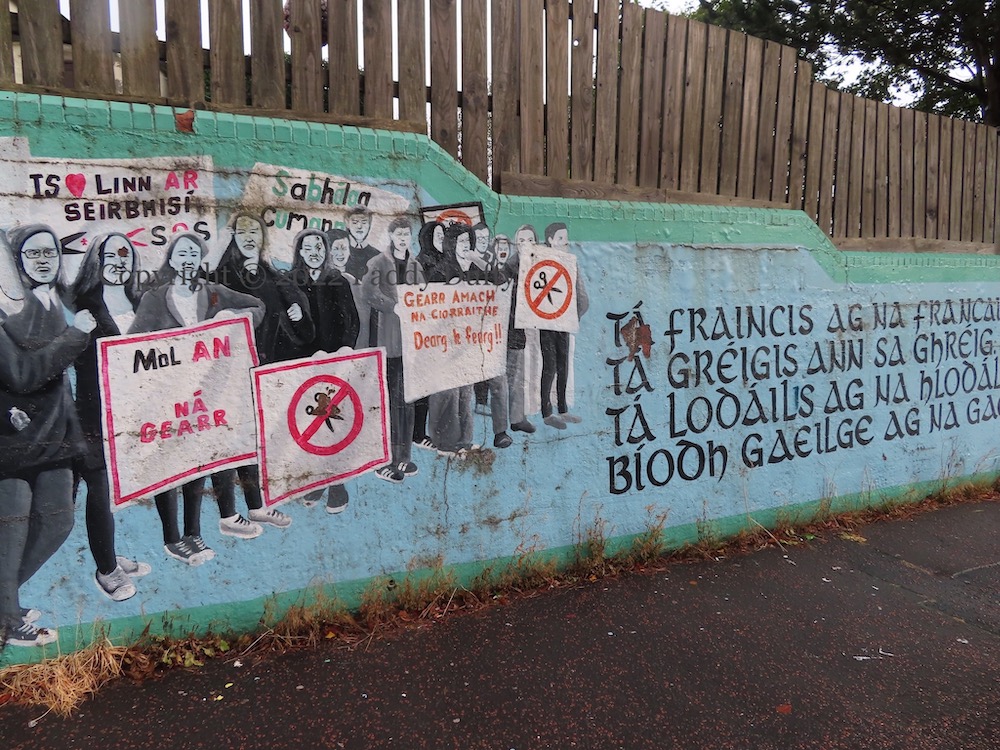
“Welcome to West Belfast.” The sights of nationalist west Belfast are depicted in (part of) a new mural by Mickey Doherty and Marty Lyons on the side wall of the tourist office. From left to right: The (2015) Bobby Sands mural in Sevastopol Street, tourists being introduced to the IRA D Company memorial garden on the lower Falls by Peadar Whelan, Conway Mill, Divis tower, RISE at the bottom of Broadway (better known as the “Balls on the Falls”), the Falls library, the “international wall” in 2012 (with marchers in support of a nondescript international cause, crocodiles for the Irish language, and gay rights), St Peter’s pro-cathedral, a black taxi, the Connolly statue outside Comhaırle Phobaıl an bhFál, and the model for the new Casement Park stadium.

Below: Michael Conlan (tw | ig) won his first title and tenth professional bout on Saturday night (December 22nd), in Manchester, by defeating Englishman Jason Cunningham (BBC). He is featured here alongside the traditional Gaelic games of hurling, camogie, football, and handball.

Click image to enlarge
Copyright © 2022 Paddy Duffy
T00812 [T00813] T00814 T01596

The Red Hand Of Ulster

“There are many legends telling the origins of the Red Hand Of Ulster. This mural depicts only one of those.” In this case, the myth is that Ulster was offered as a prize to whoever could reach it first and was won by throwing a severed hand onto the shore. The flag of Northern Ireland (the Ulster Banner) is in the apex.

Replaces the Lower Shankill UFF mural (M02478).

Shankill Parade, lower Shankill, west Belfast

Click image to enlarge
Copyright © 2008 Paddy Duffy
T00669 [T00668]

Malvern Street Arch

This mural shows Orange Order marchers in front of a banner depicting previous gatherings in Malvern St. The text on the side wall reads “This mural depicts Malvern St arch which was where the local community gathered to celebrate the traditional 12th of July commemoration.”

By Blaze FX in Hopewell Crescent, lower Shankill, west Belfast

Click image to enlarge
Copyright © 2008 Paddy Duffy (no date given)
T00463

The Battle Of Talavera

Talavera De La Reina is southwest of Madrid, Spain. The French, who had invaded Portugal but been driven out by British forces under Wellesley, fought the combined forces of the Spanish (previously allies of the French in the Peninsular War) and British armies. Writing on the side-wall would later be added (see X00327).

By Blaze FX in Hopewell Crescent, lower Shankill, west Belfast

Click image to enlarge
Copyright © 2008 Paddy Duffy (no date given)
T00465 T00468 T00466

Andrew Jackson

The information along the bottom reads: “Andrew Jackson was the 7th President of the USA and the first of Ulster-Scots descent, his family emigrated from Carrickfergus to North Carolina in 1765. After leading the army to victory in the Battle Of New Orleans in 1815 Jackson became a national hero and became known as “Old Hickory” after the tough wood of the native American tree. His “common man” credentials earned Jackson a massive popular vote and swept him into the Presidency for two consecutive terms (1829-1837).” He also hated the British, owned slaves, and signed the Indian Removal Act of 1830, which led to the infamous “Trail of Tears” (Irish Times).

Boundary Way, west Belfast

See also the Visual History page on Ulster-Scots murals.

Click image to enlarge
Copyright © 2008 Paddy Duffy
T00438

East Belfast Volunteers

This mural at the mouth of Canada Street commemorates The main mural features insignia of more than thirty units of types from the 8th Batt. RIR, ranging from machine gunners to vets.

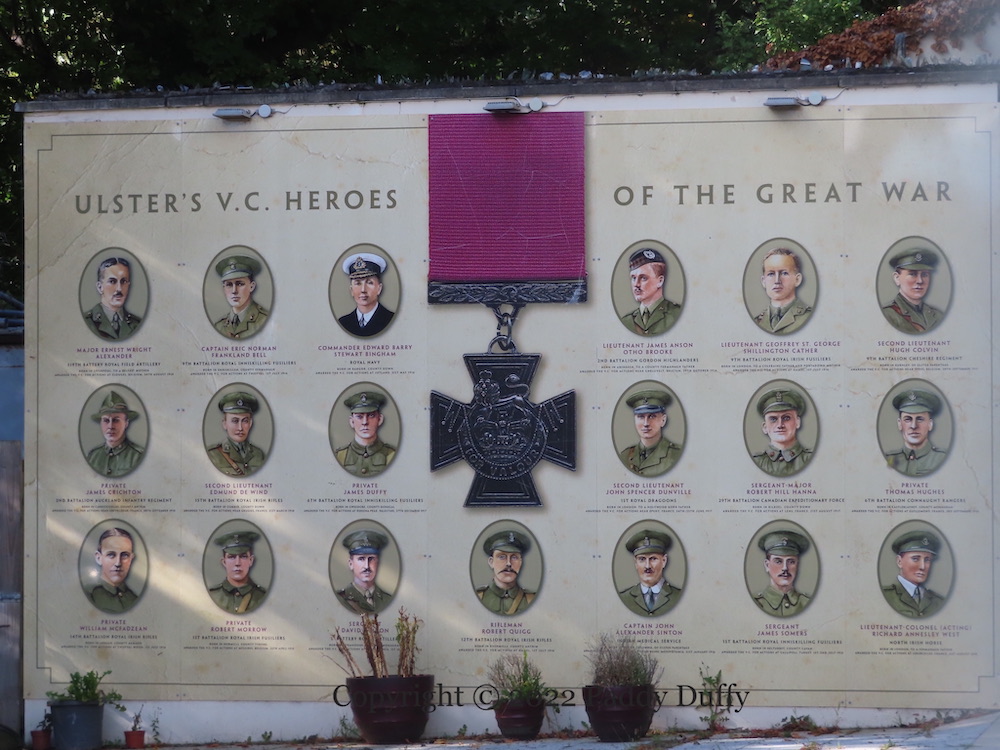
The plaques on the wall to the left celebrate the nine Victoria Crosses won by members of the 36th (Ulster) Division “For valour”: Cather, McFadzean, Bell, Quigg, Emerson, De Wind, Seaman, Knox, and Harvey; the final plaque is McCrae’s In Flanders’ Fields. 

Canada Street, east Belfast

Click image to enlarge
Copyright © 2008 Paddy Duffy
[T00432] T00632

The People’s Army

“The arming, the training, and the sacrifice of The People’s Army.” The arming of the Ulster Volunteers (top left) comes from the guns smuggled into Larne on the Clyde Valley. The training of the Ulster Volunteers shown (top right) is probably at Ballywalter. The sacrifice (bottom) is the 36th (Ulster) Division going over the top in James Beadle’s painting ‘Charge of the 36th (Ulster) Division, Somme, 1st July 1916’.

Inverary Drive, east Belfast

Click image to enlarge
Copyright © 2008 Paddy Duffy
T00442