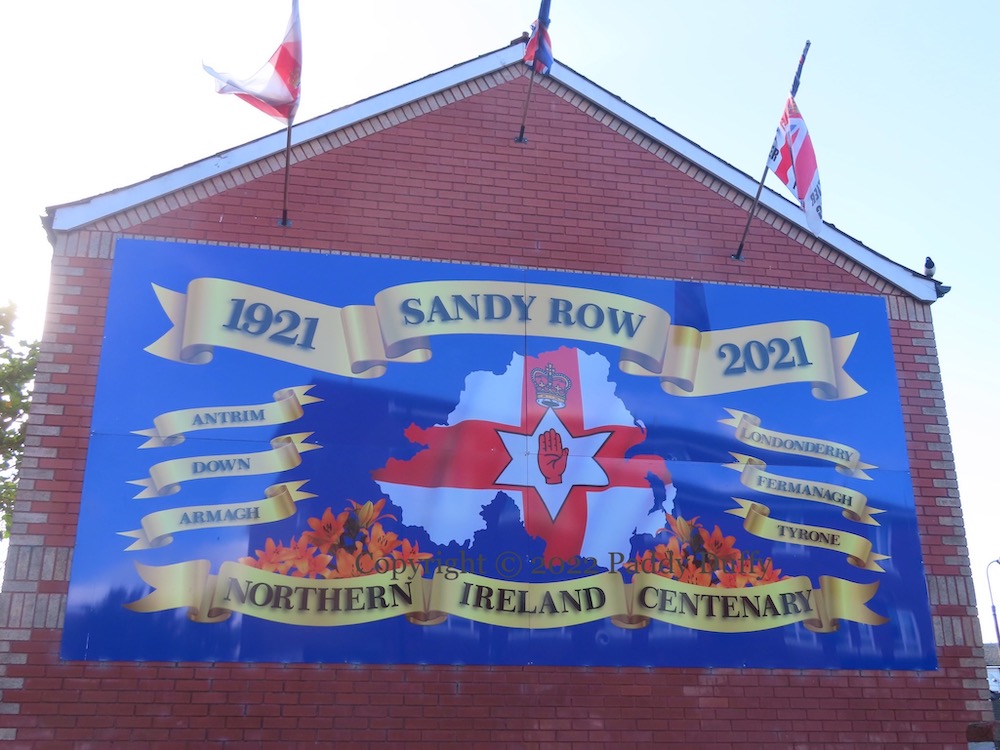
“From Sandy Row to the house of Windsor: happy diamond jubilee 1952-2012. God save the Queen.” Although the coronation was held in June 1953, Elizabeth acceded to the throne immediately upon the death of George VI, on February 6th, 1952. This board was previously on an adjacent wall but has been moved to this location (on top of the ‘Our Wee Country’ mural, replacing a damaged mosaic) to make way for the NI centenary board shown below.
The Irish Football Association (web | tw) is the governing body for Northern Irish soccer, overseeing both domestic and international events. The original Our Wee Country (fan organisation Web | tw) mural was in Carnforth Street, east Belfast.
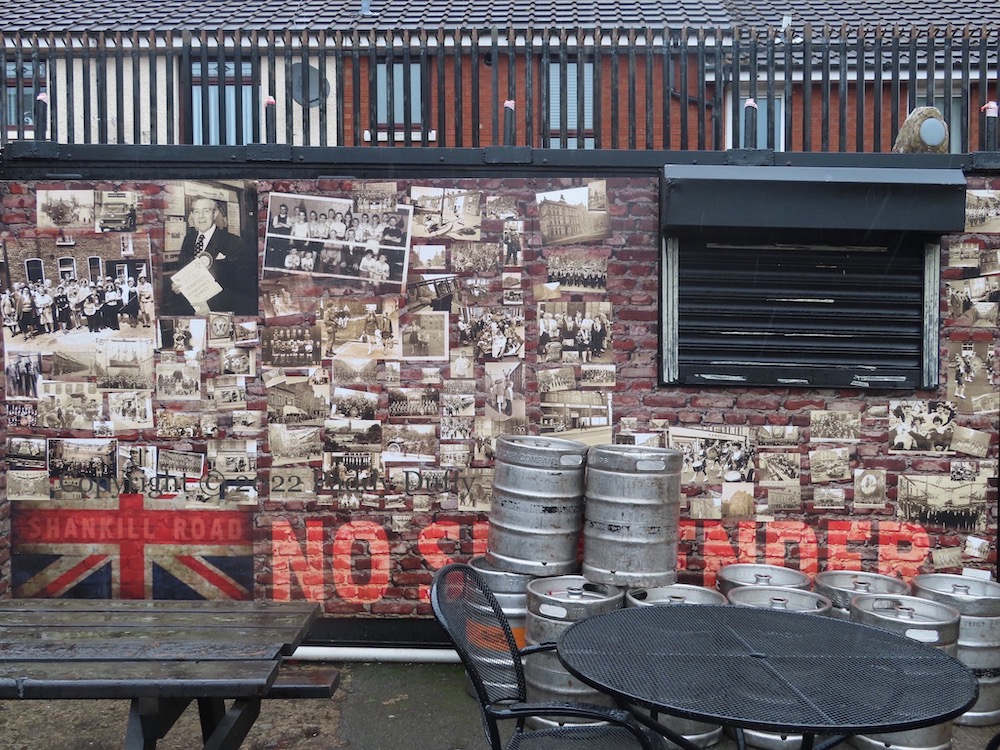
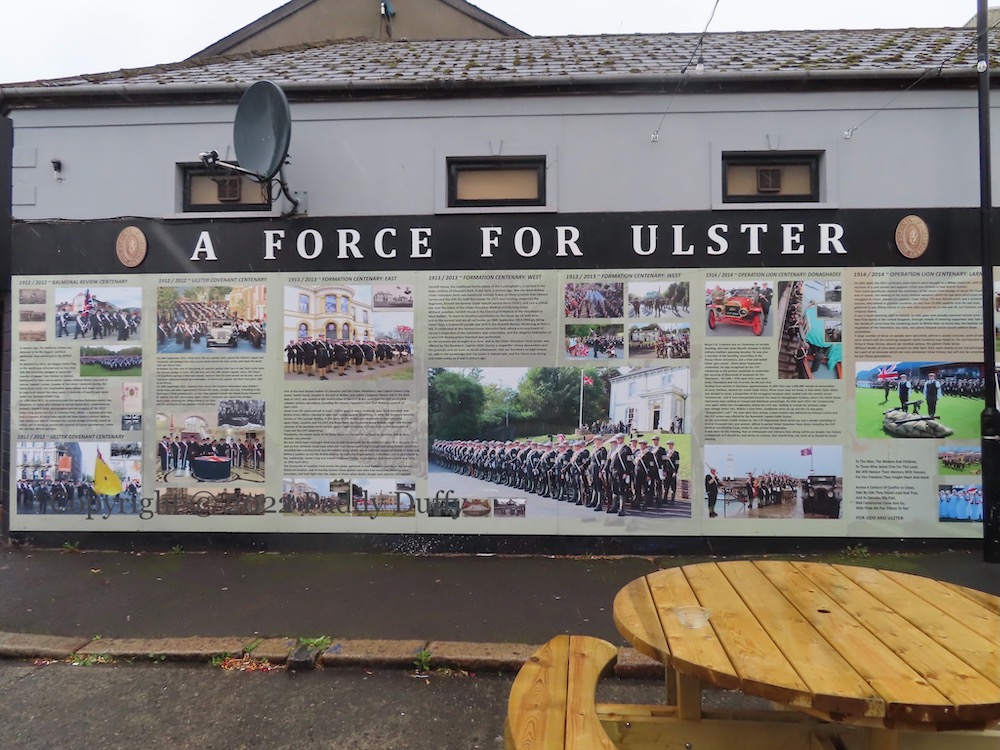
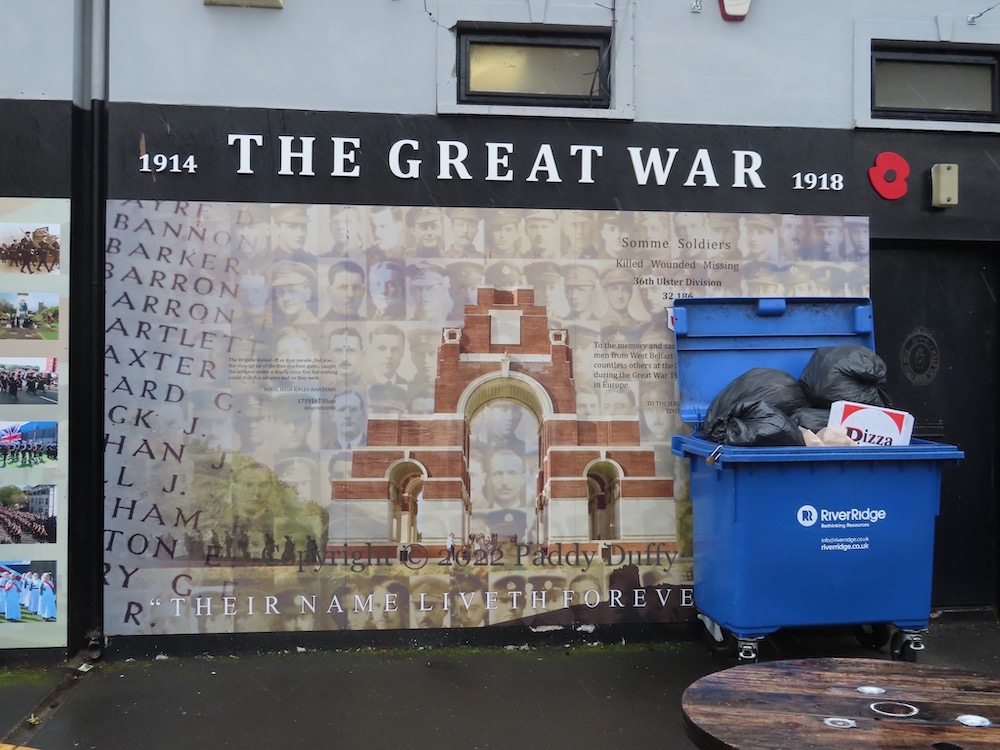
This is the scene at the Rex Bar at (the old) Moscow Street on the Shankill, including, below, three boards describing the formation of the Ulster Volunteers (‘A Force For Ulster’) and using the Thiepval Memorial To The Missing Of The Somme against a background of portraits to commemorate the losses suffered by the 36th (Ulster) Division of the British Army, which the Volunteers became, at the Somme and in other battles, mowed down by “the Hun machine guns” (‘The Great War’). 32,186 men from west Belfast were killed, wounded, or missing. “To them bravery was without limit, to us memory is without end”.
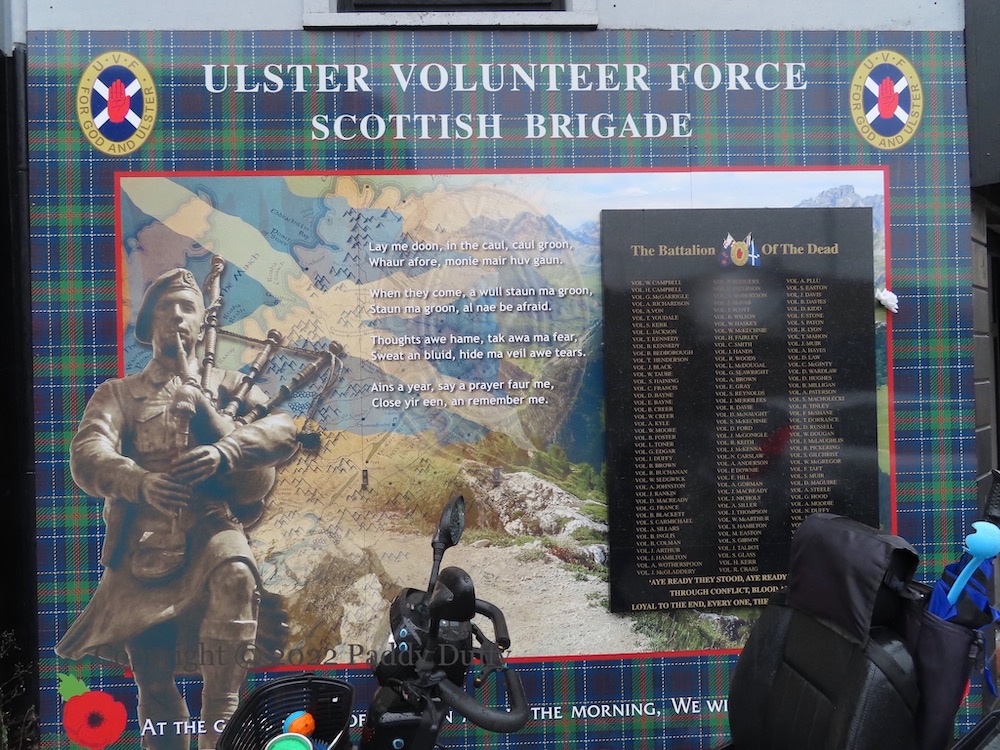
On the Shankill proper (at the newly-christened “Scots Corner”) is a board and plaque to the UVF’s “Scottish Brigade”: “Aye ready they stood, aye ready they fought, through conflict, blood and tears, loyal to the end, every one, the Scottish volunteers.” “Aye ready” was the motto of the 59th Scinde Rifles of the British Indian Army (and later of the Canadian Navy) but is best known from the label of Camp Coffee, in which a Highlander was served a cup of Camp by a Sikh servant (nowadays, they both have a cup of their own).
A Scottish soldier plays the pipes over a list of the “Battalion Of The Dead”, Scottish volunteers from the (modern) UVF. The list is led by William “Big Bill” Campbell, who has had a small plaque in his memory at this spot since (at least) 2014. Preacher and DUP politician George Seawright (see A Crown Of Life) is also included – he was born in Glasgow in 1951.
“In memory of the men and women from the Orangefield area, who have made the ultimate sacrifice in the defence of our freedom in all theatres of conflict, both foreign and at home.” These boards are memorials to the members of the 8th battalion 36th (Ulster) Division, formed from men from Avoniel and Strandtown.
Left: “The Annals of the Four Masters record that in 665 AD, the Battle of Farset (Belfast) took place between the County Down Dal Fiatach, self styled Ulaid, and the Pretani or Cruthin where Cathasach, son of Laircine, was slain. This was an attempt by the Dal Fiatach to encroach on the Curtain territory of Trian Congail. The “third of Congal”, which encompassed territory on both sides of the Lagan, corresponding more to less to Uppers and Lower Clandeboye, including modern Belfast. Cathasach was Congal’s grandson. The battle was the first mention of Belfast in Irish history.”
The battle scene shown is Jim Fitzpatrick’s vision of the battle of Moira (in 637), rather than “Bellum Fertsi”. The salience of this description of intra-Ulster fighting is that there is a contention that the Cruthin were Scots (Picts) thus allowing for the idea (employed especially by the UDA – see Ulster’s Defenders and Defender Of Ulster From Irish Attacks) that present-day northern Protestants have a heritage, and a history of fighting for what is roughly Co. Antrim, that pre-dates the plantations. For more information and a similar board, featuring the tower blocks of Rathcoole rather than Cuchulainn and the Battle of Moira, see Kingdom Of The Pretani. For the debate over a connection to the Picts, see WP.
The Annals date back to the 1630s though they mostly comprise a variety of earlier sources.
The image of the gentleman with the sword appears to be a stock fantasy image, used for at least two characters in Game Of Thrones fandom (Rhaegon Targaryen and Lord Cameron Umber).
Middle: 2021 was the centenary of the creation of Northern Ireland and the year in which Scottish football club Glasgow Rangers won their 55th league title. Support for the club is widespread among the PUL community in Northern Ireland; local soccer and the international team is overseen by the IFA.
Right: “Centenary of cultural expression 1921-2021. Sons Of Belfast LOL 743. Castleton Temperance LOL 867. The Memorial LOL 1197. Belfast Harbour LOL 1883. The Coote Memorial LOL 1921. Cave Hill Temperance LOL 1956.”
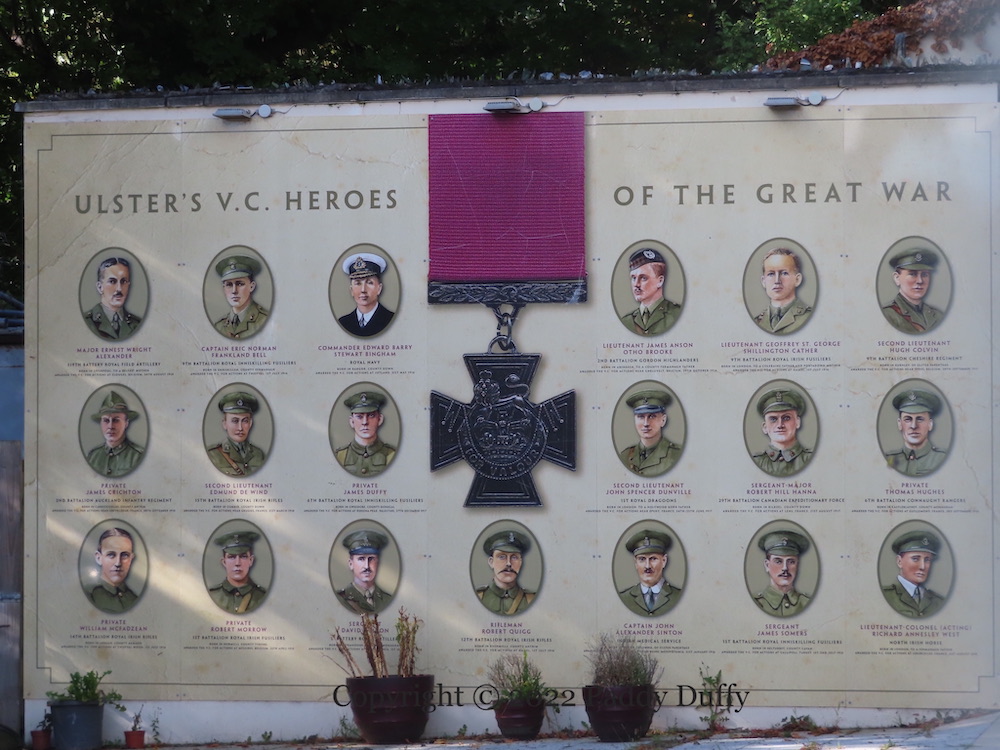
Here are two boards outside the north Belfast Orange hall in Alexandra Park Avenue, north Belfast.
Above: sporting heroes Joey Dunlop, Alan Campbell, Darren Clarke, Alex Higgins, George Best, and Carl Frampton.
Below: nineteen winners of the Victoria Cross: (left) Major Ernest Wright Alexander, Captain Eric Norman Frankland Bell, Commander Edward Barry Stewart Bingham, Private James Crichton, Second Lieutenant Edmund De Wind, Private James Duffy, Private William McFadzean, Private Robert Morrow, Sergeant David Nelson, (centre) Rifleman Robert Quigg, (right) Lieutenant James Anson Ortho Brooke, Lieutenant Geoffrey St. George Shillington Cather, Second Lieutenant Hugh Colvin, Second Lieutenant John Spencer Dunville, Sergeant-Majjor Robert Hill Hanna, Private Thomas Hughes, Captain John Alexander Sinton, Sergeant James Somers, Lieutenant-Colonel (Acting) Richard Annesley West.
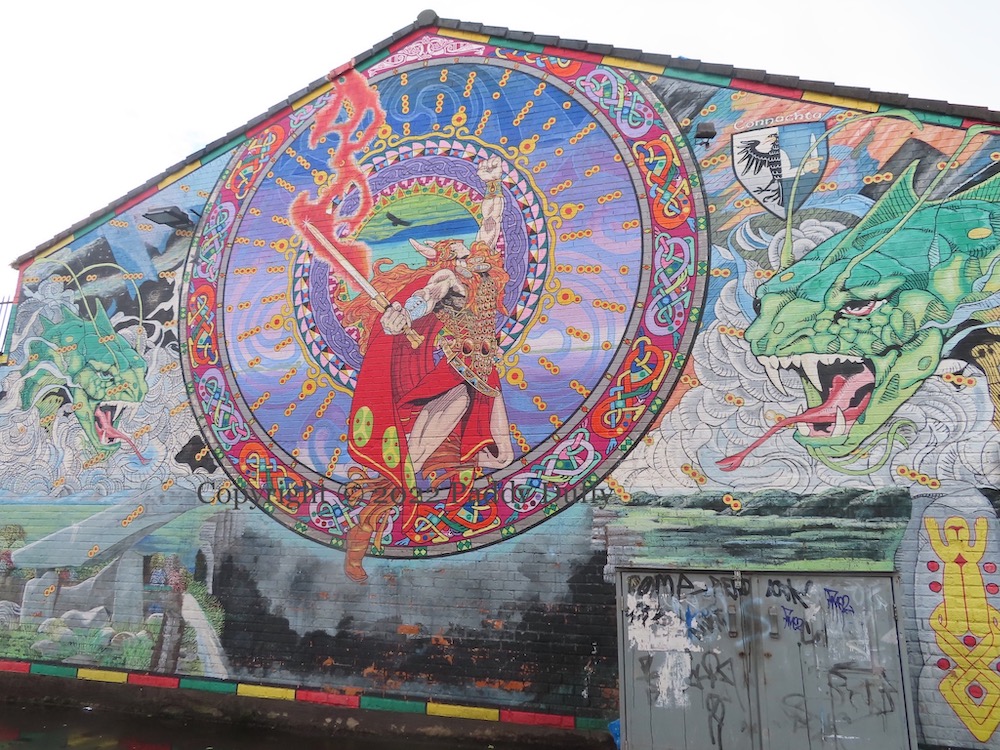
Gerard ‘Mo Chara’ Kelly first painted a mural of King Nuada in 1987, a year after being released from Long Kesh. He reproduced an illustration by Jim Fitzpatrick on a gable wall in Springhill (see images from 1987 | 1988 | 1989). This post-peace version is on the side-wall of the Whiterock Road Spar and was painted as statement of Kelly’s own rebirth after ceasing to work with funding agencies such as the Upper Springfield Development Trust.
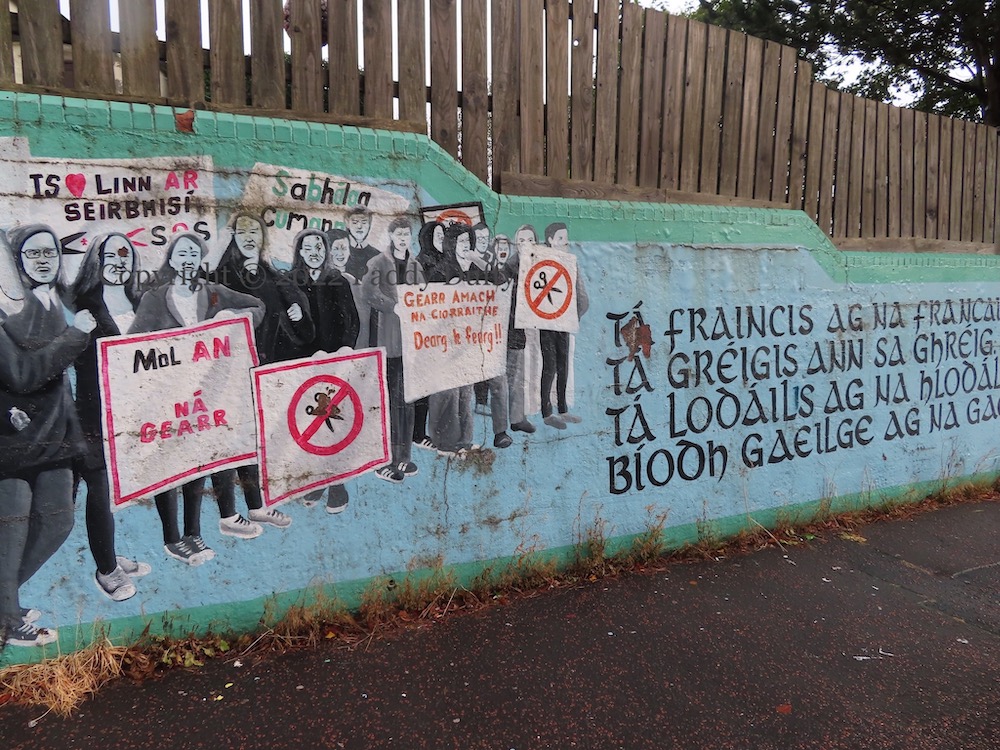
Above is a pro-Gaelic (Irish-language) mural on the Whiterock Road, with signs in Irish being held by young people protesting cuts to social services (on the left) and (on the right) a short poem: “Tá Fraıncıs ag na Francaıgh/Tá Gréıgıs ann sa Ghréıg/Tá Iodáılıs ag na hIodálaıgh/Bíodh Gaeılge ag na Gaeıl.” That is: the French have French, the Greeks Greek, the Italians Italian; let there be Irish for the Irish.
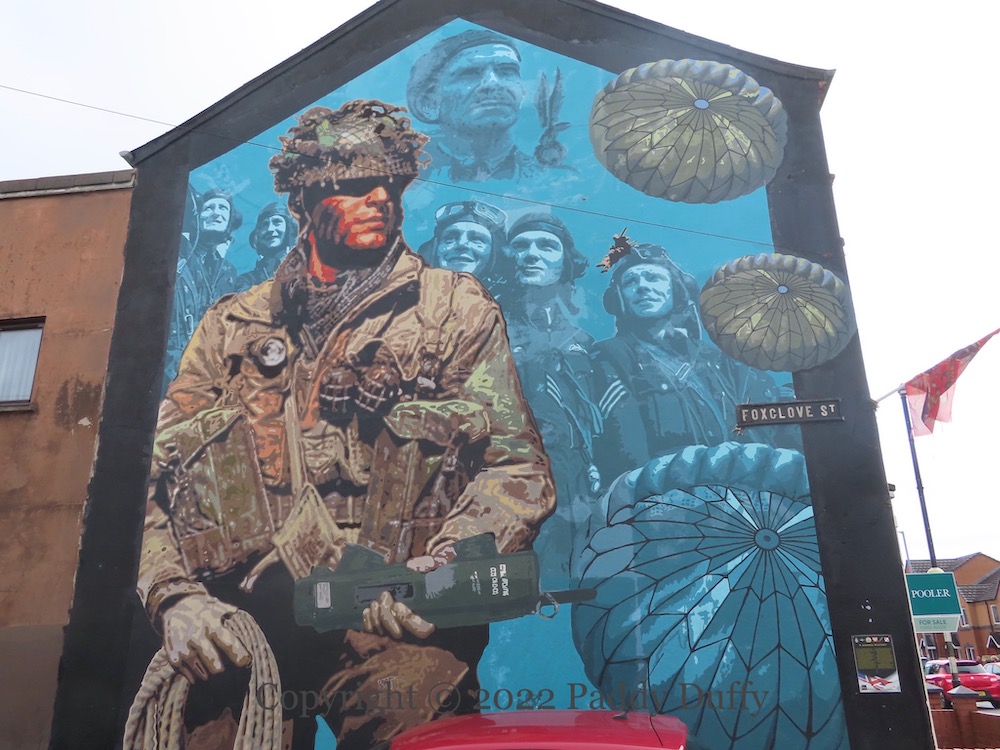
Stanislaw Sosabowski — who appears in the apex of this mural in east Belfast — survived the first World War (fighting for Austria-Hungary), the occupation of Poland in 1939, and escaped from a prisoner-of-war camp before crossing Europe and taking command, in Britain, of the 1st Polish Paras. The unit fought in Operation Market Garden at the Battle Of Arnhem. (WP | Polish Heritage Society for a booklet of text and images)
His memoirs have been published as Freely I Servedand interviews about his service were collected for a film called A Debt Of Dishonour (youtube) – the title comes from the fact that Sosabowski was blamed for the failure of the Operation, perhaps as a bargaining tactic in negotiations between Britain, Russia, and Poland.
Across the middle of the mural are airmen from the 303 Polish Squadron, which was celebrated in a Shankill mural: Love Demands Sacrifice. In the foreground is a modern British paratrooper in field gear.
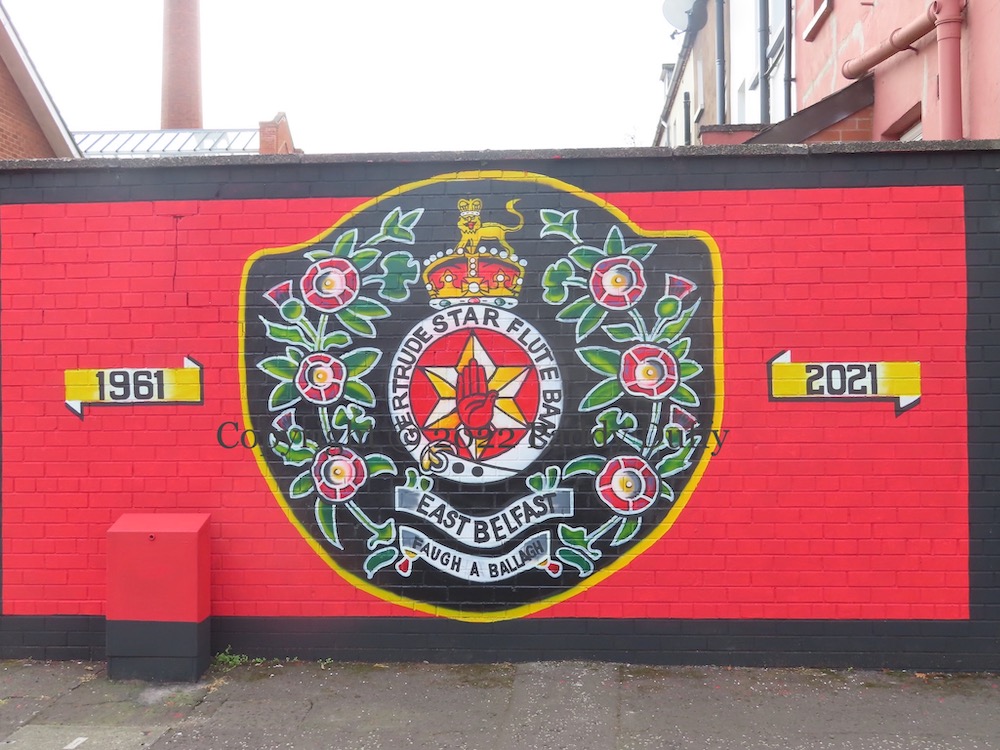
Gertrude Star flute band (Fb) celebrated its 60th anniversary in 2021 and to mark the occasion this (2022) May, the two side-walls were painted, one of which is shown below. The main mural was painted for the 50th anniversary in 2011, with Ulster Banners and Union Flags flanking the UK coat of arms – “Dieu et mon droit”, “Honi soit qui mal y pense”. The following areas are listed: (left) Gertrude St, Clarawood, Templemore Ave, Woodstrock Road, Albertbridge Rd, south Belfast, Scotland, Antrim, Glengormley, Carrickfergus, Braniel; (right) Dee Street, Newtownards Rd, Cregagh Rd, Castlereagh Rd, Holywood, Ballybeen, Tullycarnet, Shankill Rd, north Down, Bangor.
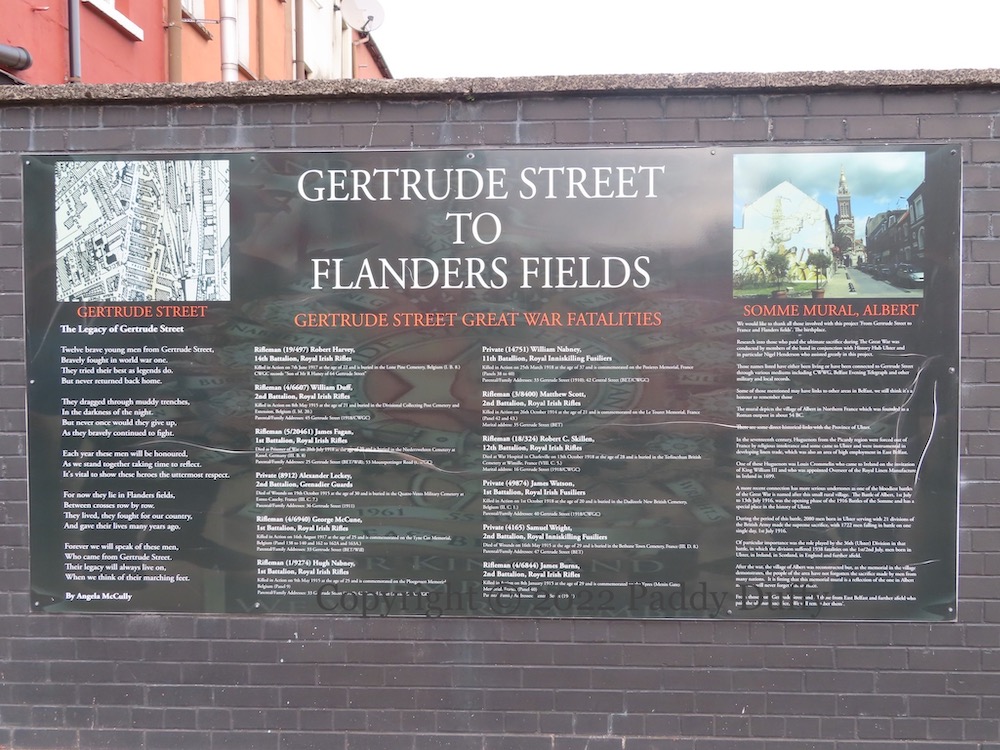
The twelve “Gertrude Street Great War Fatalities” are: Robert Harvey; William Duff; James Fagan; Alexander Leckey; George McCune; Hugh Nabney; William Nabney; Matthew Scott; Robert C. Skillen; James Watson; Samuel Wright; James Burns.
This board was originally next to the To France And Flanders mural on the adjacent wall; the mural also named these twelve but which only lasted a year. That mural depicted the damaged basilica tower in the village of Albert and there is a similar mural in the village itself – a photograph of the mural and the rebuilt tower can be seen in the top right of the board; the mural can be seen in full here.
As the map in the top left shows, Gertrude Street was where Wolff Close now is, running north from the Newtownards Road; the original Gertrude Star mural (circa 1989) was on the first gable of what is now called “Freedom Corner” – see D00388.
The emblem of the Gertrude Star flute band serves as a background. The band’s 50th/60th anniversary mural is across the street.
“‘The Legacy Of Gertrude Street. Twelve brave young men from Gertrude Street,/Bravely fought in world war one./They tried their best as legends do./But never returned back home.//They dragged through muddy trenches,/In the darkness of the night./But never once would they give up,/As they bravely continued to fight.//Each year these men will be honoured,/As we stand together taking time to reflect./It’s vital to show these heroes the uttermost respect.//For now they lie in Flanders fields,/Between crosses row by row./They lived, they fought for our country,/And gave their lives many years ago.//Forever we will speak of these men,/Who came from Gertrude Street./Their legacy will always live on,/When we think of their marching feet.’ By Angela McCully”




 Paddy Duffy Collection