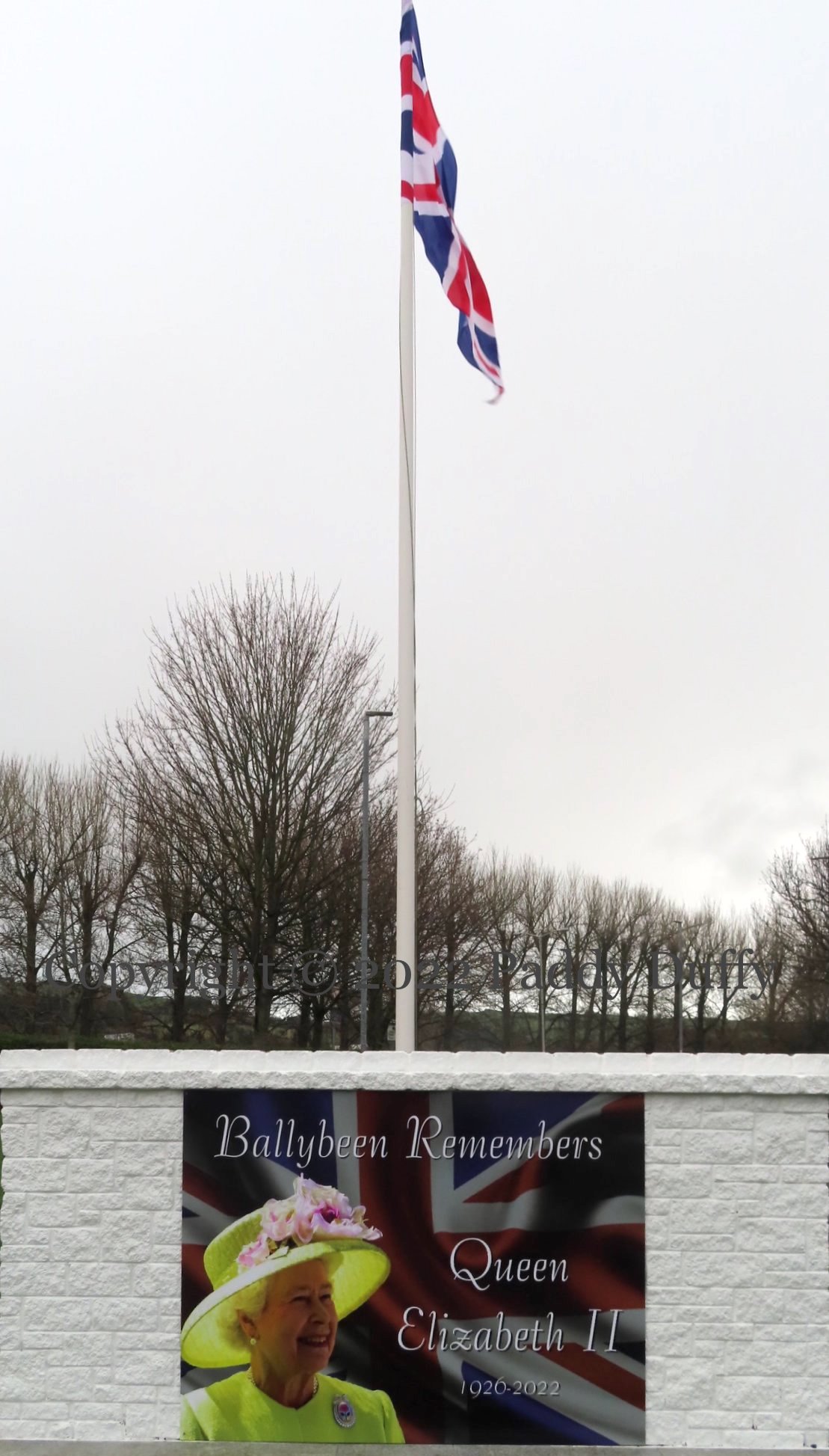
“Ballybeen remembers Queen Elizabeth II 1926-2022” on the back of the “Ballybeen estate” sign at the Davarr Avenue entrance to the estate. Elizabeth died in September 2022, shortly after her platinum/70th jubilee.
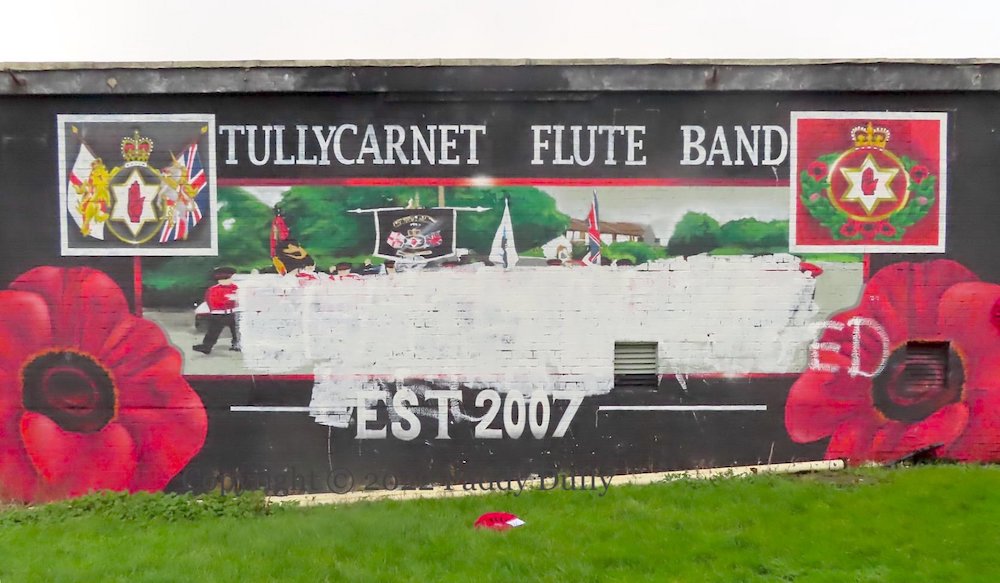
The Tullycarnet flute band (Fb) murals on the hill were repainted for Remembrance Sunday in November 2021 but vandalised shortly thereafter (Belfast Live) with graffiti naming an alleged paedophile which was then whited out. One year on and the mural has not been repaired.
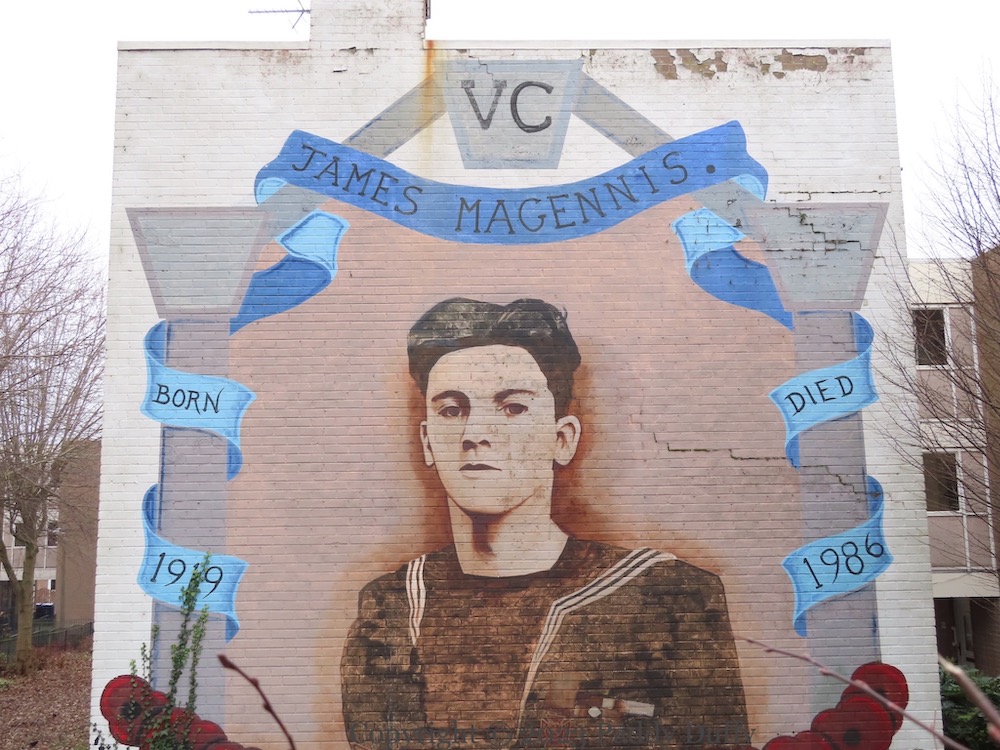
Victoria Cross recipient James Magennis was the only person from Northern Ireland awarded the VC for action during WWII (WP). Although the mural is in loyalist Tullycarnet, Magennis was a Catholic, born in west Belfast, though he later lived in Castlereagh. He was given a reception in 1945 at Belfast city hall.
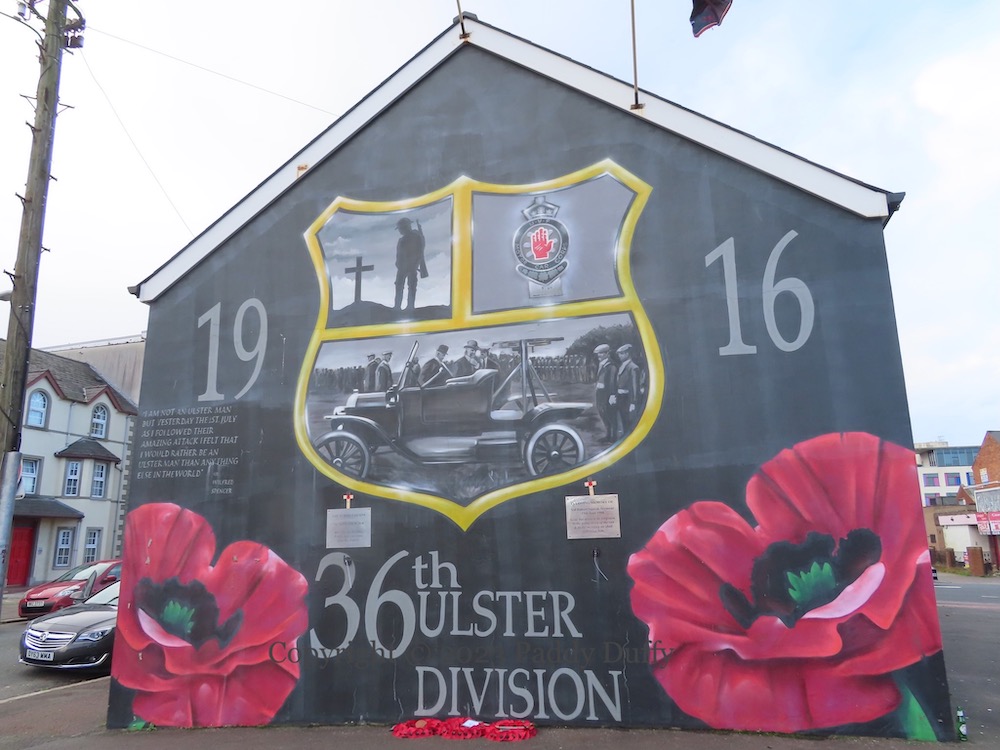
The first time that the horseless carriage was used in a military operation was the Ulster Volunteers’ “Larne Gunrunning” of April 1914. By this time, there are thought to have been 350 vehicles in the Corps (Angelsey). It’s not clear whether the cars were later used by the 36th (Ulster) Division – please comment/get in touch if you can shed light on this. (For Spencer’s quote on the left, see I am not an Ulsterman.) The plaque is to (modern) UVF volunteer ‘Squeak’ Seymour.
Bunscoıl Mhıc Reachtaın (McCracken Primary) is an Irish-language school named after the famous Belfast family and in particular after Mary Anne McCracken, who was a campaigner in the 1800s for the education of children both male and female (among with many other causes – see previously the post on the bust of Mary Anne in Carrick Hill, opposite Clifton House: The World Affords No Enjoyment Equal To That Of Promoting The Happiness Of Others.
The bunscoil opened in 1999 in the New Lodge, before moving to its current location (and site of this mural) in Lancaster Street (Naíscoıl Mhıc Reachtaın). (Lancaster Street is itself named after the controversial Quaker educator, Joseph Lancaster (WP) – Joe Baker p. 72.) According to an Irish News report in 2020 on Irish-language schools, the bunscoıl at that time, at least, had more pupils than its approved maximum.
The school borrows from the teaching philosophy of Patrick Pearse (Belfast Media), discussed previously in connection with Coláıste Feırste in An Tusa An Chéad Laoch Eıle?
“Time changes! But the sacrifice remains the same.” The board shows, in black and white, a WWI soldier, who is comforting another solider, in modern gear and in colour. The emblems of the 36th (Ulster) division and Royal Irish Rifles are also shown. Sponsored by the EU and the Cosy Somme Association. This is a repainted version of the original (late 2013) board which had faded badly.
The 36th (Ulster) Division Memorial Association (Fb) put on a play called From The Shipyard To The Somme (Fb | watch on youtube) in Connswater Community Centre in 2013. It follows a group of men from east Belfast who joined the Ulster Volunteers in Belfast but are now training at Abercorn barracks in Ballykinlar (later an internment camp) as members of the 36th Division, before going to the Battle Of The Somme in France.
Belfast – with one tenth of the population – provided about a third of the Irish soldier to participate in WWI. In the shipyards, Harland & Wolff responded to the slow-down in production not by putting everyone on short time but by letting go of employees, particularly unskilled employees, for whom the wages of soldiering were competitive (particularly if married), while skilled men were reclassified as “munitions workers” needed to fulfill war contracts (History Ireland | Long Kesh Inside Out).
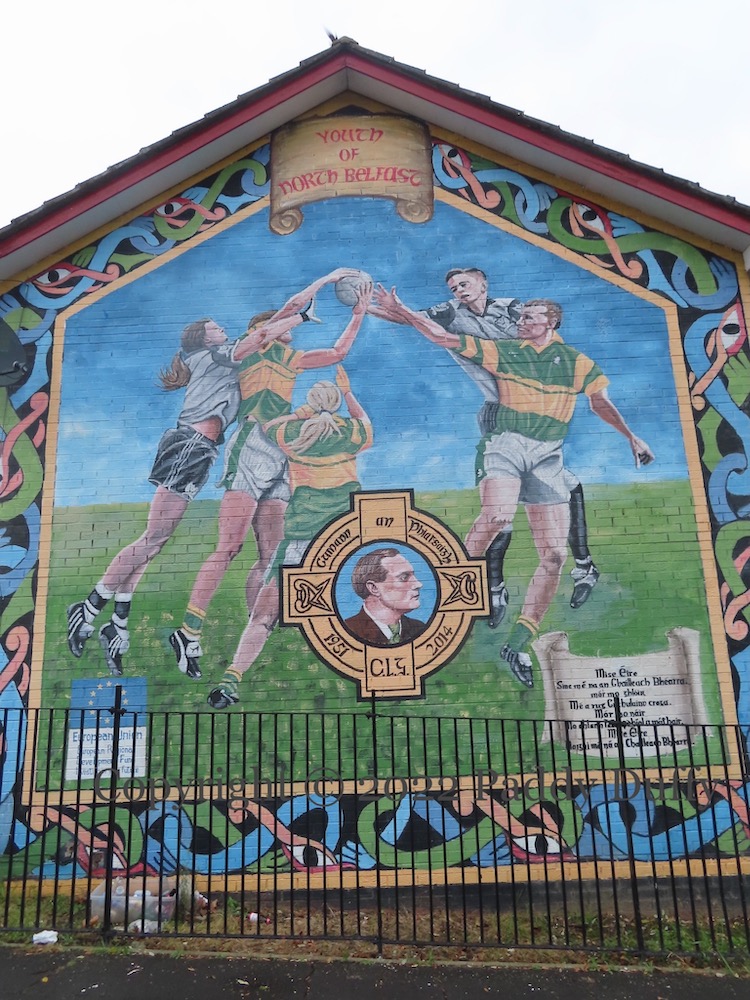
The local New Lodge GAA club Cumman An Phıarsaıgh is named in honour of Patrick Pearse, executed after the 1916 rising. The club’s new mural features footballers contesting a ball and Pearse’s image appears at the centre of a Celtic cross along with part of his 1912 poem Mıse Éıre in the bottom corner (shown below in a close-up). Painted by Lucas Quigley and Michael Doherty. Replaces ‘New Lodge 2000‘.
Mıse Éıre: Sıne mé na an Chaılleach Bhéarra. Mór mo ghlóır: Mé a rug Cú Chulaınn croga. Mór mo náır: Mo chlann féın a dhíol a máthaır. [Mór mo phıan: Bıthnaımhde do mo shíorchıapadh. Mór mo bhrón: D’éag an dream ınar chuıreas dóchas.] Mıse Éıre: Uaıgní mé ná an Chaılleach Bhéarra.
I am Ireland: I am older than the old woman of Beare. Great my glory: I who bore Cuchulainn, the brave. Great my shame: My own children who sold their mother. [Great my pain: My irreconcilable enemy who harasses me continually. Great my sorrow: That crowd, in whom I placed my trust, died.] I am Ireland: I am lonelier than the old woman of Beare.
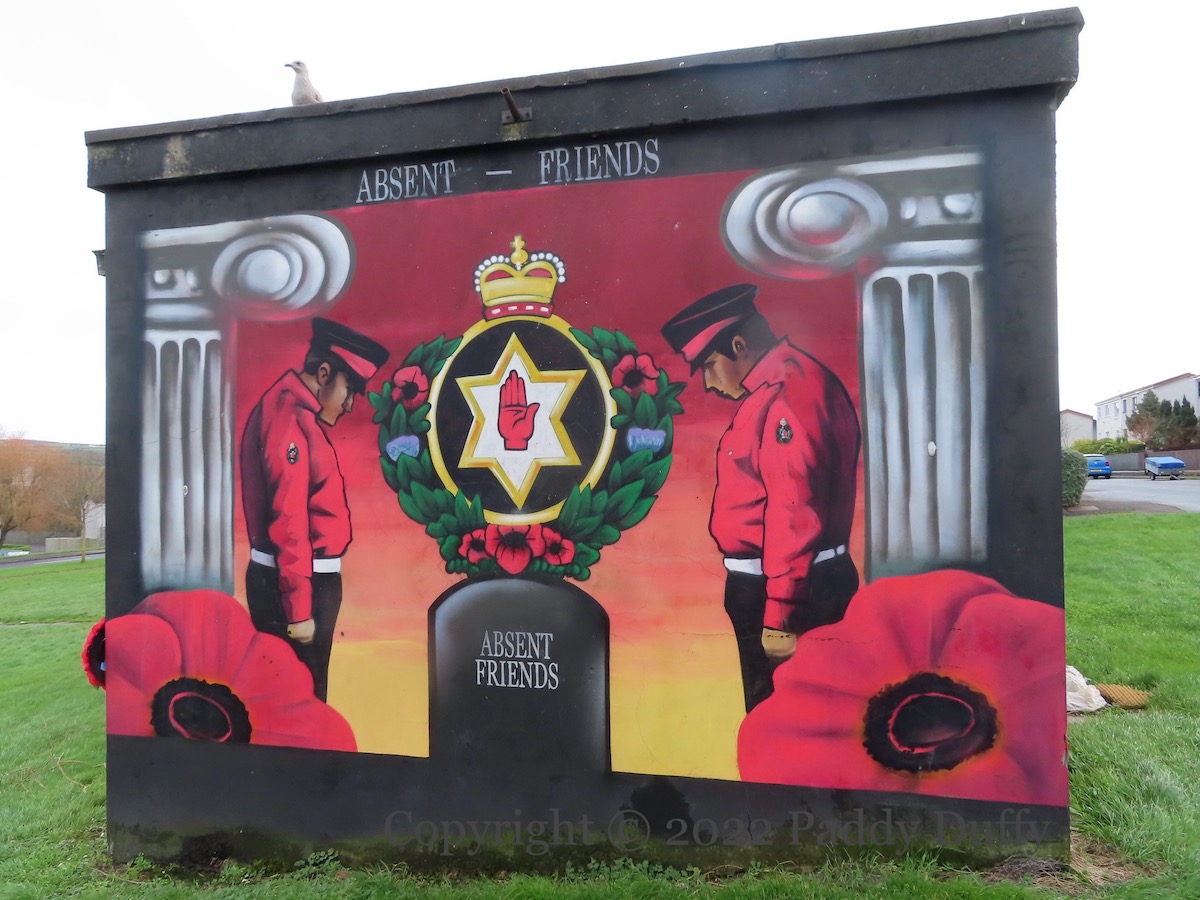
Two types of mourner at the grave of a fallen WWI soldier: on the left, comrades in arms; on the right, members of the family they left behind.
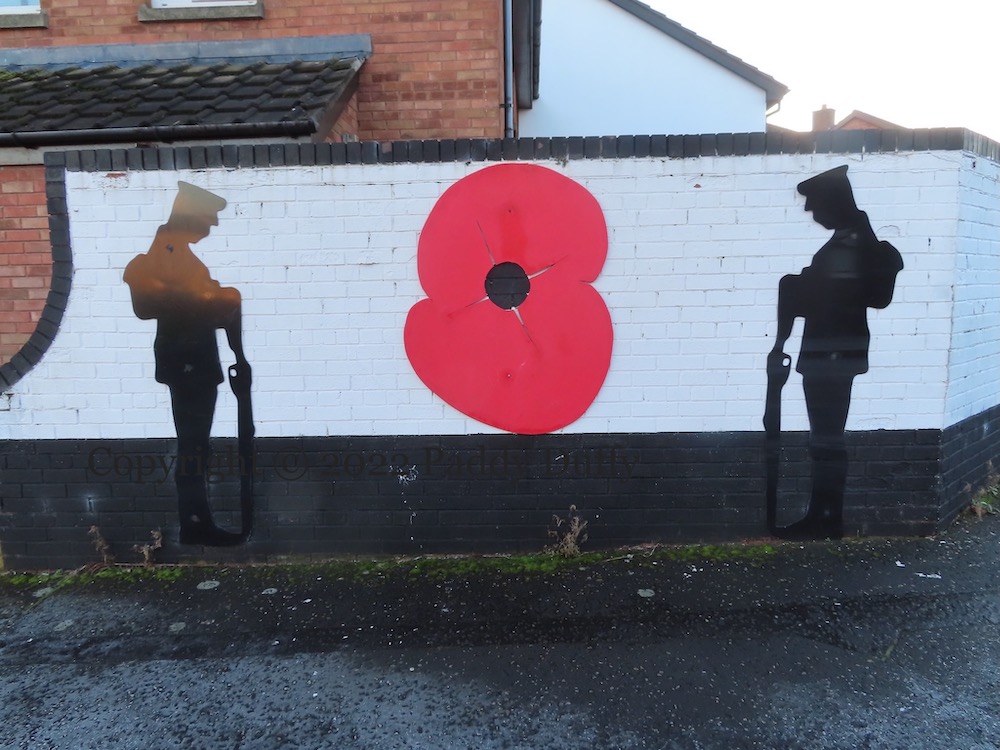
Work on the mural began in December, 2021, but progress seems to have stalled. One of the bayonets is in outline as is the giant poppy overheard. The effect is that the scene seems to be taking place under the stars.