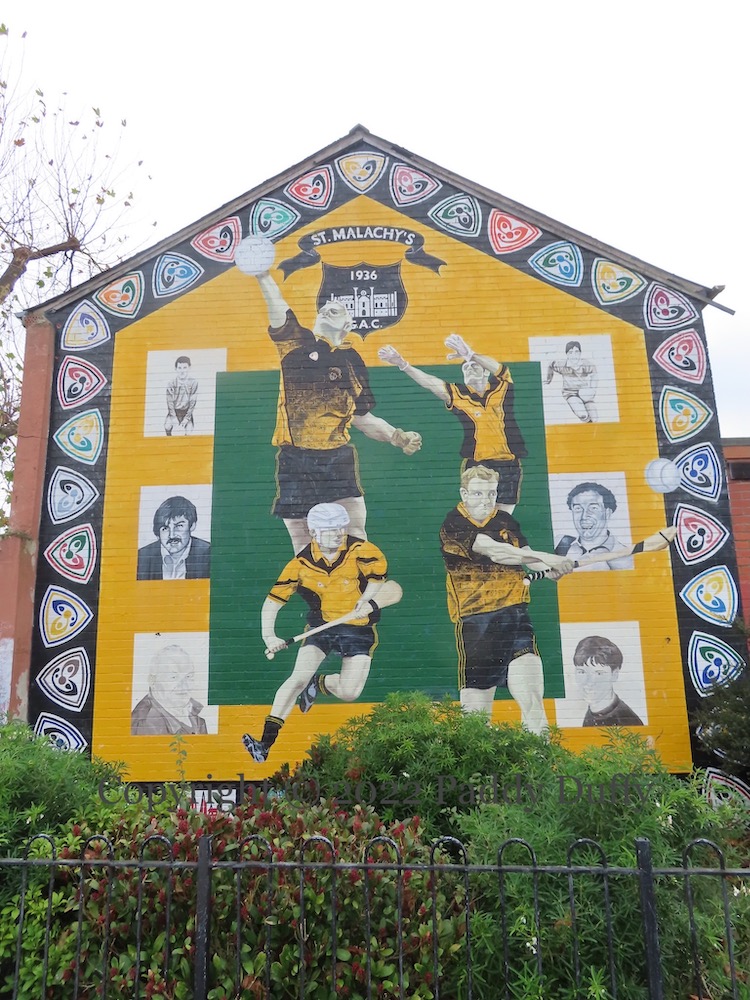
St Malachy’s (tw | Fb) is a junior (i.e. 2nd division/B-tier) GAA club established 1936 in the Markets area of south Belfast. It is not known who the six portraits are of (there were originally only the four at the corners – see M08137) or who the four players are. Get in touch if you have any information.
With sponsorship from Pulse, Belfast City Council, New Belfast Community Arts Initiative, the Housing Executive, and ?Brighten Belfast?
Soldiers from the 36th (Ulster) division in the trenches of WWI prepare to go ‘over the top’. One waits for the precise moment according to his watch, ready to fire a shot, while the other prepares to blow a whistle and launch a flare.
There is no definitive source for the quotation, and many sources are at odds, but all agree on the basic wording and that the words belong to George V: “Throughout the long years of struggle, [which now so gloriously ended,] the men of Ulster have proved [on many fields] how nobly they fight and die.” The date is given as ‘November 16’ or as ‘December’ 1918, and possibly come from a note sent to Edward Carson. The quote also appears on the Ulster Tower in Thiepval (Ulster Tower) and on the Cenotaph in Belfast (WP).
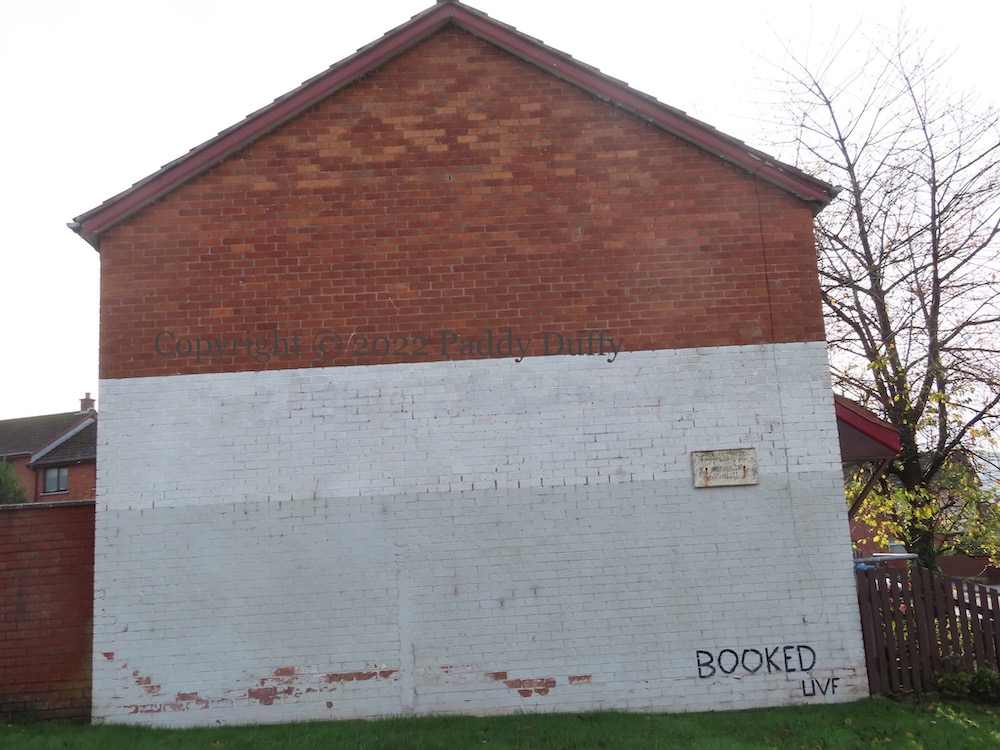
Included below is a “Booked UVF” on an adjacent wall. Queens Avenue, Glengormley.
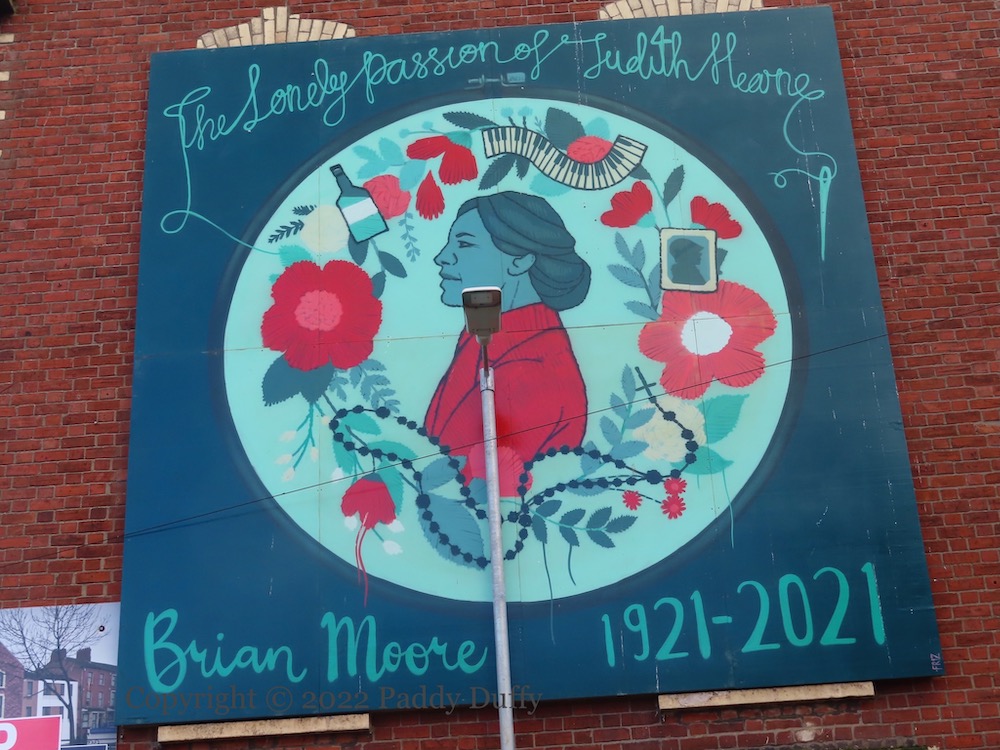
Novelist Brian Moore grew up on the Antrim Road and went to St Malachy’s, before emigrating to Canada in 1948. For the centenary of his birth in 1921, Paradosso Theatre adapted Moore’s best-known novel, (The Lonely Passion Of) Judith Hearne, for the stage and mounted this board in Duncairn Avenue, showing the elements of Judith’s life: the bottle, the beads, the aunt who raised her, the piano used for lessons, and her red coat.
The board by Friz (ig) replaces the anti-joy-riding mural “Where’s The Joy?”, the last to go of the three, the others having been in CNR west Belfast and PUL west Belfast.
This board has a dual purpose. On the one hand, it was part of celebrations marking the 75th anniversary of the Battle Of Britain, which was waged from July to October in 1940. On the other, it is part of an anti-racism project, celebrating in particular the contributions to the Battle made by roughly 145 Polish aviators (WP) and especially the 303 squadron: “The Polish nation – part of us then, part of us now”. The 303 was later stationed in Northern Ireland for a time. (BBC-NI)
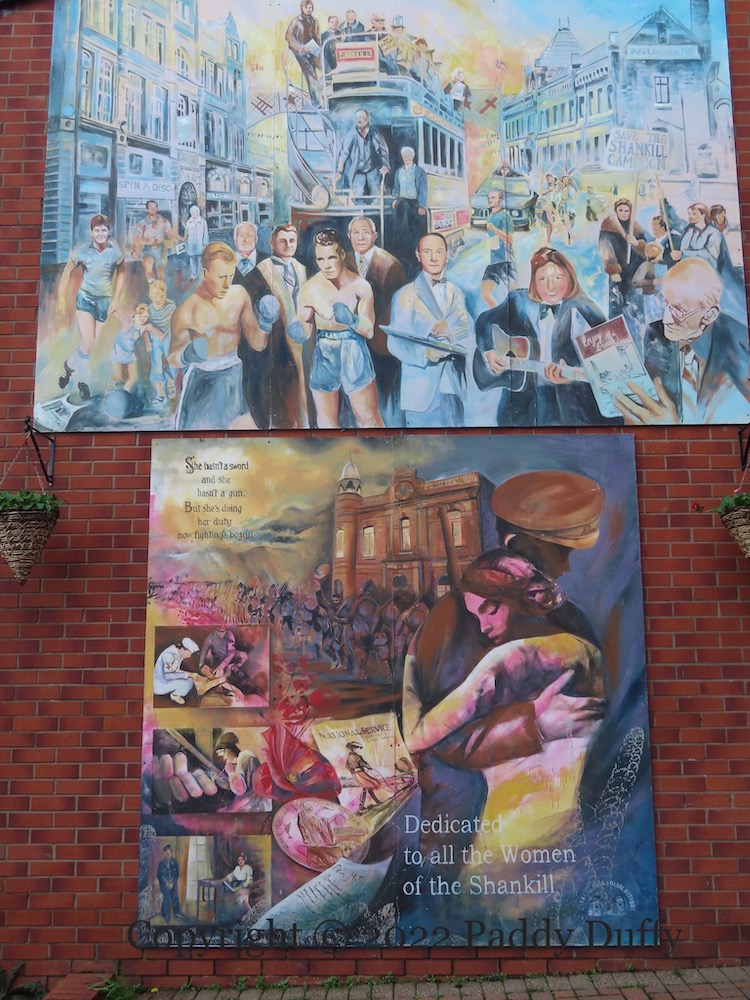
Here are two boards outside the Ulster Rangers Supporters Club (Fb) on the Shankill Road.
The upper one features a tram going under an Orange arch between the public baths on one side an Spin-A-Disc records on the other, surrounded by notable figures from the Shankill area.
Many thanks to Johnny Dougan of Shankill Area Social History (Fb) for the information below! Please e-mail or add a comment with additions or corrections.
Front, from left to right: Manchester United and Northern Ireland Soccer player Norman Whiteside (WP) and behind him boxer Davy Larmour and community worker Saidie Patterson (see WRDA), boxer Sammy (Cisco) Cosgrove, Senator Charlie McCullough (WP), Tommy Henderson, boxer Jimmy Warnock (original photograph here), Hugh Smyth (see previously Third Class Citizens), artist William Conor (see previously Conor’s Corner, Jack Henning (running), musician Belter Bell, writer Albert Haslett (Northern Visions interview).
Atop the tram: on the left is Jackie Redpath of the Save the Shankill Campaign (note other members of the group with placard on right; Northern Visions has a documentary about the Save The Shankill campaign) and Jack Higgins holding his book The Eagle Has Landed (WP). Up there too is Miss Sands, the music teacher in the Girls Model School, and historian Bobby Foster (Northern Visions interview). On the stairs are May Blood MBE and above her D.I. Nixon.
The lower board highlights the roles played by women during WWI as nurses and welders and in the Land Army. “She hasn’t a sword and she hasn’t a gun. But she’s doing her duty now fighting’s begun.” The forces are shown gathered outside the West Belfast Orange Hall, on the Shankill at Brookmount Street.
London street artist Dan Kitchener’s (web | ig) piece “Hope” features a Tokyo landscapes behind a geisha. “The wall is dedicated to Sandra – サンドラ. Sandra McCurry worked and owned Mikala’s Kitchen on The Shankill Road, Sandra worked tirelessly for the local community and sadly passed away” (Belfast Walking Tours Fb).
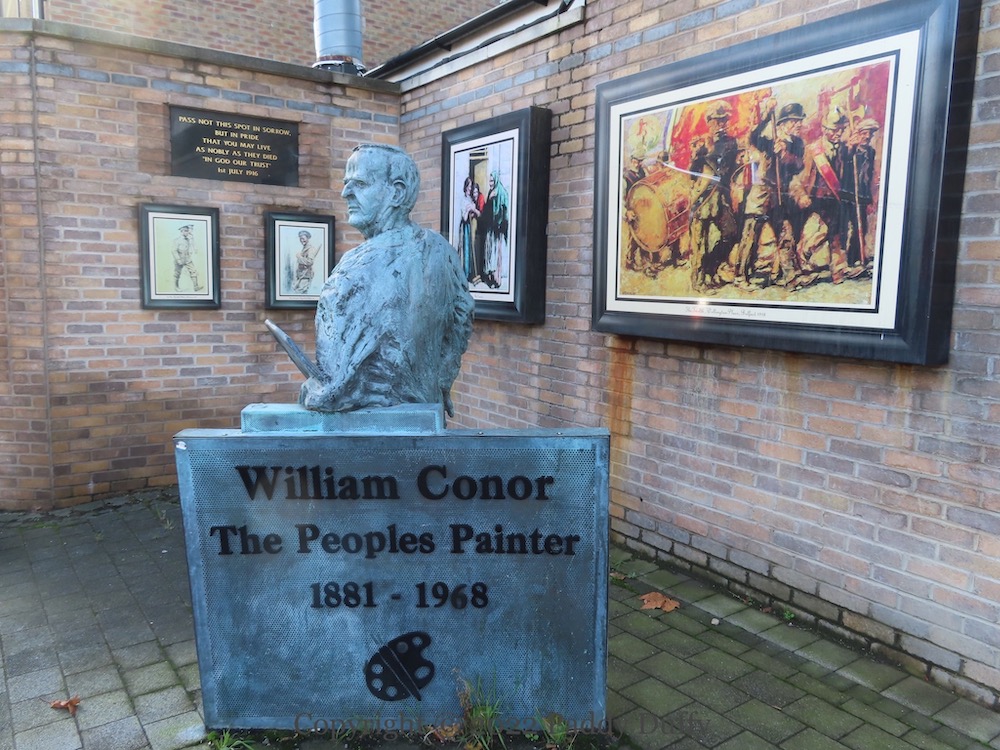
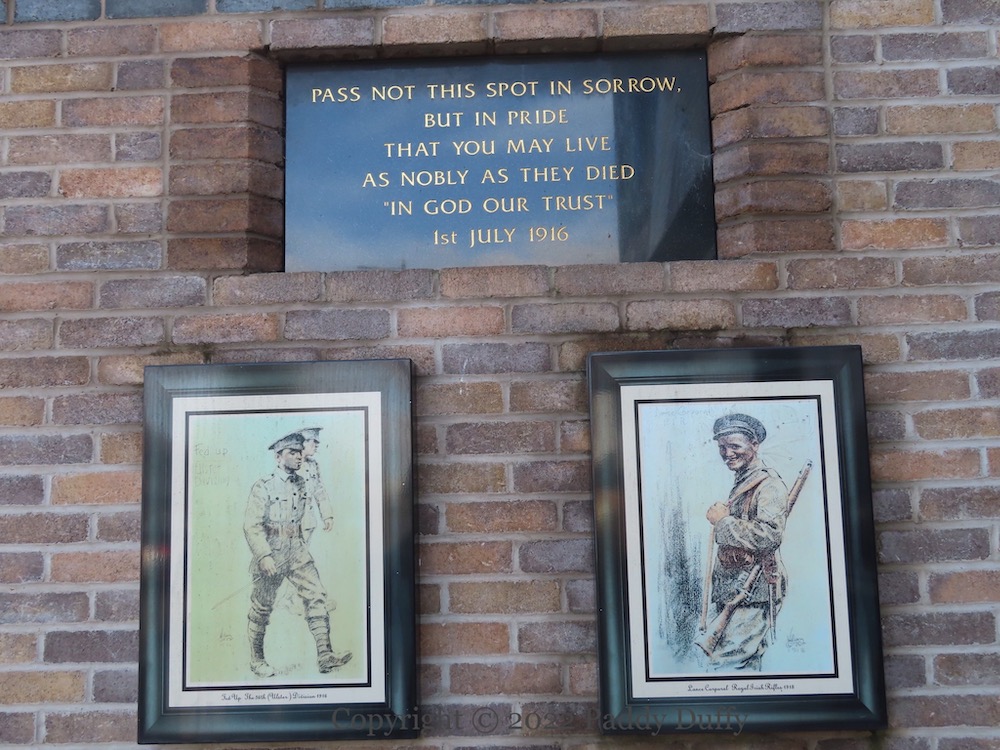
The geisha has (bizarrely) been situated above “Conor’s Corner”, where William Conor has been rendered in bronze by sculptor Holger Lönze and placed among a number of Conor’s paintings. (For images of the sculpture in progress, see Lönze’s site and the project’s Facebook page.) Connor (later Conor) was born in the Old Lodge area of Belfast (in 1881) close to the location of the new bronze statue shown in these images, which is at the corner of Northumberland Street and Shankill Road, replacing the UVF/Shankill Protestant Boys mural (see M02457).
The info board describes his methods in capturing the Belfast street scenes for which he is most famous: “Conor was developing a spontaneous drawing technique by recording quick impressions, and it soon became a habit for him to go out into the streets with a newspaper, which contained loose leaves from his sketchbook. When he saw anything of interest he leant against a lap post or wall, took out his newspaper as though he were simply reading the sports results and sketched away.”
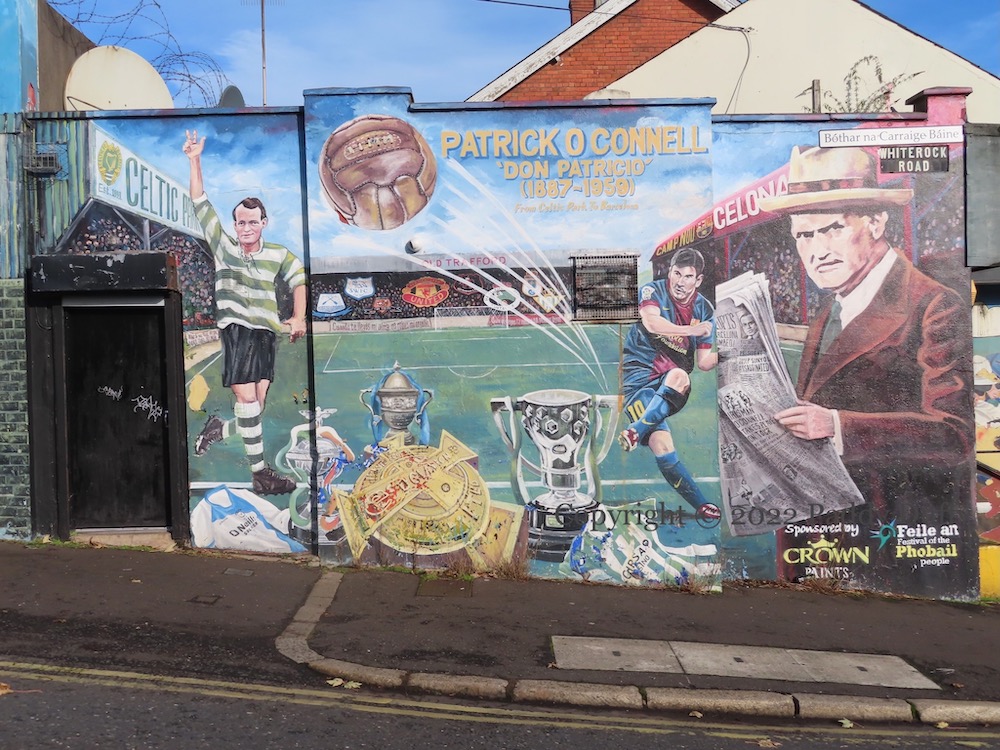
As a player, the Dublin-born Patrick O’Connell started with Belfast Celtic before moving on to various English and Scottish clubs, including a period at Manchester United at the time of WWI. He then went on to manage a string of Spanish clubs. As manager (“Don Patricio”) of Barcelona during the Spanish civil war, he accompanied the club on their tour of Mexico and the United States. The money from the tour saved the club from bankruptcy but 12 of the 16 players went into exile in Mexico and France. (WP) Barcelona returns to the US this month (2015-07) for games against the LA Galaxy, Manchester United, and Chelsea. (FCBarcelona)
The newspaper in the mural above crams all of this news onto one page: “Civil war erupts in Spain – Barcelona bombed”, “Football suspended – President [of FC Barcelona] Josep Sunyol assassinated” [by Franco’s troops] (WP); “Irishman O’Connell takes players on tour – FC Barcelona saved from extinction”; “Funds lodged in Switzerland”. In the bottom left-hand corner of the newspaper is Robert Capa’s famous photograph of ‘The Falling Soldier’, purporting to show a Republican soldier at the very moment he is struck by a bullet and dies. The image is now thought to have been staged (WP).
The player on the right is Lionel Messi. The Argentinian forward is shown in front of the Spanish League cup, which Barcelona won in the year the mural was painted (2014-2015) with a goal from “La Pulga” (“the flea”) – Messi is 5’7″ but four-time world player of the year.
The stands of three football stadiums are shown in the background: Belfast Celtic’s Celtic Park (“Paradise”), Manchester United’s Old Trafford, and Barcelona’s Camp Nou. The Old Trafford stands bear the emblems of the teams Patrick O’Connell played for and managed: Liffey Wanderers (whose shirt is also featured, on the left), Sheffield Wednesday, Hull City (The Tigers), Manchester United, Dumbarton, Real Racing Club de Santander, Real Oviedo, and Real Betis Balompié (also shirt on the right).
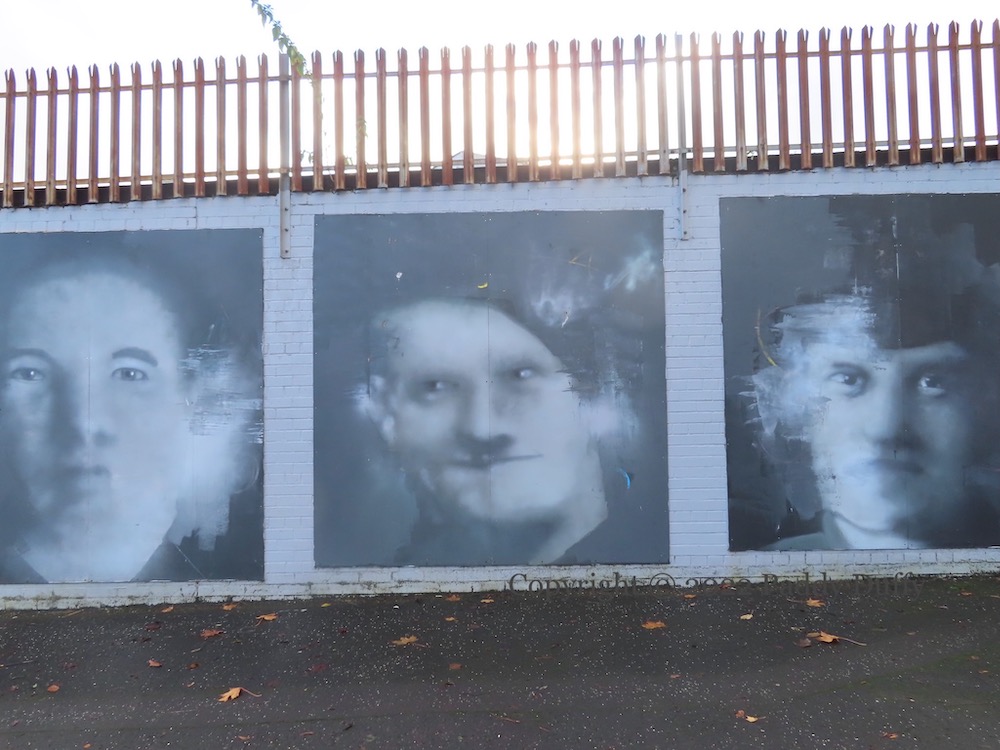
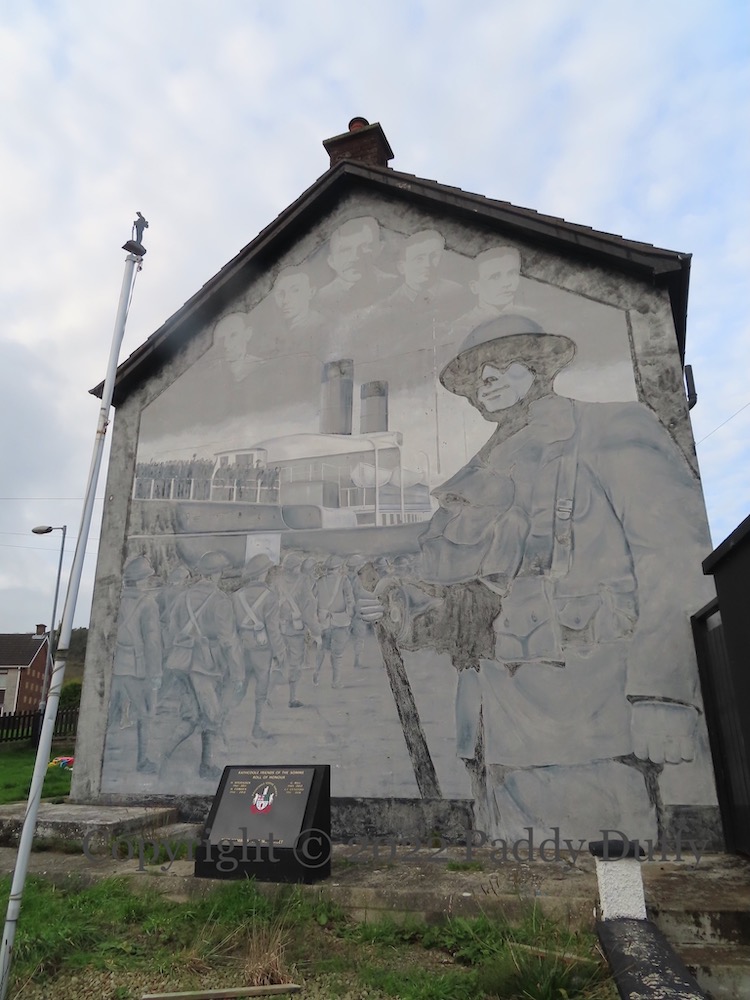
A memorial stone has been added to the fading mural of soldiers of the 15th battalion heading to France in 1915, beginning a list of former members of the Rathcoole Friends Of The Somme (Fb). For the names of the five portraits, and the mural in better condition, see Many Did Not Return.
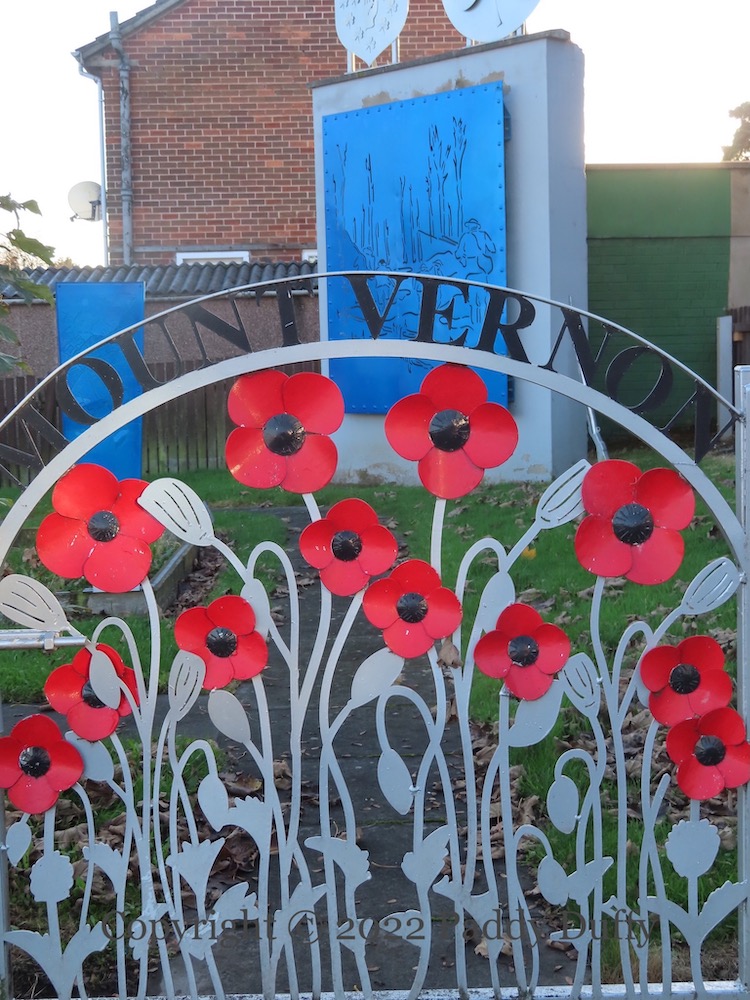
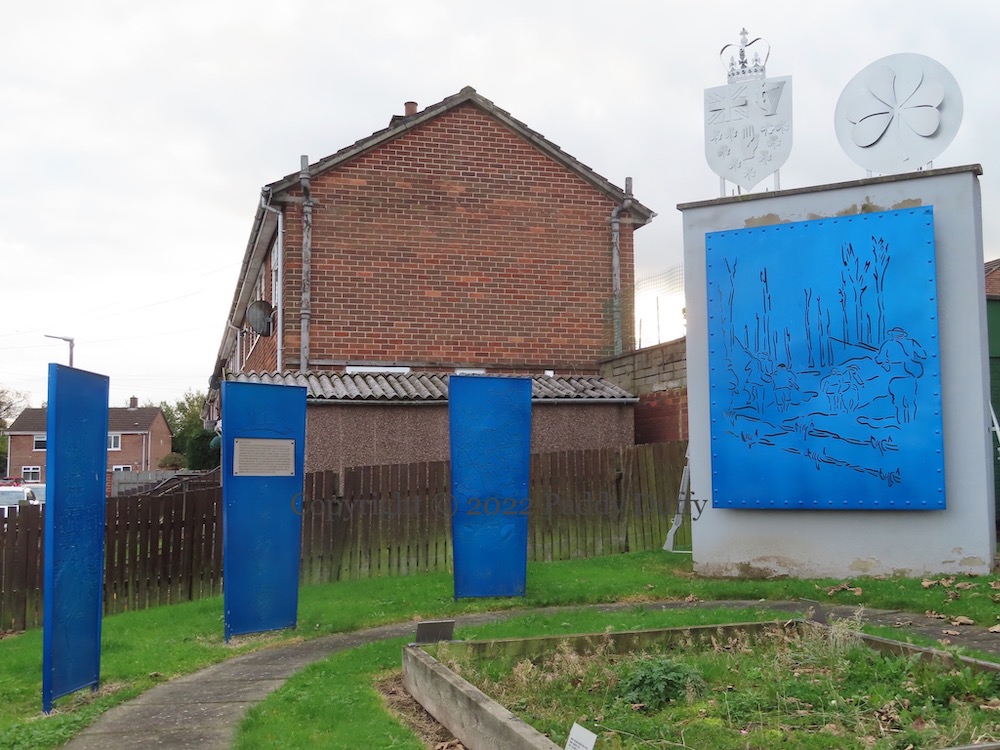
This metal gate of poppies opens onto a cluster of blue metalworks showing scenes from WWI and a map of the area around Messines. The silver emblems are of the 36th and 16th divisions.
For more, including the panels to John Cordon and William McFadzean, see M07770.