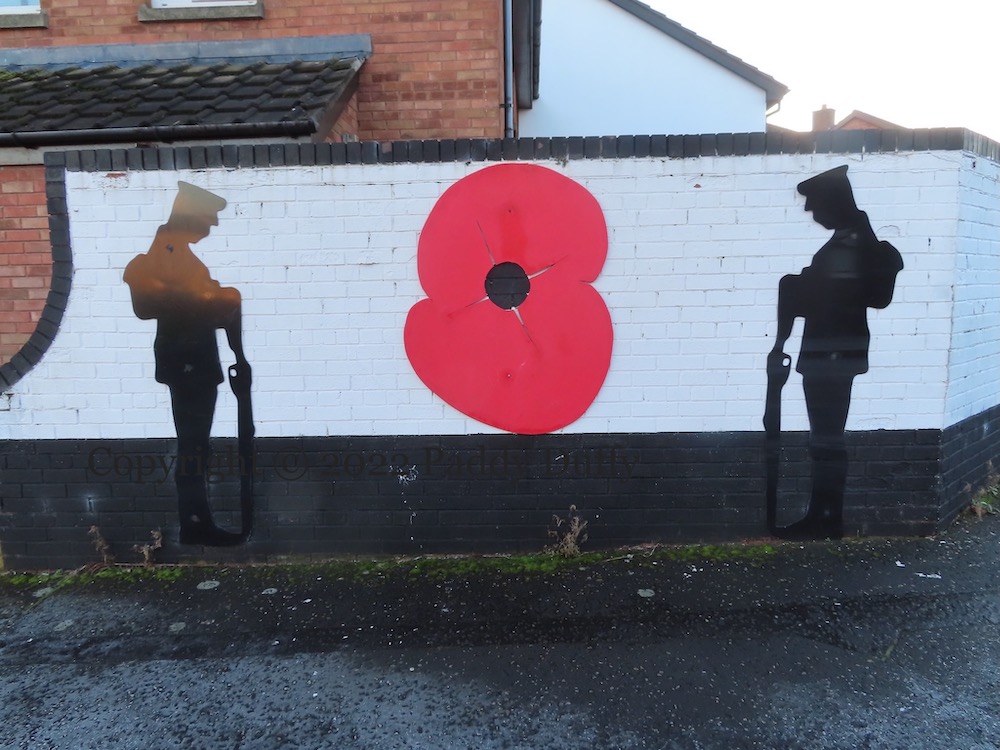
Two types of mourner at the grave of a fallen WWI soldier: on the left, comrades in arms; on the right, members of the family they left behind.
Work on the mural began in December, 2021, but progress seems to have stalled. One of the bayonets is in outline as is the giant poppy overheard. The effect is that the scene seems to be taking place under the stars.
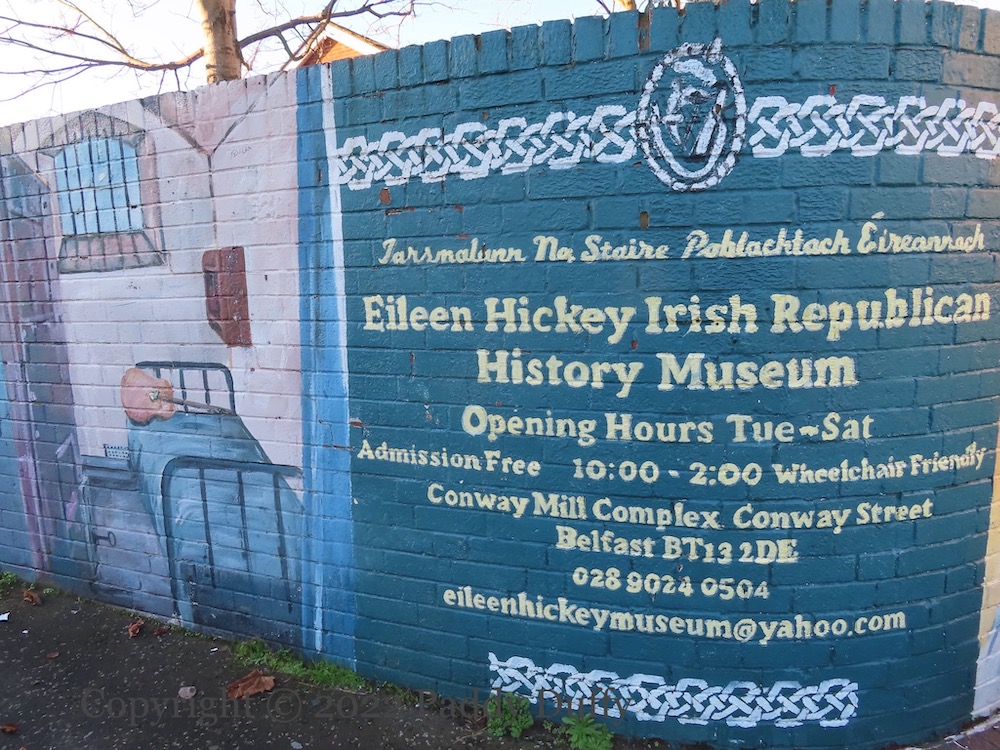
The ‘Eileen Hickey Irish Republican History Museum‘ — which is across the street from this mural and behind the Conway Mill — is named for Eileen Hickey, a Provisional IRA member who served time in Armagh prison; she died in 2006, one year before the opening of the museum (obituary at An Phoblacht).
Next to the opening hours is an image of a prison cell in the Armagh women’s prison. The museum itself contains a cell door and a bed from the prison.
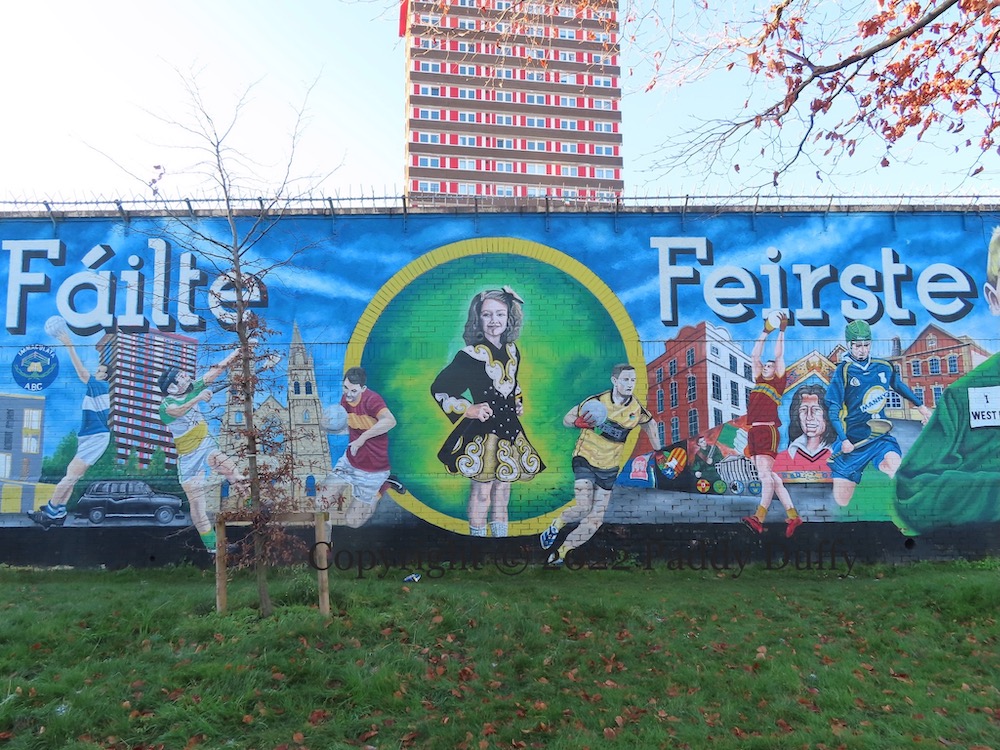
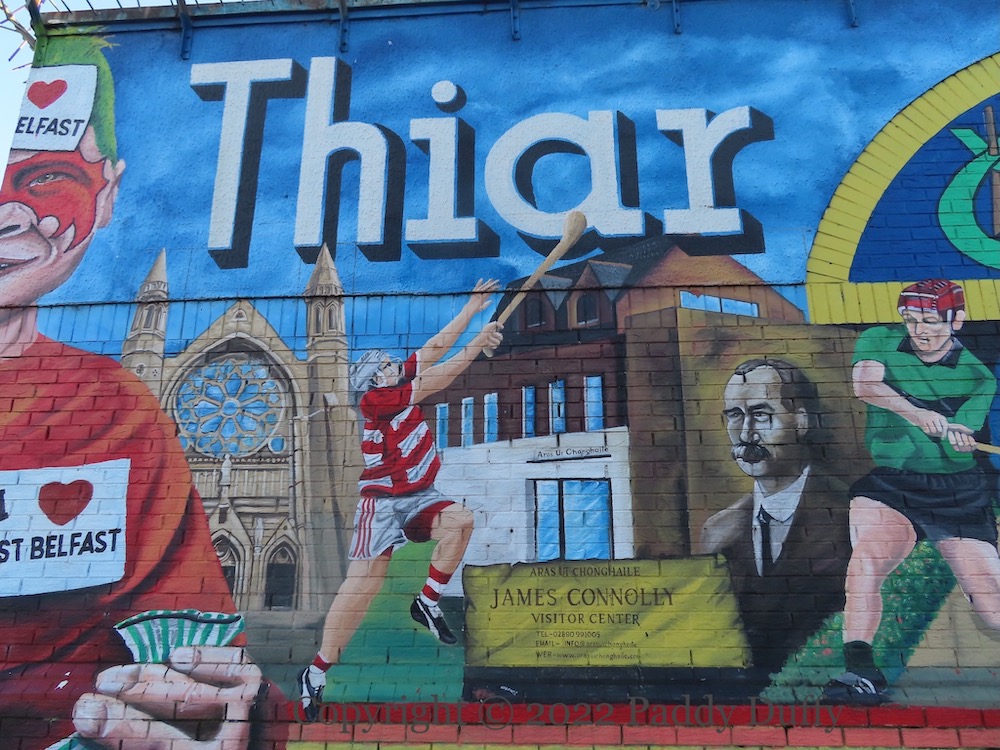
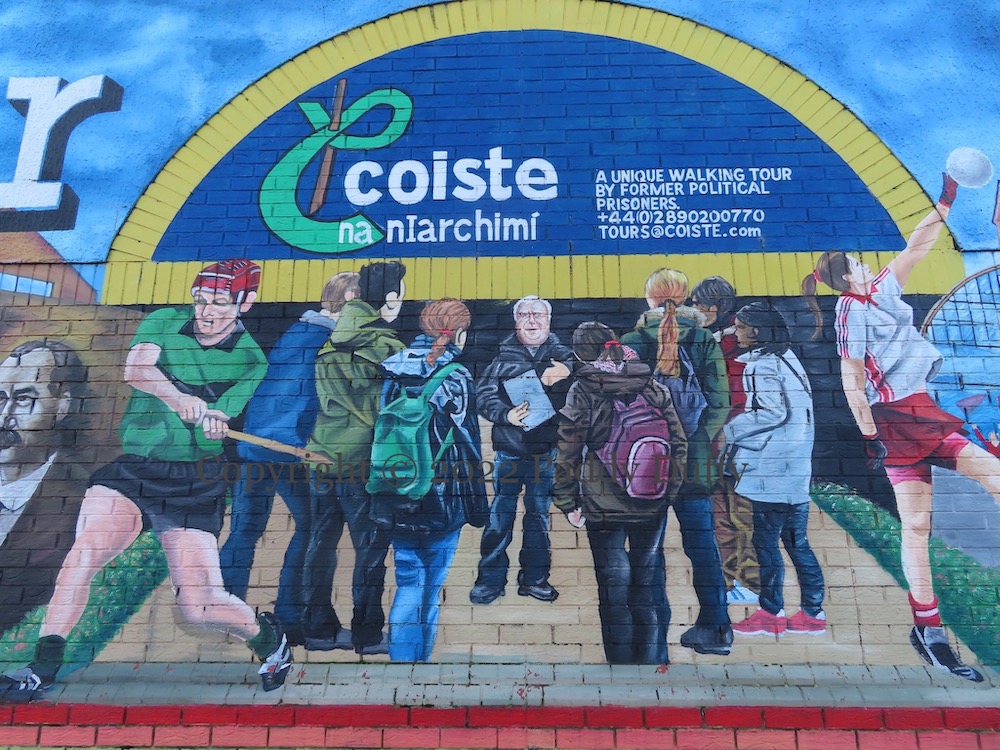
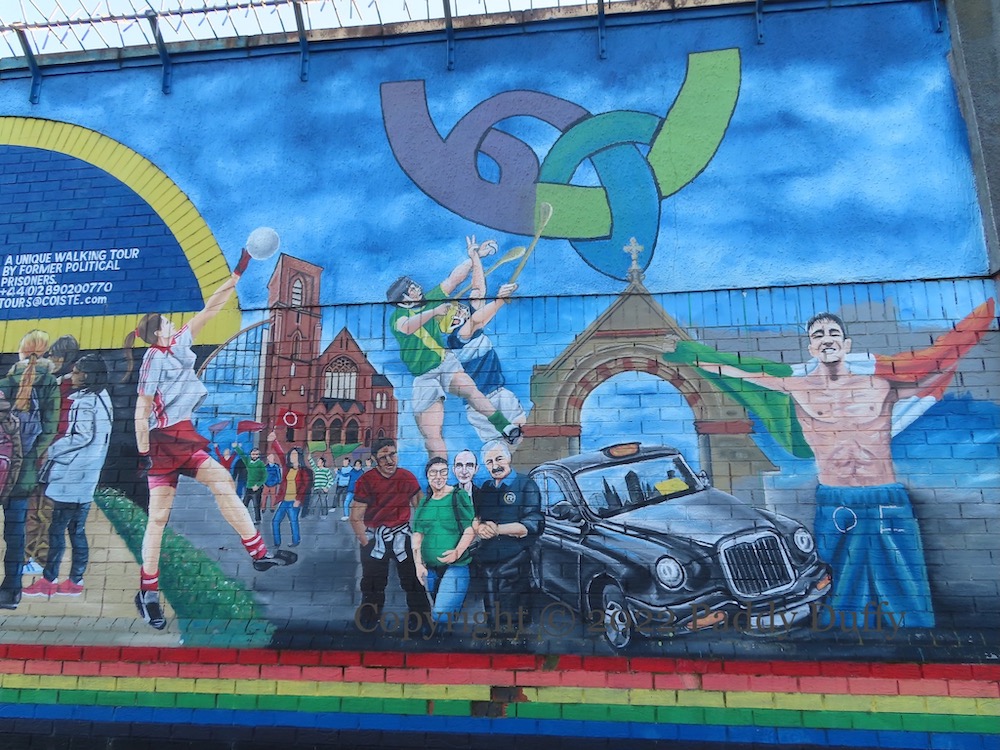
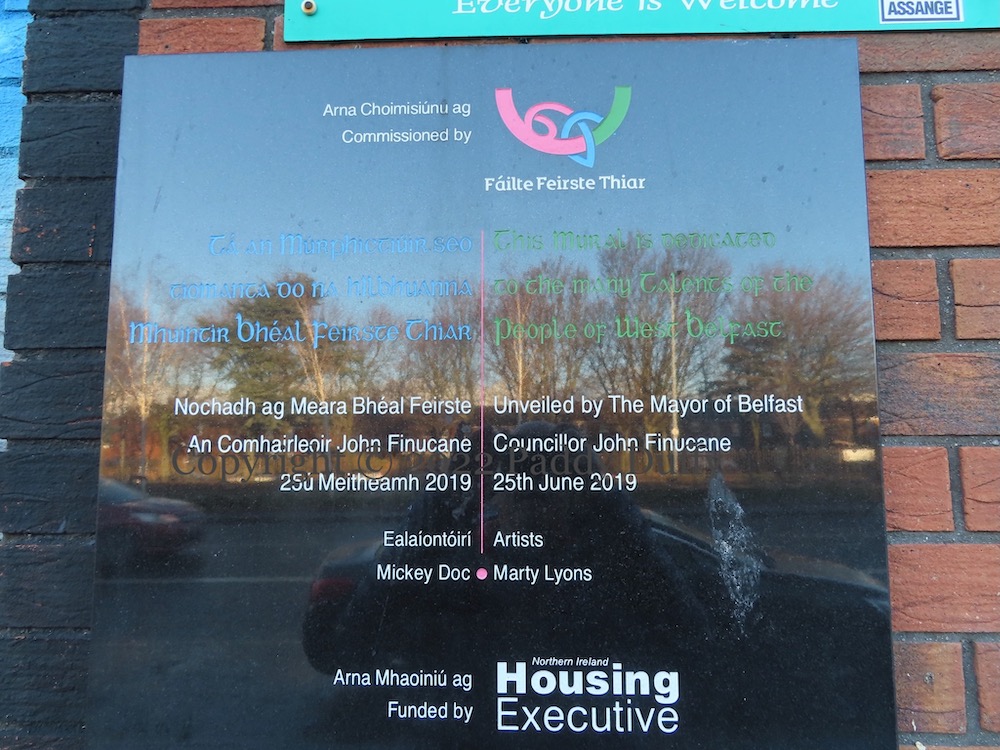
Fáılte Feırste Thıar‘s second mural (the first is outside its offices in the middle Falls – see Fáılte Feırste Thıar) reinforces the claim that (republican) west Belfast begins as soon as you cross the motorway, five minutes’ walk from the city centre. Coıste’s tour of republican murals begins at Divis Tower and the new mural already seems to be drawing tourists – see the final image, below. The previous Coıste mural (M04900) has been deleted and incorporated into the mural, promising tourists “a unique walking tour by former political prisoners”.
The mural is a mix of landmarks – the new Raıdıó Fáılte building (which is located just below the mural), Divis tower, St Peter’s, Conway Mill, the “international wall” of murals, the Bobby Sands mural, the Falls library, the new James Connolly centre, Cultúrlann, and Milltown cemetery – cultural images (Irish dancing and Féıle An Phobaıl) – and sporting images (clubs include Immaculata ABC, Gort Na Móna GAC, St Paul’s GAC). A gay pride ‘rainbow’ stripe runs below the Divis Street portion. Before the previous mural was painted (M07533), there was a Gateway To Belfast board at this spot.
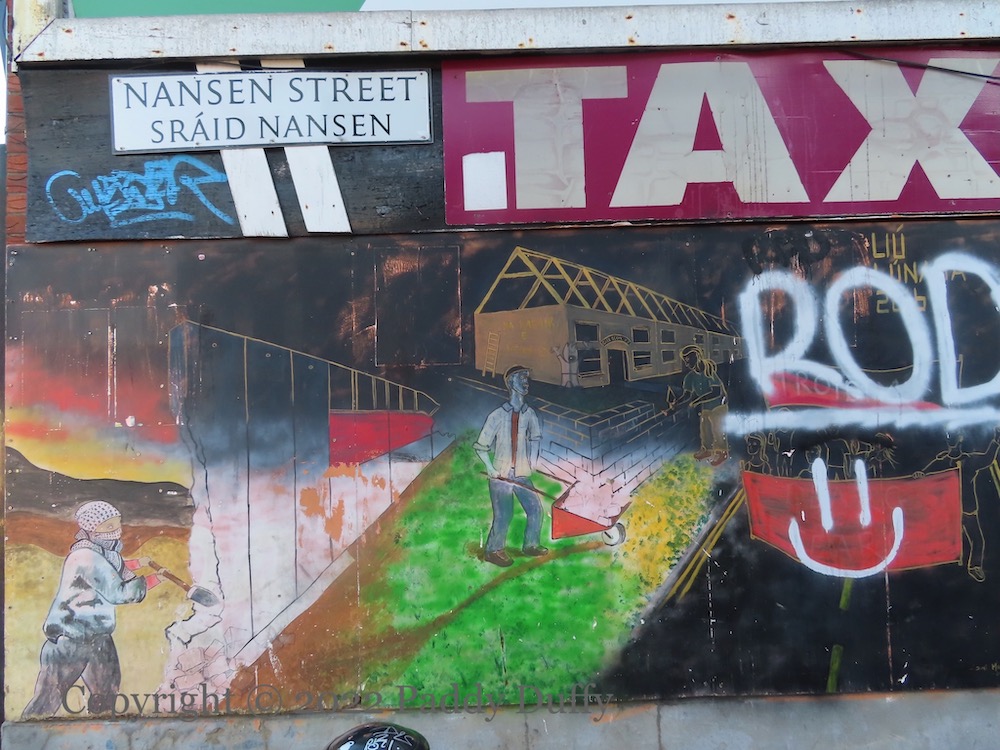
Lıú Lúnasa is an Irish language festival. The board above shows rocks taken from the wall separating Palestine and Israel being used to build a gaelscoıl (an Irish-language school). The mural was painted by Jımí Mac Fhlannchadha.
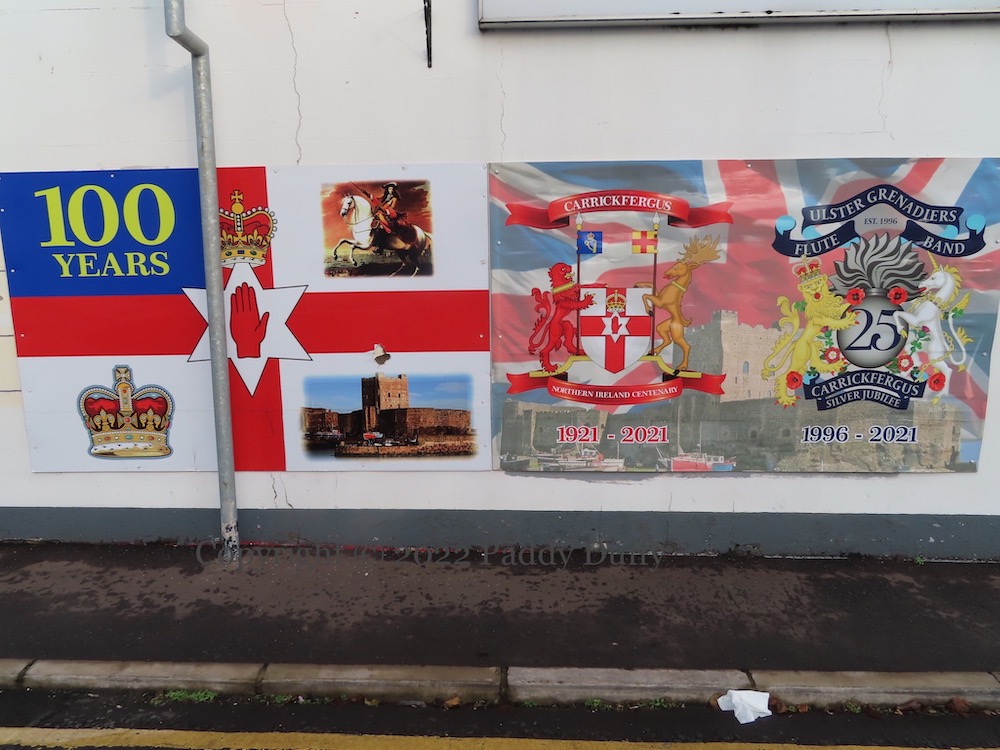
On the left of this memorial board in Carrickfergus are five portraits from the later life of the child who began life in Greece as Prince Philip of Greece and Denmark. The family was exiled during the Greco-Turkish War. He ended up in Britain where he later joined the navy and stopped using his titles when he became the British subject, Philip Mountbatten. When he married Elizabeth he became Prince Philip, Duke of Edinburgh. His life-time matches that of the Northern Irish state (see in the second image): he was born a month after its creation and died in 2021 at the age of 99, a month shy of its centenary.
These boards and banners are in Albert Road and Thomas Street, Carrickfergus, near the Orange lodge, (for which see On Foreign Fields). They are perhaps all sponsored by the Ulster Grenadiers flute band. “Carrickfergus says “No” to Irish Sea border”
“Sgt. Thomas George Wortley , “D Coy” 14th Btn. Royal Irish Rifles, Service No. 14/17063, Died Messines 07-06-1917, Spanbroekmolen British Cemetary Grave C10″. Wortley was born in Carrickfergus, lived in Belfast, died on the first day of the battle at Messines (findagrave), buried in a small cemetery of British soldiers, many from the 36th (Ulster) Division, in Spanbroekmolen on the Ypres Salient in Flanders (WP) – shown in the mural – and is remembered in Carrickfergus with a parade each year on the date of his death (carrickfergusrollofhonour).
Bowtown (Newtownards) marks the passing of Elizabeth Windsor in September, 2022, at the age of 96 and after 70 years as monarch of the United Kingdom and various Commonwealth realms, with two boards at the junction of Abbot Drive and Movilla Road: “Her majesty Queen Elizabeth II – the Bowtown est[ate] thanks you for your service 1926-2022.” “Her majesty Queen Elizabeth II 1926-2022 – grief is the price we pay for love.”
In this board the Rising Sons Flute Band (“RSFB”) portrays itself as following in the footsteps of the Ulster Volunteers who joined the British Army and specifically the 8th battalion of the Royal Irish Rifles in the 36th (Ulster) Division, which was drawn from east Belfast’s Ulster Volunteers in 1914.
Tommy Dickson ended his career (in 1965) with a partial season at Glentoran. Before that, however, he spent 16 seasons in the first team at Linfield, scoring 451 goals and leading the club to titles in the League Cup, Irish Cup, Gold Cup, Ulster Cup, City Cup, North-South Cup, and County Antrim Shield (shown at the top of the mural). (WP)
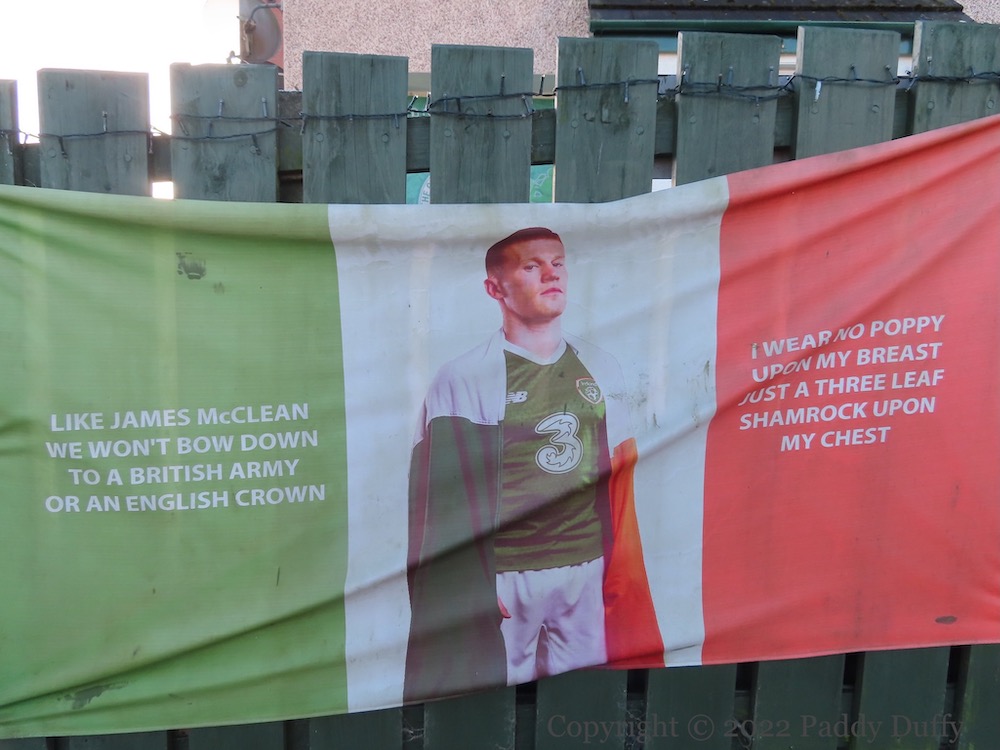
Here are two soccer-related images from Gardenmore Road, in Twinbrook. Above, James McClean in his Ireland strip – “Like James McClean we won’t bow down/To a British Army or and English crown.//I wear no poppy upon my breast/Just a three leaf shamrock upon my chest.” (though McClean is shown wearing the 2016-2018 jersey which featured a ball rather than an FAI shamrock).
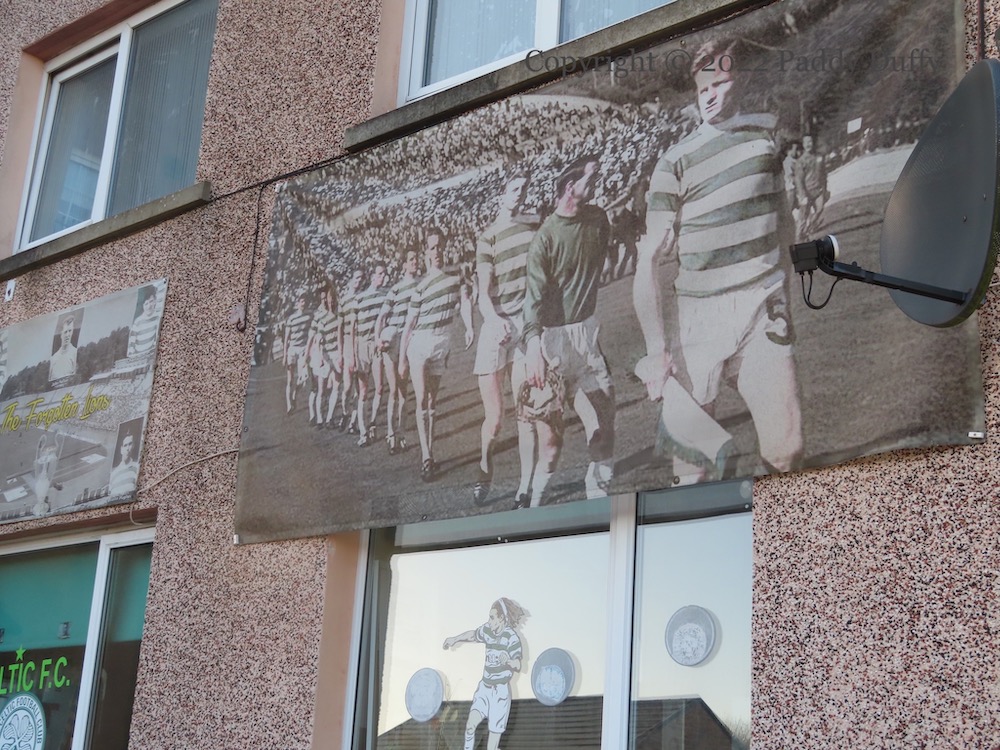
The other three leaf shamrock familiar from soccer is that of Scottish team Glasgow Celtic, which is widely supported among the CNR community.





 Paddy Duffy Collection