Ulster Sails West

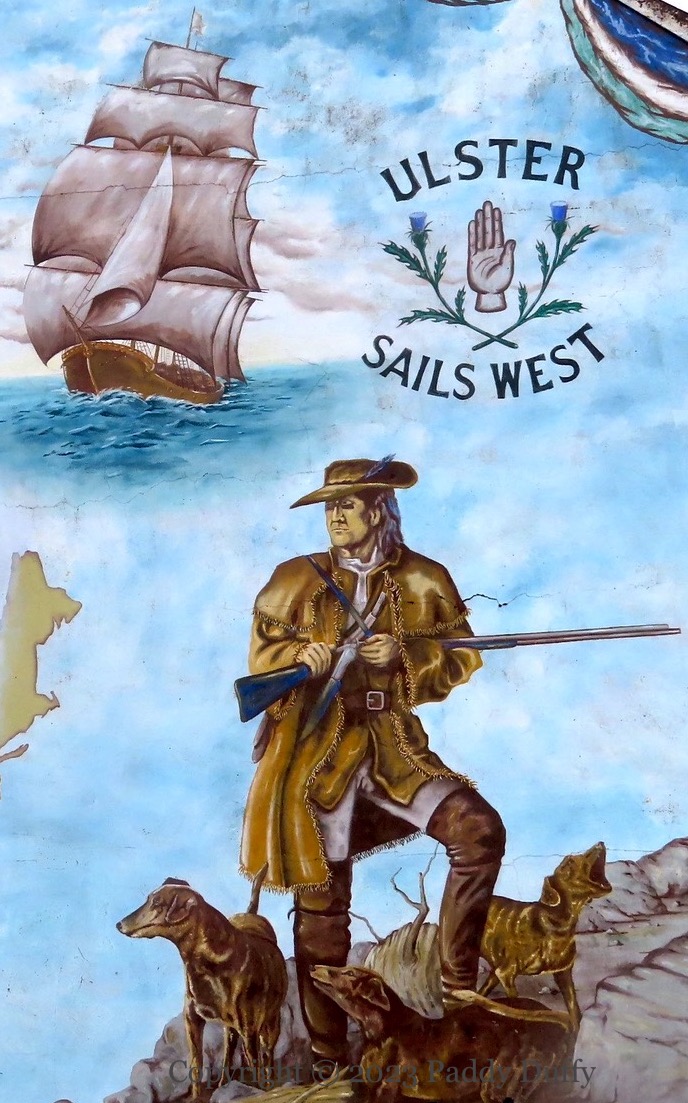
This Ballymoney mural goes all the way back to at least 2004 and to the wave of Ulster-Scots – or as here, “Scotch-Irish” – murals painted in PUL areas after the promotion of Ulstèr-Scotch as a parallel language to Irish by the Good Friday/Belfast Agreement.

As the Visual History page on Ulster-Scots Murals shows, most of these murals made a connection to (what would-become) the United States, to where about a quarter million people emigrated (WP). The mural is intended to tell a story of emigration (signified by the sailing ship), American independence (the McKinley quote), and American expansion (the frontiersman).

The Scotch-Irish were Presbyterians and supporters of breaking the ties to Great Britain. In 1893, Governor Of Ohio (and later US President) (Ulster Nation) William McKinley said, “They were the first to proclaim for freedom in these United States. Even before Lexington [i.e. the outbreak of the Revolutionary War, on April 19, 1775] the Scotch-Irish blood had been shed for American Freedom.” (According to William Marshall’s book Ulster Sails West, the battle McKinley is referring to took place on the Alamace river in North Carolina in 1771 (p. 29).)

The frontiersman on the right is generally taken to be David “Davy” Crockett, from the 1830s (Rolston in Al Jazeera | McCormick J2024); it is in fact a 1991 sketch of a generic frontiersman by David Wright (web), called “The Long Knife”, and the figure is referred to generically as “a trapper” by the artist (BBC).

None of the conquests of European-American colonists provides a good parallel to unionism, due to the complicated nature of political conflicts both there and here. The Americans, of course, threw off British rule in their revolution; Irish unionists want to remain part of the UK. And Crockett died in the Battle Of The Alamo in the Texas Revolution; that is, he died fighting for Texan independence from the Mexican government, which again doesn’t line up well with the desire of Irish unionists to remain part of the United Kingdom. (For another strained analogy involving the Scotch-Irish and US political history, see The War Of Northern Aggression and its discussion in the Ulster-Scots Murals page.)

The reason for its inclusion is the simpler idea that the Scotch-Irish are a rugged and feisty people who are not to be trifled with, whether in North America or Ireland.

Painted by Kenny Blair (Fb) in Hillview Avenue, Ballymoney; sponsored by the North Antrim Cultural And Musical Society and funded by the Heritage Commission. “Ulster Sails West” is the title of a 1943 book by WF Marshall (Isles Abroad).

Hillview Avenue, Ballymoney

Click image to enlarge
Copyright © 2023 Paddy Duffy
T03233c T03232
Daddy’s Home

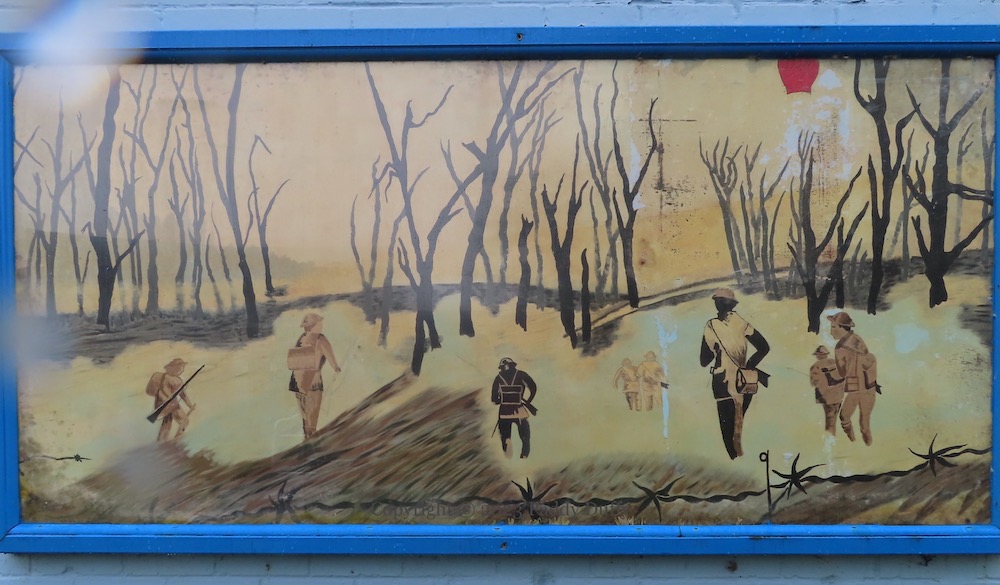
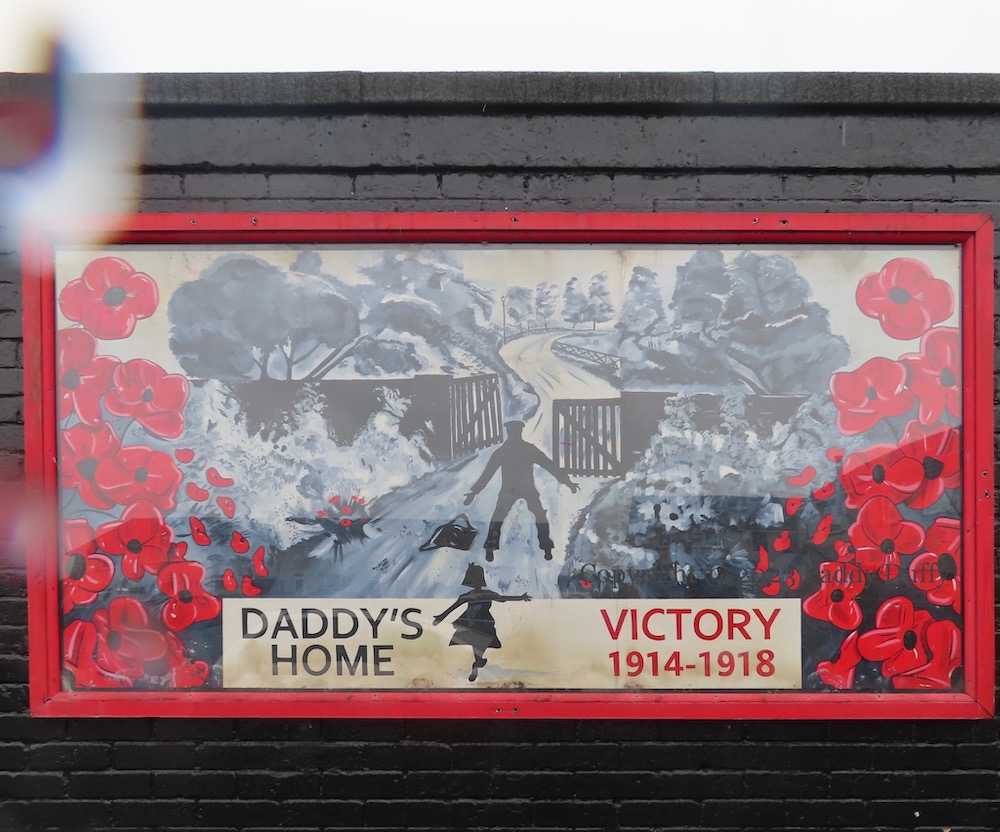
There was previously a mural of the UDA emblem and flags on the substation on the Loughanhill side of Ballysally (Coleraine) (seen in The Hell They Call Highwood) which has now been replaced by the painting of a daughter greeting her father who is returning home after “Victory 1914-1918”. There is also a new version of the painting of the attack on Highwood, as seen below.

The style of the paintings and their frames is the same as the panels in Footsteps Through Our History.

Click image to enlarge
T03282 T03281
Copyright © 2023 Paddy Duffy

Cloughfern Young Conquerors 50th

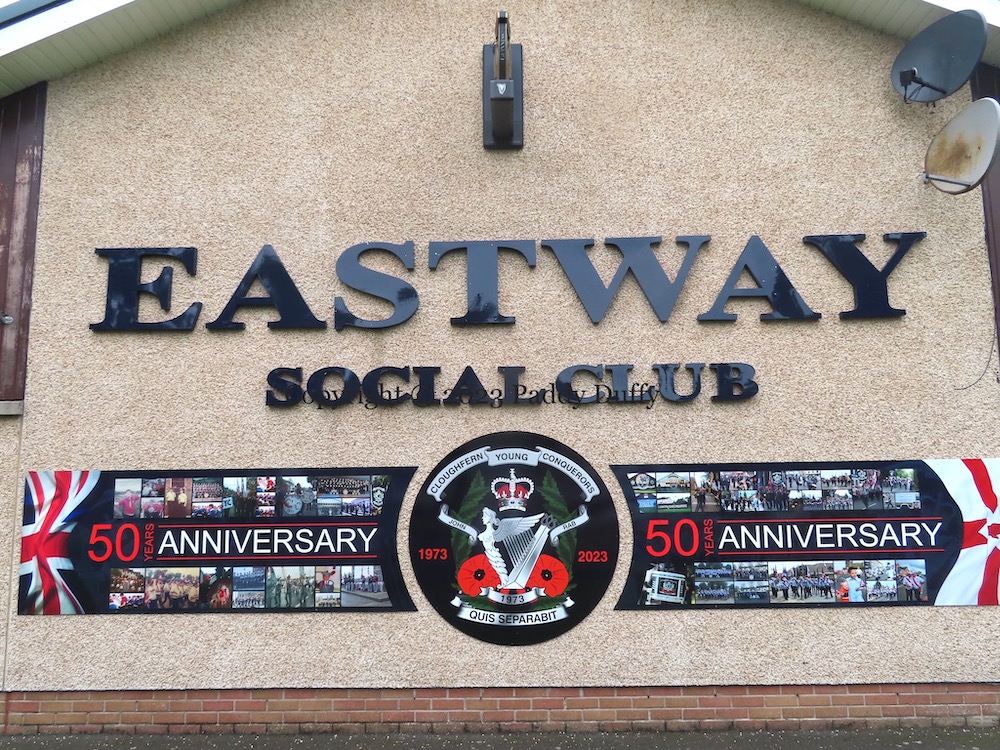
For their “50th anniversary 1973-2023” the Cloughfern Young Conquerors (Fb) mounted a new board on the wall of the Eastway social club in Rathcoole; a parade and fun day took place on August 19th (Fb).

Back in June, a mural was painted on the long wall at the entrance to Cloughfern; see 50 Years Unbroken.

Click image to enlarge
Copyright © 2023 Paddy Duffy
T03213

The Skins

The Inniskilling Fusiliers were recruited from the four Ulster counties of Fermanagh, Tyrone, Derry, and Donegal. In WWI, battalions also served in the 4th, 29th, and 10th Divisions, as well as the 109 Brigade of the 36th Division. In WWII (represented here by the Spitfire in pursuit of the Messerschmitt) the Fusiliers served in France, India, and Italy. (Ciroca | Long Trail | WP)

(For a broader history, from the Williamite campaign to modern Afghanistan, see Inniskilling.)

This Tyndale mural appears to have be painted without fanfare in 2022.

Click image to enlarge
Copyright © 2023 Paddy Duffy
T03182 [T03183]

Leckagh Remembers The Fallen

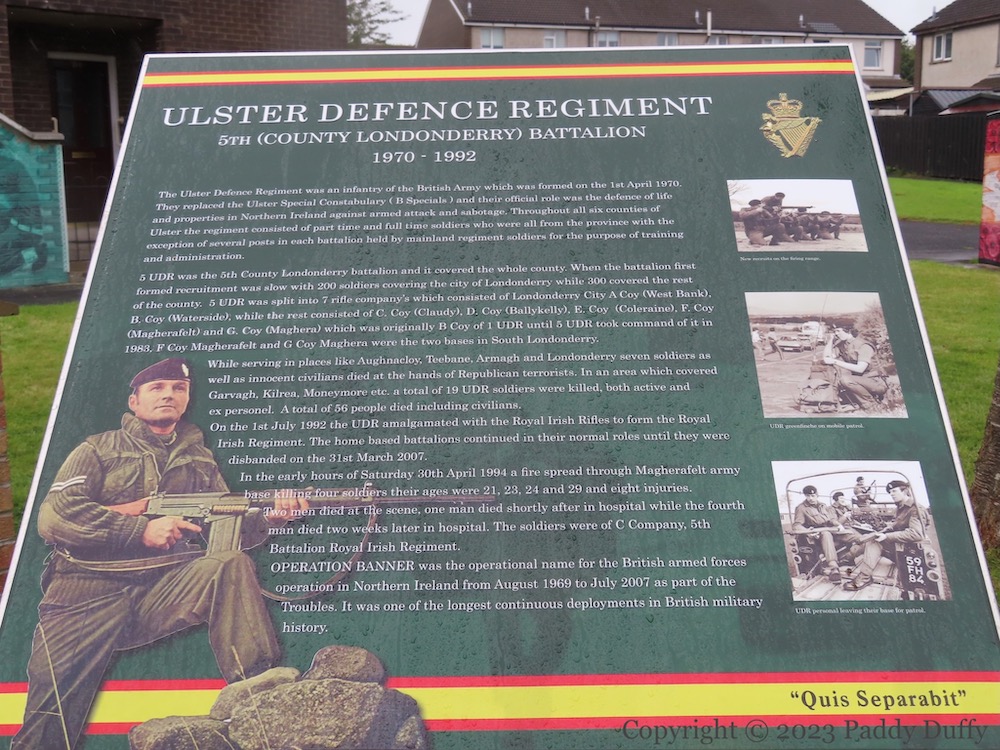
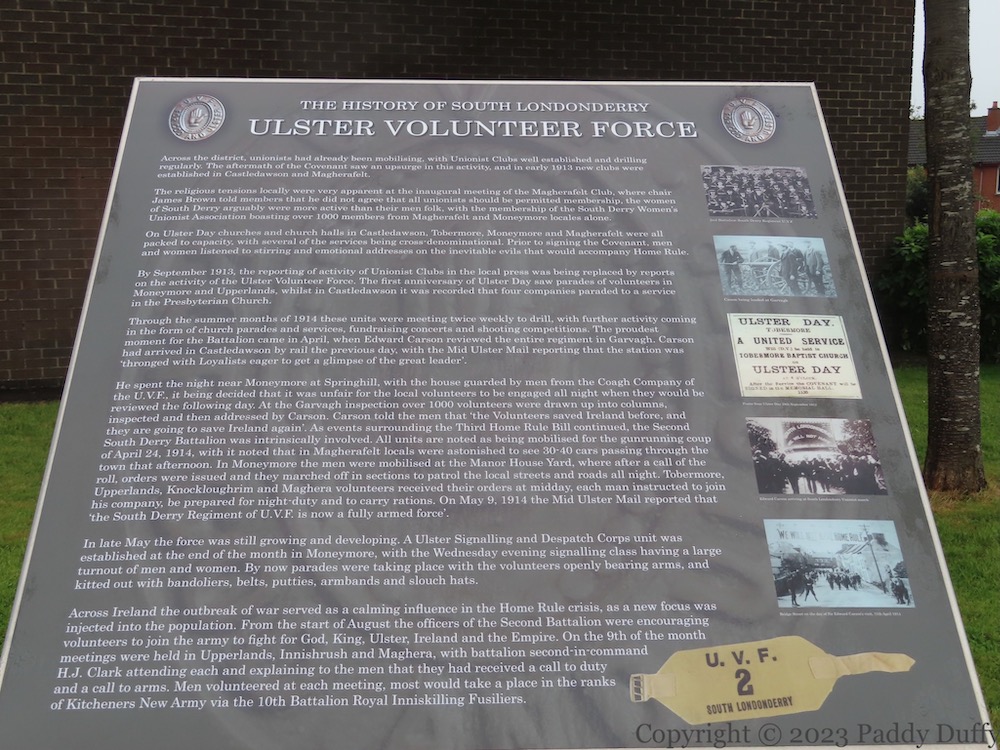
This selection of images from Leckagh Drive, Magherafelt, focuses on the memorials to the dead of WWI (and WWII in the mural above), with an additional board commemorating the UDR 5th (County Londonderry) battalion); there is also a mural and some plaques commemorating (modern-day) UVF volunteers, which will be in tomorrow’s post.

The board shown in the final image provides a history of the South Londonderry volunteers from towns such as Magherafelt, Castledawson, Moneymore, and Tobermore. Edward Carson reviewed the volunteers in April 1914. Later that same month, arms were received from the weapons landed in Larne. In the Great War, the men from the area served in the 10th battalion of the Royal Inniskilling Fusiliers in the 109th brigade of the 36th Division.

Click image to enlarge
Copyright © 2023 Paddy Duffy
T03155
T03142 [T03141]
T03143 T03144 T03146

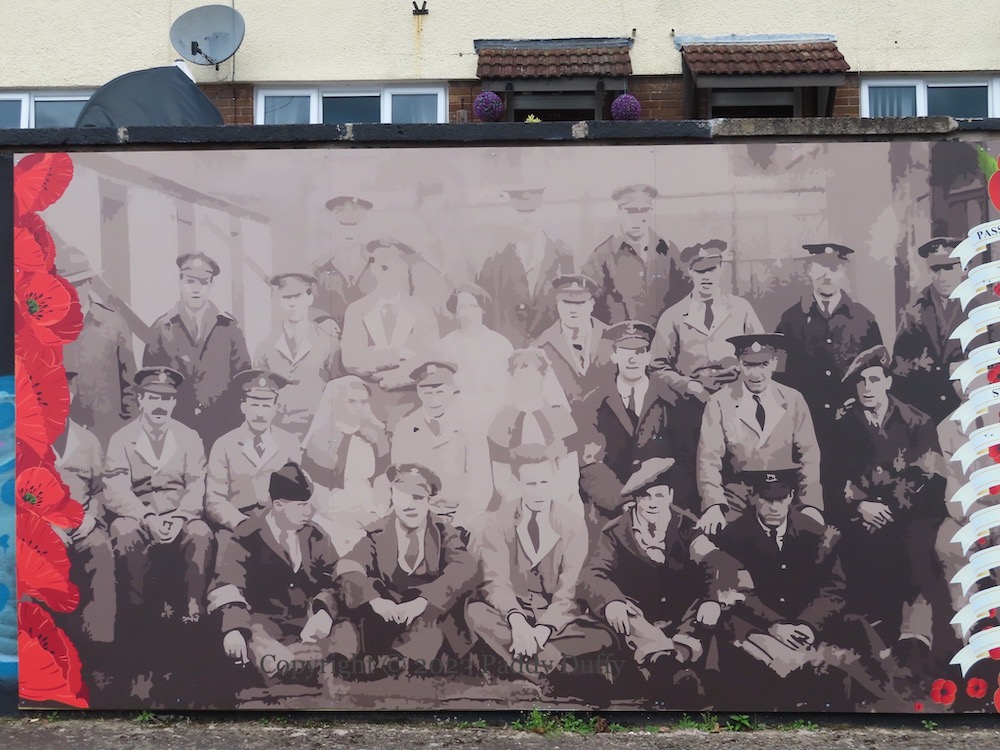
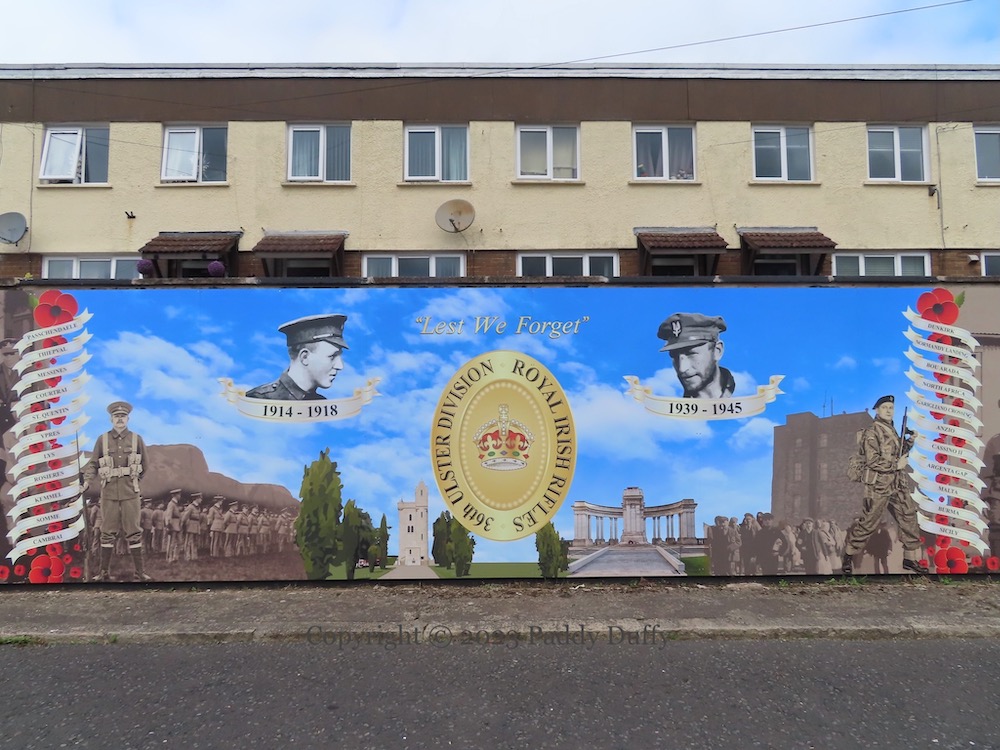
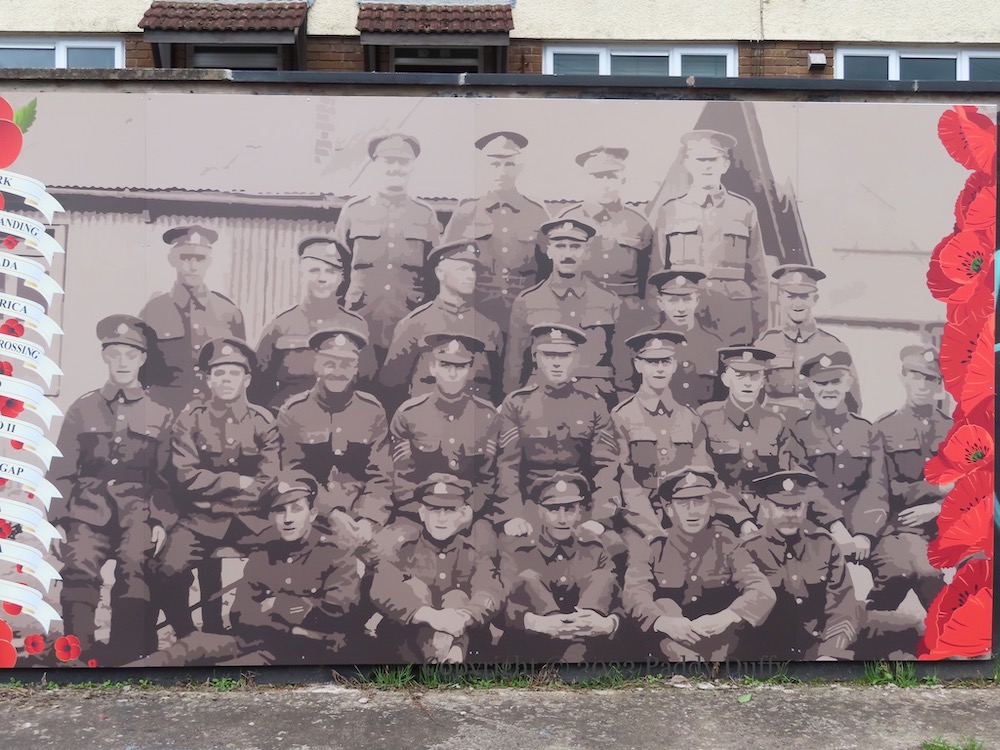
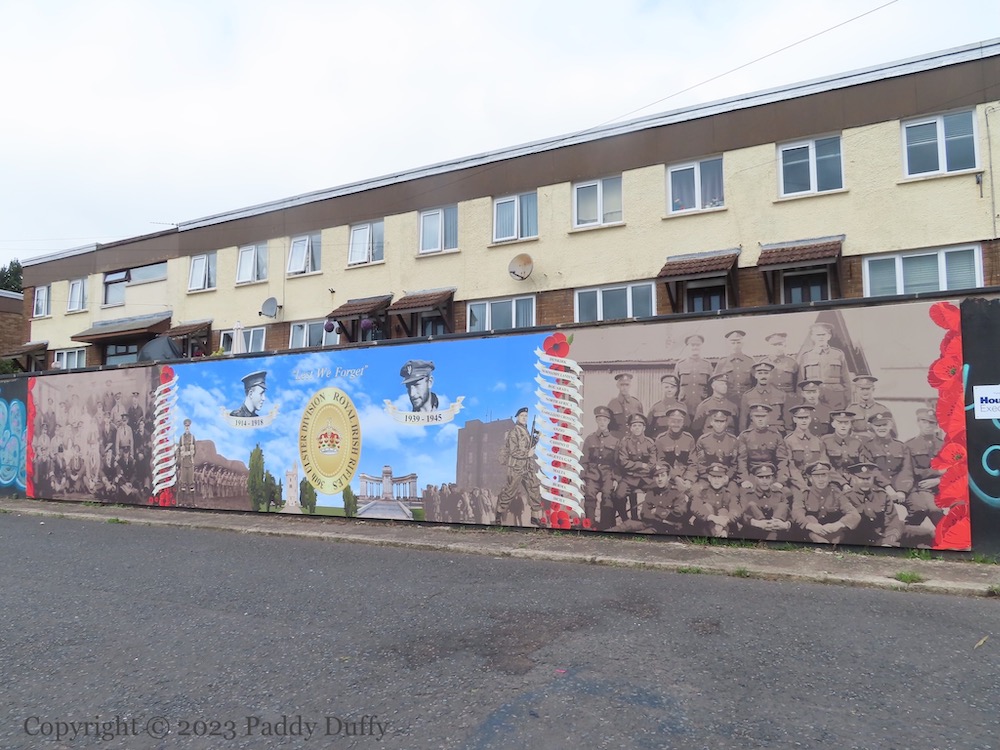
Royal Irish Rifles

After WWI, the Royal Irish Rifles became the Royal Ulster Rifles (and later became part of the Royal Irish Rangers). This board prioritises WWI as the Rifles were part of the 36th Division. The hero of WWI portrayed in the central panel is William McFadzean, awarded the VC for falling on two live grenades in the trenches on July 1st, 1916. McFadzean is familiar from many previous murals both individually and in the company of other VC winners; for his family home in Cregagh, see Rubicon.

Alongside McFadzean, the hero of WWII is Blair “Paddy” Mayne, who was only briefly in the Ulster Rifles before making his name in the Parachute Unit (later, and better, known as the SAS). His many medals of honour are shown in an old Newtownards mural, though he was denied the VC.

Click image to enlarge
Copyright © 2023 Paddy Duffy
T03128 T03129 T03130 T03127

Gort Na Móna

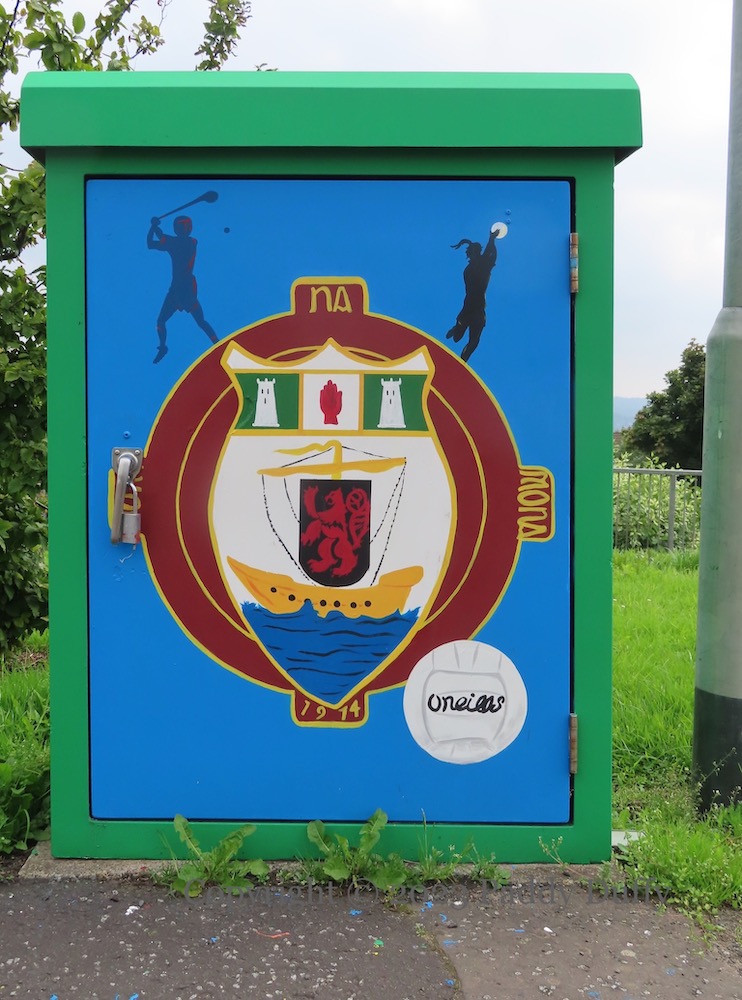
These two boards are at Gort Na Móna CLG. The one above was put developed by young Gorts as they learned about the history of the club as part of a twentieth anniversary celebration of Terry Óg Enright (Fb) who was killed by the LVF in 1998. The second board, below, combines the two previous boards to Terry Óg, seen previously in No Such Thing As Failure and Páırc Mhıc Ionnrachtaıgh.

Click image to enlarge
Copyright © 2023 Paddy Duffy
T03118 T03117

Lóıste Na Móna

“Welcome to Turf Lodge” — “Fáılte go dtí Lóıste Na Móna”. Turf Lodge was one of a number of estates built in the foothills of Black Mountain — including Westrock, Springhill, Ballymurphy, New Barnsley, and Dermot Hill — meant to house an underserved Catholic population and displaced families from other areas of Belfast.

The estate was built over a number of years but most people moved in between 1960 and 1962. (Northern Visions made a documentary about the history and people of the Turf Lodge estate that includes descriptions of the various ways in which the estate was left unfinished even as people took up residence.)

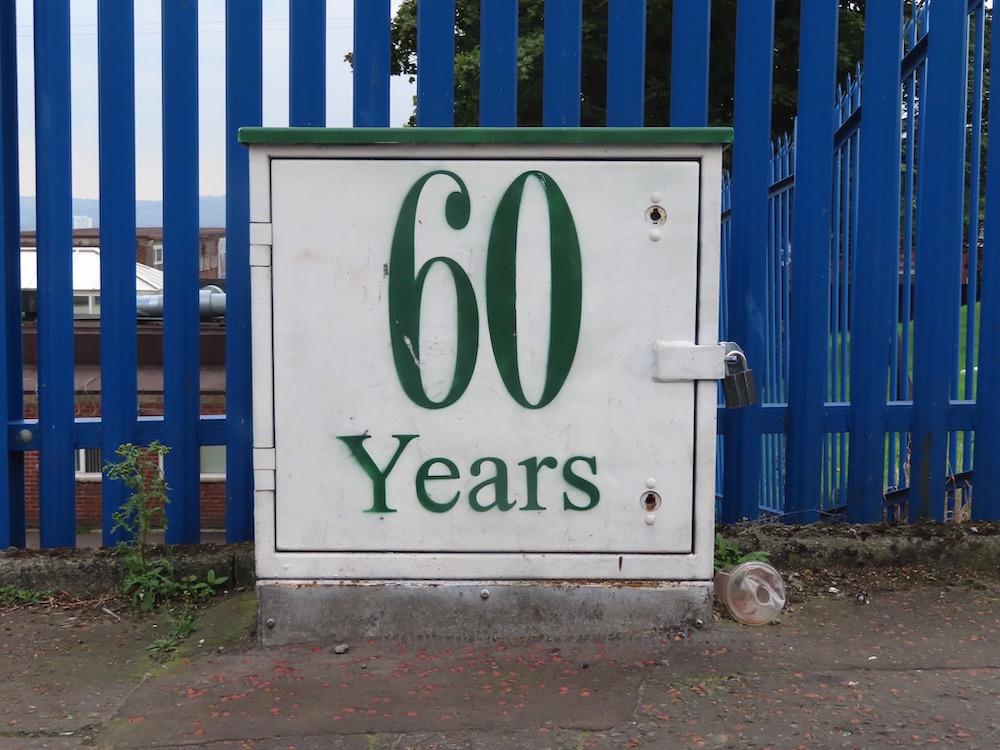
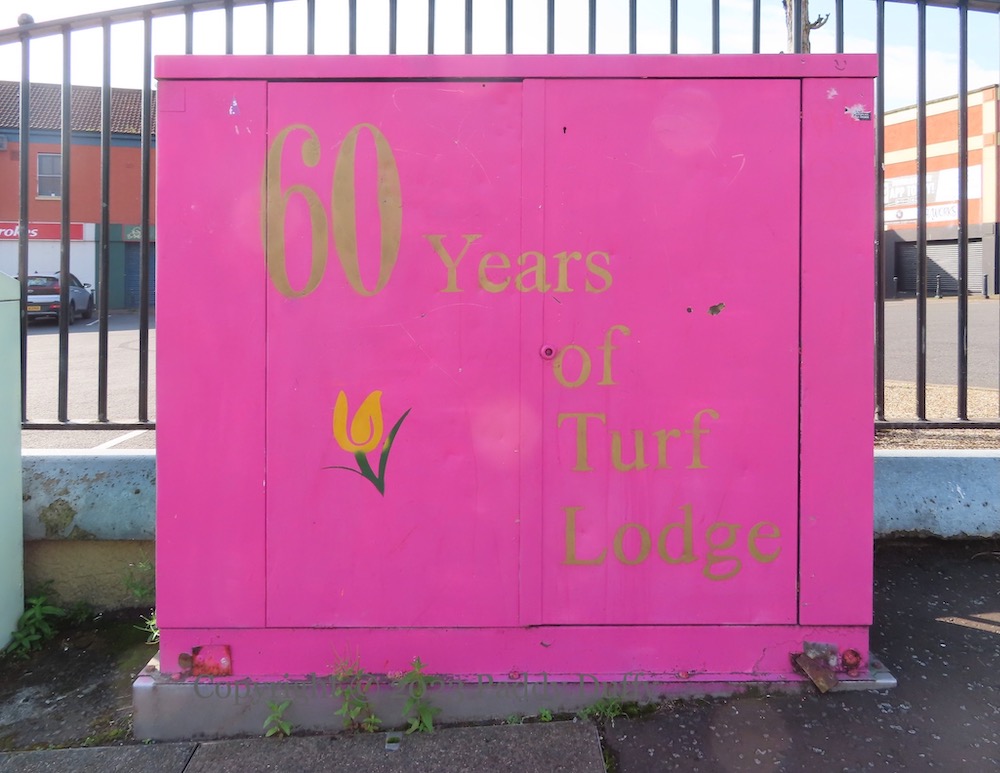
For the sixtieth anniversary, the electrical boxes outside John Paul II (formerly St Aidan’s) were stencilled (above and immediately below). This year (2023), more boxes have been painted, with images of gaelic games (see Gort Na Móna), bluebells (see Féıle Na gCloıgíní Gorma), and the silver fáınne on red background (see #AchtAnoıs).

See also: Klaus Fröhlich has a gallery of photos of the flats in the middle of the estate in great disrepair in 1979 (at BAP).

Click image to enlarge
Copyright © 2023 Paddy Duffy
T03113 T03114 T03115 T03116 T03120 T03209 T03210

Full Spectrum

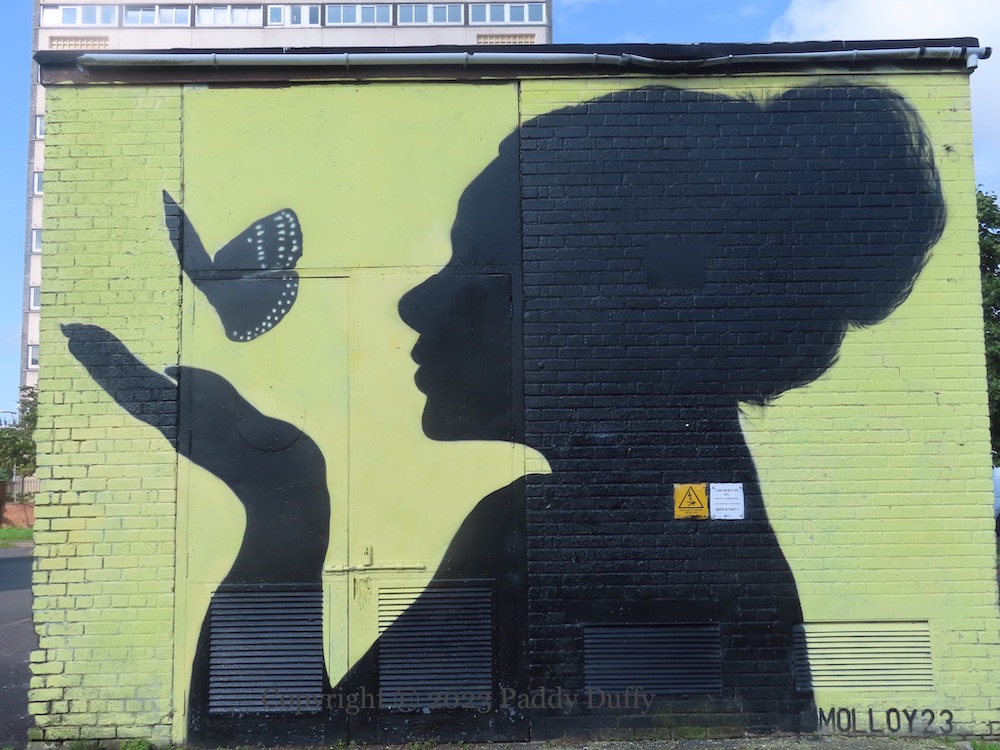
Here are five pieces of street art by Glen Molloy (ig) at Clarawood flats. The first three are new; the pair following is from earlier this year (Jan and Feb). The artist of the sixth piece is unknown. The seventh piece is by “The Spermer” (web) from 2020 and already in some disrepair – it was painted at the same time as Glen’s spitfire, shown last.

Demolition of the two blocks of flats was approved by the Housing Executive in May 2021 (Belfast Live) and by the Department Of Communities in September 2021 (Belfast Live). Demolition of Kilbroney is scheduled for the autumn and Clarawood (the tower block) for 2024 (Irish News).

(See also the Housing Executive’s ‘Action Plan’ for all tower blocks (pdf).)

Click image to enlarge
Copyright © 2023 Paddy Duffy
T02988 [T02987] T02989 [T02990] T02991
T02984 T02986 T02992 [T02993]
T02985 T02983

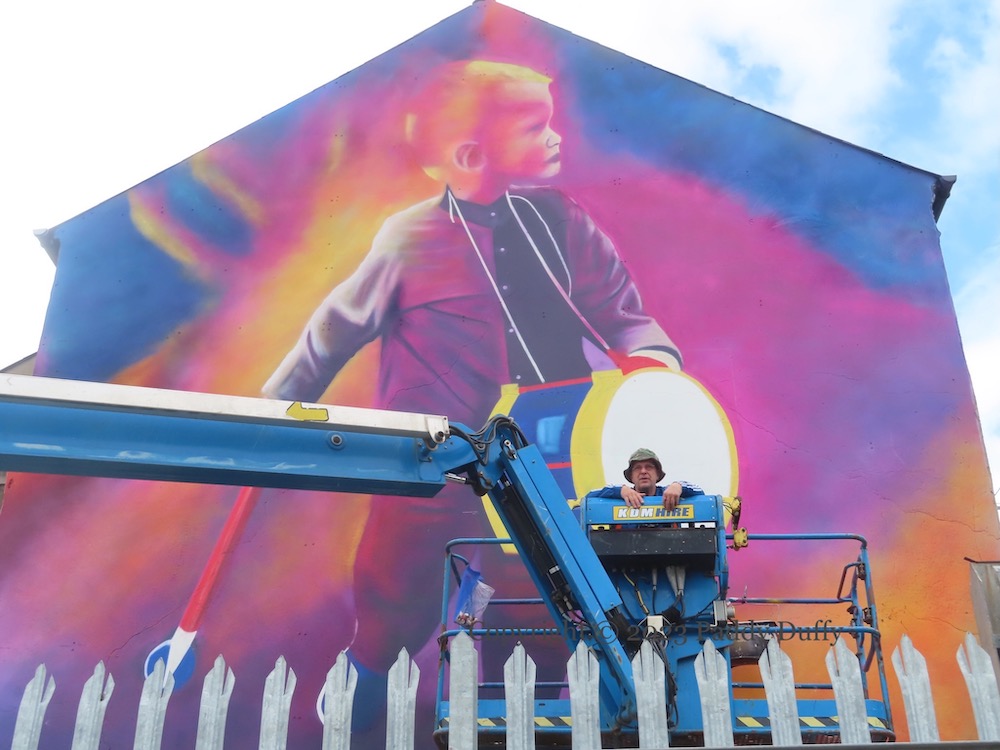
Shankill Drummer

Tomorrow (August 30th, at 12:30) there will be a family fun-day and the launch of a new mural of a colourful drummer boy. The mural is on Peter’s Hill; it takes the place of the “Original Belfast” murals (2009 and 2020) and before that a UDA emblem (M02480).

Painted by Glen Molloy (ig) with support from SAFE Shankill (see Woodvale OK), Alternatives (web), Executive Office, Communities In Transition.

Click image to enlarge
Copyright © 2023 Paddy Duffy
T02981 [T02974] [T02980] T02982