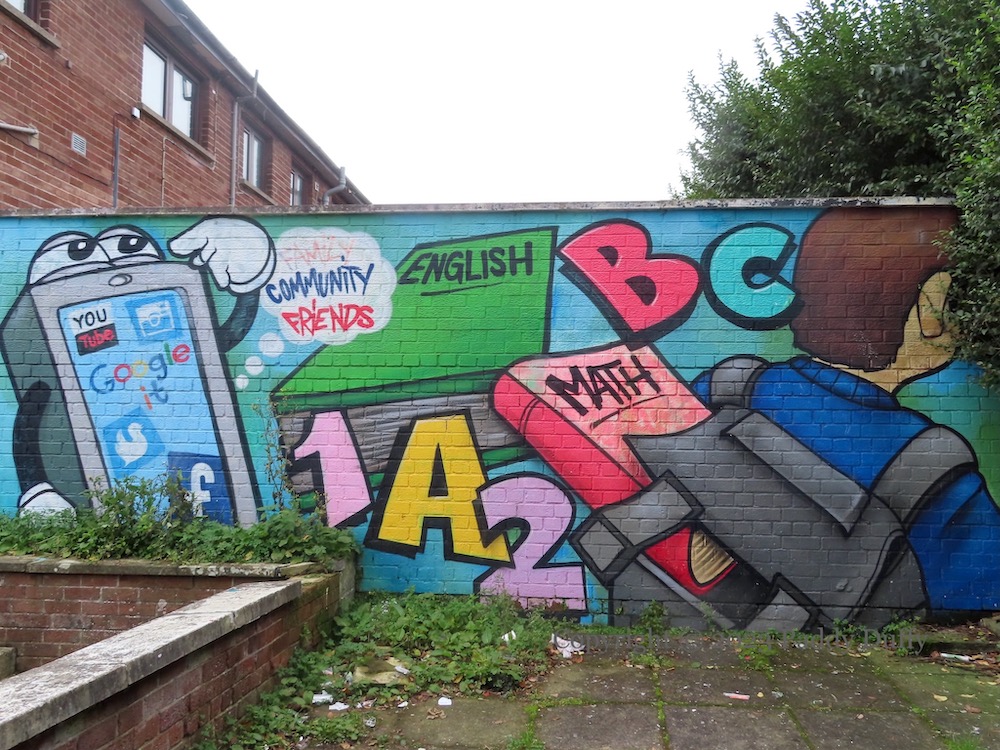
Which direction will you go in? To the negative west of the compass of “choice” lie “Alcohol, paramilitaries, drugs”; to the positive east are “Education, employment, life. On the side panel, youngsters are encouraged to study English, math(s), social media and Google.
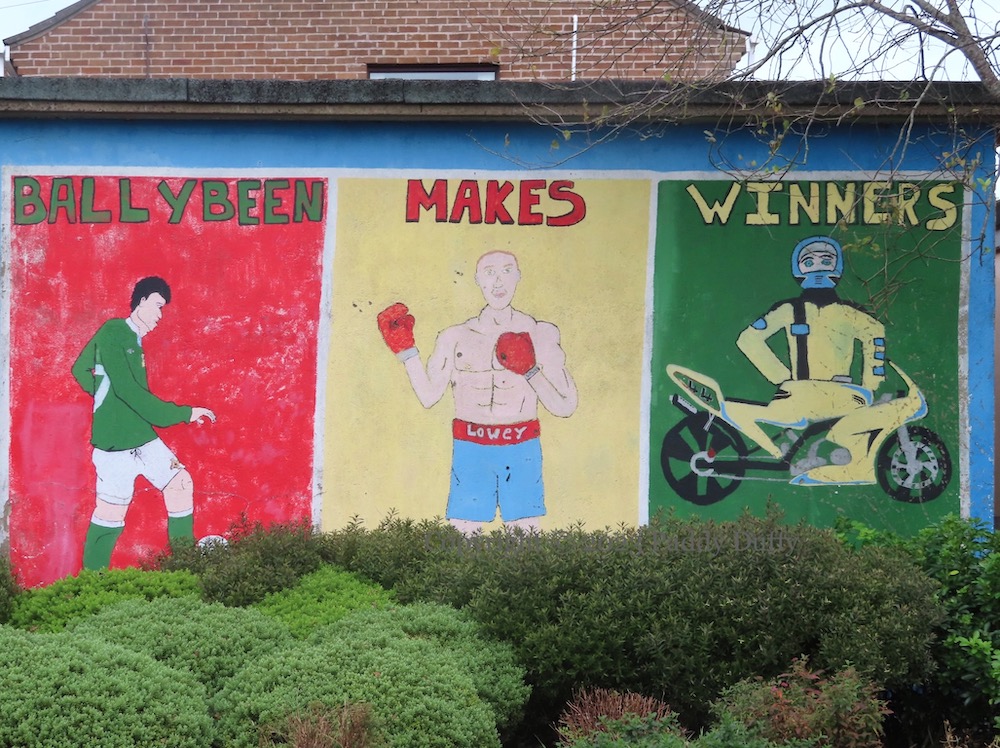
And further down Brooklands Drive, “Ballybeen makes winners” in sports: soccer, boxing, and motorcycle racing. The boxer is John Lowey, who represented Ireland at the 1988 Olympics; he is also featured in Boxing Through The Generations and Ballybeen Dream which last also includes three local footballers.
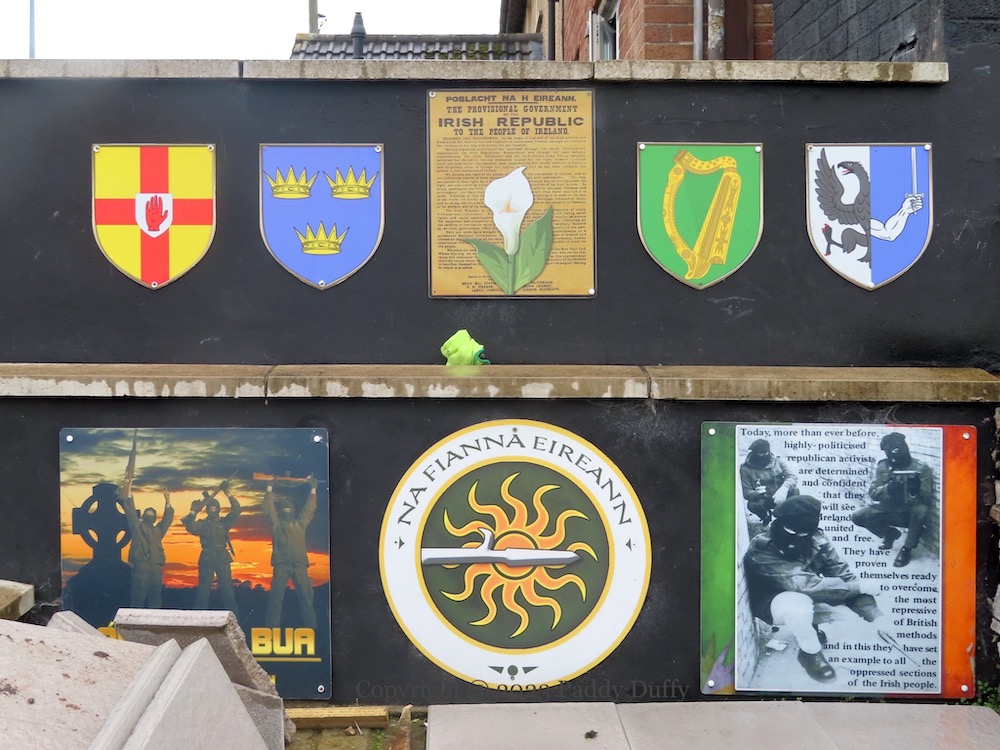
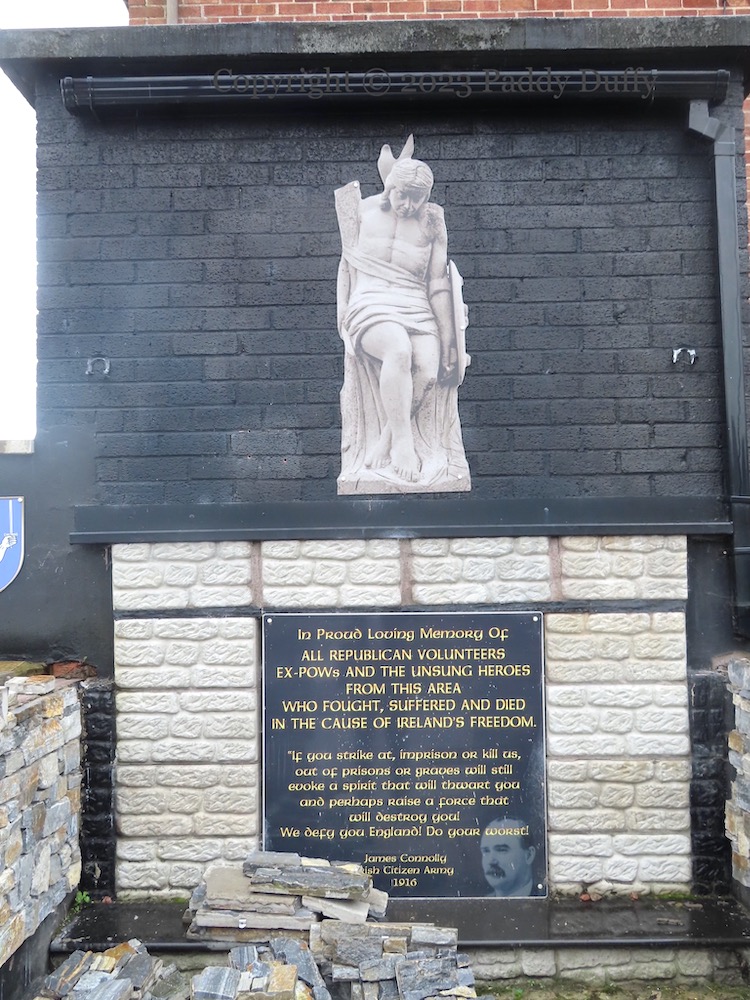
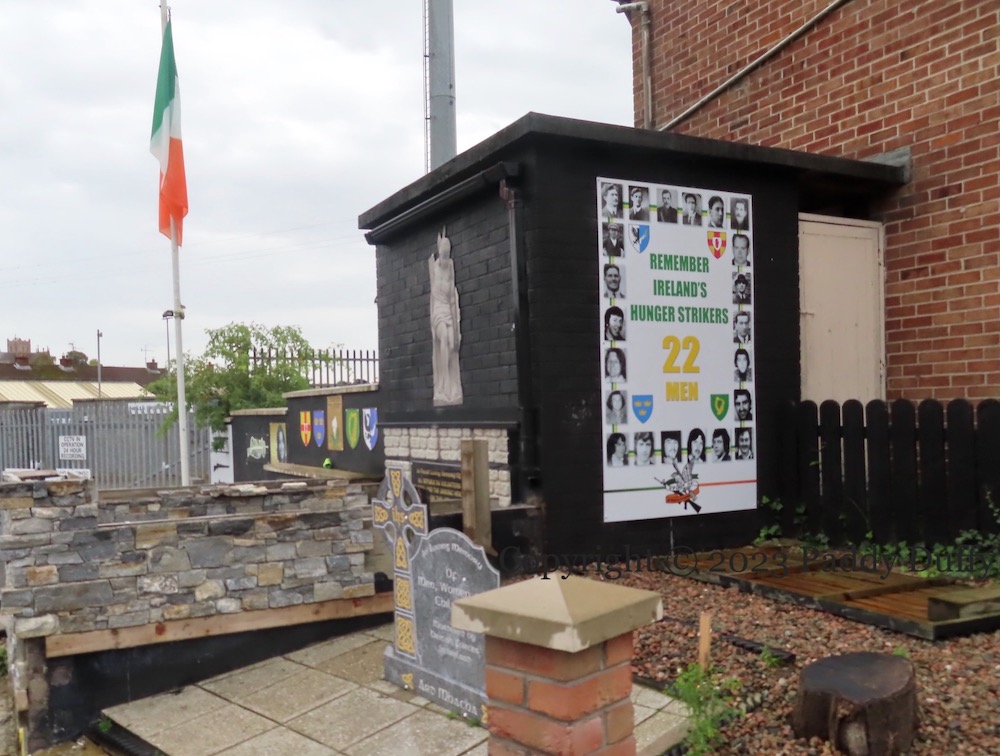
There is a memorial garden to the history of Irish resistance at the entrance to the Athletic Grounds in Armagh. From left to right, the images presented here show:
“More than 800 years of Irish resistence” – a sword for the Norman invasion under Strongbow, a pike for the 1798 and 1803 rebellions, a bolt-action rifle for the Easter Rising of 1916, and an assault rifle for the Troubles;
Cumann Na mBan, Mairéad Farrell and republican women who made “the supreme sacrifice”;
The Proclamation, Provisional IRA and Na Fianna;
The dying Cú Chulainn and a plaque “in proud and loving memory of all republican volunteers, ex-POWs and the unsung heroes from this area who fought, suffered and died in the cause of Ireland’s freedom, with a quote from James Connolly: ‘If you strike at, imprison or kill us, out of prisons or graves will still evoke a spirit that will thwart you and perhaps raise a force that will destroy you! We defy you England! Do your worst!”;
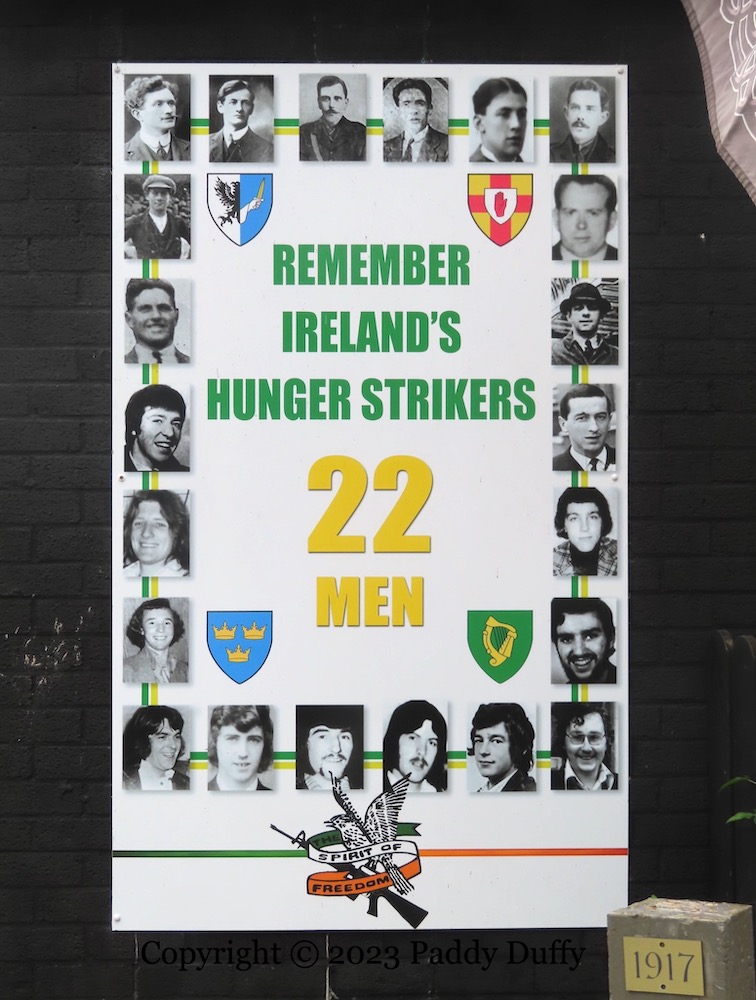
“Remember Ireland’s hunger strikers – 22 men” – the ten 1981 hunger strikers and Thomas Ashe, Terence MacSwiney, Michael Fitzgerald, Joe Murphy, Joseph Whitty, Andy O’Sullivan, Denny Barry, Tony D’Arcy, Jack McNeela, Seán McCaughey, Michael Gaughan, Frank Stagg;
A stone “in loving memory of men, women and children murdered by British forces in Ireland.”
“Marching into the future”. The 35th anniversary board – and the Pride Of The Bann flute band (Fb) itself – is still going over a decade after it was mounted in Harpur’s Hill, Coleraine; here is the board in 2012. It has now been joined by a board aimed at young people, designed by members of Sunlea Youth Club.
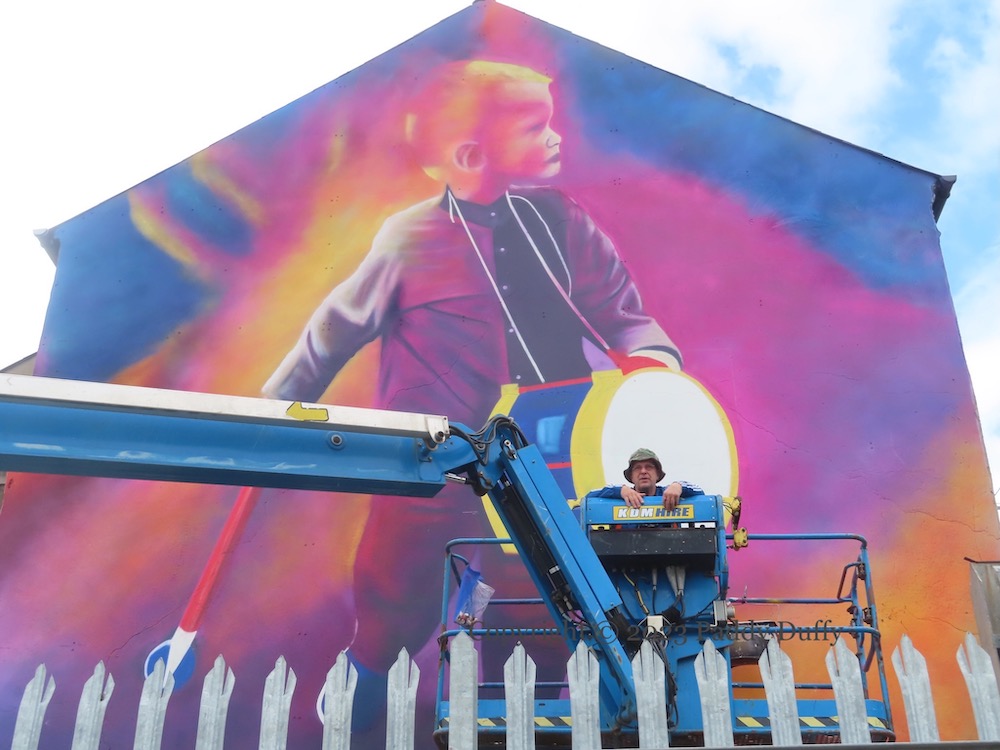
Tomorrow (August 30th, at 12:30) there will be a family fun-day and the launch of a new mural of a colourful drummer boy. The mural is on Peter’s Hill; it takes the place of the “Original Belfast” murals (2009 and 2020) and before that a UDA emblem (M02480).
Painted by Glen Molloy (ig) with support from SAFE Shankill (see Woodvale OK), Alternatives (web), Executive Office, Communities In Transition.
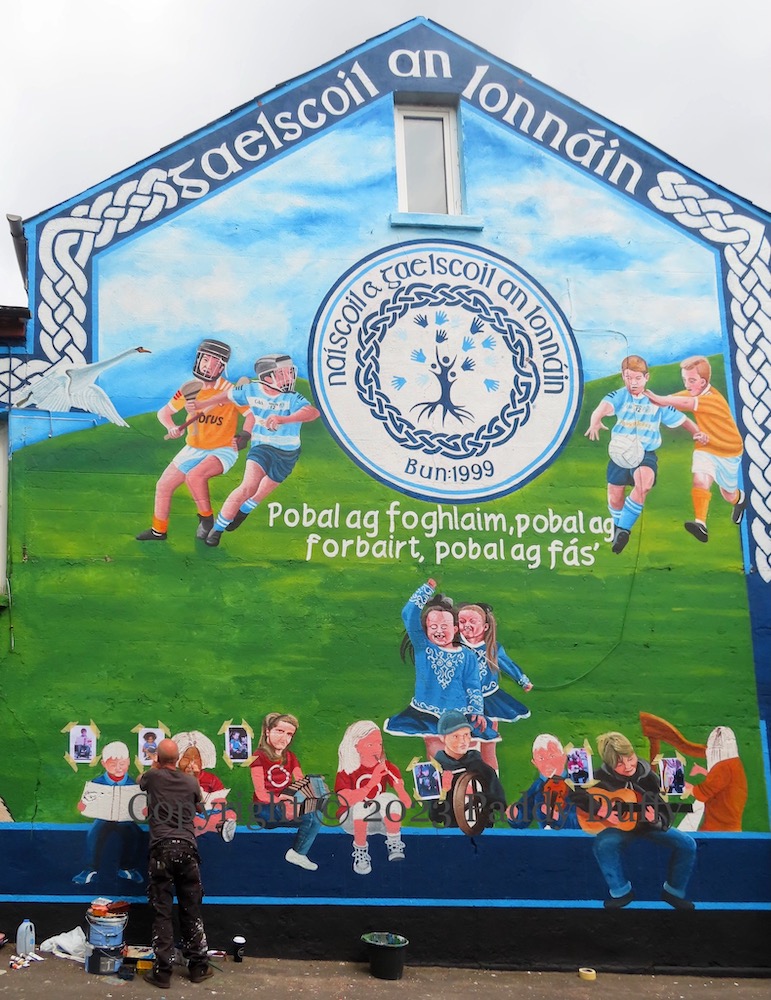
“Pobal ag foghlaım, pobal ag forbaırt, pobal ag fás” [a community learning, developing, growing]
Students from “Naíscoıl & Gaelscoıl An Lonnáın (Fb) bun[aithe] 1999″ [Nursery-school and Irish-language [primary] school of the loney, founded 1999] are shown playing Gaelic games, Irish dancing, and playing traditional instruments (and the guitar). On the left are representations from Irish mythology: the Children Of Lear and Setanta killing Culann’s hound (and taking the name Cú Chulaınn in taking its place), along with hedge-row school (see Hedge Row School).
The origin of the name is unclear; the nearest loney [lane] was the “Pound” loney, so-called because of the animal pen just outside Barrack Street, used to store livestock before moving on to the markets the following day (Rushlight | Uachtar Na bhFál). (The Pound Loney is included in the mural in Durham Street – see Et In Arcadia Ego.)
The other well-known loney in Belfast is the “buttermilk loney” which was either/both what is now Ballysillan Park (that is, connecting Olpark with the horsehoe bend) or the top part of the loney that connected Wheatfield (the top of Ardoyne) to the Ligoniel junction and on towards the old Ligoneil House (there are a mixture of usages in this Belfast Forum thread); this image from the 1930s might show the lane in (what was still at the time) the hills above Oldpark; a new housing-development towards the top of the Ballysillan Park is euphemistically called “Buttermilk Loney”. (It is also said to have been a prior name of Skegoniell Avenue (Belfast History).)
(The Uachtar Na bhFál page also mentions “Turf” loney, “Mountain” loney, and “Killoney”.)
The history of the Irish word “lonnán” is unclear. Uachtar na bhFál says the word is of Scots origin (perhaps as “loanin”). (See this BelTel article on the opening of the Ulster-Scots centre in 2014.) Spelled “lonnen”, it is also a Geordie word (Heslop’s Northumberland Words | wiktionary). The Irish News and Belfast Live, working from the same (uncited) press-release about Páırc An Lonnáın (which is along the Westlink below Raıdıó Fáılte), state that “loney” comes from the English word “loaning”. The Irish word “lonnán” does not appear in Dinneen 1904; Dinneen 1953 defines it (hyper-specifically) as “a grassy recess running up into high basaltic cliffs”.
The image above and immediately below are from May 19th, as the mural was nearing completion; other ‘in-progress’ images are as dated below. See Extramural Activity for images of the completed work.
“Our revenge will be the laughter of our children” – The words of Bobby Sands are illustrated on an electrical box on the Whiterock Road, Belfast, with silhouettes of children at play in nature.
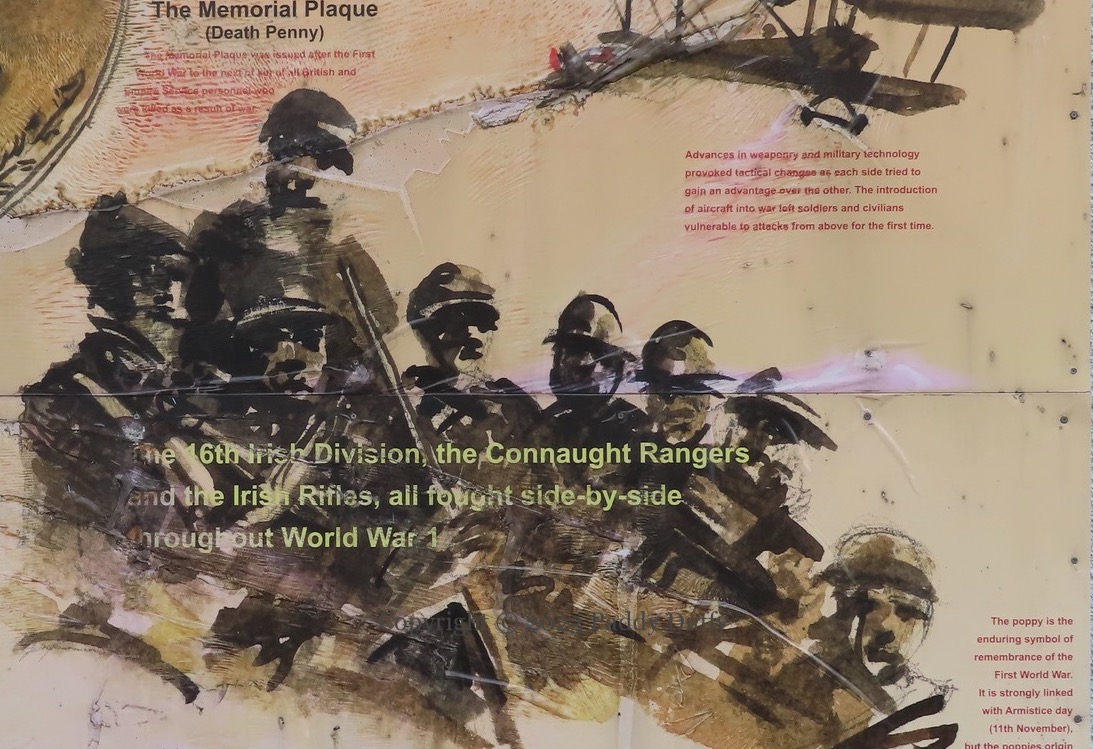
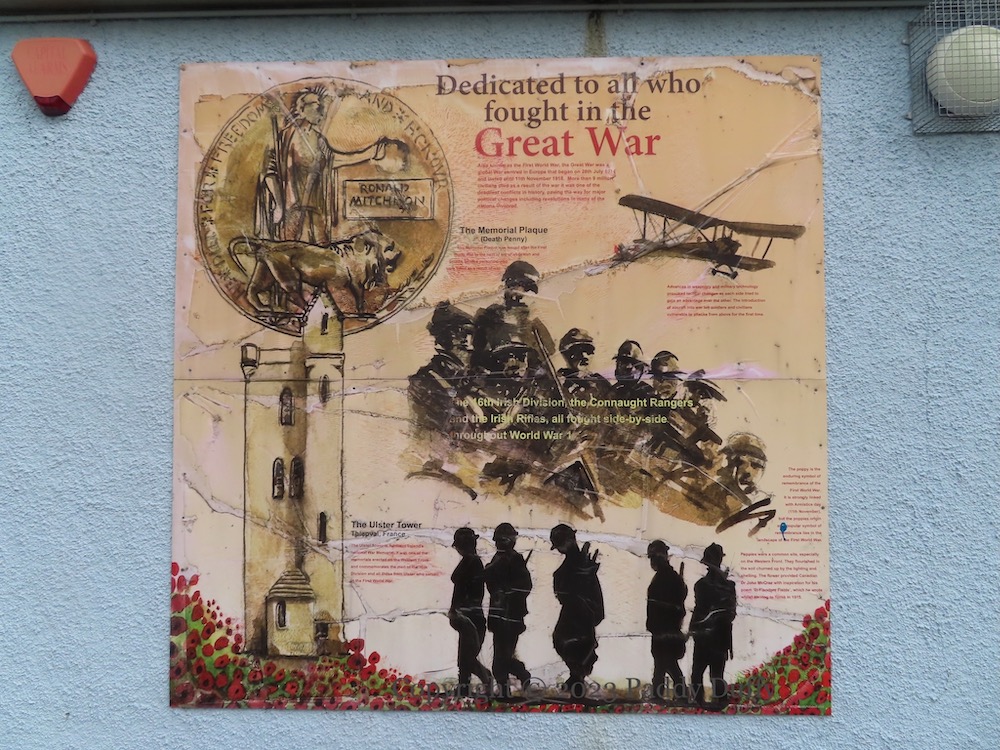
This board presents imagery and information about WWI, centrally including the statement (shown above) that “The 16th Irish Division, the Connaught Rangers [7th battalion] and the Irish Rifles [7th battalion], all fought side-by-side throughout World War I.”
The Ulster Tower on the left is familiar from many other murals and boards. In the top left, we see “The Memorial Plaque (Death Penny” which was also known as the “Dead Man’s Penny”. It was issued after the First World War to the next of kin of all British and Empire Service personnel who were killed as a result of the war. The “penny” was in fact five inches in diameter and cast in bronze. It showed Britannia with a trident and two dolphins swimming around her, and a lion on oak, along with the name of the deceased (here, Ronald Mitchison) without indication of rank. (Here is a close-up of a plaque from WP.)
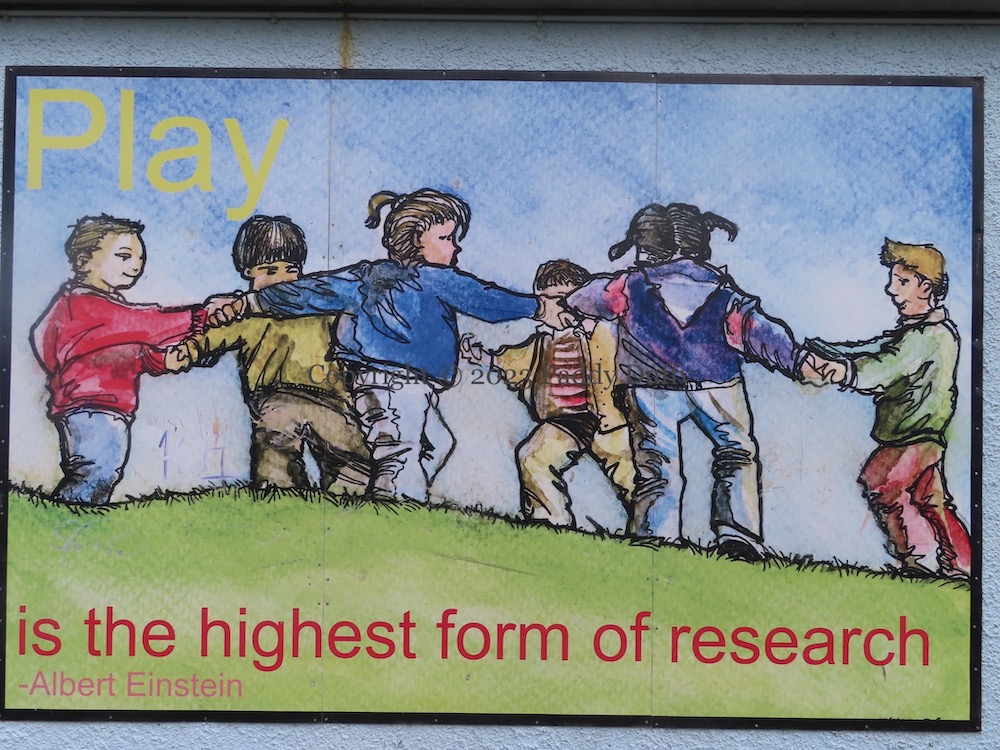
The second piece (mis-)attributes the quote “Play is the highest form of research” to Albert Einstein and shows children playing ring-a-ring-o’-roses. Painted by Ed Reynolds (steadyhanded.com).
Both boards are on the community centre in the lower Shankill estate.
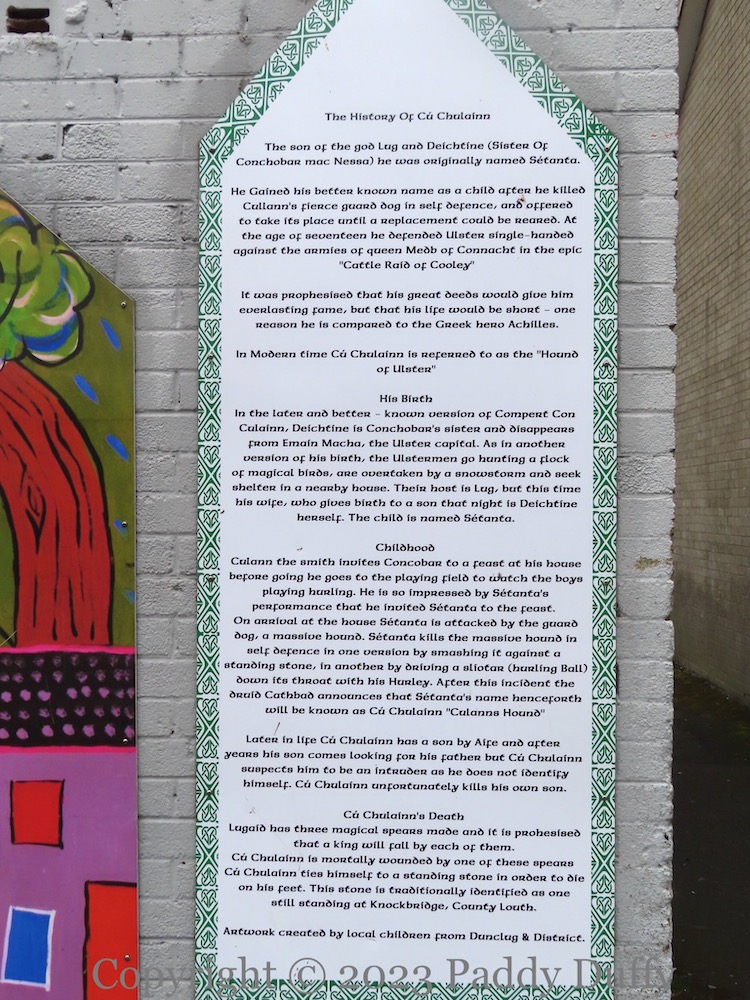
Cú Chulaınn is revered as a living god who might watch over children and their pets, homes, food, and toys in these devotional panels in Dunclug, Ballymena. As the info board says, “It was prophesied that his great deeds would give him everlasting fame.” Cú Chulaınn has his own Visual History page.
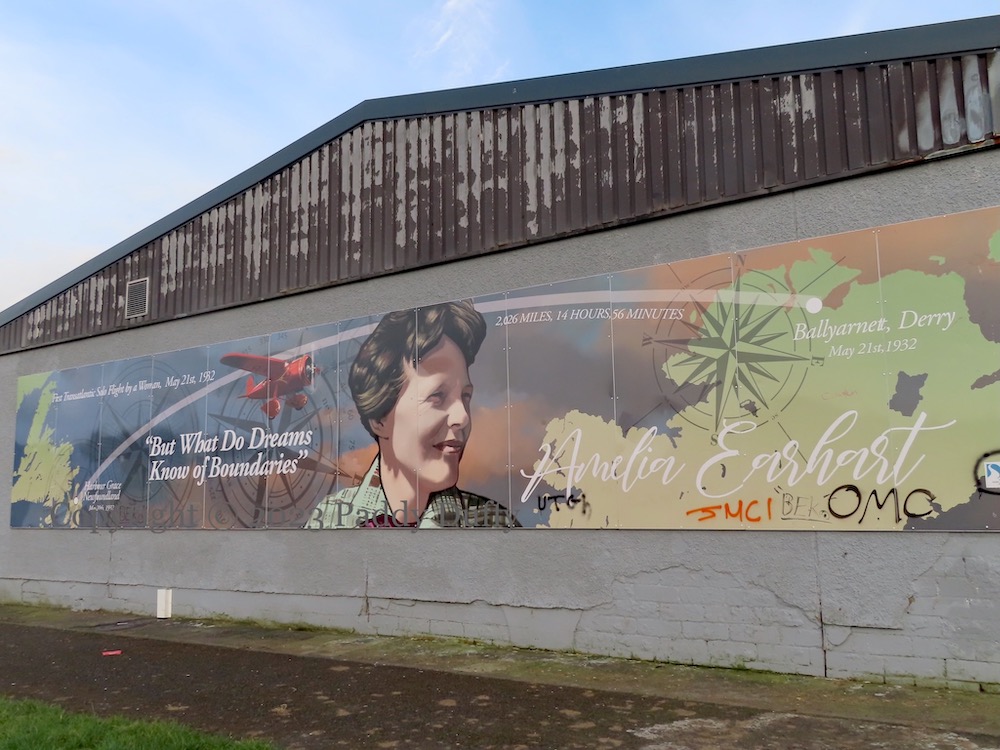
“Everyone has oceans to fly, if they have the heart to do it. Is it reckless? Maybe. But what do dreams know of boundaries?” When she left Harbour Grace, Newfoundland, on the evening of May 20th, 1932, Amelia Earhart’s intended destination for the first solo trans-Atlantic flight by a woman was Paris, France, but after various mechanical difficulties she landed instead in Ballyarnett, just outside Derry. For the 90th anniversary of her history-making flight, the artwork above was created by Joe Campbell (web), commissioned “by Community Restorative Justice in partnership with Derry & Strabane Distict Council’s Good Relations Programme and with the assistance of Greater Shantallow Community Arts.”
For the mosaic already mounted in 2010, see Flying Solo.
Jon “Ugg” Clifford died in 2011, having founded Tristar Boys FC (web) in 1974. Bull Park in Creggan has been renamed in his honour and this portrait on boards has been mounted next to the park.












 Paddy Duffy Collection