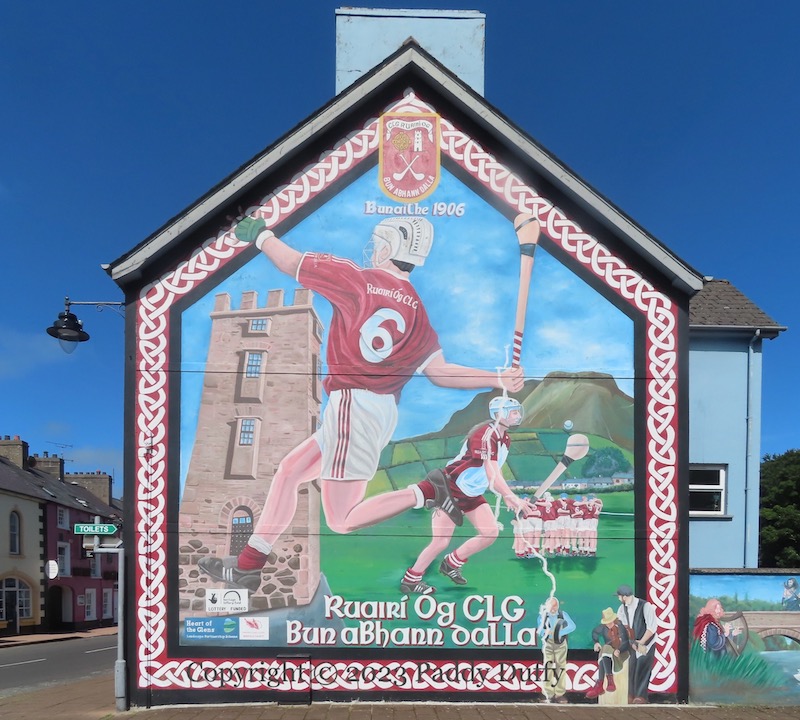
This is the second version of the Ruaırí Óg (web) (and Clann Lır) mural in the middle of Cushendall – the original dates back to 2006, which was the 100th anniversary of the club’s founding (“bunaıthe”) (see M02832). The hurlers and Curfew tower remain; the “Big Ears” (Volunteer) trophy is gone and in its place are three traditional musicians. The Clann Lır has been painted to include the harper seen in Jim Fitzpatrick’s painting of the Lear myth. A Celtic warrior has appeared on the bridge over the Dall.
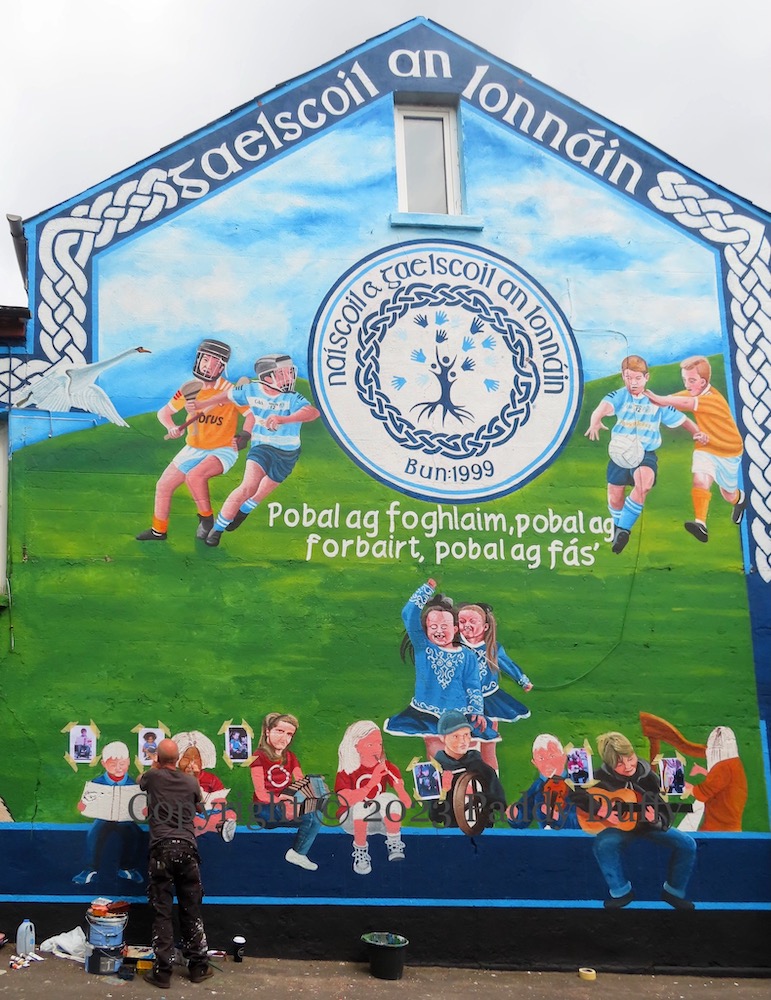
“Pobal ag foghlaım, pobal ag forbaırt, pobal ag fás” [a community learning, developing, growing]
Students from “Naíscoıl & Gaelscoıl An Lonnáın (Fb) bun[aithe] 1999″ [Nursery-school and Irish-language [primary] school of the loney, founded 1999] are shown playing Gaelic games, Irish dancing, and playing traditional instruments (and the guitar). On the left are representations from Irish mythology: the Children Of Lear and Setanta killing Culann’s hound (and taking the name Cú Chulaınn in taking its place), along with hedge-row school (see Hedge Row School).
The origin of the name is unclear; the nearest loney [lane] was the “Pound” loney, so-called because of the animal pen just outside Barrack Street, used to store livestock before moving on to the markets the following day (Rushlight | Uachtar Na bhFál). (The Pound Loney is included in the mural in Durham Street – see Et In Arcadia Ego.)
The other well-known loney in Belfast is the “buttermilk loney” which was either/both what is now Ballysillan Park (that is, connecting Olpark with the horsehoe bend) or the top part of the loney that connected Wheatfield (the top of Ardoyne) to the Ligoniel junction and on towards the old Ligoneil House (there are a mixture of usages in this Belfast Forum thread); this image from the 1930s might show the lane in (what was still at the time) the hills above Oldpark; a new housing-development towards the top of the Ballysillan Park is euphemistically called “Buttermilk Loney”. (It is also said to have been a prior name of Skegoniell Avenue (Belfast History).)
(The Uachtar Na bhFál page also mentions “Turf” loney, “Mountain” loney, and “Killoney”.)
The history of the Irish word “lonnán” is unclear. Uachtar na bhFál says the word is of Scots origin (perhaps as “loanin”). (See this BelTel article on the opening of the Ulster-Scots centre in 2014.) Spelled “lonnen”, it is also a Geordie word (Heslop’s Northumberland Words | wiktionary). The Irish News and Belfast Live, working from the same (uncited) press-release about Páırc An Lonnáın (which is along the Westlink below Raıdıó Fáılte), state that “loney” comes from the English word “loaning”. The Irish word “lonnán” does not appear in Dinneen 1904; Dinneen 1953 defines it (hyper-specifically) as “a grassy recess running up into high basaltic cliffs”.
The image above and immediately below are from May 19th, as the mural was nearing completion; other ‘in-progress’ images are as dated below. See Extramural Activity for images of the completed work.
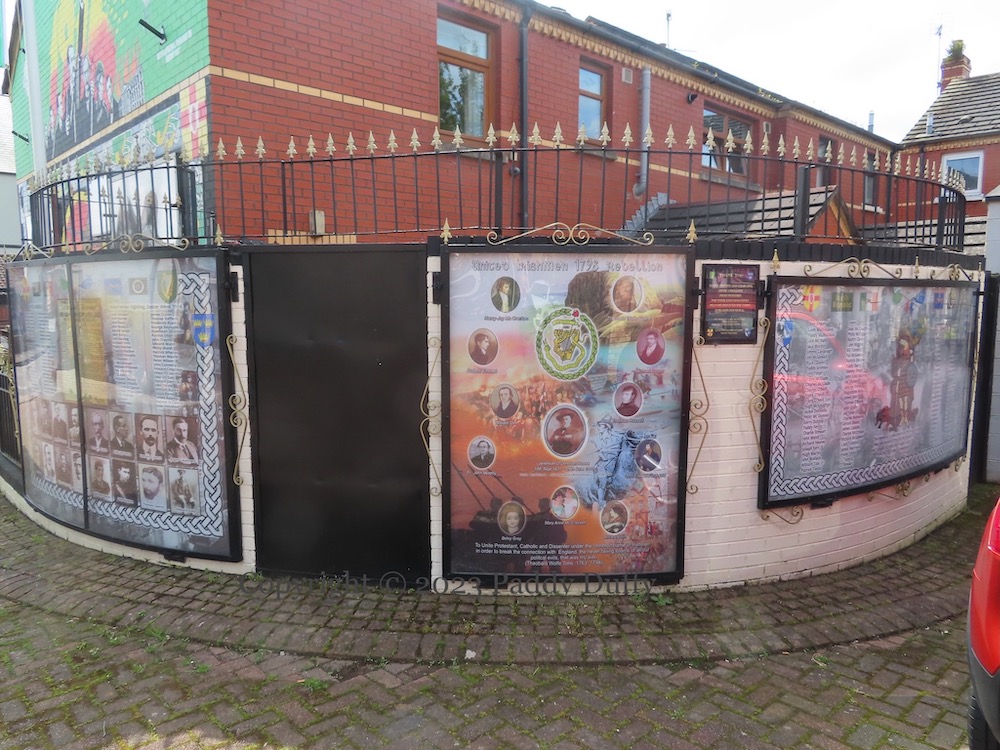
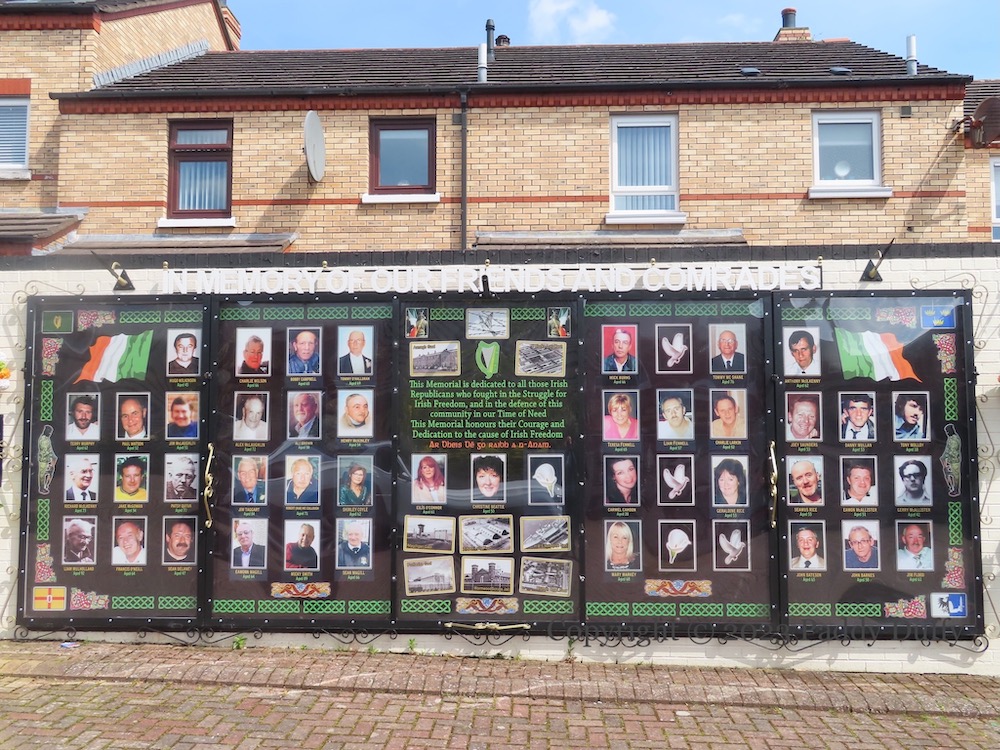
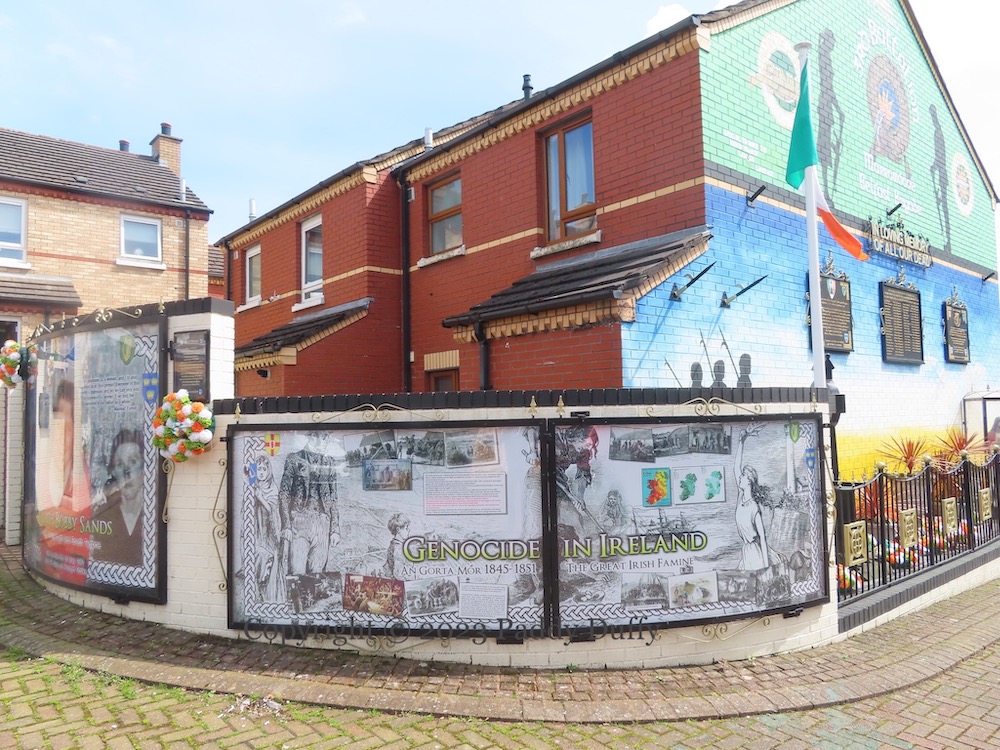
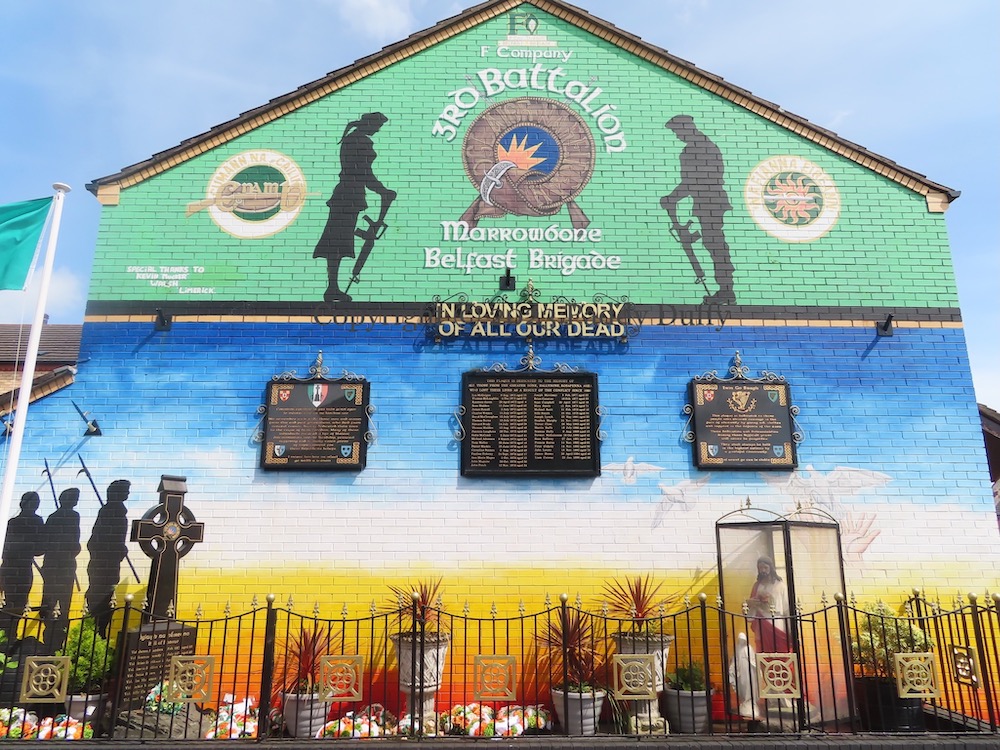
Here is a gallery of the murals and plaques in Clós Ard An Lao/Ardilea Close in the Machaıre Botháın/Marrowbone area of north Belfast. A full repertoire of republican events is commemorated – the United Irishmen, Great Hunger, the Rising, the Troubles, the (modern) hunger strikes. What is most striking is the significant presence of religious icons, such as the Sacred Heart in the glass cases in front of the two main murals (above and last below).
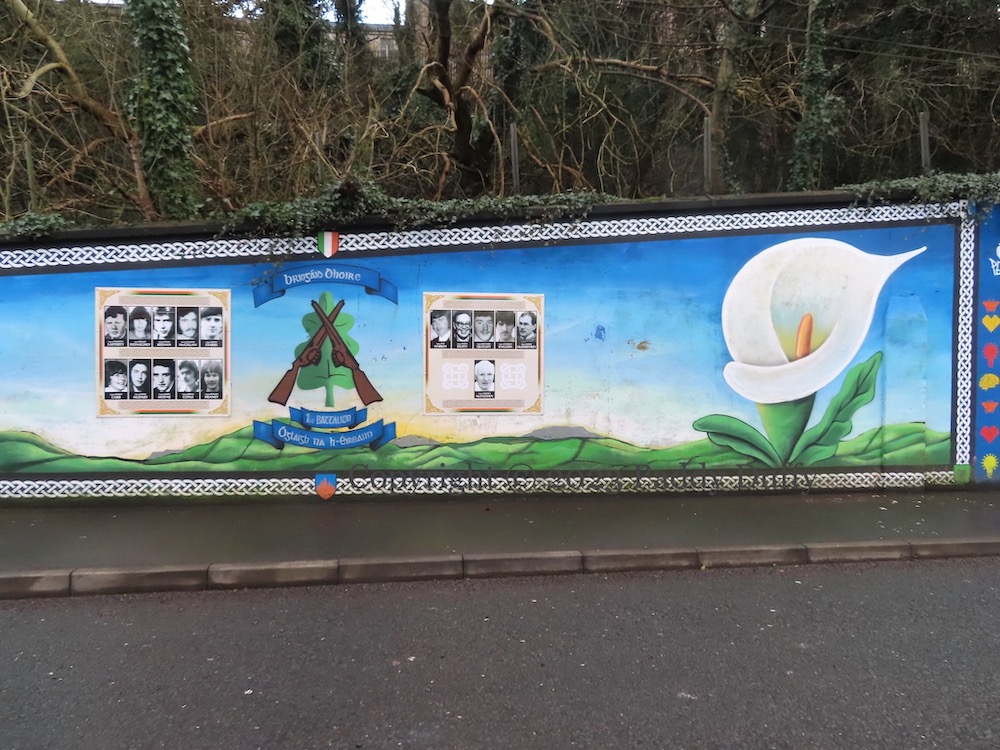
The Provisional IRA emerged from a split in the IRA in the wake of sectarian unrest in 1969. The Derry battalion became the Derry Brigade (An Brıogáıd Dhoıre) in 1972 when the number of people wishing to become volunteers swelled in the aftermath of Bloody Sunday. It is estimated that 1,000 Derry Catholics (2% of the population) were imprisoned for IRA activities in the 70s and 80s. (WP)
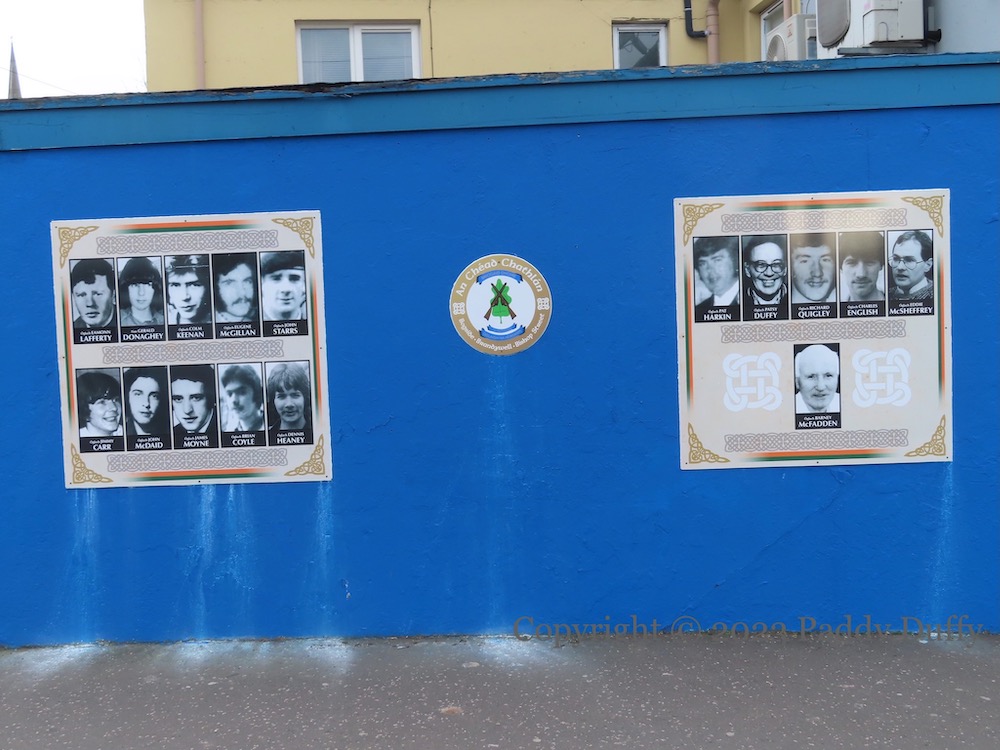
The image above shows a mural with Cú Chulaınn (Visual History), an oak leaf with crossed rifles, and a lily. Two boards commemorate volunteers from the 1st battalion. The sixteen portraits are of Lafferty, Donaghey, Keenan, McGillan, Starrs, / Carr, McDaid, Moyne, Coyle, Heaney, // Harkin, Duffy, Quigley, English, McSheffrey, / McFadden.
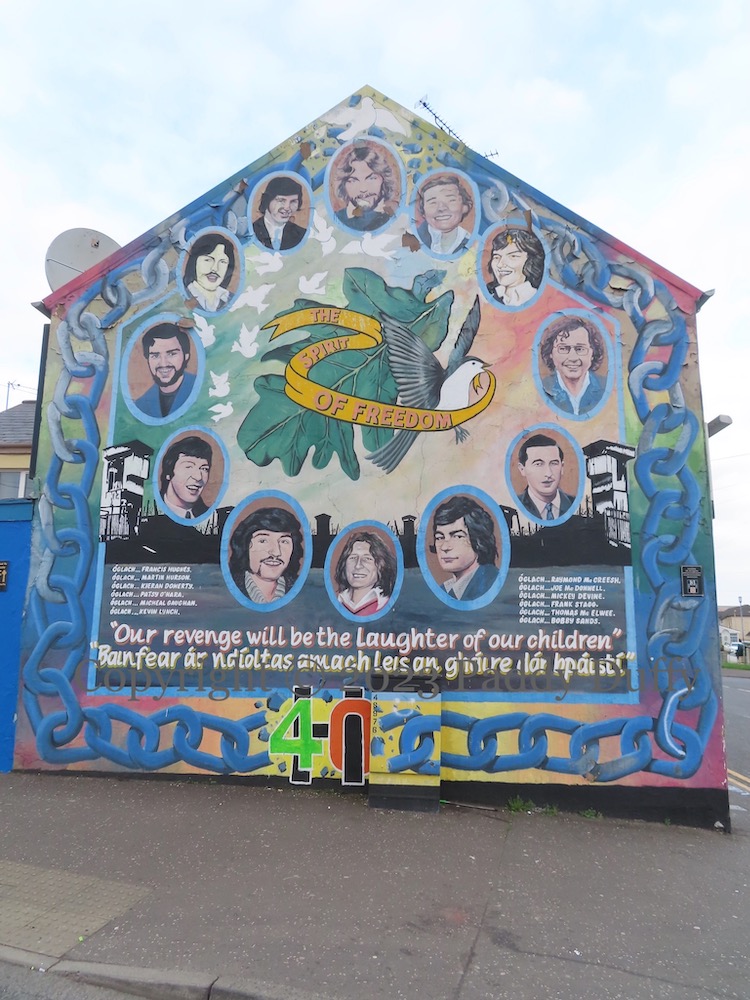
The plaque to the left reads, “This mural is dedicated to all those who tragically died on the streets of Derry during the hunger strike era. Suaımhneas Dé da nanamacha. 3rd October 2006.” The mural referred to is in fact the ‘crumbling cell’ mural (see M03350); the ‘Spirit Of Freedom’ mural was first painted in 2011 for the 30th anniversary (see X00999) – the 30th anniversary plaque remains, on the right of the mural but for the 40th anniversary of the 1981 hunger strike “40” replaced the “30” in the bottom border.
The mural features both the lark and the dove (Visual History).
On the side wall, two new panels remember members of the IRA’s Derry brigade, replacing the single board seen in M07635.
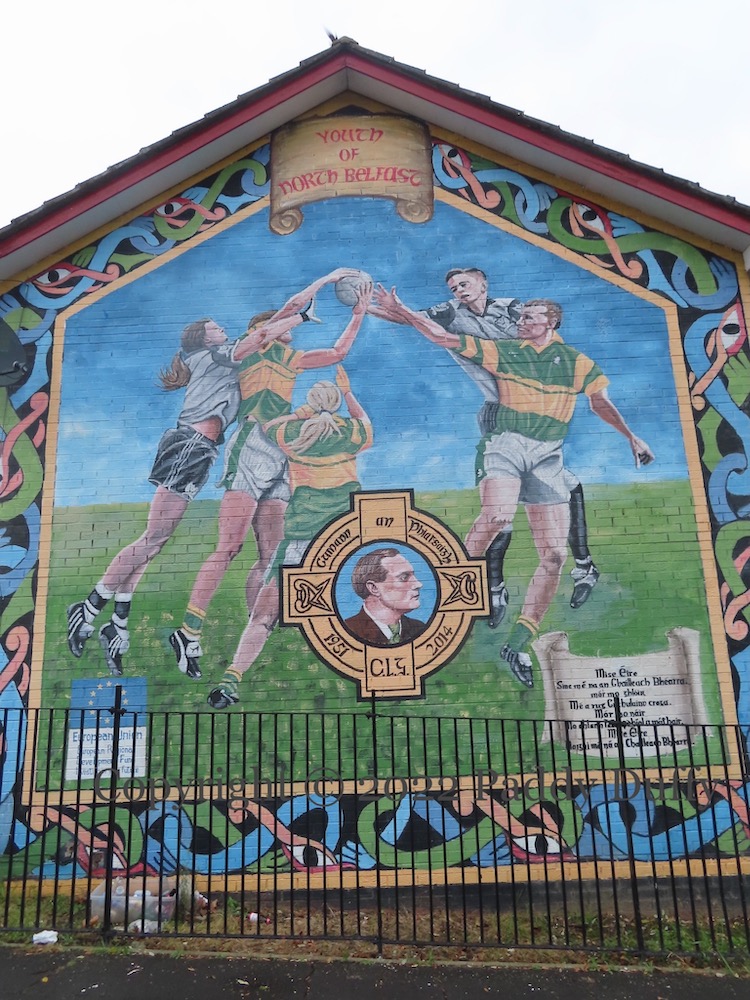
The local New Lodge GAA club Cumman An Phıarsaıgh is named in honour of Patrick Pearse, executed after the 1916 rising. The club’s new mural features footballers contesting a ball and Pearse’s image appears at the centre of a Celtic cross along with part of his 1912 poem Mıse Éıre in the bottom corner (shown below in a close-up). Painted by Lucas Quigley and Michael Doherty. Replaces ‘New Lodge 2000‘.
Mıse Éıre: Sıne mé na an Chaılleach Bhéarra. Mór mo ghlóır: Mé a rug Cú Chulaınn croga. Mór mo náır: Mo chlann féın a dhíol a máthaır. [Mór mo phıan: Bıthnaımhde do mo shíorchıapadh. Mór mo bhrón: D’éag an dream ınar chuıreas dóchas.] Mıse Éıre: Uaıgní mé ná an Chaılleach Bhéarra.
I am Ireland: I am older than the old woman of Beare. Great my glory: I who bore Cuchulainn, the brave. Great my shame: My own children who sold their mother. [Great my pain: My irreconcilable enemy who harasses me continually. Great my sorrow: That crowd, in whom I placed my trust, died.] I am Ireland: I am lonelier than the old woman of Beare.
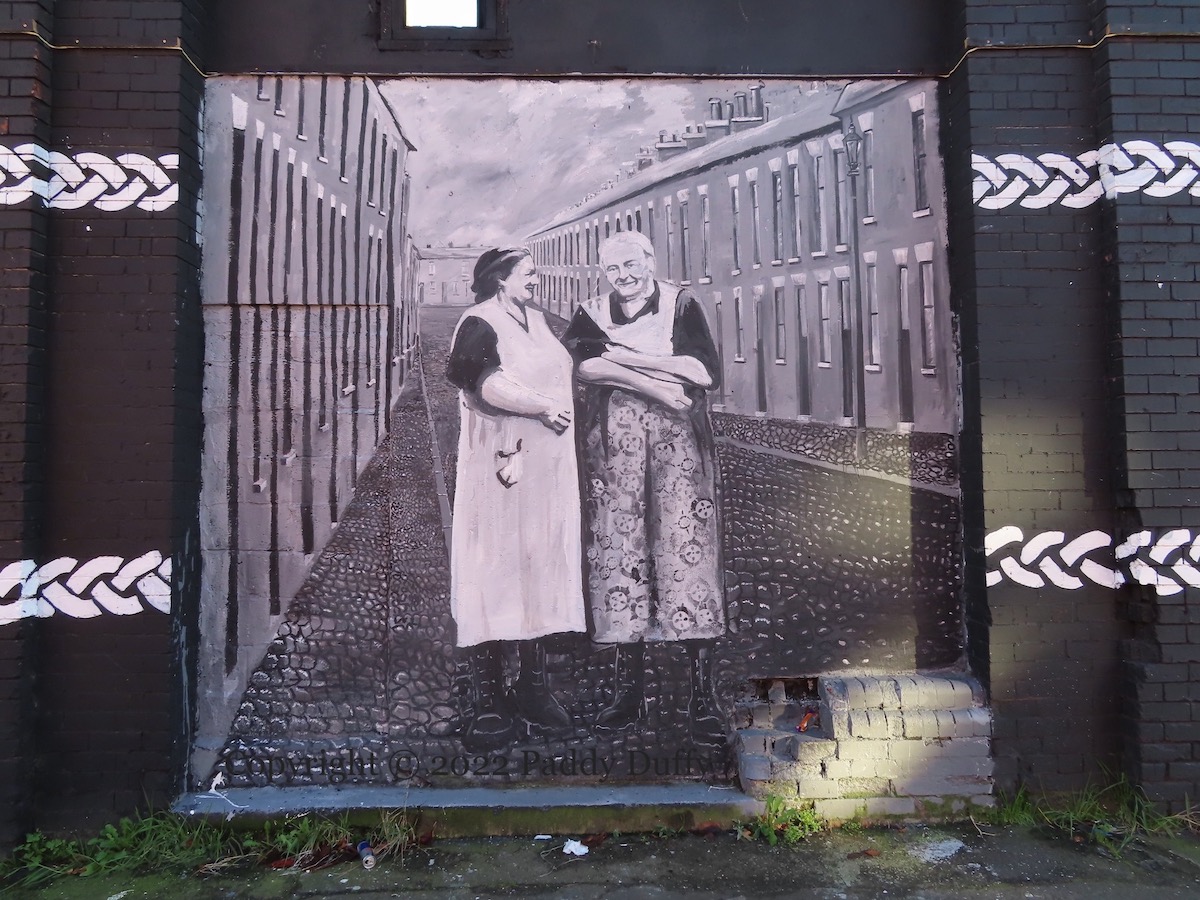
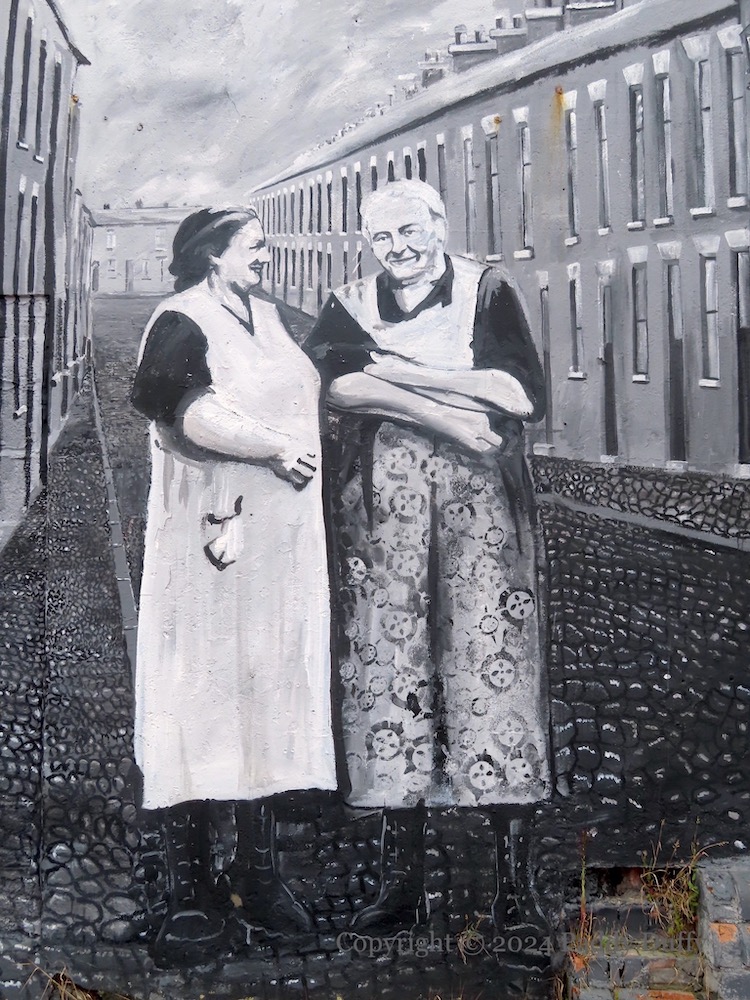
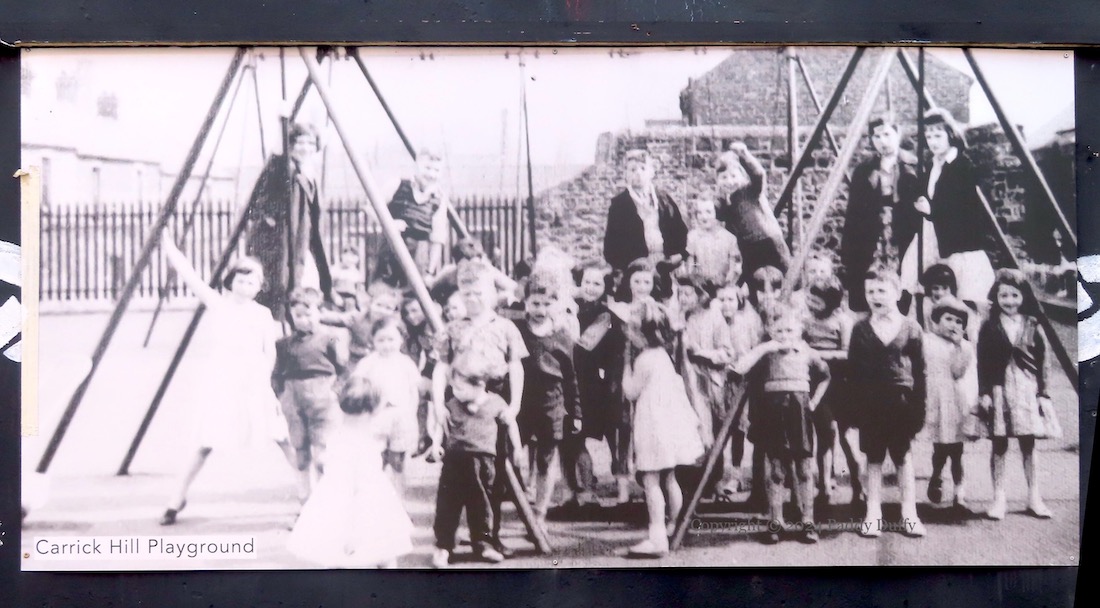
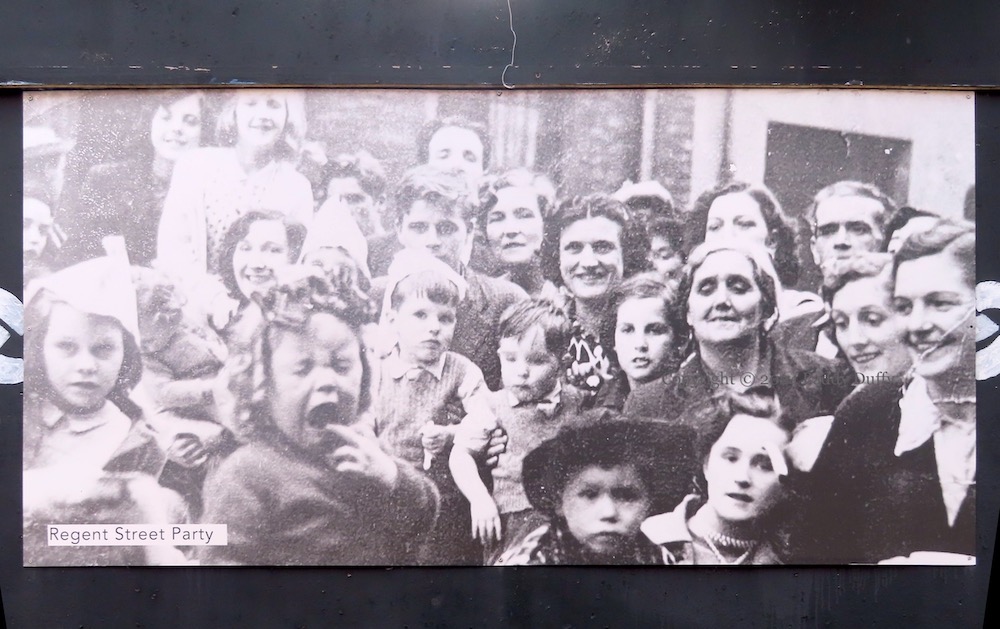
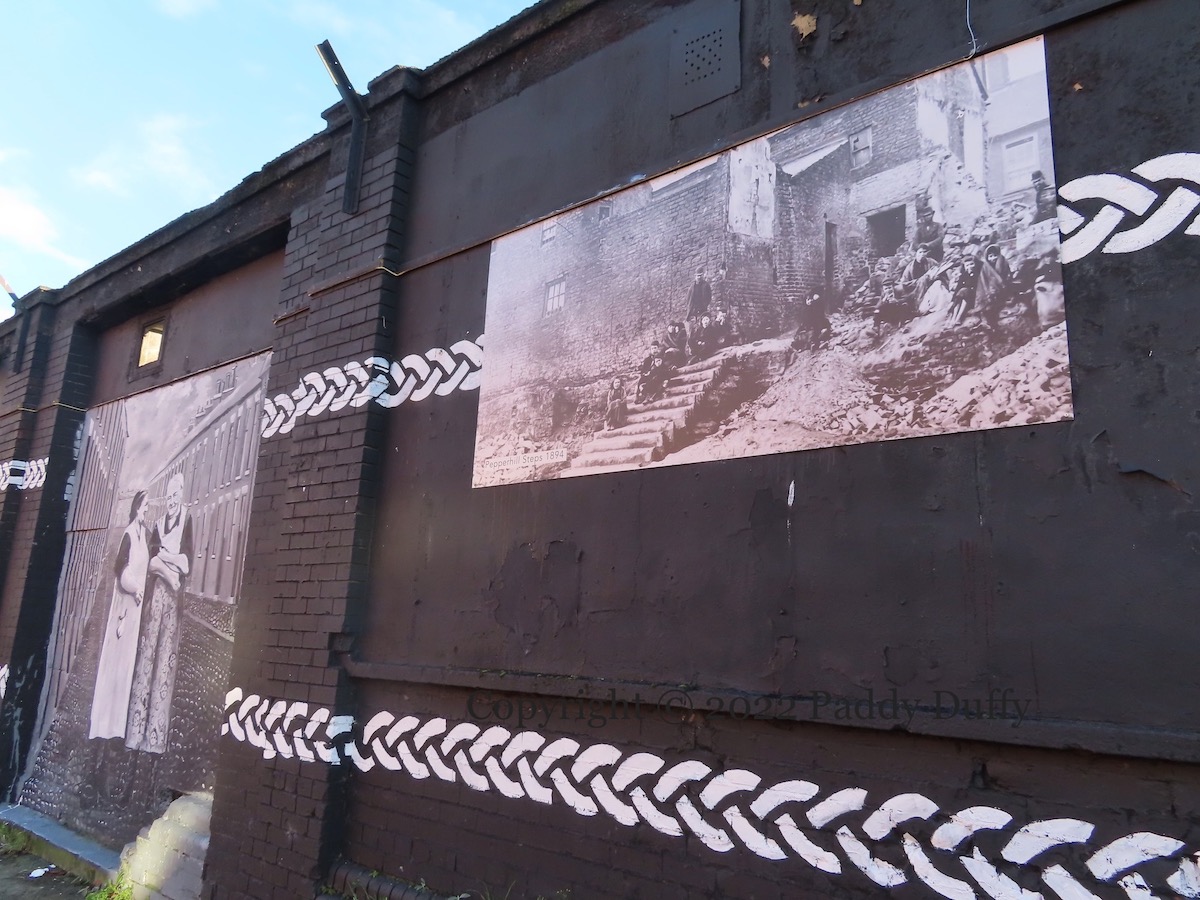
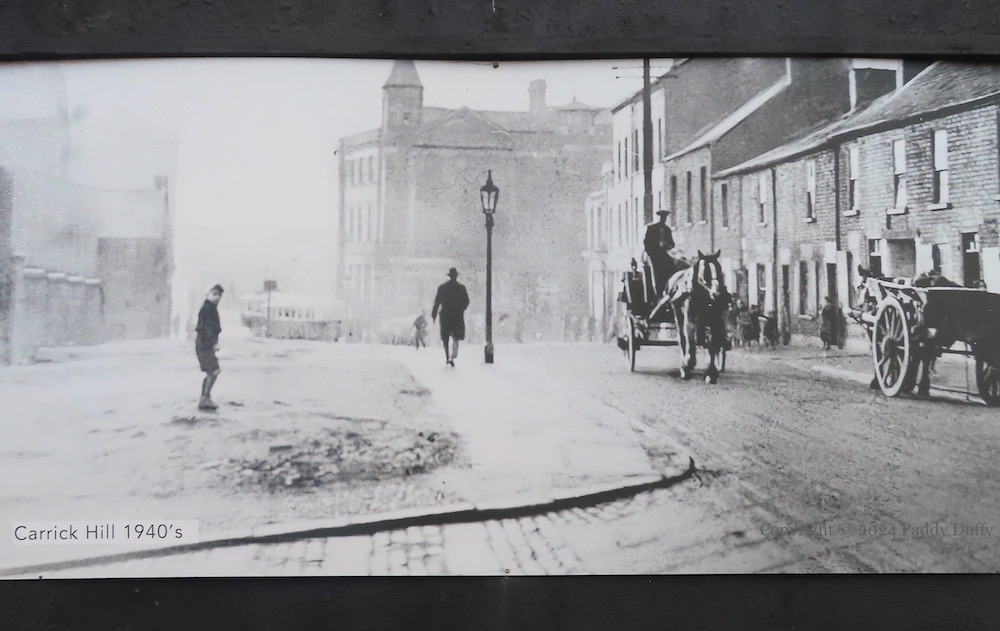
The collection of images showing “Carrick Hill in the old days” now includes a mural, of two women talking in the street.
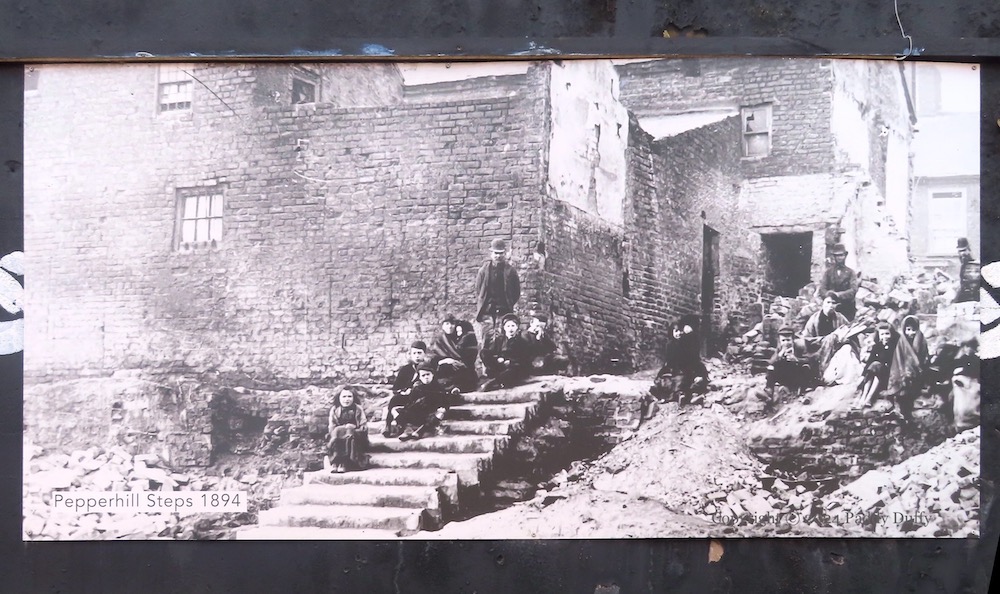
In addition to the mural, there are four boards, two on either side: Carrick Hill playground; Regent Street party; Pepper Hill steps, 1894; Carrick Hill 1940s.
There are eleven more boards in Regent Street. (Later increased to fifteen with the addition of 1976 Mandiville dart team; Mary McCusker & Kitty Spotwoods; Maggie Jane Largey & Mary Ann Largey; Richard & Alan Crean – see The Tea Bar for all fifteen.)
The board in the image below (from Stanhope Street) shows Pepper Hill Steps before the turn of the twentieth century. The steps used to lead from Mustard Street (which was what Library Street used to be) towards Upper Library Street (now Carrick Hill, the street).
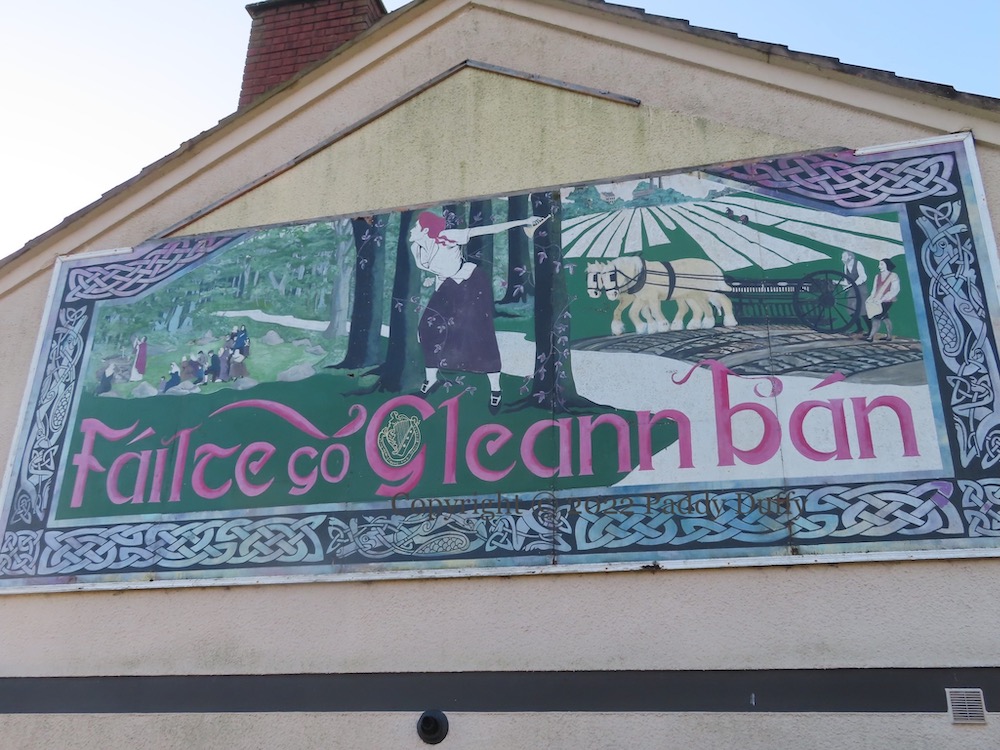
“Were you at the rock?” A red-headed lass with a horn stands watch for others at a mass rock – a stone in a remote location for Catholic worship, made necessary by a Penal law of 1695 which forbade the religious practice of Catholicism and “dissenter” forms of Protestantism (that is, anything other than Anglicism) (source). The harp, with a “cap of liberty” rather than a crown (WP), together the slogan “Equality – It is new strung and it shall be heard” is the emblem of the Society of United Irishmen (WP). On the other side of the mural (seen below) linen lies in the fields bleaching and a farmer and wife plough the land with a team of horses and distribute seed.
Glencolin estate was built next to Moyard House (which in 1984 became home to the Roddy’s (web)) on the Glen Road in 1979 (Belfast Forums). For the fortieth anniversary of “eastát Ghleann Collaınn” the mural at the entrance to the estate was (belatedly) repainted. The composition of the mural remains as in the previous version, with the Roddy’s and Oliver Plunkett church in the shadow of Dubhaıs and Slıabh Dubh; they are now joined by images of Gaelic games. The Bobby Sands quote has been removed.
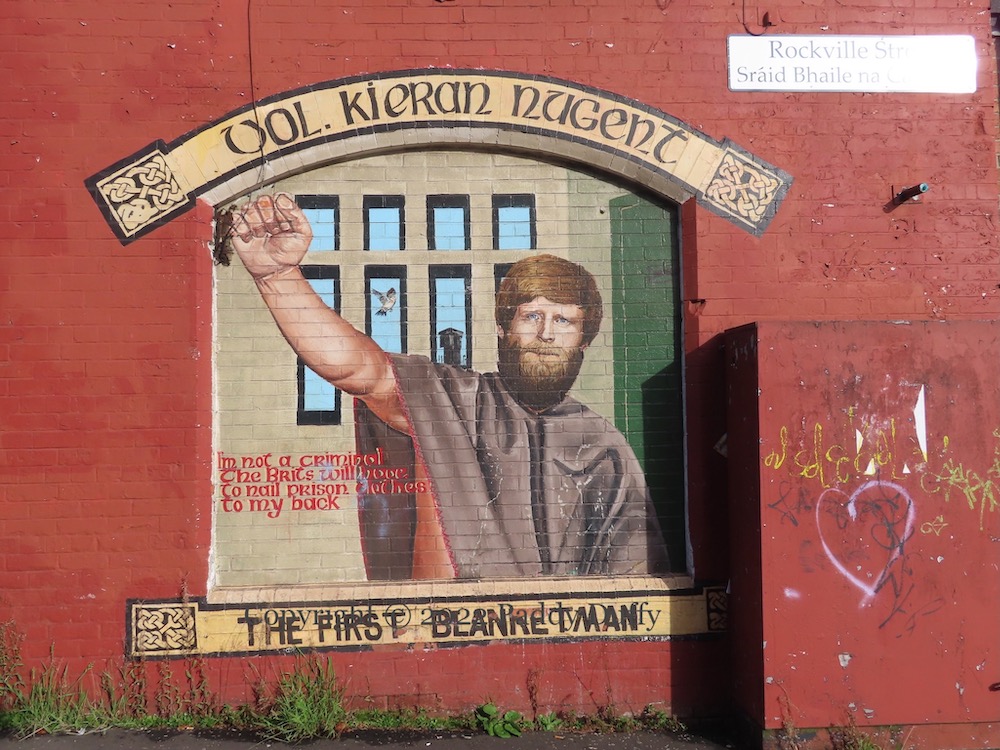
“The first blanketman”. IRA prisoner Kieran Nugent is reputed to have said – upon being imprisoned after the removal of Special Category status in 1976 – “I’m not a criminal – the Brits will have to nail prison clothes to my back.”








 Paddy Duffy Collection