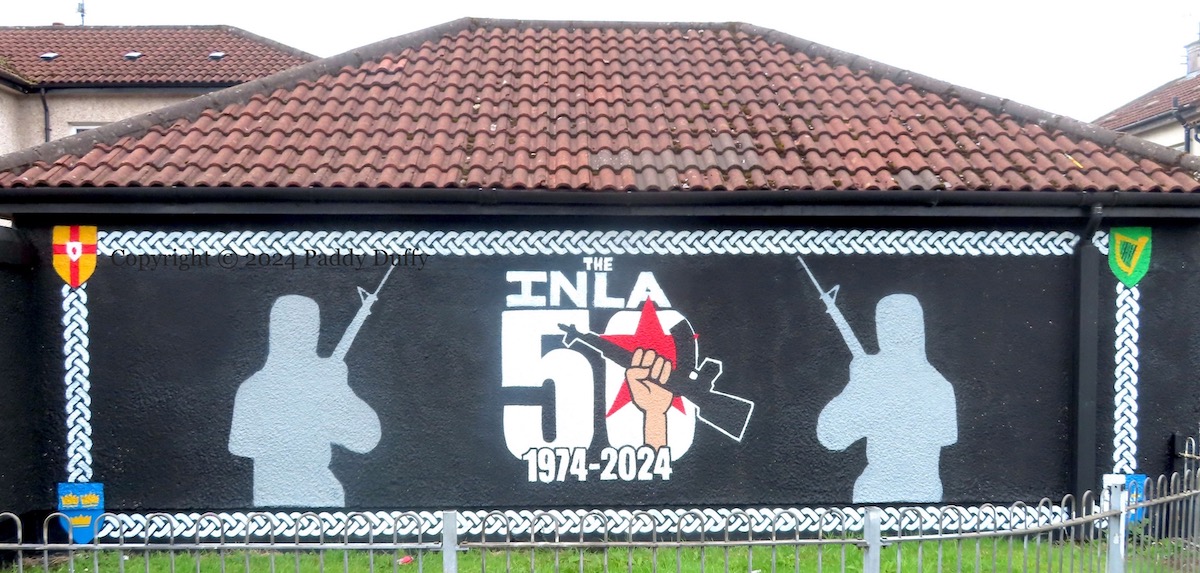
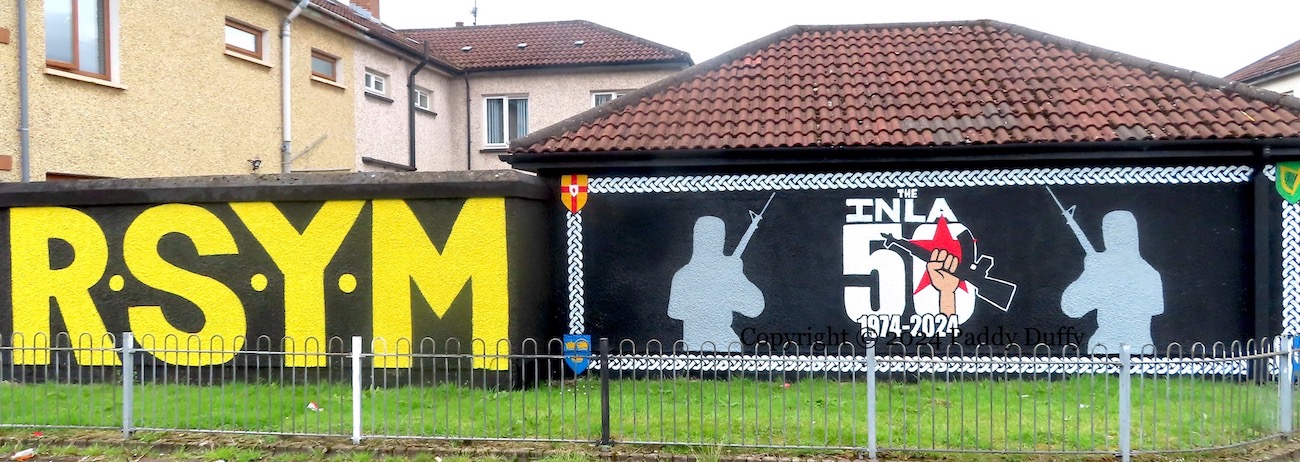
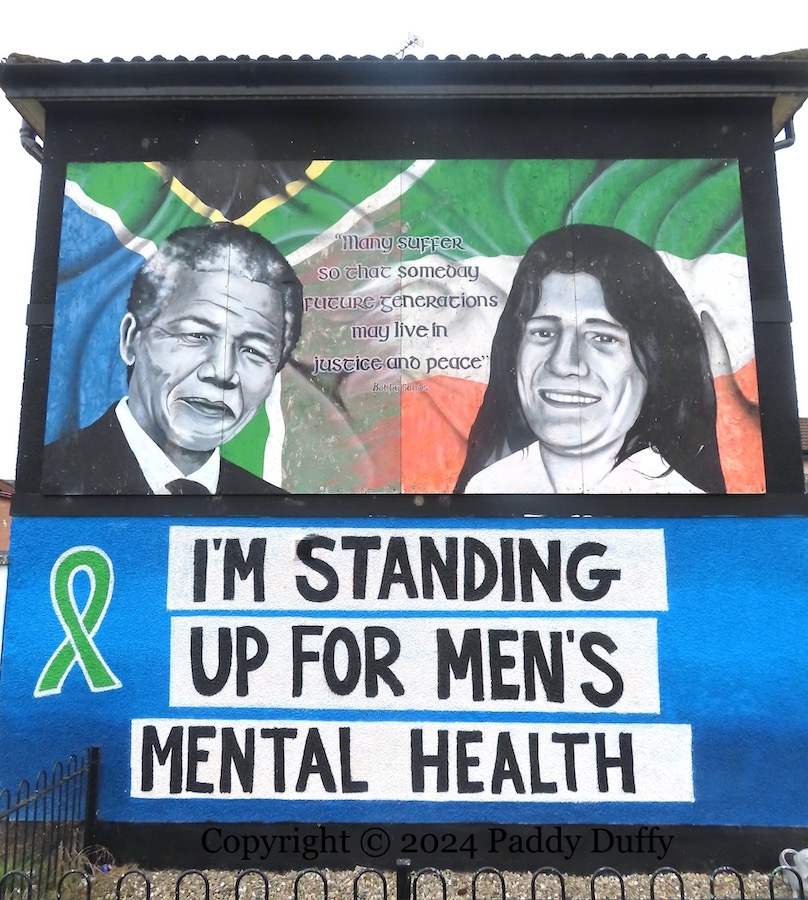
Commemorations of the INLA’s fiftieth anniversary have so far been limited to graffiti – see Saoırse Go Deo in Derry and Let The Fight Go On in Belfast – but here we have two deliberately painted panels in the Bogside (specifically Meenan Square) (one replacing The Way We Were).
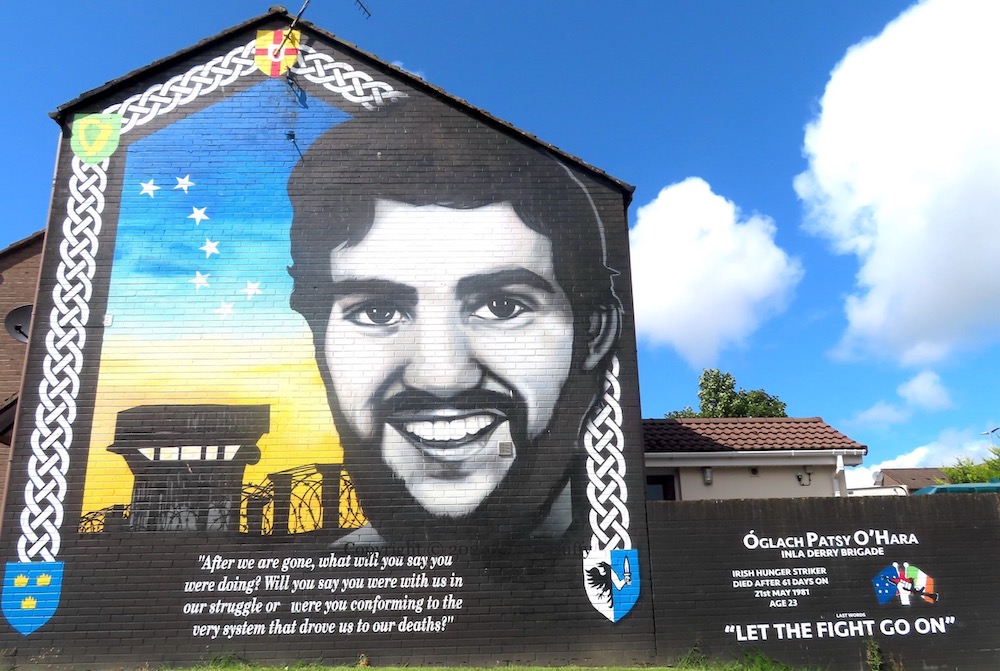
Patsy O’Hara was born in 1957 Bishop Street, Derry, and joined Na Fıanna in 1970 and the local Sınn Féın cumann in 1971 and, in August was shot in the leg by British soldiers. In 1972 he joined the Republican Clubs and in 1975 the IRSP. He was imprisoned multiple times, the final time being in January 1979 for possession of a hand grenade (Bobby Sands Trust). He went on hunger strike 41 years ago tomorrow (March 22nd) and was the first of the three INLA hunger strikers to die in 1981. The long-standing mural in Bishop Street was repainted for the 40th anniversary of his death. (For the previous version, see Let The Fight Go On.)
“Óglach Patsy O’Hara, INLA Derry Brigade, Irish hunger striker, who died after 61 days on 21st May 1981, age 23. Last words ‘Let the fight go on’.”
“After we are gone, what will you say you were doing? Will you say you were with us in our struggle or where you conforming to very system that drove us to our deaths?” – these words also appeared in the 2013 mural to O’Hara on Shaws Road, west Belfast.
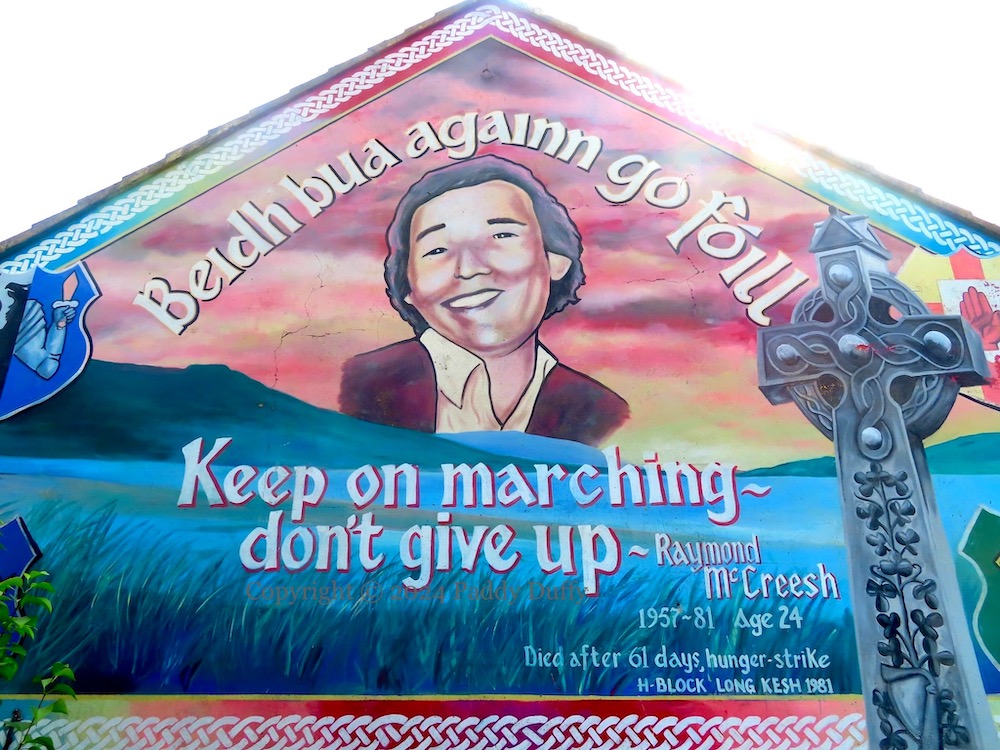
“Beıdh bua agaınn go fóıll” [victory will be ours yet] – Keep on marching, don’t give up – Raymond McCreesh 1957-81, age 24. Died after 61 days hunger-strike, H-Block Long Kesh 1981.” The phrase was spoken at the end of a visit with Jim Gibney.
Outside Raymond McCreesh House – his birthplace – at Maryville, Camlough.
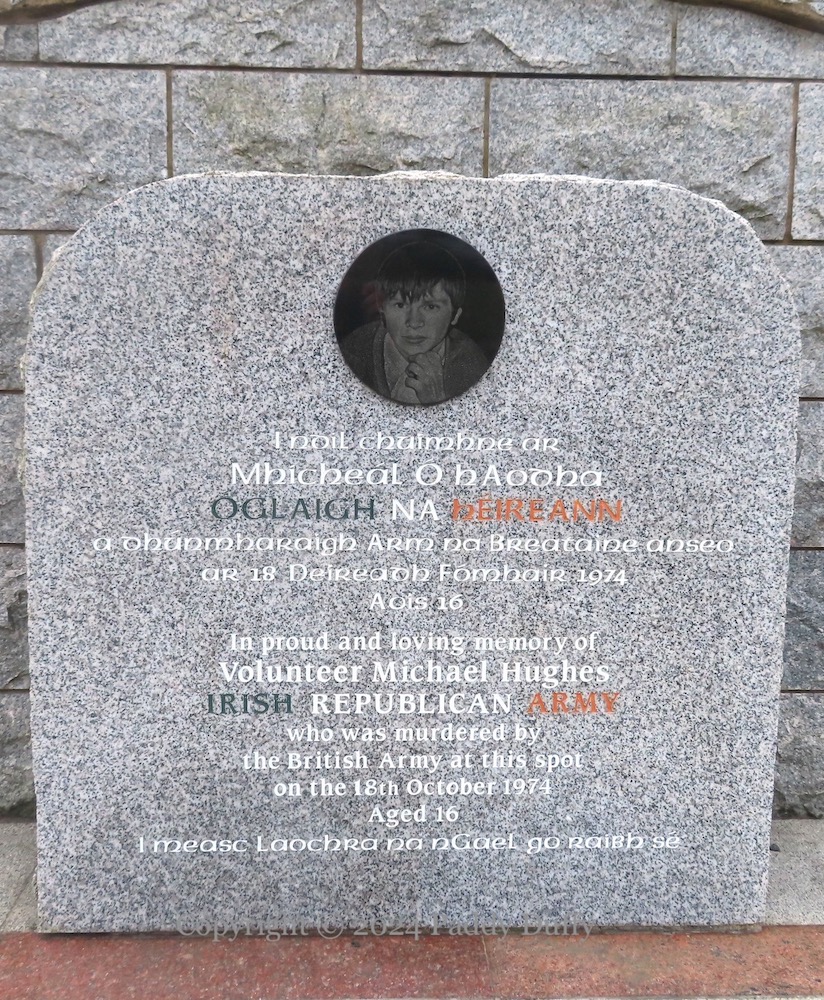
“I ndıl chuımhne ar Mhıcheál Ó hAodha, Óglaıgh na hÉıreann, a dhúnmharaıgh Arm na Breataıne anseo ar 18 Deıreadh Fómhaır 1974, aoıs 16. In proud and loving memory of Volunteer Michael Hughes, Irish Republican Army, who was murdered by the British Army at this spot on the 18th October 1974 aged 16. I measc laochra na nGael go raıbh sé.”
Hughes was shot when he and several other youths attempted to hijack a bus at the stop at the entrance to the area which was under observation by a Royal Marine unit; the soldier who fired the shot claimed that Hughes had pointed a pistol at him, but no weapon or forensic evidence was recovered (Lost Lives 1208).
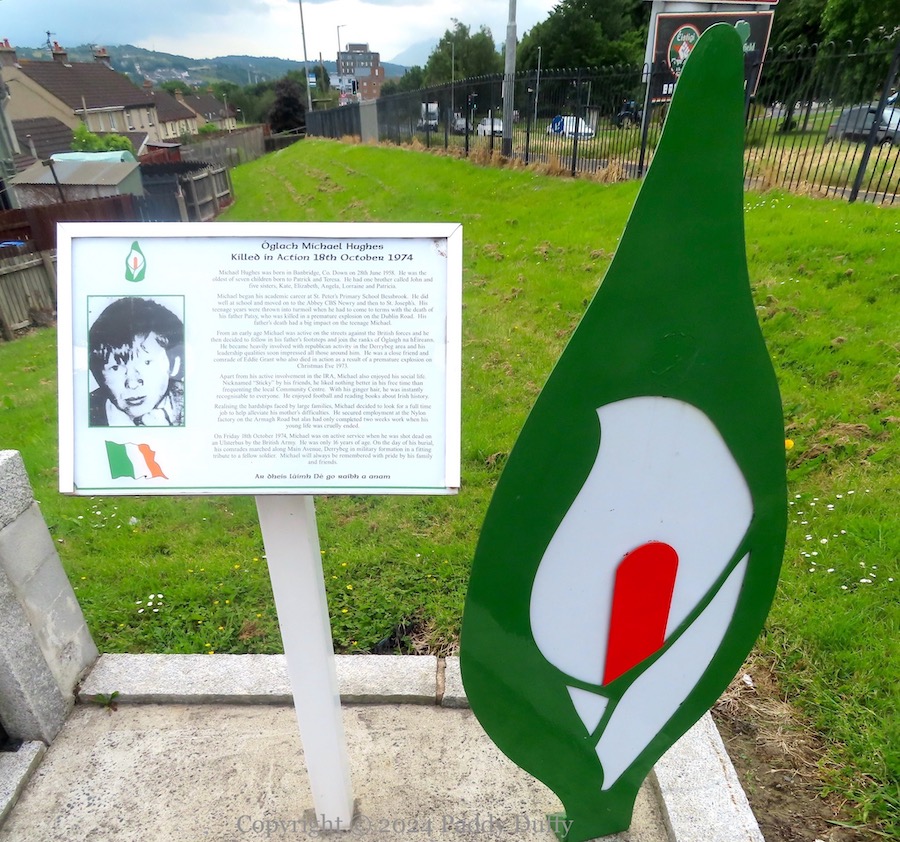
This is an enlarged memorial to Hughes at the upper entrance to Derrybeg. For the previous memorial, see M08521); Peter also photographed the bus shelters (in 2002).
From the printed info board: “Michael Hughes was born in Banbridge, Co. Down on 28th June 1958. He was the oldest of seven children born to Patrick and Teresa. He had one brother called John and five sisters, Kate, Elizabeth, Angela, Lorraine and Patricia. Michael began his academic career at St. Peter’s Primary School Bessbrook. He did well at school and moved on to the Abbey CBS Newry and then to St. Joseph’s. His teenage years were thrown into turmoil when he had to come to terms with the death of his father Patsy, who was killed in a premature explosion on the Dublin Road. His father’s death had a big impact on the teenage Michael. From an early age Michael was active on the streets against the British forces and he then decided to follow in his father’s footsteps and join the ranks of Óglaıgh Na hÉıreann. He became heavily involved with republican activity in the Derrybeg area and his leadership qualities soon impressed all those around him. He was a close friend and comrade of Eddie Grant who also died in action as a result of a premature explosion on Christmas Eve 1973. Apart from his active involvement in the IRA, Michael also enjoyed his social life. Nicknamed “Sticky” by his friends, he liked nothing better in his free time than frequenting the local Community Centre. With his ginger hair, he was instantly recognisable to everyone. He enjoyed football and reading books about Irish history. Realising the hardships faced by large families, Michael decided to look for a full time job to help alleviate his mother’s difficulties. He secured employment at the Nylon factory on the Armagh Road but alas had only completed two weeks work when his young life was cruelly ended. On Friday 18th October 1974, Michael was on active service when he was shot dead on an Ulsterbus by the British Army. He was only 16 years of age. On the day of his burial, his comrades marched along Main Avenue, Derrybeg in military formation in a fitting tribute to a fellow soldier. Michael will always be remembered with pride by his family and friends. Ar dheıs láımh Dé go raıbh a anam.”
Nine people died in the 1972 blast that killed Patsy Hughes, at the customs station in Newry – two lorry-drivers, four customs officials, and three IRA volunteers (Lost Lives 551).
Here are three pieces from the Drumcor Hill area of Enniskillen.
Above, “Enniskillen remembers the hunger strikers” – for the fortieth anniversary of the 1981 strike, against a background of sunburst and starry plough, in Loughview Drive.
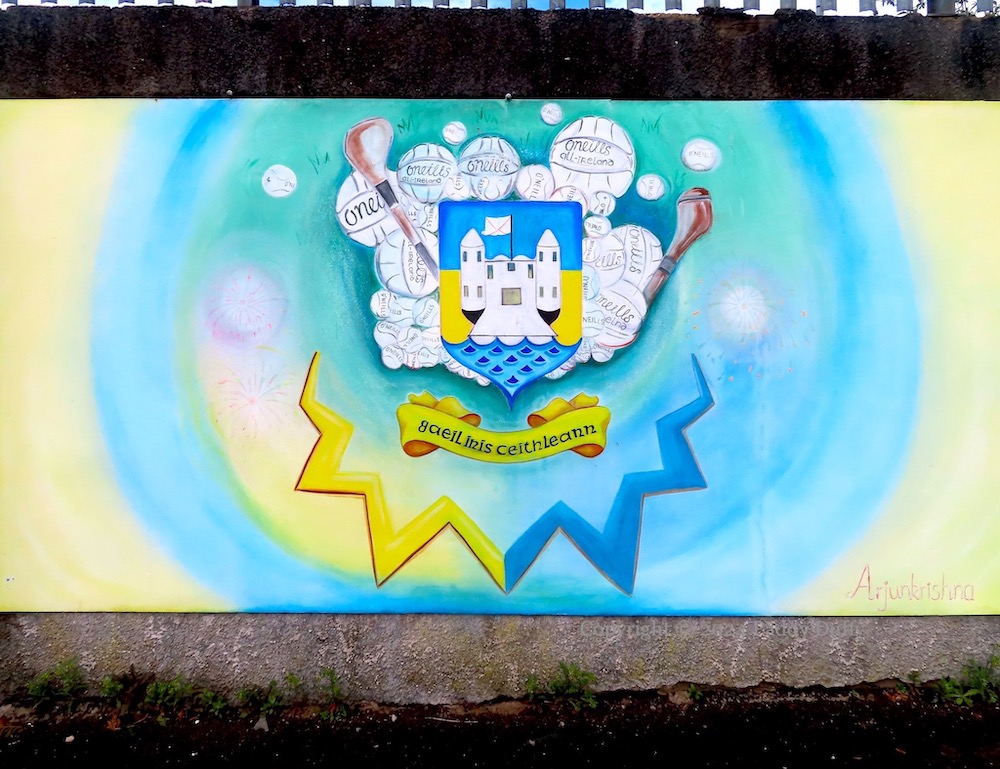
Below, the emblem of Gaeıl Inıs Ceıthleann/Enniskillen Gaels (web) on the wall outside their home field of Brewster Park.
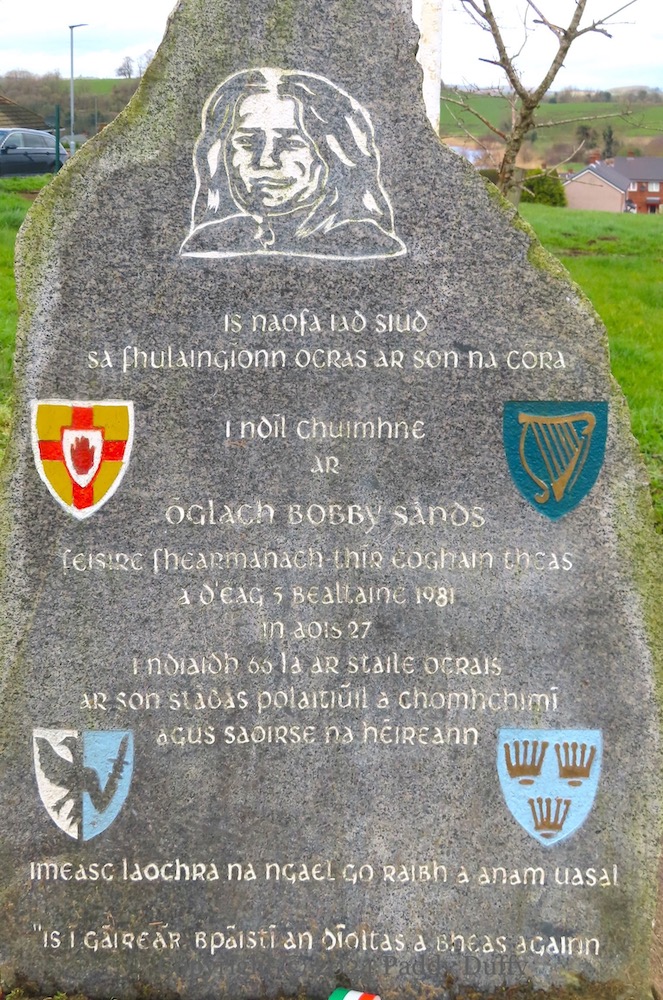
Finally, a memorial stone to Bobby Sands in Erne Drive. The inscription on the stone reads, “‘Is naofa ıad sıud sa fhulaıngíonn ocras ar son na córa.’ [= Holy are those who suffer hunger for the sake of justice/”Blessed are those who hunger for justice”] I ndíl [ndıl] chuımnhe ar Óglach Bobby Sands, feısıre [= M.P.] Fhearmanach-Thír Eoghaın Theas, a d’éag 5 Bealtaıne 1981 ın aoıs 27 ı ndıaıdh 66 lá ar staıle [staılc] ocraıs ar son stádas polaıtıúıl a chomhchımí agus saoırse na hÉıreann. I measc laochra na nGael go raıbh a anam uasal. ‘Is í gáıre ár bpáıstí an díoltas a bheas agaınn'”
For an alternative translation of Sands’s quote “Our revenge will be the laughter of our children”, see The Spirit Of Freedom in the Peter Moloney collection.
Katie Taylor and Carl Frampton are featured on the large mural at Antrim Boxing Club (Fb), painted by Visual Waste (ig) with support from the Housing Executive (Press Release), Antrim and Newtownabbey Borough Council, and the executive’s T:BUC programme (see previously Belfast Melt).
Below are the small murals on the other walls, of the club’s logo, including the Round Tower (DfC), and of the Irish Athletic Boxing Association (web).
For another Taylor mural, see School Of Champions. Frampton appears in half-a-dozen other murals, most prominently in The Jackal.
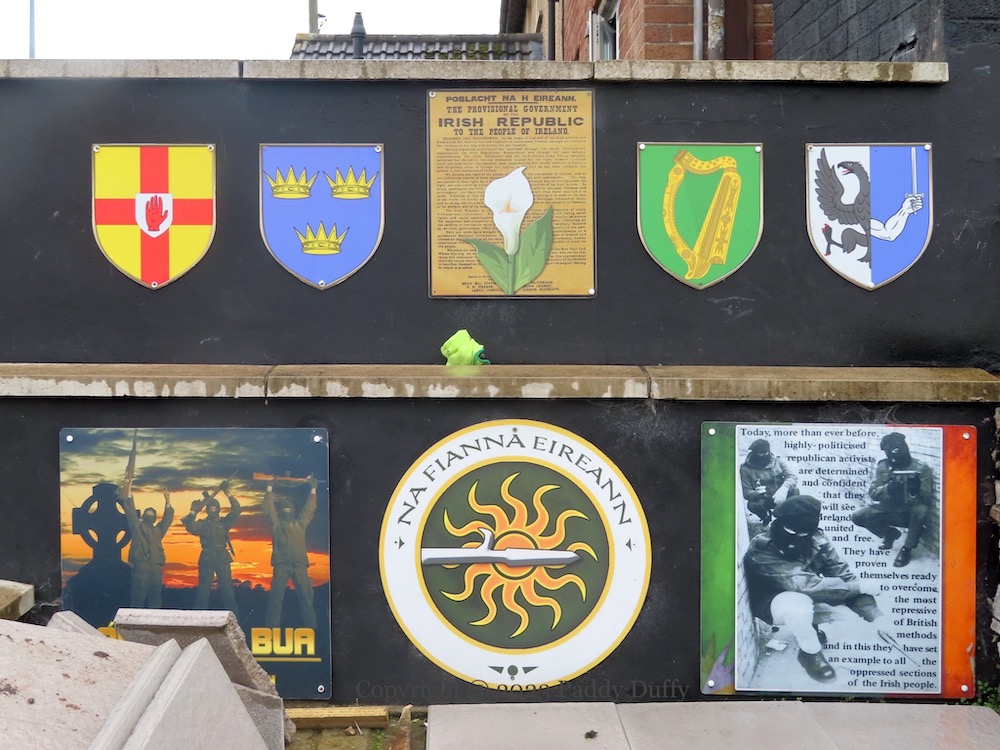
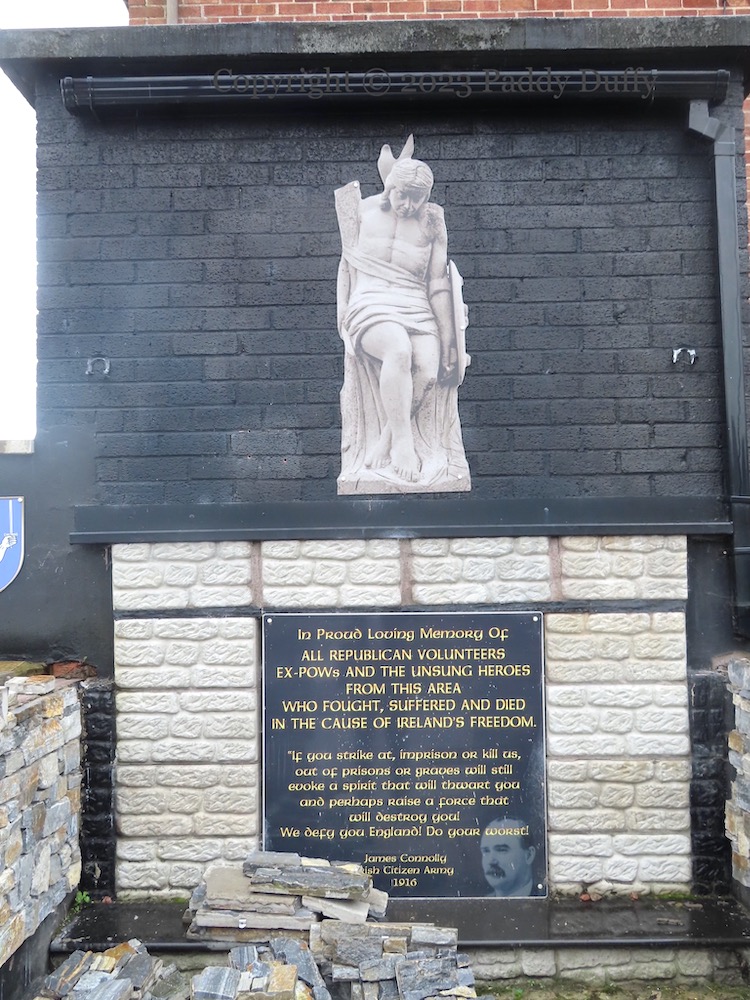
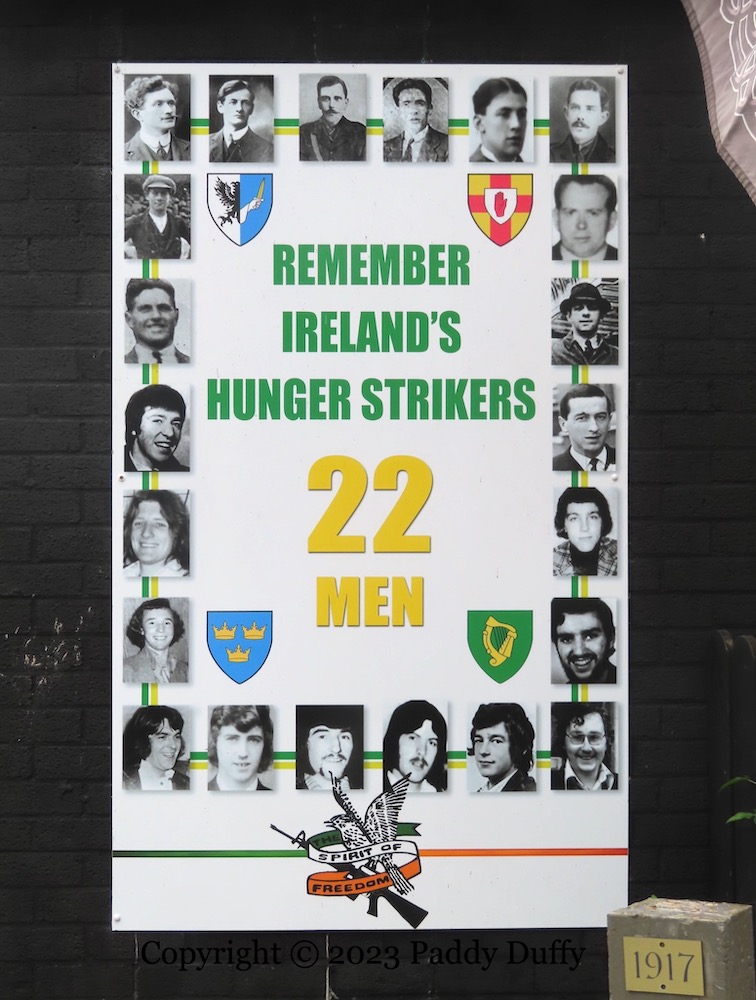
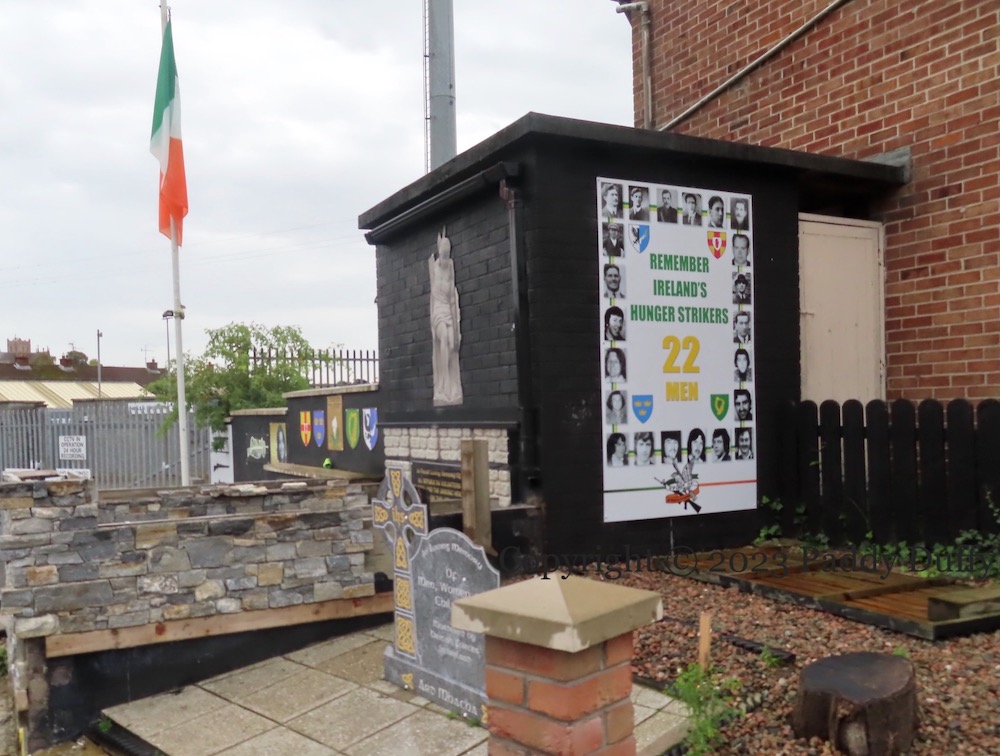
There is a memorial garden to the history of Irish resistance at the entrance to the Athletic Grounds in Armagh. From left to right, the images presented here show:
“More than 800 years of Irish resistence” – a sword for the Norman invasion under Strongbow, a pike for the 1798 and 1803 rebellions, a bolt-action rifle for the Easter Rising of 1916, and an assault rifle for the Troubles;
Cumann Na mBan, Mairéad Farrell and republican women who made “the supreme sacrifice”;
The Proclamation, Provisional IRA and Na Fianna;
The dying Cú Chulainn and a plaque “in proud and loving memory of all republican volunteers, ex-POWs and the unsung heroes from this area who fought, suffered and died in the cause of Ireland’s freedom, with a quote from James Connolly: ‘If you strike at, imprison or kill us, out of prisons or graves will still evoke a spirit that will thwart you and perhaps raise a force that will destroy you! We defy you England! Do your worst!”;
“Remember Ireland’s hunger strikers – 22 men” – the ten 1981 hunger strikers and Thomas Ashe, Terence MacSwiney, Michael Fitzgerald, Joe Murphy, Joseph Whitty, Andy O’Sullivan, Denny Barry, Tony D’Arcy, Jack McNeela, Seán McCaughey, Michael Gaughan, Frank Stagg;
A stone “in loving memory of men, women and children murdered by British forces in Ireland.”
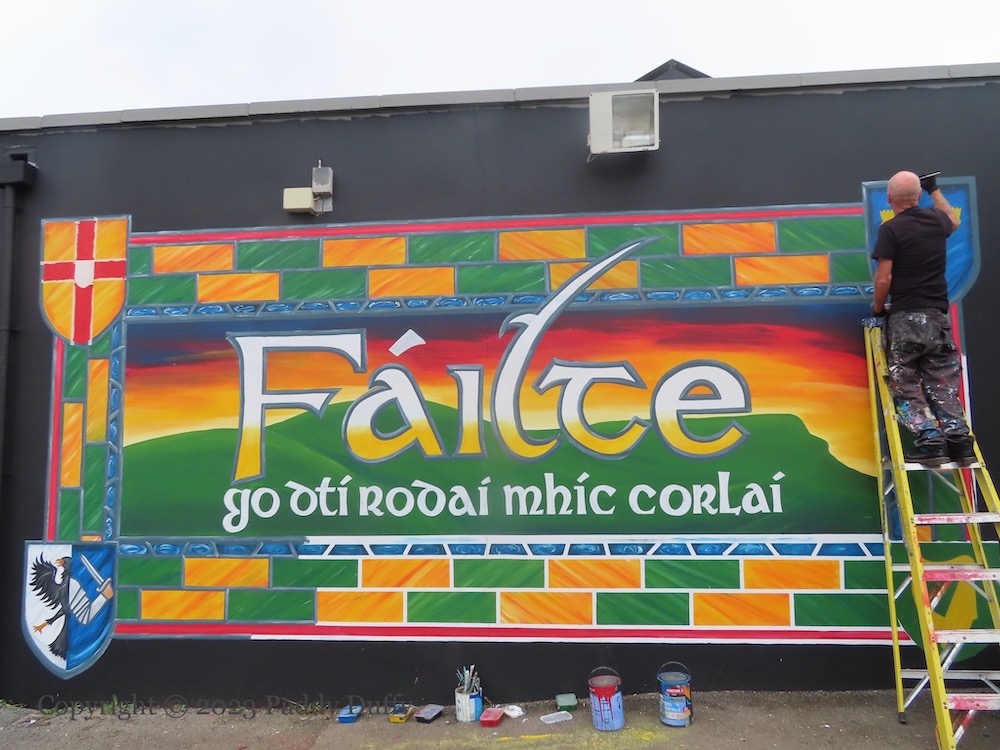
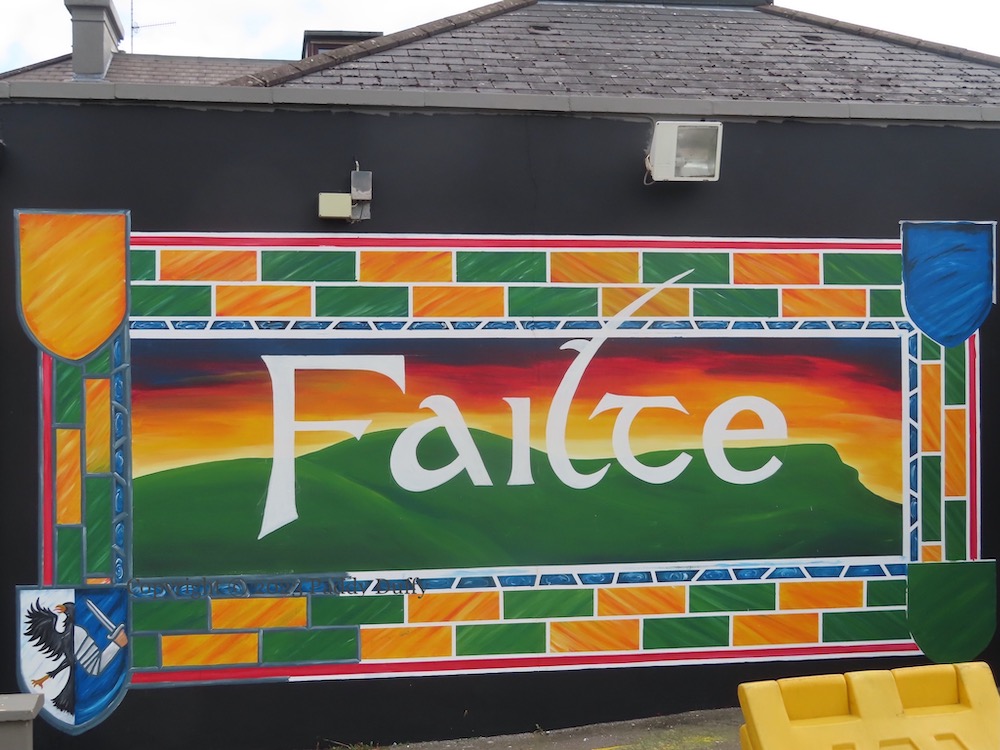
A new “fáılte” [“welcome”] mural was painted at the Roddy’s in anticipation of the official opening of the new republican heritage centre/ıonad oıdhreachta poblachtaí (web) which took place on September 28th. Construction of the museum and the adjacent restaurant began in May 2021 with an investment of 1.35 million pounds (Belfast Live). The museum’s exhibits cover republican history from 1798 to the present, and items on display from the Society’s collection include vintage uniforms and artefacts, historic maps and documents, and prison handicrafts.
These two boards are at Gort Na Móna CLG. The one above was put developed by young Gorts as they learned about the history of the club as part of a twentieth anniversary celebration of Terry Óg Enright (Fb) who was killed by the LVF in 1998. The second board, below, combines the two previous boards to Terry Óg, seen previously in No Such Thing As Failure and Páırc Mhıc Ionnrachtaıgh.
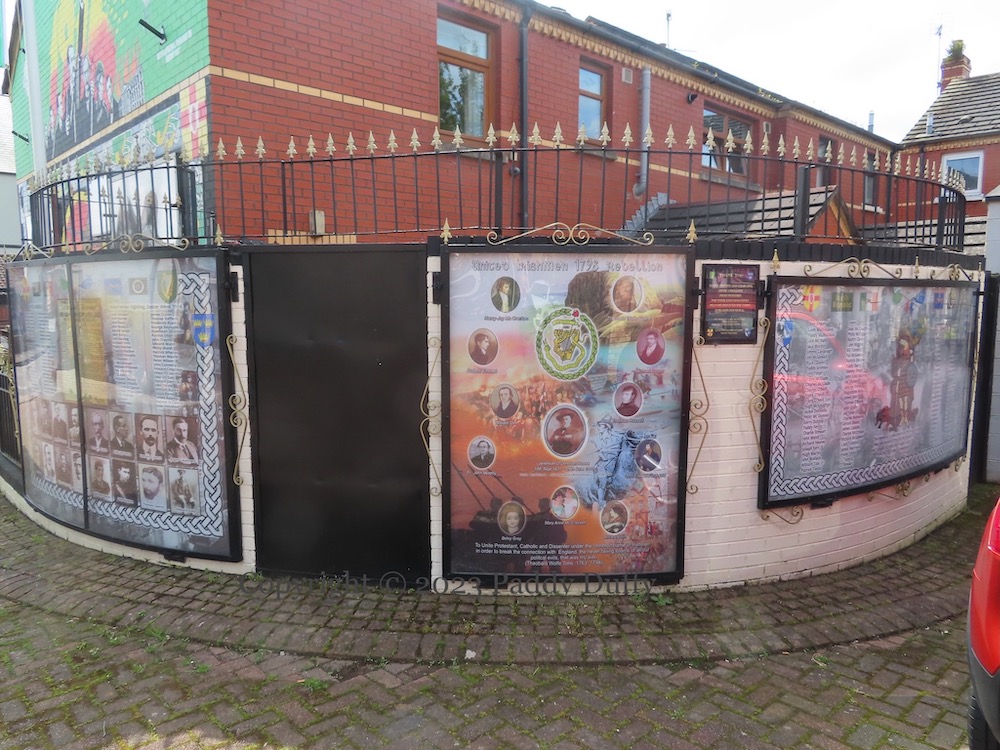
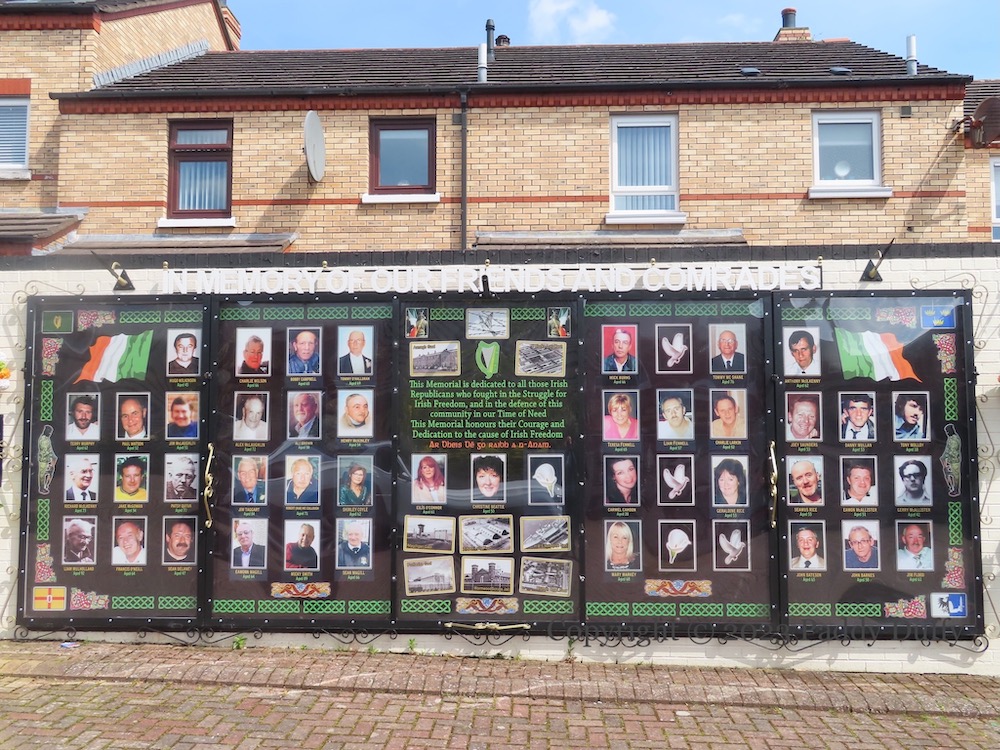
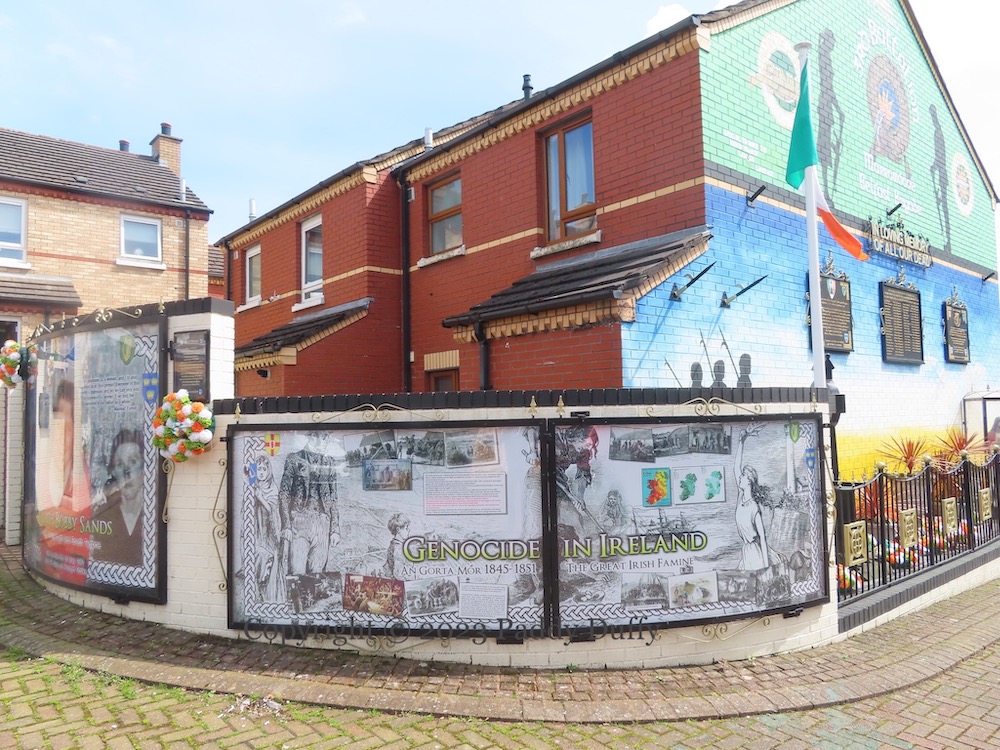
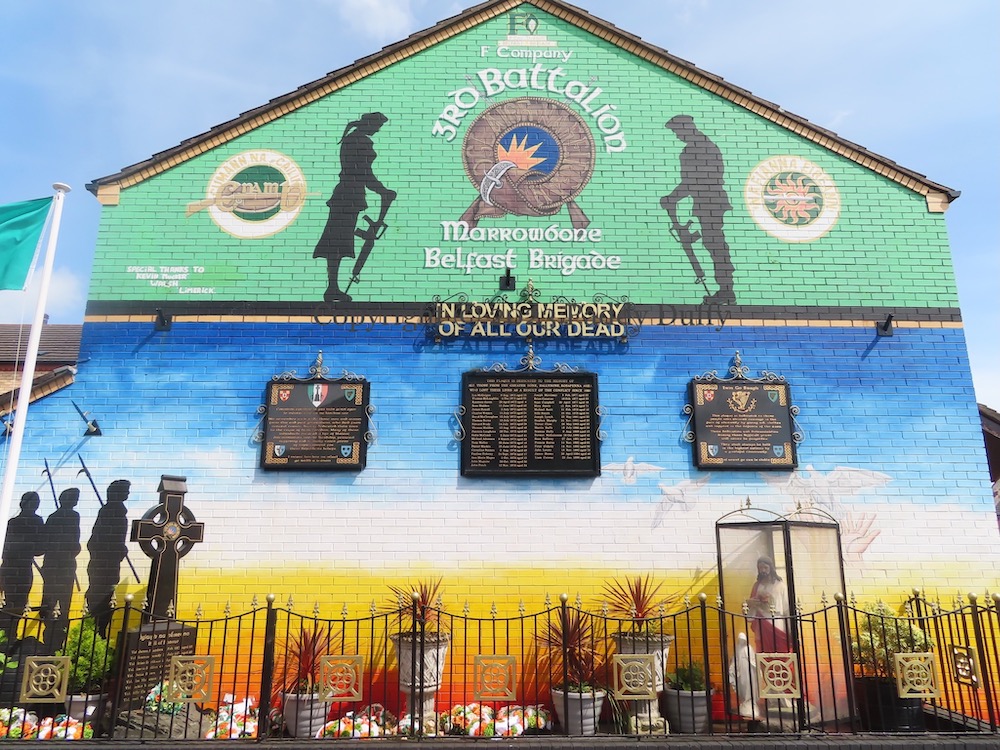
Here is a gallery of the murals and plaques in Clós Ard An Lao/Ardilea Close in the Machaıre Botháın/Marrowbone area of north Belfast. A full repertoire of republican events is commemorated – the United Irishmen, Great Hunger, the Rising, the Troubles, the (modern) hunger strikes. What is most striking is the significant presence of religious icons, such as the Sacred Heart in the glass cases in front of the two main murals (above and last below).














 Paddy Duffy Collection