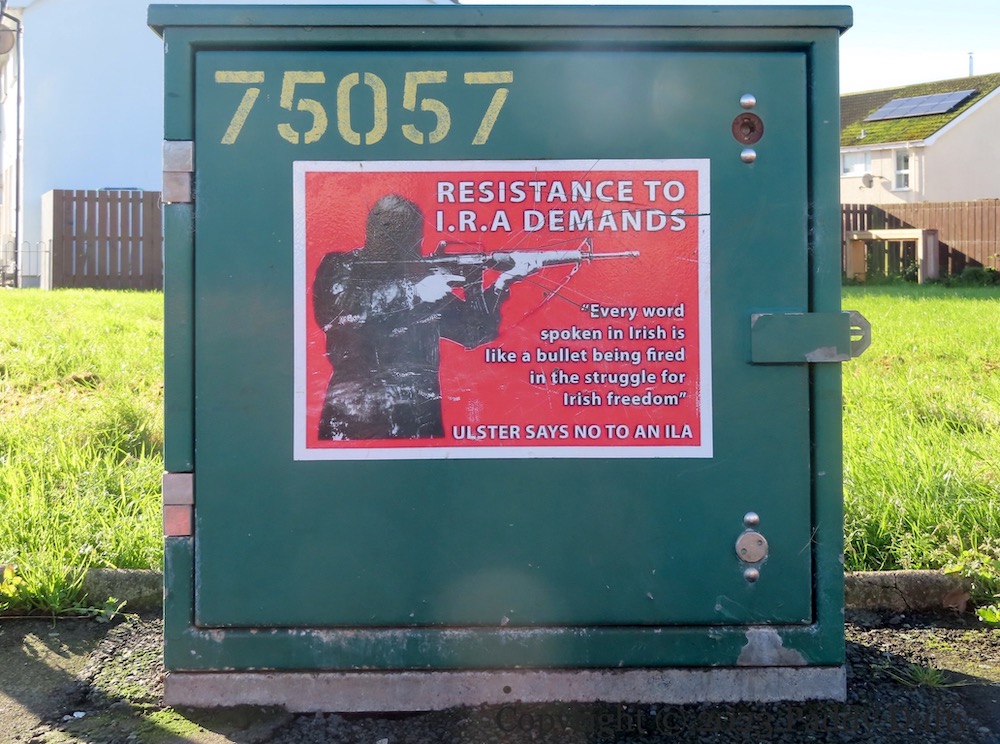
“Resistance to IRA demands – “Every word spoken in Irish is like a bullet being fired in the struggle for Irish freedom” – Ulster says no to an ILA.” The precise wording and the author of the quotation are unclear. Nelson McCausland of the DUP gives it as “Now every phrase you learn is a bullet in the freedom struggle” and attributes it to Sınn Féın’s Pádraıg Ó Maolchraoıbhe in May 1982 (BelTel | Nelson’s View). The Irish language is not, of course, the exclusive property of militant republicanism, and, although the IRA has ceased its campaign and decommissioned its weapons, it is used here in conjunction with an image of a gunman firing an assault rifle in order to provoke fear against an Irish Language Act. The bill – enacted by Westminster rather than Stormont – became law last (2022) December (BBC). The poster dates from 2022 or 2021.
“It is not for riches, fame or glory that we remain in the shadows of our community, but for its protection.”
These words are echoed on the central stone in the garden of reflection, with adjacent North Down UDA roll of honour: “‘Who shall separate us?’ Right up to the present day, these words have been the inspiration and motivation of numerous men and women to serve, fight and die for the defence of their homeland, its people and its heritage. This selfless action is not for riches, fame or glory, but is freely given out of a love of freedom, commitment to the faith and culture of our nation, and a desire that all future generation in all communities can live in peace.”
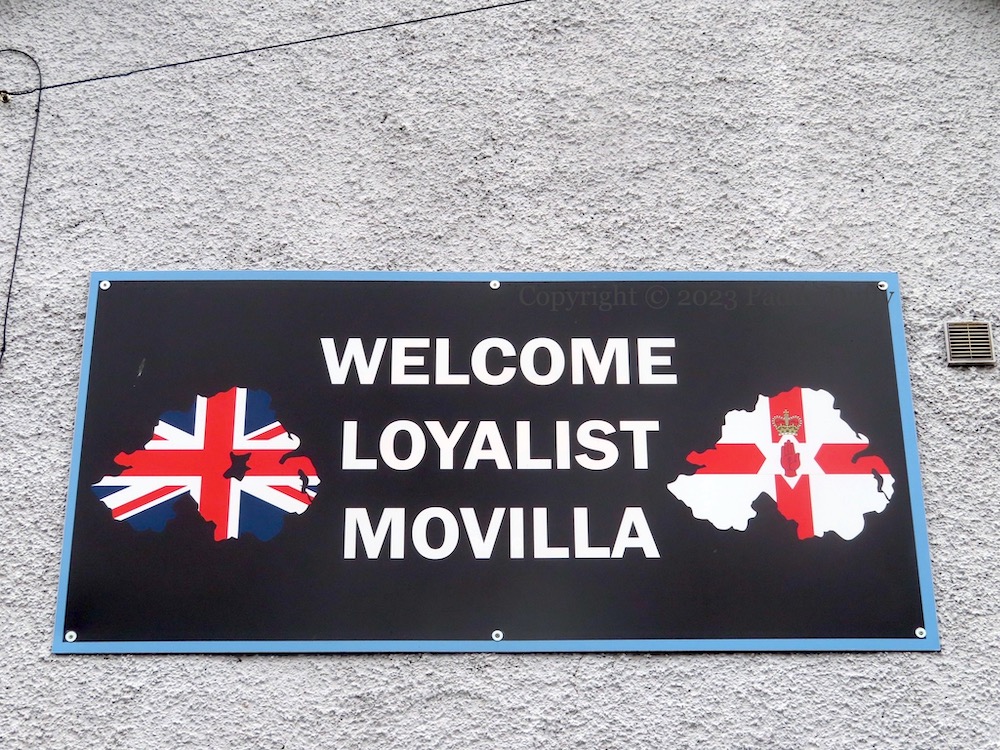
Movilla Street and Wallace’s Street, off Upper Movilla Street. “Loyalist Movilla” in Newtownards.
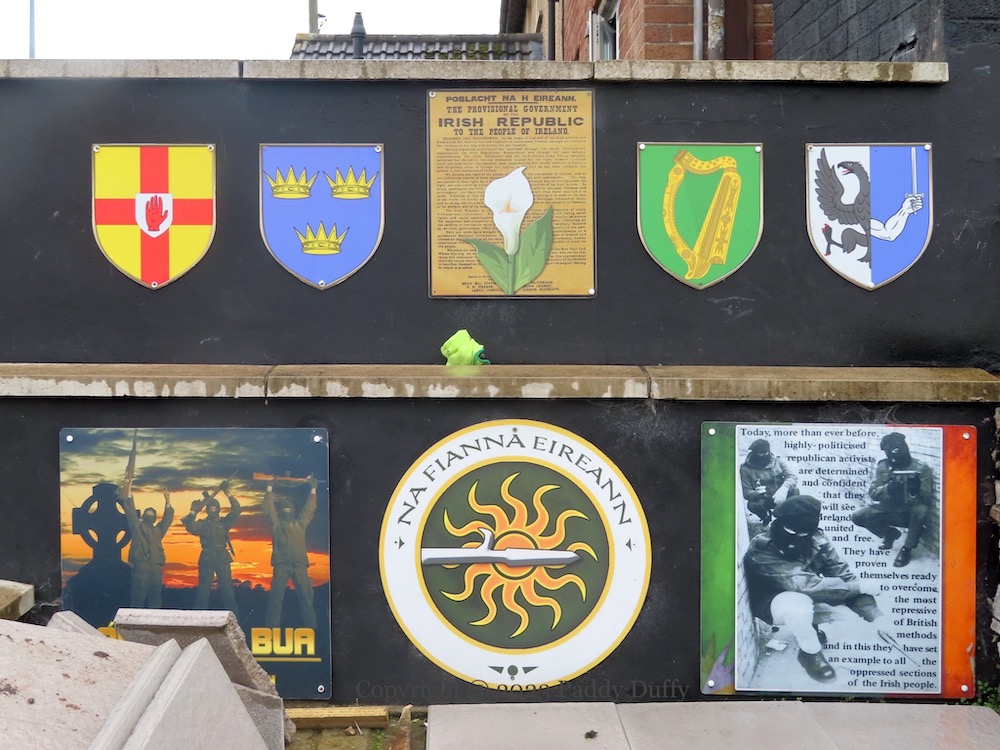
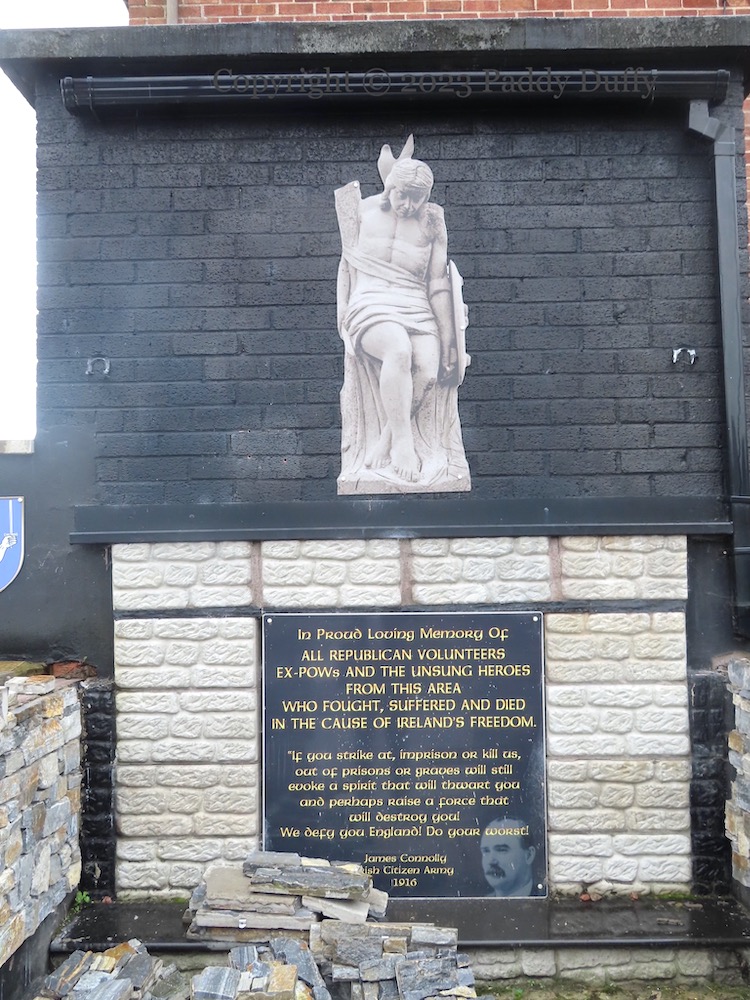
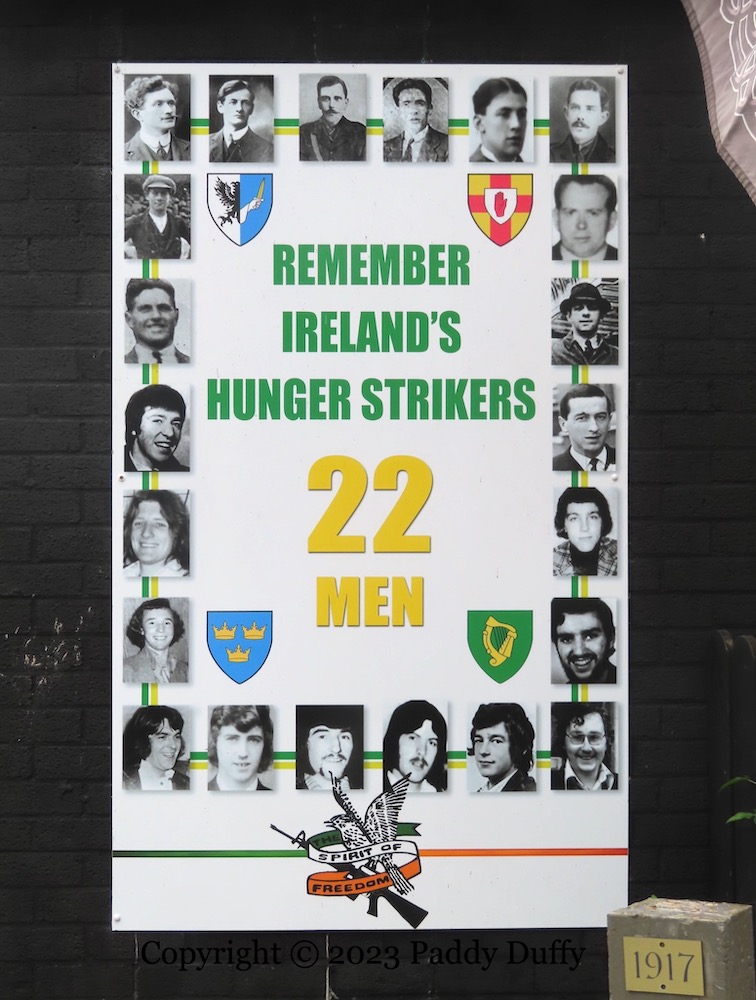
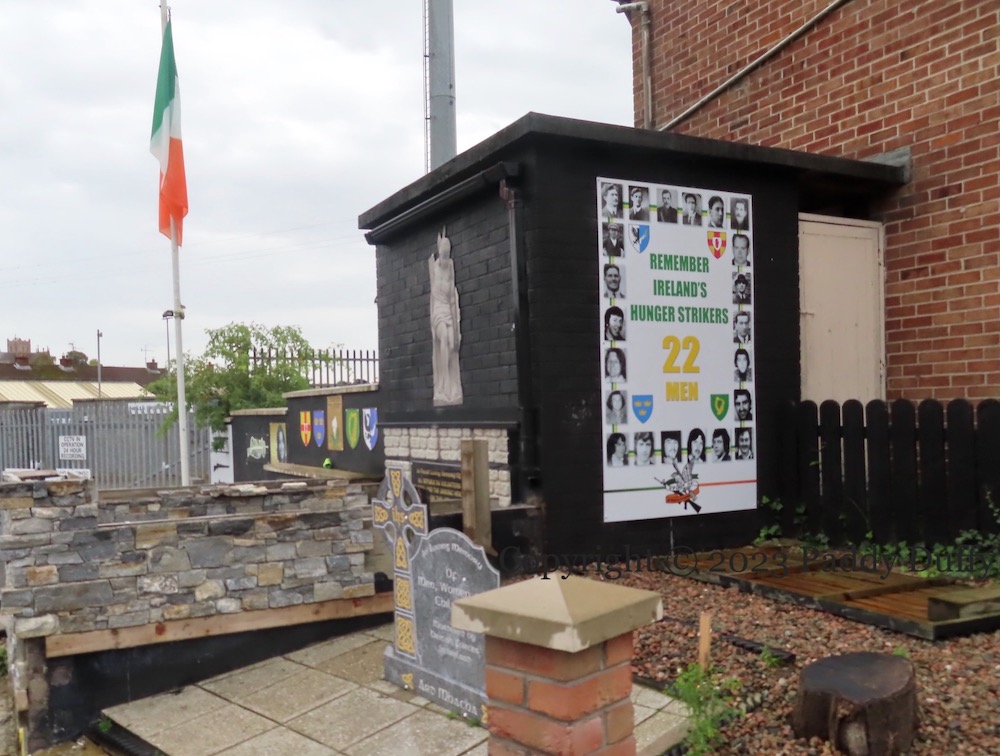
There is a memorial garden to the history of Irish resistance at the entrance to the Athletic Grounds in Armagh. From left to right, the images presented here show:
“More than 800 years of Irish resistence” – a sword for the Norman invasion under Strongbow, a pike for the 1798 and 1803 rebellions, a bolt-action rifle for the Easter Rising of 1916, and an assault rifle for the Troubles;
Cumann Na mBan, Mairéad Farrell and republican women who made “the supreme sacrifice”;
The Proclamation, Provisional IRA and Na Fianna;
The dying Cú Chulainn and a plaque “in proud and loving memory of all republican volunteers, ex-POWs and the unsung heroes from this area who fought, suffered and died in the cause of Ireland’s freedom, with a quote from James Connolly: ‘If you strike at, imprison or kill us, out of prisons or graves will still evoke a spirit that will thwart you and perhaps raise a force that will destroy you! We defy you England! Do your worst!”;
“Remember Ireland’s hunger strikers – 22 men” – the ten 1981 hunger strikers and Thomas Ashe, Terence MacSwiney, Michael Fitzgerald, Joe Murphy, Joseph Whitty, Andy O’Sullivan, Denny Barry, Tony D’Arcy, Jack McNeela, Seán McCaughey, Michael Gaughan, Frank Stagg;
A stone “in loving memory of men, women and children murdered by British forces in Ireland.”
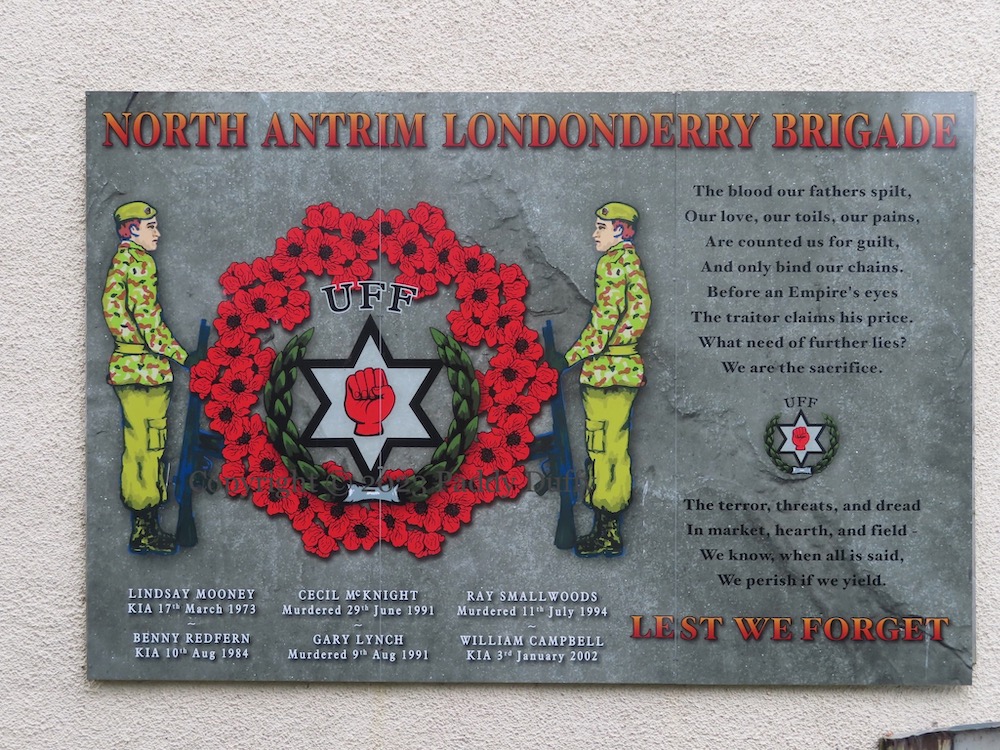
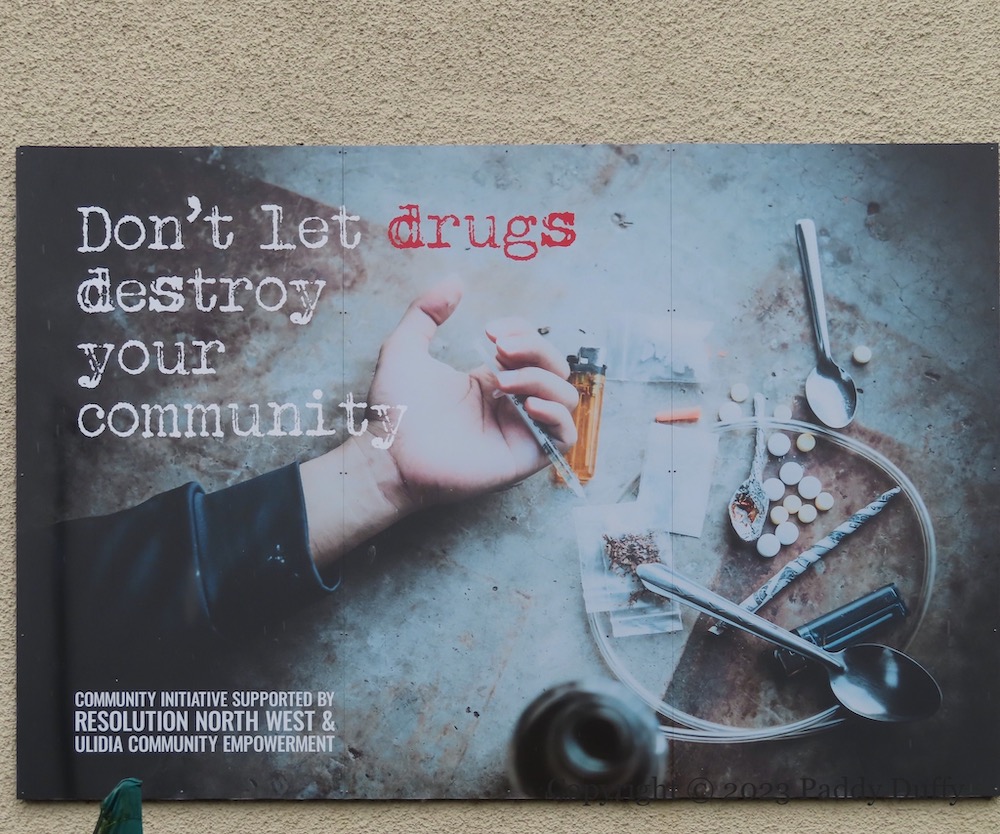
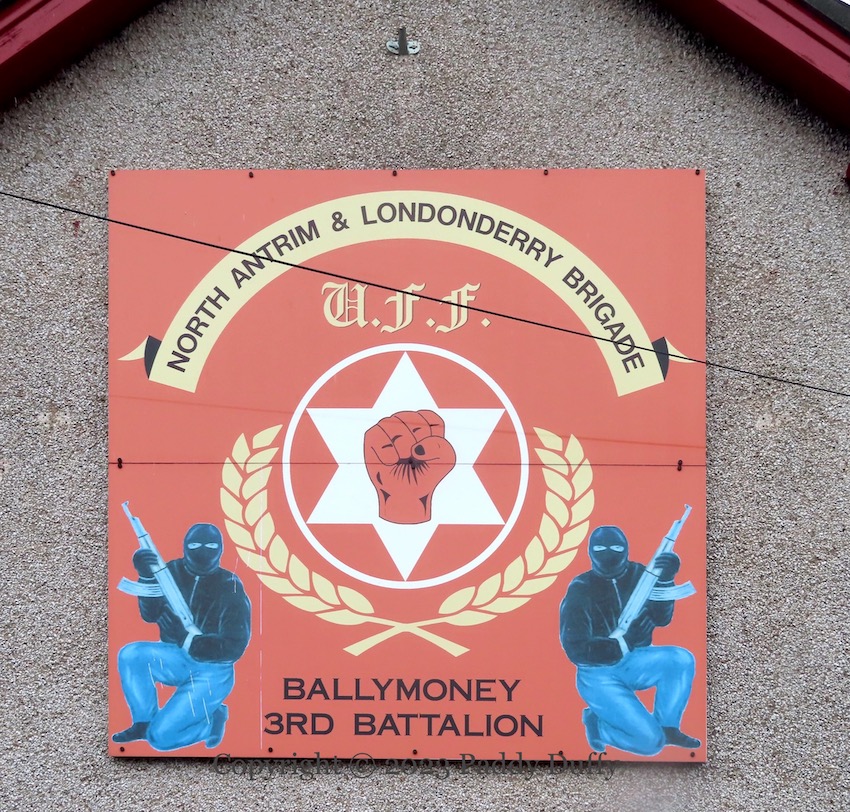
Here is a survey of the UDA boards in Carnany estate, Ballymoney. Many of these have been seen before (in Ulster’s Past Defenders, Ulster’s Present Defenders, The Terror, Threats, And Dread, and Ballymoney UDA). The anti-drugs board in the final image is new (see previously the one in Londonderry: Peace Impact Programme) and the one shown above and immediately below is an updated version of the board shown in Past, Present, For All Time. The dates given in the earlier version were 1972 and 2016; in this one, for “50 years of service”, they are 1971 and 2021. 1971 is the typical date given for the formation (in Belfast) of the the UDA; the 1972 date might have been a specific reference to the North Antrim And Londonderry brigade or the beginning of the Londonderry UDA’s actions, with bomb attacks on a factory and a pub in Donegal in October and November, 1972 (WP).
“North Antrim & Londonderry brigade, UFF, Ballymoney 3rd battalion” – hooded men with assault rifles remain on the walls in Alexandra Avenue/The Crescent, Ballymoney.
This is the new Sam Rockett mural in the Woodvale, replacing the mural seen in Murdered By Cowards. The old mural just featured Rockett, who died in August, 2000, in the feud between the UVF and lower Shankill UDA. This new mural also features the “ethnic cleansing” of Torrens in 2004.
Torrens sits between Cliftonville, Ardoyne, and the lower Oldpark, and was one of the many historically mixed areas in north Belfast that, with the Troubles, became increasingly segregated and separated from neighbouring areas by “peace” lines. Jarman (1996) provides eye-witness testimony of the dispute in Torrens in 1996 which saw Catholic families leave the area. Its proximity to Ardoyne (and Cliftonville), however, meant that over the next few years the houses were gradually abandoned by Protestants, culminating in 2004 when ten of the remaining Protestant families moved out of the area, alleging persistent intimidation and employing the term term “ethnic cleansing” – a term the poem to the right of the mural uses three times.
The area was eventually redeveloped from 2008-2012, with the Wyndham Street “peace” line coming down and Elmgrove Street being opened to the Oldpark Road.
The line in the poem “the resistance formed a steady band” is unclear – it might refer to loyalists being bussed into Torrens in 1996 (see the testimonies in Jarman); if it refers to B Company it would make a connection to Rockett. As it is, the connection between the two elements of the mural (if any is intended) seems to be that Rockett was from the lower Oldpark, near Torrens.
“In the name of Ireland’s cruel game/Oh, land that once sang freedom’s song/Now marred by ethnic cleansing’s wrong.//Echoes of anguish haunt the Protestants of Torrens,/Ethnically cleansed, a sinister goal,/Their weapon honed, to exact a toll.//Families robbed of essence and space,/fuelled by hated, to erase their trace.//Against the darkness, spirits sincere,/Hand in hand across the land,/the resistance formed a steady band.//Ethnic cleansing’s horrors unveiled at last,/Hearts of courage, unbreakable souls,/Truths unfurled, their power untold,/A captured scene of the evil deeds done.”
The in-progress images are from August 17th and 18th. The mural was completed for the anniversary of Rockett’s death on August 23rd. The source for the central image (of furniture being loaded into a lorry) is unknown.
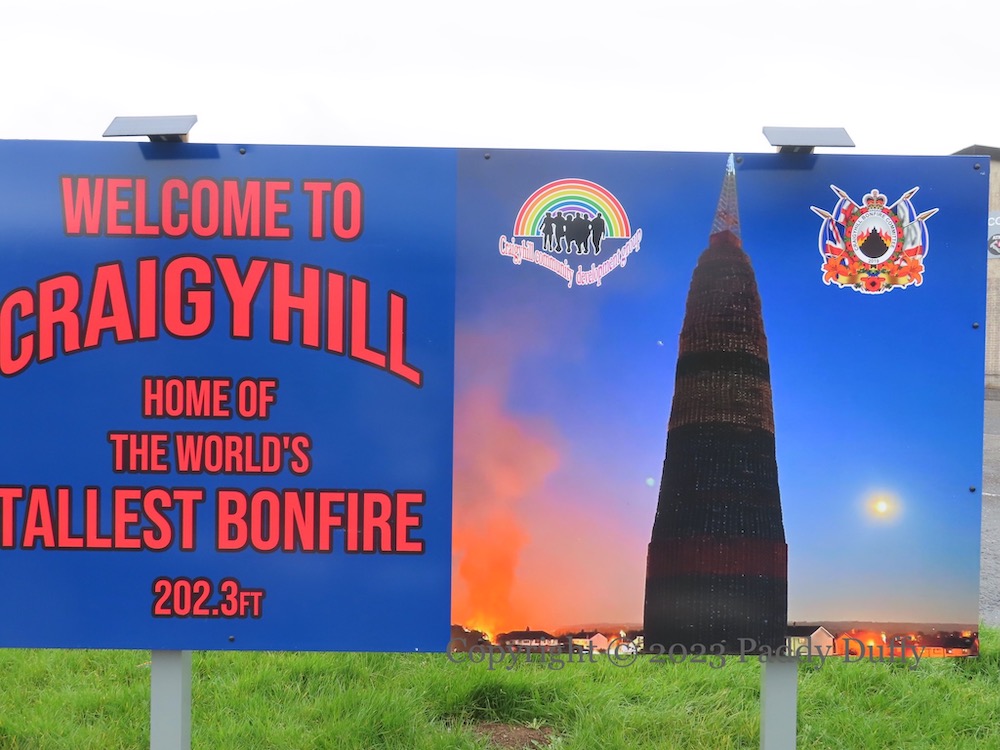
Bullets and bonfires in Craigyhill, Larne: the hooded gunman shown above is next to the boards shown in The Loyalist Executioner in Glenfarne Place, Craigyhill (Larne).
Both it and the second image (from the top of Cairngorm Drive) have been added since July, 2022. For the claim to be the “world’s tallest bonfire”, see Commonwealth Handling Equipment.
The image of a pair of assault rifles is in Fanad Drive.
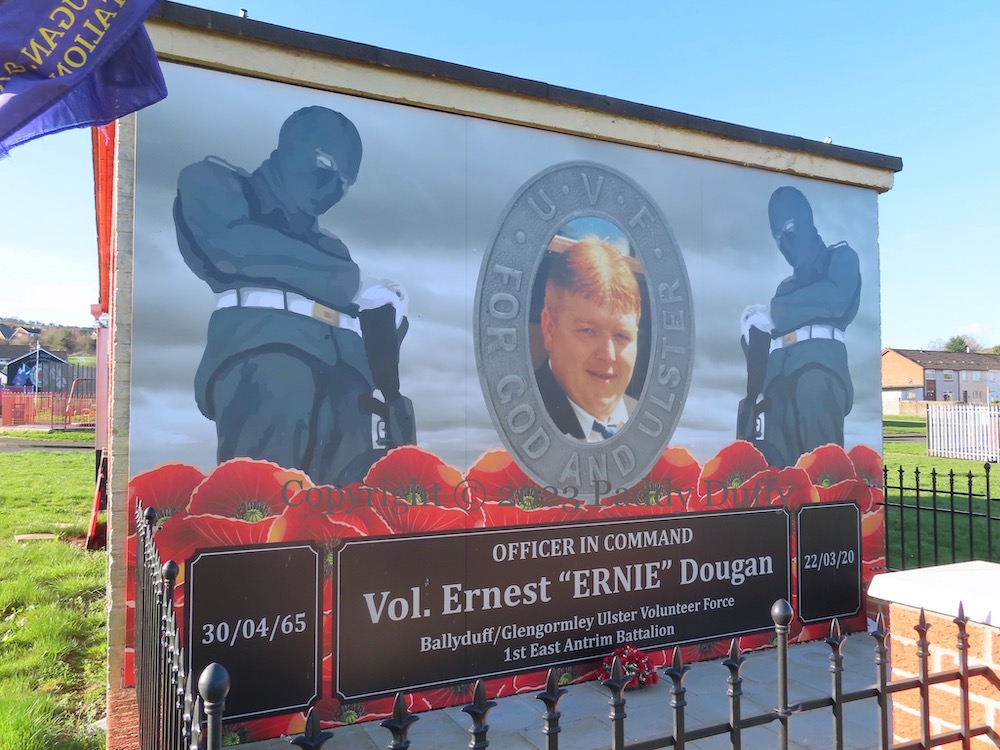
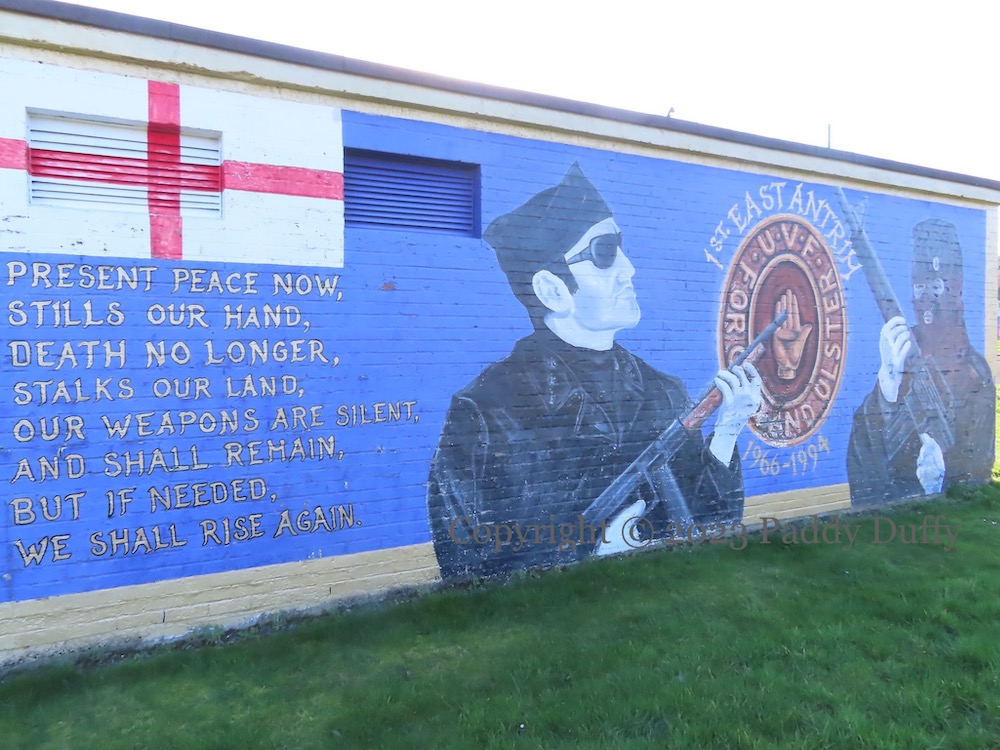
“Officer in command Vol. Ernest “Ernie” Dougan (30/04/65-22/03/20) Ballyduff/Glengormley Ulster Volunteer Force 1st East Antrim Battalion.” Dougan died at the beginning of lockdown and so the public commemoration of his passing did not take place until 2022. He was also involved in the Ballyduff Community Redevelopment Group (Fb). According to a Sunday World article, Dougan did not join the UVF until sometime after the Agreement, after he was given a punishment beating by the UDA in north Belfast (see Irish Times | Mirror) and moved out to Ballyduff.
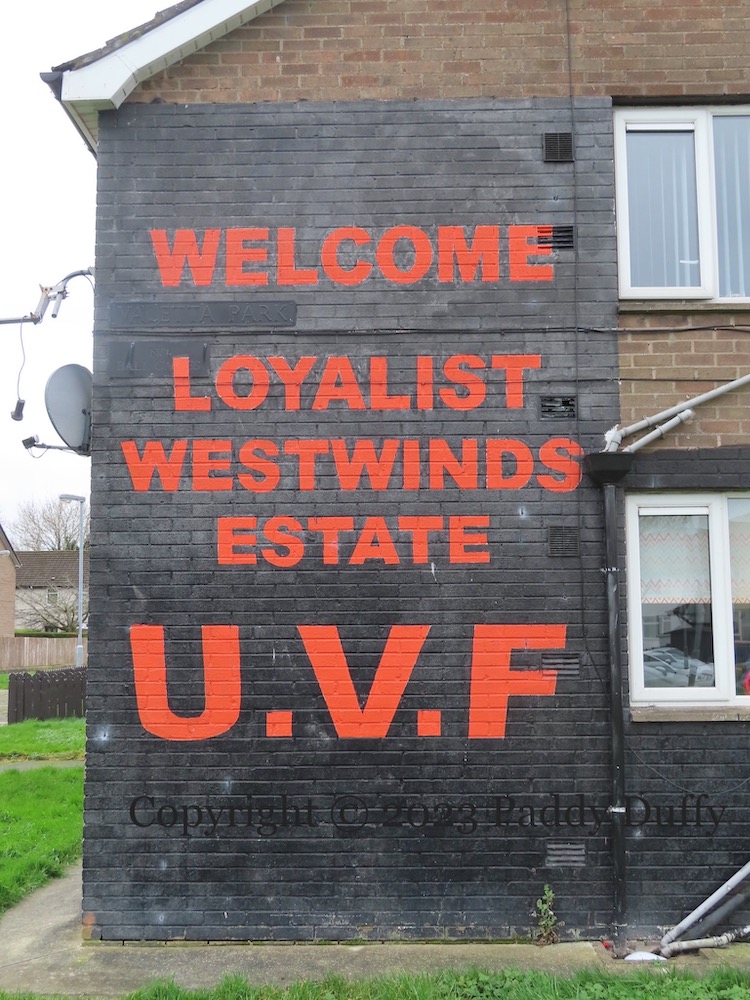
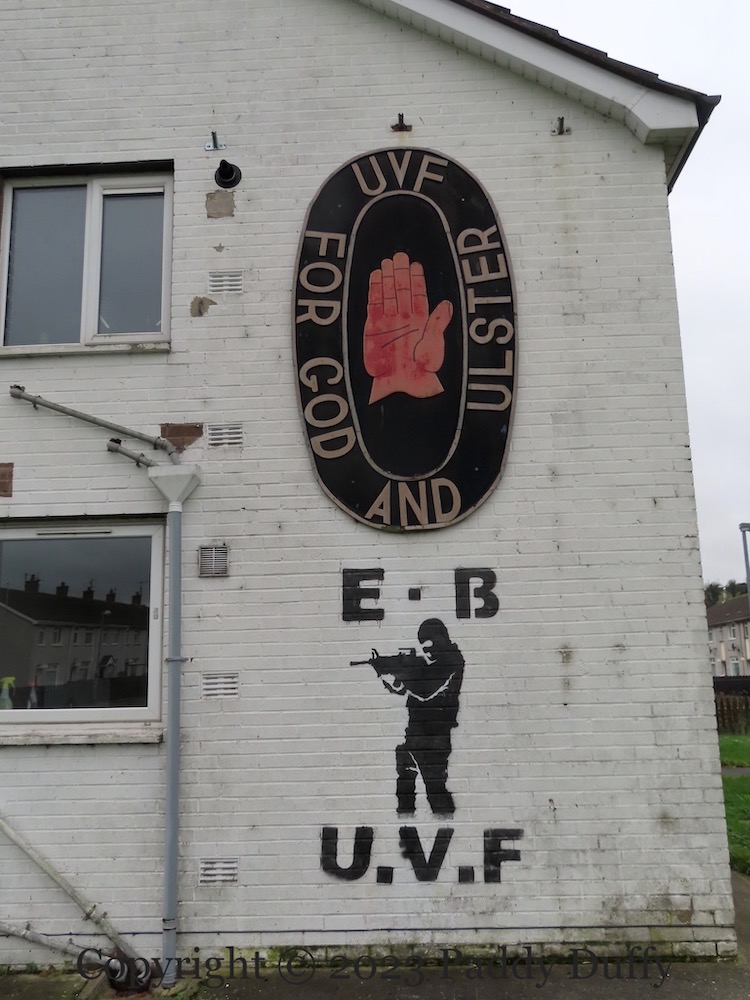
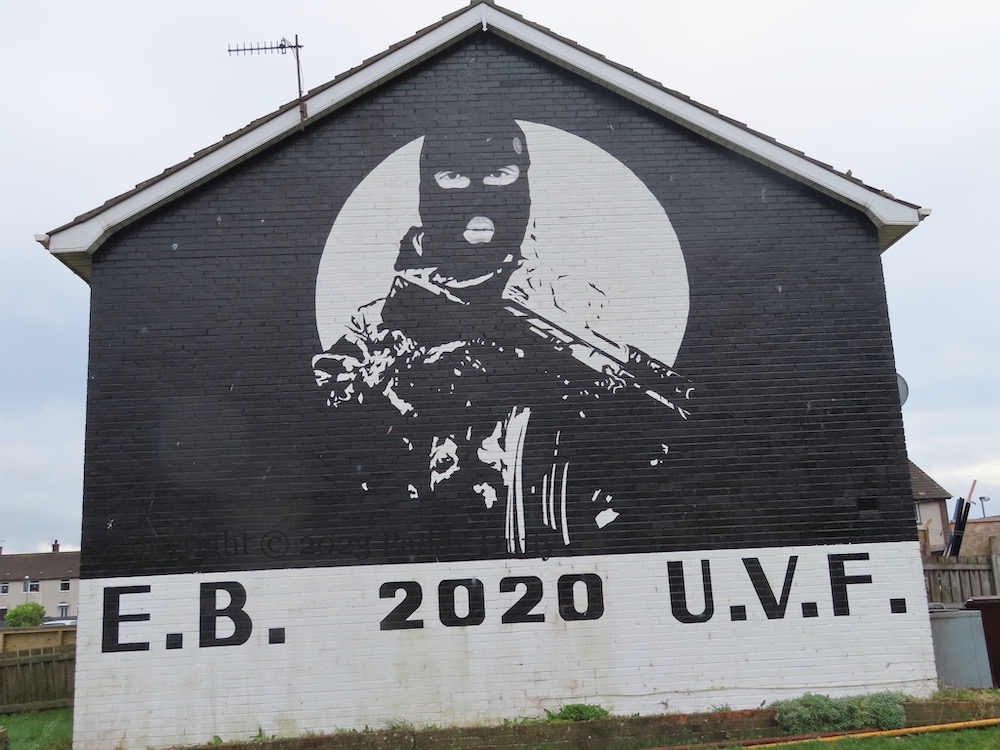
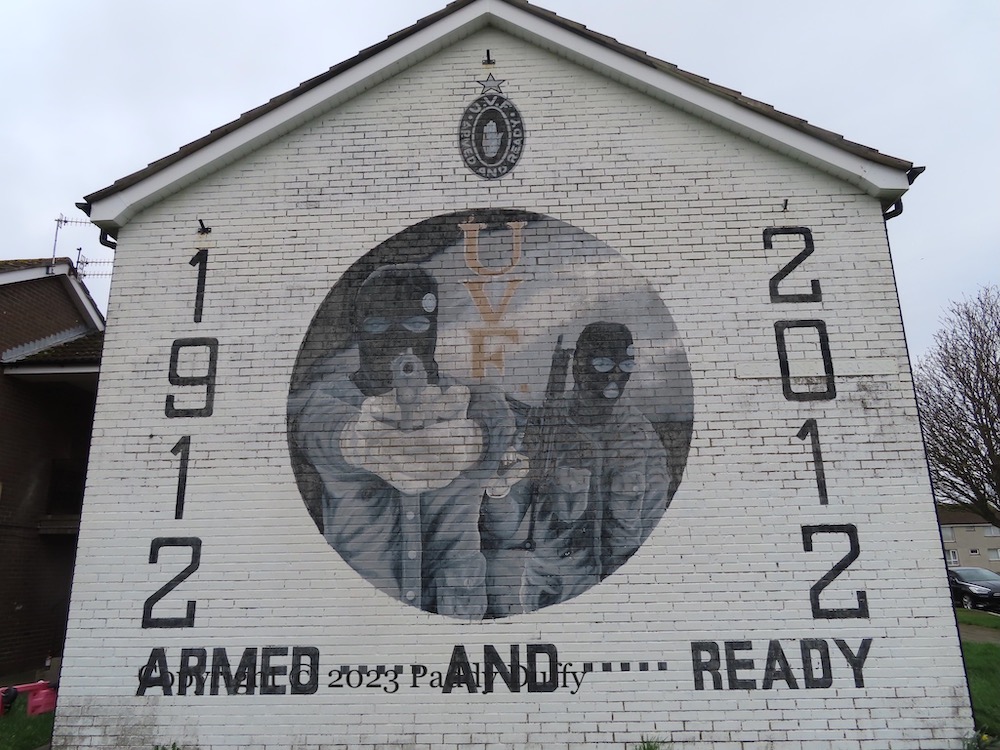
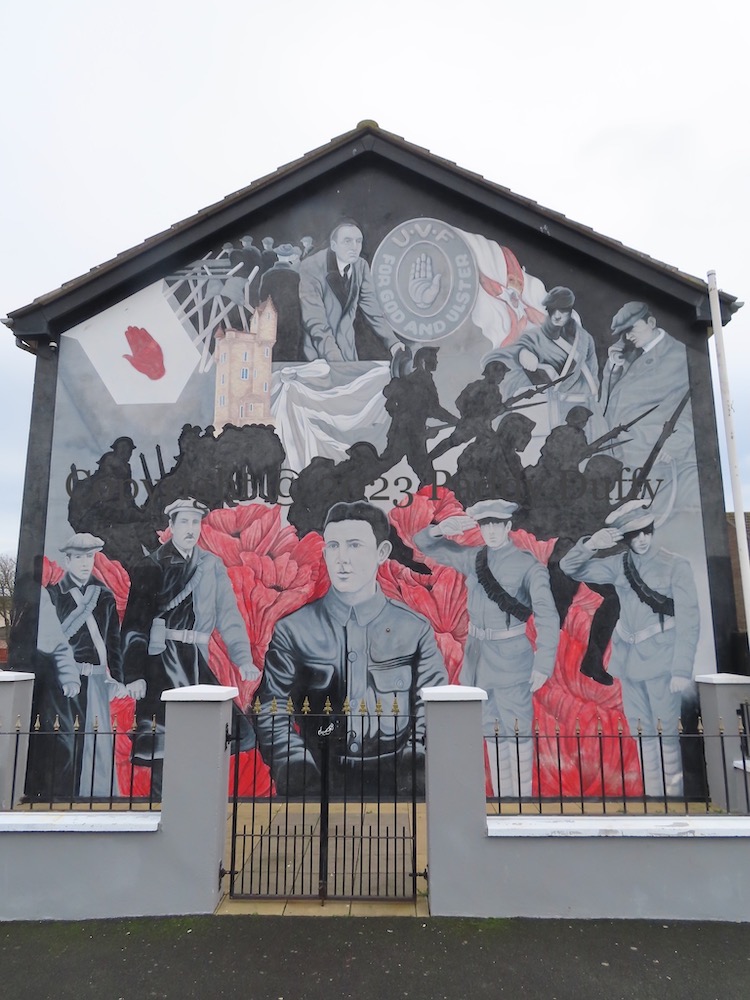
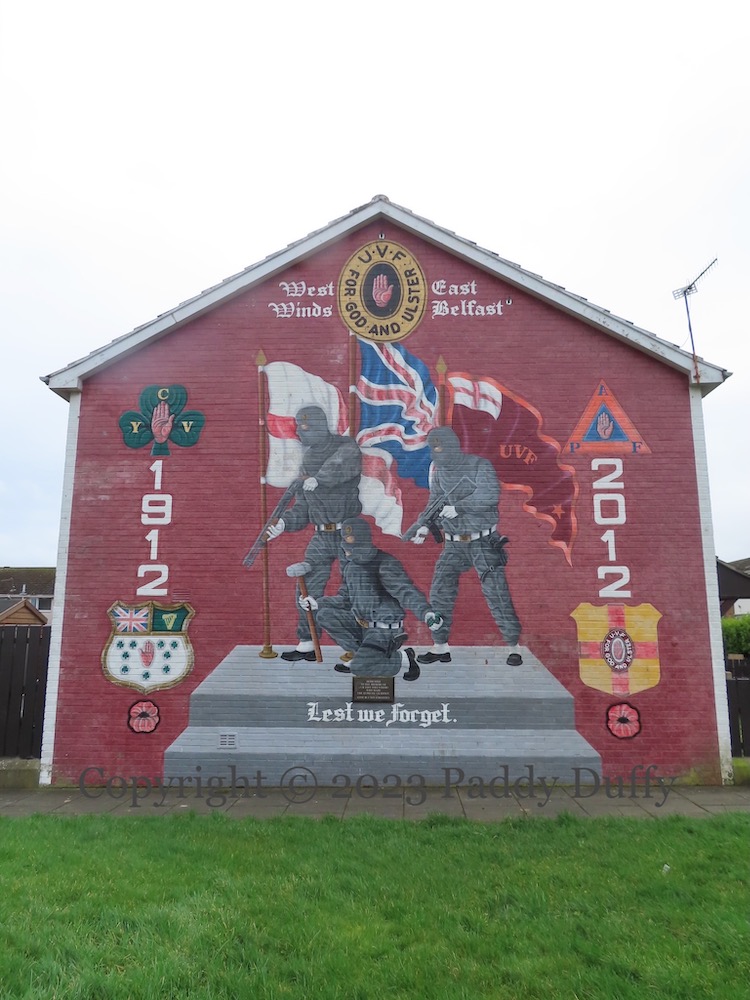
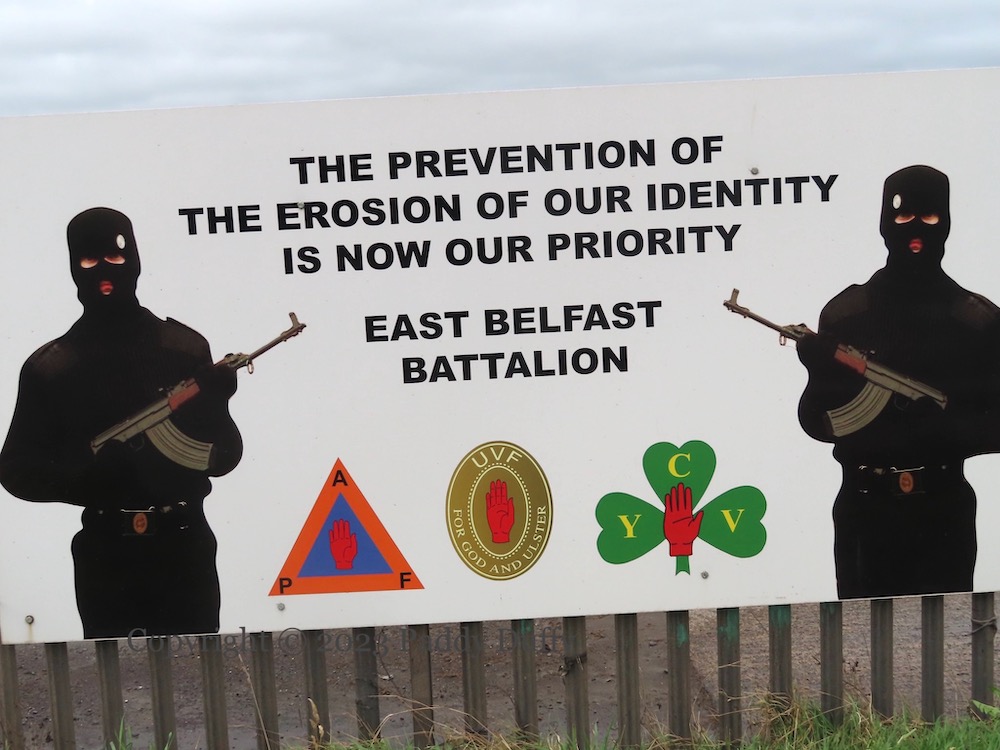
Here is a gallery of UVF stencils and boards in the Westwinds estate. Despite being in Newtownards, the UVF here is allied with the East Belfast brigade, rather than the North Down brigade – see Belfast Live for background.
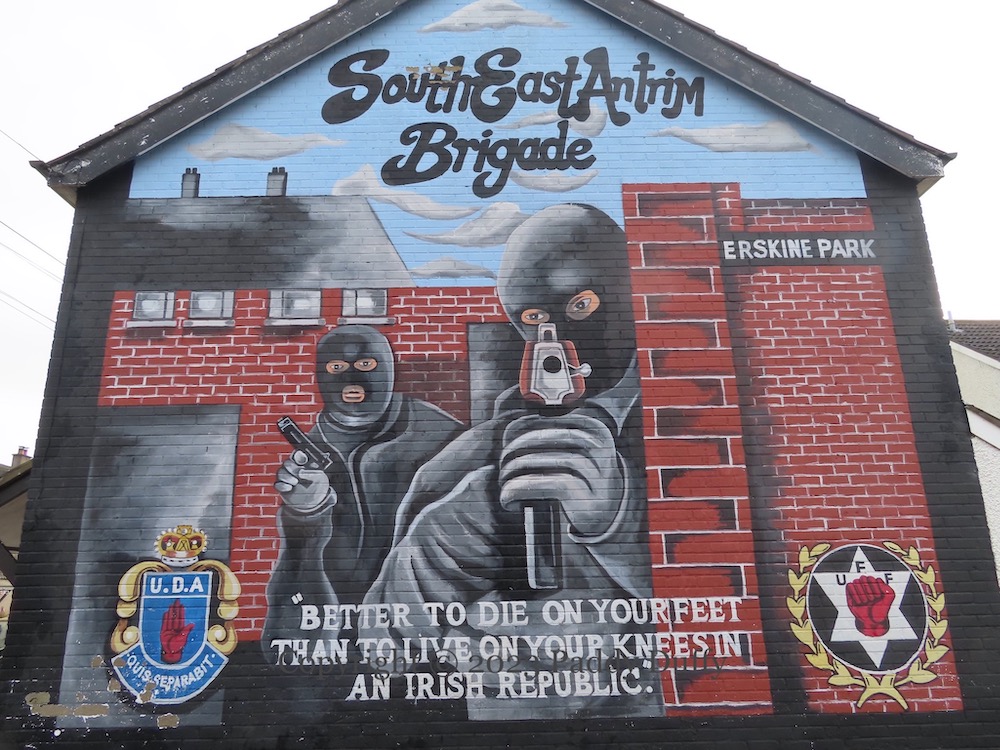
UDA volunteers in balaclavas stand ready to defend Erskine Park (Ballyclare) against forces (from the south? from Britain?) that would implement ‘home rule’ in (north-east) Ireland.
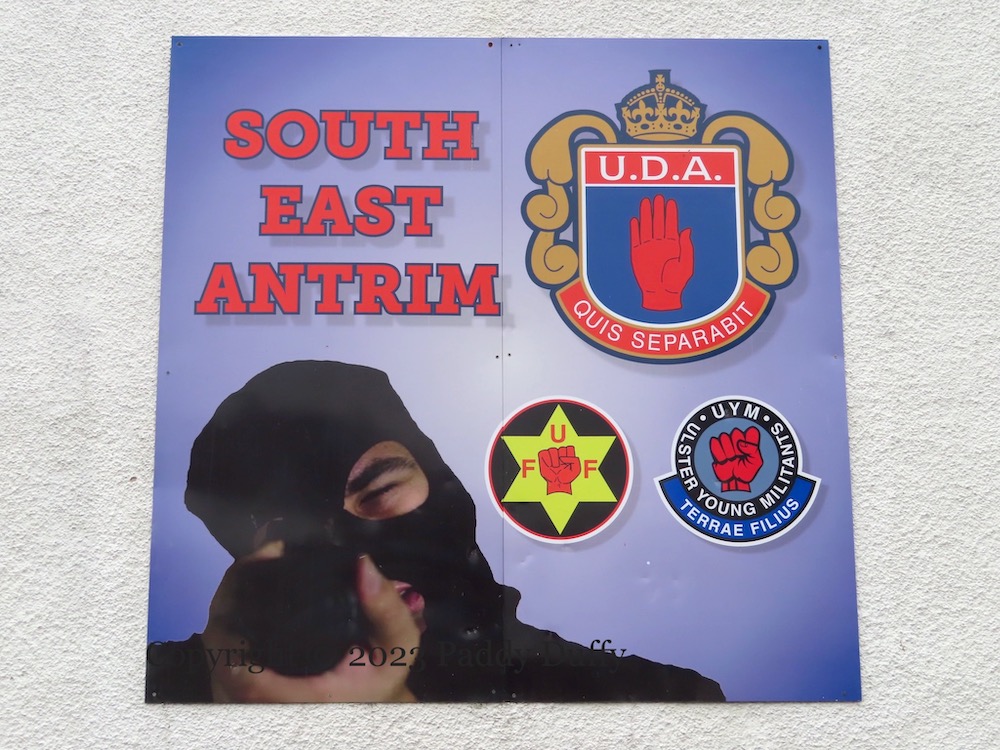
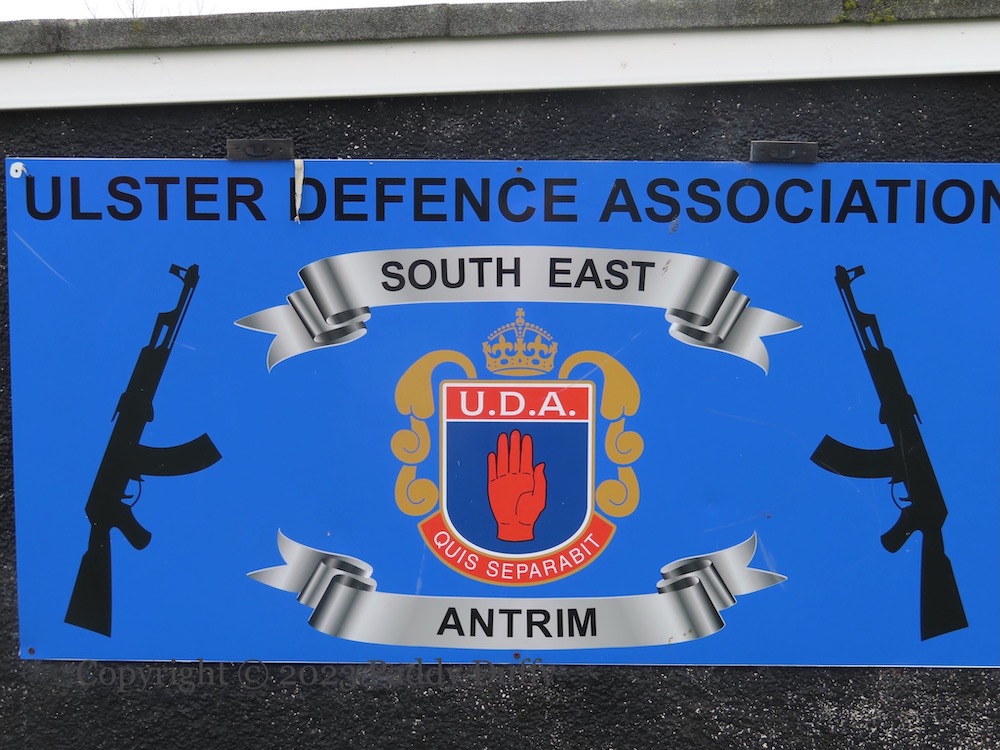
“South East Antrim Brigade – “Better to die on your feet than to live on your knees in an Irish republic.” (A slogan from Mexican revolutionary Emiliano Zapata.)











 Paddy Duffy Collection