“The UDA formed in 1971 as an umbrella for Loyalist Vigilante groups being formed. There [sic] role to defend the Protestant community from IRA violence. They remain today. Ask yourself this question: When the battle has been finally won, will I be able to stand and be counted amongst the men won it? Make sure the answer is yes – join your local unit of the UDA. Your country needs you.” This is an addition to the panels shown in Show No Mercy, Expect None Back.
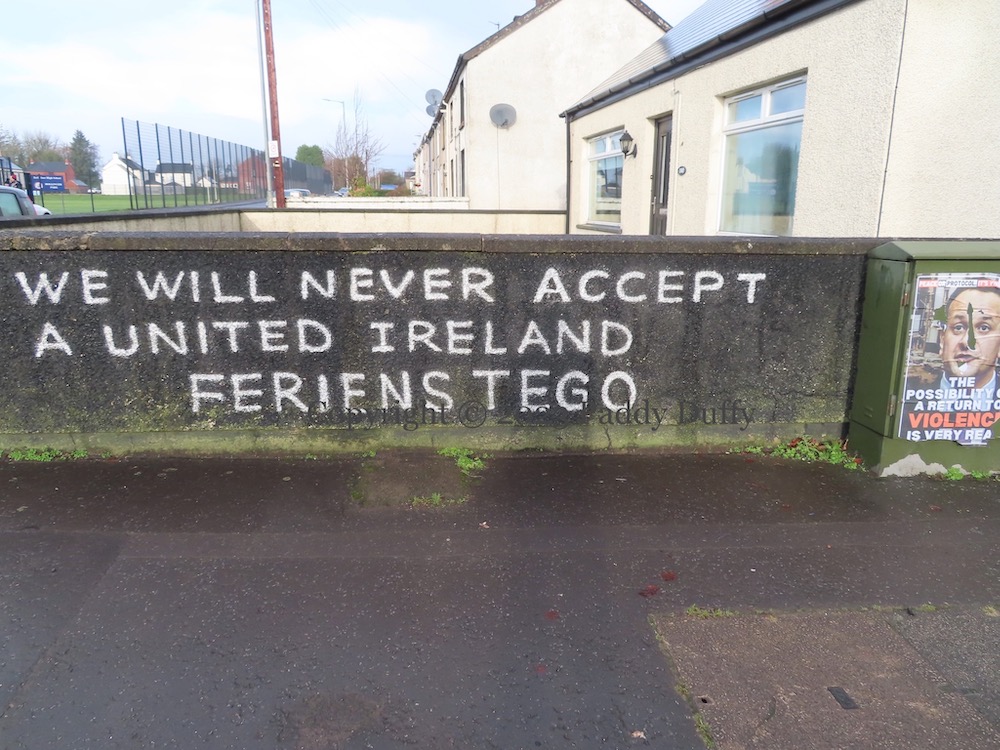
And (on the other side of the street) the tarp is an addition to ‘We Will Never Accept A United Ireland’. “We remember our culture, from the siege of Derry to the battle of the Boyne. ‘No Surrender’.”
These three panels form a single installation at the top (Woodvale) end on the Shankill Road. The one above celebrates the ties between Belfast and the Stirling & District Campsie Club, a branch of one of the associated clubs of the Apprentice Boys Of Derry. It features the cannon “Roaring Meg” (“presented by the Fishmongers Company of London 1642″) which is used as the seal for the club, the club’s flag which includes a red hand of Ulster, the key to the gates, and the emblem and coat of arms of the Apprentice Boys.
“Formed on the 2nd May 1987 we have been at the forefront of loyalist culture in our area since then and were the first club in Scotland to have a Battle of the Somme Commemoration Parade. Since our inauguration we have formed many friendships with our brethren and bands from the province many of which are still active today. For many years the club has participated with Belfast Campsie Club at the closing of the gates parade in December. We have through the years had great affinity with the many bands from Belfast some who are unfortunately no longer with us. The club would like to thank the people of Belfast for their support and friendship through the years and to the people of the Shankill for giving us the privilege of this murals. No surrender.
The Campsie Club is the only Apprentice Boys Club to be named after one of the “Brave 13″. It is persumed presumed that Henry Campsie was the first man to shed blood in the Defence of Londonderry. Campsie was the inspiration behind the Shutting of the Gates and was severely wounded whilst leading his associates to secure the City Magazine and armoury. The emblem of the Roaring Meg was adopted as the Seal of the new club.”
The middle panel celebrates the Stirling Protestant Boys Flute Band and its association with the Shankill Road: “Stirling Protestant Boys Flute Band [Fb] were formed in February 2003 and to this day take part in parades across Scotland, England and Northern Ireland. The band has a great connection with our friends from Belfast, especially those from the Greater Shankill area. In November 2012 Stirling Protestant Boys were presented with the battle honours of the Young Citizen Volunteers and the 36th (Ulster) Division. The band would like to thank the people of the Shankill Road for their continued support.”
The third celebrates the Apprentice Boys contains a long description of the Shutting Of The Gates in December 1688 and the Siege Of Derry, which was ended with the breaking of the boom of the river Foyle in July 1689.
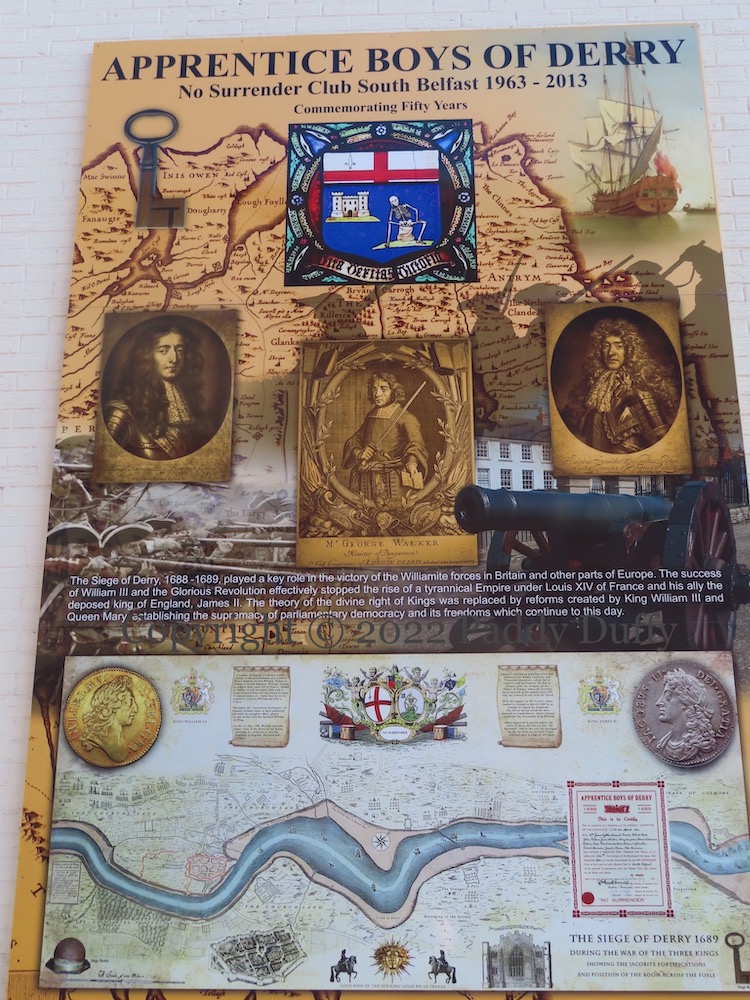
Oak Street is a fitting place for a mural about the Siege of Derry, as the oak leaf, shown to the left and right of the board above (and in the wide shot, below) is a symbol of the town, “doire” meaning an oak grove. The gates to the city were locked by thirteen apprentices, against the wishes of Governor Robert Lundy who wised to surrender the city. When the deposed king James II and his army arrived and demanded the surrender of the city of Derry, the cry from within was “No surrender!” The city was then besieged for 105 days until relief arrived in the form of ships of the navy of the newly crowned William & Mary.
The board shown above celebrates 50 years of the No Surrender Club South Belfast (1963-2013) a club affiliated with the Apprentice Boys Of Derry.
Left: “The Annals of the Four Masters record that in 665 AD, the Battle of Farset (Belfast) took place between the County Down Dal Fiatach, self styled Ulaid, and the Pretani or Cruthin where Cathasach, son of Laircine, was slain. This was an attempt by the Dal Fiatach to encroach on the Curtain territory of Trian Congail. The “third of Congal”, which encompassed territory on both sides of the Lagan, corresponding more to less to Uppers and Lower Clandeboye, including modern Belfast. Cathasach was Congal’s grandson. The battle was the first mention of Belfast in Irish history.”
The battle scene shown is Jim Fitzpatrick’s vision of the battle of Moira (in 637), rather than “Bellum Fertsi”. The salience of this description of intra-Ulster fighting is that there is a contention that the Cruthin were Scots (Picts) thus allowing for the idea (employed especially by the UDA – see Ulster’s Defenders and Defender Of Ulster From Irish Attacks) that present-day northern Protestants have a heritage, and a history of fighting for what is roughly Co. Antrim, that pre-dates the plantations. For more information and a similar board, featuring the tower blocks of Rathcoole rather than Cuchulainn and the Battle of Moira, see Kingdom Of The Pretani. For the debate over a connection to the Picts, see WP.
The Annals date back to the 1630s though they mostly comprise a variety of earlier sources.
The image of the gentleman with the sword appears to be a stock fantasy image, used for at least two characters in Game Of Thrones fandom (Rhaegon Targaryen and Lord Cameron Umber).
Middle: 2021 was the centenary of the creation of Northern Ireland and the year in which Scottish football club Glasgow Rangers won their 55th league title. Support for the club is widespread among the PUL community in Northern Ireland; local soccer and the international team is overseen by the IFA.
Right: “Centenary of cultural expression 1921-2021. Sons Of Belfast LOL 743. Castleton Temperance LOL 867. The Memorial LOL 1197. Belfast Harbour LOL 1883. The Coote Memorial LOL 1921. Cave Hill Temperance LOL 1956.”
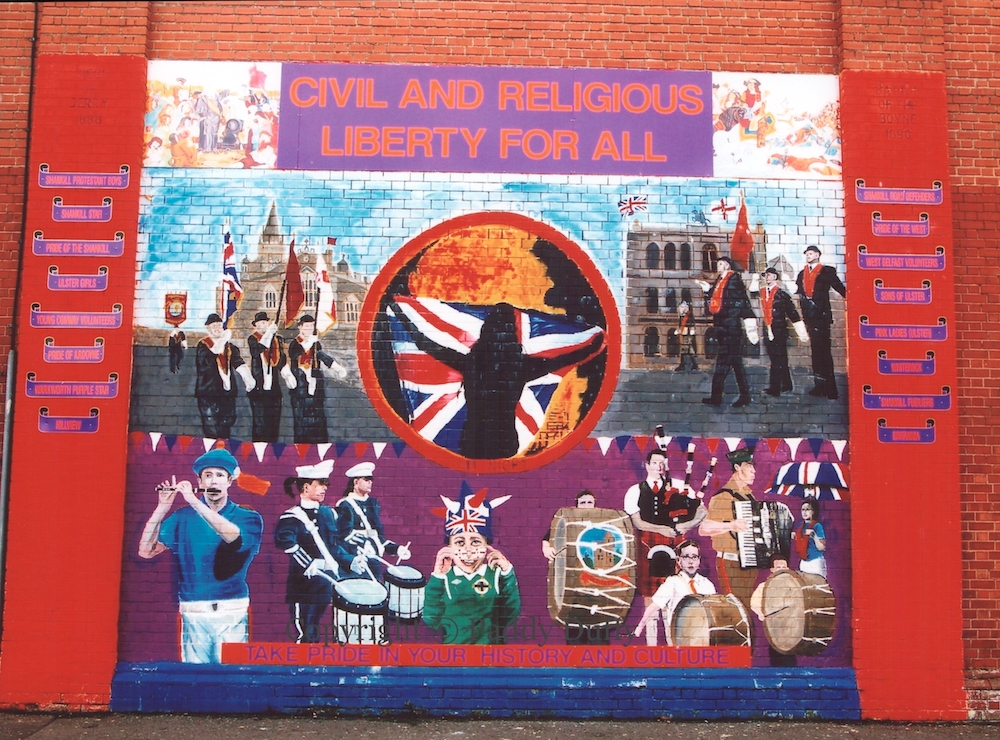
“Take pride in your history and culture”, namely: the Siege Of Derry and the Battle Of The Boyne (from the Jackson Mural in the Fountain); flute bands (Shankill Protestant Boys, Shankill Star, Pride Of The Shankill, Ulster Girls, Young Conway Volunteers, Pride Of Ardoyne, Warkworth Purple Star, Hillview, Shankill Road Defenders, Pride Of The West, West Belfast Volunteers, Sons Of Ulster, Pink Ladies (Ulster), Whiterock, Shankill Fusiliers, Britannia); Royal Black and Orange Order parades (marching past the Guildhall in Londonderry and the Clifton Street lodge in Belfast), 11th night bonfires, supporting the Northern Ireland soccer team, lambeg drumming, playing the pipes, accordion playing – with Union flags and bunting throughout.
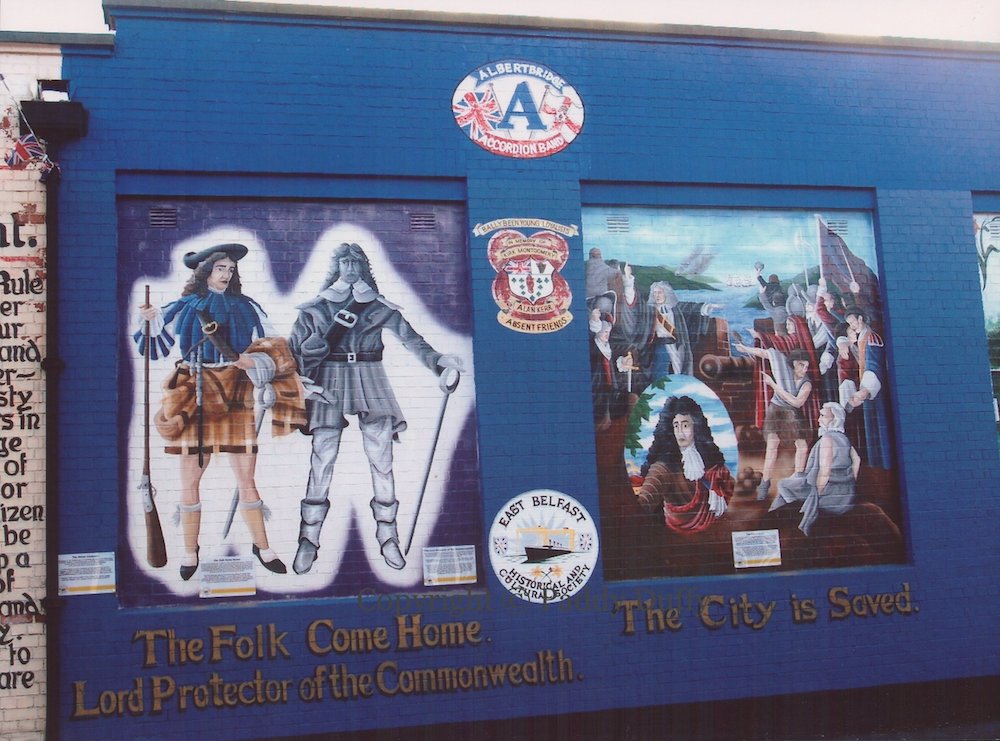
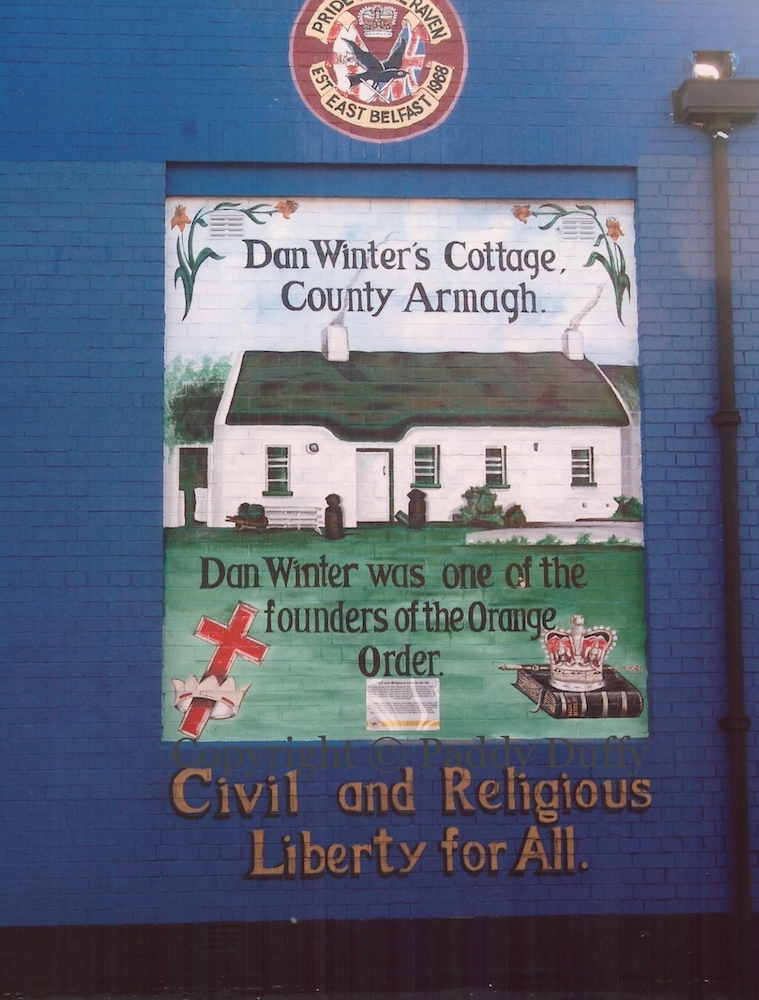
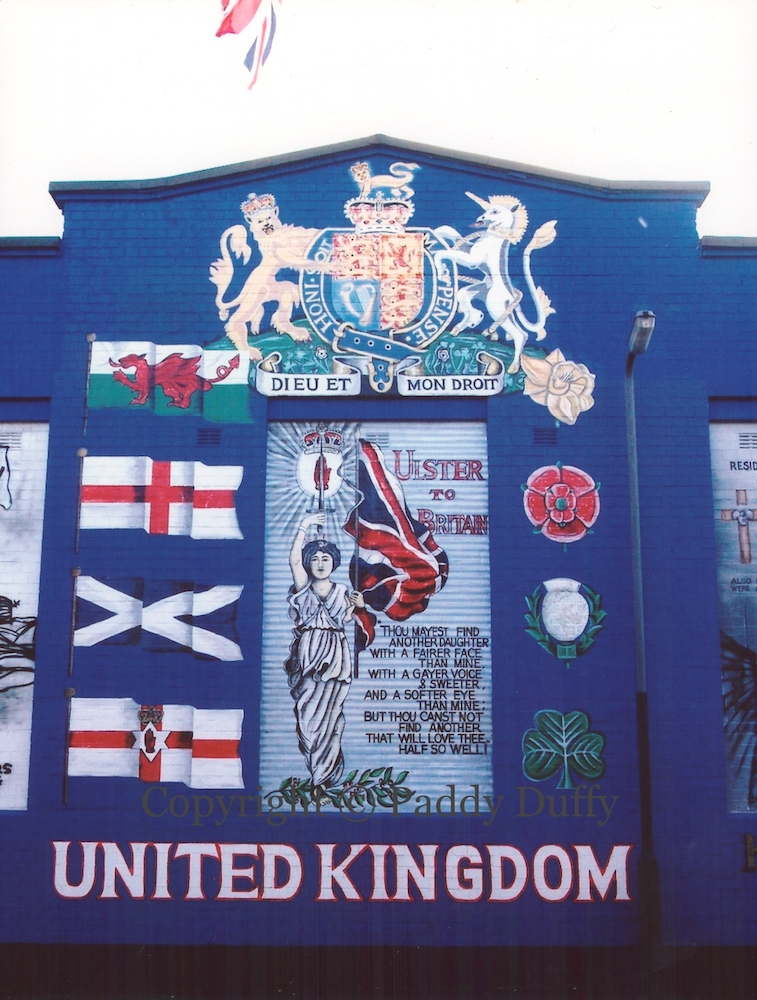
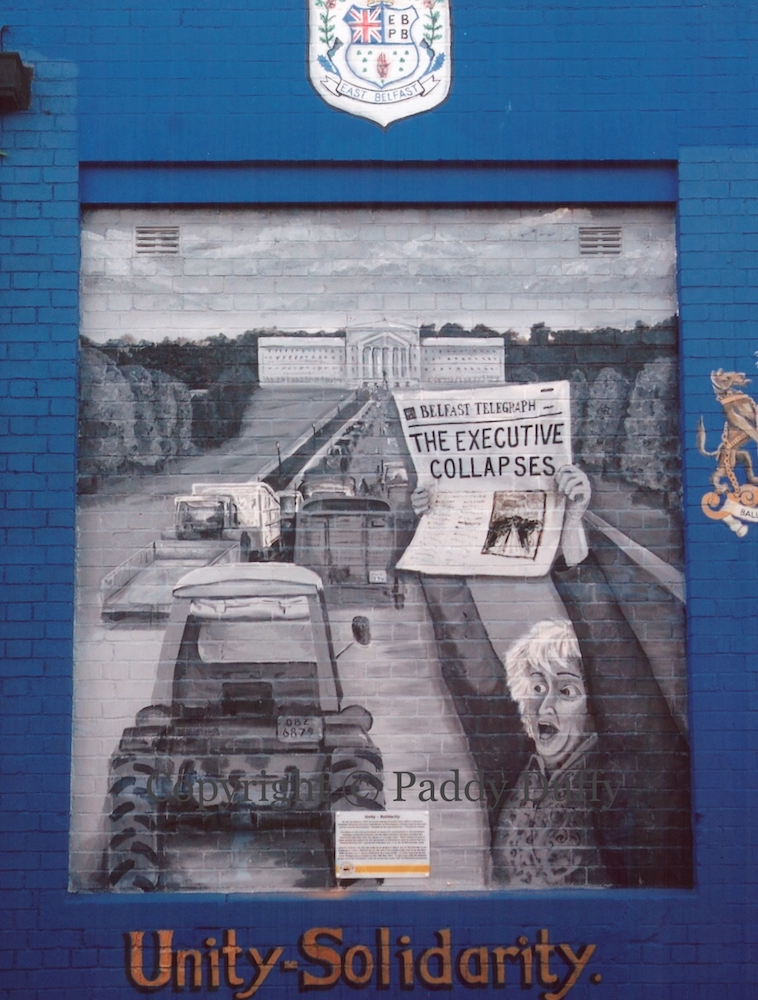
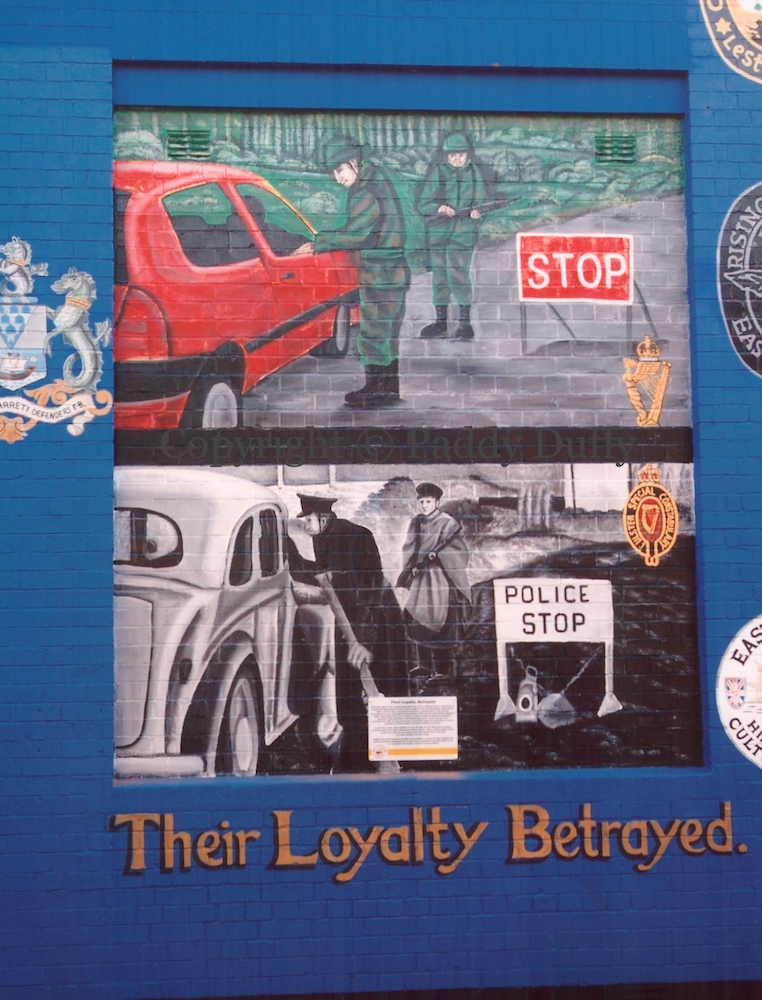
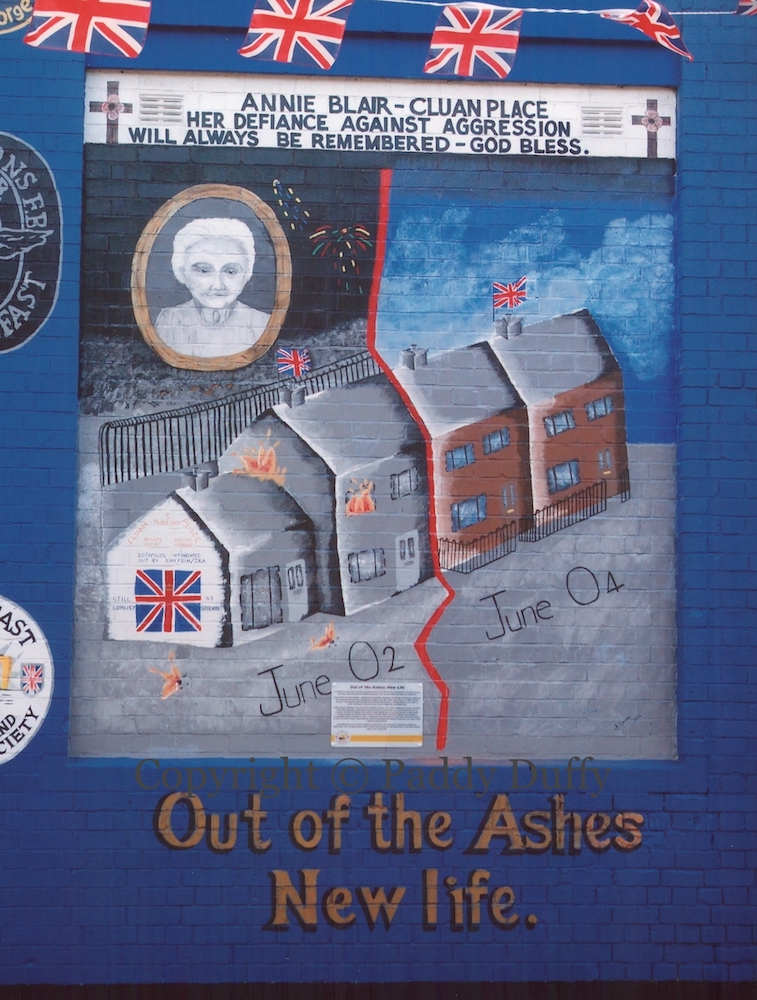
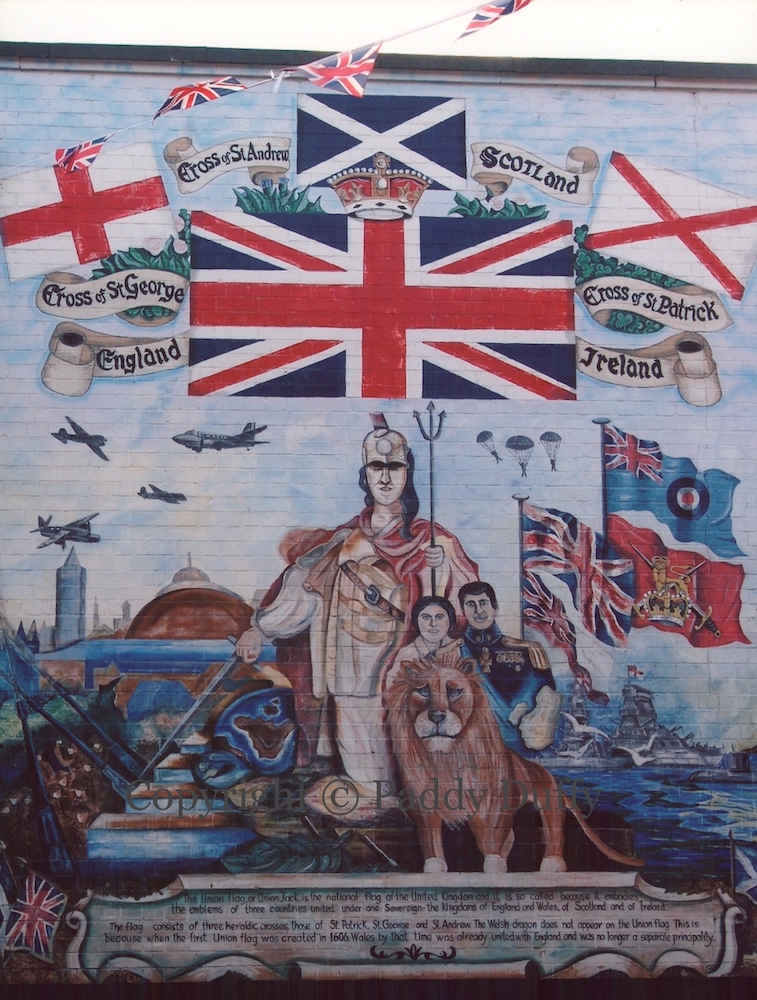
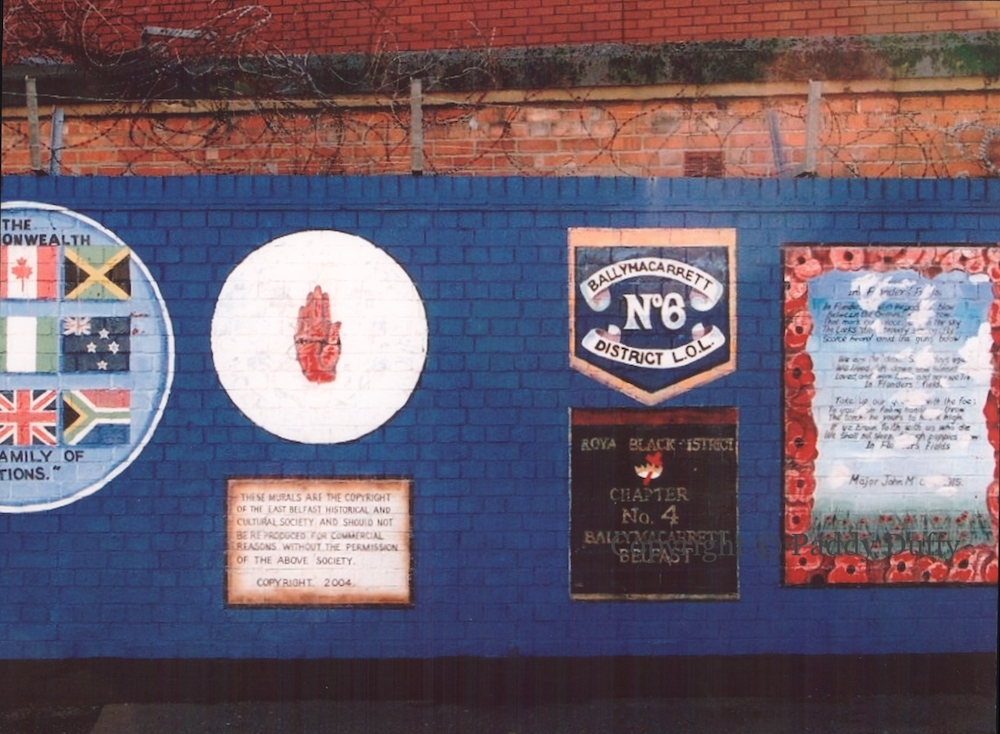
In 2004 the East Belfast Historical And Cultural Society sponsored a series of 14 murals in Thorndyke Street charting Protestant history from Cromwell to Cluan Place. From left to right, these are:
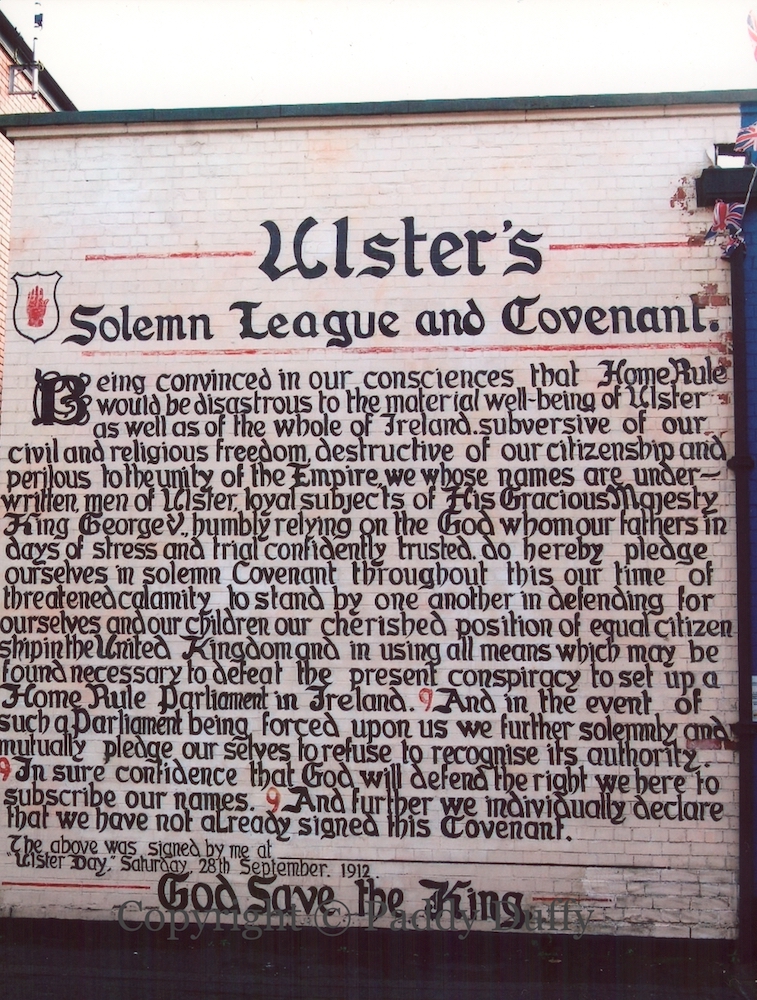
The Covenant
“The Folk Come Home. Lord Protector of the Commonwealth” (Cromwell)
“The City Is Saved” (Siege Of Derry)
“Civil And Religious Liberty For All.” “Dan Winter’s cottage, County Armagh. Dan Winter was one of the founders of the Orange Order”
“Better The Grave Than Slavery.” “How is freedom measured? By the effort which it costs to retain. Freedom!” (WW1)
“Their Sacrifice, Our Freedom.” “As we scrambled over the trench ladders, the YCV flag appeared. Jim Maultsaid” (WWI)
“United Kingdom”
“Hitler Attacks Belfast”
“Defending The Community” (Paramilitaries)
“Unity – Solidarity” (Sunningdale Agreement)
“Their Loyalty Betrayed” (UDR/B Specials)
“Out Of The Ashes, New Life.” “Annie Blair – Cluan Place. Her defiance against aggression will always be remembered – God bless”
Britannia. “The Union flag, or Union Jack, is the national flag of the United Kingdom and it is so called because it embodies the emblems of three countries united under one sovereign – the Kingdoms of England and Wales, of Scotland and of Ireland. The flag consists of three heraldic crosses, those of St Patrick, St George and St Andrew. The Welsh dragon does not appear on the Union flag. This is because when the first Union flag was created in 1606, Wales by that time was already united with England and was no longer a separate principality.”
Commonwealth/Sponsors
The murals were launched in 2004 and information panels were added in 2005.
This mural shows Orange Order marchers in front of a banner depicting previous gatherings in Malvern St. The text on the side wall reads “This mural depicts Malvern St arch which was where the local community gathered to celebrate the traditional 12th of July commemoration.”
By Blaze FX in Hopewell Crescent, lower Shankill, west Belfast
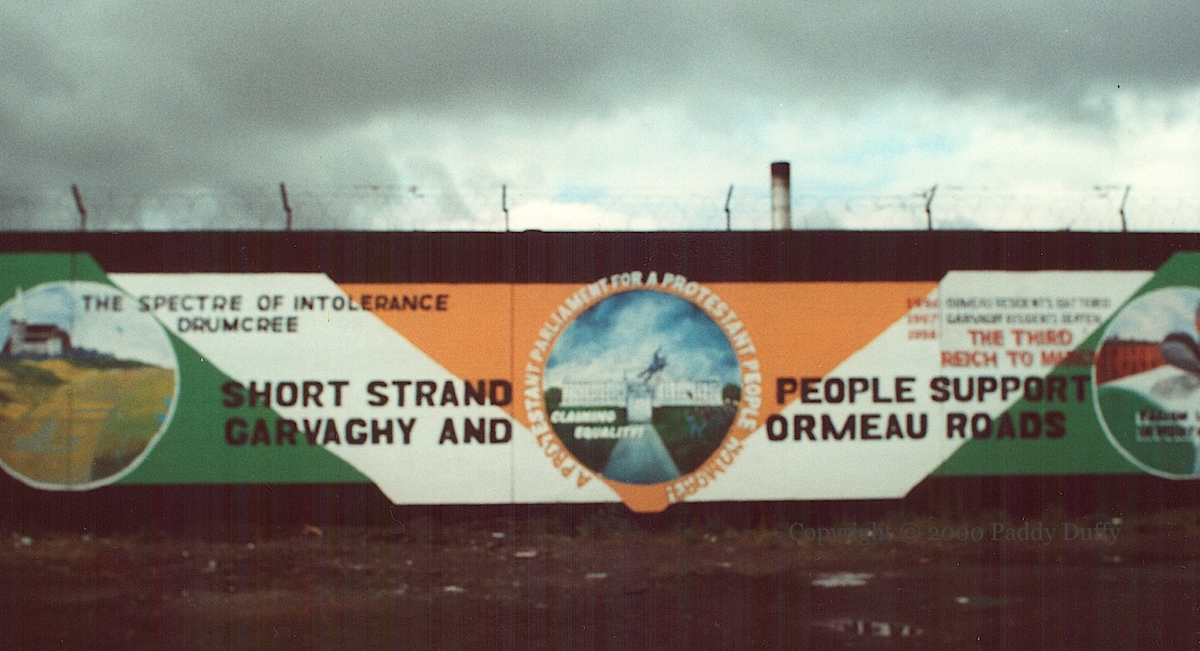
Northern Ireland’s first Prime Minister, James Craig, said in 1934, that Stormont was “carrying on a Protestant Government for a Protestant People” (NI Parliamentary Debates), though the phrase has now been transformed into the doubly alliterative “A Protestant parliament for a Protestant people”. In the centre of a long mural at the waste-ground at the top of Mountpottinger Road, people carrying Irish Tricolours tear down the statue to Northern Ireland’s most prominent leader, Sir Edward Carson, that stands outside Stormont, “claiming equality”.
The main issue that has tested the resolve of governments both local and national to the equality declared in the 1998 Belfast (Good Friday) Agreement is Orange Order parading through nationalist areas, such as the Garvaghy Road below Drumcree church in Portadown, and the Ormeau Road in south Belfast.
“Short Strand people support Garvaghy and Ormeau Roads.” On the left: The spectre of intolerance – Drumcree.” Centre: “A Protestant parliament for a Protestant people no more!” On the right “1996: Ormeau residents battered; 1997: Garvaghy residents beaten; 1998: The third reich to march.” and “Fascism lives! in Portadown”.
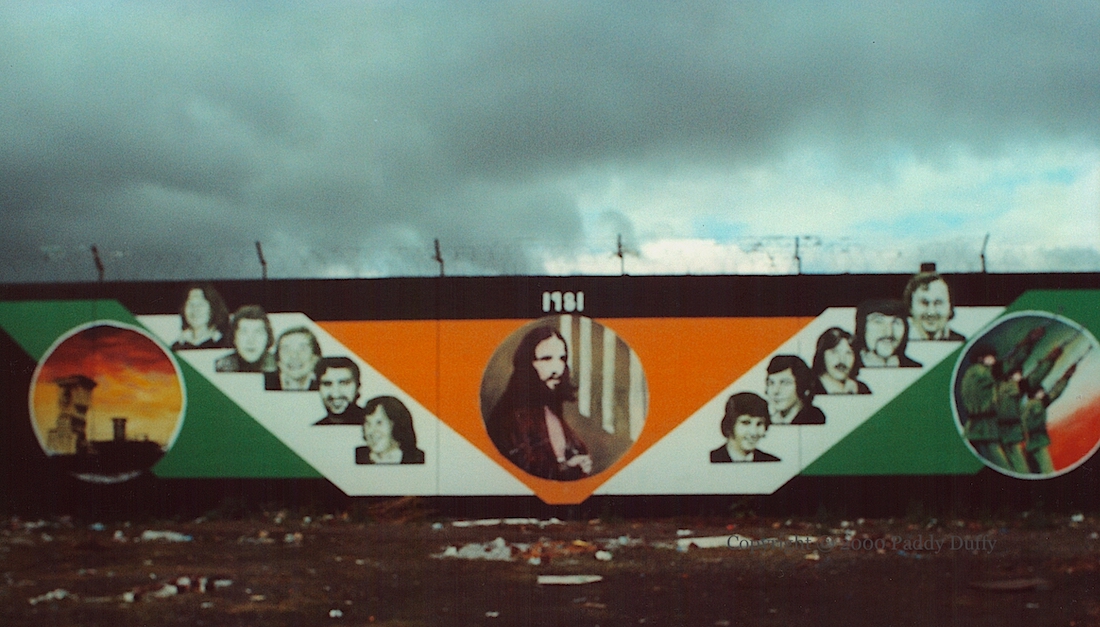
The piece is next to a hunger-strikers commemoration piece with ten portraits on shaped wooden boards against a painted background with blanket-man Hugh Rooney in the center. Between the two is a “spirit of freedom” lark and the names of the ten deceased 1981 strikers.
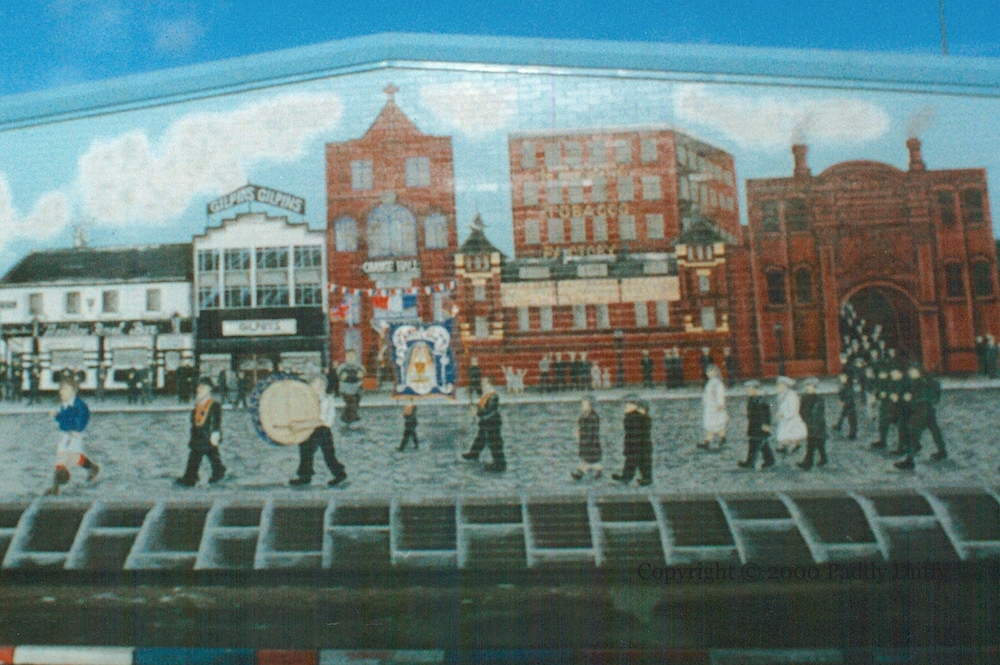
Here (in three parts) is a wide community mural replacing the POW mural in Linfield Road, in the Sandy Row area of south Belfast, depicting a parade marching along Sandy Row past a lot of landmarks (not all in appearing as they actually do along the road).
From left to right, the buildings shown are: the Carnegie Library on Donegall Road, Weaver’s Court (which is at the end of the road that the mural is on), the Royal Bar (Hamilton’s), Gilpin’s shoe shop, Orange Hall, Murray’s tobacco factory, the Belfast & Ulster Brewery building (the courtyard of which was used as a drilling ground by the Ulster Volunteers), Sandy Row District No 5 (Fb) arch.
“We demand the right to march”, “Portadown District LOL No 1 [Fb]”, “Here we stand – we can do no other”.
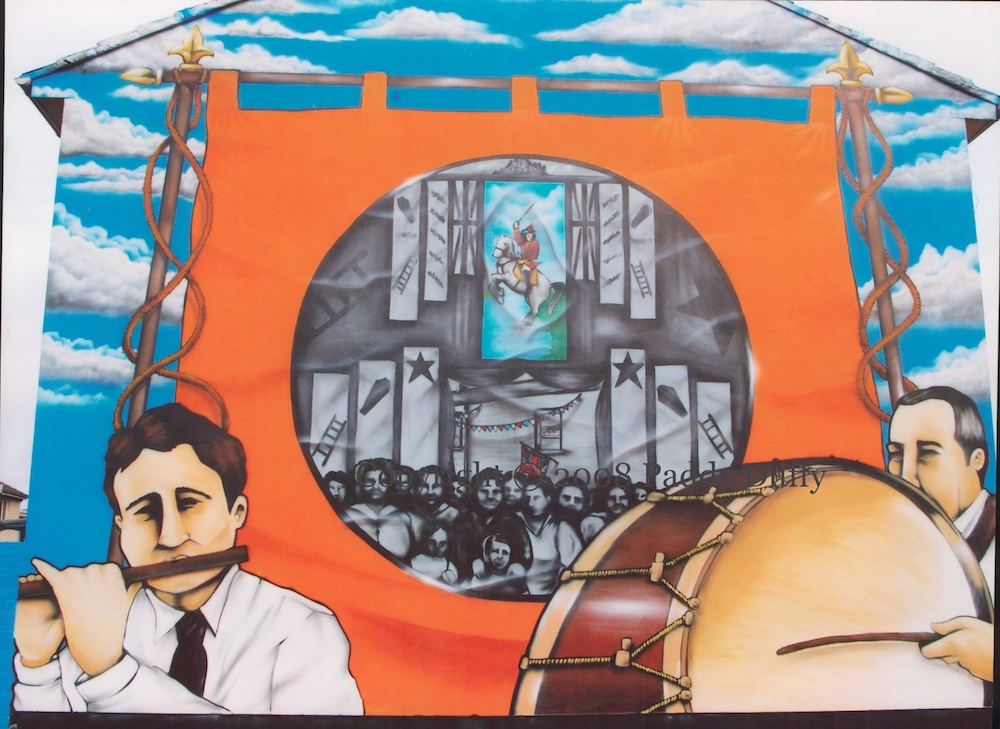
This mural in the lower Shankill estate is about the disputed Orange Order parade (WP entry, including a map of the route) to Drumcree Church (in Portadown, shown in the mural) part of which goes along the Catholic Garvaghy Road. After many contentious years (beginning in 1995), the re-routing of the marches in 2000 led to some rioting, but was the last year of notable conflict over the parade (CAIN).















 Paddy Duffy Collection