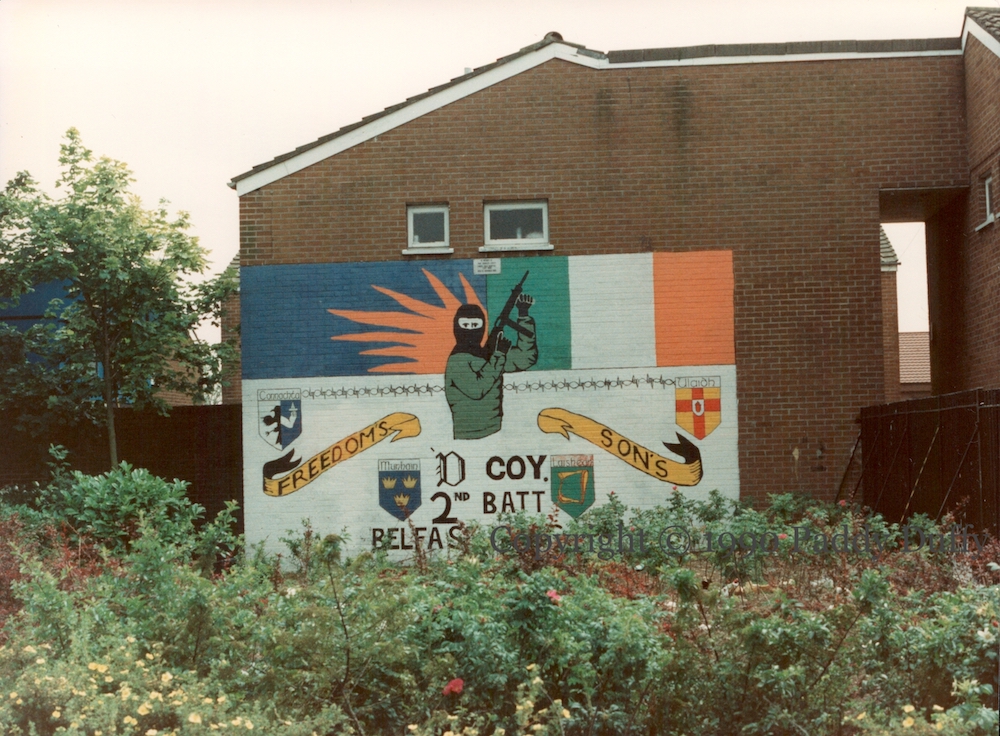
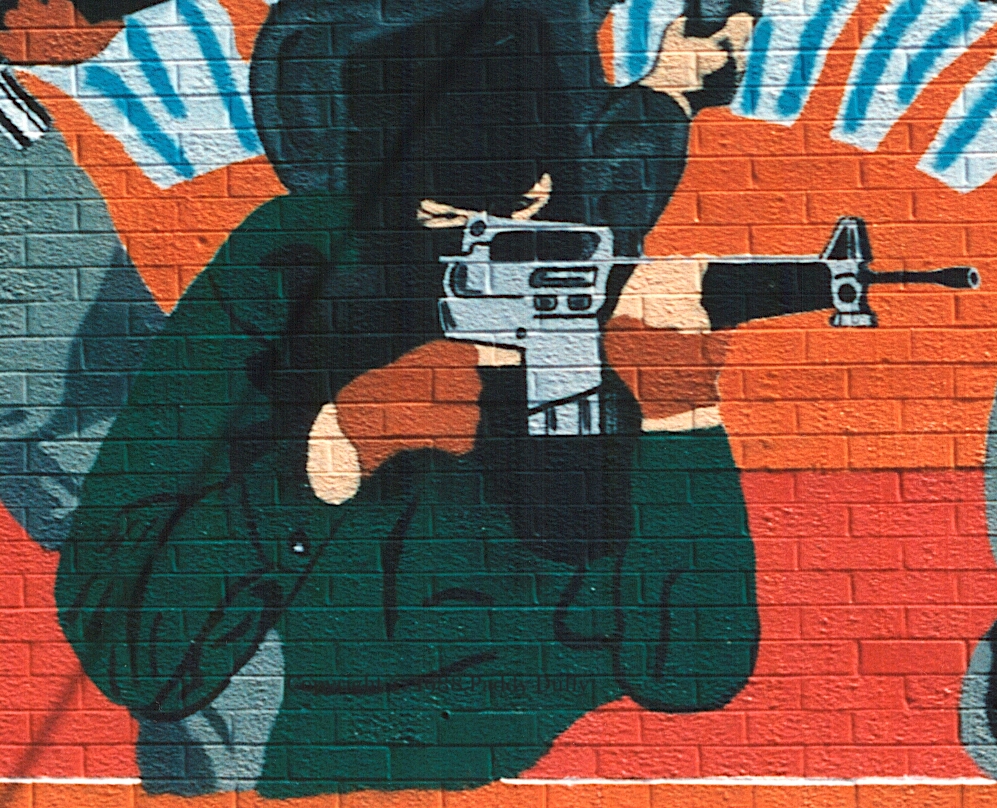
The writing – D coy, 2nd batt, Belfast Brigade [IRA] – has been added where the volunteer’s legs used to be – see the Peter Moloney Collection for the original. A small plaque has been added at the top. Otherwise, the mural remains as before, with a hooded volunteer raising an assault rifle in front of a sunburst and Tricolour, with a row of barbed wire and the four provinces named in Irish.
Falls Road, west Belfast, now the site of the Garden Of Remembrance
Manacles “Made in Britain” constrain the republican desire for a united Ireland, contrary to the burning GPO and rising phoenix.
“Numerous foreign groups and delegations visited Ballymurphy and west Belfast during the troubles. I remember one meeting I was at in Conway Mill, I picked up a pamphlet with a drawing of a manacled fist. The caption read “Made in the USA.” So I just took the image and changed the slogan to “Made in Britain”.” (Painting My Community/An Pobal A Phéınteáıl – English-language version available for free)
The plaque – which pre-dates this mural – is to local (A Company 2nd Battalion) IRA volunteers Stan Carberry, Frankie Dodds, Paul Fox, Sean Bailey, Paul Marlowe, and Tony Campbell. “Fuaır sıad bás ar son na hÉıreann”, “Ireland unfree will never be at peace”. (See the Peter Moloney Collection.)
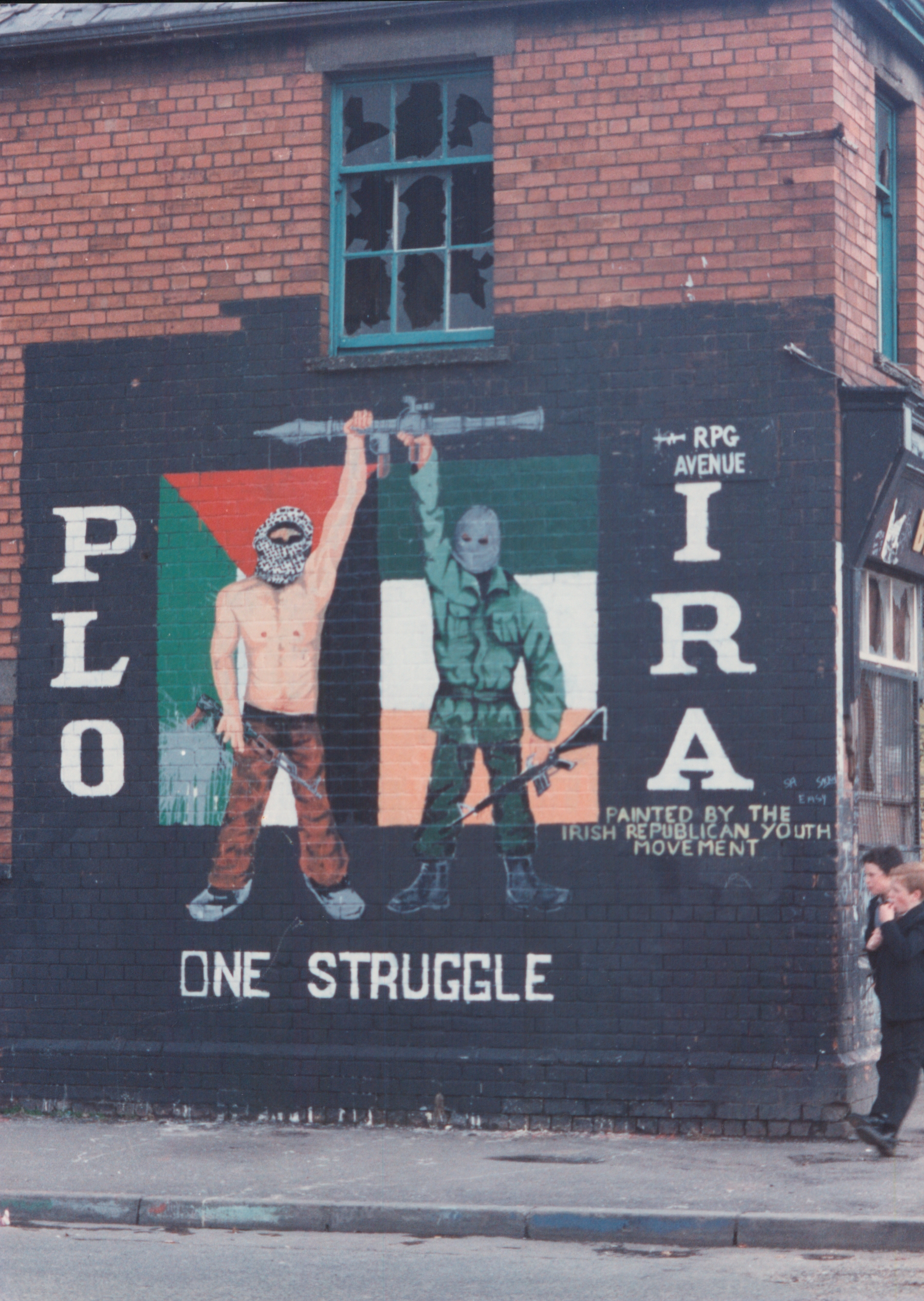
Painted by Mo Chara Kelly in Beechmount Avenue/RPG Avenue.
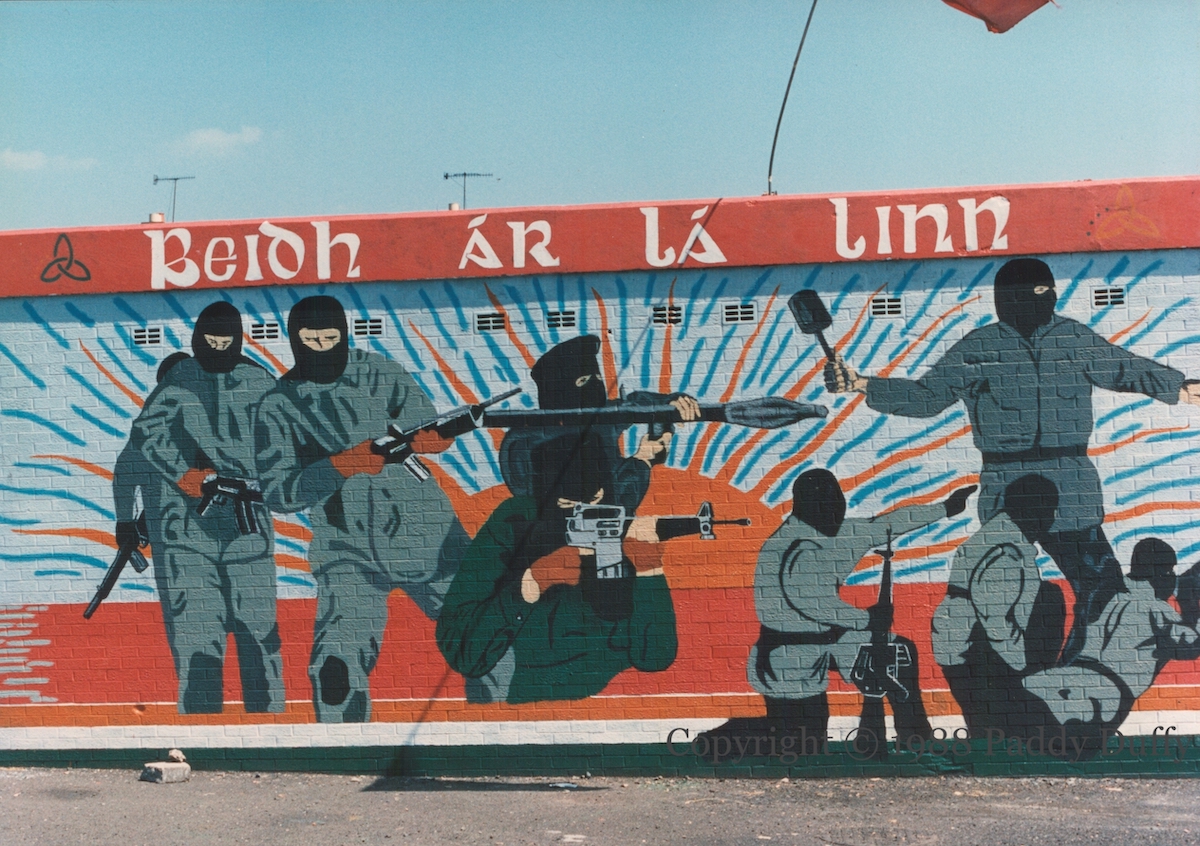
This mural shows nine hooded republican volunteers employing an assortment of weapons – rifles, RPG launcher, drogue bomb, machine gun – against a rising sun. “We will have our day.” The trio in the bottom right corner are familiar from other murals, such as this one in Strabane.
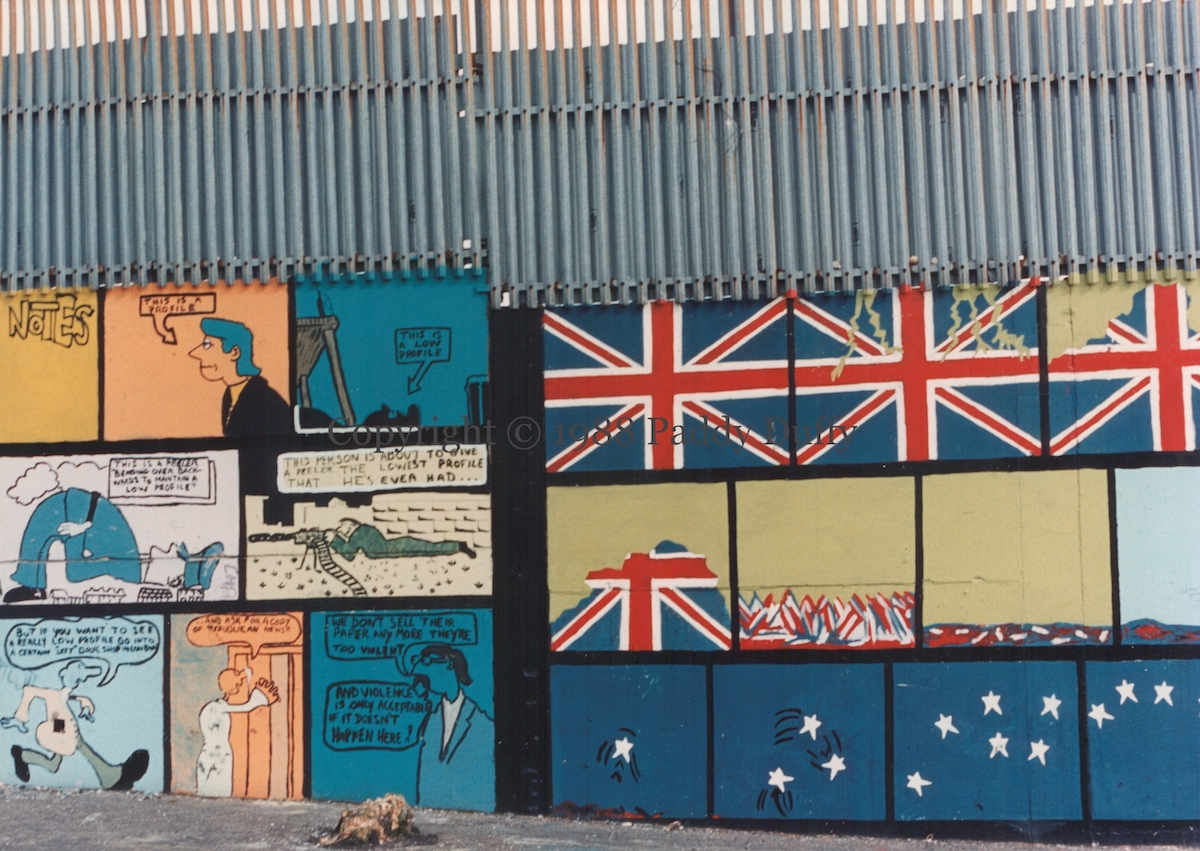
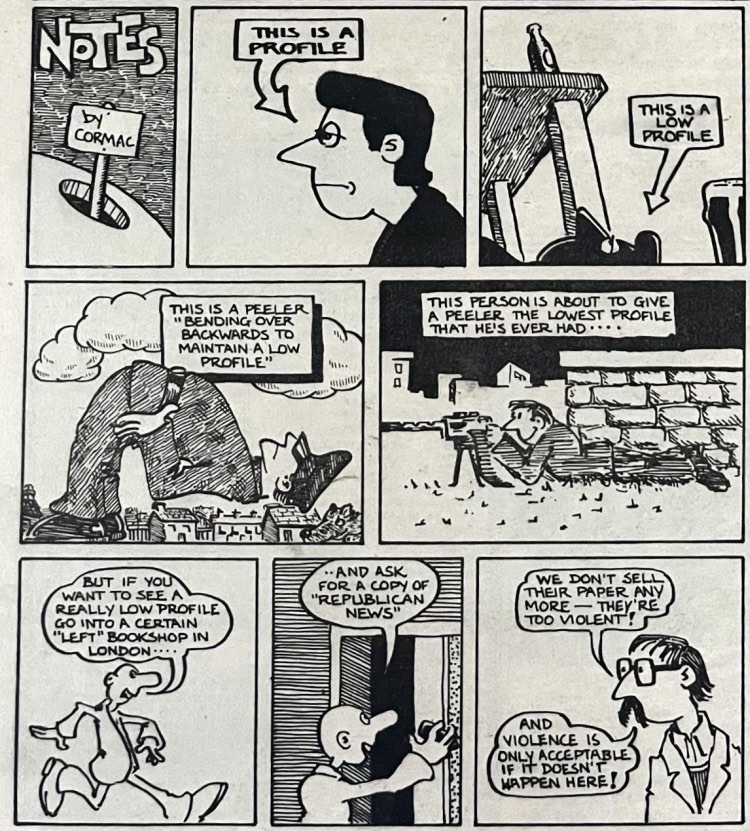
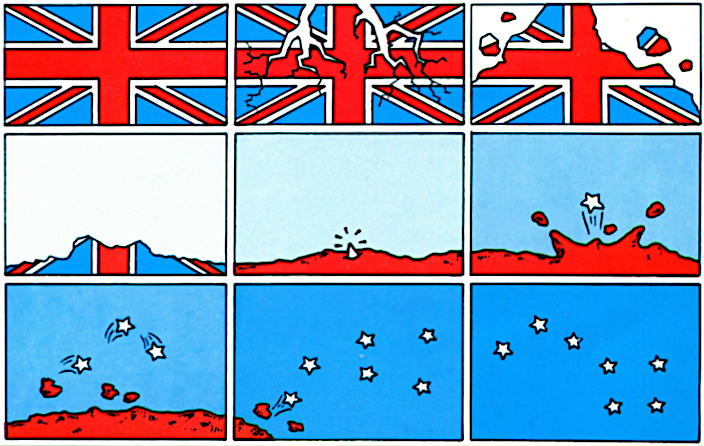
These two pieces are both by cartoonist “Cormac” (Brian Moore), as reproduced on the wall of Corry’s Timber at the top of Springhill Avenue, west Belfast, by Mo Chara Kelly.
Cormac produced cartoons for Resistance Comics, Republican News (and then An Phoblacht/Republican News), Socialist Challenge (and then Socialist Action), and Fortnight. His “Notes (For A History Of Ireland)” appeared in RN and AP/RN for about 30 years.
The mural on the left reproduces a cartoon from February 1979, combining hatred of the “Britz” and RUC with criticism of a left-leaning London bookshop that no longer stocks the paper because “violence is only acceptable if it doesn’t happen here”.
The other is an eleven-panel version of the nine-panel image that appeared on the cover of the 1982 collection Cormac Strikes Back, showing the Union Flag crumbling and the Starry Plough rising from its ashes.
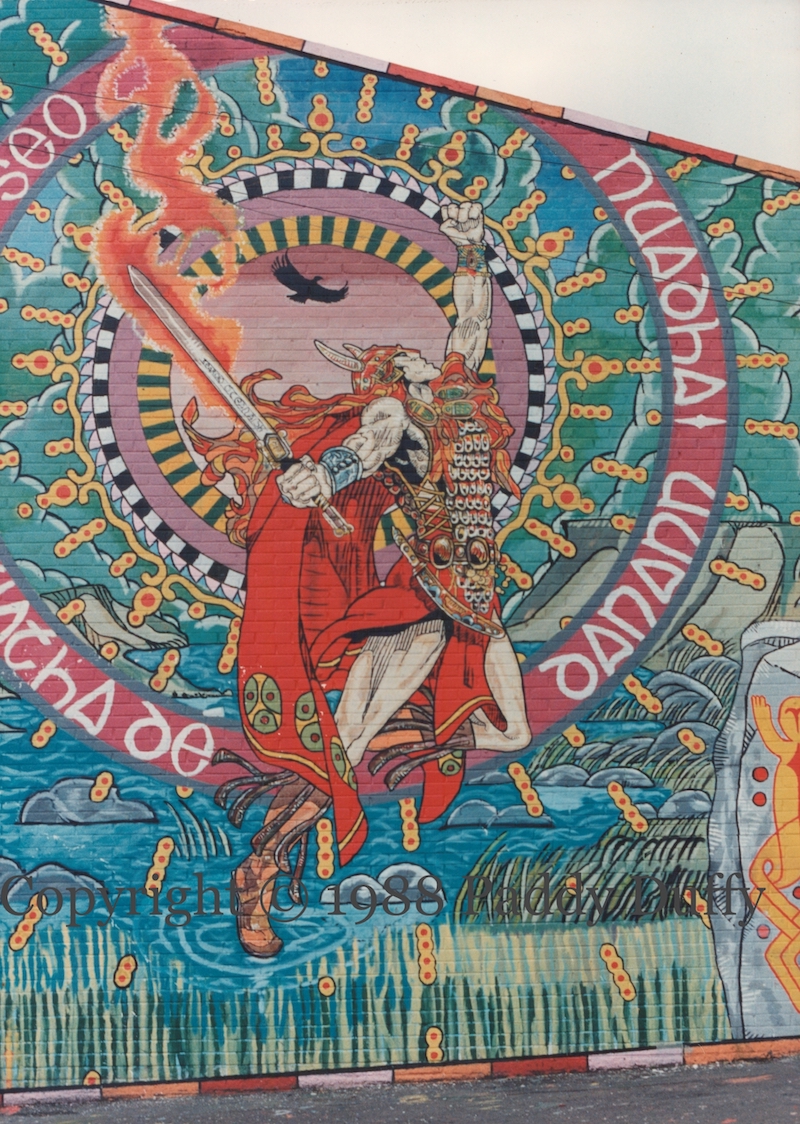
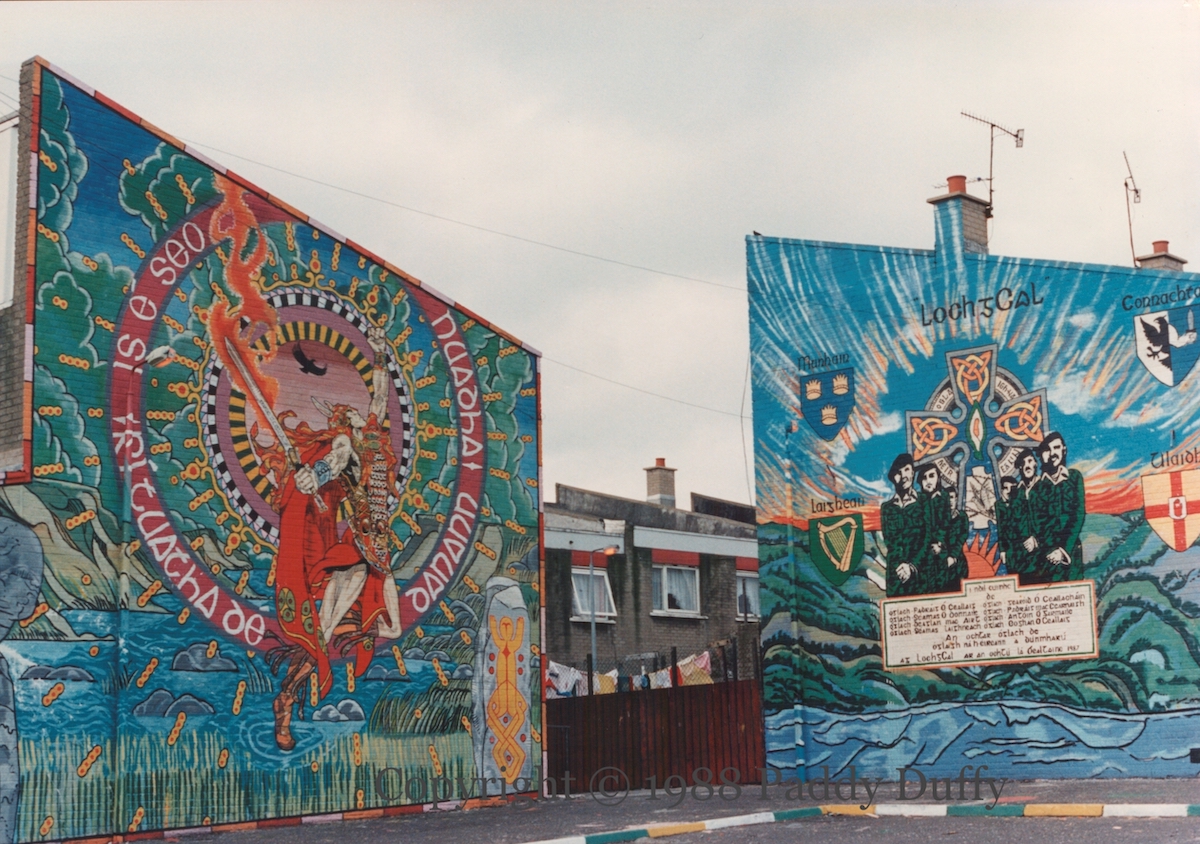
This pair of murals was painted by Mo Chara Kelly at the top of Springhill in 1987 after his release from prison. Both are inspired by the work of Jim Fitzpatrick. The central figure of the Rí Nuadha [King Nuada] mural above and immediately below comes from a painting of Fitzpatrick‘s called ‘Nuada Journeys To The Underworld’ while the background has a Fitzpatrick style and colour-scheme.
Of the myth of Nuada, Mo Chara said, “I had never heard the story of King Nuada before. Then I read the story. Wow! What a yarn! Nuada Of The Silver Arm is one of my favourite stories. As one of the Tuatha Dé Danann you had to be whole and physically perfect to hold the kingship. Nuada lost an arm in the first battle of Moy Tura and so he lost his kingship. He went into the other world, to middle earth, fought through trials and tribulations until Dıan Cécht made a silver arm for Nuada and he was restored to the kingship for another twenty years. But the moral of the story to me was that, no matter what happens, get up again and fight back. No matter how bad the situation you are in, you get back up and fight again. Do not let people isolate you. Get up and fight again. It was very inspiring!” (Painting My Community/An Pobal A Phéınteáıl – English-language version available for free.)
The Loch gCál/Loughgall mural likewise draws on Fitzpatrick for the landscape behind the Celtic cross and funeral guard in memory of the eight IRA volunteers from the East Tyrone brigade who were killed in an SAS ambush during an attack on an RUC base in May, 1987 (WP).
The names of the eight volunteers are given here in Irish and (partially) in the old script:
“I ndıl cuimh[n]e de [= ar] Óglach Pádraıg Ó Ceallaıġ [Patrick Kelly], Óglach Séamus Ó Donn[ġ]aıle [Seamus Donnelly], Óglach Deaglán Mac Aırt [Declan Arthurs], Óglach Séamus Laıghneach [Jim Lynagh], Óglach Gearóıd Ó Ceallacháın [Gerry O’Callaghan], Óglach Pádraıg Mac Cearnaıgh [Pádraıg McKearney], Óglach Antóın Ó Garmaıle [Ó Gormghaıle | Tony Gormley], Óglach Eoghan Ó Ceallaıġ [Eugene Kelly]
an ochtar óglach de óglaigh na hÉireann a dúnmharú ag Loch gCál ar an ochtú lá Bealtaine 1987.” [the eight volunteers from the Irish Volunteers [IRA] who were murdered at Loughgall on the eighth day of May, 1987]
The town (Loughgall) and the four provinces are also named in Irish. An Easter lily is at the centre of the Celtic cross in the middle of the image, above a lark in barbed wire and a gal gréıne/sunburst.
“”I have always believed we had a legitimate right to take up arms …” from an interview by IRA volunteer Maıréad Farrell, executed with her gallant comrades Seán Savage & Dan McCann.”
Yann Goulet’s Ballyseedy Memorial sculpture was rendered in paint for the funeral procession of the Gibraltar Three on March 16th, 1988. The sculpture is a reflection on the killing of eight anti-Treaty prisoners at Ballyseedy Cross (Baıle Ó Síoda), Kerry, during the Irish Civil War. From left to right, we see the dead victim, the grieving widow and orphaned child, and a person (in the painted version wearing the same clothes as the victim) defiantly striding off to take his place and seek revenge.
In the wake of the killings in Gibraltar, six more people were killed in one of the most tense weeks in Troubles history – the IRA’s Kevin McCracken on the 14th, Thomas McErlean, John Murray, and IRA-member Caoımhín Mac Brádaıgh by Michael Stone in the graveyard on the 16th, and British Army corporals Wood and Howes at Mac Brádaıgh’s funeral on the 19th.
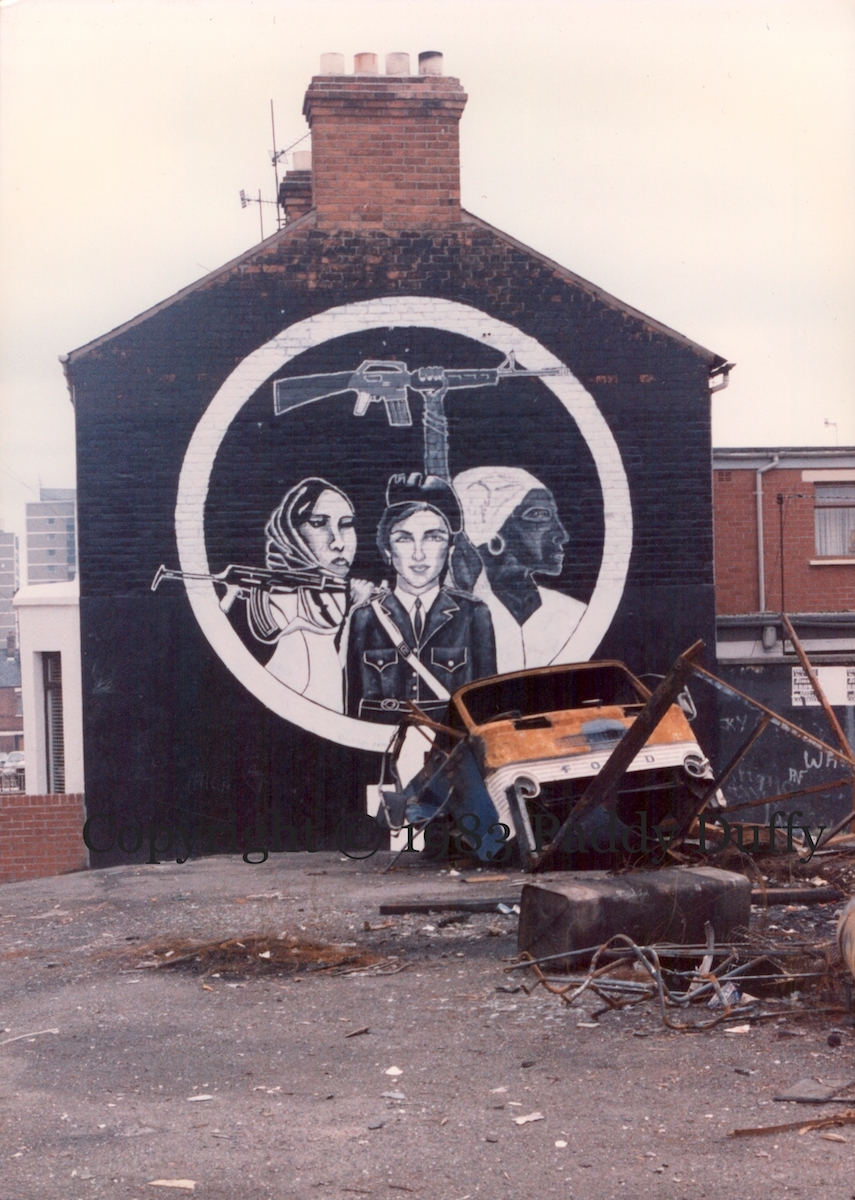
“Solidarity between women in armed struggle” would be added in the bottom right (or is perhaps obscured by the burnt-out lorry. The imagery shows female members of the Palestine Liberation Organisation (PLO), Cumann Na mBan, and the Southwest African People’s Organisation (from Namibia) drawn within the symbol for woman (also the planet Venus in astrology).
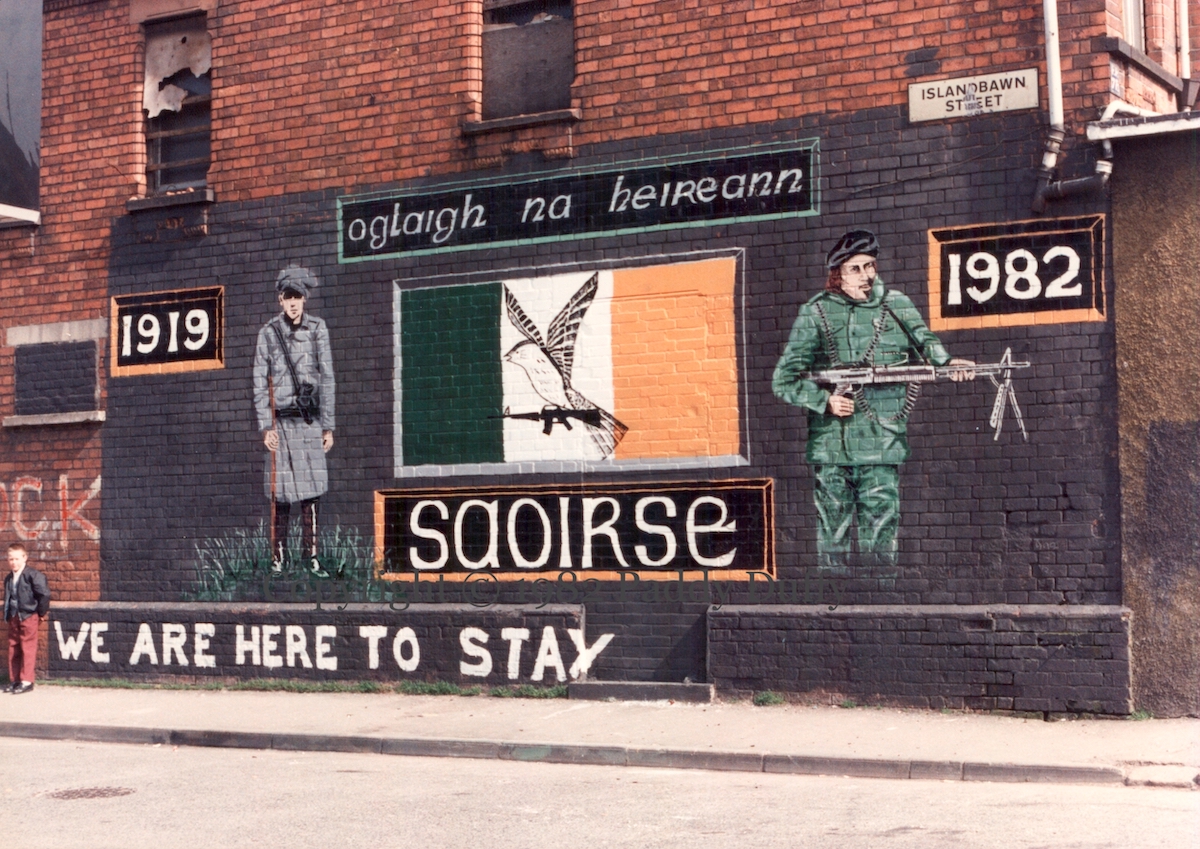
This mural celebrates the IRA (“Óglaigh Na hÉıreann” at the top) from 1919 (the army of the independent Dáıl Éıreann) to the “present” day of 1982. In the centre, a lark flies against a Tricolour, with the word “Saoırse” (“freedom”) beneath.
This is a repainted version of the original, which was one of several murals in Beechmount and the Rock streets that were paint-bombed by “marauding Coldstream Guards” (according to AP/RN of 1982-04-29) – for the damaged mural, see the Peter Moloney Collection. The “1919” date would be changed to “1916”.