The Road To The Somme

Above is a mural in Carlingford St, east Belfast showing gravestones of two deceased locals: “6322 Private J. Condon, Royal Irish Regiment, 24th May, 1915, age 14” and “10/16015 Rifleman S. Thompson Royal Irish Rifles, 5th October, 1918”. Their gravestones are the end-point of a journey that began with the Covenant and the Ulster Volunteers (illustrated by images of Carson, the Covenant, gun-running, and Volunteers drilling).

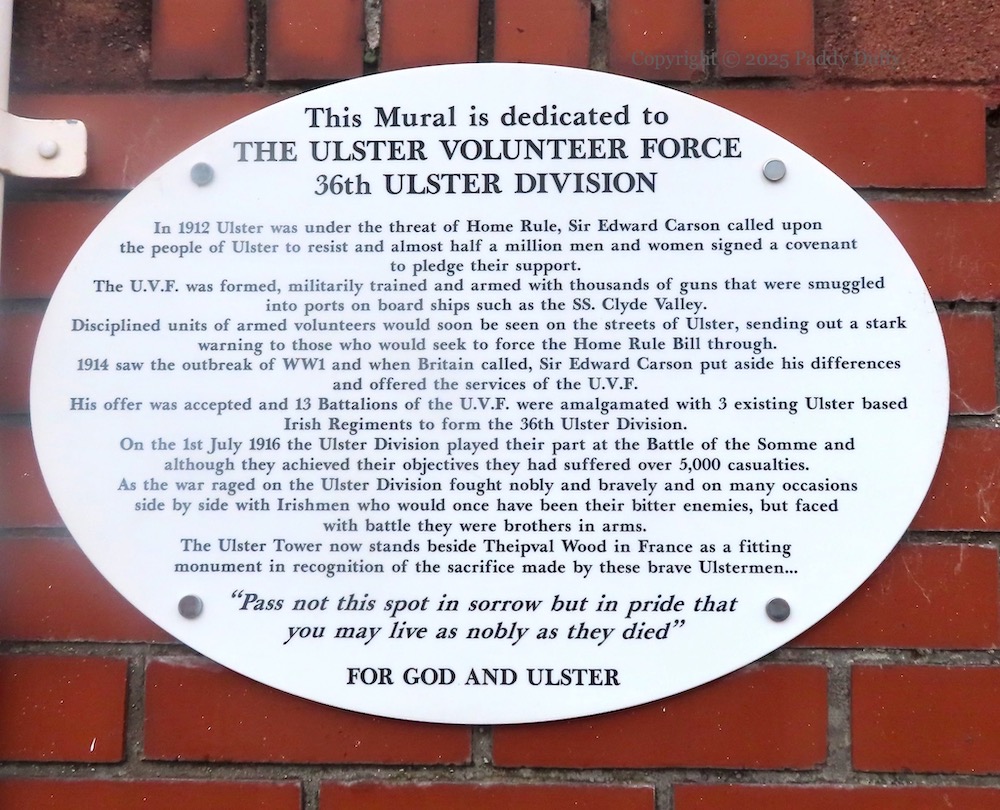
To the left is a plaque describing the journey from the Covenant to the Ulster Volunteers to the Somme: “In 1912 Ulster was under the threat of Home Rule, Sir Edward Carson called upon the people of Ulster to resist and almost half a million men and women signed a covenant to pledge their support. The U.V.F. was formed, militarily trained and armed with thousands of guns that were smuggled into ports on board ships such as the SS. Clyde Valley. Disciplined units of armed volunteers would soon be seen on the streets of Ulster, sending out a stark warning to those who would seek to force the Home Rule bill through. 1914 saw the outbreak of WW1 and when Britain called, Sir Edward Carson put aside his differences and offered the services of the U.V.F. His offer was accepted and 13 battalions of the U.V. F. were amalgamated with 3 existing Ulster based Irish regiments to form the on the 36th (Ulster) Division. On the 1st july the Ulster Division played their part at the Battle of the Somme and although they achieved their objectives they had suffered over 5,000 casualties. As the war raged on the Ulster Division fought nobly and bravely and on many occasions side by side with Irishmen who would once have been their bitter enemies, but faced with battle they were brothers in arms. The Ulster Tower now stands beside Theipval [sic] Wood in France as a fitting monument in recognition of the sacrifice made by these brave Ulstermen … “Pass not this spot in sorrow but in pride that you may live as nobly as they died” For God and Ulster”

There is also a side-wall (out of frame to the right) with the words of Captain Wilfrid Spender, describing the first day of the Battle Of The Somme, 1916, but it is in poor condition.
Click image to enlarge
Copyright © 2023/2025 Paddy Duffy
T03171 T07085
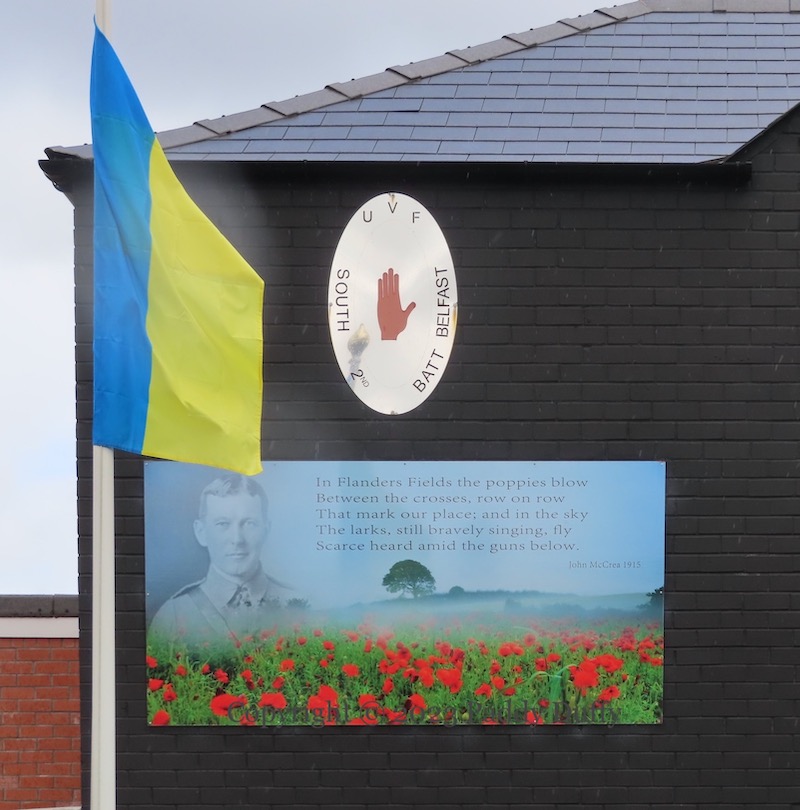
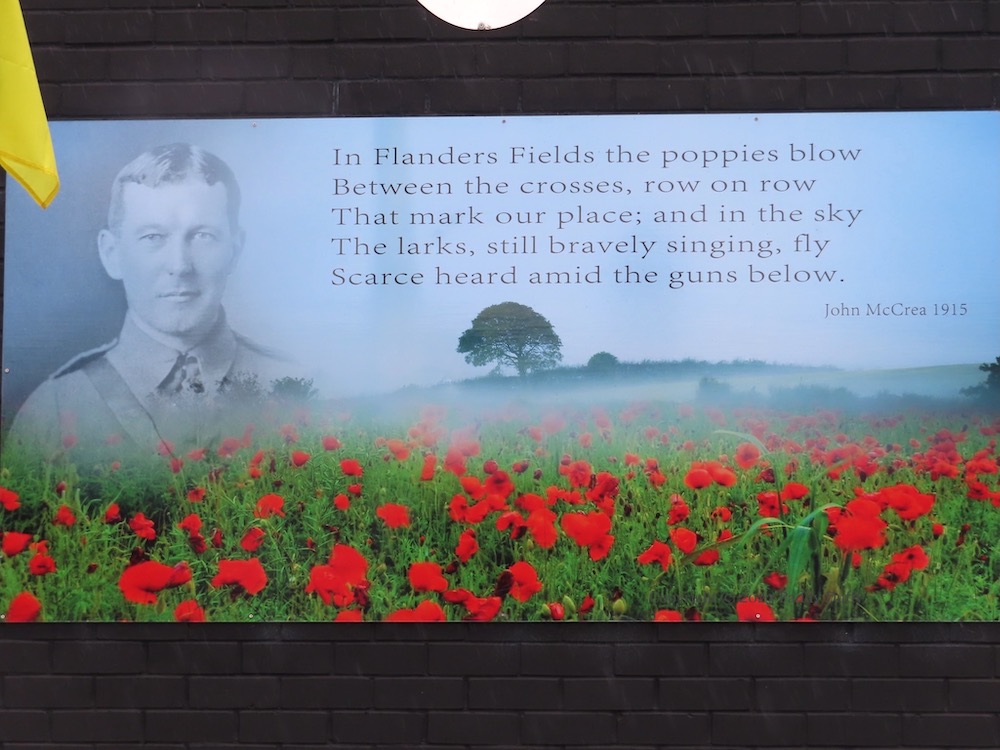
South Belfast Ulster Volunteers

The house next to the Village memorial garden got an extension at the back in 2020 and with it the left-hand part of the house’s gable wall was extended upward (compare with the images from 2017 in Continuing Conflicts). The board with a verse from McCrea’s In Flanders Fields was present previously, but has been raised, and above it there now stands a red-hand emblem of the “UVF 2nd batt. south Belfast”.

Click image to enlarge
Copyright © 2023 Paddy Duffy
T03093 T03092

Kindness Is Free

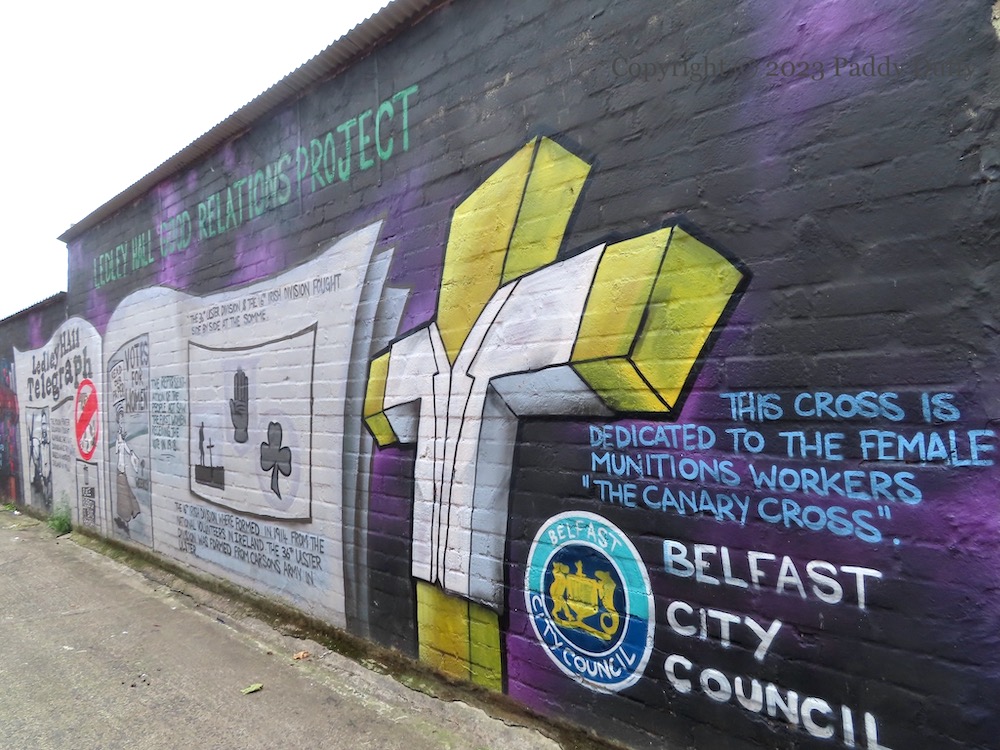
An imaginary newspaper called the “Ledley Hall Telegraph” includes stories on the 303 (Polish) RAF Squadron (which was stationed in Northern Ireland from 1943 to 1944), “Votes for women” (“the Representation Of The People Act saw the first women receiving the vote in 1918”), and the 16th and 36th Divisions (the mural says they “fought side by side at the Somme” – but the 36th was withdrawn on July 2nd after the Battle Of Albert and the 16th arrived in September and fought in the battles of Guillemont and Ginchy; both were withdrawn to Messines and both would take part in the Battle Of Messines in June 1917).

The “newspaper” is bookended by two painted crosses (for Row On Row), one for Guardsman Connor Lilley, a member of the Gertrude Star flute band, who was serving with the 1st battalion Royal Irish Guards when he was killed in an accident in Canada (Fb), and the other for WWI female munitions workers who, because of their work with TNT, risked yellowing skin both from direct exposure and from liver damage (“toxic jaundice”) (WP).

Also included is “The Kindness Hut”: “Be the reason someone smiles today”, “Kindness is free – please share”, “In a world where you can be anything, be kind”, “Take only what you need! If everyone shares there’s enough to go around”.

Click image to enlarge
Copyright © 2023 Paddy Duffy
T03135 T03136 T03137 T03138 T03139 T03140 Ledley Hall Good Relations Project Ledley Hall established 1942

Republican Network For Unity

RNU unveiled a new monument in Milltown as part of their Easter Rising commeration on April 9th, 2023. This photo of it is on a new board on the Falls Road, next to the Rook O’Prey board.

For the stone itself, see An Attitude Of Rebellion. There do not appear to be any images of the new monument on the RNU Fb or tw accounts.

“Republican Network For Unity. Erected by the Belfast Commemoration Committe[e]. Miltown cemetery Easter 2023.”

Click image to enlarge
Copyright © 2023 Paddy Duffy
T03134

Essence And Space

This is the new Sam Rockett mural in the Woodvale, replacing the mural seen in Murdered By Cowards. The old mural just featured Rockett, who died in August, 2000, in the feud between the UVF and lower Shankill UDA. This new mural also features the “ethnic cleansing” of Torrens in 2004.

Torrens sits between Cliftonville, Ardoyne, and the lower Oldpark, and was one of the many historically mixed areas in north Belfast that, with the Troubles, became increasingly segregated and separated from neighbouring areas by “peace” lines. Jarman (1996) provides eye-witness testimony of the dispute in Torrens in 1996 which saw Catholic families leave the area. Its proximity to Ardoyne (and Cliftonville), however, meant that over the next few years the houses were gradually abandoned by Protestants, culminating in 2004 when ten of the remaining Protestant families moved out of the area, alleging persistent intimidation and employing the term term “ethnic cleansing” – a term the poem to the right of the mural uses three times.

The area was eventually redeveloped from 2008-2012, with the Wyndham Street “peace” line coming down and Elmgrove Street being opened to the Oldpark Road.

The line in the poem “the resistance formed a steady band” is unclear – it might refer to loyalists being bussed into Torrens in 1996 (see the testimonies in Jarman); if it refers to B Company it would make a connection to Rockett. As it is, the connection between the two elements of the mural (if any is intended) seems to be that Rockett was from the lower Oldpark, near Torrens.

Sources:
John Darby, Intimidation In Housing, 1974. At CAIN.
Neil Jarman, On The Edge, 1996, which also covers the exodus from nearby Cliftonpark Avenue. At CAIN.
1996 AP footage on youtube
2004: BelTel | BBC | Guardian | Republican News | An Phoblacht

“In the name of Ireland’s cruel game/Oh, land that once sang freedom’s song/Now marred by ethnic cleansing’s wrong.//Echoes of anguish haunt the Protestants of Torrens,/Ethnically cleansed, a sinister goal,/Their weapon honed, to exact a toll.//Families robbed of essence and space,/fuelled by hated, to erase their trace.//Against the darkness, spirits sincere,/Hand in hand across the land,/the resistance formed a steady band.//Ethnic cleansing’s horrors unveiled at last,/Hearts of courage, unbreakable souls,/Truths unfurled, their power untold,/A captured scene of the evil deeds done.”

The in-progress images are from August 17th and 18th. The mural was completed for the anniversary of Rockett’s death on August 23rd. The source for the central image (of furniture being loaded into a lorry) is unknown.

Click image to enlarge
Copyright © 2023 Paddy Duffy
T03131 T03132
T03097 [T03098] T03124

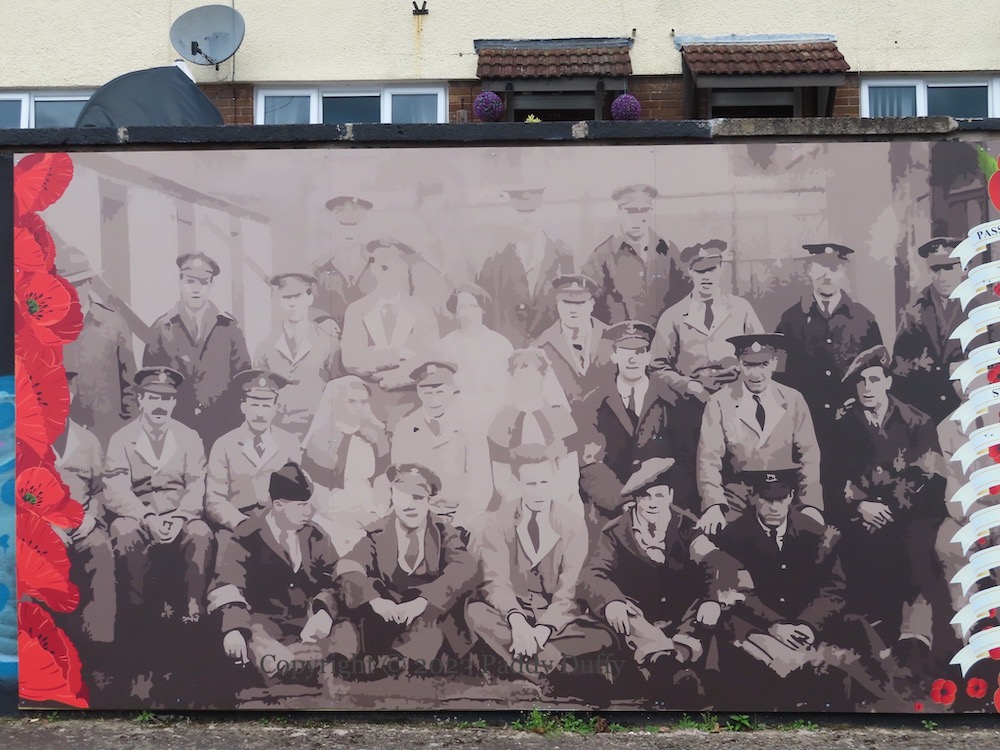
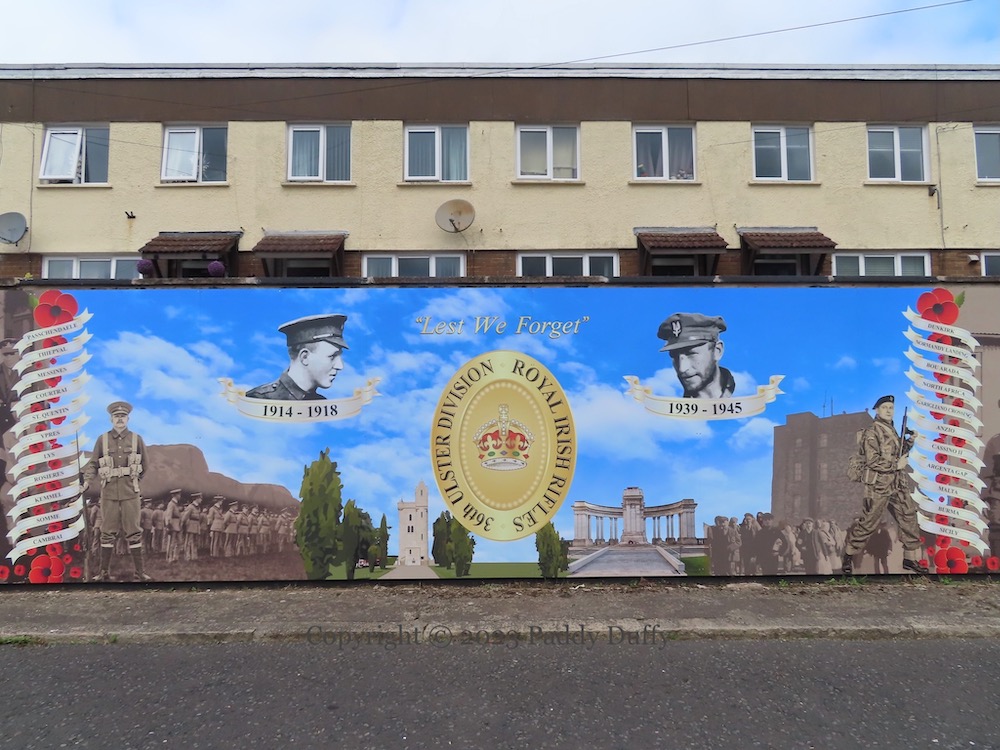
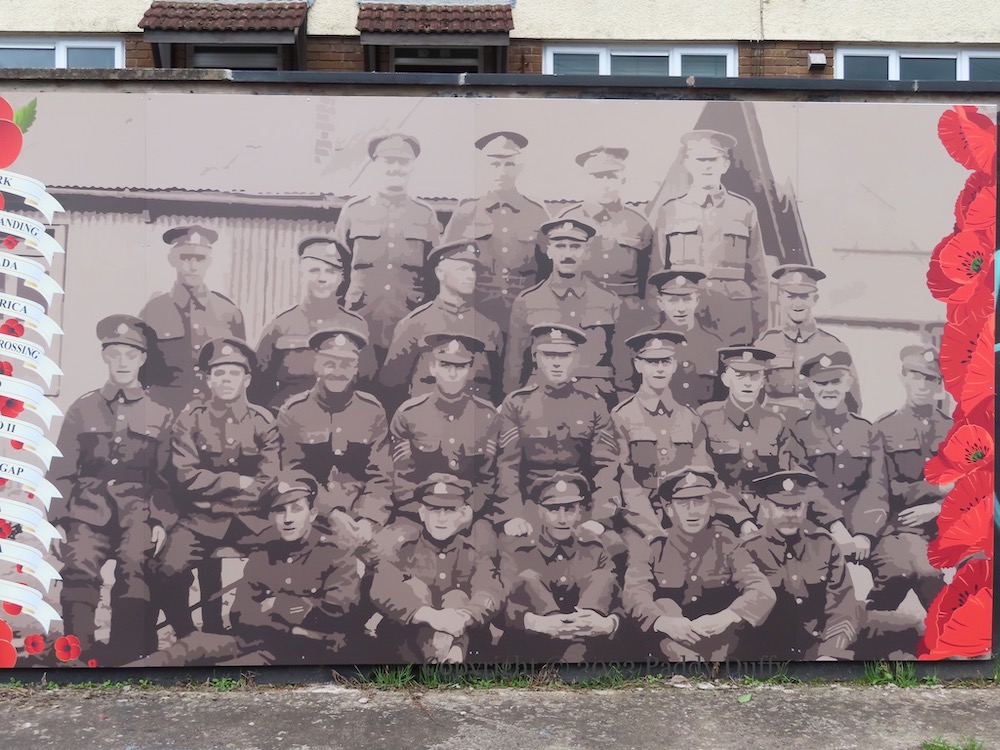
Royal Irish Rifles

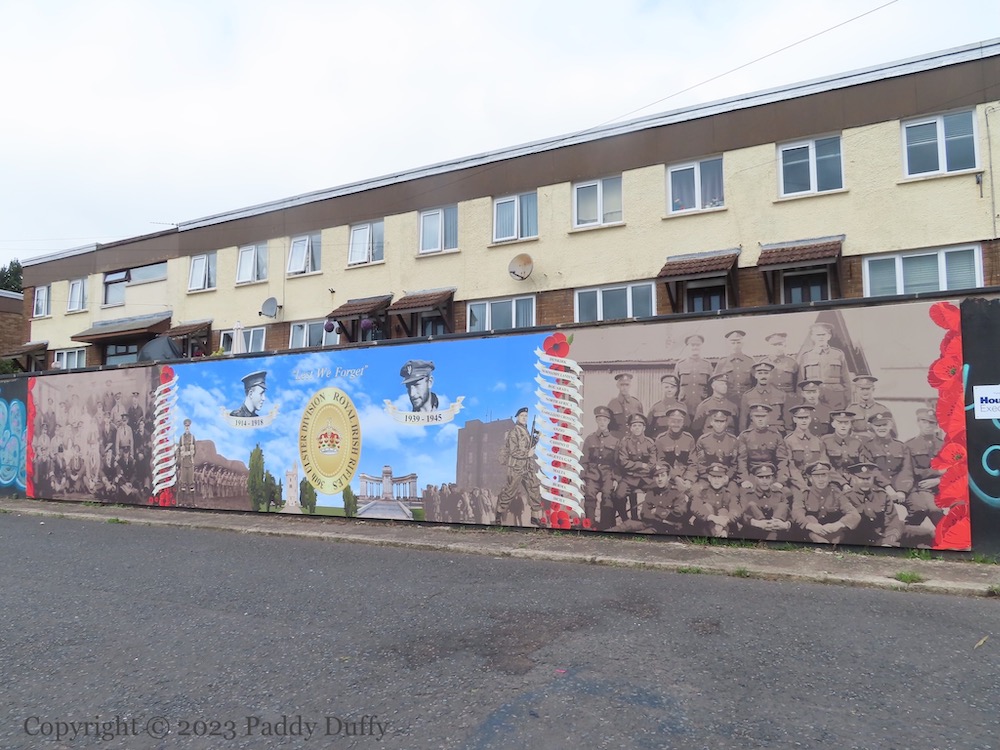
After WWI, the Royal Irish Rifles became the Royal Ulster Rifles (and later became part of the Royal Irish Rangers). This board prioritises WWI as the Rifles were part of the 36th Division. The hero of WWI portrayed in the central panel is William McFadzean, awarded the VC for falling on two live grenades in the trenches on July 1st, 1916. McFadzean is familiar from many previous murals both individually and in the company of other VC winners; for his family home in Cregagh, see Rubicon.

Alongside McFadzean, the hero of WWII is Blair “Paddy” Mayne, who was only briefly in the Ulster Rifles before making his name in the Parachute Unit (later, and better, known as the SAS). His many medals of honour are shown in an old Newtownards mural, though he was denied the VC.

Click image to enlarge
Copyright © 2023 Paddy Duffy
T03128 T03129 T03130 T03127

Gort Na Móna

These two boards are at Gort Na Móna CLG. The one above was put developed by young Gorts as they learned about the history of the club as part of a twentieth anniversary celebration of Terry Óg Enright (Fb) who was killed by the LVF in 1998. The second board, below, combines the two previous boards to Terry Óg, seen previously in No Such Thing As Failure and Páırc Mhıc Ionnrachtaıgh.

Click image to enlarge
Copyright © 2023 Paddy Duffy
T03118 T03117

Bóthar Chluanaí

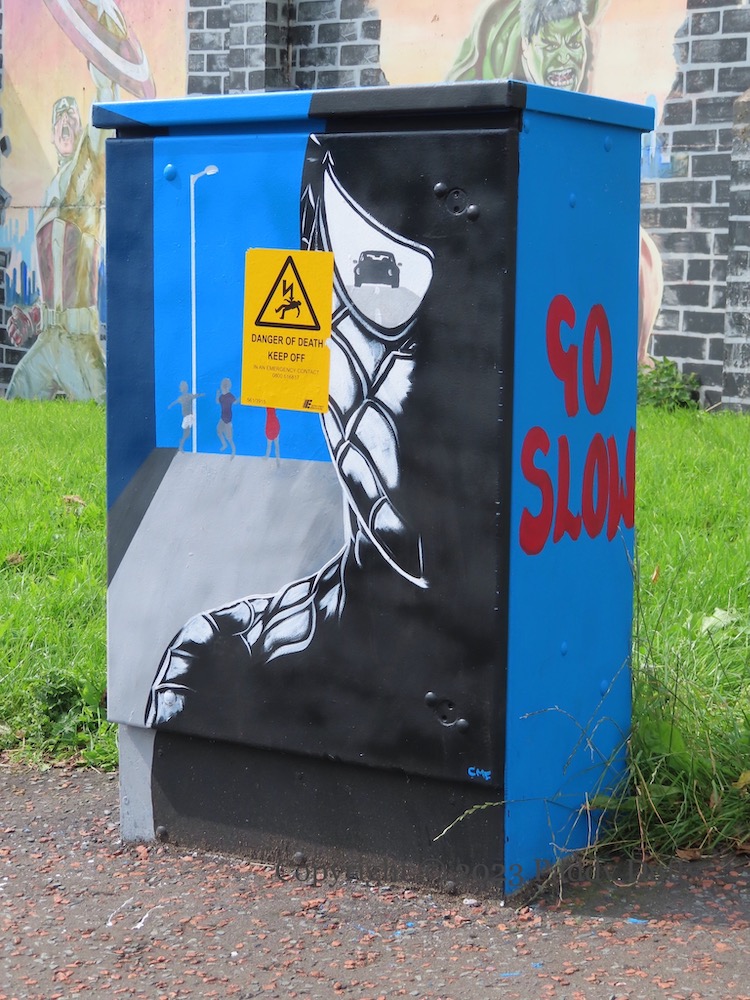
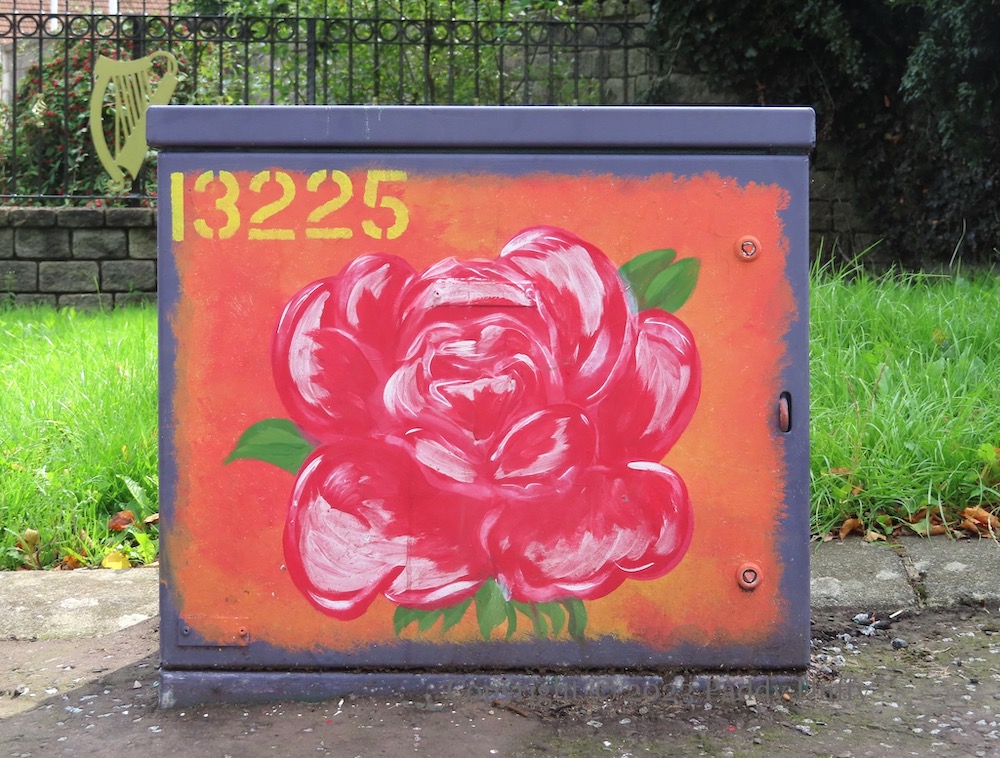
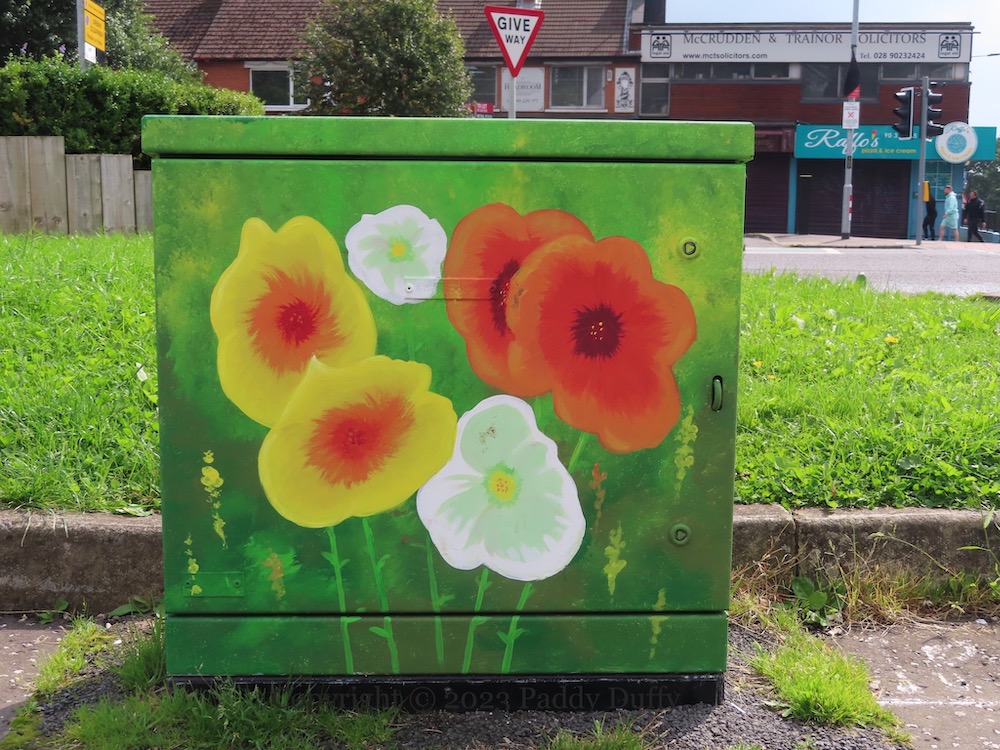
This post is an update to last year’s Gaırdín Na hÉıreann which showed various painted electrical boxes in Ballymurphy. To these have been added some boxes in Slıabh Dubh and New Barnsley.

The second Slıabh Dubh image (immediately below) is of Spiderman, to fit with the wall of superheroes that can be seen in the background (seen previously in Red Eye).

(After three from the top of Ballymurphy which were included in last year’s post,) there are five from the New Barnsley side of Springfield Road, including two featuring Newhill Youth/Football Club (Fb) ahead of its 50th anniversary, which will be celebrated in City Hall this Saturday, September 2nd (Fb).

Click image to enlarge
Copyright © 2023 Paddy Duffy
T03101 T03100 [T03099]
T03102 T03103 [T03104] T03105 T03109 T03110 T03111
T03211

Lóıste Na Móna

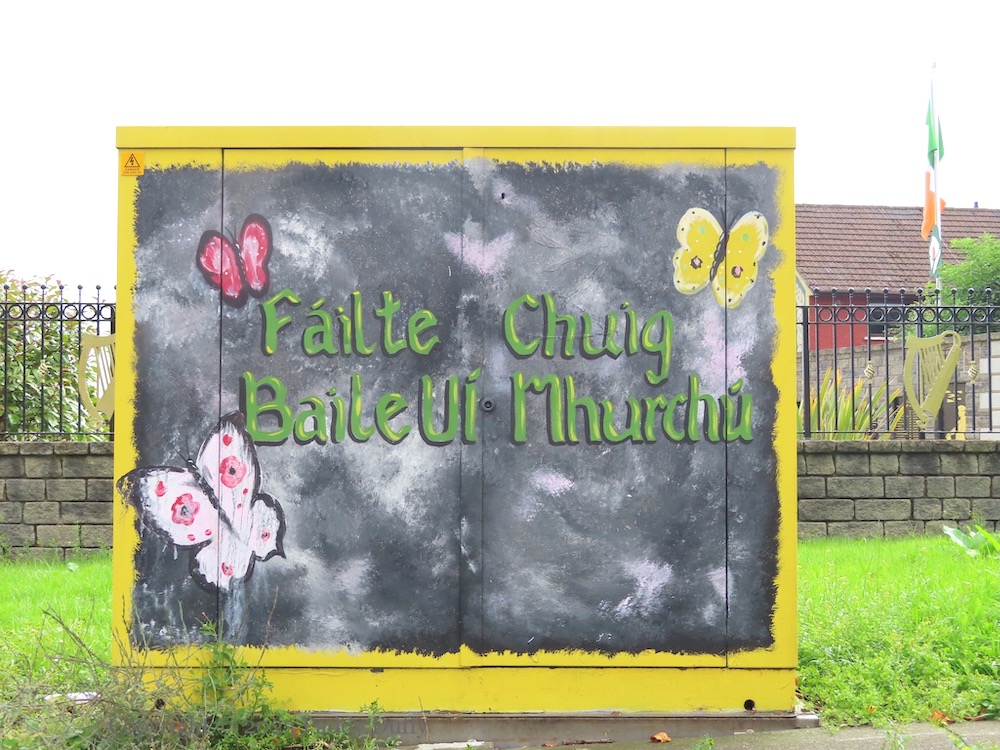
“Welcome to Turf Lodge” — “Fáılte go dtí Lóıste Na Móna”. Turf Lodge was one of a number of estates built in the foothills of Black Mountain — including Westrock, Springhill, Ballymurphy, New Barnsley, and Dermot Hill — meant to house an underserved Catholic population and displaced families from other areas of Belfast.

The estate was built over a number of years but most people moved in between 1960 and 1962. (Northern Visions made a documentary about the history and people of the Turf Lodge estate that includes descriptions of the various ways in which the estate was left unfinished even as people took up residence.)

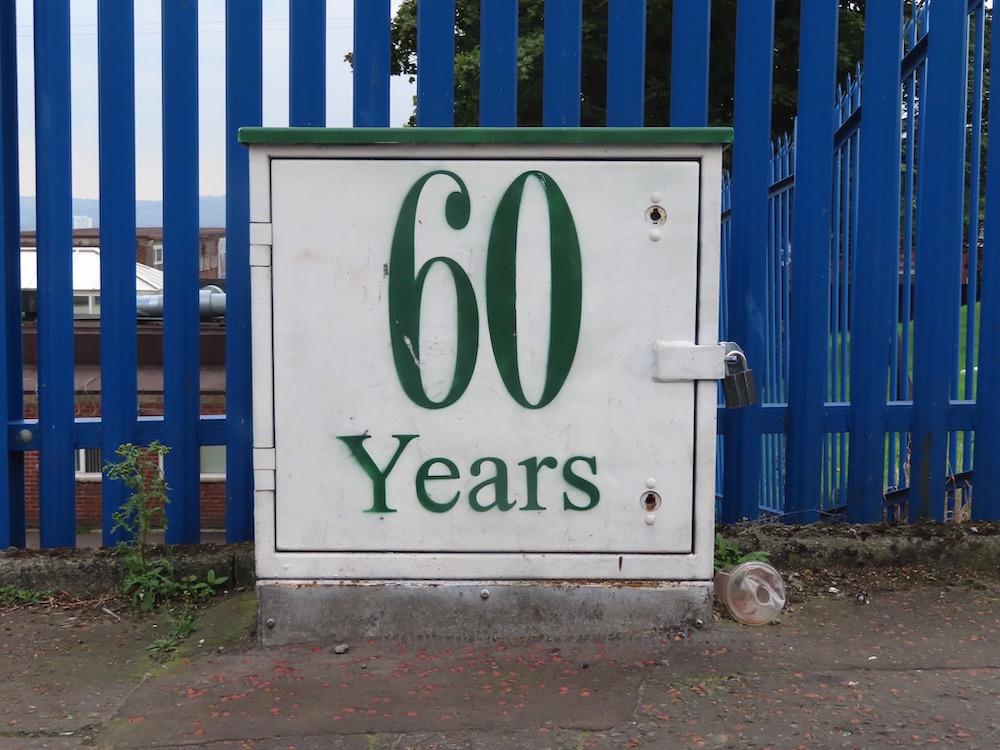
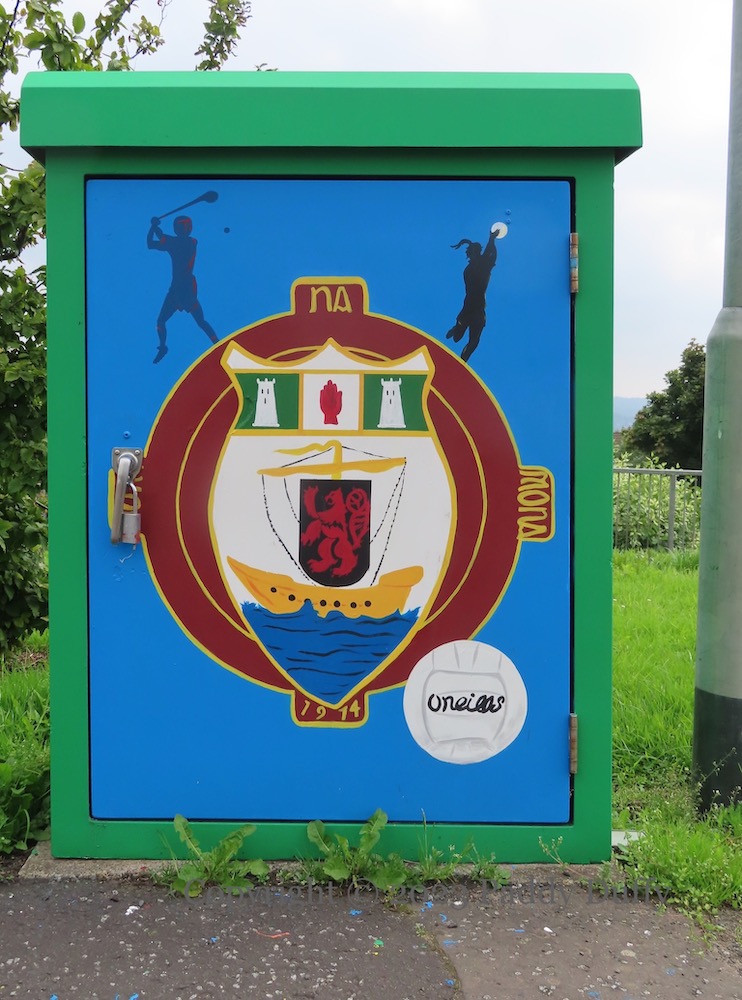
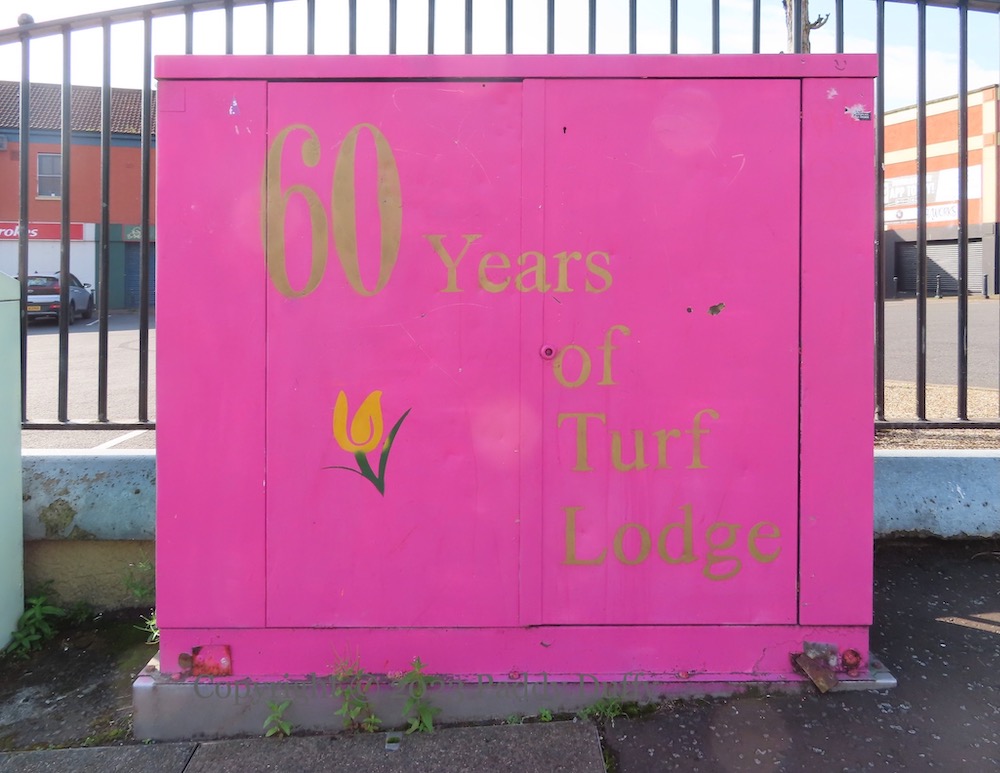
For the sixtieth anniversary, the electrical boxes outside John Paul II (formerly St Aidan’s) were stencilled (above and immediately below). This year (2023), more boxes have been painted, with images of gaelic games (see Gort Na Móna), bluebells (see Féıle Na gCloıgíní Gorma), and the silver fáınne on red background (see #AchtAnoıs).

See also: Klaus Fröhlich has a gallery of photos of the flats in the middle of the estate in great disrepair in 1979 (at BAP).

Click image to enlarge
Copyright © 2023 Paddy Duffy
T03113 T03114 T03115 T03116 T03120 T03209 T03210

Faith, Blood, Service, Sacrifice

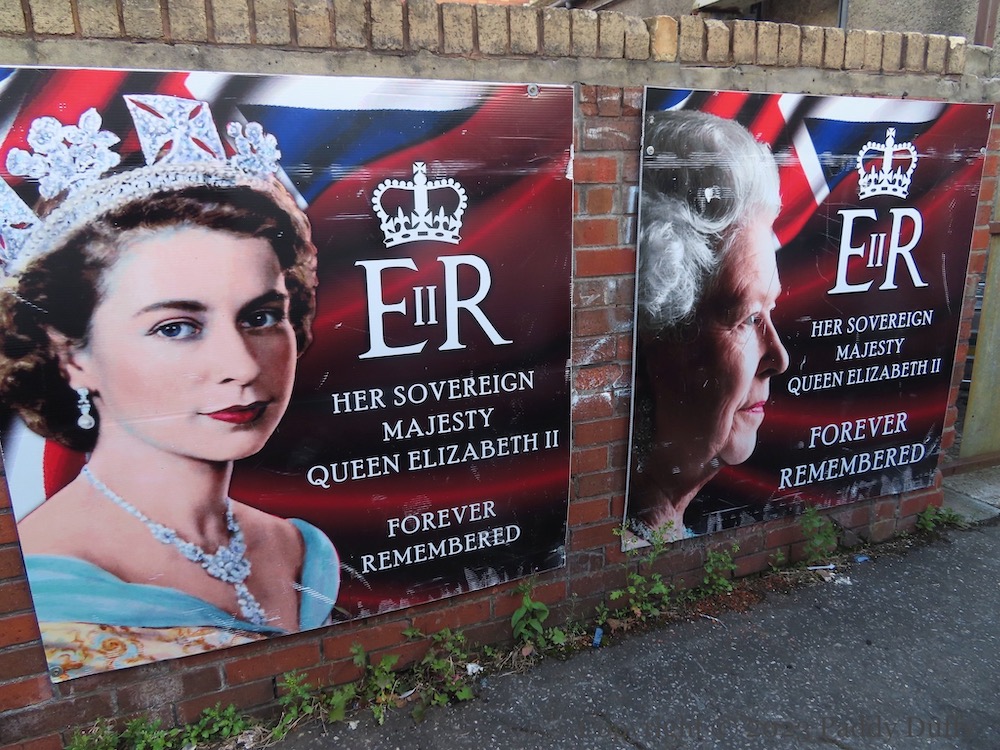
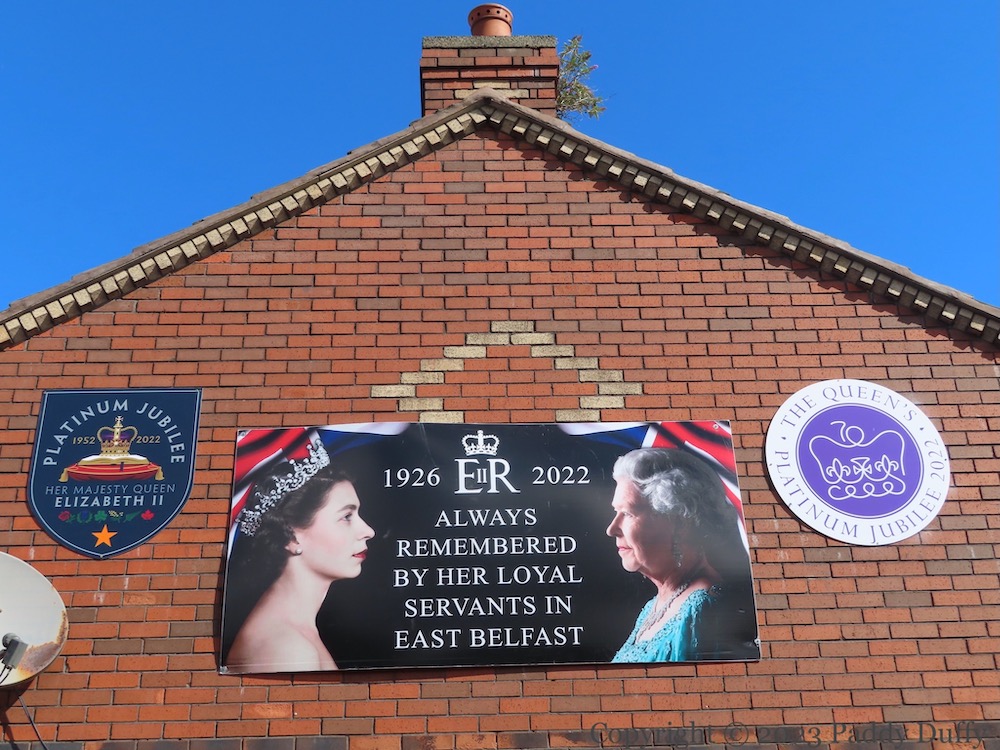
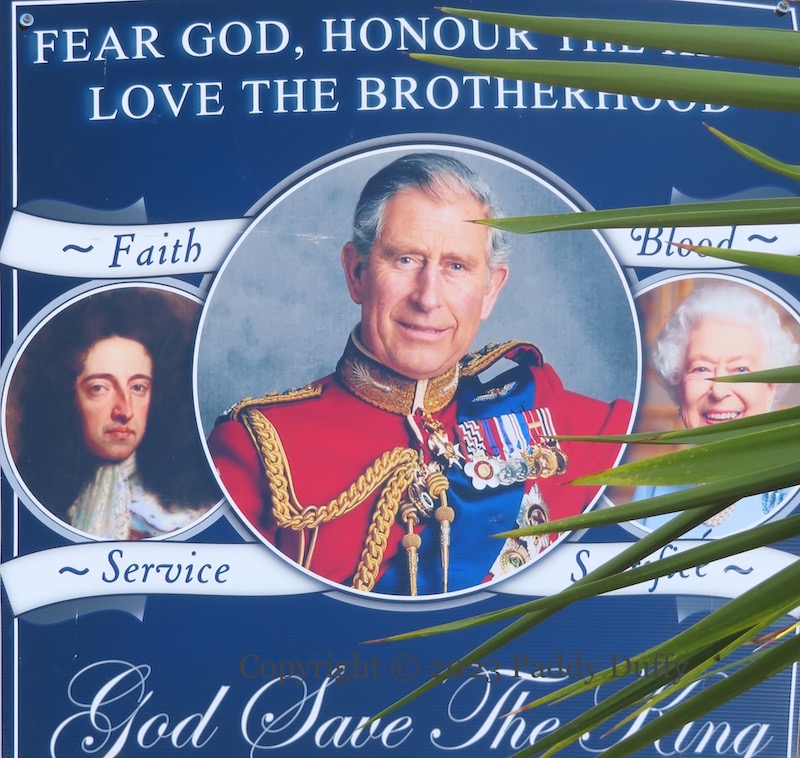
Here are three images from the blind end of Montrose Street, east Belfast, updating a post from November last year (Loyal Servants) with the addition of the boards above, on the death of Queen Elizabeth II, and the final image below, which puts the new King Charles III between Queen Elizabeth and King William III.

Click image to enlarge
Copyright © 2023 Paddy Duffy
T03083 T03085 T03084c