Executed

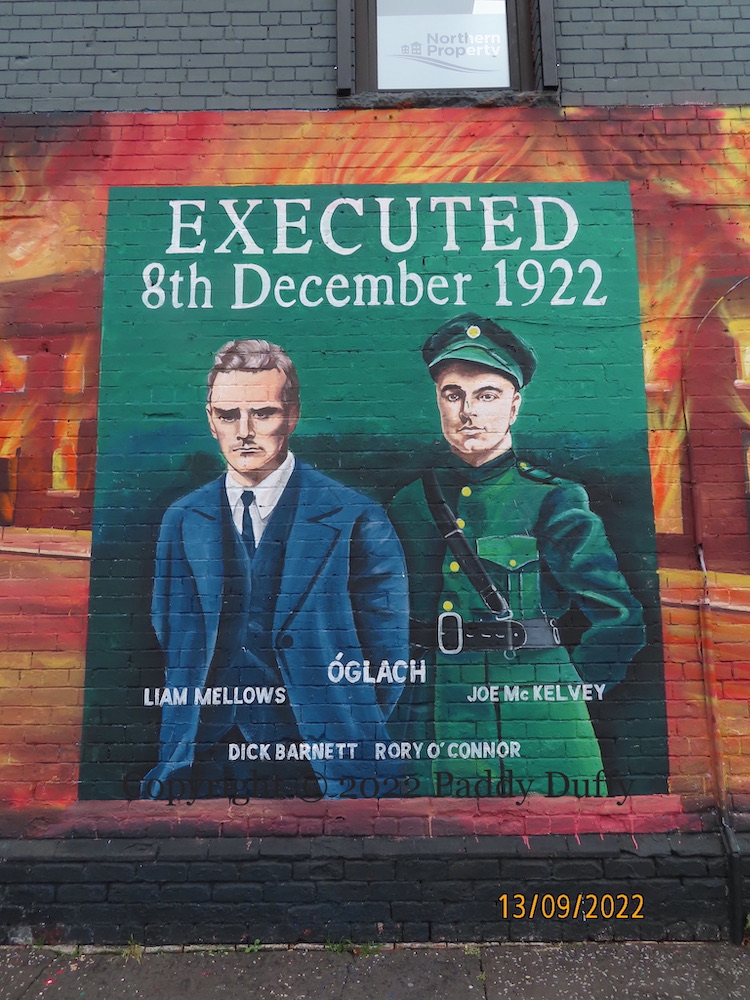
On October 18th, 1922, the third Dáıl/second Provisional Government Of Southern Ireland approved – in the absence of anti-Treaty members – a bill entitled the “Army Emergency Powers Resolution” which introduced martial law, including martial courts with the death penalty for anyone found in possession of an illegal firearm – “illegal” meaning not sanctioned by the nascent pro-Treaty Free State. Under these powers, seven IRA volunteers were executed on November 17th and 19th, followed on the 24th by Erskine Childers (a member of the team that negotiated the Treaty but subsequently against it). In response, the IRA declared that TDs who had voted for the bill were fair game, and on December 7th Seán Hales of Cork was shot and killed. In reprisal, the government ordered the execution of four more volunteers, one from each province: Liam Mellows, Joe McKelvey, Dick Barnett, Rory O’Connor. The four had been arrested five months earlier, on June 30th, 1922, at the start of the Civil War, after surrendering the Four Courts. By the end of the war, 81 executions had taken place. (An Phoblacht | Irish Times | The Irish Story | WP | WP)

For the left-hand side of the wall, on the shipyard clearings and the McMahon murders, see Belfast Butchery.

Click image to enlarge
Copyright © 2022 Paddy Duffy
T00803 [T00802]
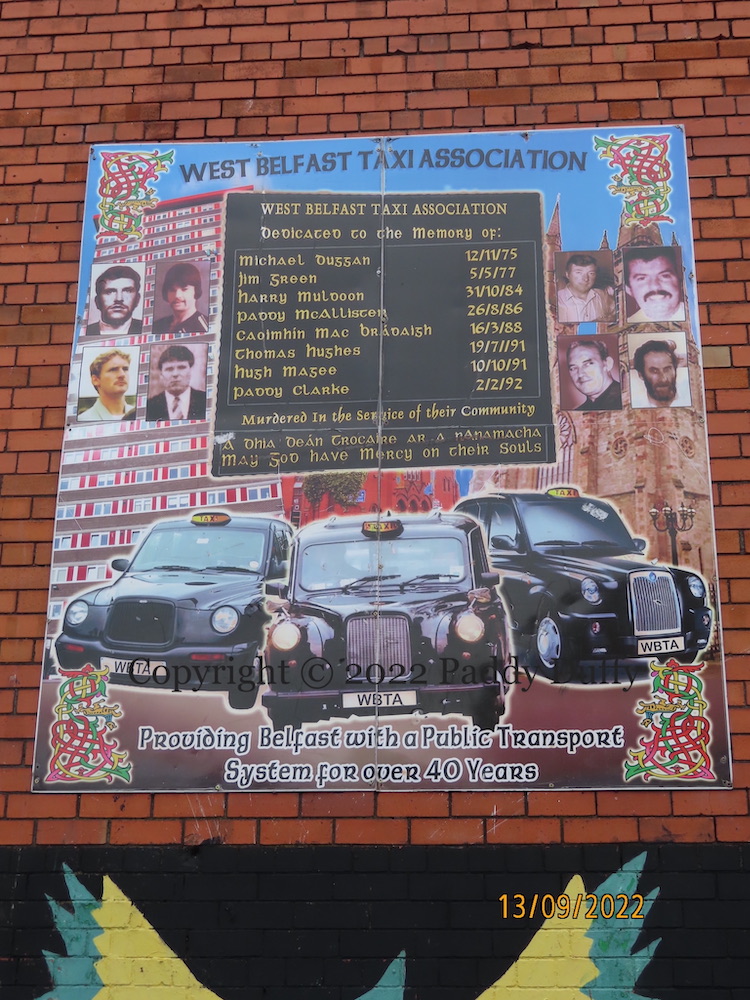
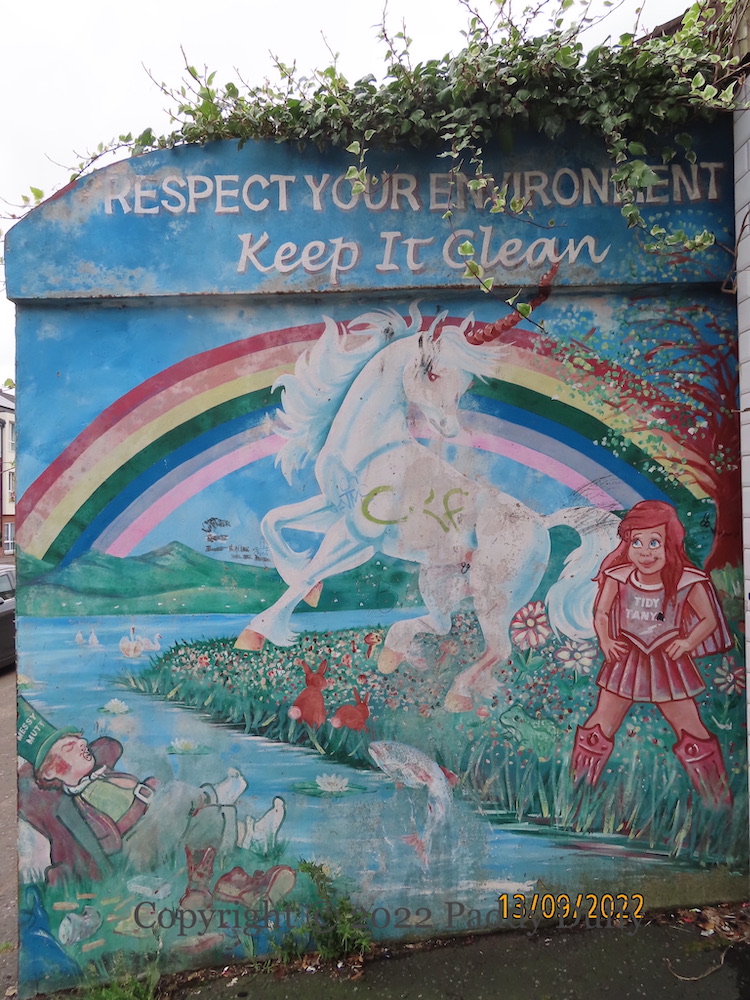
Alternative Transport, Alternative Location

Pieces of the long Beechmount Avenue wall have moved to different locations due to the construction of new fencing and other improvements. The WBTA Alternative Transport board is now above the longest-surviving mural in Belfast, the Clowney Street phoenix.

Click image to enlarge
Copyright © 2022 Paddy Duffy
[T00800] T00801

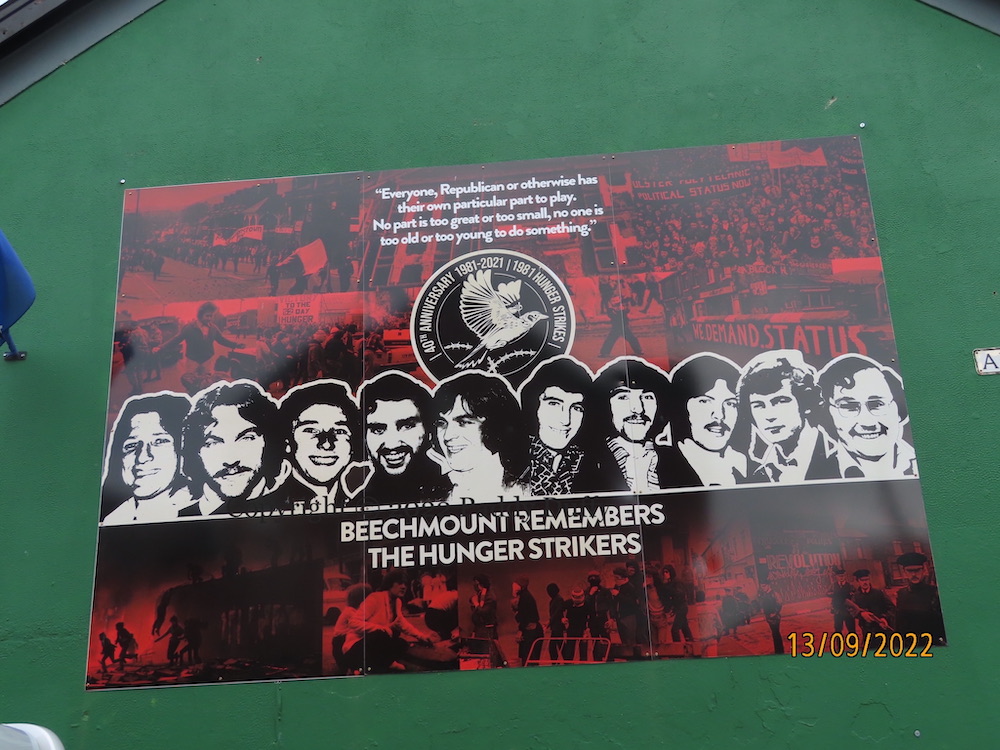
Beechmount Remembers

This board was mounted in AMCOMRI Street for the fortieth anniversary of the 1981 hunger strike, with photographs from the area in the background, including the Revolution mural at the bottom of Beechmount Avenue in 1996-1997.

“Everyone, Republican or otherwise, has their own particular part to play. No part is too great or too small, no one is too old or too young to do something.”

Click image to enlarge
Copyright © 2022 Paddy Duffy
T00798 [T00799]

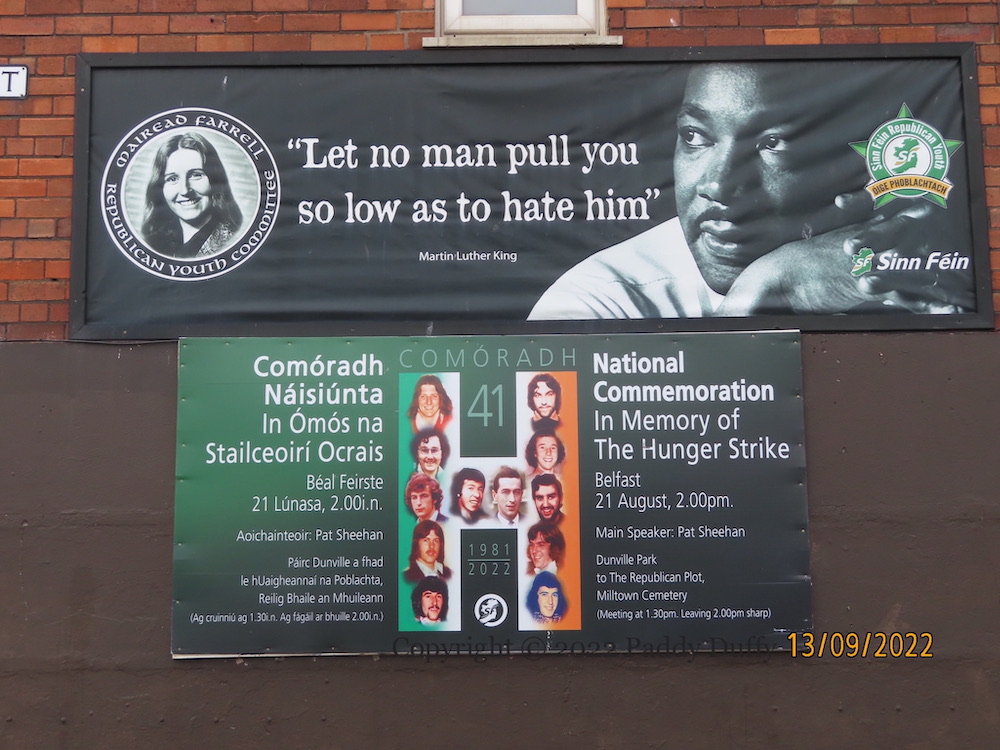
Let No Man Pull You So Low As To Hate Him

This Sınn Féın Youth/Maıréad Farrell Youth Committee banner uses Martin Luther King to advocate for non-violent protest (featured previously in Always Avoid Violence). Below is a call to attend a 41st-anniversary commemoration of the 1981 hunger strike.

Beechmount Street, west Belfast

Click image to enlarge
Copyright © 2022 Paddy Duffy
T00797 [T00815]

The People’s Queen Is Dead

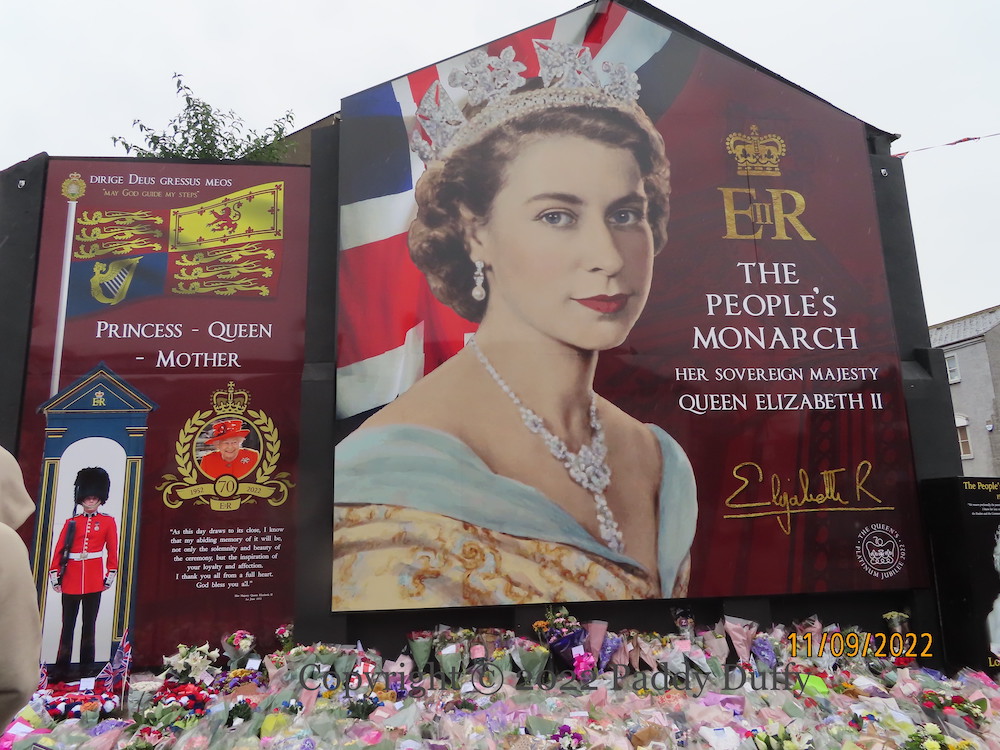
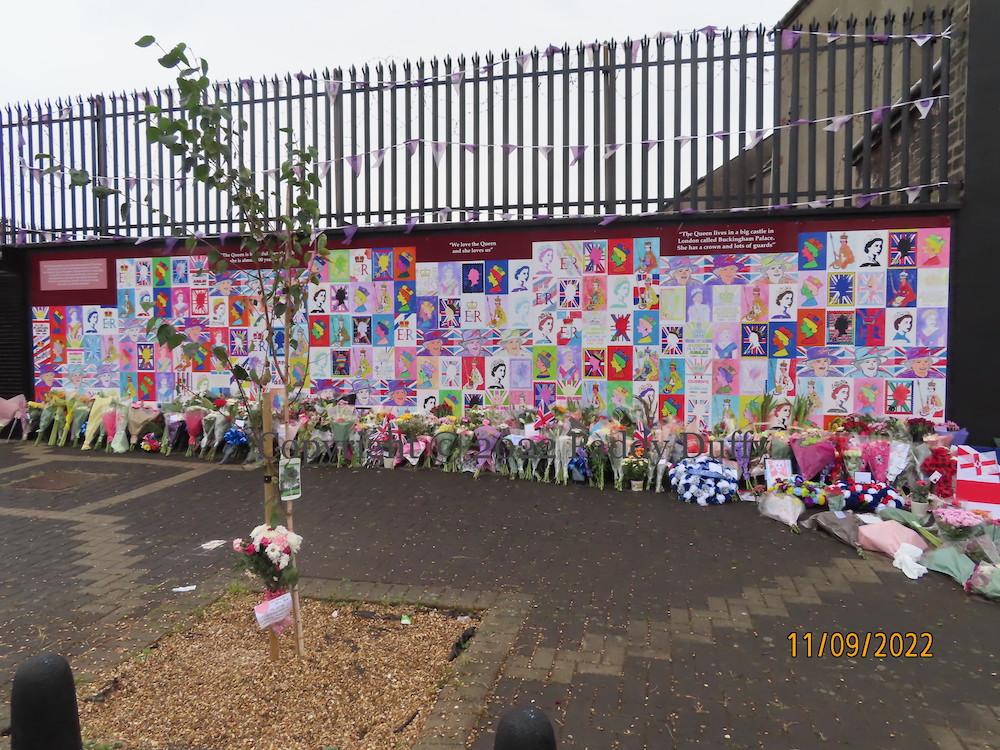
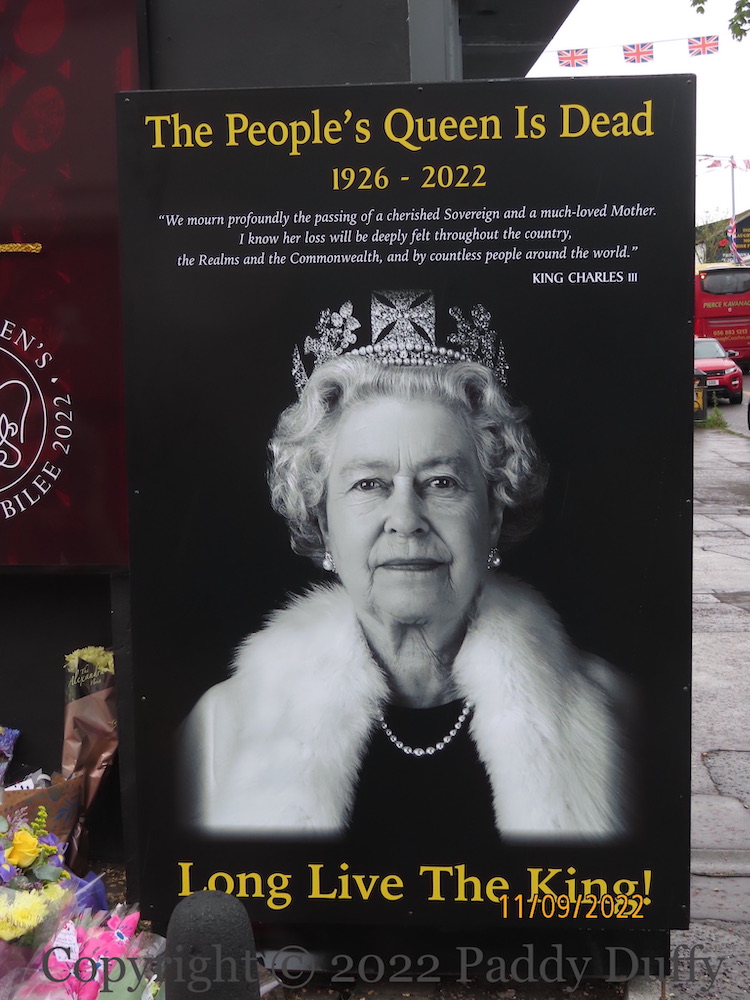
Upon news of Queen Elizabeth’s death, the platinum jubilee mural at the bottom of Crimea Street became a memorial, with hundreds of bouquets being laid before it and a “wall of condolences” set up. (For the mural itself, see The People’s Monarch.) In addition, to the right-hand side has been added a small commemoration of her passing, with a quote from her son, the newly acceded King Charles:

“We mourn profoundly the passing of a cherished Sovereign and a much-loved Mother. I know her loss will be deeply felt throughout the country, the Realms and the Commonwealth, and by countless people around the world”; “Long live the king!”

The fifteen commonwealth “realms” (previously called “dominions”) share a monarch – formerly Elizabeth II and now Charles III – while the commonwealth comprises 41 additional nations, including some which are now republics: Barbados, for example, became a republic on November 30th last year (2021) but is still in the Commonwealth (WP). Additional countries might take the passing of Elizabeth as a suitable juncture at which to sever ties (Edinburgh News has a round-up | for the Bahamas see Caribbean National Weekly | for Canada see Toronto Star).

Click image to enlarge
Copyright © 2022 Paddy Duffy
T00791 [T00792] [T00793] T00794 [T00795] T00796

Springhill-Westrock Massacre

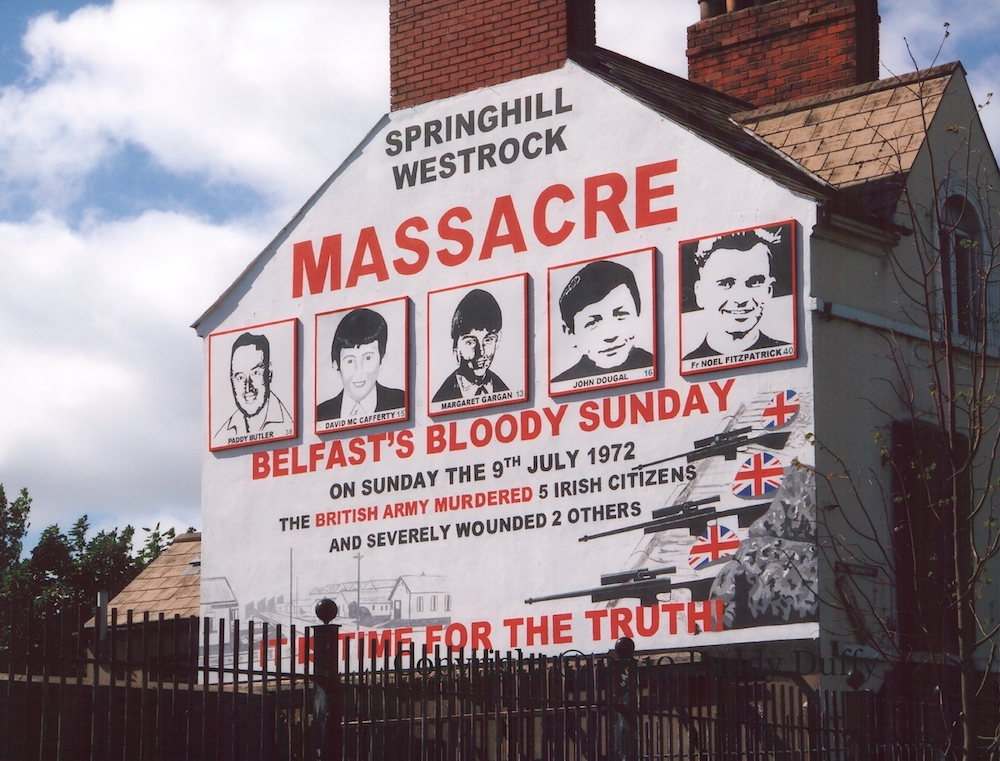
This is a mural by Mo Chara Kelly (with DD Walker, Michael Kelly, and Ta Heath) commemorating the deaths of five people shot by British Army snipers in 1972: Paddy Butler (39), David McCafferty (15), Margaret Gargan (13), John Dougal (16), Fr Noel Fitzpatrick (40). The snipers fired from JP Corry’s timber yard (shown on the right) and at the time the Westrock bungalows were still standing (shown lower left).

“Belfast’s Bloody Sunday. On the 9th July 1972 the British Army murdered 5 Irish citizens and severely wounded 2 others. It’s time for the truth.”

Springfield Road, west Belfast

Click image to enlarge
Copyright © 2010 Paddy Duffy
T00495

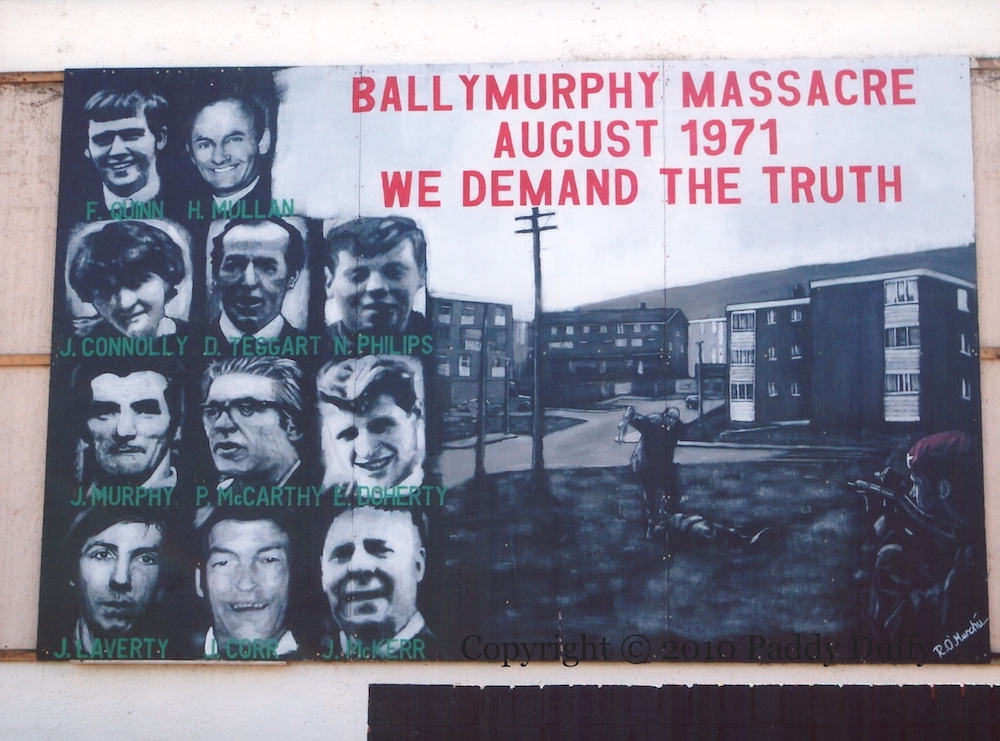
We Demand The Truth

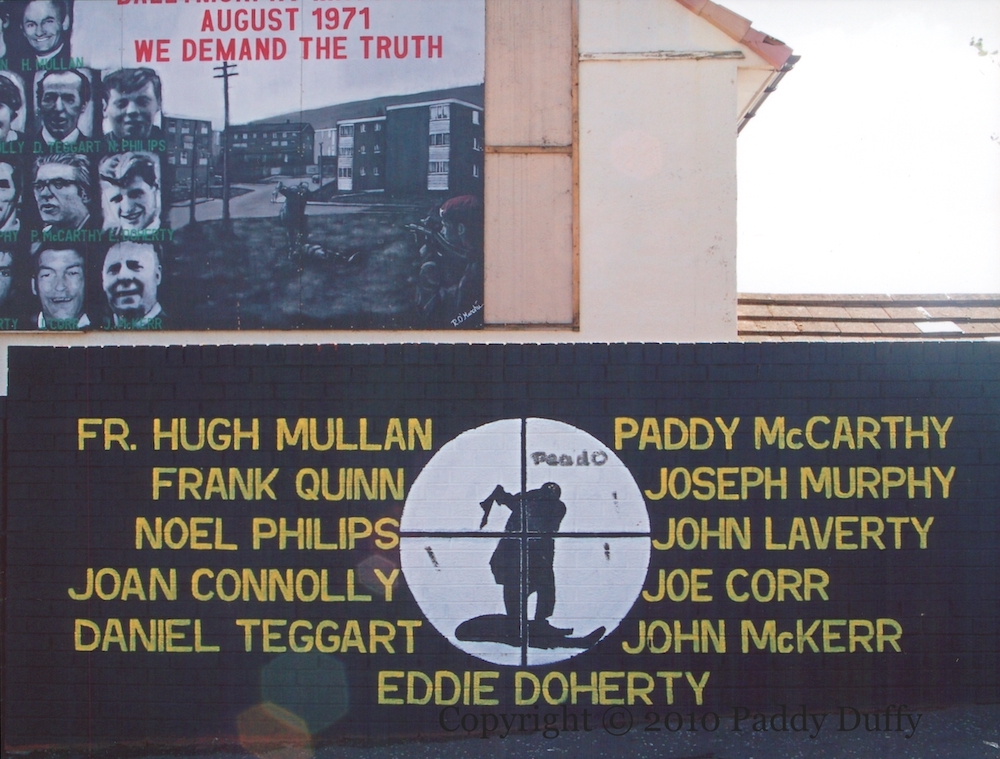
“Ballymurphy Massacre – August 1971 – We demand the truth” with portraits of the 11 dead – Quinn, Mullan, Connolly, Teggart, Philips, Murphy, McCarthy, Doherty, Laverty, Corr, McKerr.

The painting (by Rıstead Ó Murchú) on the board shows the killing (from the direction of Springmartin) of Father Hugh Mullan in waste ground near Springfield Park. It was previously on the Whiterock Road but has now been moved onto the Springfield Road to join the murals on the low wall calling for justice. Two of the panels are also included. More can be seen in in Peter Moloney’s collection.

Springfield Road, west Belfast

Click image to enlarge
Copyright © 2010 Paddy Duffy
T00496 T00493 T00494

State-Sponsored Killings

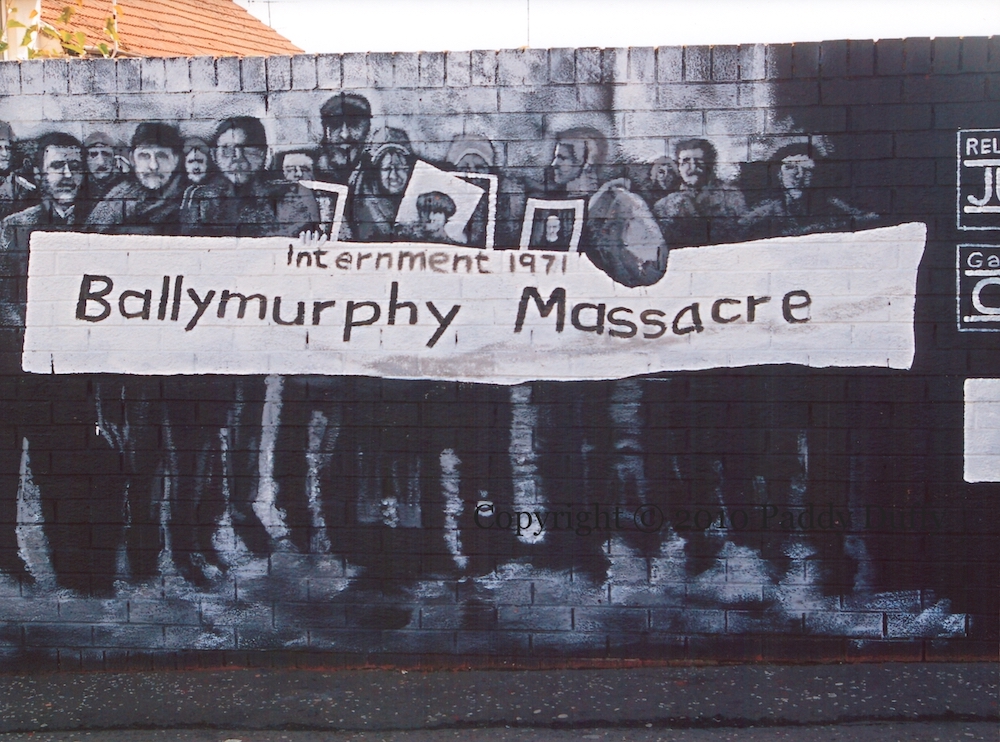
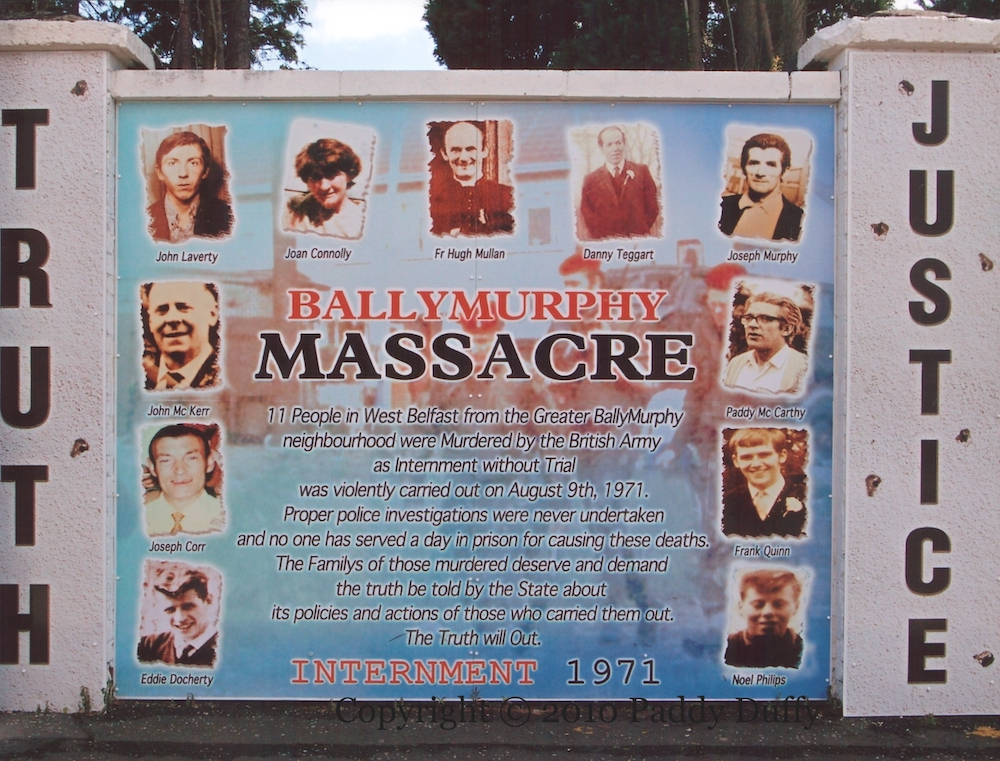
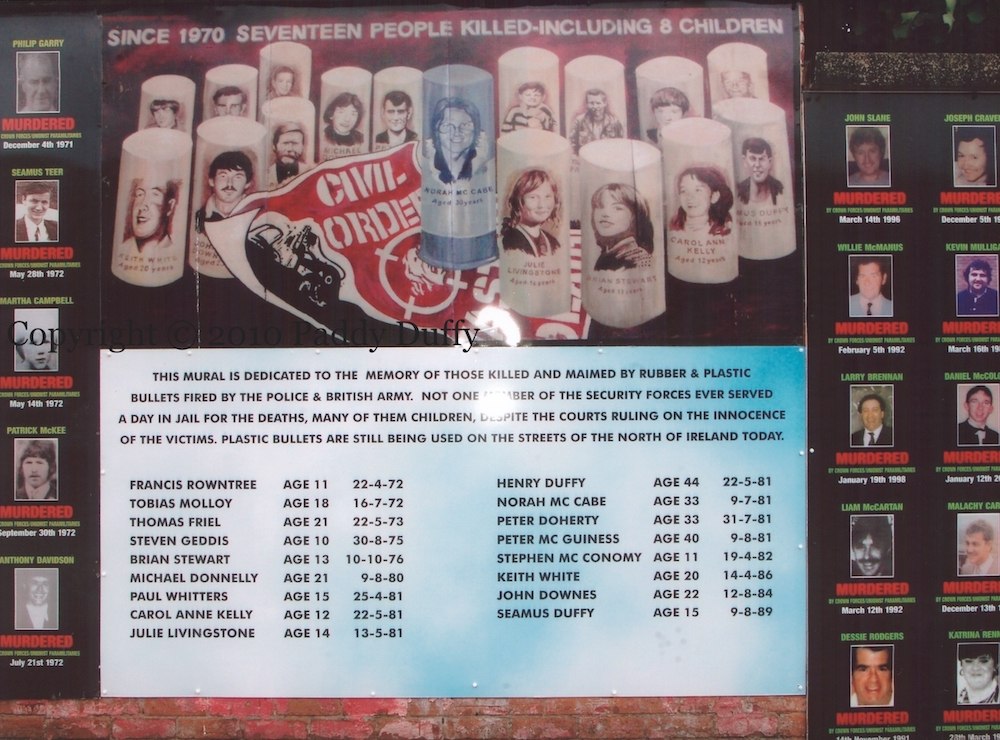
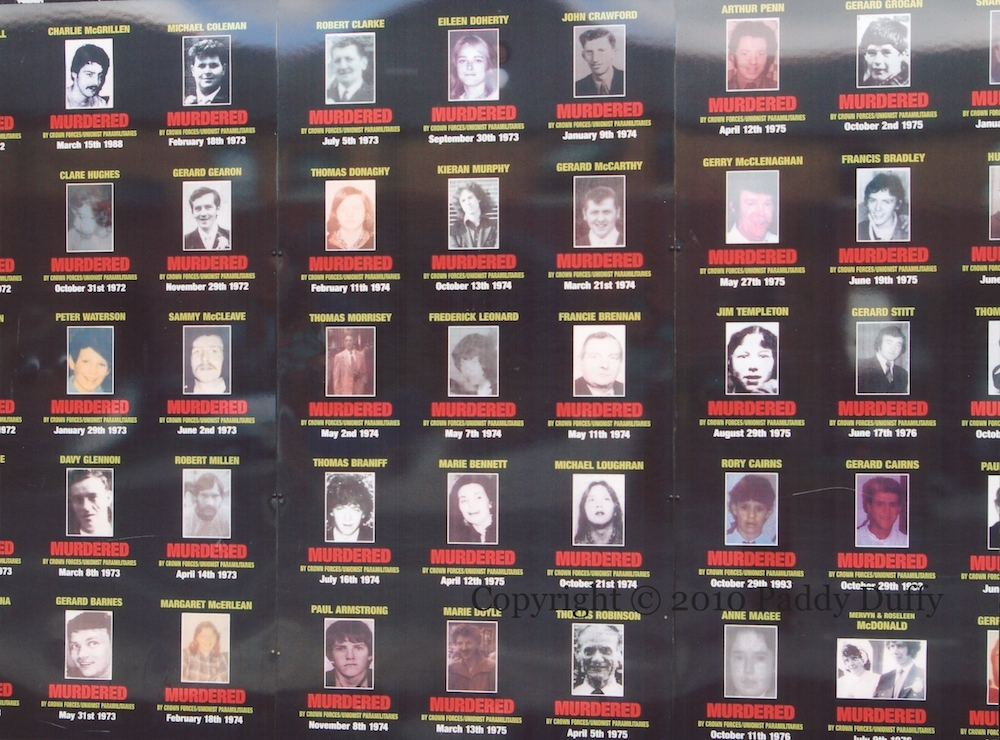
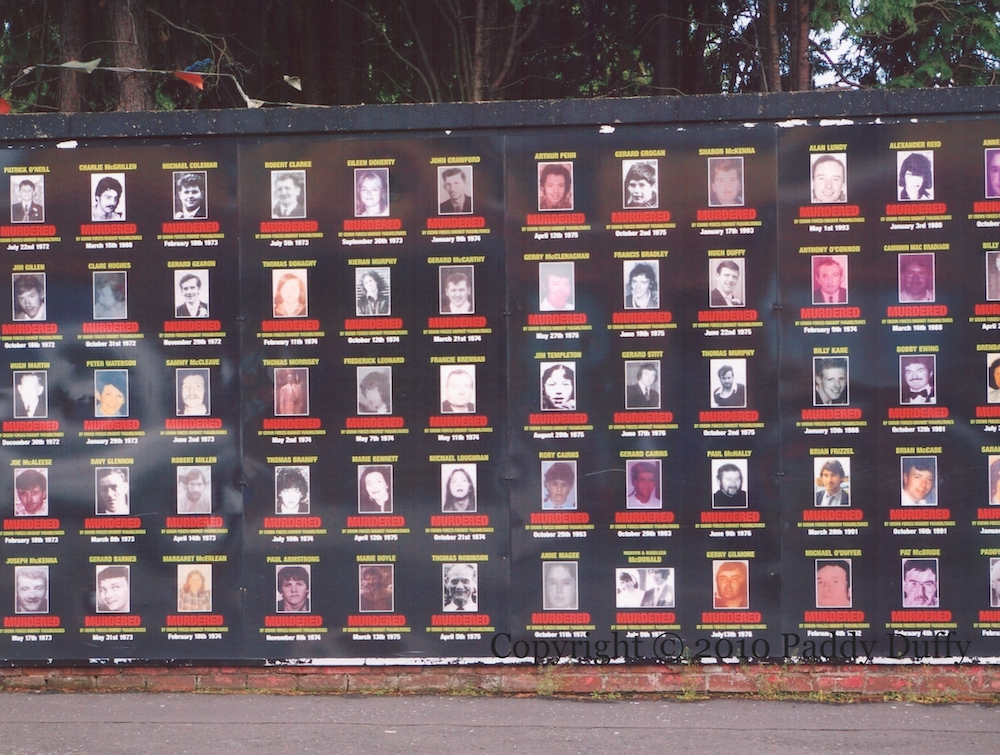
The victims of the Ballymurphy Massacre in 1971 and of plastic and rubber bullets throughout the troubles receive particular attention among galleries of “murdered” people.

“11 people in west Belfast from the Greater Ballymurphy neighbourhood were murdered by the British Army as internment without trial was violently carried out on August 9th, 1971. Proper police investigations were never undertaken and no one has served a day in prison for causing these deaths. The familys [sic] of those murdered deserve and demand the truth be told by the state about its policies and actions of those who carried them out.” The 11 are (clockwise) Eddie Docherty, Joseph Corr, John McKerr, John Laverty, Joan Connolly, Fr Hugh Mullan, Danny Teggart, Joseph Murphy, Paddy McCarthy, Frank Quinn, Noel Philips.

“This mural is dedicated to the memory of those killed and maimed by rubber & plastic bullets fired by the police & British Army. Not one member of the security forces ever served a day in jail for the deaths, many of them children, despite the courts ruling on the innocence of the victims. Plastic bullets are still being used on the streets of the north of Ireland today.”

Click image to enlarge
Copyright © 2010 Paddy Duffy
T00492 T00497 T00498 T00499