The Inniskilling Fusiliers were recruited from the four Ulster counties of Fermanagh, Tyrone, Derry, and Donegal. In WWI, battalions also served in the 4th, 29th, and 10th Divisions, as well as the 109 Brigade of the 36th Division. In WWII (represented here by the Spitfire in pursuit of the Messerschmitt) the Fusiliers served in France, India, and Italy. (Ciroca | Long Trail | WP)
(For a broader history, from the Williamite campaign to modern Afghanistan, see Inniskilling.)
This Tyndale mural appears to have be painted without fanfare in 2022.
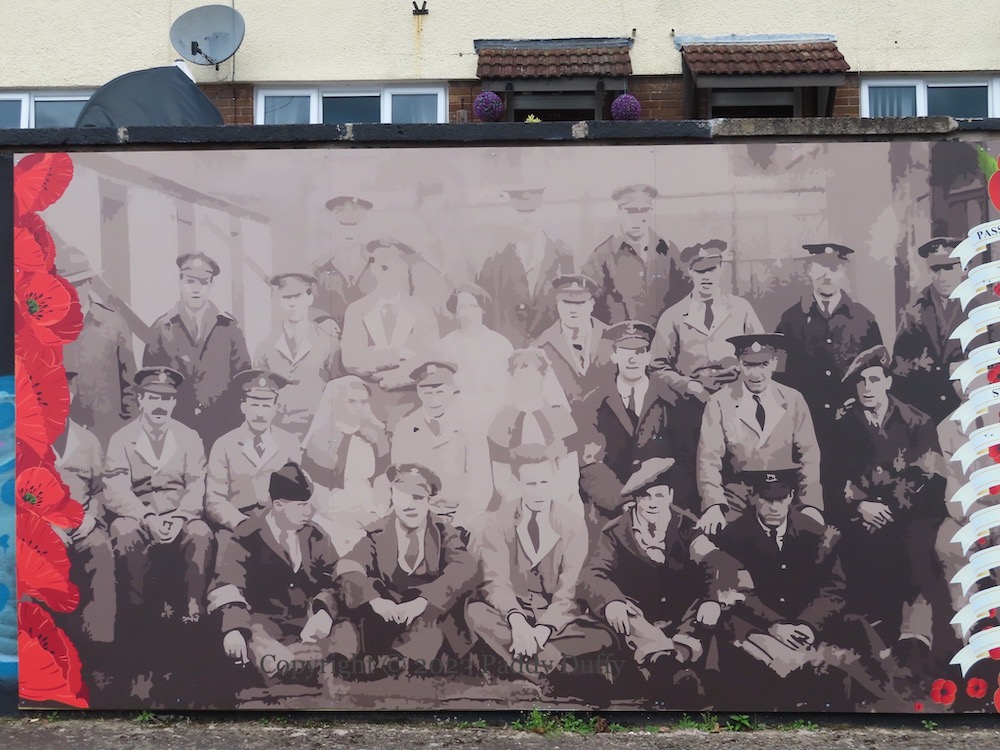
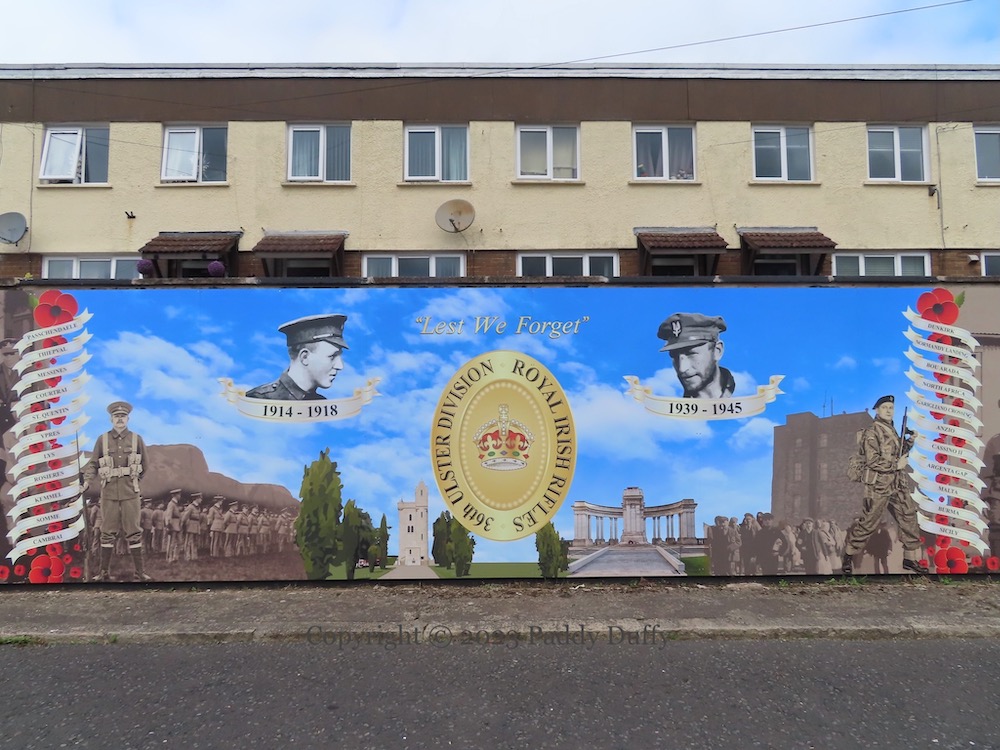
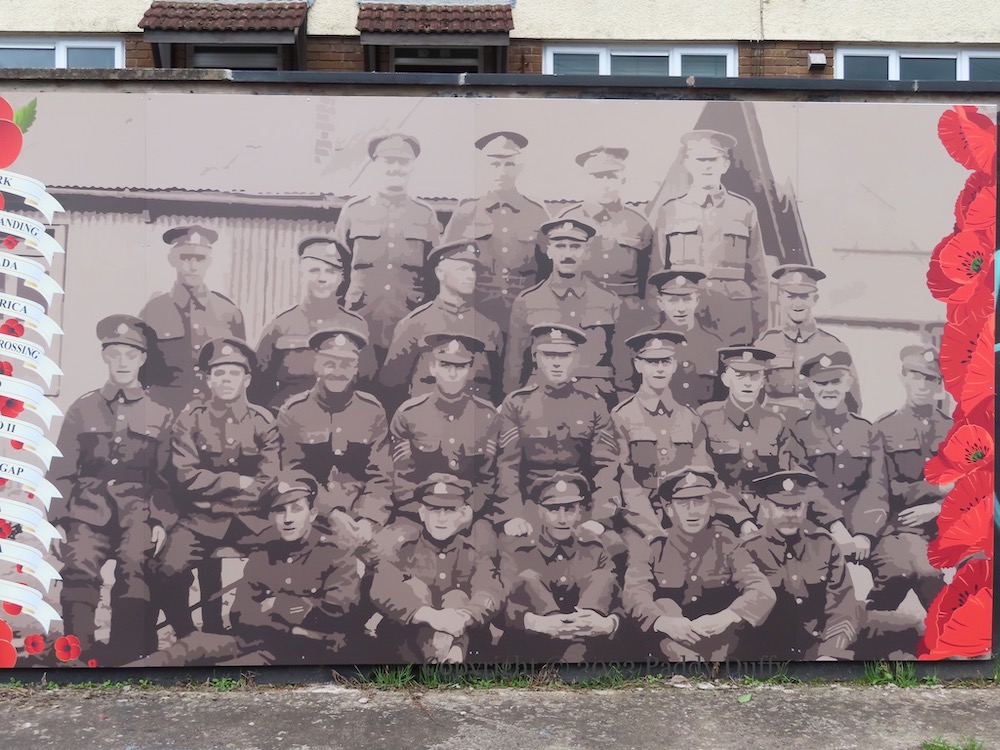
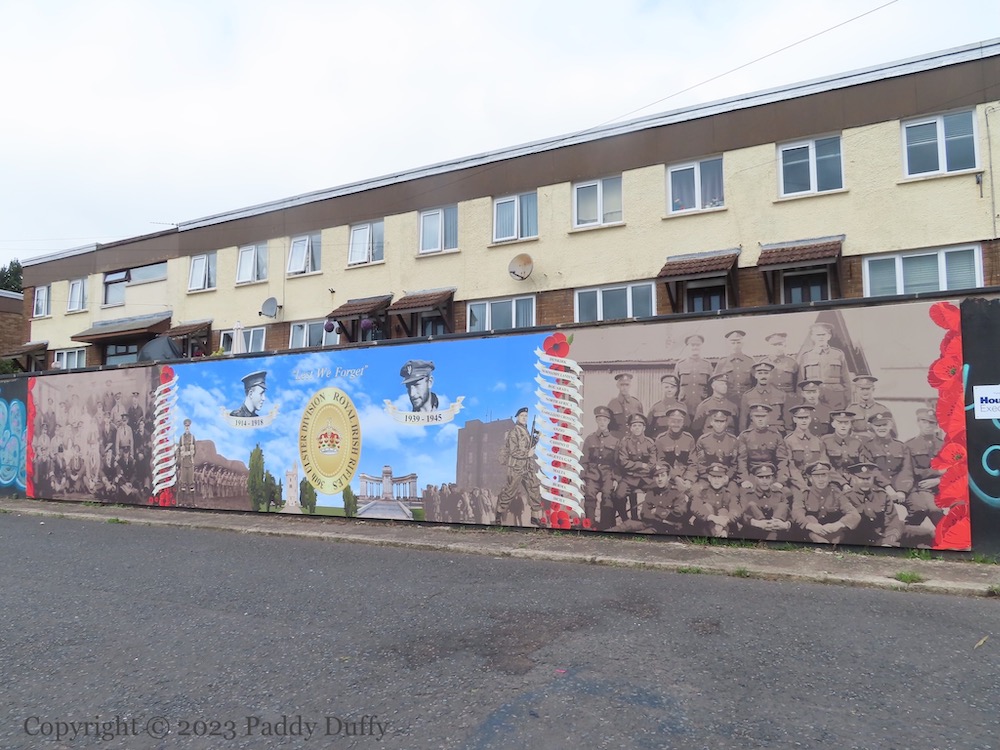
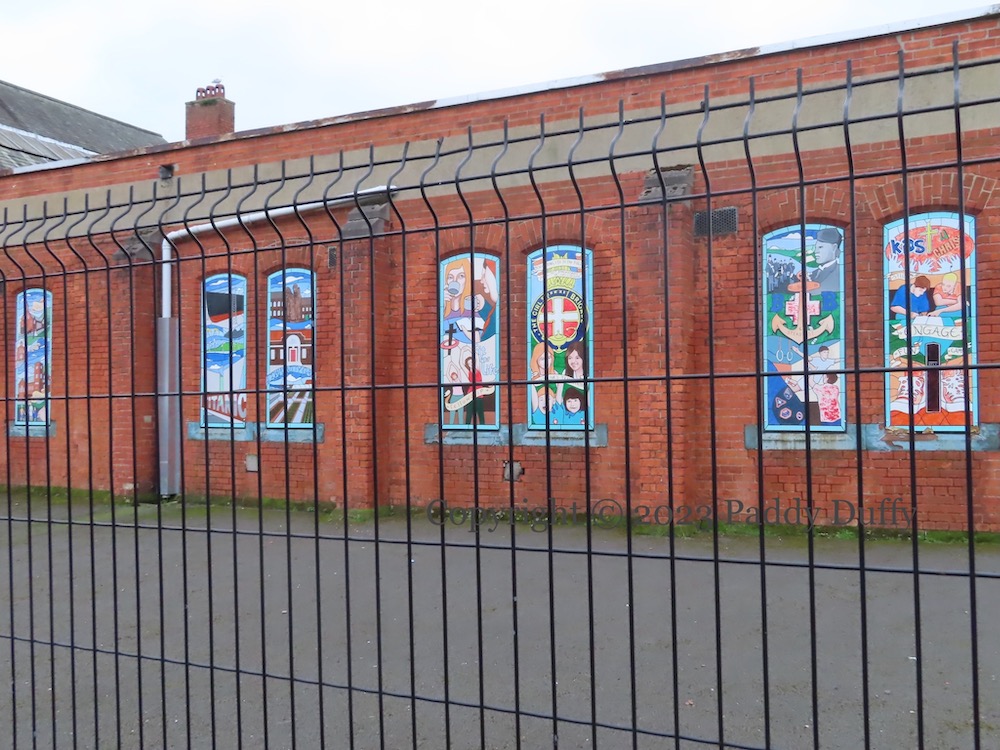
After WWI, the Royal Irish Rifles became the Royal Ulster Rifles (and later became part of the Royal Irish Rangers). This board prioritises WWI as the Rifles were part of the 36th Division. The hero of WWI portrayed in the central panel is William McFadzean, awarded the VC for falling on two live grenades in the trenches on July 1st, 1916. McFadzean is familiar from many previous murals both individually and in the company of other VC winners; for his family home in Cregagh, see Rubicon.
Alongside McFadzean, the hero of WWII is Blair “Paddy” Mayne, who was only briefly in the Ulster Rifles before making his name in the Parachute Unit (later, and better, known as the SAS). His many medals of honour are shown in an old Newtownards mural, though he was denied the VC.
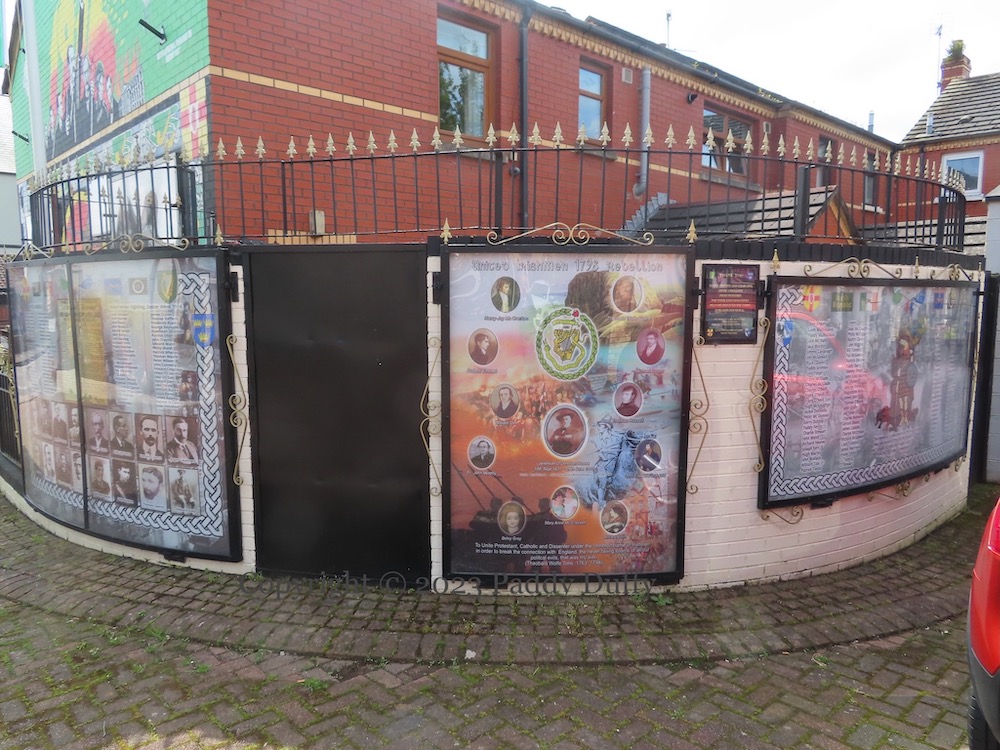
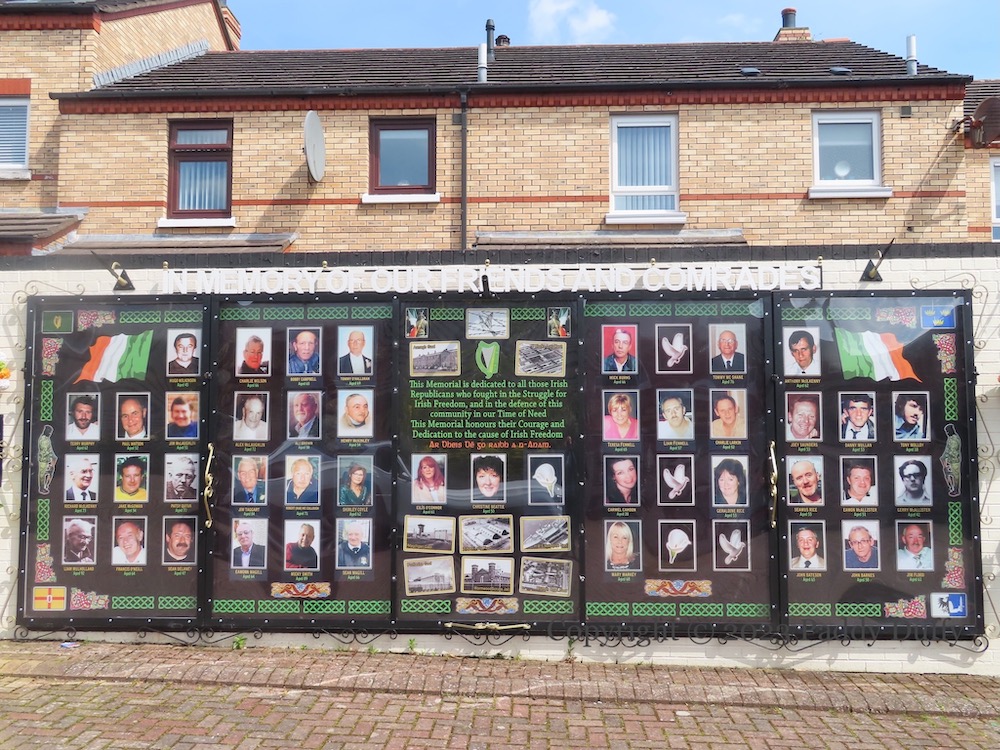
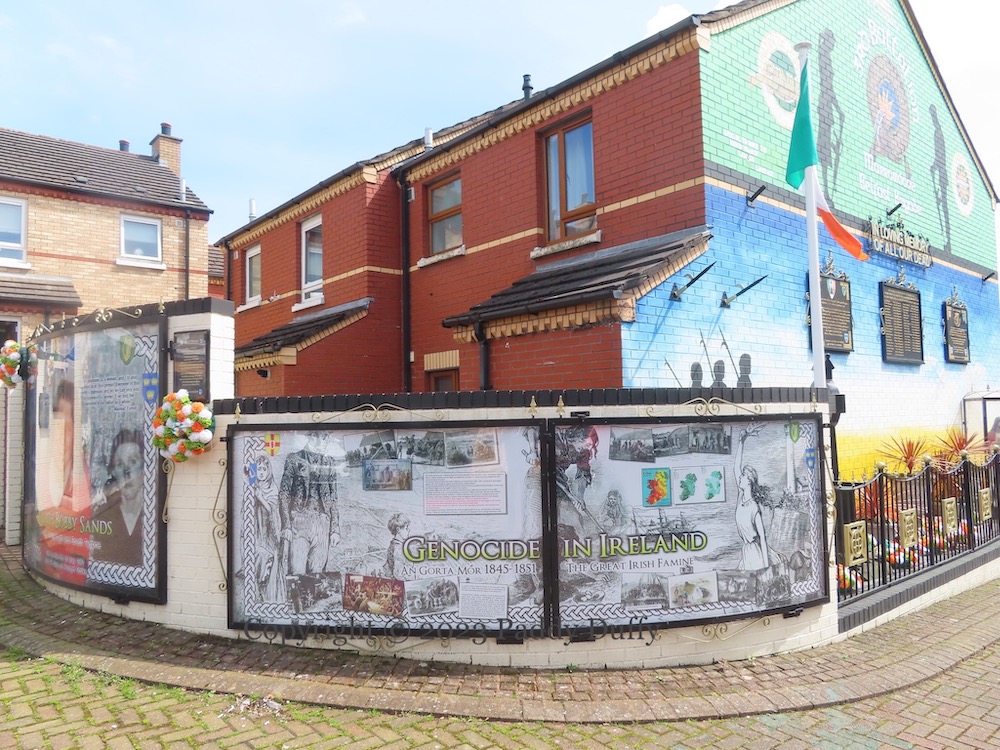
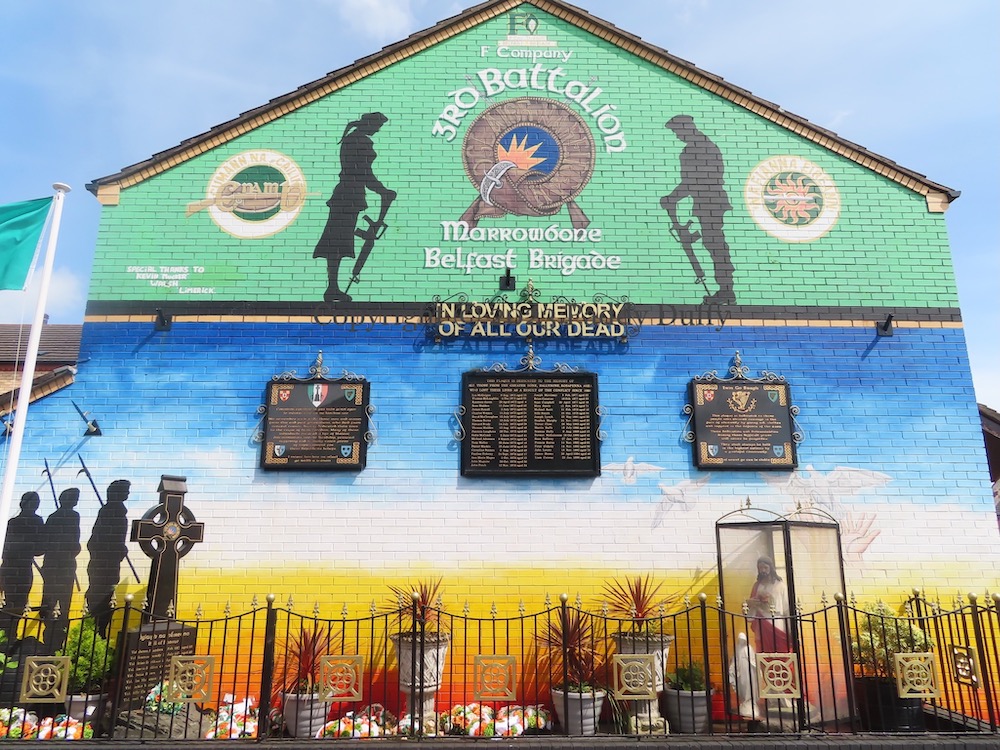
Here is a gallery of the murals and plaques in Clós Ard An Lao/Ardilea Close in the Machaıre Botháın/Marrowbone area of north Belfast. A full repertoire of republican events is commemorated – the United Irishmen, Great Hunger, the Rising, the Troubles, the (modern) hunger strikes. What is most striking is the significant presence of religious icons, such as the Sacred Heart in the glass cases in front of the two main murals (above and last below).
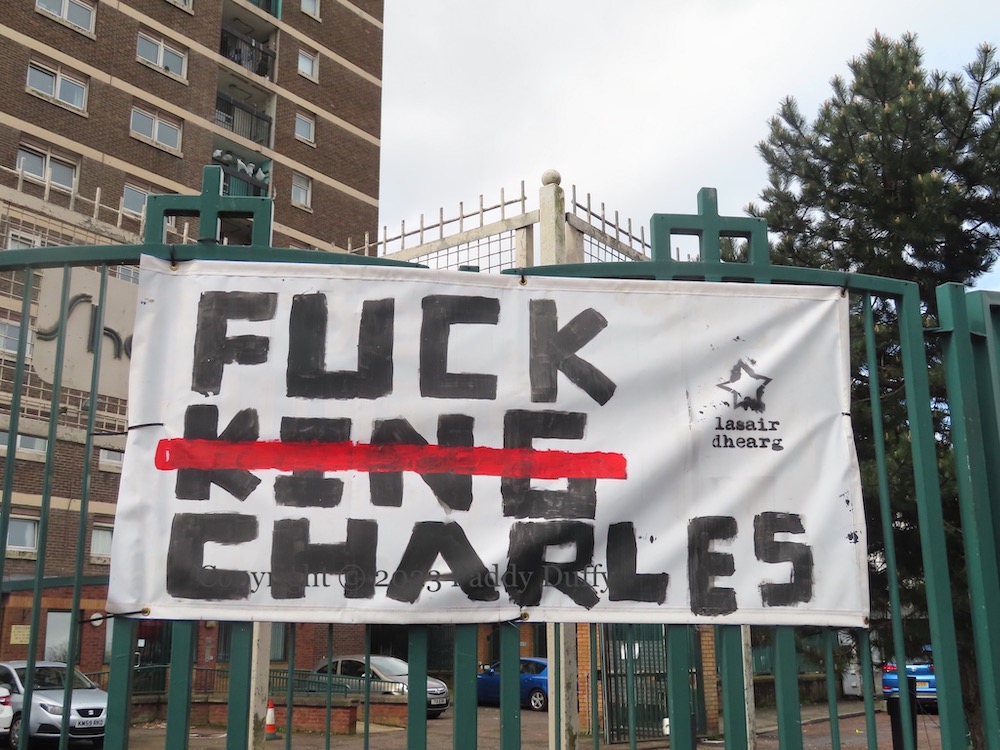
Here is another response to the coronation of King Charles last weekend: (above and last) a Lasaır Dhearg (web) tarp in north Belfast reading “Fuck King Charles”.
The stencil is in Mount Vernon, which is also home to a series of metalworks – see They Sleep Beyond Ulster’s Foam. That title, as well as the title of this entry, comes from Binyon’s poem For The Fallen, the fourth stanza of which is often cited in memorial for the dead of the Great War: “They shall grow not old, as we that are left grow old; / Age shall not weary them, nor the years condemn. / At the going down of the sun and in the morning / We will remember them.”
The stencil is perhaps not only a memorial to the dead of WWI – the planes appear to be WWII models such as the Hurricane or Spitfire (as on the box below, and in A Miracle of Deliverance); most WWI planes were biplanes.
900 people died and half the homes in Belfast were destroyed or damaged in the Belfast Blitz of WWII (WP). in the apex of this mural a Nazi bomber sets buildings alight; in the main panel, people, including a milkman, walk among the bombed-out buildings and play a piano that has been pulled from the rubble.
Painted in 2013 by JMK, in Hogarth Street, Tiger’s Bay, north Belfast
“Civilisation has its roots in the soil & without soil there will be no future life – Tá an duıne fréamhaıthe san ıthır, gan í ní hann dó” by Ed Reynolds (web | tw) and Tancredi Caruso. Together they put on an exhibition and painted a mural for the Belowground Visions Of Life project (Soil Security Programme). The mural is outside Bunscoıl Mhıc Reachtaın (hence the Irish translation) in the old ‘Little Italy’ area of Belfast. Sand or soil has been added to the mural to give it texture.
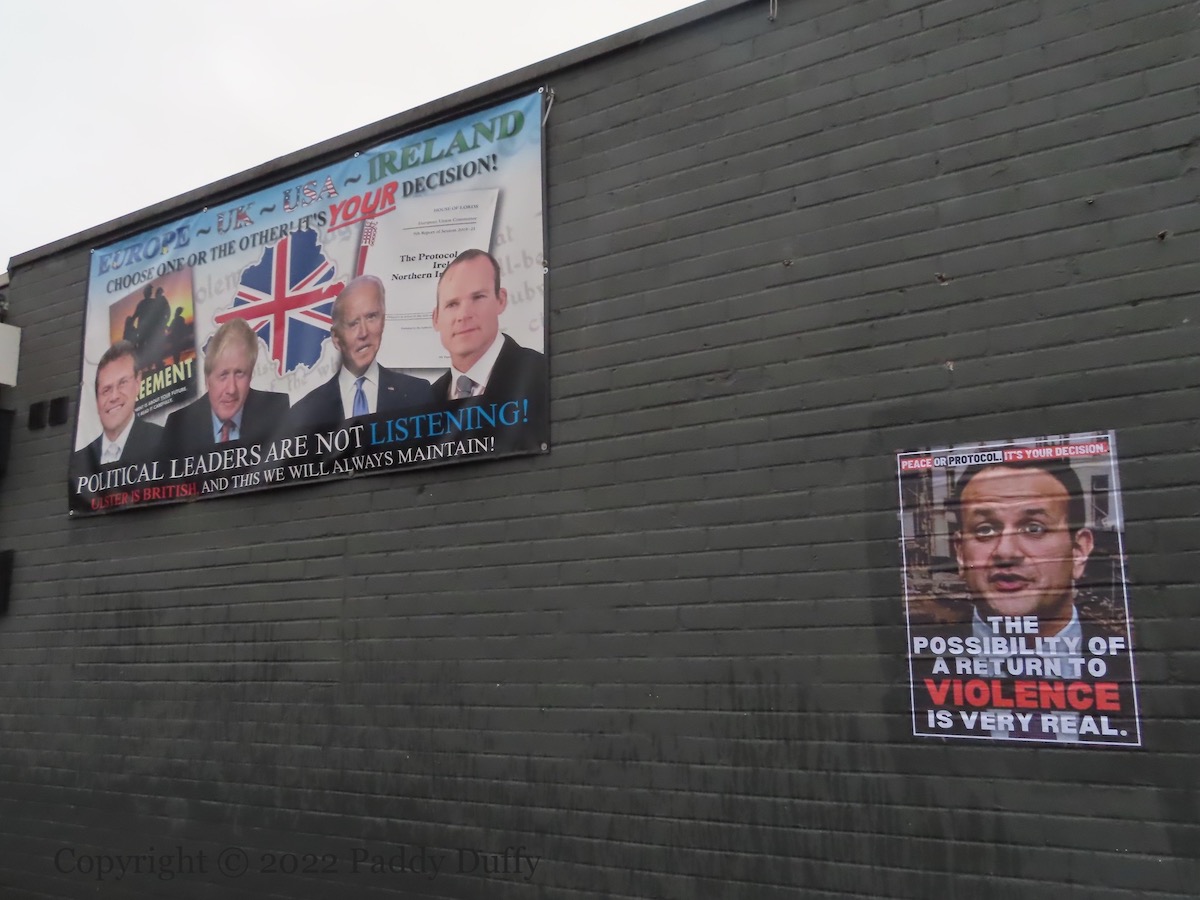
Left: After a break for the funeral of the Duke Of Edinburgh, the Loyalist Communities Council has resumed its protest of Brexit with a banner campaign (Irish News). The banner seems to be offering viewers the choice of one of four affiliations (“Europe – UK – USA – Ireland – choose one or the other! It’s your decision!) but the “correct” answer is at the bottom (and in the faded background of the Covenant): “Ulster is British and this we will always maintain!” even though “Political leaders are not listening!” (including, perhaps, Arlene Foster and the DUP.) The Belfast Agreement (Good Friday Agreement) allows people in Northern Ireland to identify themselves as Irish, British, or both.
Right: “Peace or protocol – it’s your decision”, aimed at Leo Varadkar on the day that he again became Taoiseach (Irish Times) and repeating his words back to him from a speech in 2018: “The possibility of a return to violence is very real”. At that meeting, Varadkar was anticipating violence by anti-Agreement republicans in response to customs posts on the Ireland-Northern Ireland border, and brought a newspaper describing the death of four customs officials, two lorry drivers, and three IRA volunteers at a Monaghan post in 1972 (BelTel).
The authors of this poster are not known, but the parallel statement (mutatis mutandis) would be that anti-Protocol agents – perhaps the “young loyalists” that the UVF “can no longer contain” (UK Daily; see also RTÉ from November) – might return to acts of violence such as the 1974 “Dublin & Monaghan Bombings” that killed 33 people – in the background of the poster is part of a photograph (included below) of bomb damage in Talbot Street – if the Protocol’s “Irish Sea border” is not removed.
Ballysillan Road and (below) Oakmount Drive (near Mount Vernon), north Belfast.












 Paddy Duffy Collection