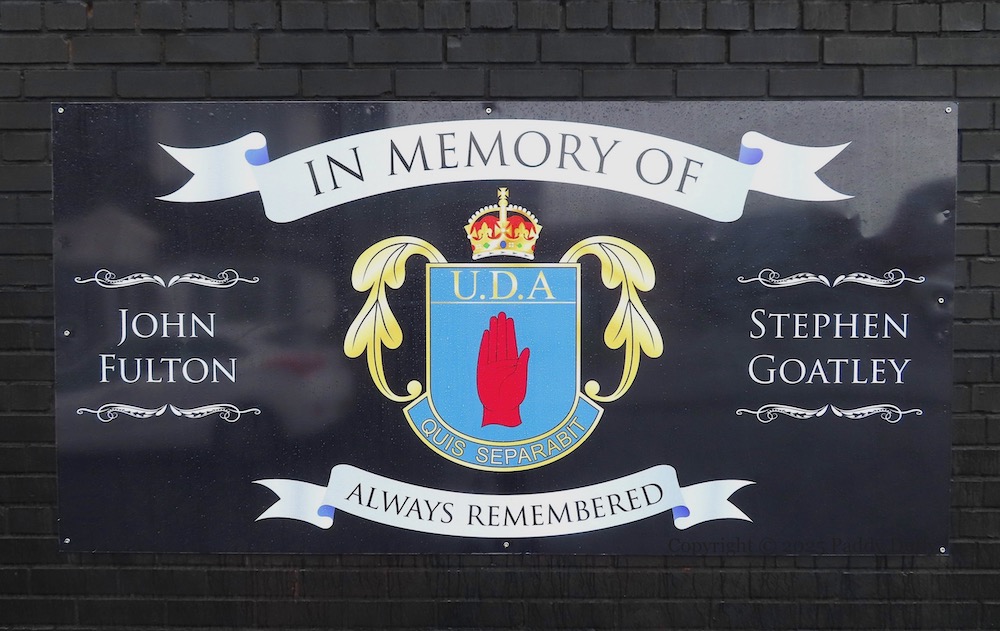
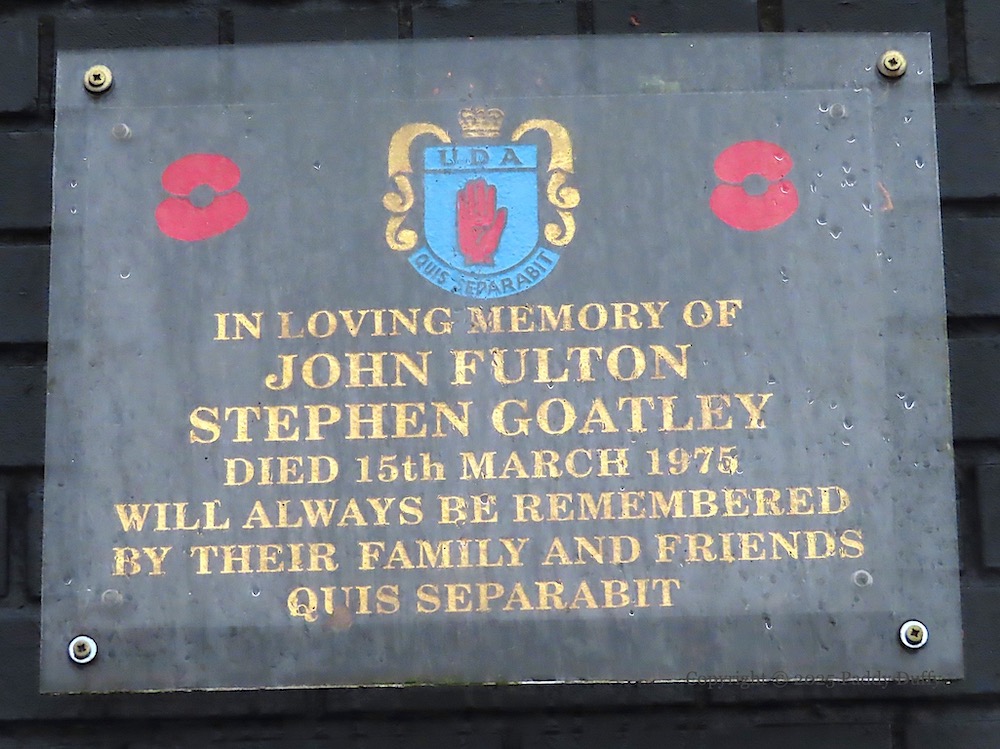
“In loving memory of John Fulton [and] Stephen Goatley, died 15th March 1975. Will always be remembered by their family and friends. Quis separabit.” UDA members John Fulton and were Stephen Goatley were killed together in the Alexandra Bar on York Road (close to the Mervue Street location of this memorial) in revenge for the stabbing of the UVF’s Joe Shaw in the North Star Bar. , by the UVF as part of the UDA-UVF feud in 1975.
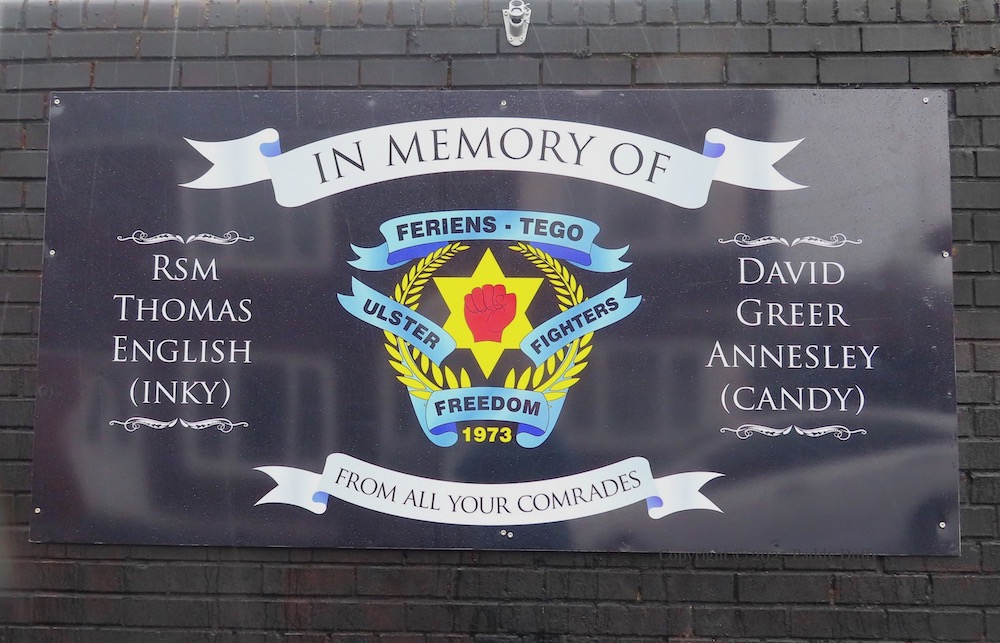
The two men named on the other board were also killed in a feud between the UDA and UVF, in 2000 – see Inky & Candy. “In loving memory Thomas (Inky) English & David (Candy) Greer Annesley. Together in the same old way/would be our dearest wish today./Silent memories true and tender/just to show we still remember.”
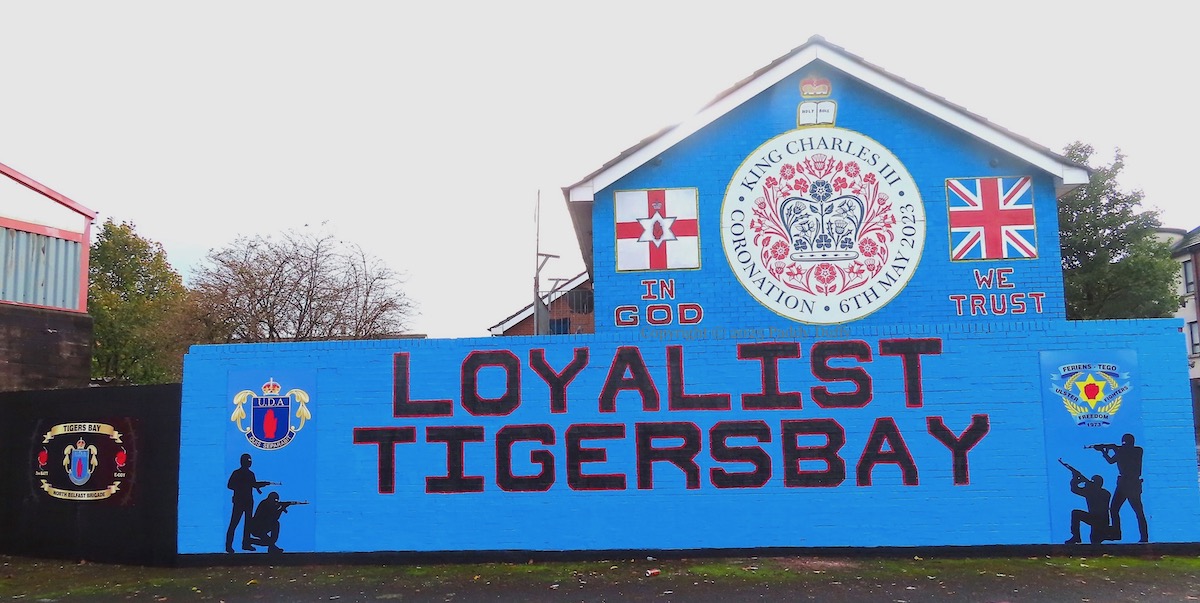
Stop The Boats has been painted out below the large “Loyalist Tiger’s Bay” and the entire wall painted in solid blue and book-ended by UDA and UFF boards showing silhouetted gunmen in active poses.
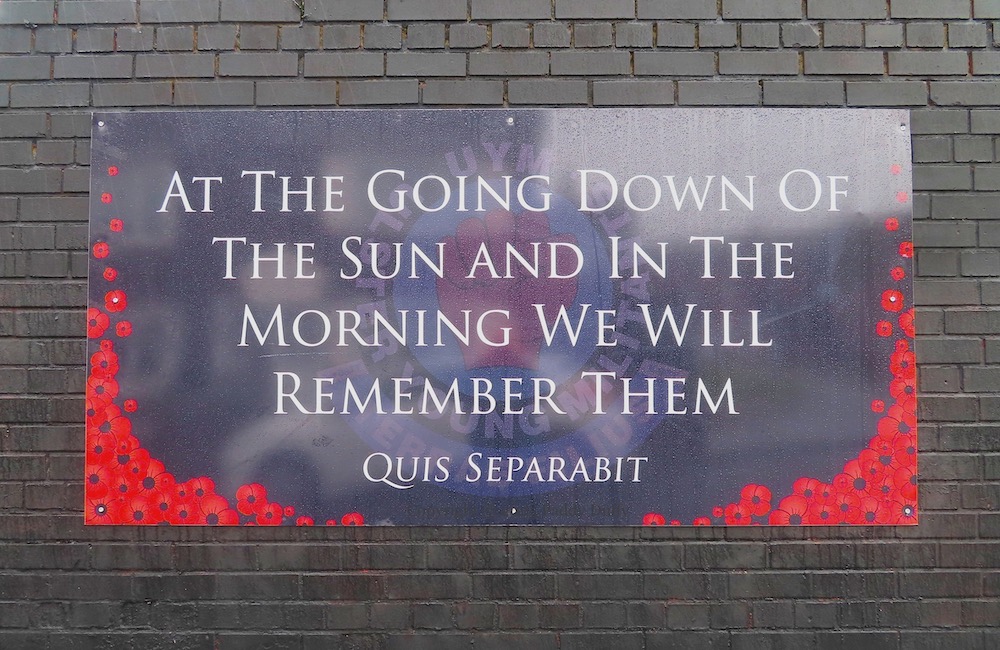
The side-wall, home to painted Orange Order symbols since 2017, has been painted black and a board (above) added to E company from Tiger’s Bay. (It’s possible “North Belfast brigade” and “3rd battalion” are the same thing.)
In case the large medallion celebrating Queen Elizabeth’s platinum jubilee (in 2022) was not a sufficient indicator, a small “Loyalist” has been added above the street-sign. In the last century, Glenrosa Street in Tiger’s Bay used to continue across Duncairn Gardens into the New Lodge as Glenrosa Street South.
At the other end of the street is a warning sign next to the bonfire site: “All taigs will be shot – TBH #1. If this boney goes, so does NLR [New Lodge Road]”
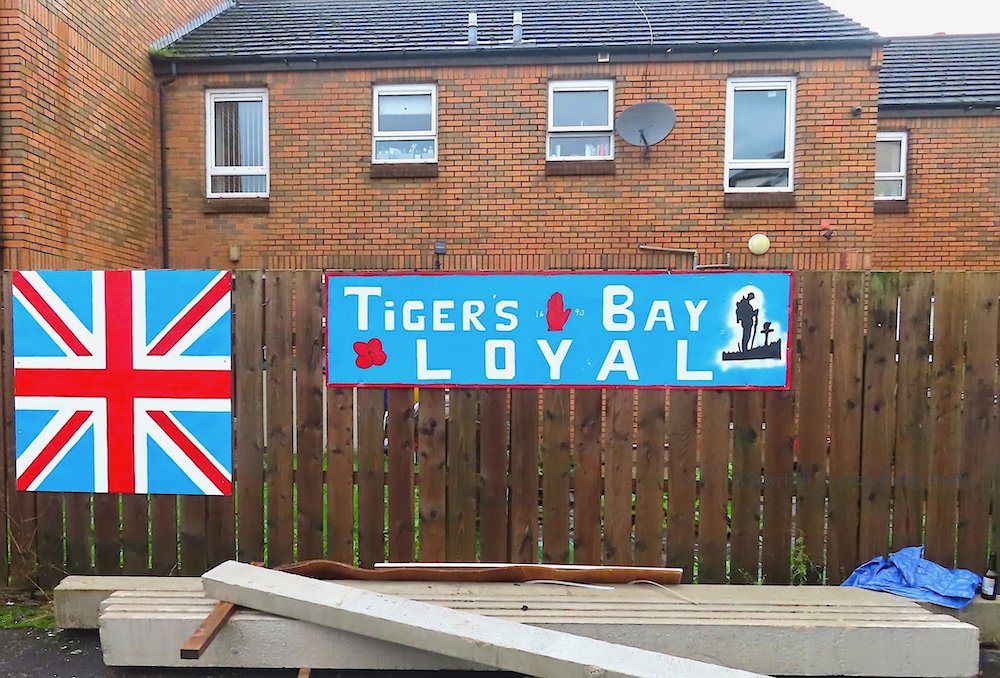
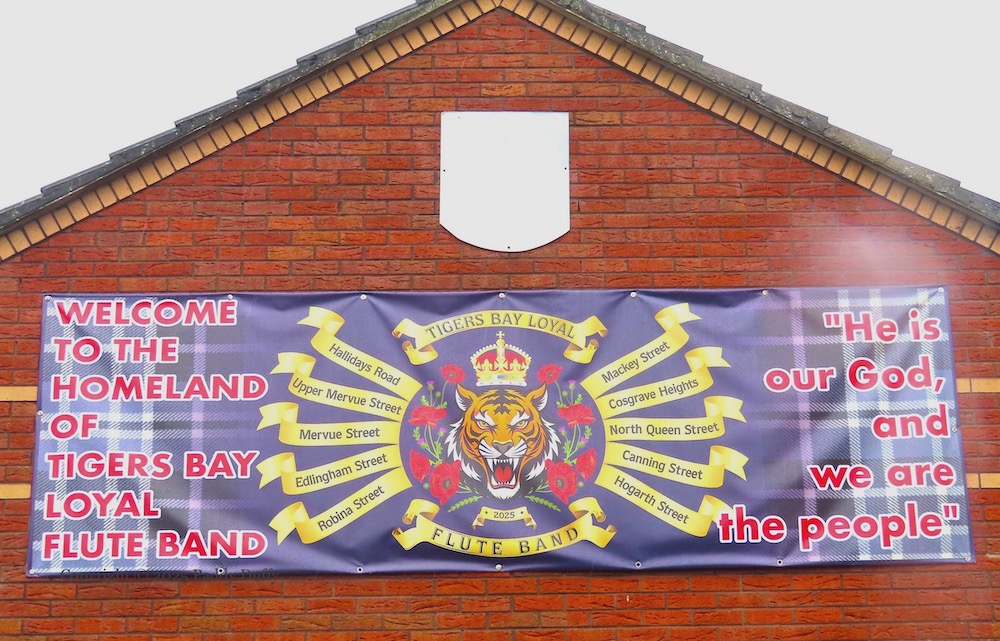
“Welcome to the homeland of Tiger’s Bay Loyal flute band. “He is our God, and we are the people.”” Tiger’s Bay Loyal [Fb] is a new flute band, formed in 2025.
Ten local streets are named around the central tiger: Robina Street, Edlingham Street, Mervue Street, Upper Mervue Street, Hallidays Road, Mackey Street, Cosgrave Heights, North Queen Street, Canning Street, Hogarth Street.
Etna Drive in Ardoyne has undergone a make-over in the last twelve months. The large board below was mounted in December 2024, the planters added in March 2025, and the boxes along the street were painted in June. The boxes celebrate local groups and initiatives: “Cıceam Ard Eoın [Fb]”, “Ardoyne-Bone Community health & leisure trust [Fb]”, “Community larder. Drop in. Locally sourced food.”, “Ardoyne Association [Fb] Citizens’ Advice Centre”, and the “Lawrenson-Toal academy of Irish dance [ig]”.
Bronze busts of Máıre Áıne Mhıc Reachtaın/Mary Ann McCracken and Anraí Seoıgh Mhıc Reachtaın/Henry Joy McCracken have been unveiled outside Áras Mhıc Reachtaın, the Irish-language centre on the Antrim Road and home of Cumann Cultúrtha Mhıc Reachtaın (web).
The pair – brother and sister – were Presbyterians and republicans; their mother was Ann Joy, daughter of Francis Joy, linen manufacturer and founder of the Belfast Newsletter. Henry led the Antrim uprising of the United Irishmen in 1798 and was hanged for it in Corn Market at age 30. (WP)
Mary, the mother of Jesus, is remembered in various guises around the New Lodge Grotto. Above, and in the underpass, she takes the form of the ‘Immaculate Heart Of Mary’ (alongside St. Joseph the carpenter and St Patrick(?)).
The prayer next to the trio is a Prayer To Our Lady Of Knock: (Our Lady of Knock, Queen of Ireland, you gave hope to your people in a time of distress, and comforted them in sorrow. You have inspired countless pilgrims to pray with confidence to your divine Son, remembering His promise, “Ask and you shall receive; seek and you shall find.” Help me to remember that we are all pilgrims on the road to heaven. Fill me with love and concern for my brothers and sisters in Christ, especially those who live with me. Comfort me when I am sick, lonely or depressed. Teach me how to take part ever more reverently in the Holy Mass. [Give me a greater love of Jesus in the Blessed Sacrament.] Pray for me now, and at the [hour of my death.] Amen.)
The Apparition At Knock took place on August 21st, 1879; there was a mural of the standard depiction of the event in nearby Newington (Street View).
The presentation on the “New Lodge Grotto” side-wall (alongside St Thérèse) is of Our Lady Of Medjugorje. (There was a mural with the same title not far from the grotto.)
There was also an “Our Lady Of Fátima” image on the doors, best seen in C07117.
The ‘Hail Mary’ is also given, in English (Hail, Mary, full of grace, the Lord is with thee. Blessed art thou amongst women and blessed is the fruit of thy womb, Jesus. Holy Mary, Mother of God, pray for us sinners, now and at the hour of our death. Amen.) and in Irish (Sé do bheatha, a Mhuıre, atá lán de ghrásta. Tá an Tıarna leat. Is beannaıthe thú ıdır mná, agus ıs beannaıthe toradh do bhroınne, Íosa. A Naomh-Mhuıre, a Mháthaır Dé, guıgh oraınn na peacaıgh, anoıs, agus ar uaır ár mbáıs. Amen.)
Painted by Paddy McCloskey, with help from Eddie Rossbotham and others.
“Sky is not [the] limit – it’s only the beginning” – this is new mental health art from the New Lodge Youth Centre (Fb | previously seen), at the war-wall that separates Lepper Street from Duncairn Avenue, next to the (long-empty) Corner House, suggesting that young people can transcend their earthly bonds and actualise themselves in space.
This new mural below Teach Gráınne in the New Lodge features locals Anthony Duffy and Hugh Russell.
Duffy was a youth leader in Artillery and Trinity clubs (Xitter); he died in July of this (2025) year. Russell was a champion boxer in the 80s and then an Irish News photographer; he died in October 2023 (Irish Times).
Painted by young people from Artillery Youth Centre (Fb).
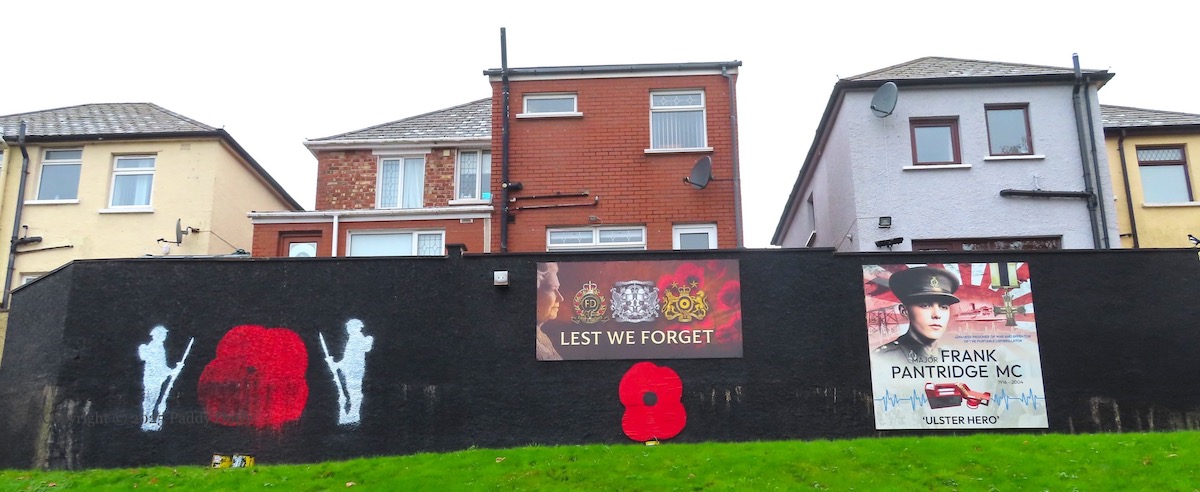
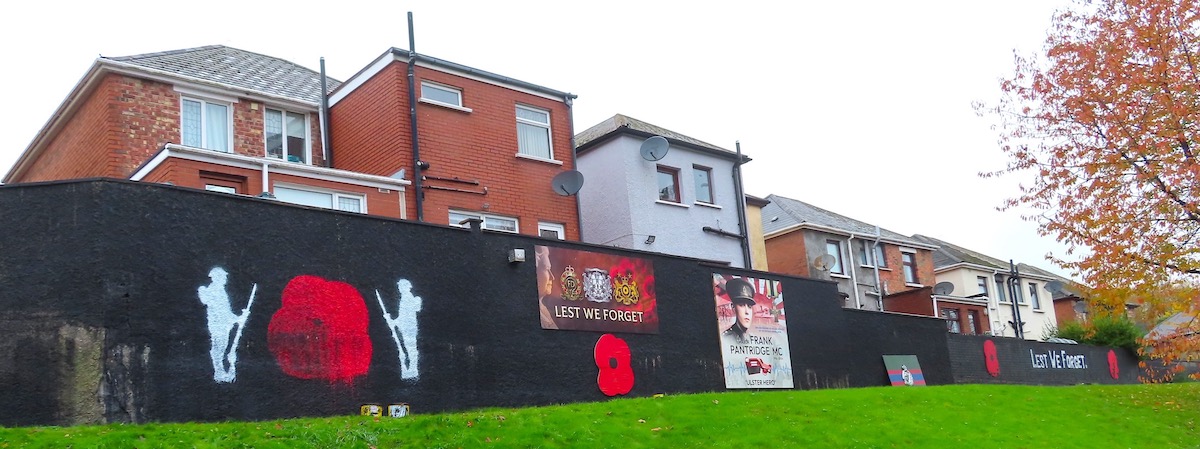
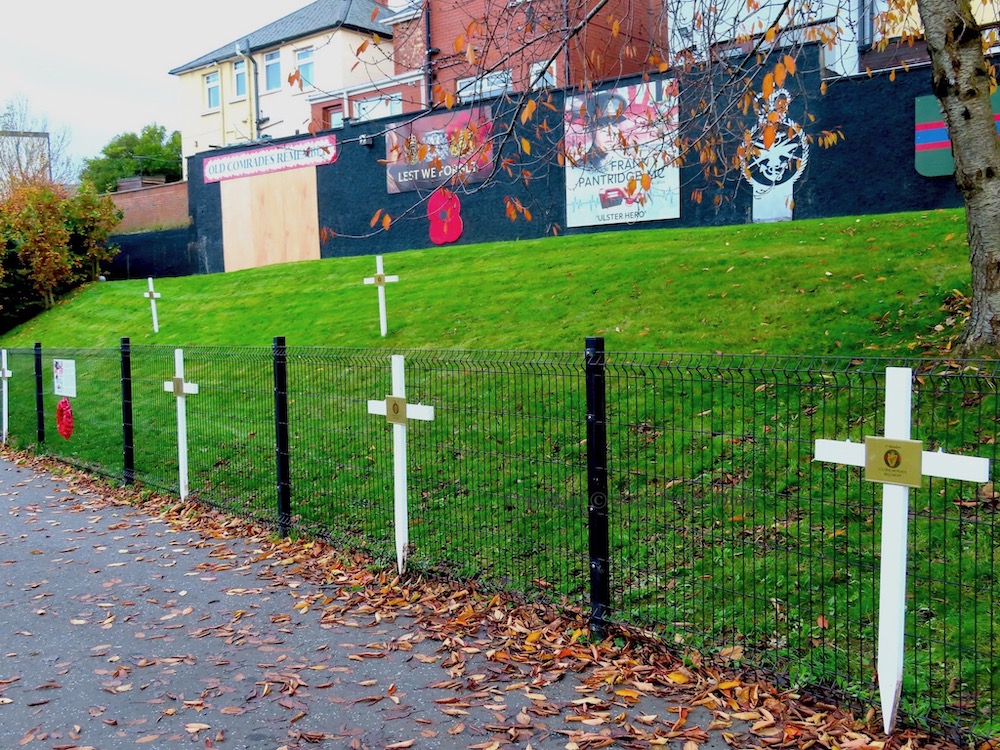
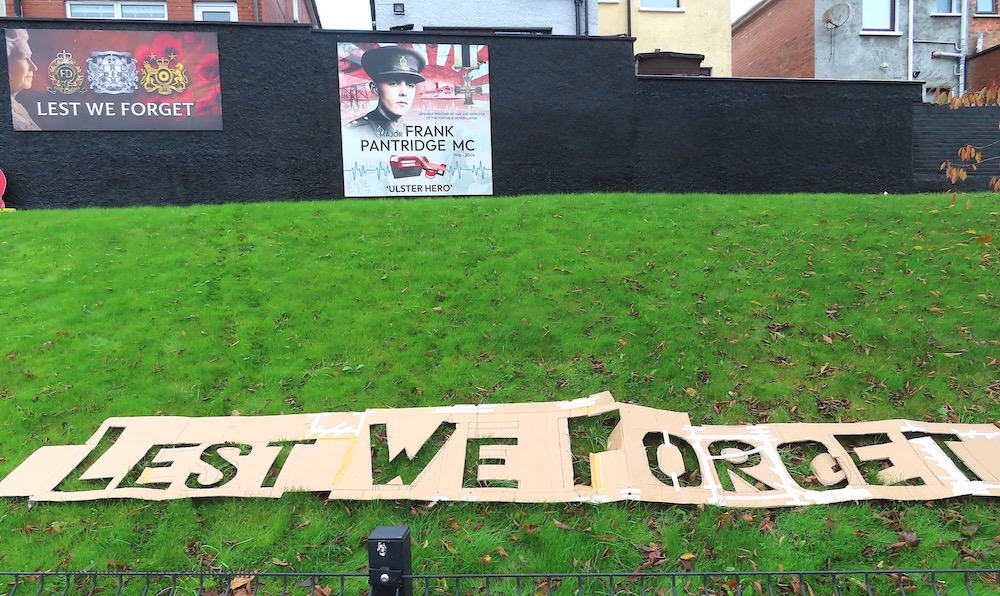
“Japanese prisoner of war and inventor of the portable defibrillator” – Frank Pantridge was born and died in Hillsborough, outside Lisburn and there is a statue of Pantridge with a defibrillator – his key invention – at the Lisburn Civic Centre and he is now remembered by this pair of printed boards on the Shore Road, unveiled on August 16th. He is also included in the nearby gallery of Great Ulster-Scots.
“Major Frank Pantridge, MC, ‘Ulster Hero’. Around the world tens of thousands of people have survived cardiac arrest, this would not have been possible without Professor Frank Pantridge surviving almost 4 years in a Japanese Prisoner of War camp. On the outbreak of WW2 Frank and colleagues at Belfast Royal Victoria Hospital enlisted in the British Army, taken prisoner in 1942 he endured horrendous conditions and deprivation. Frank won the Military Cross. His citation read “Frank was absolutely cool under the heaviest fire, completely regardless of his own personal safety at all times.” Returning to the Royal Victoria Hospital in 1945, basically as a walking skeleton he dedicated his life to treating heart disease, going on to invent the worlds first portable defibrillator in Belfast in 1965 saving the lives of countless men, women and children including Lyndon Johnston. A portrait of Frank initiated by Dame Many Peter’s hangs in Queens University and a statue of Frank sits proudly in the grounds of Lagan Valley Civic Centre.”