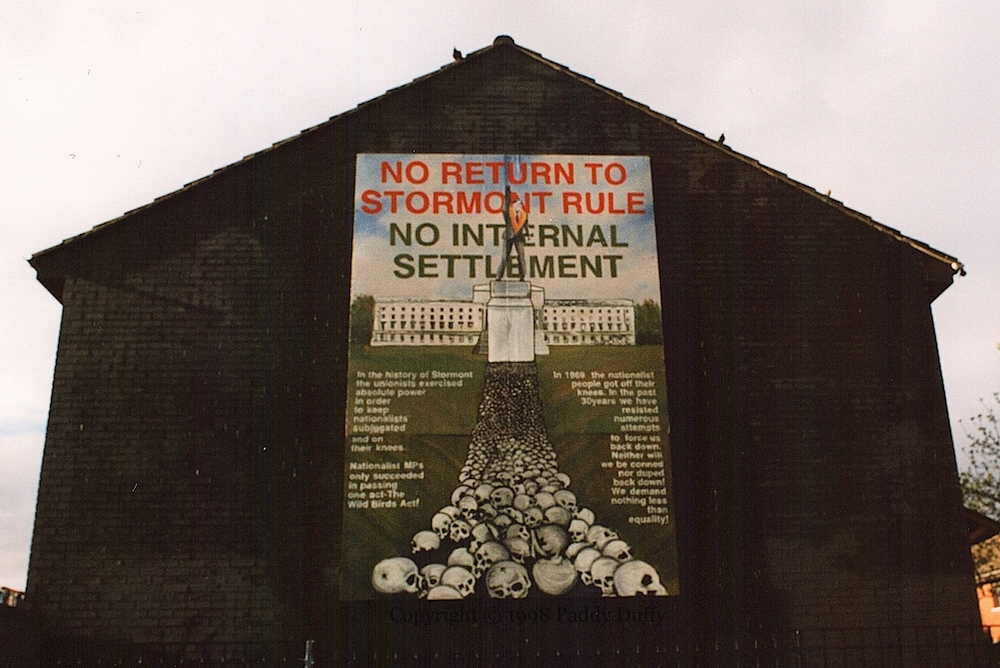
A trail of skulls flows from the base of Carson’s statue, which is adorned with an Orange sash. “No internal settlement” means a settlement among the northern parties only, but rather that there should be an all-Ireland dimension to any agreement.
“No return to Stormont rule – no internal settlement. In the history of Stormont the unionists exercised absolute power in order to keep nationalists subjugated and on their knees. Nationalist MPs only succeeded in passing one act – The Wild Birds Act! In 1969, the nationalist people got off their knees. In the past 30 years we have resisted numerous attempts to force us back down. Neither will we be conned nor duped back down! We demand nothing less than equality!”
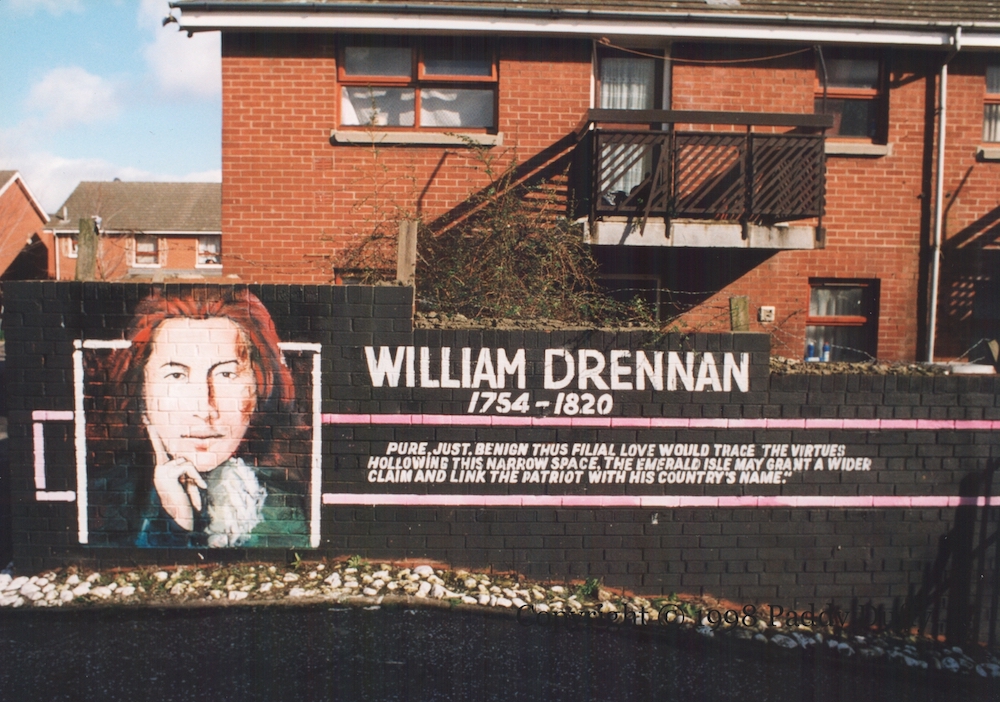
This is a trio of murals along the New Lodge Road to William Steel Dickson, William Drennan, and Mary Ann and Henry Joy McCracken. What the three have in common is that they were all Presbyterians and Irish republicans, and members of the Society Of United Irishmen.
William Steel Dickson was adjutant-general of the County Down Irishmen (see the blue plaque in Portaferry M08948) and was arrested a few days before the insurrection (WP). Like the McCrackens, he is buried in Clifton Street Cemetery.
William Drennan, 1754-1820, was a doctor, poet, a founder of the Society of United Irishmen, and the first person to refer to Ireland as “the Emerald Isle”, in his poem When Erin First Rose. The words in the mural are the epitaph on his stone in Clifton Street Cemetery: “Pure, just, benign. Thus filial love would trace the virtues, hollowing [sic] this narrow space. The Emerald Isle may grant a wider claim and link the patriot with his country’s name.”
Mary Ann McCracken (“What a wonderful clamour is now raised at the name of union, when in reality there has always been such a union between England and this country, as there is between husband and wife by which the former has the power to oppress the latter.”) and her older brother Henry Joy McCracken (“These are the times that try men’s souls … the rich always betray the poor.”) are the best-known of the figures. Henry led the Antrim uprising of the United Irishmen in 1798 and was executed for it; Mary Ann was an abolitionist and social reformer.
A collage of image from the previous 30 years, including banging bin-lids on the ground, Maıréad Farrell in Armagh prison, men on the blanket, the cages of Long Kesh, marches in support of the hunger strikers, and reproductions of various posters, against Margaret Thatcher, plastic bullets, internment, and censorship. There’s a quote from Bob Dylan in the middle, “How many times can a man turn his head and pretend that he just doesn’t see – the answer, my friend, is blowing in the wind, the answer is blowing in the wind.”
“Old Labour 1969 – new Labour 1997 – nothing has changed!” Members of the Orange Order march with a large Union Flag on the backs of the RUC (with an Orange accent on their helmets) who are holding back the protesting local Catholic residents – particularly of the Garvaghy Road in Portadown and the Ormeau Road in Belfast.
The party in power (of the UK government) was the Labour party under Harold Wilson; in the general election of May 1st, 1997, Tony Blair’s Labour party regained power from the Conservatives. The mural hopes to pressure Labour into taking definitive action on the issue of parading – see (e.g.) Approved Parade Route, No Consent, No Parade and Not All Traditions Deserve Respect.
An Gorta Mór is the Great Famine, or the Great Hunger among those who point out that there was plenty of food in Ireland in the late 1840s, just not made available to peasants. Of a population around eight million, a million people died and a million more emigrated.
“They buried us without shroud or coffin” is a line from an unrelated Seamus Heaney poem Requiem For The Croppies.
A Robert Emmet mural was painted by Robbie Kane in 1953 (for the 150th anniversary of the 1803 rebellion and his execution) in Crumlin Street. This was one of a very few CNR murals painted prior to the Troubles, and nationalist symbols were formerly outlawed in the Flags And Emblems Act of 1954. (See Visual History 02.) As can be seen below, the original was accompanied by a Christian cross and the words “Hail Christ our king”. This version reproduces only the two medallions, showing a Celtic harp (left) and a dramatic portrait of Emmet waving his hat, from the mid-1800s (WP/LoC).
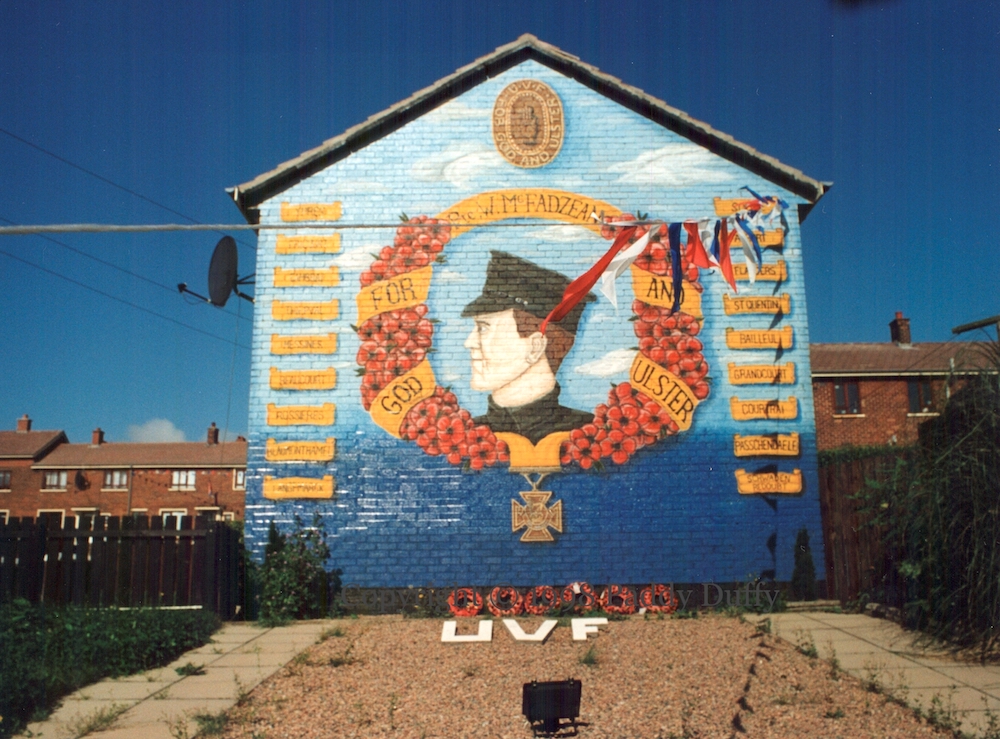
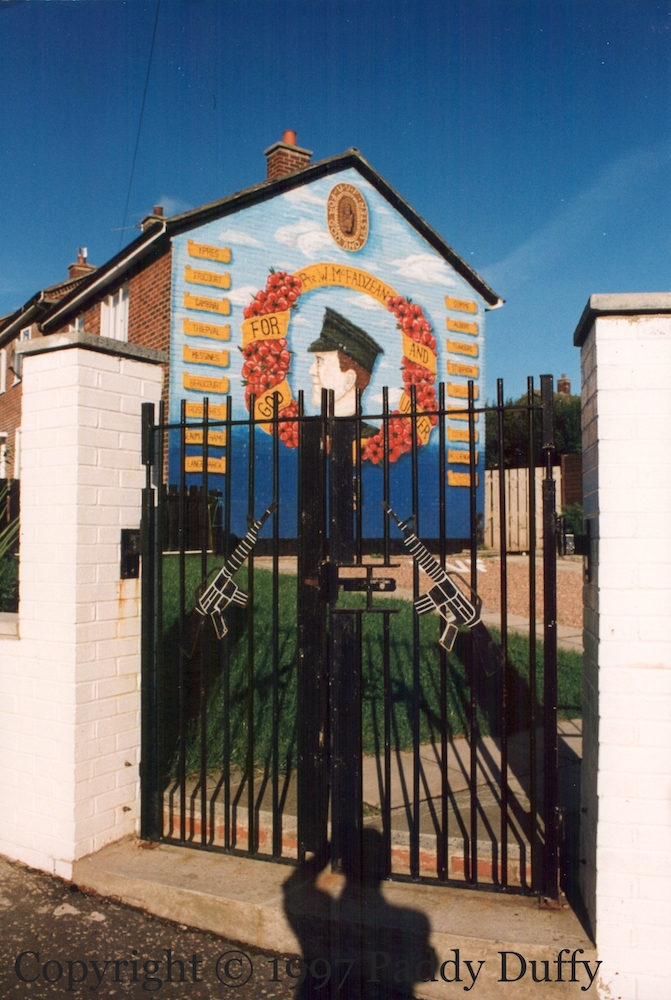
William McFadzean was awarded the VC medal for throwing himself on a fallen box of grenades on the first day of the Battle Of The Somme. The battles listed to either side are: “Ypres, Fricourt, Cambrai, Thiepval, Messines, Beaucourt, Rossieres, Beaumonthamel, Langemarck,” and, “Somme, Albert, Flanders, St Quentin, Bailleul, Grandcourt, Courtrai, Passchendaele, Schwaben Redoubt”.
The gates are decorated with modern assault rifles.
In Aboriginal cultures, “Dreamings” are the stories – in words or in paintings – of the creation and persistence of the Aboriginal peoples and lands, and their inter-relation. They belong to the person or tribe who told the story; it’s not know how this image came to be painted in Belfast’s New Lodge, or whether it is an authentic dreaming.
It shows two slender figures in black – one female, one male – looking upward at a jagged red circle/sun, all three of them contained in an inverted egg-like shape, itself surrounded (above) by a field of stars (including a small Plough) and (below) a variety of snake-like shapes and other designs.
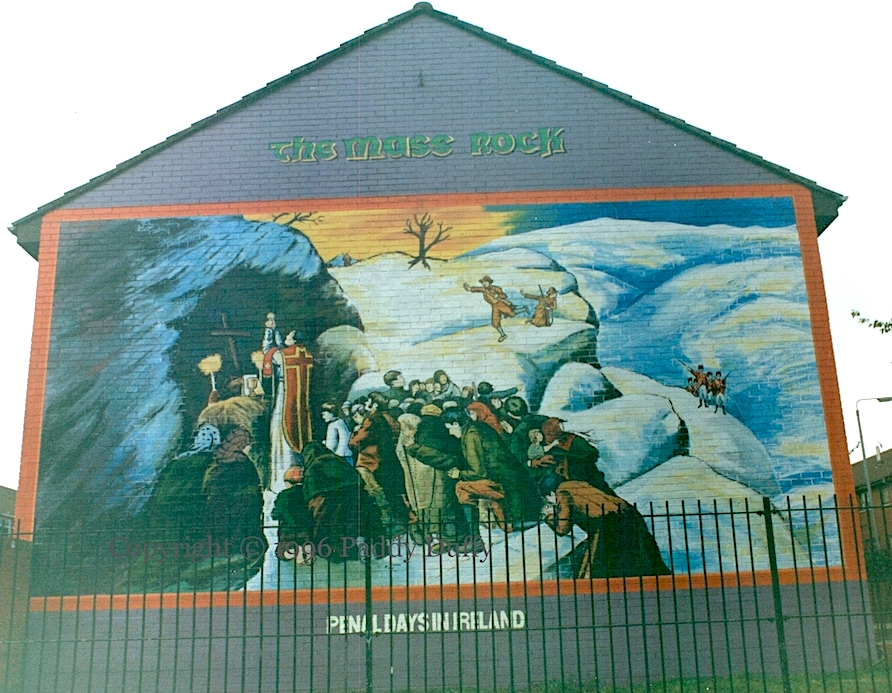
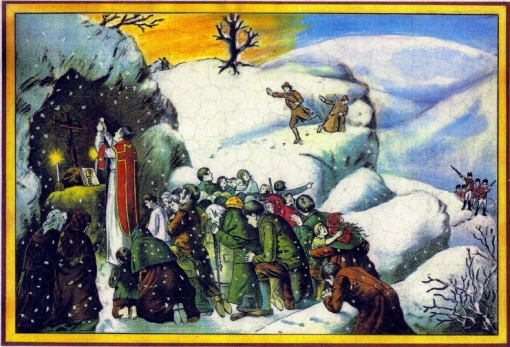
“Penal days in Ireland” – this mural commemorates the repression of Catholicism and use of mass rocks as secret locations in the days of Cromwellian conquest and the penal laws, c. 1650-1800. The 1652 Act Of Settlement (WP) banished Catholic priests from the island and services had to be held at short notice and in remote locations, with sentries posted to keep watch against soldiers from the New Model Army. Laws against the practice of Catholicism in Ireland were not lifted until the 1782 Roman Catholic Relief Act (PCUG).
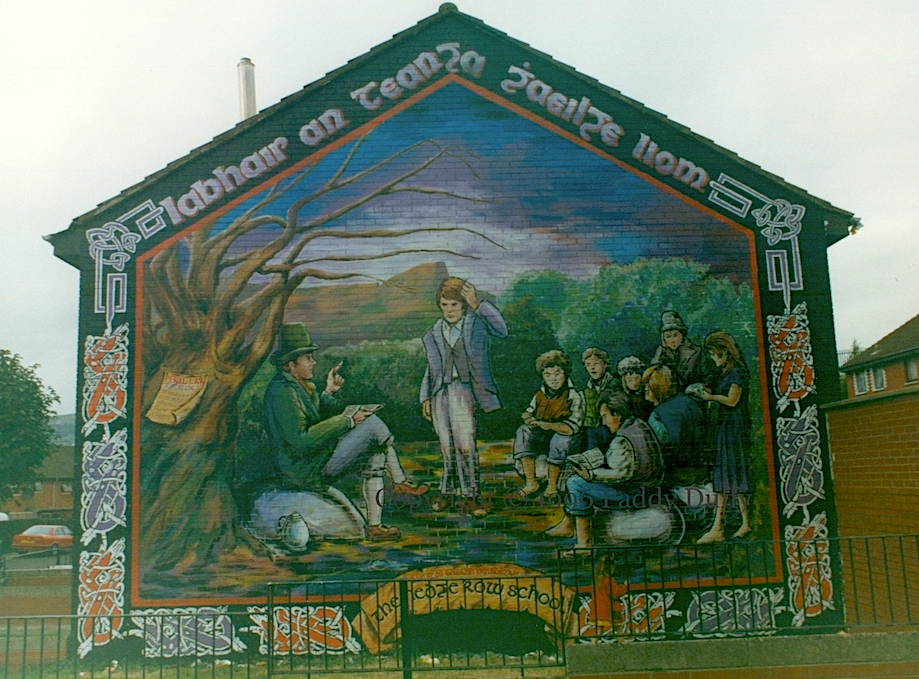
Catholic (and Presbyterian) education was prohibited by the penal laws (WP) and particularly the Education Act of 1695 (WP) – this is probably what’s on the notice on the left-hand tree. Schooling by Catholics (in Irish) nonetheless took place, in covert houses and outhouses, as well as in fields and hedge-rows. The Act was repealed in 1782, provided the teacher took an oath of allegiance to the Crown.





 Paddy Duffy Collection