The galleries below provide a quick way to view the roughly 6,000 images added to Paddy’s collection so far. Write-ups with descriptions and background information for many individual images are also available – click on each image in the galleries for individual entries or use the search tools in the side-bar on the right (or simply keep scrolling).
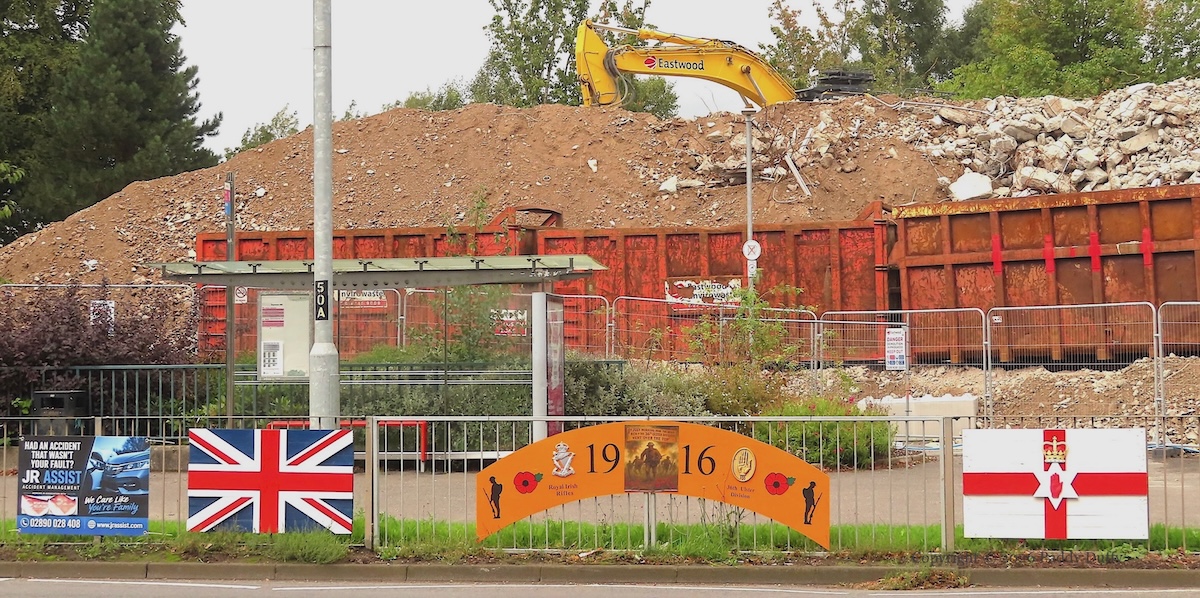
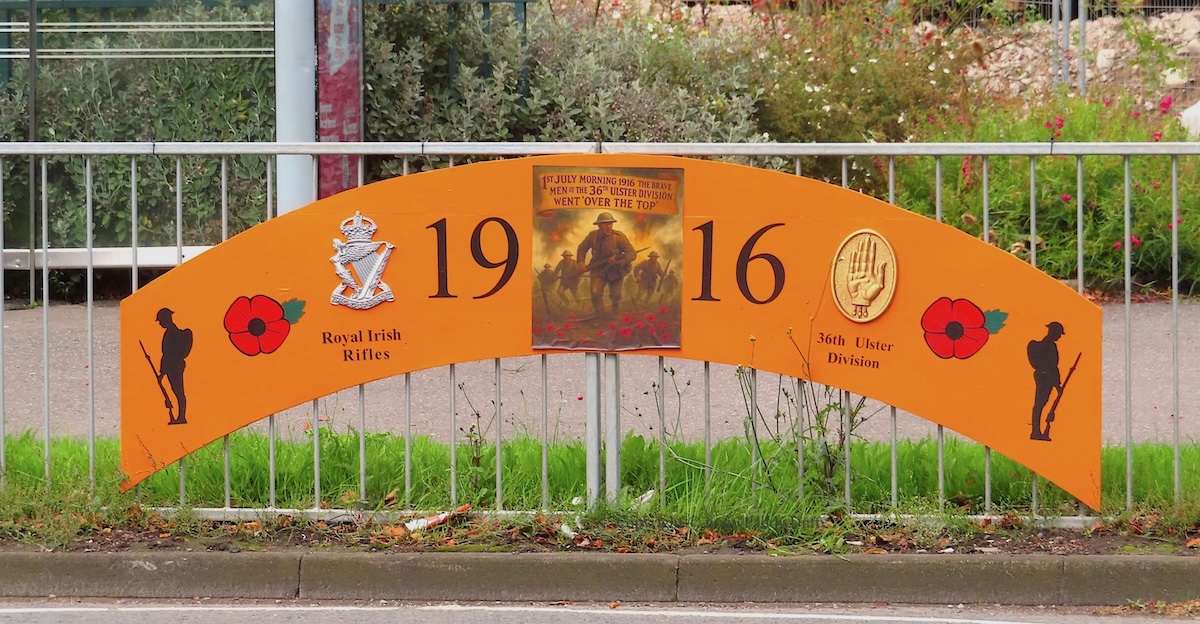
The badge or insignia of the 36th (Ulster) Division most frequently seen in murals is the one on the left of this board in Ballyduff, combining a red hand on a field of shamrocks with the Union Flag and the harp of the Royal Irish Rifles. The simpler insignia of the 36th Division on the right is being seen more frequently – it features a left-handed red hand, while the other uses a right-handed red hand, as do the flags of Ulster and of Northern Ireland.
“Macha – máthaır, bandıa, banríon, gaıs[c]íoch/mother, goddess, queen, warrior.” Armagh is named after Macha, who is shown here pregnant against knot-work of three interwoven horses. In one story about Macha, she wins a race against the horses of Connor, the king of Ulster, even though she is pregnant. The race caused her to give birth and she cursed the men of the Red Branch for nine generations, which would leave them all – except for Cú Chulaınn – unable to fight to the forces of Medb (Visual History).
This memorial for Glen “Spacer” Branagh, launched on the twentieth anniversary of his death in 2021, is at the junction of Canning Street and Orchard Street, north Belfast.
For information and the earlier plaque on N Queen St, see Forever Young.
This is a mural of King Niall (Nıall Caılle, Niall of the Callan) and Queen Macha. Niall was high king of Ireland (in competition with Fedelmıd of Munster WP) who held off the Vikings in the late 800s (WP) and died in 846 by drowning in the Callan river. Macha is a much earlier and mythological queen, and gives her name to the town: Ard Mhacha.
The central figures reproduce paintings by Jim Fitzpatrick (Visual History). The Niall figure comes from Nemed The Great but the Macha figure comes from a label Fitzpatrick produced in 1988 for Rosc “mead”, even though Macha (one of them, at least) was the wife of Nemed and there is a female figure in Nemed The Great.
Below the planets and stars, St Patrick’s (Catholic) Cathedral is on the left (WP) and St Patrick’s (CofI) Cathedral is on the right (WP).
In the border, clockwise from left to right, we see: the Tandragee Idol (WP), Naomh Bríd/St Brigid’s, St Patrick preaching the trinity, Irish dancing, Gaelic football, Armagh Harps, “Ard Mhacha”, the Armagh county crest in colour in the apex (Club & County), “Armagh”, Na Pıarsaıgh Óga, hurling/camogie, Cú Chulaınn’s, mummers (perhaps specifically the Armagh Rhymers), Jonathan Swift, a steam locomotive (perhaps representing the Armagh rail disaster of 1889, in which 80 people died WP); a vintage image of Callan Street is depicted along the bottom (History Armagh).
The side-wall features the word “welcome” in many languages, and Celtic knot-work surrounding an image of the Celtic Cross below St Patrick’s, perhaps inspired by this 1903 photograph (Flickr).
Painted by a crew of Belfast artists – Danny D and Mark Ervine, along with Lucas Quigley, Marty Lyons, Micky Doherty – and organised by the Callan Street Residents’ Association, with funding from the European Union’s Peace III initiative.
This entry updates 2023’s 800 Years Of Irish Resistance, showing images of the republican memorial garden in Drumarg, Armagh. The main change is the removal of Cú Chulaınn (Visual History) and the elevation of the James Connolly board into its place: “If you strike at, imprison, or kill us, out of our prisons or graves we will still evoke a spirit that will thwart you, and, mayhap, [here “perhaps”] raise a force that will destroy you. We defy you[, England]! Do your worst!” – James Connolly, Courtsmartial And Revolution, 1914.
There is also a new board in the ‘Women In Struggle’ gallery, next to a portrait of Maıréad Farrell and a “Republican Women’s Roll Of Honour”. It shows Colman Doyle’s famous ?1974? image (NLI | Treason Felony) of a female volunteer with assault rifle accompanied by the words, “This is not a man’s war but a people’s war, and very, very much suffering has been borne by the women, be they mothers, wives, political activists, or volunteers, and the men ought to remember that without the sacrifice of women there would be no struggle at all.” The words seem to come from a 1982 poster (CAIN) part of which was turned into a mural in Ballymurphy.
There is also a small plaque below the Connolly board to local woman Dympna McCague, who died in 2019 (Fb).
The photograph on the right is real: it shows British troops collaring a civilian in Coalisland in December 1971 – photographer unknown. The image on the left – a Celtic cross draped with a Tricolour – is AI slop. The first (or at least, an early and prominent) use of AI to produce images was Stop The Slaughter In Gaza from November 2023, and it is becoming more frequent in printed boards and wall-painting.
“”And still only our rivers run free” [youtube] – Independent Republicans Armagh”
This is a kids/community/mental-health mural on the sub-station in Edgarstown. The art was painted by young people from the area, organised by Edgarstown Residents’ Association in the summer of 2024 (Fb).
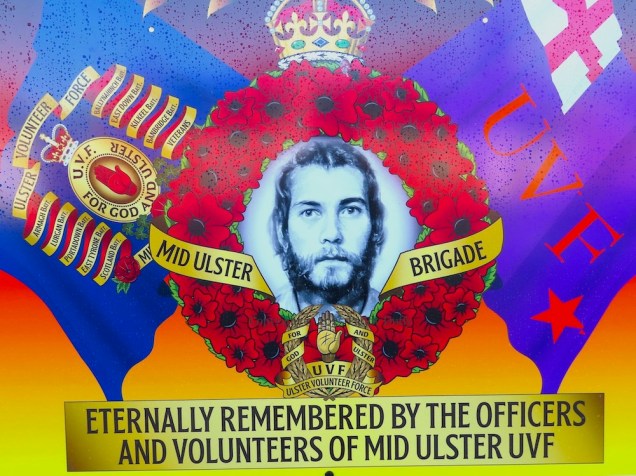
This entry updates 2024’s Here Dead We Lie – the plaque to Boyle and Somerville remains as before (it was originally mounted in 2005) but all three of the boards have been updated. The two on the extremes have the same content as before, while the central board marks the “50th anniversary” of the death of “Volunteer Harris Boyle”, “eternally remembered by the officers and volunteers of Mid-Ulster UVF”. Both Boyle and Somerville were members of both the UDR and UVF; they were “killed in action” when the bomb they were planting on the minibus of the Miami Showband went off prematurely. A parade in Boye’s memory took place in Portadown (BBC). Surviving Showband members and their sympathisers also marked the anniversary – on July 31st, 2025 – with a service at the spot of the attack (BBC).
The boards are at the junction of Gloucester Avenue and Princess Way in Portadown – Boyle was from the Killicomaine estate; Somerville is individually commemorated in Moygashel.