Volunteers in simplified clothing fire a funeral volley over an unseen coffin. The mural was later made more complex – see Slán Go Fóıll in the Peter Moloney Collection.
For the side wall, see Long Kesh in the Peter Moloney Collection.
Words from Padraıg Mac Pıaraıs’s poem Mıse Éıre are included alongside the portraits of the seven signatories to the 1916 Proclamation. It includes the line “Great is my glory, I who bore brave Cú Chulaınn” and Cú Chulaınn is pictured on the right, in the death pose made famous by Oliver Sheppard in a statue installed in the GPO in 1935 – see Cú Chulaınn’s Visual History page.
Mıse Éıre: Sıne mé ná an Chaılleach Bhéarra. Mór mo ghlóır: Mé a rug Cú Chulaınn cróga. Mór mo náır: Mo chlann féın a dhíol a máthaır. [Mór mo phıan: Bıthnaımhde do mo shíorchıapadh.] [Mór mo bhrón: D’éag an dream ınar chuıreas dóchas.] Mıse Éıre: Uaıgní mé ná an Chaılleach Bhéarra.
Painted by Mo Chara Kelly in Norglen Gardens, west Belfast
“In proud memory of those who gave their lives for Ireland’s freedom” (and out of sight to the left) “Also to all civilians murdered by the British crown forces” (and out of sight to the right) “Also to all civilians murdered by pro-British elements”. The Celtic cross bears three republican flags: Tricolour, Sunburst, and Starry Plough.
The volunteers (and one Sınn Féın member) listed are (on the left) “Martin Forsythe, Martin Skillen, Gerard Fennell, Terence O’Neill, John Dempsey” and (on the right) “Sean McDermott, Tom Magill, Sean Savage, Kevin McCracken, Paul Best”.
“Happy birthday, comrade”. ANC leader Nelson Mandela turned 70 on July 18, 1988. He spent the day, like every birthday since 1963, in prison; he would not be released until 1990, after which apartheid would be dismantled and Mandela become the first President of South Africa. “The future belongs to you.” The colours of the ANC join the colours of the Irish Tricolour as a background to Mandela’s portrait. Painted by Mo Chara Kelly, with the help of “Sınn Féın Youth”.
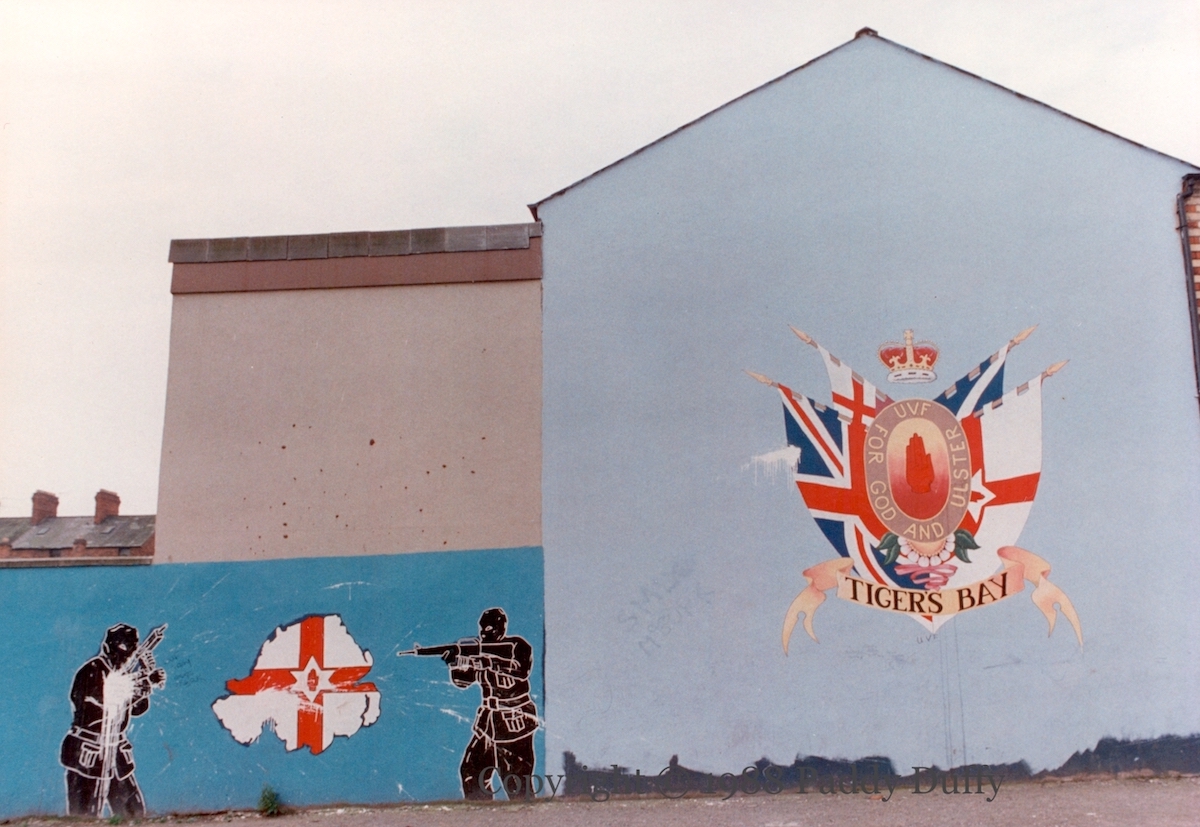
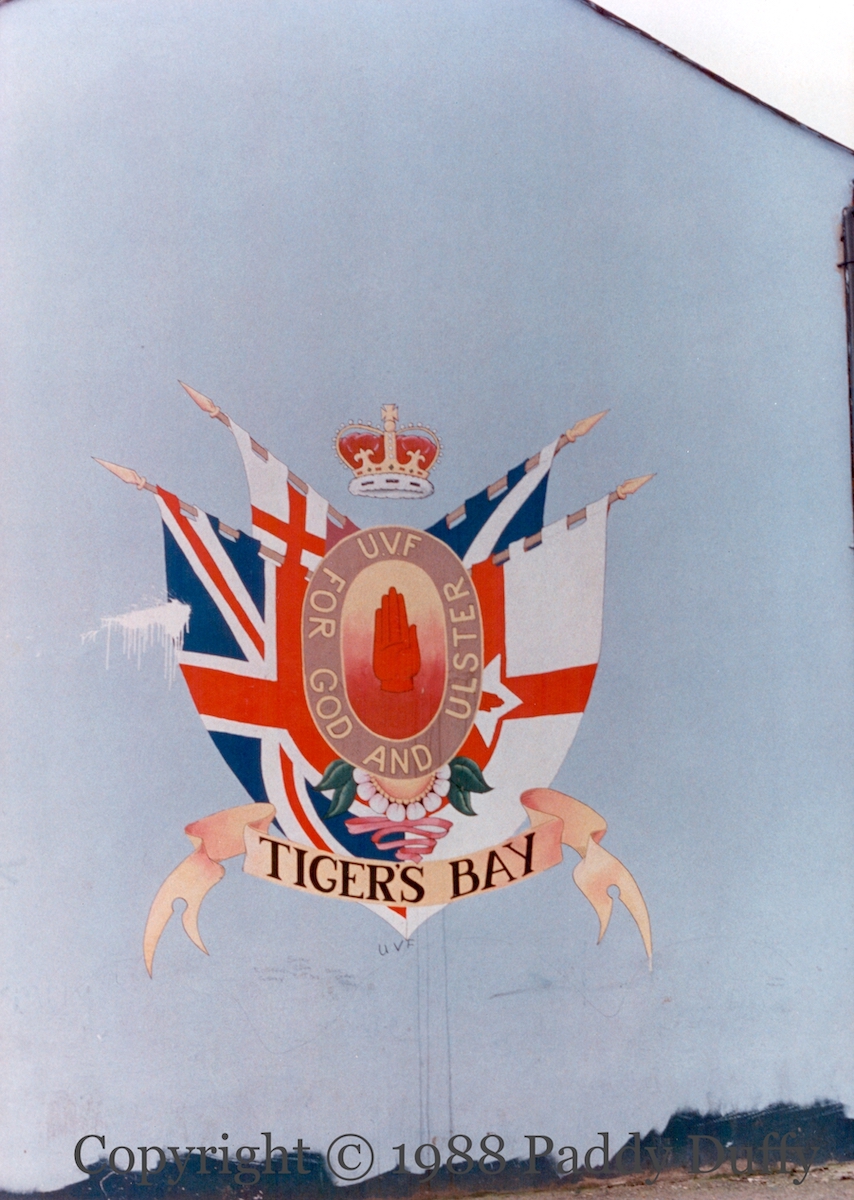
For some speculation as to the origins of the name “Tiger’s Bay” see Connolly Cove; a more realistic origin-story is given on the Belfast Forum, that a “tiger bay” or “tiger’s bay” is sailor slang for a rough area. The name was originally applied only to the warren of streets immediately below Newington (again Belfast Forum), but later extended to include everything down to North Queen Street.
Hogarth Street, north Belfast, though the precise location is uncertain
UVF volunteers in balaclavas take aim other across a free-floating Northern Ireland with an Uzi and an assault rifle. The emblem supported by flags on the right is unusual for its inclusion of a ?large daisy? and pink ribbon.
The location of this wall is unknown, which suggests the site of the Community Centre – please get in touch if you know where it was.
“West Belfast Brigade UDA C Company”. UDA/UDF/LPA/UFF mural on the Shankill. (For a similar quartet of names and explanation of “UDF”, see Sans Peur.)
The title “First Ulster Defence Assoc.” is an attempt to tie together the defenders of Derry in 1688 (300th anniversary) with the modern Ulster Defence Association. This is an early attempt to give the UDA historical roots, beyond the Shankill and Woodvale Defence Associations. To this end, the group would adopt Cú Chulaınn (beginning in 1992 – see the Visual History page) and (beginning in 2007 – see UDU-UFF-UDA) the 1893 Ulster Defence Union as ancestors.
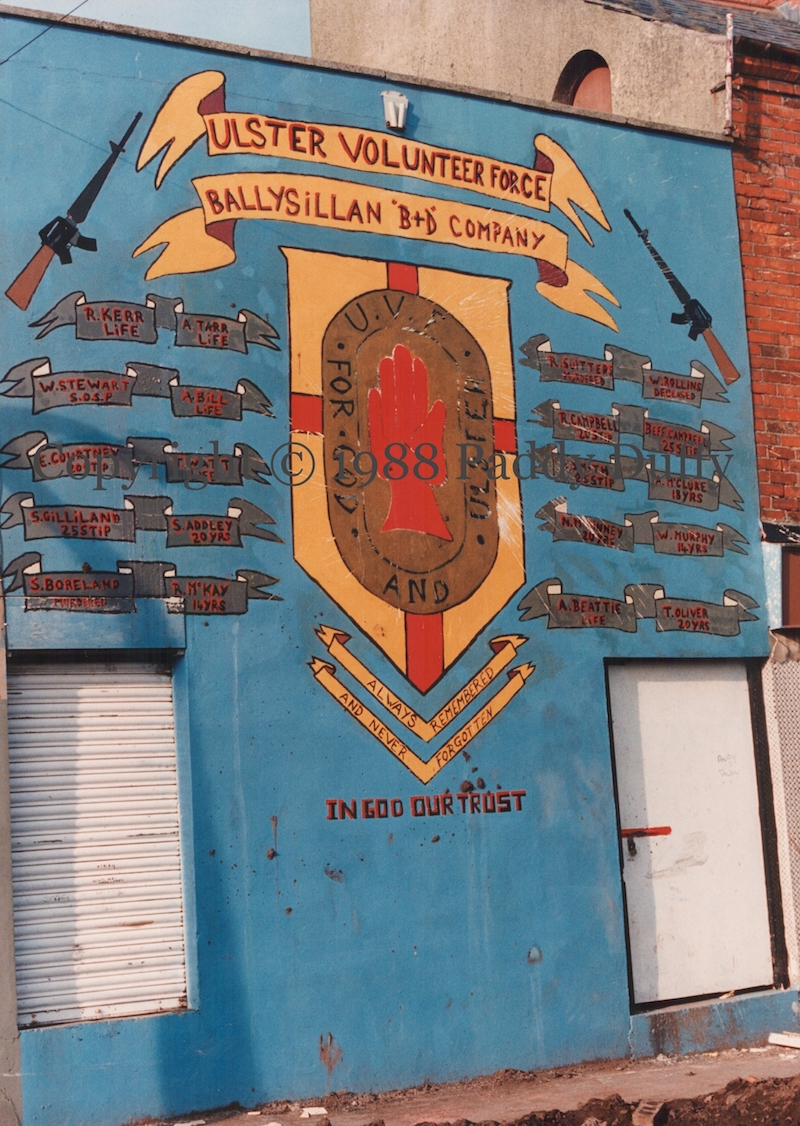
“Always remembered, never forgotten”. This mural is unique in providing the length of the sentences being served by various members of the “B + D” company of the Ballysillan UVF: Kerr, Tarr, Bill, Watt, and Beattie are serving “Life”, while others – Courtney, Gilliland, Campbell, and Smith – are serving “stip” sentences (stipulated minimums) of twenty years or more; Stewart is being held “S.O.S.P”, that is, at the “Secretary Of State’s Pleasure”, presumably because he was convicted as a minor; the rest (Addley, McKay, McClure, McKinney, Murphy) are serving ordinary terms, except for Boreland and Suitters who are marked as “murdered” and Rollins who is “deceased”.
Here is a pamphlet from the Committee On The Administrative Of Justice on the “life” prisoners in NI prisons in the years prior to 1988 (pdf).
Suitters was shot by the IRA in 1975 at his shop (Sutton) not far from this mural in Legann Street.
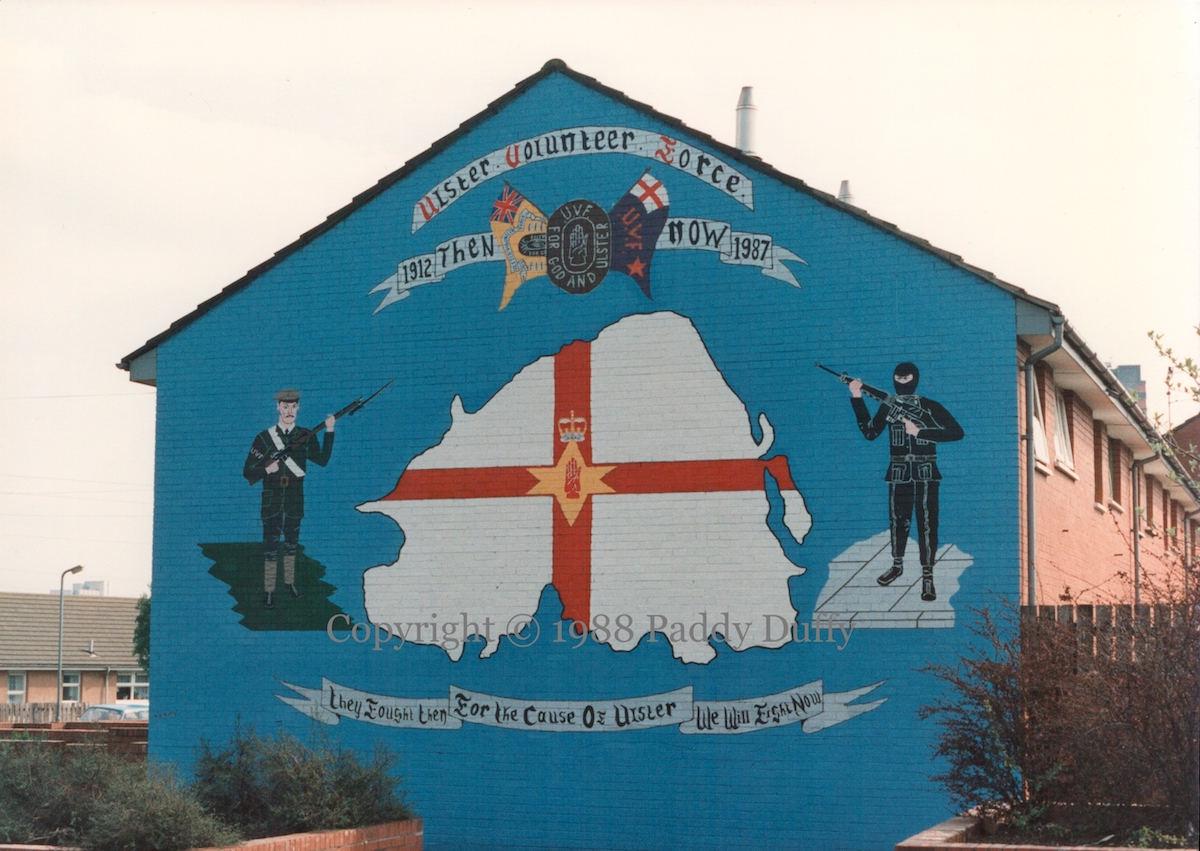
“They fought then for the cause of Ulster, we will fight now.” The 75th anniversary of the Ulster Volunteers is celebrated in this mural in Dover Place, west Belfast. On the left of the Northern Island is an Ulster Volunteer in period (1912) garb standing on a patch of ground, on the right, a modern (1987) paramilitary in hood and fatigues standing on a city footpath. The Ulster Volunteers as such did not fight for Ulster – they instead joined the British Army and fought “for King and Empire” in WWI, after which Home Rule was applied only to 26 counties of Ireland and Northern Ireland was created and remained within the UK.
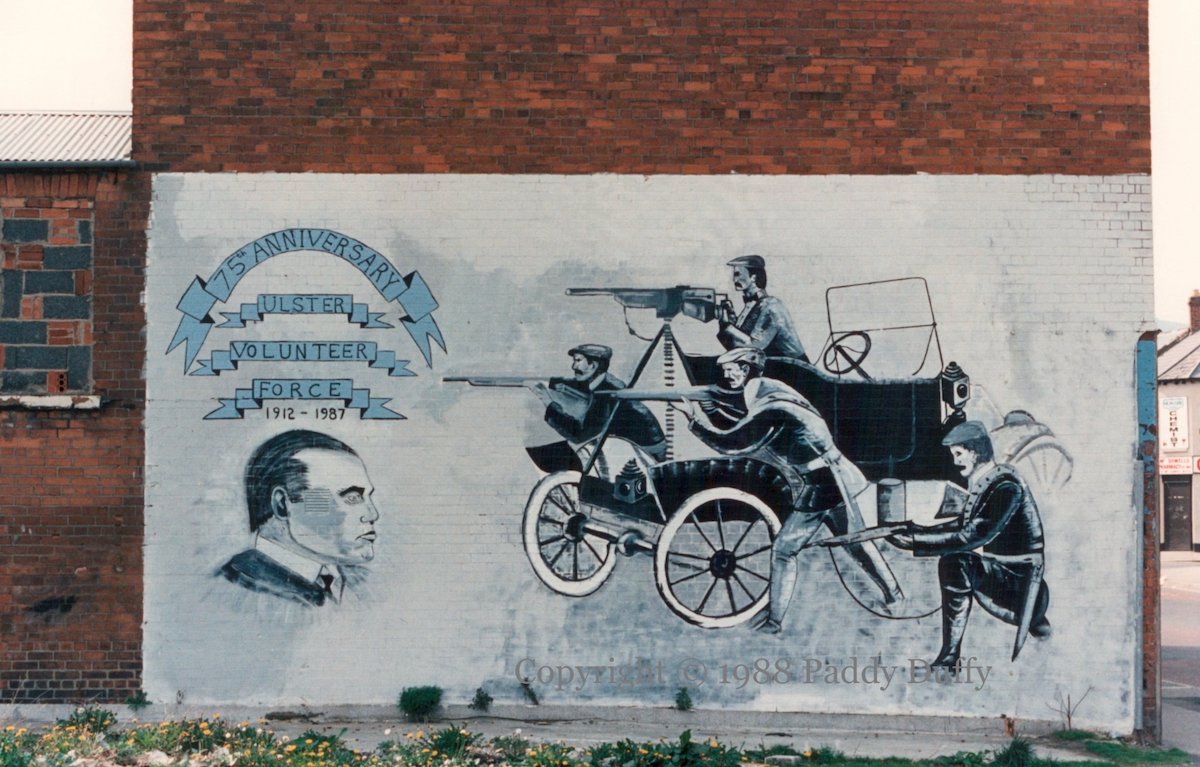
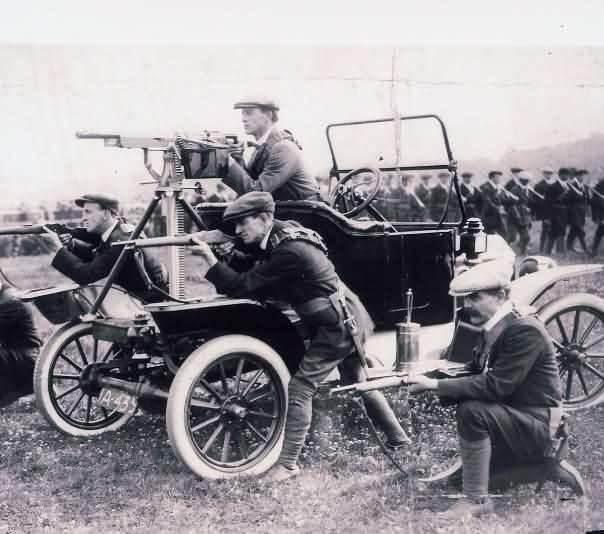
This mural celebrates the 75th anniversary of the Ulster Volunteers, 1912, with a portrait of Edward Carson and a rifle mounted on the back of a car (based on an image from 1914, included below). The Ulster Volunteers joined the Royal Irish Rifles as part of Kitchener’s Army in WWI, and when the war ended some of the survivors joined the northern RIC and the post-partition RUC, but at that point it is impossible to track them as a cohesive group and the only connection to the Ulster Volunteer Force of 1965 is the name.
Shankill Road (on the wall of the PUP offices, just west of ACT and the Bayardo memorial), west Belfast



 Paddy Duffy Collection