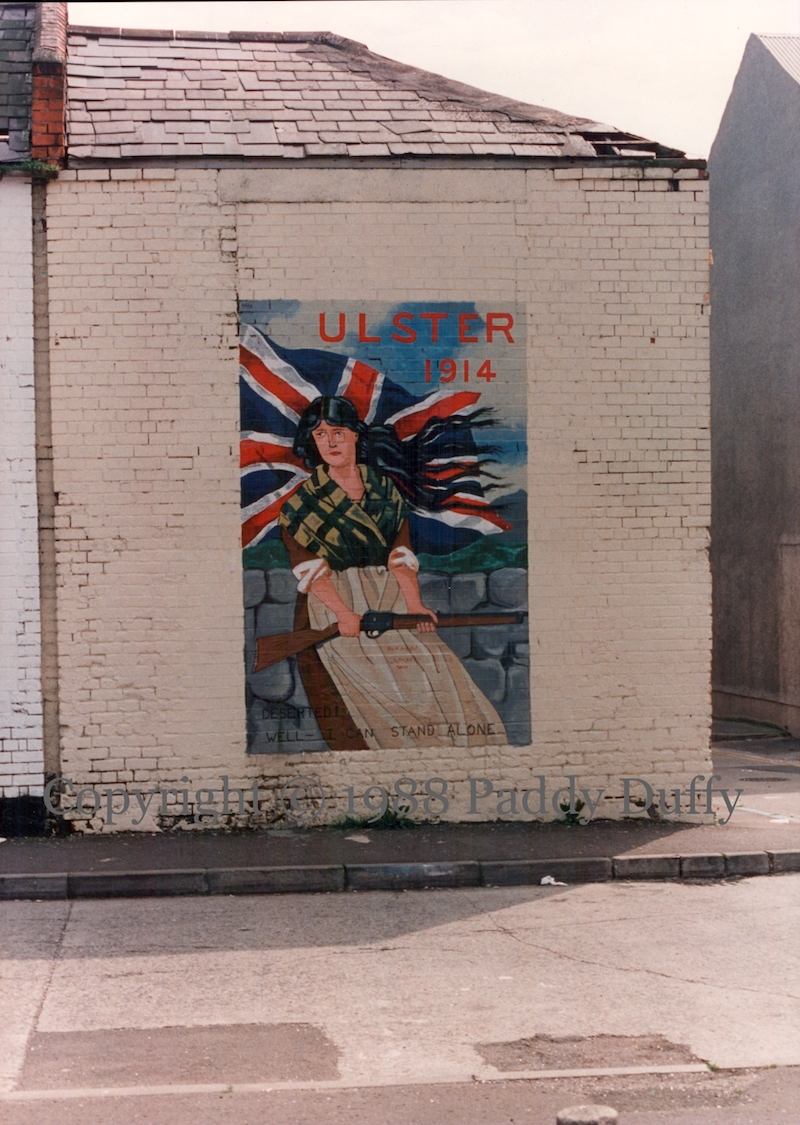
These two murals are side-by-side in Craven Street. On the right, a farmer’s wife defends the farm (the stone wall) in order to preserve it as part of the UK (the Union Flag) despite the threat of Home Rule; on the left, “in proud and loving memory” of three UVF volunteers assassinated by the IRA: Shankill Butcher Lenny Murphy, John Bingham, and William “Frenchie” Marchant. “Lest we forget.”
On the left of the lightning bolt are the soldiers of the 36th Ulster division (U.V.F.) R.I.R (Royal Irish Rifles) on the western front in 1916; on the right are “UVF prisoners of war, Long Kesh”.
A similar board was painted in the UVF compounds of Long Kesh. Of it, Billy Hutchinson (in his 2011 piece “Transcendental Art“) said, “My favourite mural was one inspired by the British anti-war poet, Siegfried Sassoon. Suicide In The Trenches depicts a UVF volunteer split down the middle by a bolt of lightning. Half of him depicts a 36th Ulster Division soldier under heavy fire in a rainsoaked WW1 trench. The other half shows a ’70s volunteer incarcerated behind barbed wire and over-shadowed by watch towers.” (The piece – W2021.1.8 in the Ulster Museum collection – includes the last verse from Sassoon’s Suicide In The Trenches.)
Craven Street, west Belfast. Hutchinson also describes the importance of the Orange Cross welfare organisation in selling prisoner art produced inside the prison. The door to the club is in black to the left of frame. Stevie McCrea of the RHC was killed in the Orange Cross in 1989 – see Stevie McCrea.
These are three of the murals painted in Percy Place, west Belfast, painted by Alan Skillen in 1984. For a gallery of all eleven piece, see the street’s Visual History page.
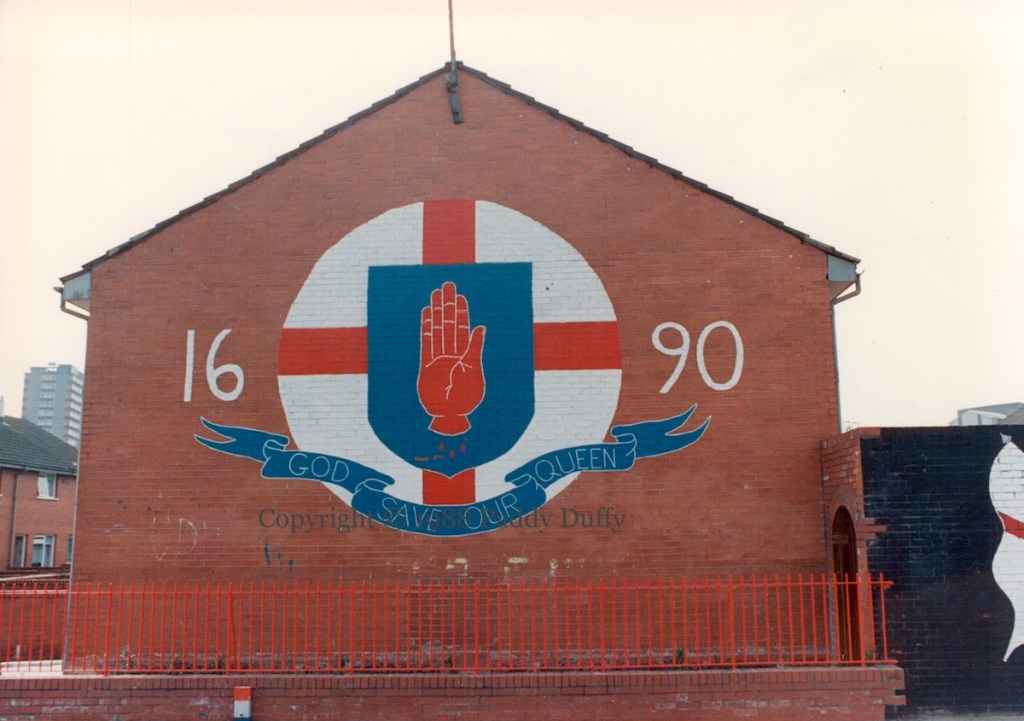
The murals combined traditional PUL themes and iconography, such as King Billy and the monarchy, with the emblems and hooded gunmen of paramilitary groups.
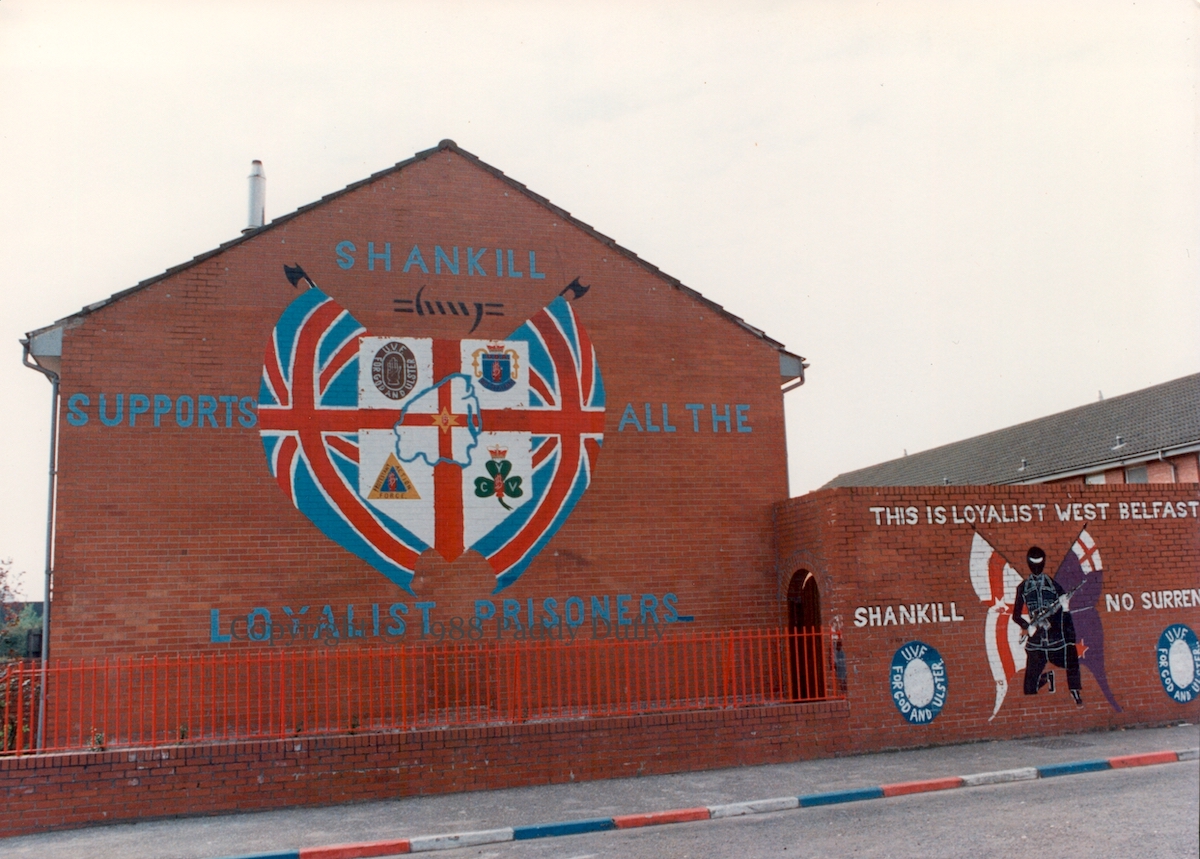
The piece above is unusual in that it takes a familiar UDA device of four emblems in the quadrants of an Ulster Banner shield (see e.g. Sans Peur) but replaces three of them with the emblems of the UVF, PAF, and YCV. A crude outline of Northern Ireland has also been applied.
An electoral portrait of Sınn Féın candidate Gerry Adams, against a background of green, white, and orange.
The mural was the first one (bar a children’s mural at a school) painted by Mo Chara Kelly (with Hector Heath). He recalls the moment as follows: “At that particular time [1987] the media were constantly, as is their role, demonising our community. The Catholic Church was in support of the SDLP because they wanted the voice of the so-called moderate nationalist to be heard and they too were constantly criticising and demonizing republicanism. … We were told constantly that republicanism had no support. That was rammed down your our throat constantly by the British and Irish media and press. One day I thought to myself — it just came to me out of the blue — “Get up, and start to paint. Be public about it!” So I painted a Gerry Adams mural for the election that was coming up.” (Painting My Community/An Pobal A Phéınteáıl – English-language version available for free.)
Adams successfully defended his Belfast West seat in the UK general election of 1987.
The death by hanging of African National Congress supporter Benjamin Moloise on 18 October, 1985, for the alleged murder of a South African policeman, drew international condemnation and led to widespread rioting in Johannesburg and Port Elizabeth. (ExecutedToday | Jet)
Moloise’s words, “tell the world, freedom is at hand”, originally appeared on the right of this ANC-IRA mural, paired with a phrase from Bobby Sands, “we aim to be free” on the left of the assault rifle and a zulu shield and spear. The quote and signature have been painted out due to paint-bombing. (There was (at least) one other paint-bombing of the mural – see the Peter Moloney Collection.)
The boards above the mural (“erected by Sınn Féın April 1986”) declare west Belfast an “apartheid free zone”/”ceantar saor ó apartheıd”. Note the “A/A” [anti-aparteid] emblem in bottom-left of the left-hand board.
“Beır bua” [seize victory] along the bottom is partly obscured by the skip.
Ascaıll Ard Na bhFeá/Beechmount Avenue, west Belfast
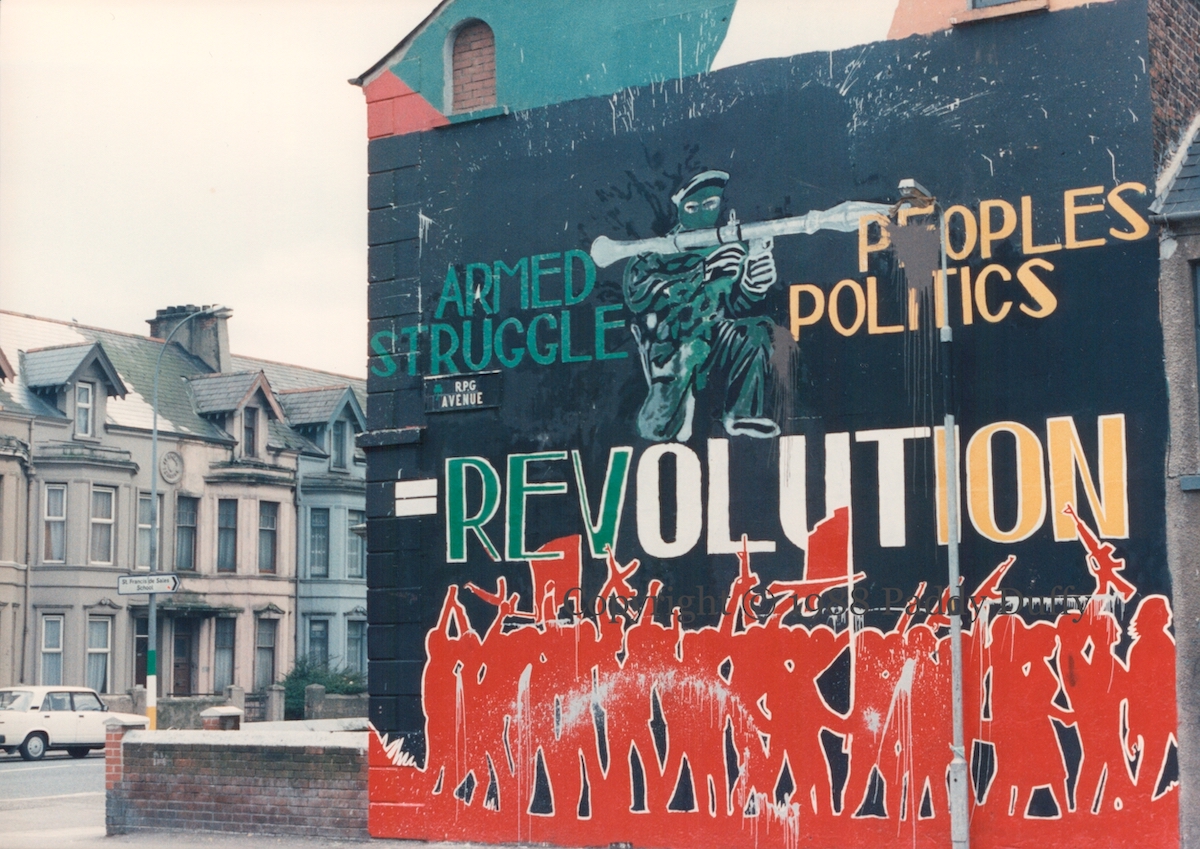
“Armed struggle, people’s politics – revolution.” A volunteer with rocket-propelled grenade launcher on “RPG Avenue” (Beechmount Avenue), west Belfast.
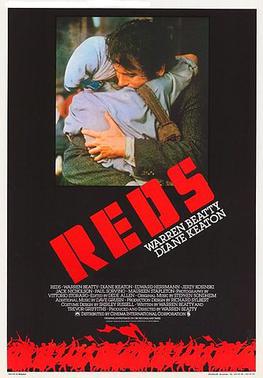
According to Rolston (1991 p. 100), the silhouettes of at the bottom are based on the movie poster for Reds.
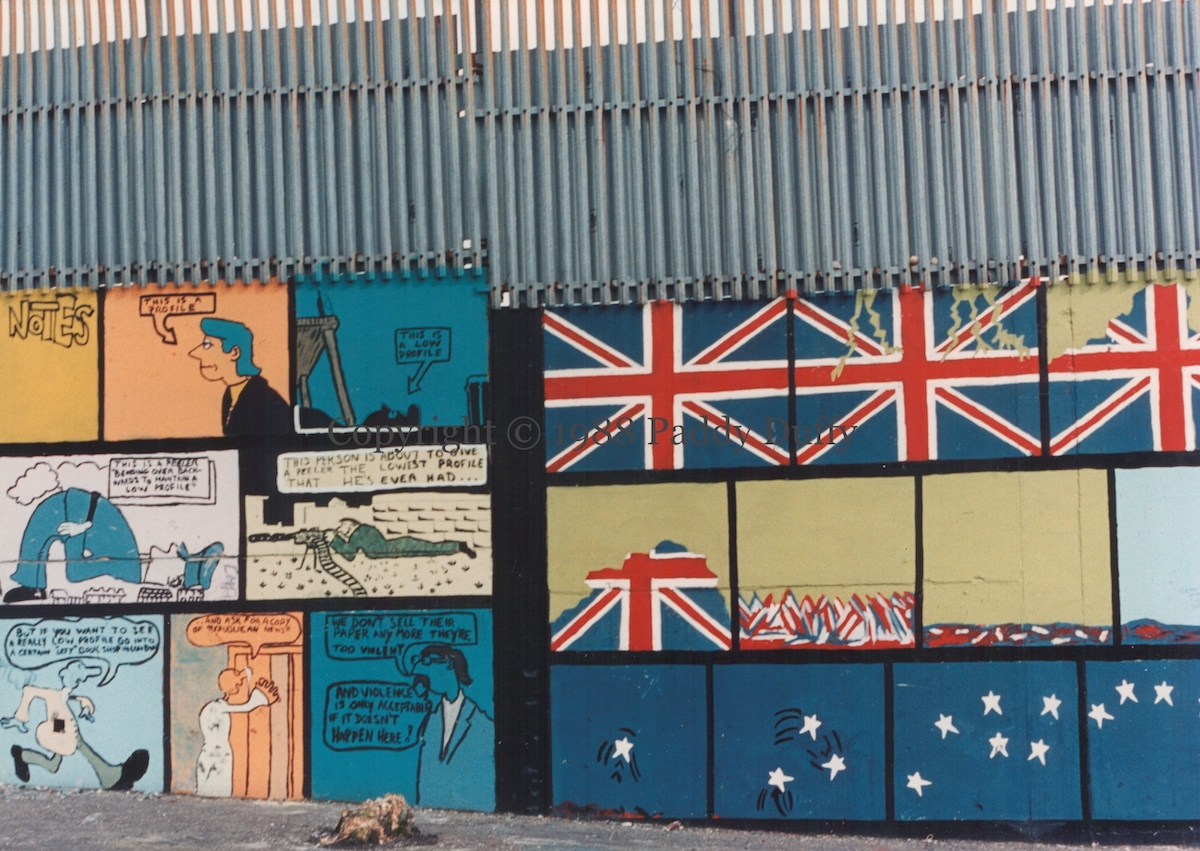
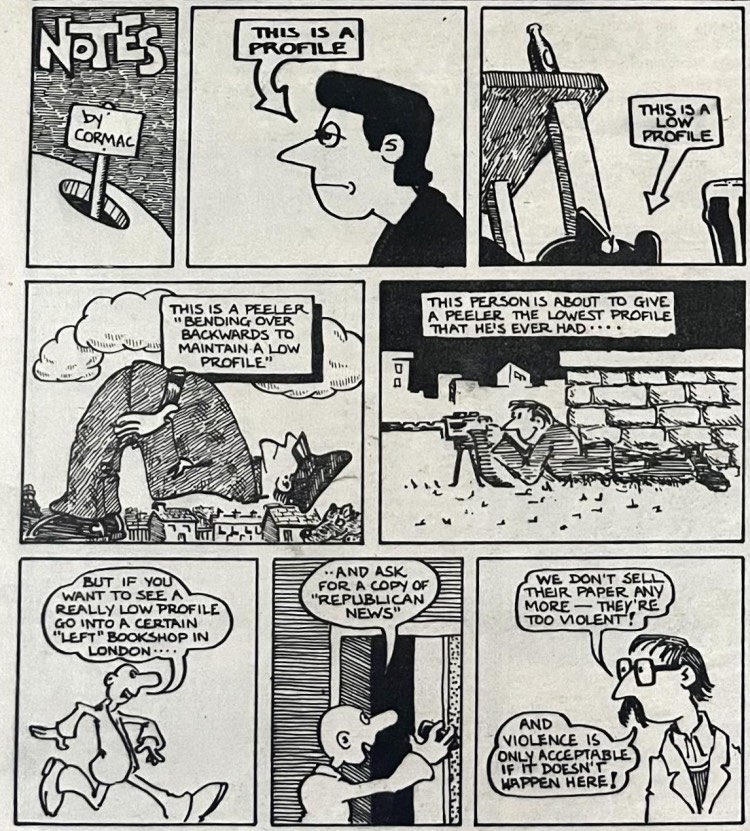
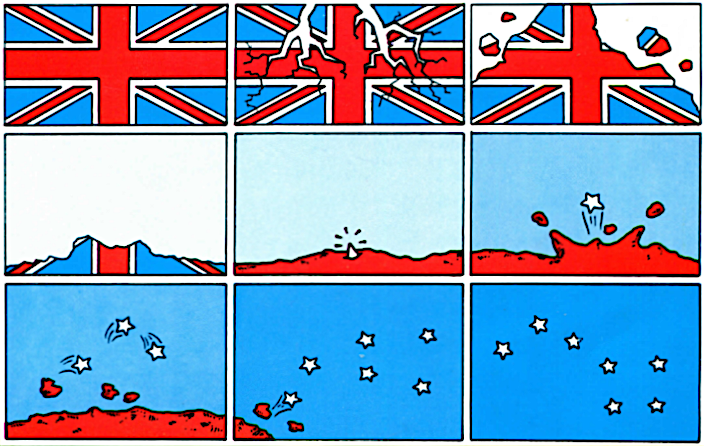
These two pieces are both by cartoonist “Cormac” (Brian Moore), as reproduced on the wall of Corry’s Timber at the top of Springhill Avenue, west Belfast, by Mo Chara Kelly.
Cormac produced cartoons for Resistance Comics, Republican News (and then An Phoblacht/Republican News), Socialist Challenge (and then Socialist Action), and Fortnight. His “Notes (For A History Of Ireland)” appeared in RN and AP/RN for about 30 years.
The mural on the left reproduces a cartoon from February 1979, combining hatred of the “Britz” and RUC with criticism of a left-leaning London bookshop that no longer stocks the paper because “violence is only acceptable if it doesn’t happen here”.
The other is an eleven-panel version of the nine-panel image that appeared on the cover of the 1982 collection Cormac Strikes Back, showing the Union Flag crumbling and the Starry Plough rising from its ashes.
The main panel, of three IRA volunteers with raised weapons, was painted by Sean ‘Conker’ Connolly, presumably based on or inspired by the poster below.
Also on the wall are (below right) a Tricolour and (below left) “Sinn Fein/Gerry Adams” and a small board (at the top) with a raised fist and the slogan “Unity is strength”.
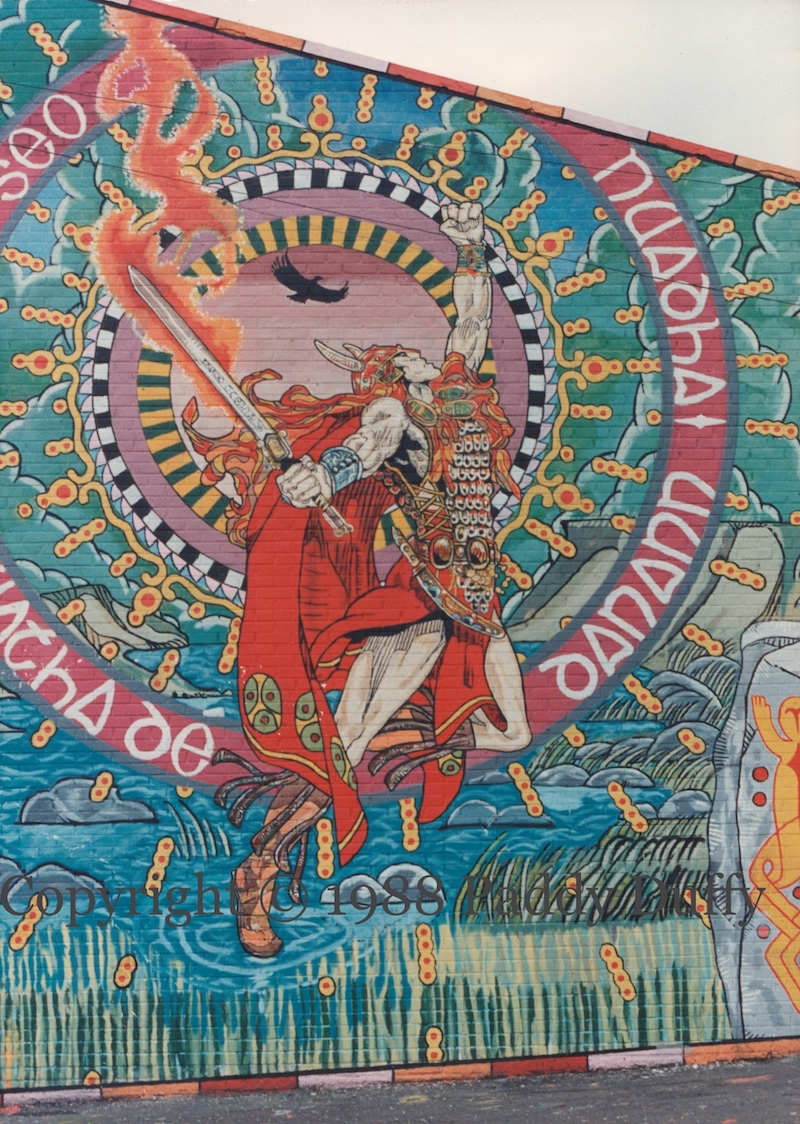
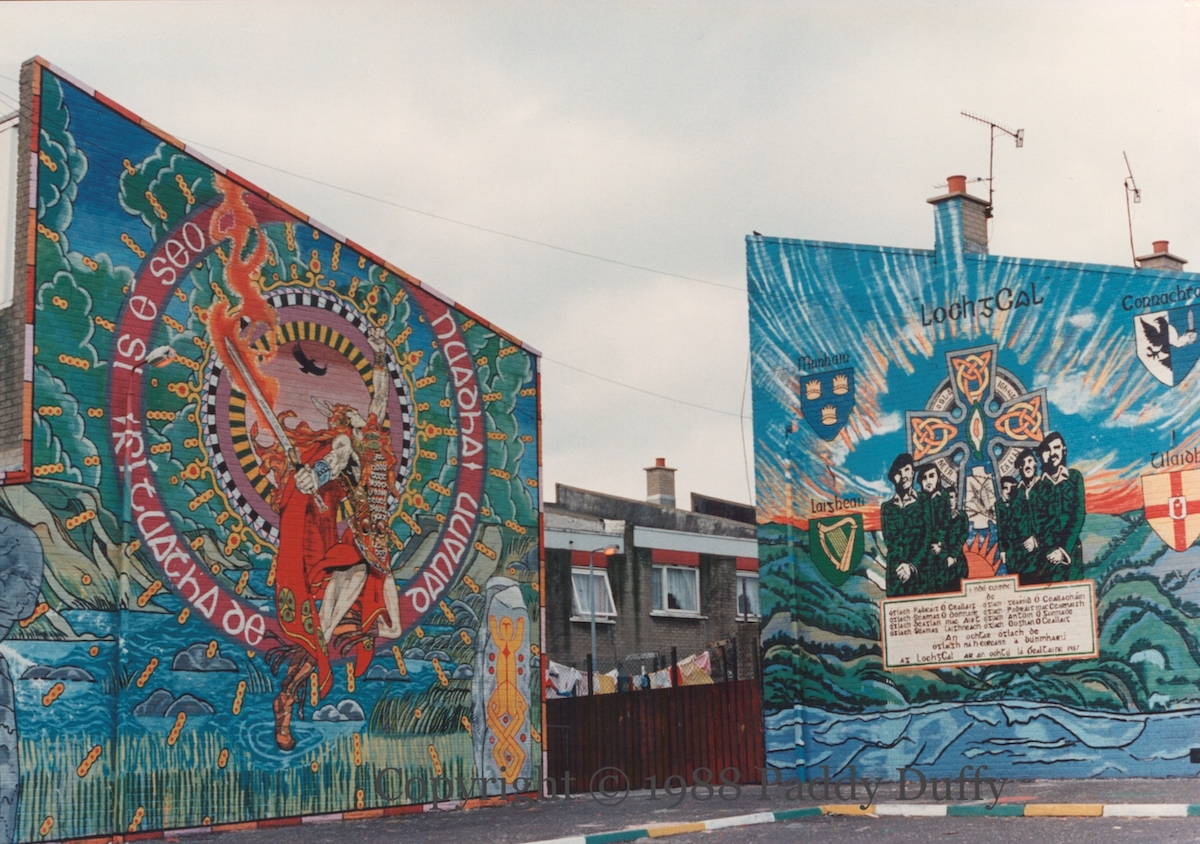
This pair of murals was painted by Mo Chara Kelly at the top of Springhill in 1987 after his release from prison. Both are inspired by the work of Jim Fitzpatrick. The central figure of the Rí Nuadha [King Nuada] mural above and immediately below comes from a painting of Fitzpatrick‘s called ‘Nuada Journeys To The Underworld’ while the background has a Fitzpatrick style and colour-scheme.
Of the myth of Nuada, Mo Chara said, “I had never heard the story of King Nuada before. Then I read the story. Wow! What a yarn! Nuada Of The Silver Arm is one of my favourite stories. As one of the Tuatha Dé Danann you had to be whole and physically perfect to hold the kingship. Nuada lost an arm in the first battle of Moy Tura and so he lost his kingship. He went into the other world, to middle earth, fought through trials and tribulations until Dıan Cécht made a silver arm for Nuada and he was restored to the kingship for another twenty years. But the moral of the story to me was that, no matter what happens, get up again and fight back. No matter how bad the situation you are in, you get back up and fight again. Do not let people isolate you. Get up and fight again. It was very inspiring!” (Painting My Community/An Pobal A Phéınteáıl – English-language version available for free.)
The Loch gCál/Loughgall mural likewise draws on Fitzpatrick for the landscape behind the Celtic cross and funeral guard in memory of the eight IRA volunteers from the East Tyrone brigade who were killed in an SAS ambush during an attack on an RUC base in May, 1987 (WP).
The names of the eight volunteers are given here in Irish and (partially) in the old script:
“I ndıl cuimh[n]e de [= ar] Óglach Pádraıg Ó Ceallaıġ [Patrick Kelly], Óglach Séamus Ó Donn[ġ]aıle [Seamus Donnelly], Óglach Deaglán Mac Aırt [Declan Arthurs], Óglach Séamus Laıghneach [Jim Lynagh], Óglach Gearóıd Ó Ceallacháın [Gerry O’Callaghan], Óglach Pádraıg Mac Cearnaıgh [Pádraıg McKearney], Óglach Antóın Ó Garmaıle [Ó Gormghaıle | Tony Gormley], Óglach Eoghan Ó Ceallaıġ [Eugene Kelly]
an ochtar óglach de óglaigh na hÉireann a dúnmharú ag Loch gCál ar an ochtú lá Bealtaine 1987.” [the eight volunteers from the Irish Volunteers [IRA] who were murdered at Loughgall on the eighth day of May, 1987]
The town (Loughgall) and the four provinces are also named in Irish. An Easter lily is at the centre of the Celtic cross in the middle of the image, above a lark in barbed wire and a gal gréıne/sunburst.
This is an interesting mural from North Queen Street, if only because of its psychedelic colour-scheme and composite style.
The two bulls (presumably from the Táın though they are not the classic brown and white bulls) provide a centre, on either side of which we find Cú Chulaınn dying (and Tuan the eagle) and a dolmen. The horse on the right is perhaps Galloper. There are four faces superimposed on flying geese. The cranes Samson and Goliath are on the left (which suggests a cross-community sponsorship) and a Pride rainbow is on the right.
A wide shot of the whole can be seen in the Peter Moloney Collection. If you have any information about the piece, please get in touch.
North Queen Street, presumably at the bottom of the New Lodge (either where the playing pitch opposite (what was then) Artillery House (now Teach Ghráınne) is, or on a wall of Gallagher’s factory, where the car park for the shopping centre now is?).











 Paddy Duffy Collection