“Serving the community for over fifty years.” BTCIC is the current name for what was previously the West Belfast Taxi Association. Black taxis have been running up and down the Falls since 1970, providing an alternative form of transportation to local people during the Troubles when buses were cancelled or, as in this picture, burnt out and used as barricades. They now, in addition, provide tours of the murals (such as the Bobby Sands mural in Sevastopol Street) and Belfast city. Taxi Trax has a web site but here provides a phone number for those already at the International Wall, where there has been a black taxi mural since 2003. There are other WBTA murals in Beechmount and Ardoyne. The painters have signed the mural: Doherty’s Coal Merchant and Lyons Tea.
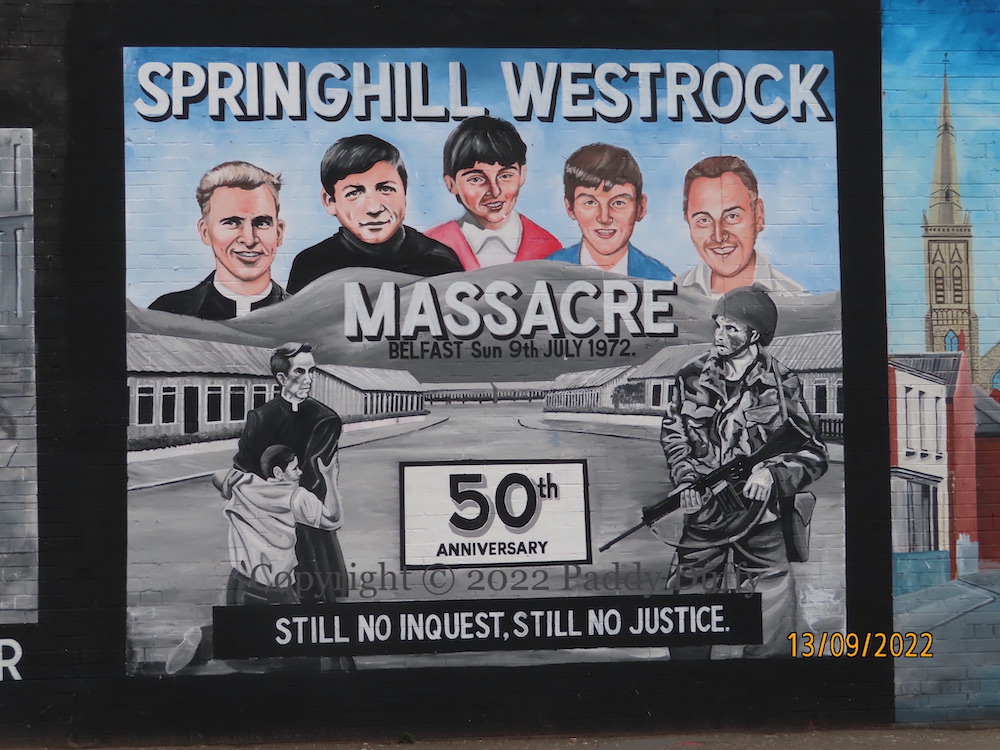
A march took place on July 9th, 2022, to mark the 50th anniversary of the Springhill-Westrock massacre, in which five people were killed by the British Army. A new inquest was directed by the AG in 2014 but has been repeatedly delayed; it is scheduled to begin next year (Belfast Live).
The march was organised by the Springhill-Westrock Campaign (Fb | tw); it began at the memorial plaque in Springhill and ended at the memorial garden in Westrock (Irish News). See also Keep On Praying.
The mural shows the pre-fab aluminium bungalows built in Westrock in 1949.
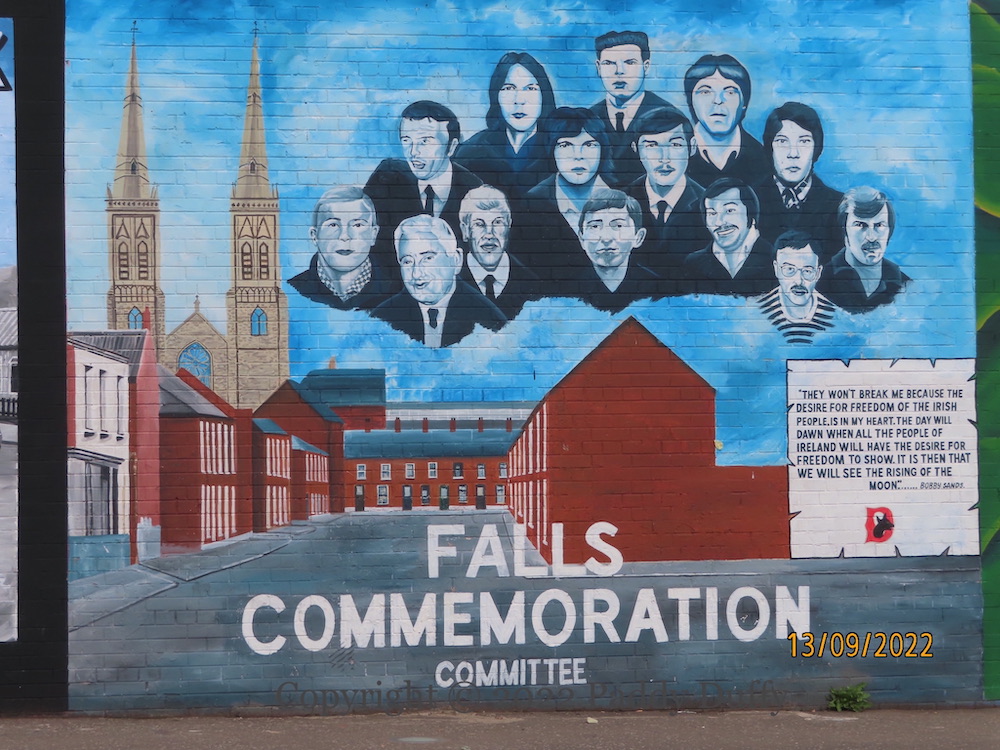
The Falls Commemoration Committee (Fb) organises an annual commemoration for IRA D company volunteers from Divis and the lower Falls (as well as special events for the fiftieth anniversary of the Falls Curfew in 2020). The fourteen local volunteers are portrayed in a group above St Peter’s. They include the five volunteers who died in 1972 and were depicted in a mural previously at this spot.
“‘They won’t break me because the desire for [freedom and the] freedom of the Irish people is in my heart. The day will dawn when all the people of Ireland will have the desire for freedom to show. It is then that we will see the rising of the moon’ – Bobby Sands [March 17th, 1981]” Originally in Irish: “Ní bhrısfıdh sıad mé mar tá an fonn saoırse, agus saoırse mhuıntır na hÉıreann, ı mo chroí. Tıocfaıdh lá éıgın nuaır a bheıdh an fonn saoırse seo le taıspeáınt ag daoıne go léır na hÉıreann. Ansın tchífıdh [chífidh] muıd éırí na gealaí.”
“Am le haontacht na hÉıreann” [Time for Irish unity]. Between stints in prison in 1976, Bobby Sands carried a green harp flag – symbol of Ireland and in particular of the United Irishmen – in an August march to protest the withdrawal of political status (Gérard Harlay/Bobby Sands Trust). He is shown here marching under the #TimeForUnity message on Slıabh Dubh in the campaign for a border poll and Irish unity “lenár lınn”/”in our time” (Fb | tw).
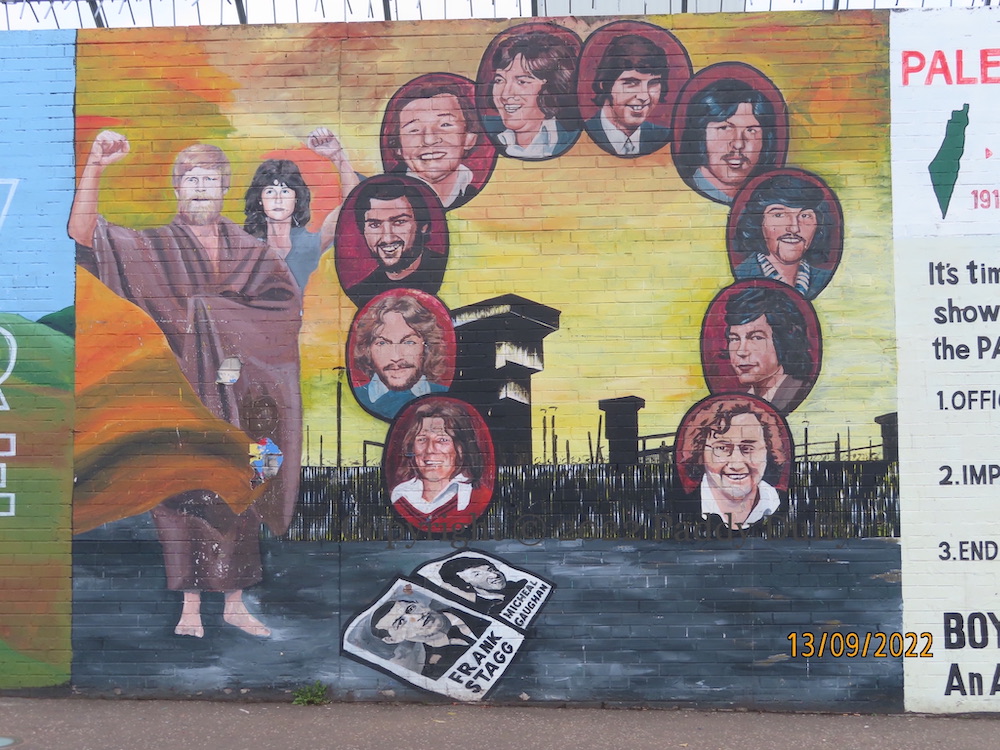
In 2014, after the Nugent/Hughes mural at the corner of Divis and Northumberland Streets (see Belfast’s Infamous Prison) was painted out to make way for a pro-Catalonia vote mural (see Votes About Votes), Kieran Nugent was added to the hunger-strikers mural further down the international wall, along with Mairéad Farrell, who was the second person, after Nugent, to refuse to wear a prison uniform. In 2016, that mural was revised for the Easter Rising centenary, by painting Kilmainham jail in the background. This background was later changed (c. 2019) to the watch-towers of Long Kesh, as shown above.
The Great March Of Return was a six-week protest by Palestinians in Gaza. Most protestors at the border fence with Israel were non-violent but there are reports of some with rocks, burning tyres, Molotov cocktails on a kite, and an AK-47 (WP). It ended (officially – incidents have continued) on May 15th, Nakba Day, the “day of the catastrophe”, meaning the displacement of Palestinians in the 1948 war. The protest demanded that refugees be allowed to return home – there are 1.1 million living in Gaza. During the protest more than 100 Palestinians died, many by live fire by Israeli forces, and more than 13,000 were injured. According to the mural above, “It’s time the Irish Government show some humanity and act for the Palestinian people. 1. Officially recognise the state of Palestine. 2. Impose economic sanctions on Israel. 3. End all diplomatic ties with the apartheid state. Boycott Israel, an apartheid state.”
The wheelchair protester shown on the right is double amputee Saber Al-Ashkar. He has not, however, been reported dead, as the text below the image (and reports on Twitter and elsewhere) suggests: “They took his land, his legs, and finally his life.” The death might refer to another such protestor Fadi Abu Salah, who was killed in May (Alaraby) (or Ibrahim Abu Thuraya, who was shot in December 2017 – Independent obituary). The UN Commissioner for Human Rights called the killing “incomprehensible” (Guardian); an internal IDF investigation found that Abu Thuraya was not shot by Israeli snipers (Times Of Israel).
The mural was was originally painted without the carton of Cookie Dough ice-cream in Al-Ashkar’s sling. Vermont-based ice-cream maker Ben & Jerry’s announced that it would no longer sell its products in the Occupied Palestinian Territory which it says is subject to an “internationally recognised illegal occupation”. In response, Israel threatened parent company Unilever with “extreme consequences” (Reuters).
“Foremost in my tortured mind is the thought that there can never be peace in Ireland until the foreign, oppressive British presence is removed, leaving all the Irish people as a unit to control their own affairs and determine their own destinies as a sovereign people, free in mind and body, separate and distinct physically, culturally and economically.” The quote is from day one of Bobby Sands’s hunger strike diary (March 1st, 1981) and the photograph is a 2007 image of a cell in the H-4 (Irish Times).
“Maghaberry – Portlaoise – Hydebank. Republican prisoners still exist!” IRPWA (web) board on Divis St, Belfast, replacing the Sands & Hughes mural – see Caırde Agus Comrádaıthe.
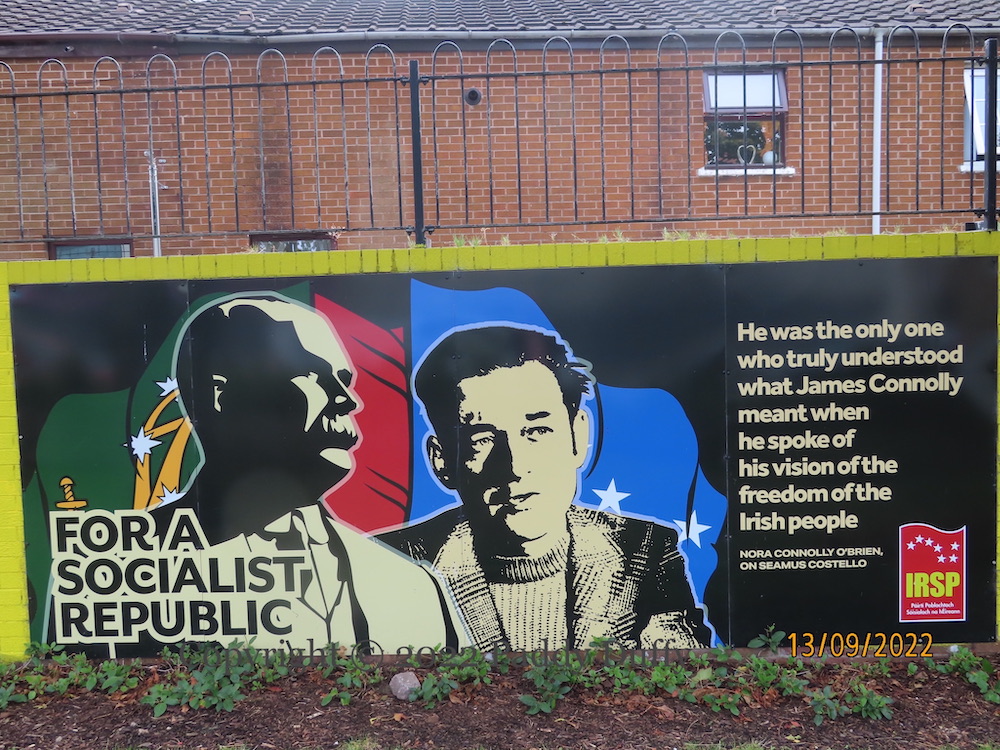
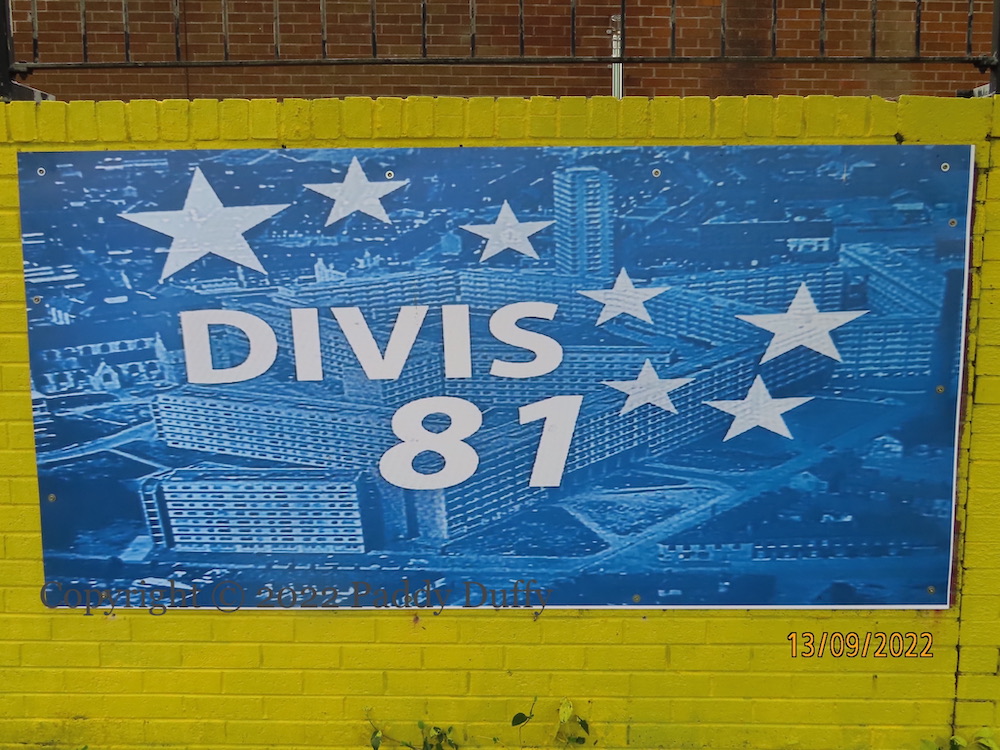
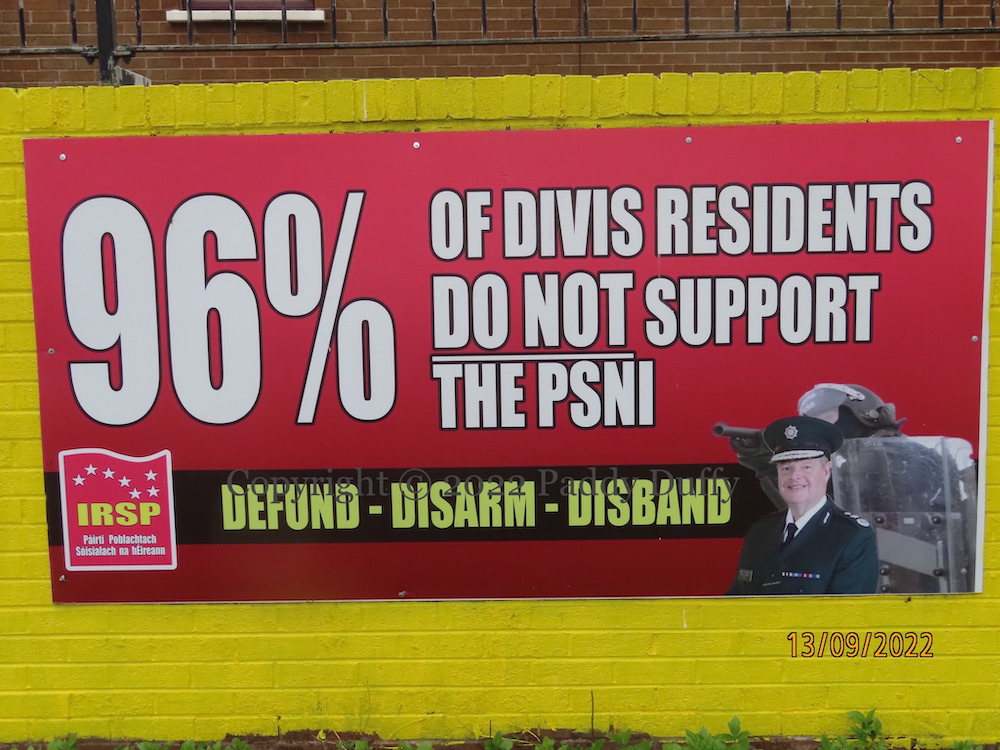
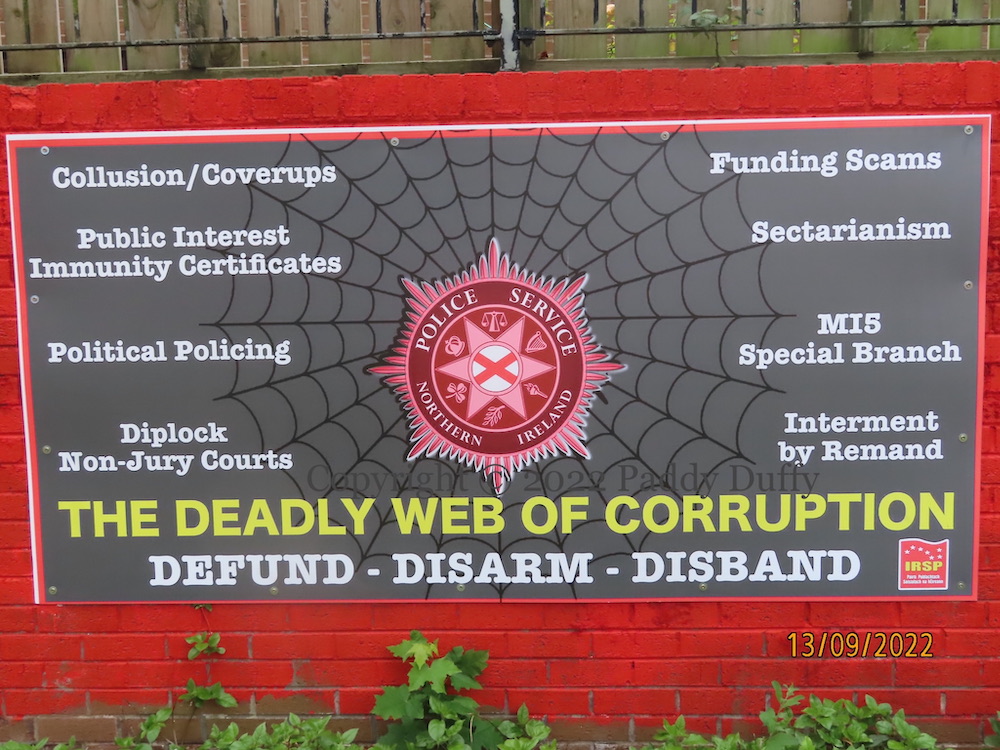
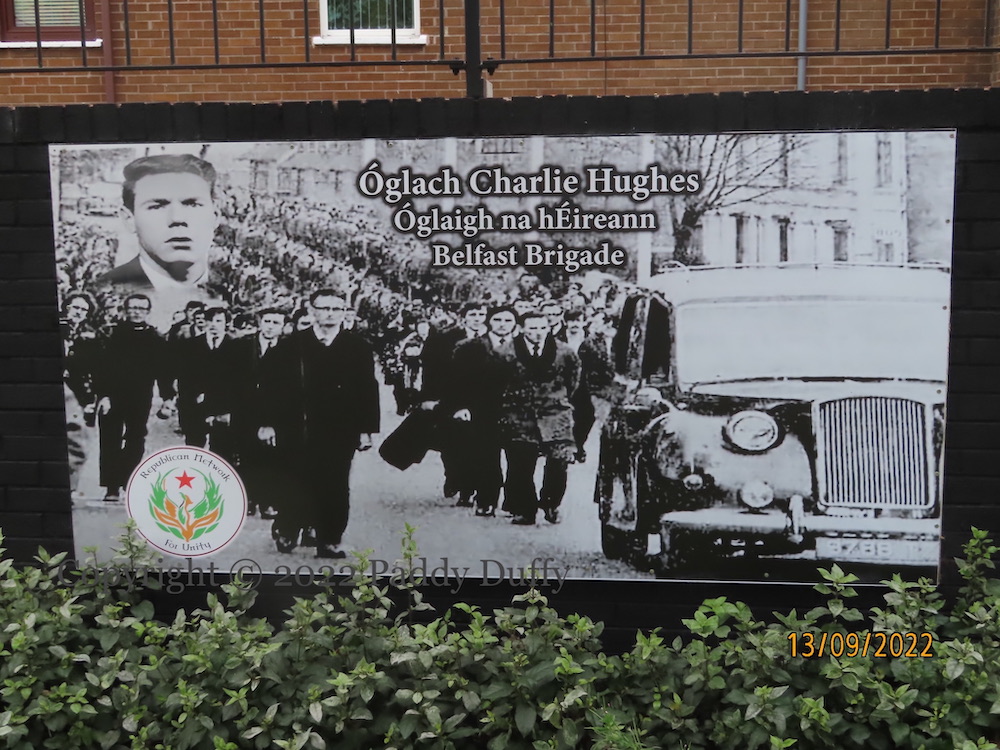
Here is a gallery of the republican boards along the low wall just east of the Falls garden of remembrance. From right to left: James Connolly and Seamus Costello; Divis 81; anti-PSNI; “web of corruption”; Charlie Hughes (killed in 1971 the feud with the OIRA); the Falls Curfew featuring Máıre Drumm; Billy McKee, Alec Murphy, and Brendan Hughes; the Falls Road Massacre 1920; Kieran Abram – Abram was knocked to the ground in the early hours of July 5th, 1992, and kicked to death by loyalists in running battles with nationalists on North Howard Street, near the old British Army sangar. Four people were convicted of manslaughter in the case (Judiciary NI).
“History of the death of Sean McCartney. This memorial was placed here on Saturday 8th May 2021 to mark the 100th anniversary of the death of Vol Sean “Johnny” McCartney of no. 55 Norfolk Street, Falls Road, Belfast. Sean was a volunteer of “D” Company 1st battalion Belfast Brigade Oglaigh na hEireann, when he was killed in action, aged 23 years old. He died while on active service with the 3rd Northern Division, 3rd County Cavan Brigade flying column during the Irish Republican War of Independence. He was shot twice during an ambush and gun battle with the British Army RIC and Black and Tans on Sunday 8th May 1921 on Croghan Mountain at the Lappanbane stretch of the Lappanduff Mountain, Co. Cavan. His body was then mutilated by the Black and Tans. Sean’s body was kicked, stamped on, danced on and tied by the ankles and feet to a Crossley Tender military vehicle and dragged along mountain lanes in an attempt to instill fear in the local Co. Cavan community. The 32 county Irish republic based on the self determination of the Irish people which Sean and many others fought and died for has yet to be achieved. Sean will always be proudly remembered by his extended family circle in Ireland and Canada.” McCartney is buried in Milltown cemetery.






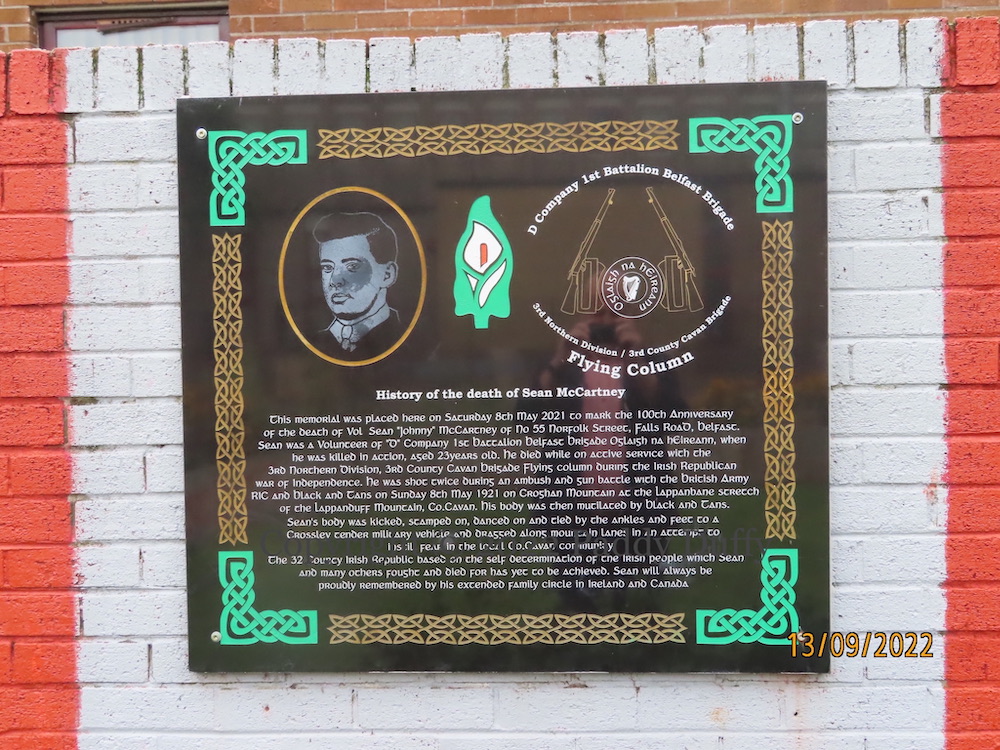

 Paddy Duffy Collection