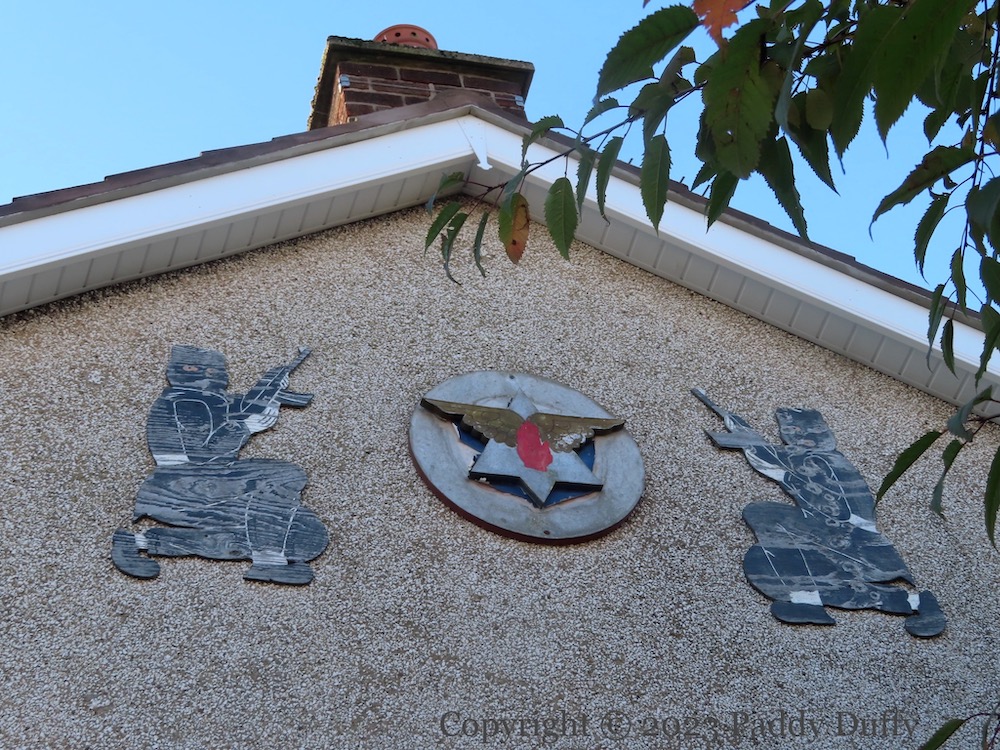
The plaque above – “Ormeau Road in memory [of] Fergie” – is now somewhat incongruously above painted signage for a coffee-and-donuts shop (Bunelos | web) on the Ormeau Road, a commercial road which is also at the edge of the Ballynafeigh neighbourhood.
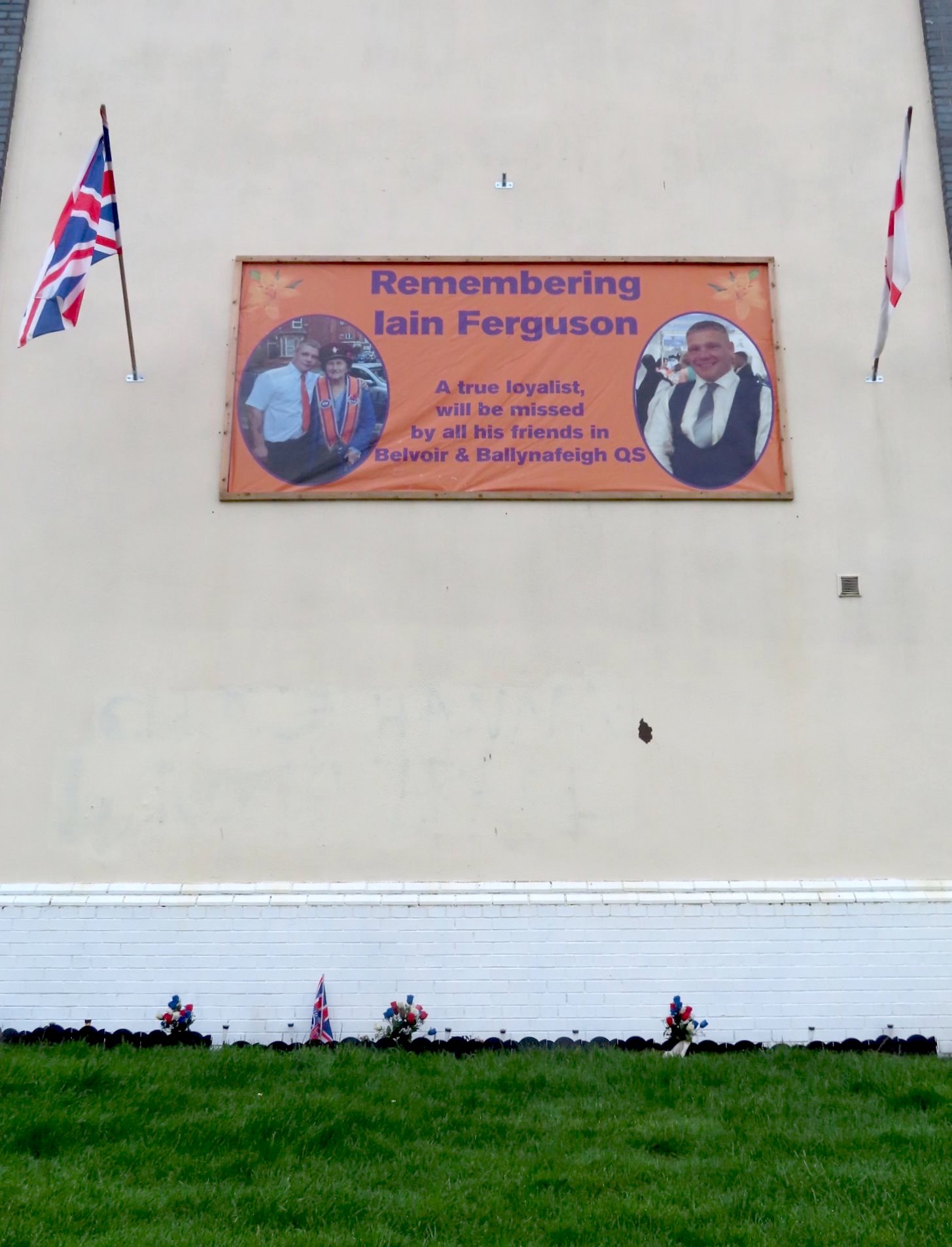
“Fergie” is perhaps Iain Ferguson, who died in 2021 (Belvoir & Ballynafeigh UPRG on Fb) and is remembered in a tarp on the side of the flats in Belvoir, shown below. (UPRG is affiliated with the UDA – hence the red hand and the six-pointed star in the plaque, alongside the flowers of the four nations – rose, shamrock, daffodil, thistle – and orange lily.)
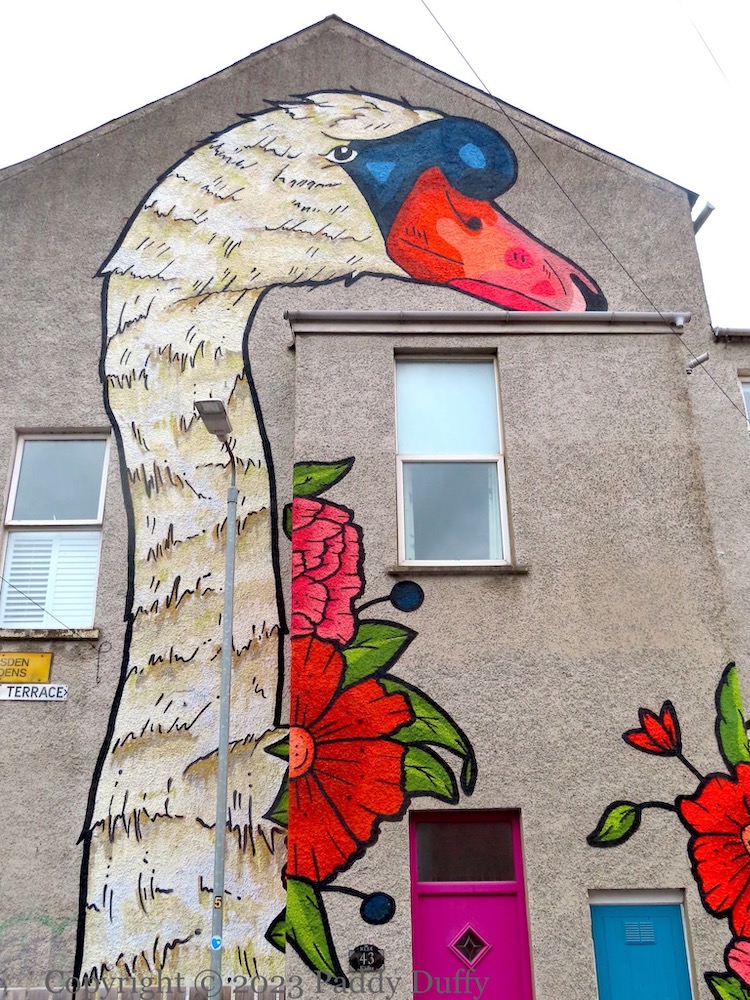
There are lots of different fowl in the Waterworks but the swan is synonymous with the place. Belfasters have been saving up the heels of their loaves and taking them to “feed the swans” at the Waterworks since the reservoir was bought by the Corporation and modified to attact wildfowl in 1956 (Belfast Entries) – it provided an encounter with wild animals and was a free and fun family activity. Disease struck the swans in 1995 (Irish Times) and more than 50 died of avian flu during lockdown (November 2021-January 2022 – Belfast Media | Belfast Live has some upsetting photos) but there are still more than enough for the tradition to persist, though feeding them is now generally discouraged as an unnecessary human intervention.
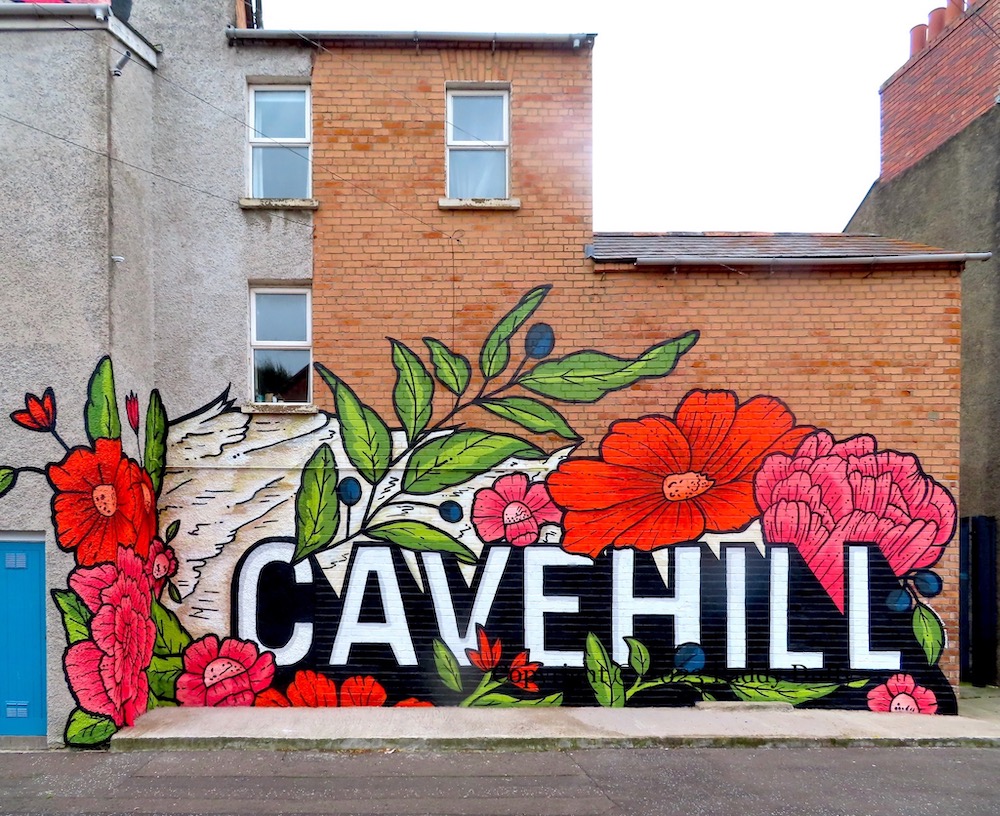
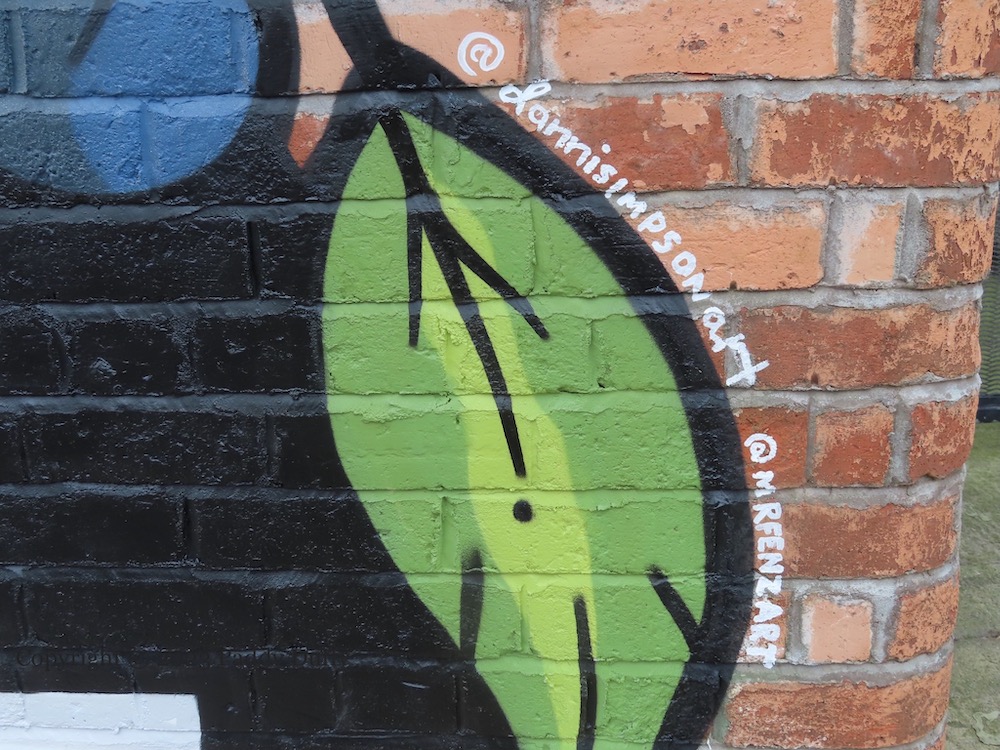
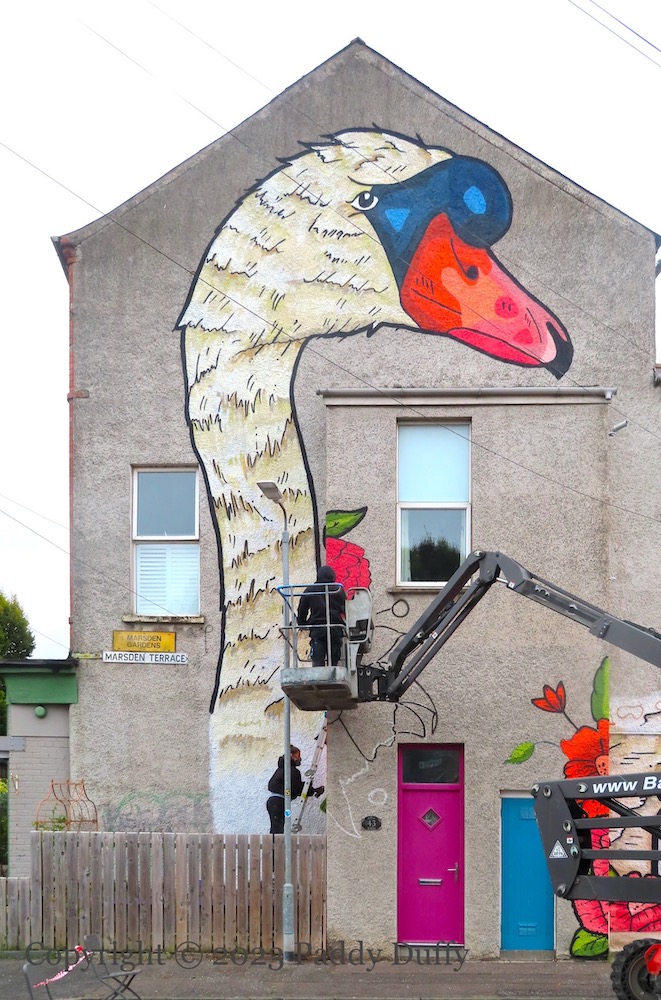
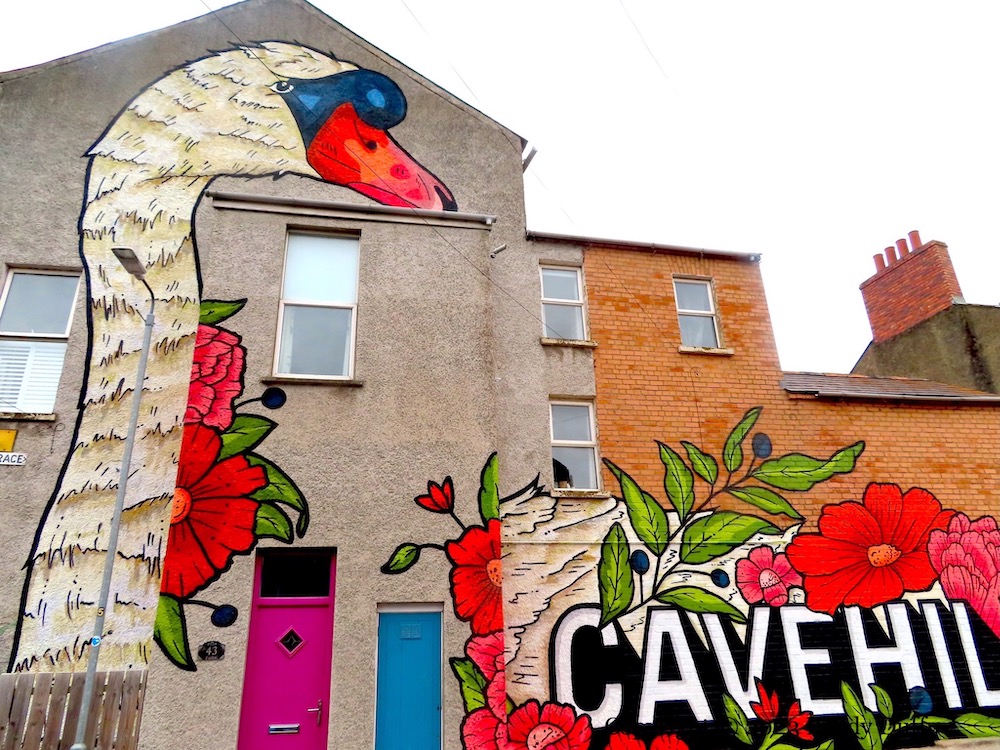
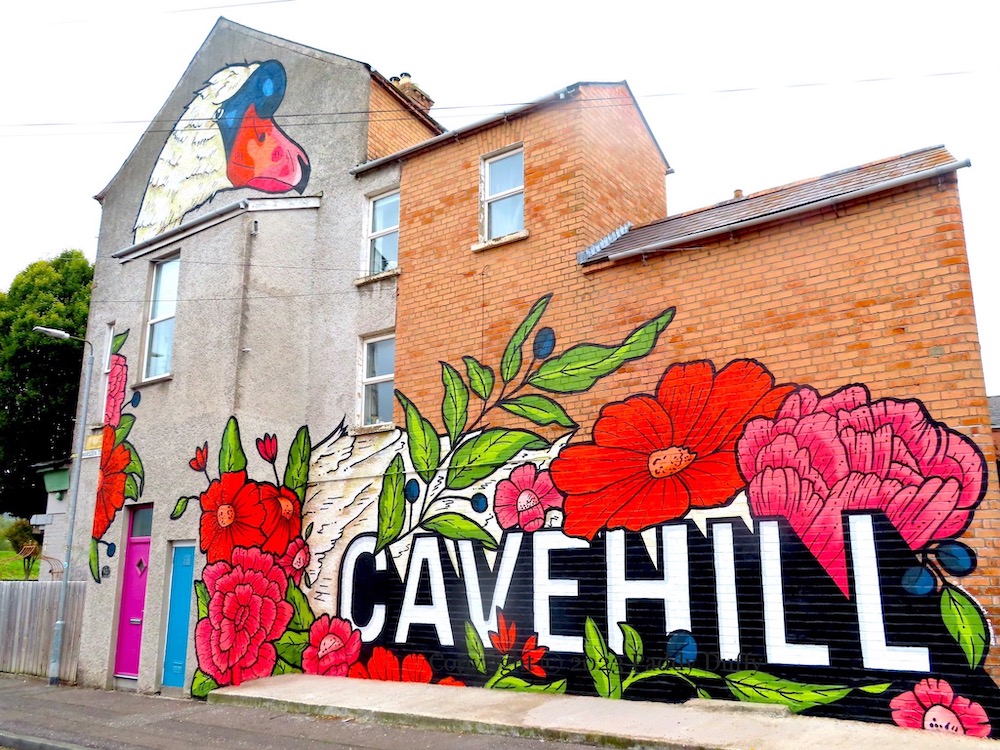
As a tribute to the iconic bird and its long tradition in north Belfast, Danni Simpson (ig) and Mr Fenz (ig) have painted this larger-than-life swan on the side-wall of a coffee shop next to the upper reservoir.
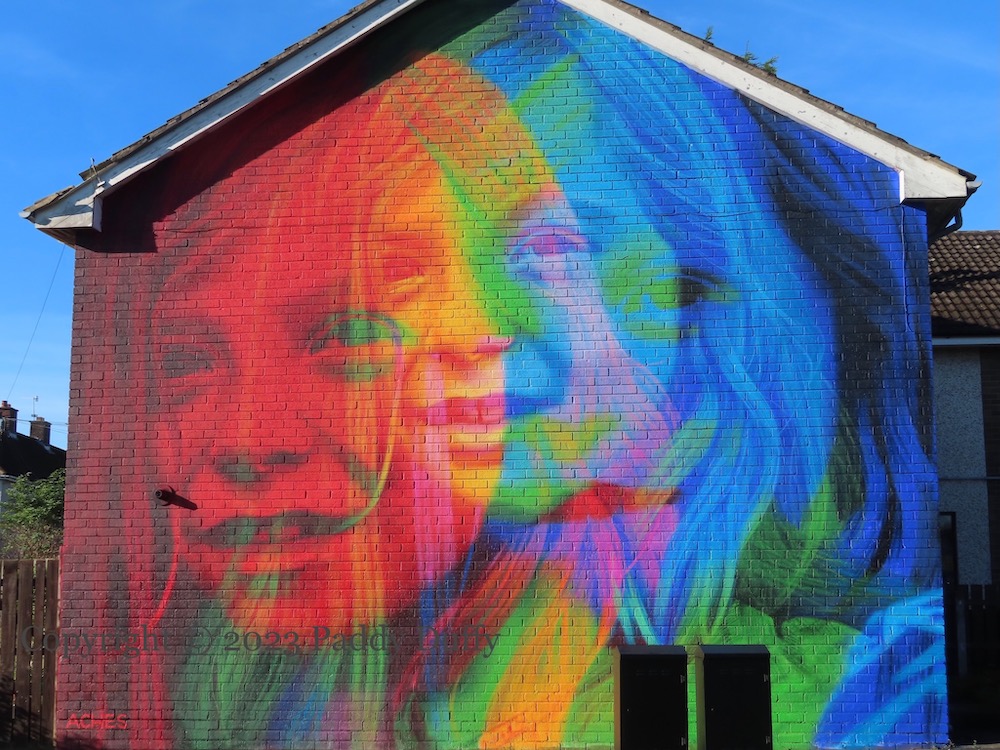
The Executive Office’s Communities In Transition programme aims to tackle “residual paramilitary activity and associated criminality” in eight areas of Northern Ireland, including the Northland/Sunnylands area of Carrickfergus, which until now has not had any street art. (It does have some community art, also sponsored by Communities In Transition.) They have sponsored this piece of street art by Aches (ig) — reproducing in overlapping triplicate a photograph of a local girl (Fb) taken by Derry photographer Megan Doherty (web) — in Drumhoy Drive, next to the ‘residual paramilitarism’ shown below: a Red Hand Commando board.
This Castlemara, Carrickfergus, board is not remarkable so much for what it depicts — the new prince and princess of Wales, “baron & baroness of [sic] Carrickfergus” — but for what it replaces, namely, the Carrickfergus Eddie, which had been in place since (at least) 2000 — see Show No Mercy.
This means that there are no large murals of Eddie remaining; there are only some smaller versions of Eddie of boards or tarps. Eddie has his own Visual History page.
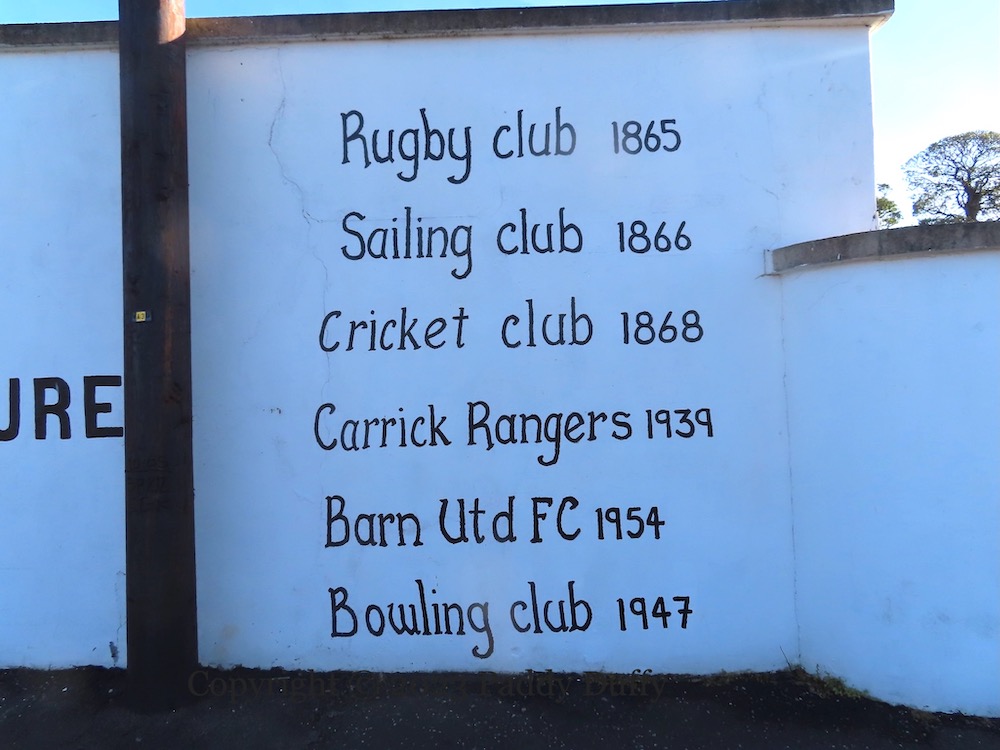
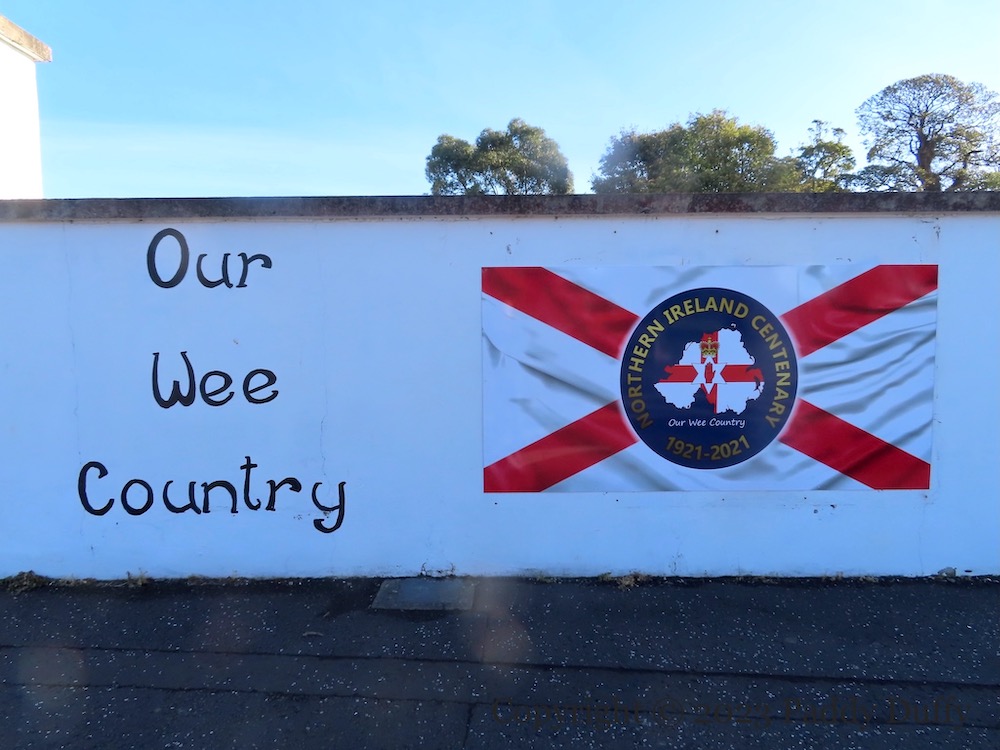
This is the second (at least) iteration of an installation along Taylor’s Avenue, Carrickfergus, showcasing the Ulster-Scots heritage of Carrickfergus and its later contributions to the United Kingdom.
The wall is 60 metres/200 feet in length and can be divided into about ten distinct panels – notes on the different panels are given below, following the order of presentation of images, which show the entire wall moving from left to right.
The original, as seen on Street View, included boards showing the Pretani Isles/British Isles, QEII, and Tom Moore. As seen here, there are now boards to King Charles III, a vintage postage stamp, ‘The Siege Of Carrickfergus’ in 1689, and ‘The Barn Mills Fallen’ of WWI.
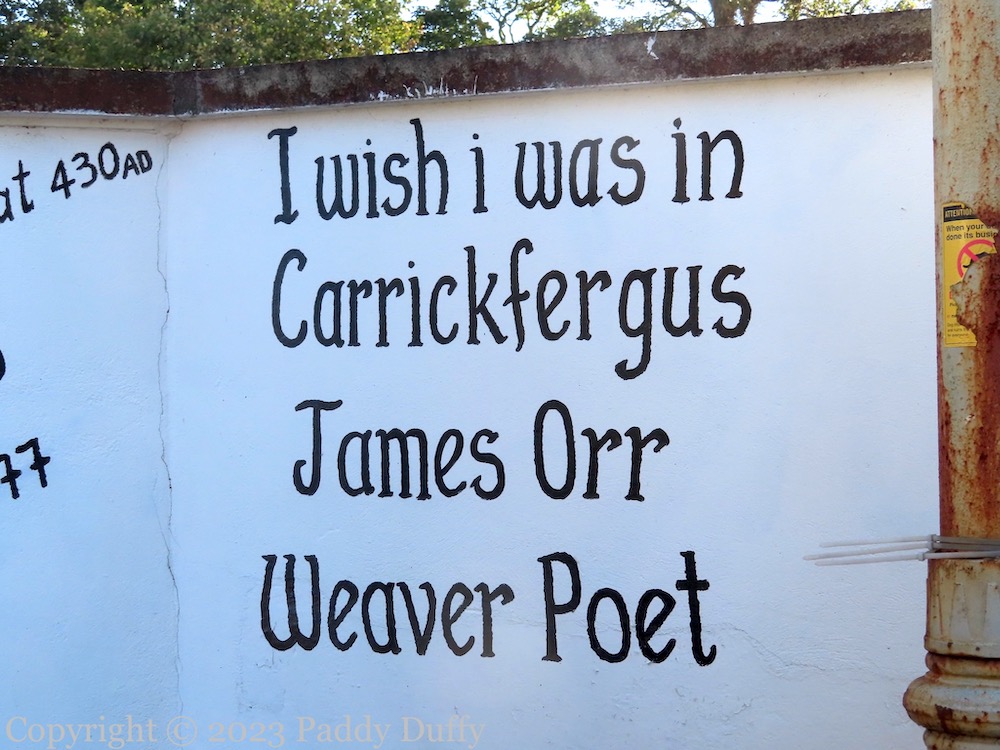
James Orr, the ‘Bard Of Ballycarry’, was a contemporary of Robert Burns and a United Irishman. It does not appear that he wrote a poem with the line “I wish I was in Carrickfergus”.
Daniel Cambridge won his VC for service in the Crimean War (WP) and James Crichton for service in WWI (WP).
CarrickfergusHistory includes “the oldest know map of Carrickfergus” from 1560, employing the spelling “Kragfargus”.
The 2/6 postage stamp featuring Carrickfergus Castle was one of four in a “Castle series” in 1955 (WP).
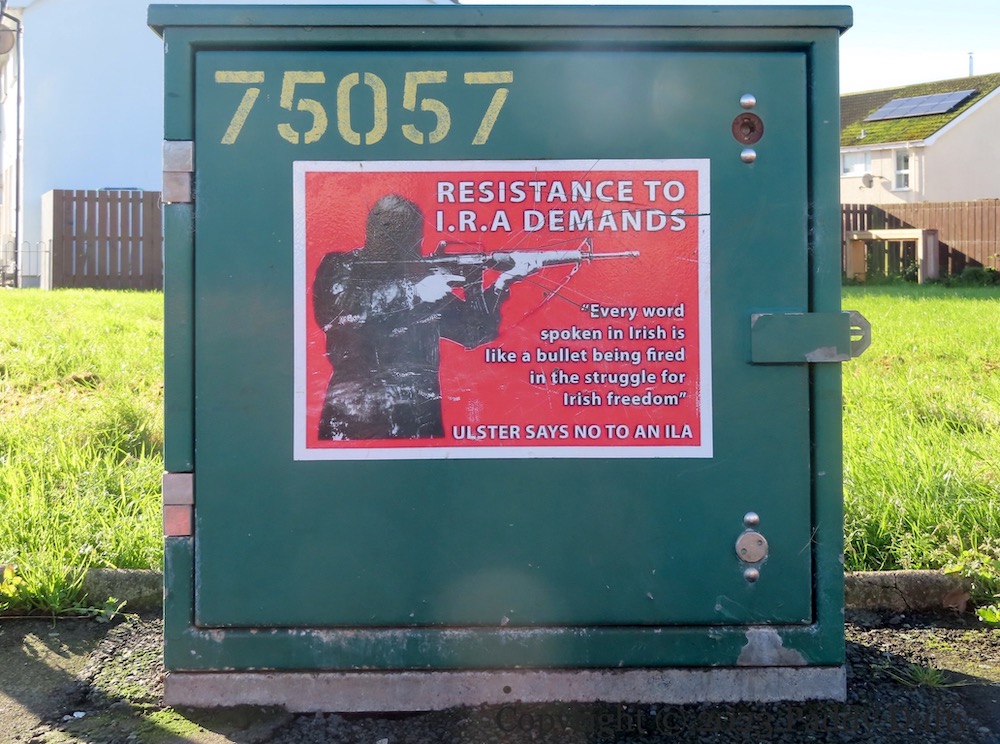
“Resistance to IRA demands – “Every word spoken in Irish is like a bullet being fired in the struggle for Irish freedom” – Ulster says no to an ILA.” The precise wording and the author of the quotation are unclear. Nelson McCausland of the DUP gives it as “Now every phrase you learn is a bullet in the freedom struggle” and attributes it to Sınn Féın’s Pádraıg Ó Maolchraoıbhe in May 1982 (BelTel | Nelson’s View). The Irish language is not, of course, the exclusive property of militant republicanism, and, although the IRA has ceased its campaign and decommissioned its weapons, it is used here in conjunction with an image of a gunman firing an assault rifle in order to provoke fear against an Irish Language Act. The bill – enacted by Westminster rather than Stormont – became law last (2022) December (BBC). The poster dates from 2022 or 2021.
This Castlemara, Carrickfergus, board is notable for its background, which follows that of old coronation and jubilee portraits. These would show the royal couple (and sometimes immediate family) in plush surroundings and standing in front of chairs. This style of composition has been seen in murals of George V’s jubilee in 1935 and George VI’s coronation in 1937 — see Visual History 01. In this board, however, Philip and Elizabeth are portrayed in old age and are not in coronation gear; the chairs shown are from the Throne Room in Buckingham Palace.
Also notable is that the board replaces a UDA mural – see Joint Manoeuvres. The other UDA mural in the estate — Carrickfergus Eddie — has also been replaced.
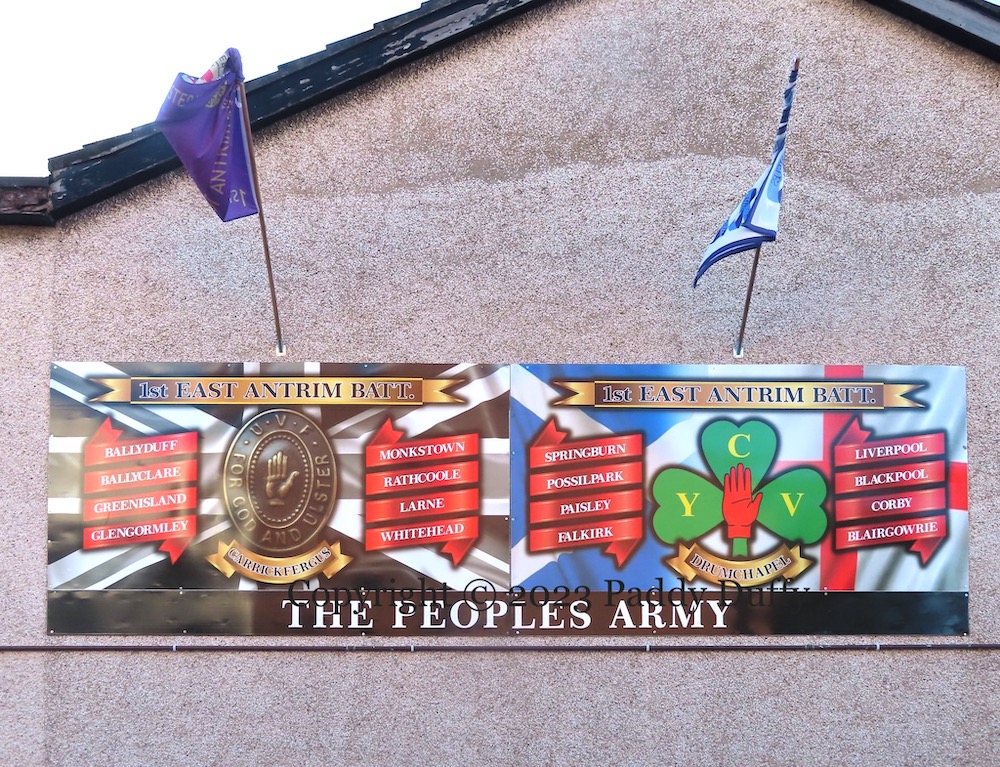
For the UVF/YCV gunmen in the background of the wide shot, see Out Of The Trenches.
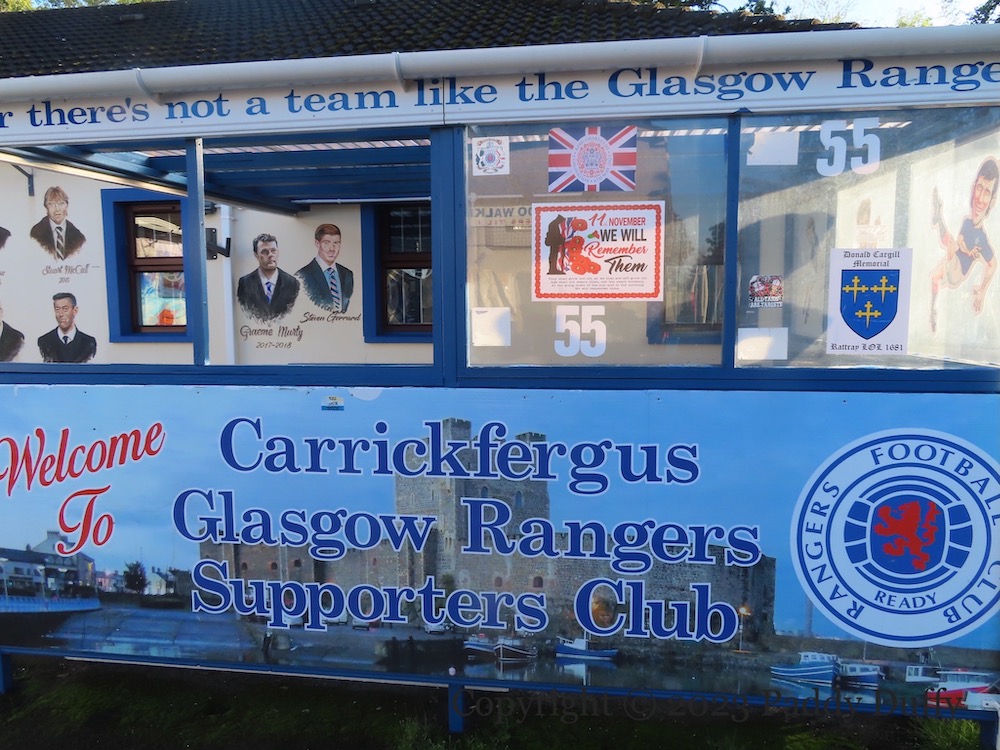
“Let others come after us – we welcome the chase.” The exterior wall of the Carrickfergus Rangers Supporters Club presents a gallery of the club’s managers from 1899 to 2018. In order they are William Wilton, Bill Struth, Scot Symon, David White, William Waddell, Jock Wallace, John Greig, Graeme Souness, Walter Smith, Dick Advocaat, Alex McLeish, Paul Le Guen, Ally McCoist, Stuart McCall, Mark Warburton, Pedro Caixinha, Graeme Murty, Steve Gerrard (and since then, there have been Giovanni van Bronckhorst, Michael Beale, and (currently) Philippe Clement).
“In memory to all who fought and gave their lives.” This is the tribute to the Ulster Division at the Carrickfergus Rangers Supporters’ Club, citing the words of Wilfrid Spender “I am not an Ulsterman but yesterday, the First of July [1916], as I followed their amazing attack, I felt that I would rather be an Ulsterman than anything else in the world.” (For more of Spender’s tribute to the 36th Division, see I Am Not An Ulsterman.)
“All gave some; some gave all.” During its twenty-two years of operation, 197 UDR soldiers were killed. The scroll on the left gives the dates of the regiment’s operation: 1970 (April 1) was the year it replaced the Special Constabulary, and 1992 (May 31) was the year seven of the nine battalions were amalgamated with the Royal Irish Rangers’ two battalions to form the (modern) Royal Irish Regiment (WP) – the piper in the top right is carrying a flag of the Royal Irish Regiment.
The inscription on the plaque reads: “Ulster Defence Regiment mural, dedicated on the 19th March 2016 by Chairman Roy Burton, Carrickfergus Glasgow Rangers Supporters Club [and] Chairman Stephen Weir, Carrickfergus Ulster Defence Regiment Association CGC. Lest we forget.”














 Paddy Duffy Collection