The (colour) RNU phoenix and the Craigavon 2 “Free The Innocent” tarp have been joined by a Cogús fist grasping a strand of barbed wire – Cogús (Fb) is (was?) the prisoners’ welfare arm of the RNU.
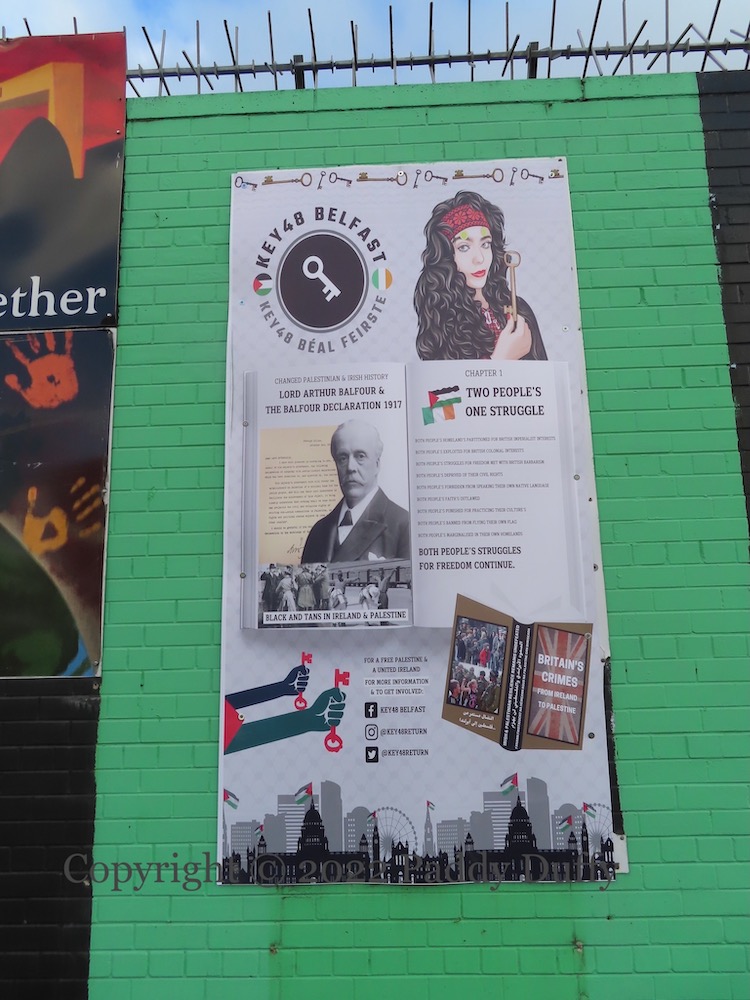
“Britain in Palestine & Ireland” The Balfour Declaration of November 1917 is seen as a pivotal moment in the history leading to the what is formally known as the State Of Israel, as it made the UK the first major government to endorse the idea of a homeland for Jews (WP).
This board on Northumberland Street draws parallels between Ireland and Palestine: homelands partitioned for British imperialist interests, struggles for freedom met with British barbarism … forbidden from speaking their native tongue, faiths outlawed … . About 650 former RIC members were recruited to the “British Gendarmarie” that would police what was called “Mandatory Palestine” (Palestine Studies | Irish History) after WWI.
The League Of Nations mandate putting the UK in change of the Palestinian territory was replaced (in 1947) by a UN plan for partition, which triggered an internal war between Jews and Arabs, and when the UK ended the mandate and evacuated from Palestine in May 1948, Israel declared independence and neighbouring Arab states entered the conflict. About 700,000 Arabs were displaced during the fighting. Key48 (tw) advocates for the right of return and uses as a symbol the keys that householders took with them when they fled.
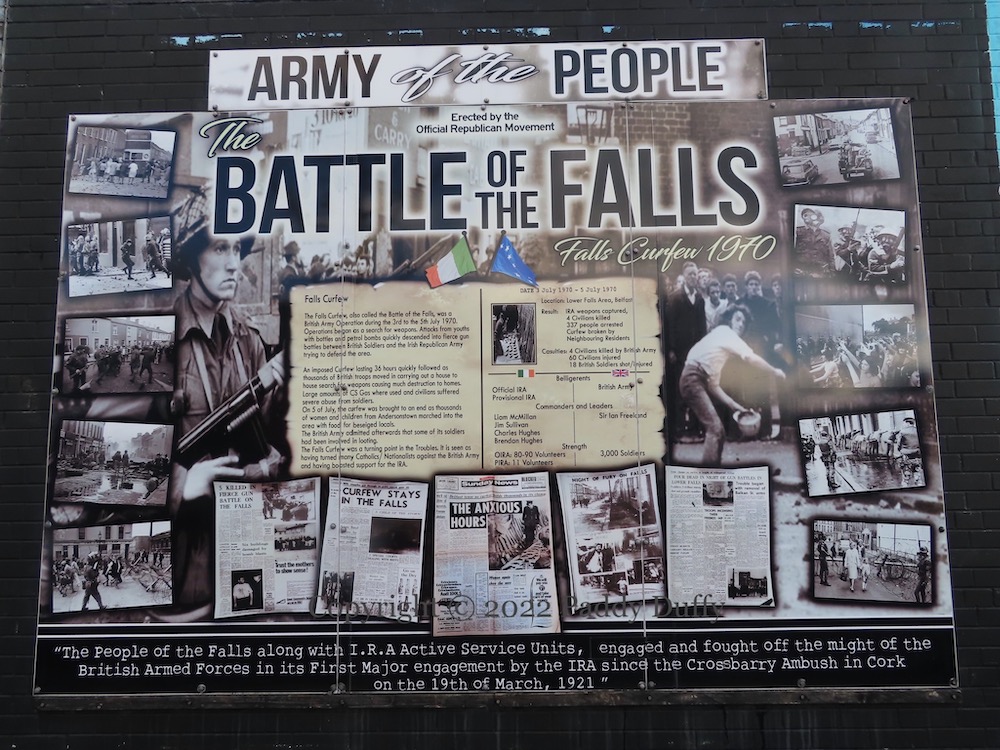
Four people were killed in the course of The Falls Curfew, the 36 hours from July 3rd to 5th in 1970 during which 3,000 houses on the lower Falls were cordoned off after a weapons search of the area devolved into a riot. The curfew ended with a march of women and children from Andersonstown bearing relief (represented in Falls Curfew 1970).
This board has a dual purpose. On the one hand, it was part of celebrations marking the 75th anniversary of the Battle Of Britain, which was waged from July to October in 1940. On the other, it is part of an anti-racism project, celebrating in particular the contributions to the Battle made by roughly 145 Polish aviators (WP) and especially the 303 squadron: “The Polish nation – part of us then, part of us now”. The 303 was later stationed in Northern Ireland for a time. (BBC-NI)
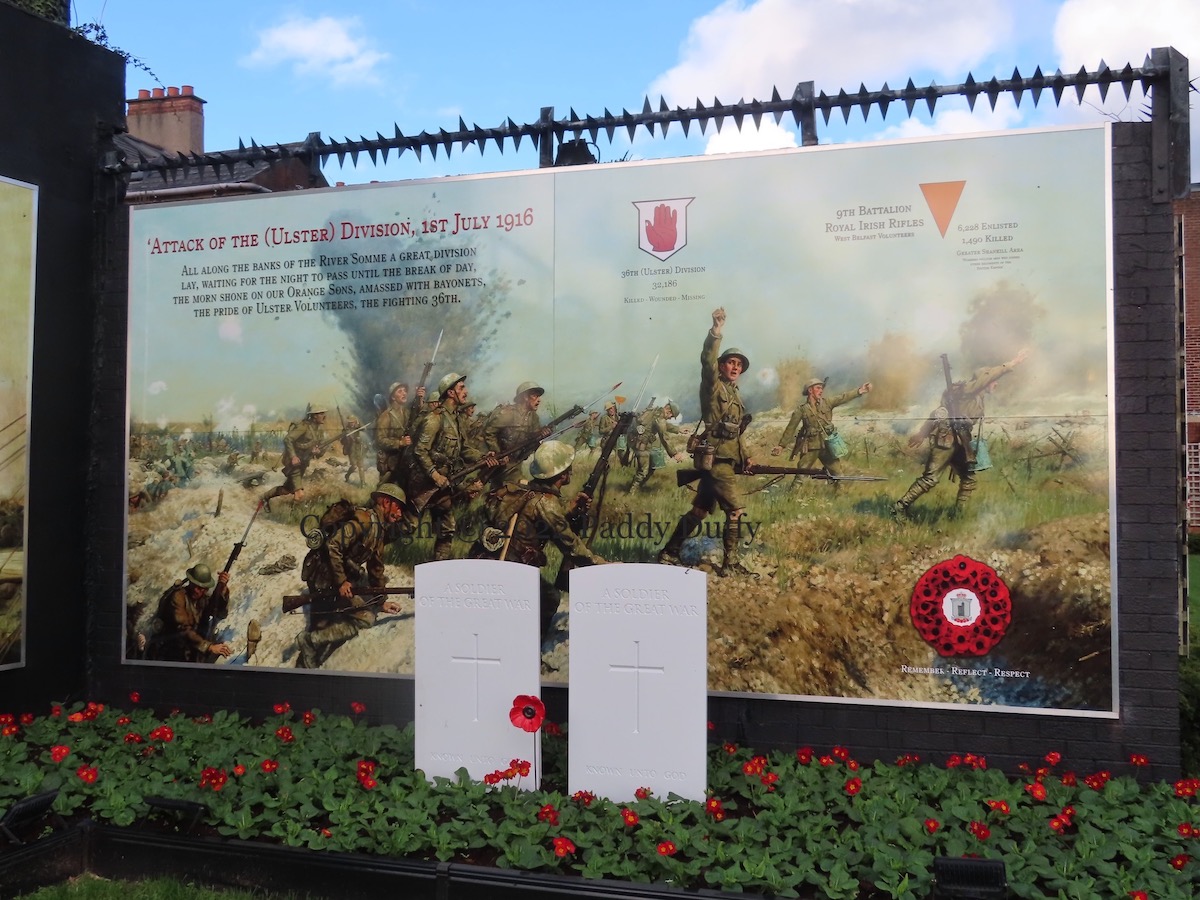
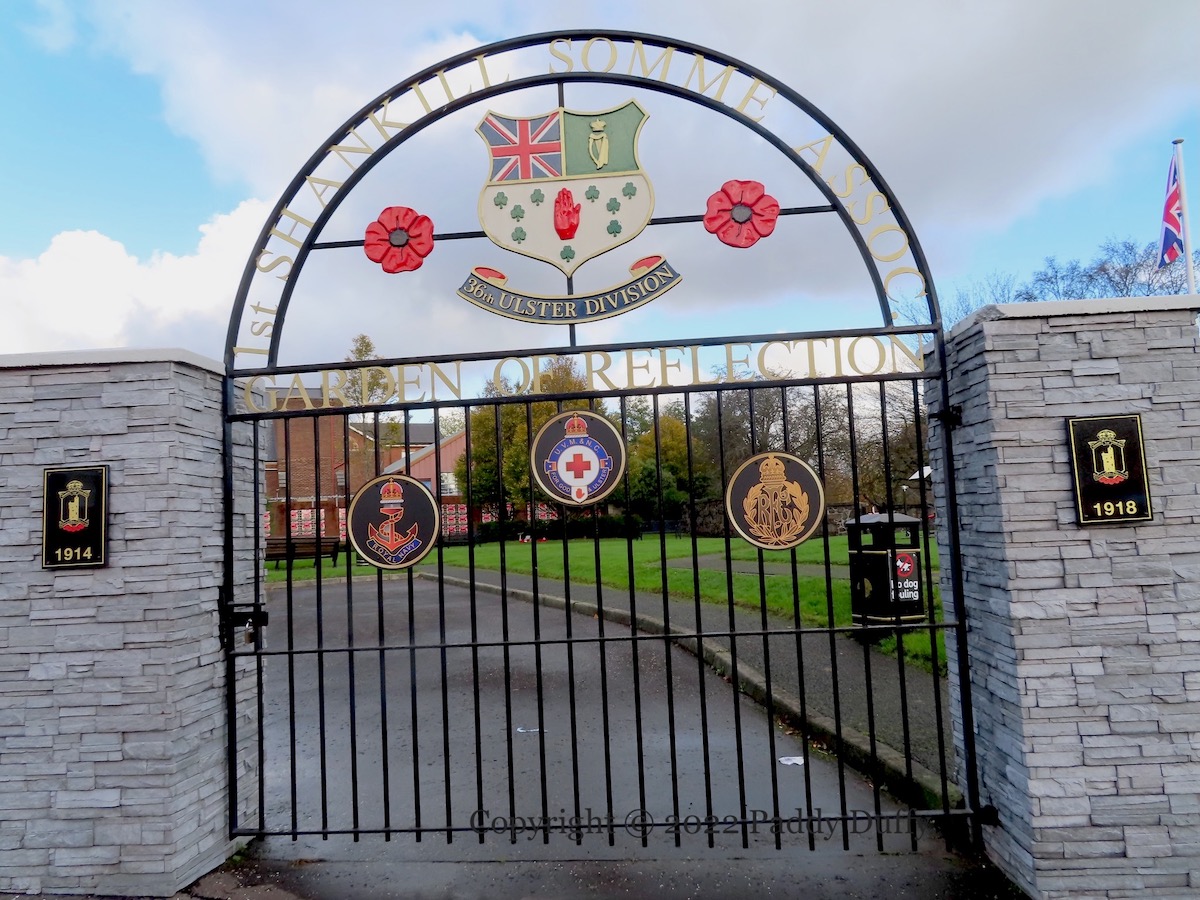
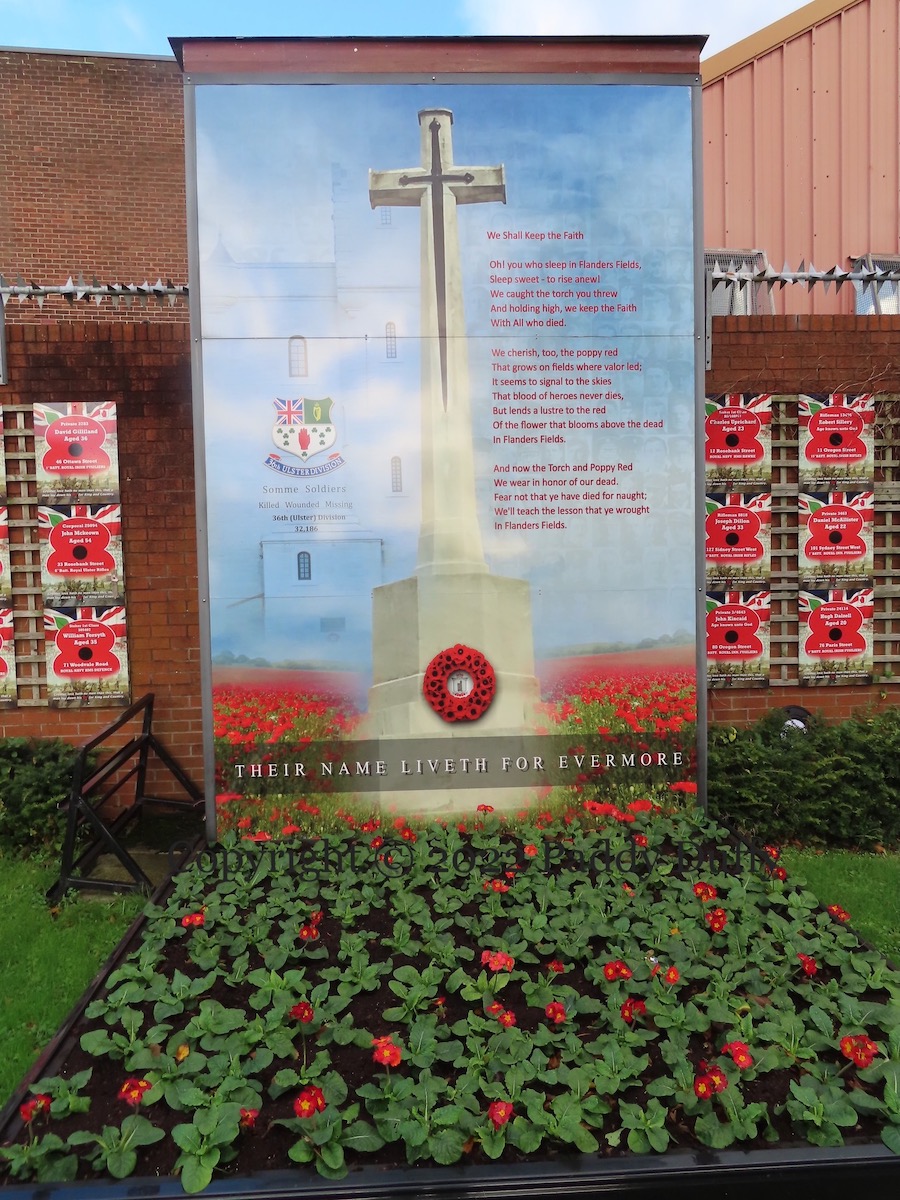
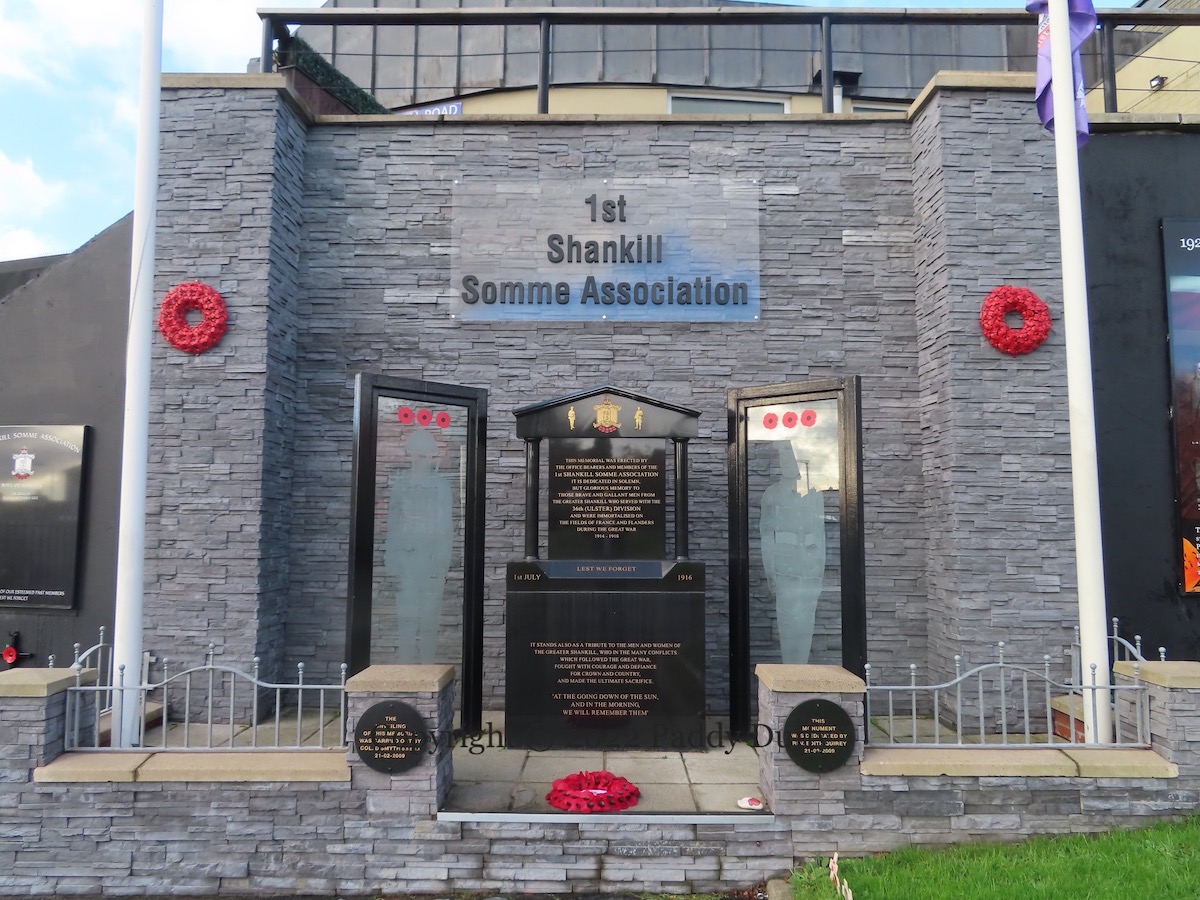
The Shankill Somme Association’s garden of reflection has added a number of new boards.
The board shown above is JP Beadle’s painting “Battle of the Somme: Attack of the Ulster Division”, which hangs in Belfast City Hall (militaryprints.com). It replaces a painting of a soldier in a field of poppies, seen in The Great War.
To its left is John Singer Sargent’s painting “Gassed”, showing the “aftermath of an indiscriminate mustard gas attack on British forces during the Battle of Arras 21st August 1918” (which also forms a part of a memorial in east Belfast) with the GK Chesterton quote “The true soldier fights not because he hates what is front of him, but because he loves what is behind him”.
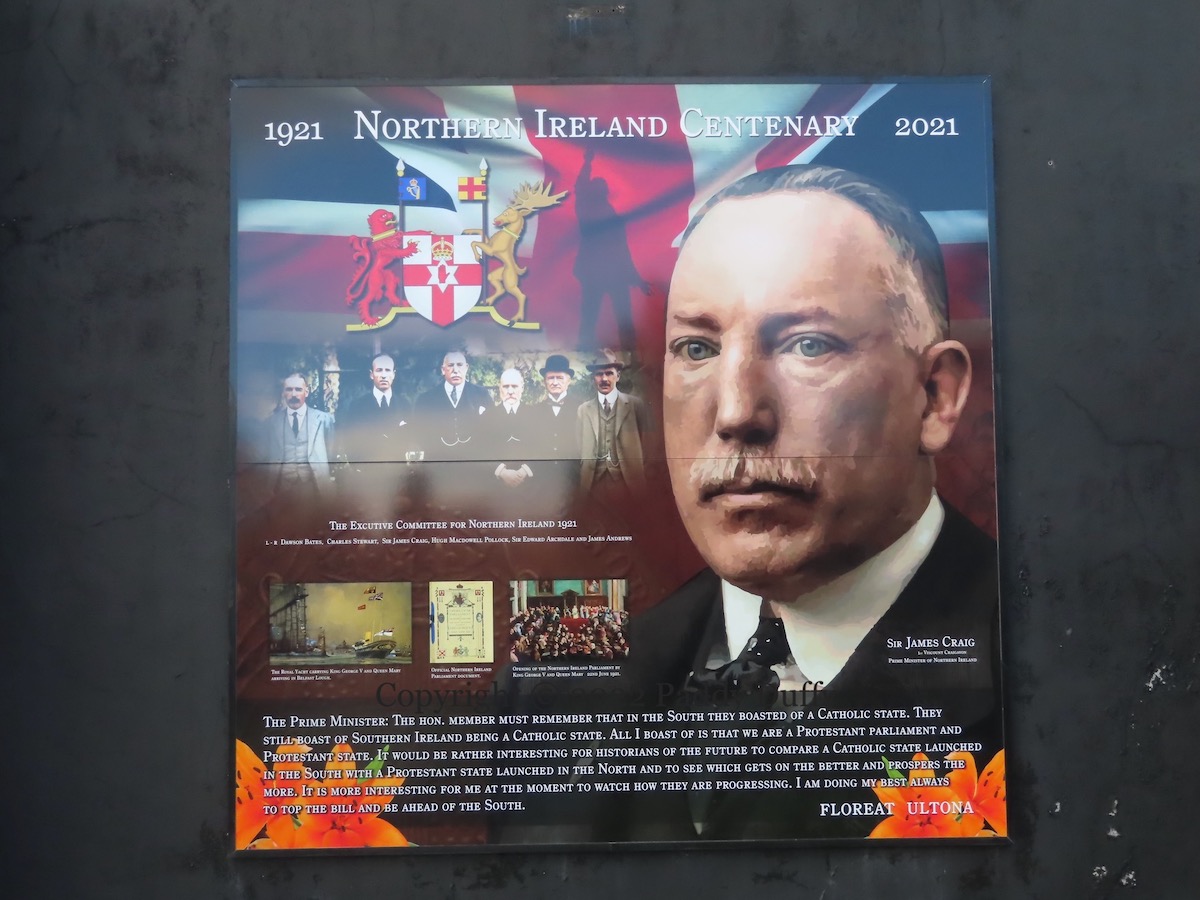
Also new – and somewhat out of place – is the Northern Ireland Centenary board featuring James Craig: “It would be rather interesting for historians of the future to compare a Catholic state launched in the south with a Protestant state launched in the north and to see which gets on the better and prospers the more”. There are other “floreat Ultona” boards/murals in the Village (focusing on the B Specials and UDR) and in Rathcoole (where “Ulster welcomes her King and Queen”).
There are also three insignia on the gates (compare with M05717), to the Royal Navy, the Ulster Volunteer Medical & Nursing Corps, and the Royal Flying Corp.
Previously (c. 2017), the undead soldiers of We Shall Not Sleep were replaced with an image of the Cross Of Sacrifice memorial – the original is in Ypres, Belgium but there is also one in the City Cemetery – see One In Design And Intention. At the same time, the poppy plaques for individual local soldiers and the image of the Menin Gate were also added.
The Flanders Field board appears to have survived since 2012 – see Somme Memorial.
The final image below shows the new stone surround for the main memorial. See (again) Somme Memorial.
These three panels form a single installation at the top (Woodvale) end on the Shankill Road. The one above celebrates the ties between Belfast and the Stirling & District Campsie Club, a branch of one of the associated clubs of the Apprentice Boys Of Derry. It features the cannon “Roaring Meg” (“presented by the Fishmongers Company of London 1642″) which is used as the seal for the club, the club’s flag which includes a red hand of Ulster, the key to the gates, and the emblem and coat of arms of the Apprentice Boys.
“Formed on the 2nd May 1987 we have been at the forefront of loyalist culture in our area since then and were the first club in Scotland to have a Battle of the Somme Commemoration Parade. Since our inauguration we have formed many friendships with our brethren and bands from the province many of which are still active today. For many years the club has participated with Belfast Campsie Club at the closing of the gates parade in December. We have through the years had great affinity with the many bands from Belfast some who are unfortunately no longer with us. The club would like to thank the people of Belfast for their support and friendship through the years and to the people of the Shankill for giving us the privilege of this murals. No surrender.
The Campsie Club is the only Apprentice Boys Club to be named after one of the “Brave 13″. It is persumed presumed that Henry Campsie was the first man to shed blood in the Defence of Londonderry. Campsie was the inspiration behind the Shutting of the Gates and was severely wounded whilst leading his associates to secure the City Magazine and armoury. The emblem of the Roaring Meg was adopted as the Seal of the new club.”
The middle panel celebrates the Stirling Protestant Boys Flute Band and its association with the Shankill Road: “Stirling Protestant Boys Flute Band [Fb] were formed in February 2003 and to this day take part in parades across Scotland, England and Northern Ireland. The band has a great connection with our friends from Belfast, especially those from the Greater Shankill area. In November 2012 Stirling Protestant Boys were presented with the battle honours of the Young Citizen Volunteers and the 36th (Ulster) Division. The band would like to thank the people of the Shankill Road for their continued support.”
The third celebrates the Apprentice Boys contains a long description of the Shutting Of The Gates in December 1688 and the Siege Of Derry, which was ended with the breaking of the boom of the river Foyle in July 1689.
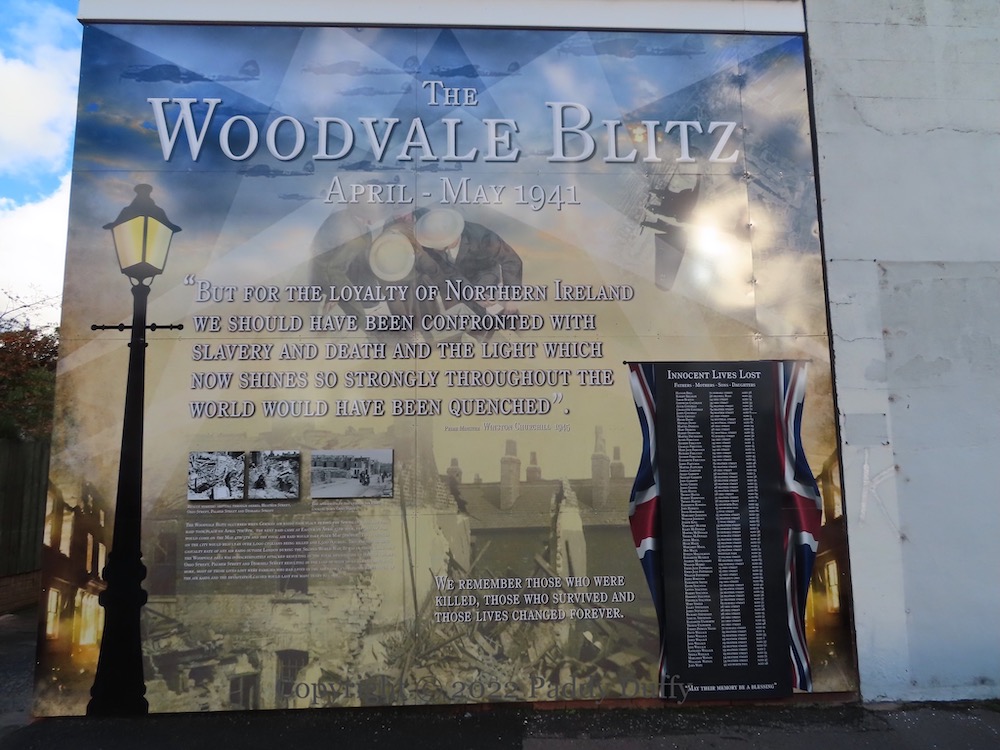
“The Woodvale Blitz occurred when German air raids took place during the spring of 1941. The first raid took place on April 7th/8th, the next raid came at Easter on April 15th/16th, the 3rd air raid would come on the May 4th/5th and the final air raid would take place May 5th/6th. These attacks on the city would result in over 1,000 civilians being killed and 1,5000 injured. This was the highest casualty rate of any air raids outside London during the Second World War. It was in these streets that the Woodvale area was indiscriminately attacked resulting in the total devastation of Heather Street, Ohio Street, Palmer Street and Disraeli Street resulting in the loss of many lives injuring 100’s more, most of those lives lost were families who had lived in the area for generations. The effects of the air raids and the devastation caused would last for many years to come.” The names of 79 victims are given on the right (see close-up below).
“The Woodvale Blitz April-May 1941. ‘But for the loyalty of Northern Ireland we should have been confronted with slavery and death and the light which now shines so strongly throughout the world would have been quenched’ – Prime Minister Winston Churchill 1945. We remember those who were killed, those who survived and those lives changed forever.”
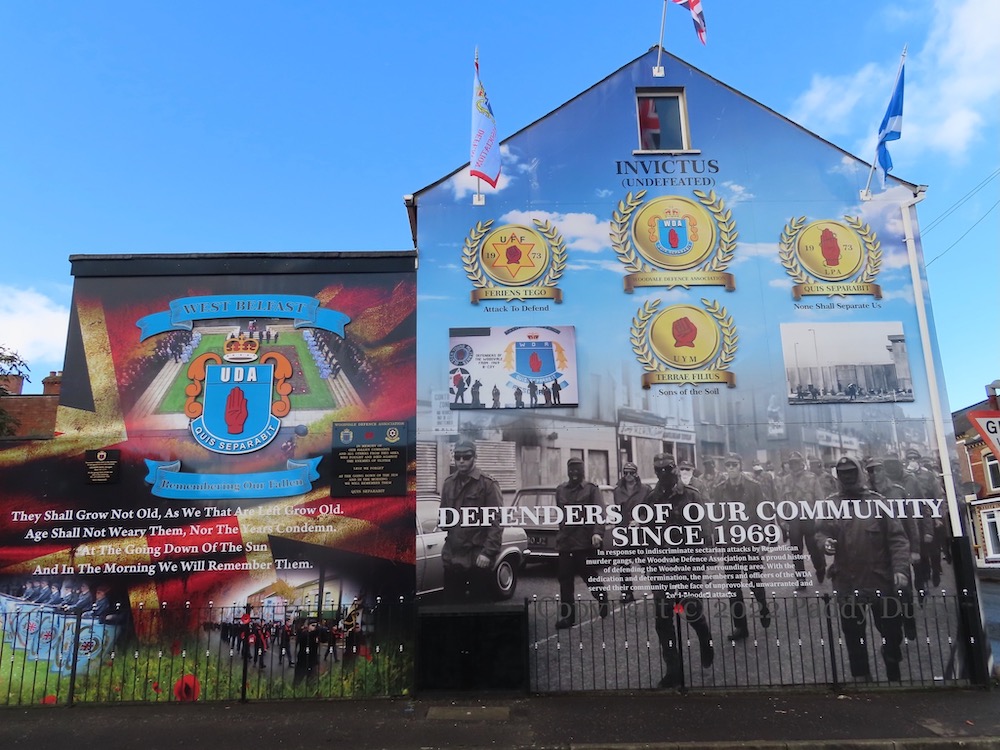
This printed display celebrates the creation of the Woodvale Defence Association as “Defenders of our community since 1969” which in 1971 merged with other associations to form the UDA, whose youth wing is the UYM (lower middle, “terrae filius” = “sons of the soil”) and which uses “UFF” (upper left, “feriens ego” = “attack to defend”) as a cover for military operation. The final emblem is of the LPA (Loyalist Prisoners’ Association, “quis separabit” = “none shall separate us”). The mural replaced by this one is in the bottom left, while the bottom right contains an image of Long Kesh in 1979. The main photograph is of a 1972 march on the Shankill.
On the side-wall, lines from Laurence Binyon’s poem For The Fallen of WWI are used: “They shall grow not old, as we that are left grow old/Age shall not weary them, nor the years condemn. At the going down of the sun/And in the morning we shall remember them.”
Both pieces are a combination of printed poster and attached boards.
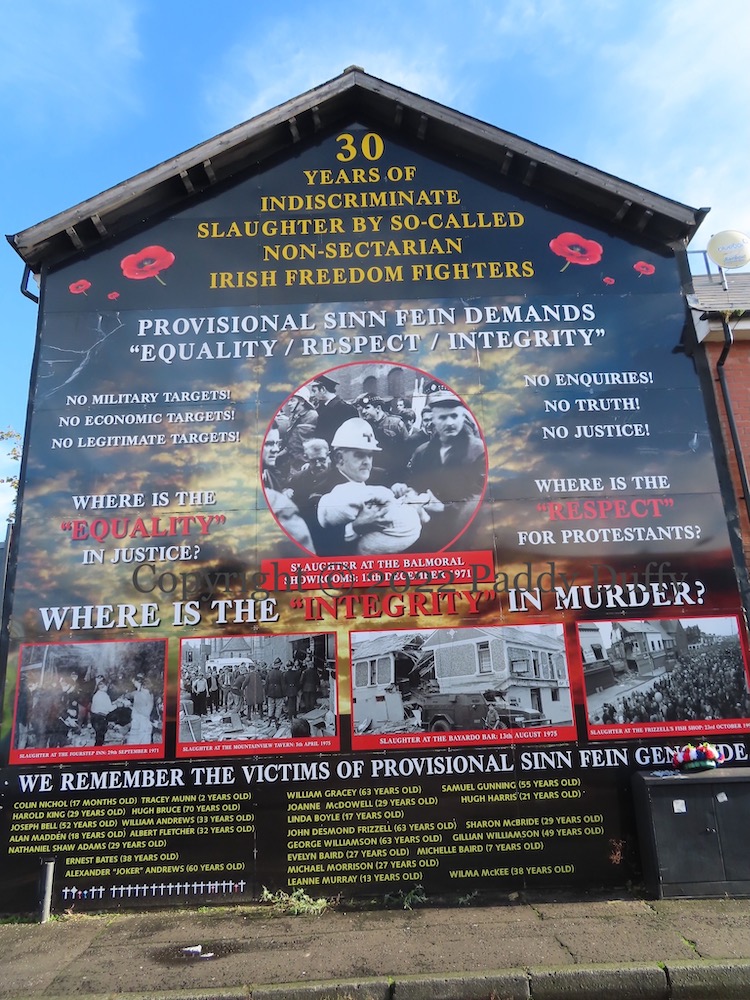
Twenty-five victims of five “Shankill atrocities” – at the Four Step Inn, the Balmoral Furniture Store, Mountainview Bar, Bayardo Bar, and (from the 1990s) Frizzell’s fish shop – are remembered in an updated board in Dundee Street. The central image remains 17-month-old Colin Nichol in the arms of ambulance man Bob Scott.
“30 years of indiscriminate slaughter by so-called non-sectarian Irish freedom fighters. Provisional Sinn Fein demands “equality/respect/integrity”. No military targets! No economic targets! No legitimate targets! No enquiries! No truth! No justice! Where is the “equality” in justice? Where is the “respect” for Protestants? Where is the “integrity” in murder? We remember the victims of Provisional Sinn Fein genocide.”
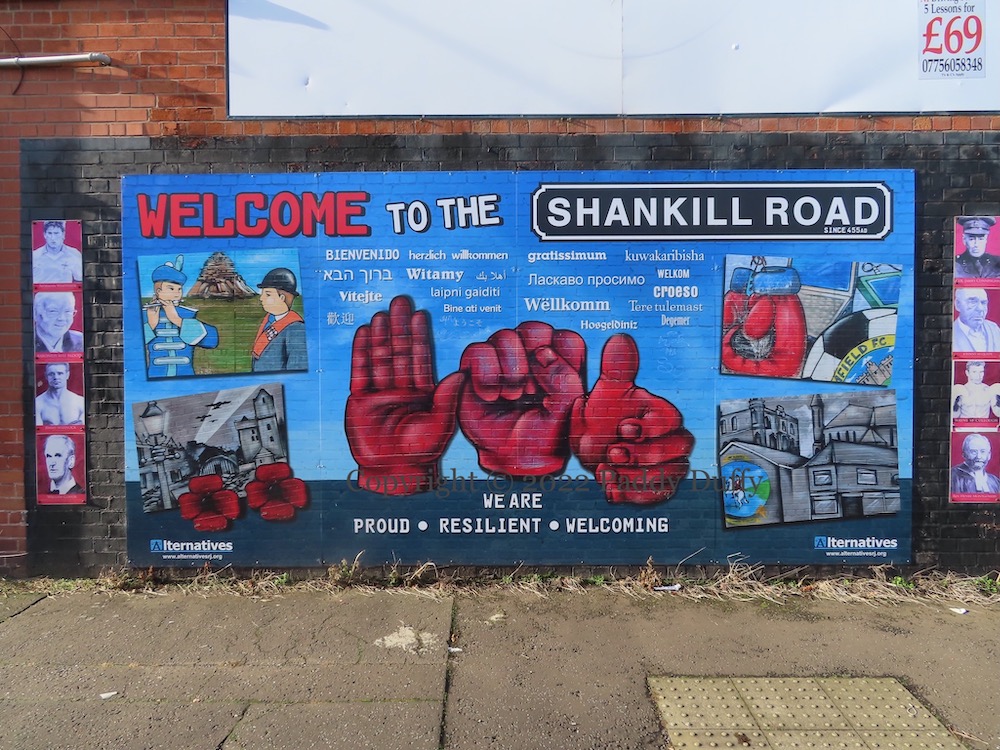
The mural is a version of the old Beverley Street ‘welcome’ mural (by Blaze FX), with the same four panels (parades/bonfire, blitz, sports, murals) and the same three hands. But instead of “Proud, Defiant, Welcoming” we now have “Proud, Resilient, Welcoming”. (I Am Not Resilient in the lower Shankill complains that the word is used to justify neglect and/or maltreatment.)
It escaped no one’s notice that, although the number of languages expressing a greeting is now much greater than the original ten, Irish is not included among them. Also Ulstèr Scots. (Also French, for some reason. Polish is included – “Witamy”). (See similarly “No Irish” in the lower Shankill estate but also All Flags Are Welcome in Divis, which omitted the Union Flag.)
Despite the appearance of bricks, the main panel is not in fact a mural but a board.
Gardiner Street. For the previous mural, see Welcome To The Shankill. Held over from the old mural are the two strips of ‘famous faces’ on the left and right.









 Paddy Duffy Collection