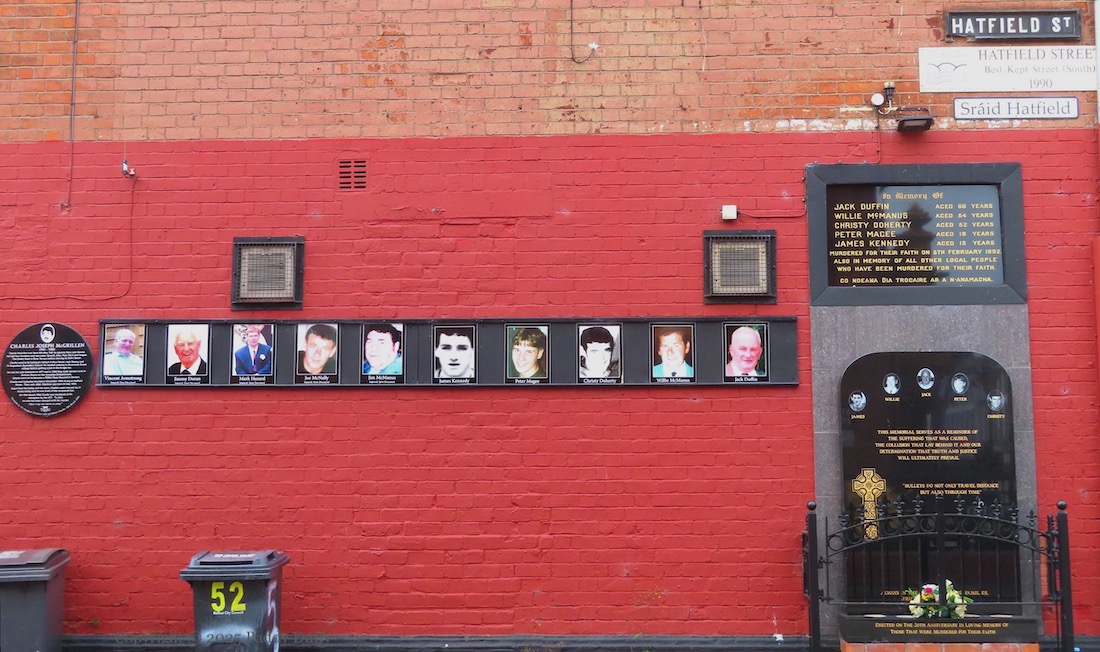
“Bullets do not only travel distance, but also through time.” Five people – Jack Duffin, Willie McManus, Christy Doherty, Peter Magee, and James Kennedy – were shot dead by the UDA in Graham’s betting parlour in February 1992. Their portraits, along with portraits of five others who are “injured, now deceased” – Vincent Armstrong, Jimmy Doran, Mark Hazard, Joe McNally, and Jim McManus – have been (permanently) added to the memorial in Hatfield Street.
The plaque on the far left is to Charles Joseph McGrillen, shot by the UDA/UFF in 1988 at his work in Dunne’s on the Annadale embankment (Sutton). (For a close-up, see the Seosamh Mac Coılle collection.)
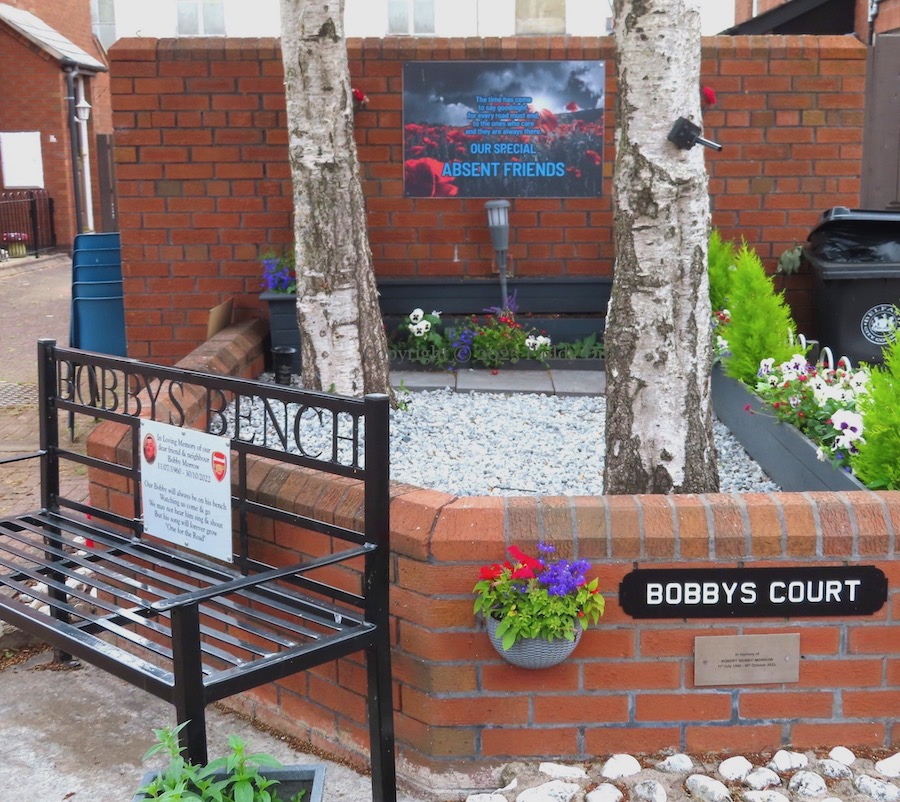
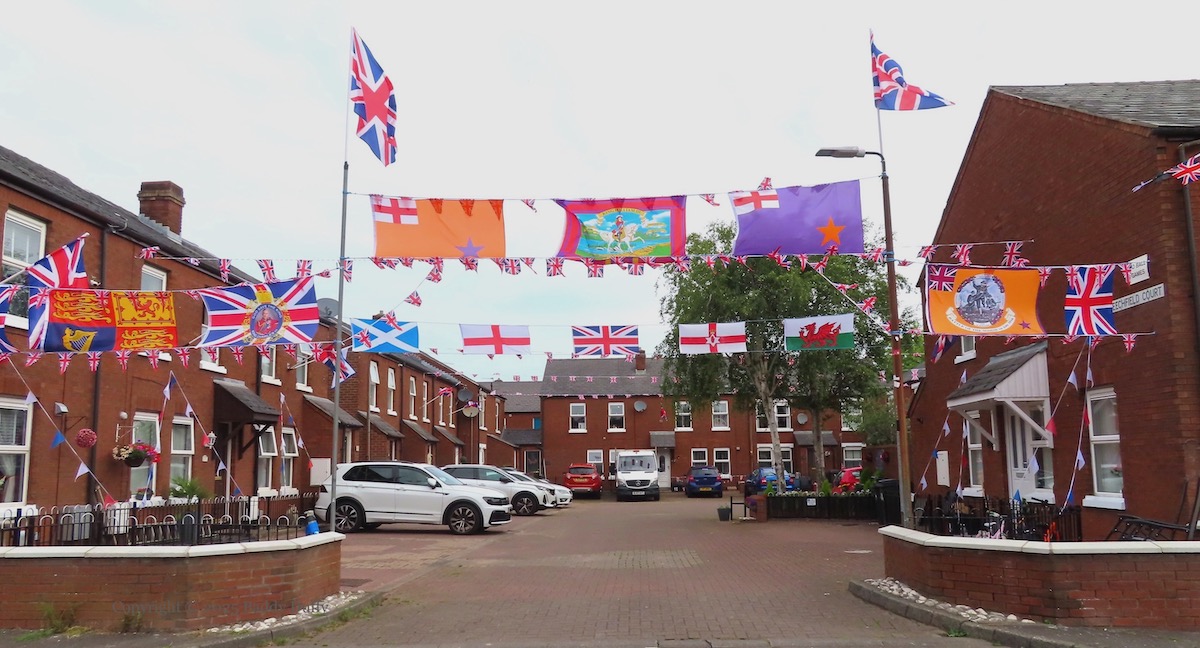
These are images of the scene in the run-up to the Twelfth in Beechfield Court (near “Ulster” Tower Street in east Belfast), including a small memorial to a local man who died in 2022, Bobby Morrow (Funeral Times).
“The time has come to say goodnight, for every road must end, to the ones who care and they are always there, our special absent friends.”
“In loving memory of our dear friend & neighbour Bobby Morrow 11/07/1960 – 30/10/2022. Our Bobby will always be on his bench/Watching us come & go/We may not hear him sing & shout/But his song will forever grow/”One for the Road””
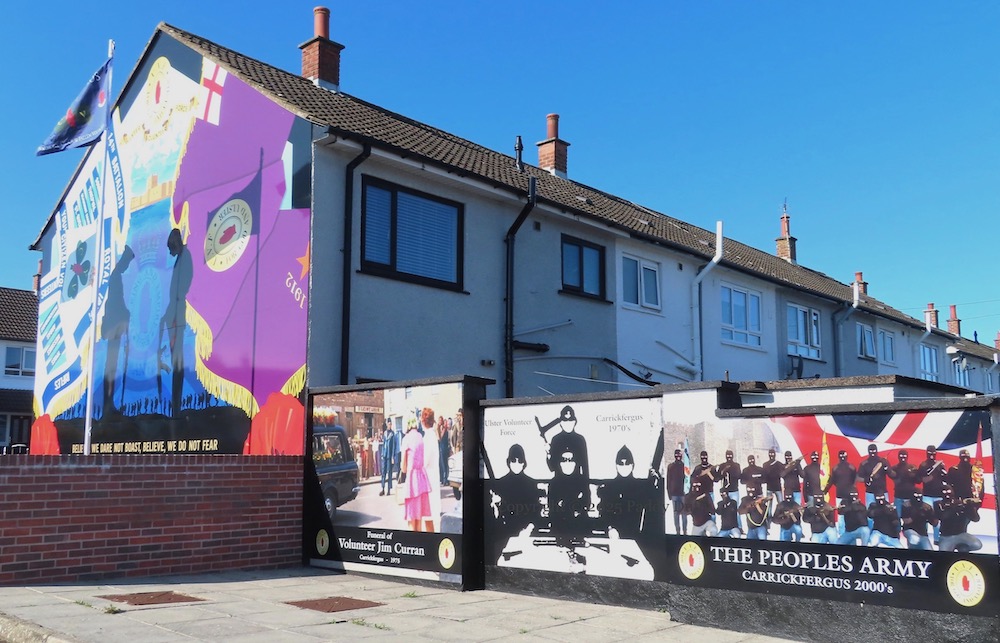
Rudyard Kipling’s 1912 poem ‘Ulster’ (Kipling Society) predicts destruction for Protestants under Home Rule and calls for violent resistance, even if it means sacrificing one’s own life: “Believe, we dare not boast/Believe, we do not fear/We stand to pay the cost/In all that men hold dear”.
As is well known, the Ulster Volunteers were founded and smuggled in weapons, but before they could be used, the Great War began and the Volunteers signed up for Kitchener’s Army – the flag on the left includes the battles in which the Central Antrim Regiment of the Royal Irish Rifles (as part of the 36th Division) participated, fighting “For King and Empire”.
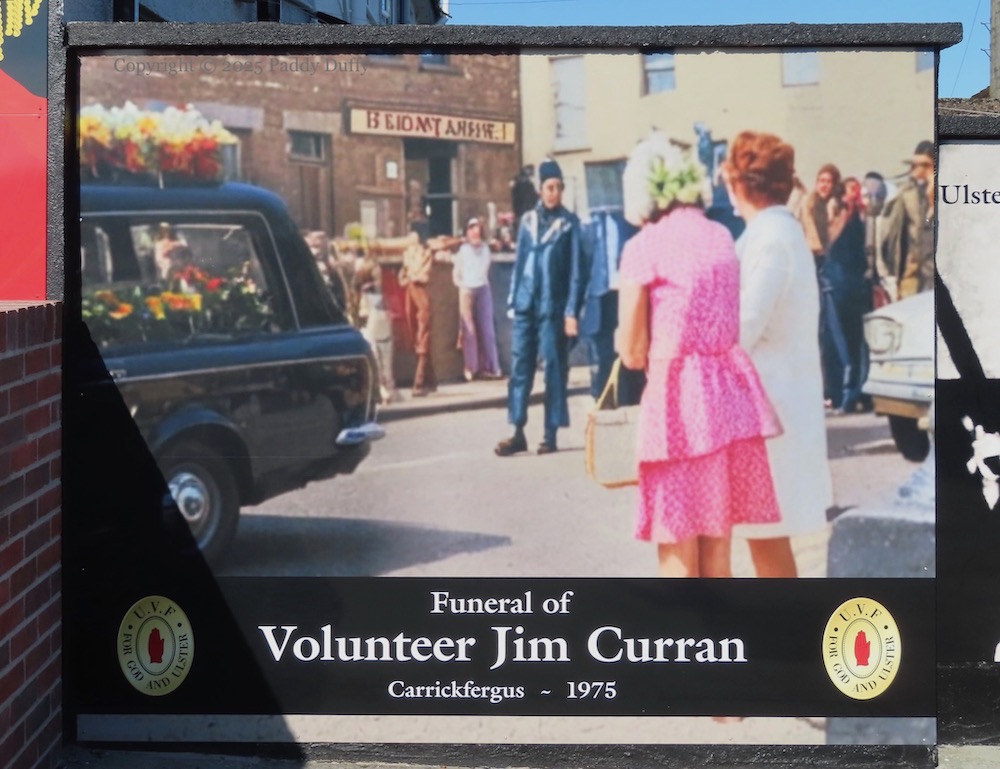
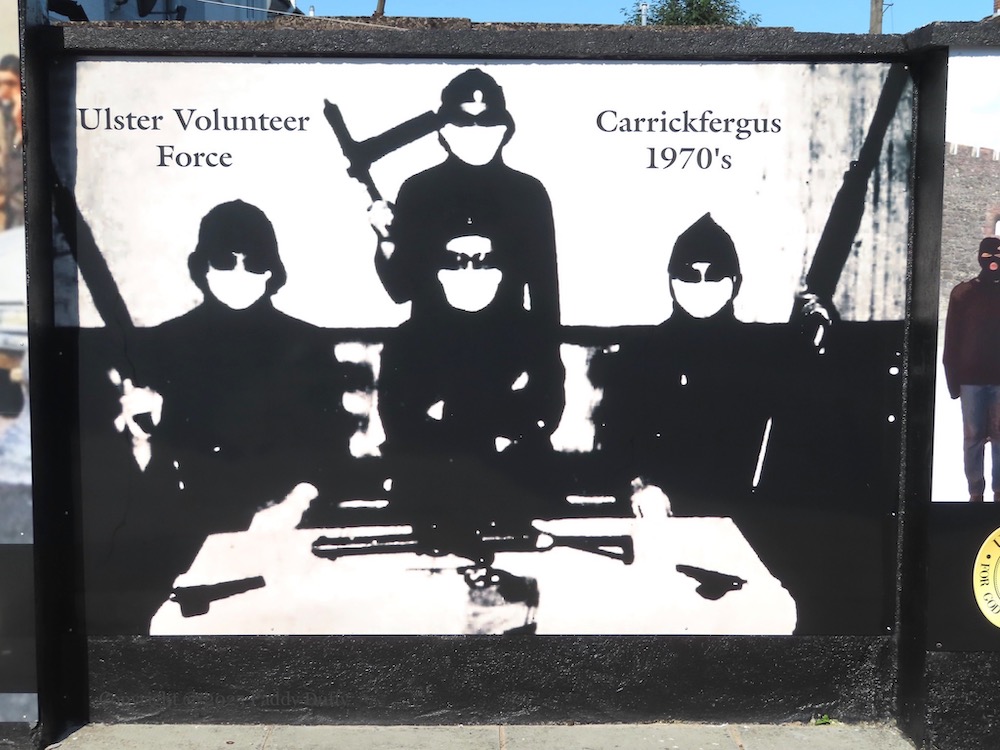
The graveside mourner on the right, the 1st East Antrim Battalion UVF, and all of the smaller panels on the right, belong to the Troubles era. There is no information about Jim Curran in 1975; the image of Curran’s funeral appears to be AI-generated.
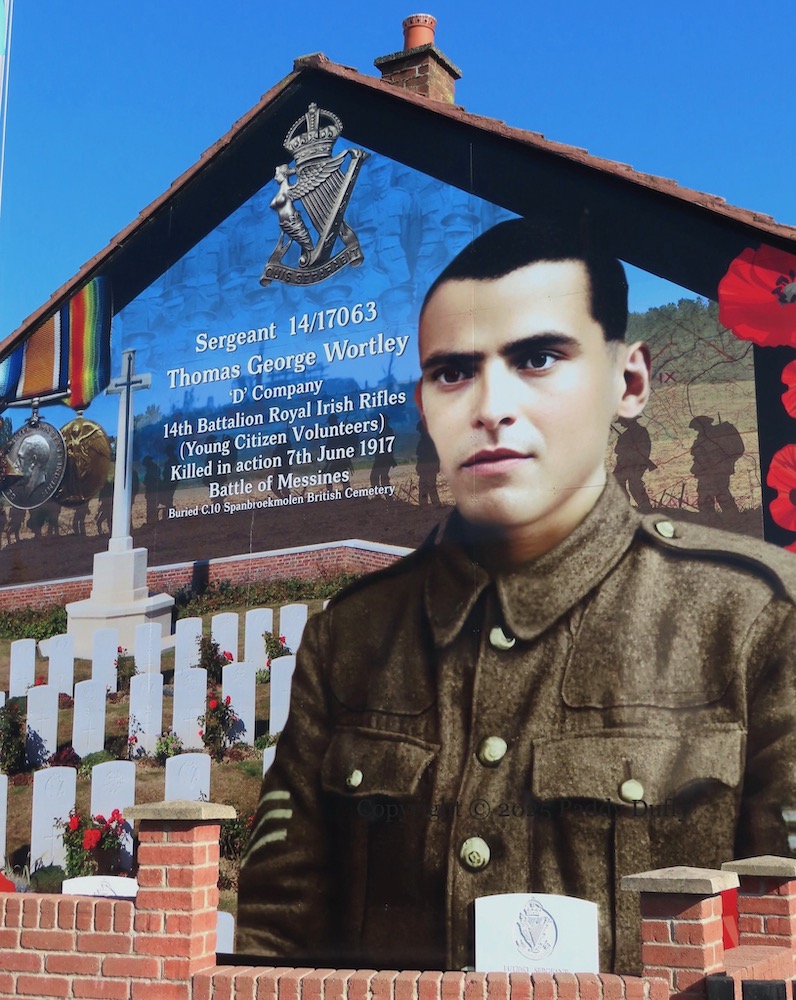
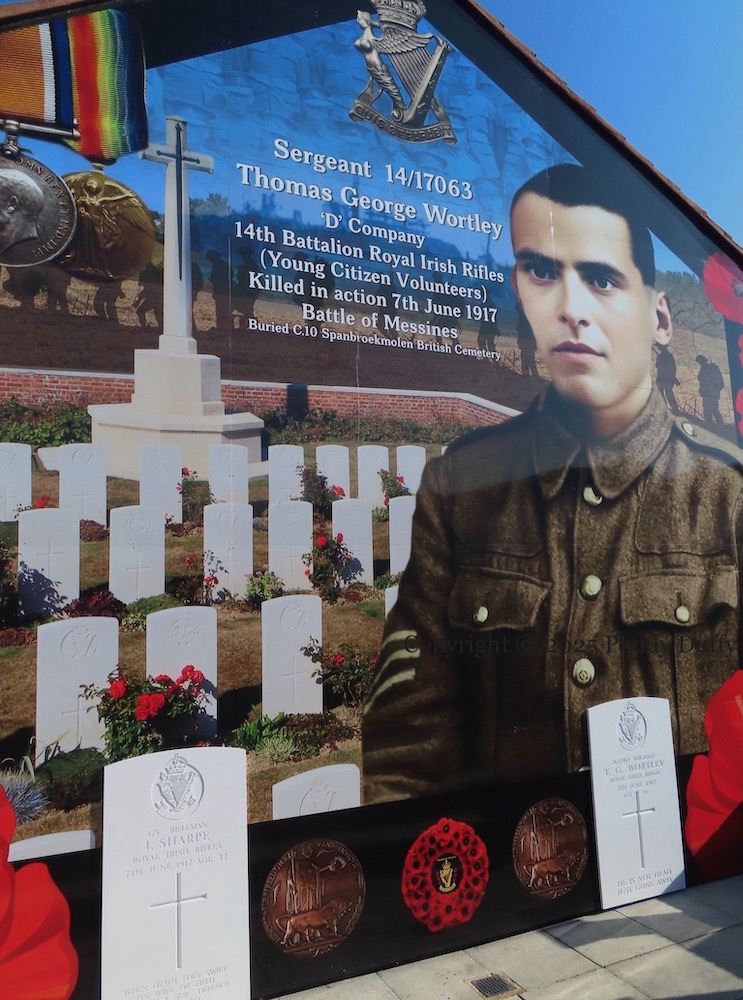
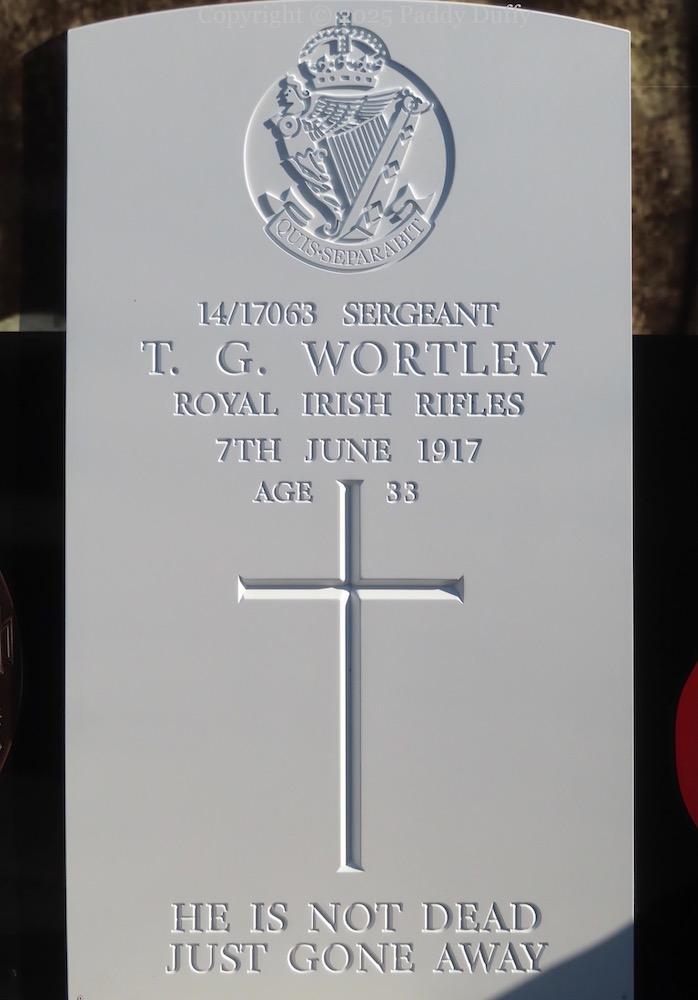
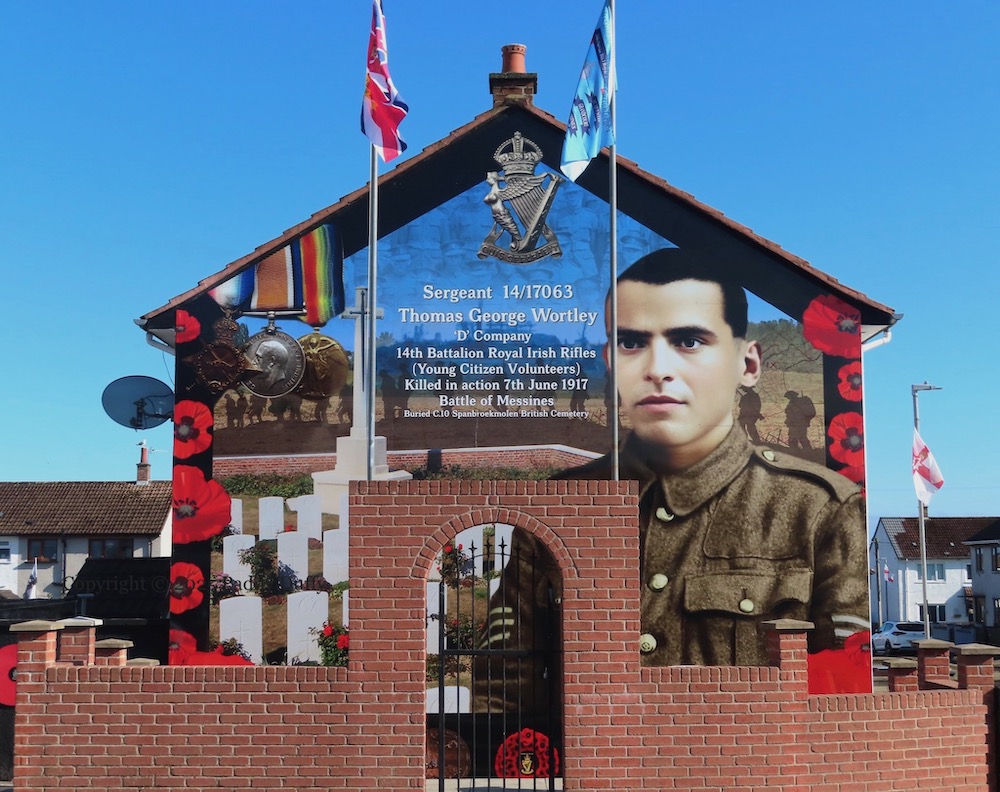
“Sergeant 14/17063 Thomas George Wortley ‘D’ Company 14th Battalion Royal Irish Rifles (Young Citizen Volunteers). Killed in action 7th June 1917 Battle of Messines. Buried C.10 Spanbroekmolen British Cemetery.”
Wortley was born in Carrickfergus and lived in Belfast. He (and James Sharpe, also from Carrick) was killed on the first day of the battle at Messines (findagrave) and buried in a small cemetery of British soldiers, many from the 36th (Ulster) Division, in Spanbroekmolen on the Ypres Salient in Flanders (WP) – shown in the mural. He is remembered in Carrickfergus with a parade each year on the date of his death (carrickfergusrollofhonour).
The medals in the top left are Pip, Squeak, and Wilfred (that is, the 1914 Star, for service in France or Belgium, the War (service) medal, and the Inter Allied Victory medal) (Identify Medals). The ‘Dead Man’s Penny’ memorial plaque (WP) appears next to the gravestones.
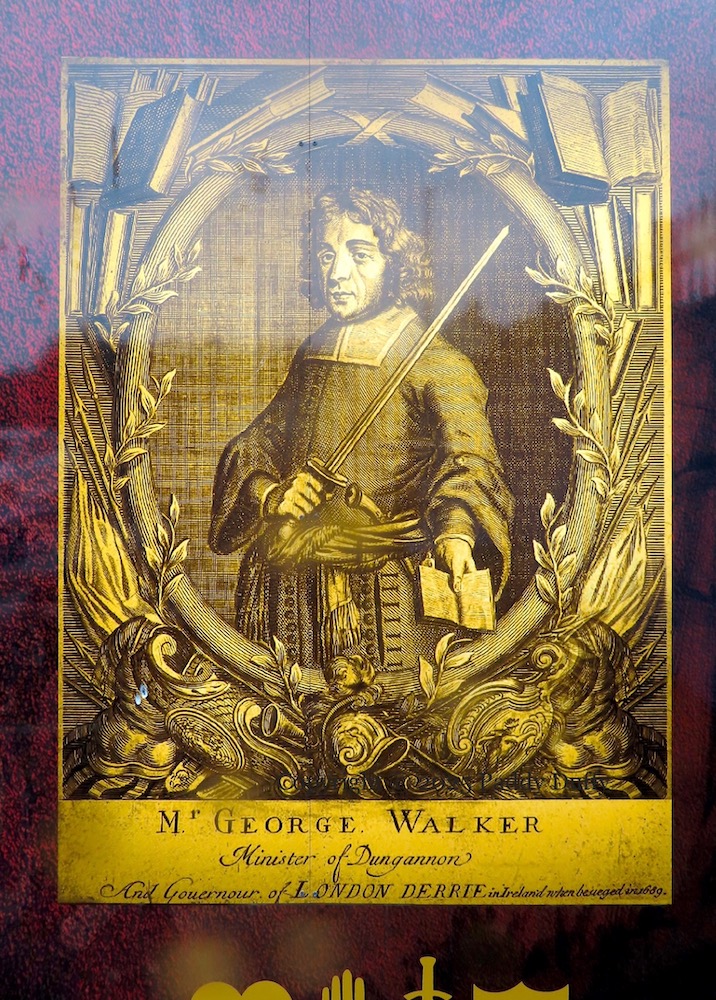
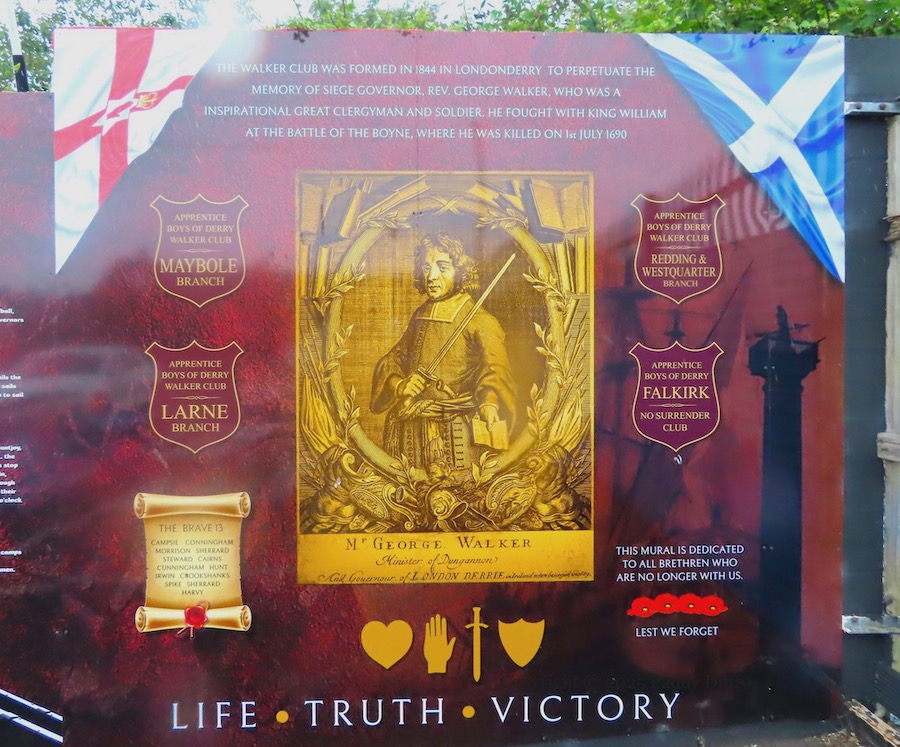
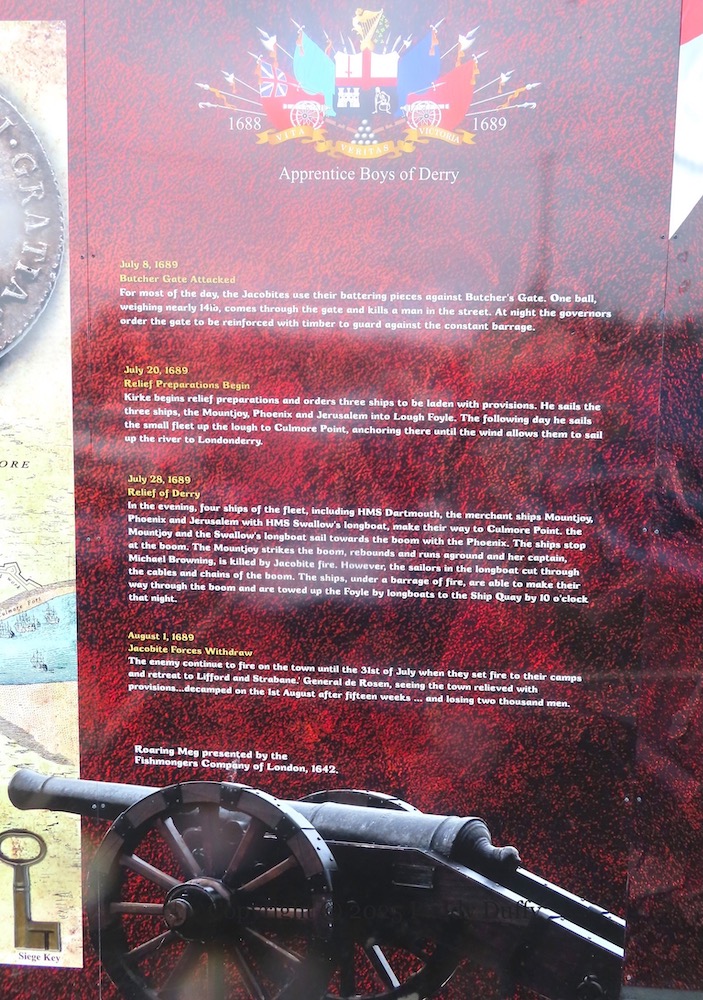
“Mr George Walker, Minister of Dungannon and Gouernour of London Derrie in Ireland when besieged in 1689.” Walker evacuated from Dungannon after Lundy’s troops pulled out and became joint governor of Derry after Lundy’s authority collapsed, first with Henry Baker and later with John Mitchelburne.
Walker put himself at the centre of his own “True Account Of The Siege Of London-Derry” (which can be read at archive.org) and drew criticism for minimising the role of Presbyterians (Walker was Anglican/CoI).
After the siege, Walker went on a victory tour of Scotland and England; while in London, he argued against a Derry trial for Lundy, on the ground that Lundy still had support there. He returned to Ireland in time to greet William III in June 1690 when William travelled from Carrickfergus to Belfast (see June 14th, 1690) and he went south with William to the Boyne, where he was shot and killed. (DIB | DIB | WP)
“The Walker Club was formed in 1844 in Londonderry to perpetuate the memory of siege governor, Rev. George Walker, who was a[n] inspirational great clergyman and soldier. He fought with King William at the Battle of the Boyne, where he was killed on 1st July 1690.”
The image of Walker is a line-engraving by John Savage, viewable at Sinclair Genealogy. “Life, truth, victory” is a translation of Londonderry’s Latin motto “Vita, veritas, victoria”.
These new boards are at the Rangers Supporters’ Club (Fb) in Boyne Square/Greenland, Larne.
This is a printed version Wilfrid Spender’s report of the first day of the Battle Of The Somme, replacing a previously painted instance that was in the same style as the adjacent mural.
“‘I am not an Ulsterman but yesterday the First of July, as I followed their amazing attack, I felt that I would rather be an Ulsterman than anything else in the world. My pen cannot describe adequately the hundreds of heroic acts I witnessed, the Ulster Volunteer Force, from which the Division was made, has won a name that equals any in history. Their devotion deserves the gratitude of The British Empire’ – Captain Wilfrid [not “Wilfred”] Spender, The Somme 1916″
Spender’s words are superimposed upon JC Beadle’s Attack Of the 36th Division (see Over The Top).
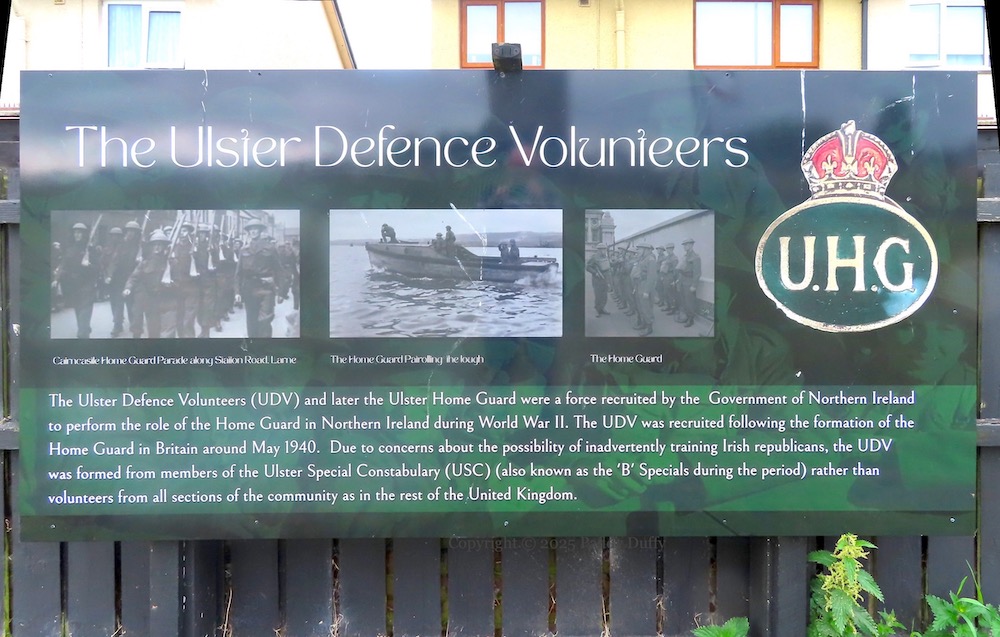
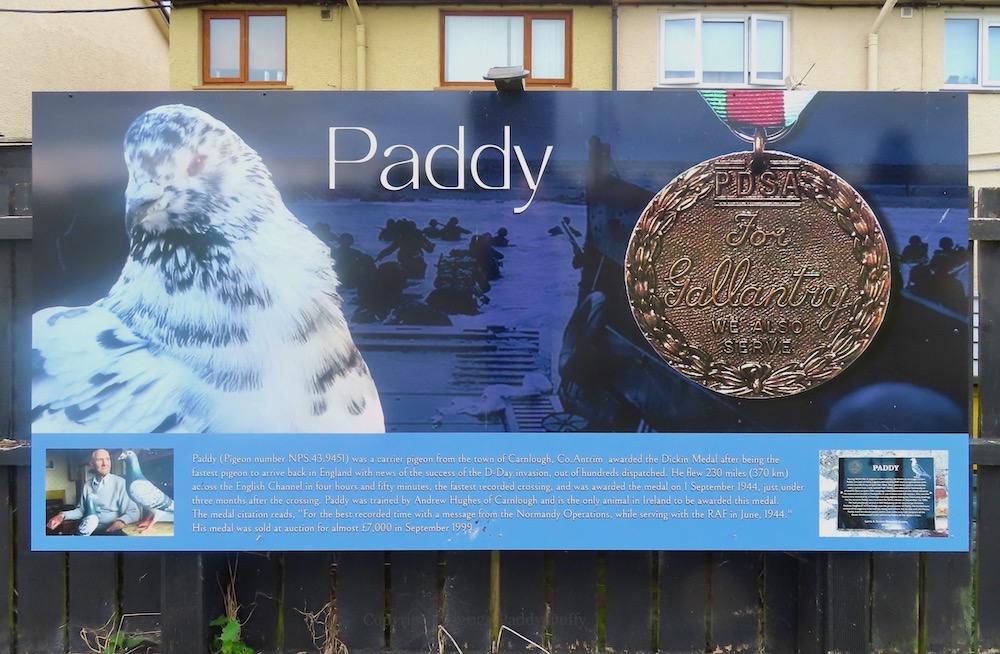
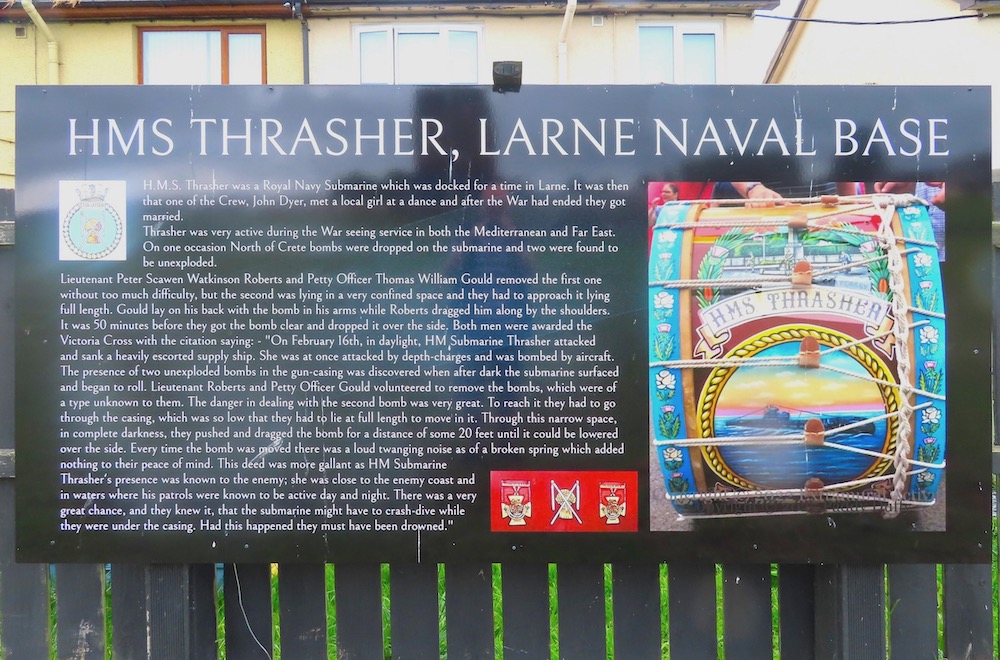
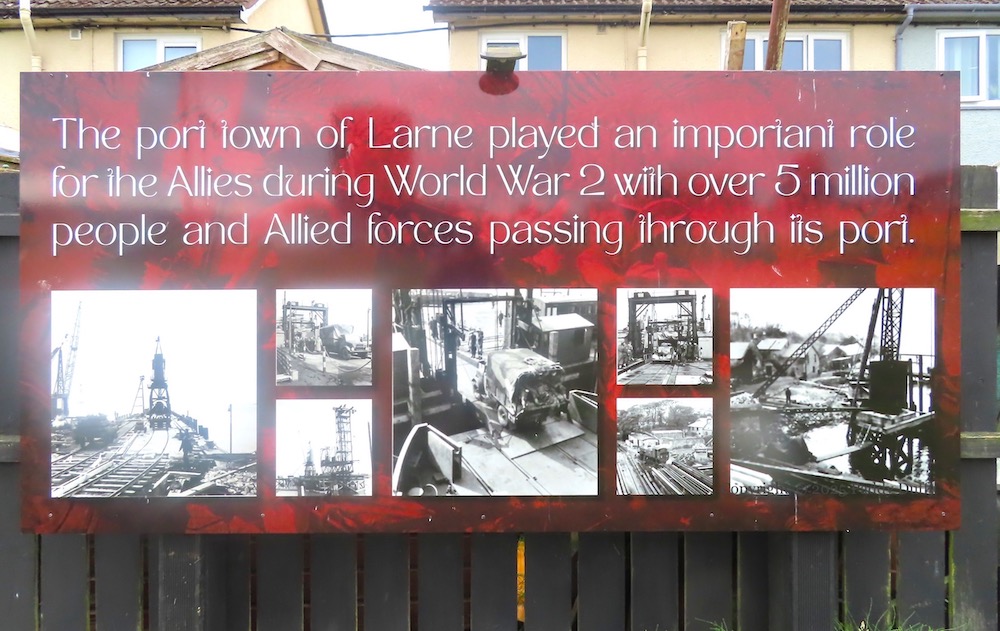
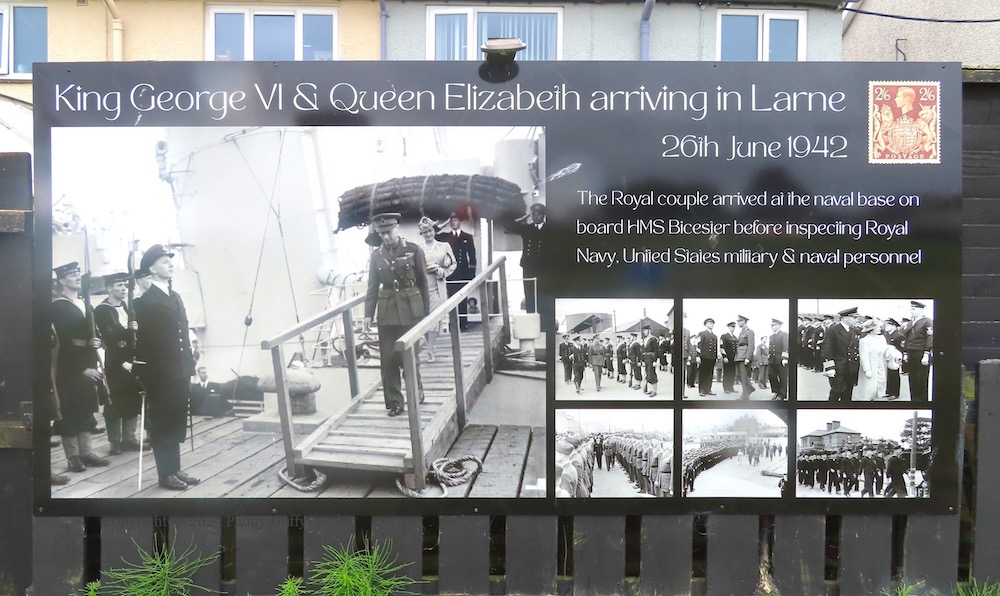
This is a series of ten boards in Craigyhill, Larne about WWII. (It replaces a set of twelve UDA boards – see The Loyalist Executioner.)
From left to right (top to bottom) their subjects are: the Ulster Defence Volunteers/Ulster Home Guard, formed from the B Specials; Paddy the pigeon; submarine HMS Thrasher (using an image from the Seosamh Mac Coılle collection); HMS Larne, a minesweeper built in Renfrew, Scotland; the port of Larne through which passed “over 5 million people and Allied forces”; Kilwaughter Castle, a training ground for UK and American troops; the royal visit of King George VI and Queen Elizabeth in June 1942; James Stuart Steele of Ballycarry, who served in both WWI and WWII; the Larne Spitfire, one of seventeen spitfires funded by a Belfast Telegraph fund-raising drive (Wartime NI | see also the Ballymena spitfire in Per Ardua Ad Astra); local casualties of WWII – “In remembrance of those from town of Larne that paid the supreme sacrifice during the Second World War”.
“North Down Defenders flute band [Fb], est. 2004. In memorium [sic] T. Mercer, R. Shaw, K. Shaw, G. Shaw, D. Shaw, A. Johnston, P. Magee, S. Stewart, J. Mills.”




















 Paddy Duffy Collection