Éıre

The main panels commemorate 25 years of “unbowed, unbroken” resistance in east Belfast (probably dating to the Battle Of St Matthew’s (WP) in 1970) with portraits of 16 deceased locals (“I measc laochra na nGael go raıbh a naınmeacha”) and two verses from Bobby Sands’s poem Weeping Winds (see below), on either side of Érıu the mythological queen of Ireland/Éıre as designed by Richard J King/Rísteard Ó Cíonga.

On the right (in the second image) is a copy of the 1916 Proclamation.

Oh, whistling winds why do you weep/When roaming free you are,
Oh! Is it that your poor heart’s broke/And scattered off afar?
Or is it that you bear the cries/Of people born unfree,
Who like your way have no control/Or sovereign destiny?

Oh! Lonely winds that walk the night/To haunt the sinner’s soul/
Pray pity me a wretched lad/Who never will grow old.
Pray pity those who lie in pain/The bondsman and the slave
And whisper sweet the breath of God/Upon my humble grave.

Click image to enlarge
Copyright © 1998 Paddy Duffy
T00287 T00304
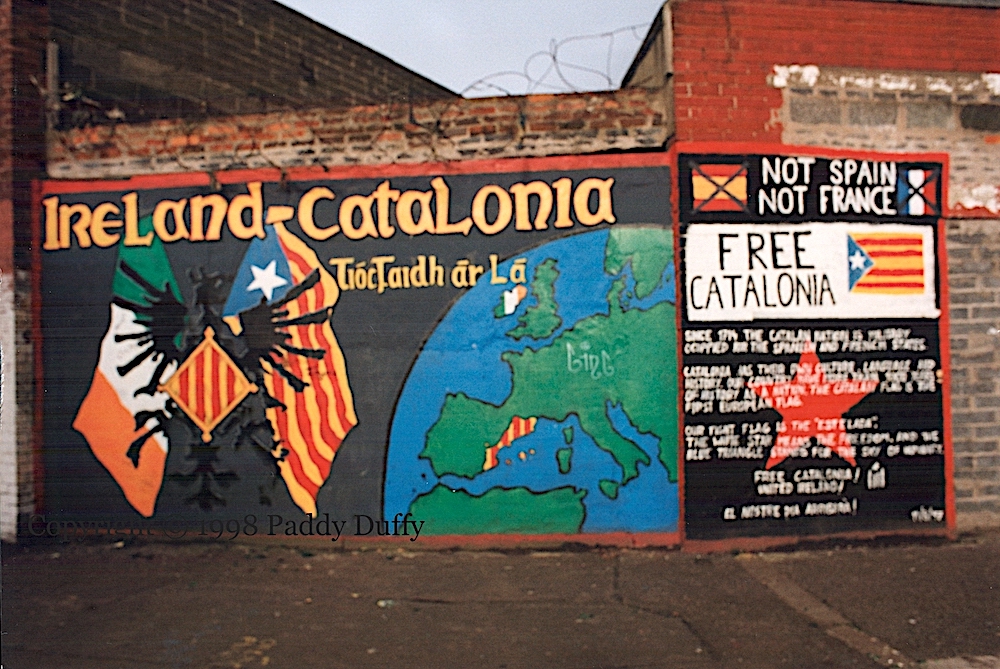
Not Spain, Not France

“Not Spain, not France. Free Catalonia. Since 1714 the Catalan nation is military [sic] occupied for the Spanish and French states. Catalonia has their own culture, language, and history. Our country have [sic] more than 1000 years of history as a nation. The Catalan flag is the first European flag. Our fight flag is the “Estelada”. The white star means the freedom, and the blue triangle stands for the sky of humanity. Free Catalonia! United Ireland! El nostre dia arribarà! Tıócfaıdh [sic] ár lá. 11/8/97″

Beechmount Avenue, west Belfast

Click image to enlarge
Copyright © 1998 Paddy Duffy
T00285

Society Of United Irishmen

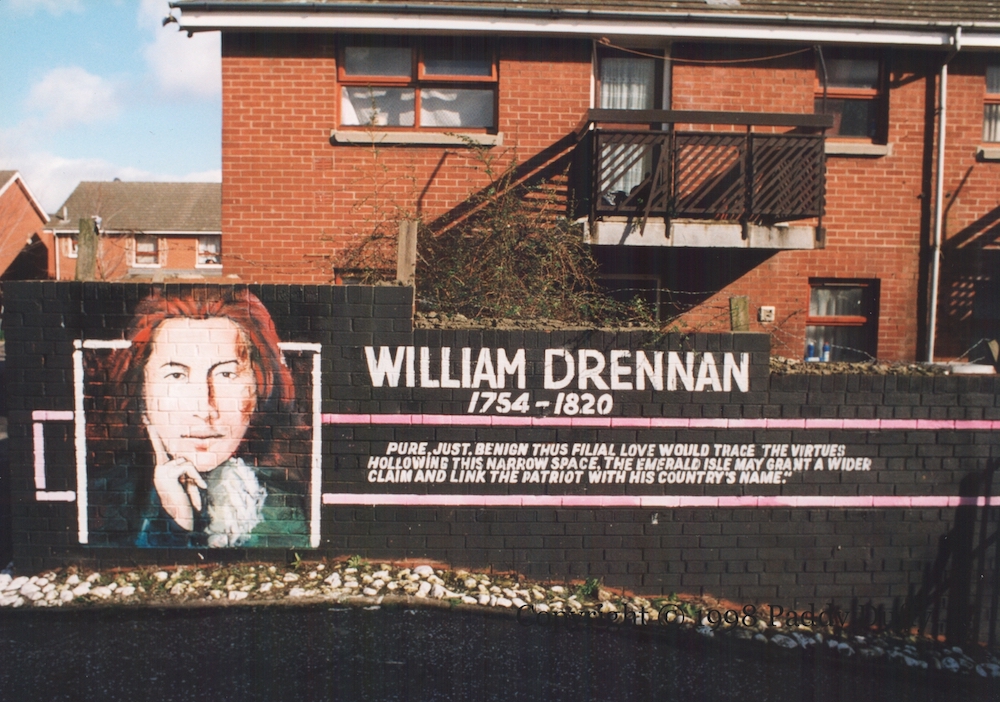
This is a trio of murals along the New Lodge Road to William Steel Dickson, William Drennan, and Mary Ann and Henry Joy McCracken. What the three have in common is that they were all Presbyterians and Irish republicans, and members of the Society Of United Irishmen.

William Steel Dickson was adjutant-general of the County Down Irishmen (see the blue plaque in Portaferry M08948) and was arrested a few days before the insurrection (WP). Like the McCrackens, he is buried in Clifton Street Cemetery.

William Drennan, 1754-1820, was a doctor, poet, a founder of the Society of United Irishmen, and the first person to refer to Ireland as “the Emerald Isle”, in his poem When Erin First Rose. The words in the mural are the epitaph on his stone in Clifton Street Cemetery: “Pure, just, benign. Thus filial love would trace the virtues, hollowing [sic] this narrow space. The Emerald Isle may grant a wider claim and link the patriot with his country’s name.”

Mary Ann McCracken (“What a wonderful clamour is now raised at the name of union, when in reality there has always been such a union between England and this country, as there is between husband and wife by which the former has the power to oppress the latter.”) and her older brother Henry Joy McCracken (“These are the times that try men’s souls … the rich always betray the poor.”) are the best-known of the figures. Henry led the Antrim uprising of the United Irishmen in 1798 and was executed for it; Mary Ann was an abolitionist and social reformer.

Ludlow Square/New Lodge Road, north Belfast

Click image to enlarge
Copyright © 1998 Paddy Duffy
T00282 T00283 T00284 [T00305]

The Ultimate Sacrifice

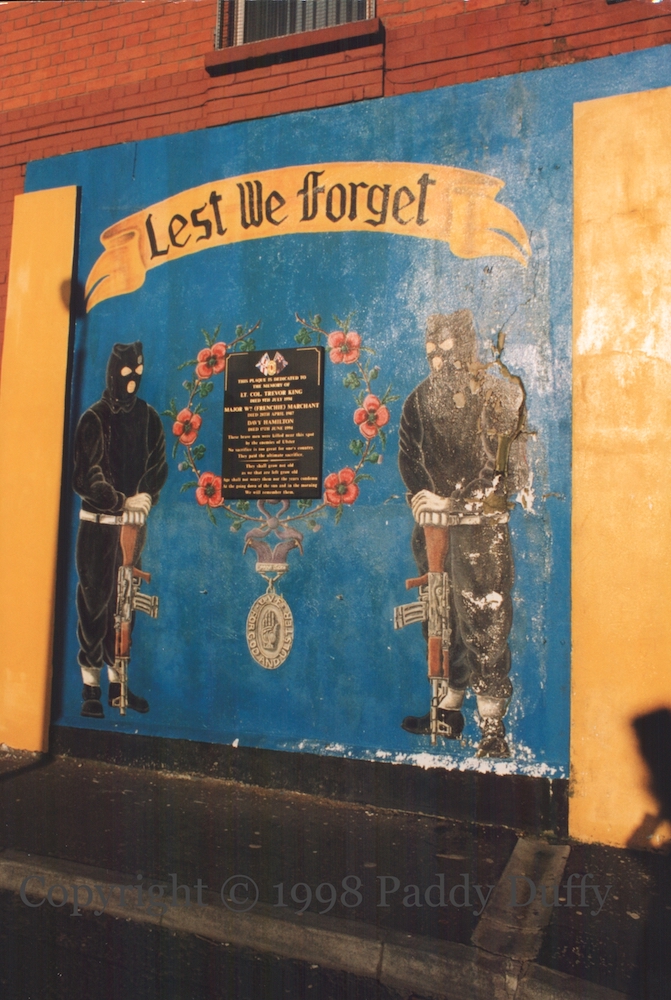
“This plaque is dedicated to the memory of Lt. Col. Trevor King, died 9th July 1994, Major Wm. (Frenchie) Marchant, died 28th April 1987, Davy Hamilton, Died 17th June 1994. These brave men died near this spot [the corner of Spier’s Place and Shankill Road, Belfast] by the enemies of Ulster. No sacrifice is too great for one’s country. They paid the ultimate sacrifice. ‘They shall grow not old/as we that are left grow old/Age shall not weary them nor the years condemn/At the going down of the sun and in the morning/We will remember them.’”

King and Hamilton (along with Colin Craig, an RUC informer and not included on the plaque) were shot by the INLA and died of their wounds three weeks and one day later. Frenchie Marchant was shot by the IRA outside The Eagle chip shop. The plaque is surrounded by a garland of three nation’s flowers: shamrock, rose, and thistle.

Spier’s Place, west Belfast. This is a new, larger, plaque, compared to previously.

Click image to enlarge
Copyright © 1998 Paddy Duffy
T00258 [T00257]

Release Our Prisoners

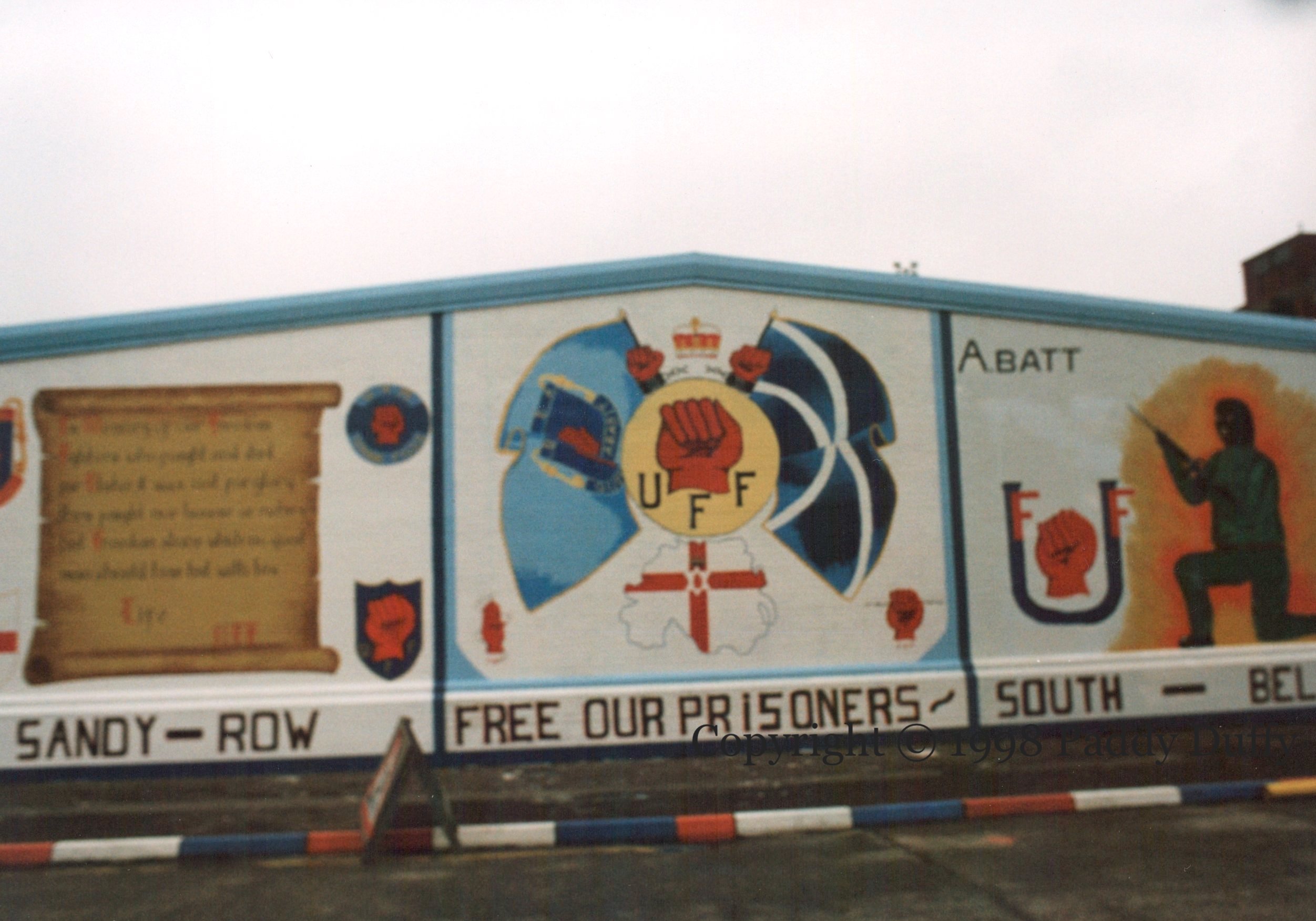
The scroll on the left between the emblems of the UDA, UYM, UFF and the Ulster banner reads, “In memory of our freedom fighters who fought and died for Ulster. It was not for glory they fought nor honour or riches but freedom alone which no good man should lose but with his life.” There is a pair of manacled red fists above the central UFF emblem, which itself rests on a free-floating outline of Northern Ireland superimposed with the Ulster banner. On the right is a crouching volunteer from A battalion, from south Belfast’s Sandy Row.

Linfield Road, south Belfast

Click image to enlarge
Copyright © 1998 Paddy Duffy
T00247

Free The POWs

A collage of image from the previous 30 years, including banging bin-lids on the ground, Maıréad Farrell in Armagh prison, men on the blanket, the cages of Long Kesh, marches in support of the hunger strikers, and reproductions of various posters, against Margaret Thatcher, plastic bullets, internment, and censorship. There’s a quote from Bob Dylan in the middle, “How many times can a man turn his head and pretend that he just doesn’t see – the answer, my friend, is blowing in the wind, the answer is blowing in the wind.”

Ludlow Square, New Lodge, north Belfast

Click image to enlarge
Copyright © 1997 or 1998 Paddy Duffy
T00292 [T00310]

Peace With Justice

“Peace with justice”, “Fáılte go dtí Bóthar Garbh Achaıdh”, “Re-route sectarian marches”.

Three murals were painted by three Belfast artists (DD, Marty Lyons, Mo Chara Kelly) in 1997 in Hurson Park (renamed from Churchill Park), Portadown, along the route of the Orange Order parade to and from Drumcree, in order to support the local residents who were attempting to block the march through the CNR Garvaghy Road.

In 1996, an initial decision to block the parade was overturned at the last minute, and 1,200 Orangemen marched down Garvaghy Road. The 1997 march also went ahead and “sit-down” protesters were physically removed from the road. (Here is 90 minutes of news footage from 1997 (youtube). There are brief clips of the muralists at work, at 20m44s, 28m48s, 35m16s, 37m32s, 43m26s, 53m23s, and 58m44s. The images of protestors being removed begin at 1h02m)

Click image to enlarge
Copyright © 1997 Paddy Duffy
T00306 T00307 T00308

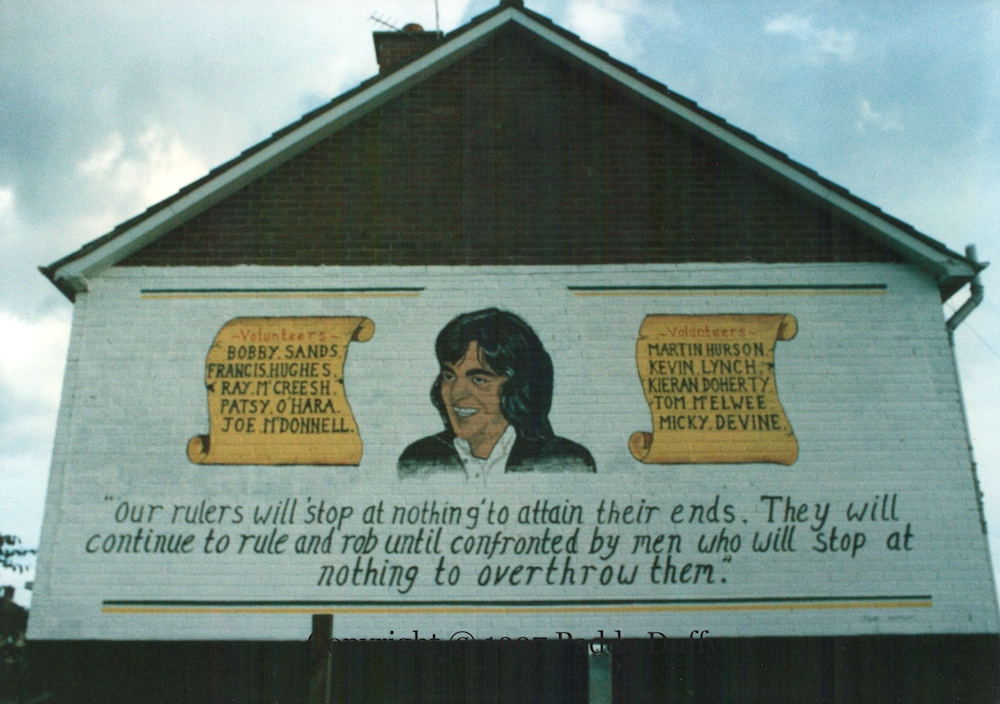
Stop At Nothing

“Our rulers will stop at nothing to attain their ends. They will continue to rule and rob until confronted by men who will stop at nothing to overthrow them.” The quote is from James Connolly on Conscription. Local volunteer Joe McDonnell is portrayed between the names of the ten deceased 1981 hunger strikers. 

Lenadoon Avenue, west Belfast

Click image to enlarge
Copyright © 1997 Paddy Duffy
T00303

Robert Emmet Commemoration

A Robert Emmet mural was painted by Robbie Kane in 1953 (for the 150th anniversary of the 1803 rebellion and his execution) in Crumlin Street. This was one of a very few CNR murals painted prior to the Troubles, and nationalist symbols were formerly outlawed in the Flags And Emblems Act of 1954. (See Visual History 02.)

The original (which can be seen at Laochra Uladh) was accompanied by a Christian cross and the words “Hail Christ our king”. This 1997 version reproduces only the two medallions, showing a Celtic harp (left) and a dramatic portrait of Emmet waving his hat, from the mid-1800s (WP/LoC).

Click image to enlarge
Copyright © 1997 Paddy Duffy
T00298