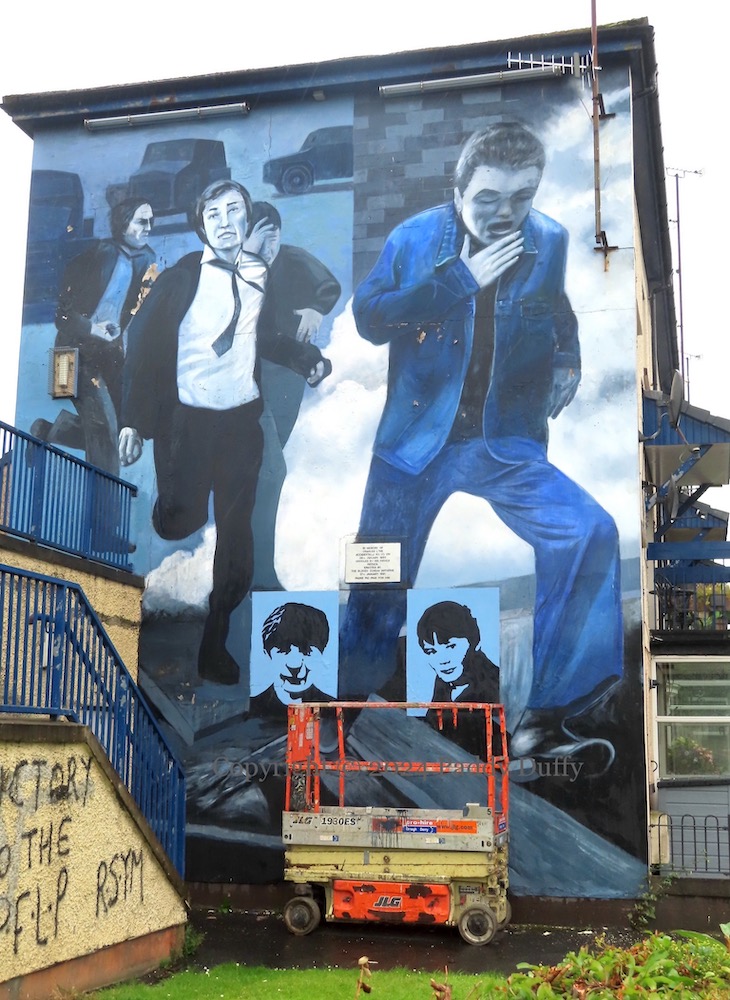
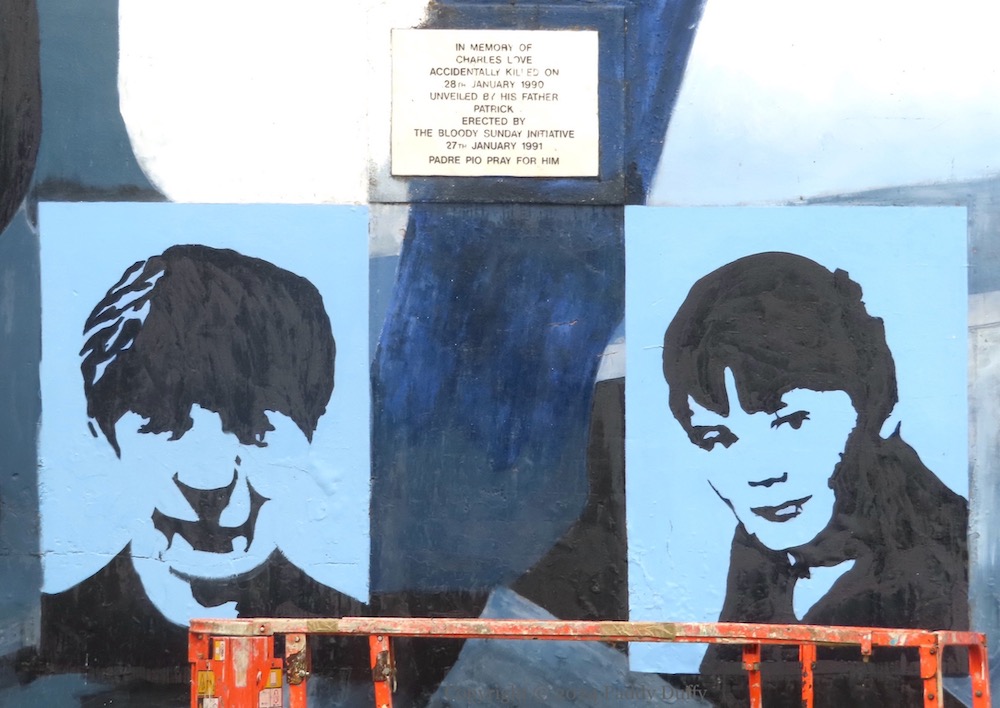
‘The Runner’ is the final mural painted by the Bogside Artists in the series that would in 2007 be collectively given the name The People’s Gallery (the John Hume mural was added in 2008). The mural shows youths running from CS gas in Creggan. There are portraits of Charles Love and Manus Deery (see his Bogside plaques) at the bottom; the plaque to Love in the centre is retained.
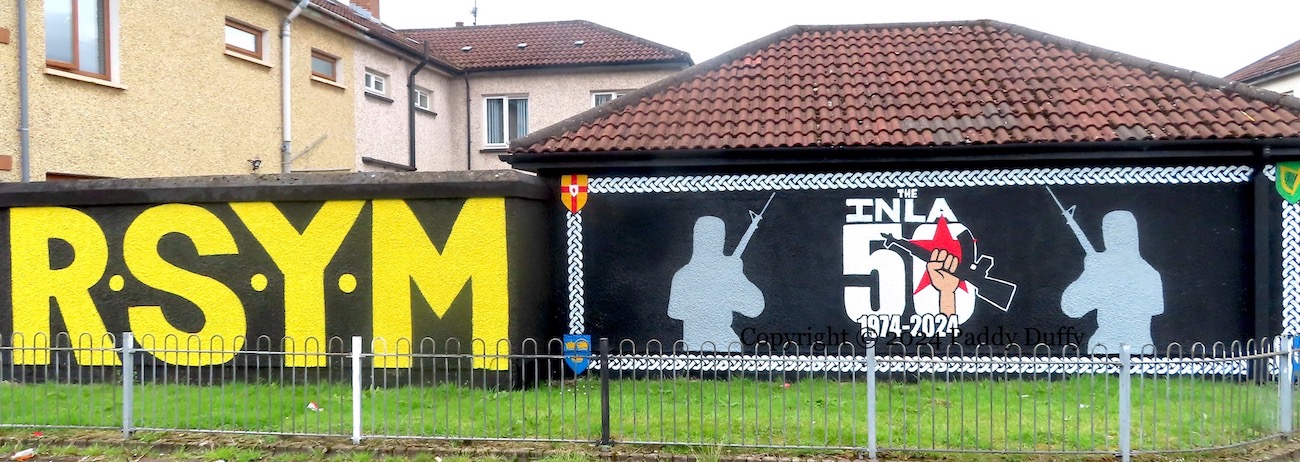
The Easter lily and the red star mark this graffiti-art-style slogan in Durrow Park, Derry, as republican-socialist; RSYM = Republican Socialist Youth Movement (Fb), IRSP = Irish Republican Socialist Party (web), AFA = Anti-Fascist Action (Fb)). There is a small “Victory to Hamas” graffito to the right.
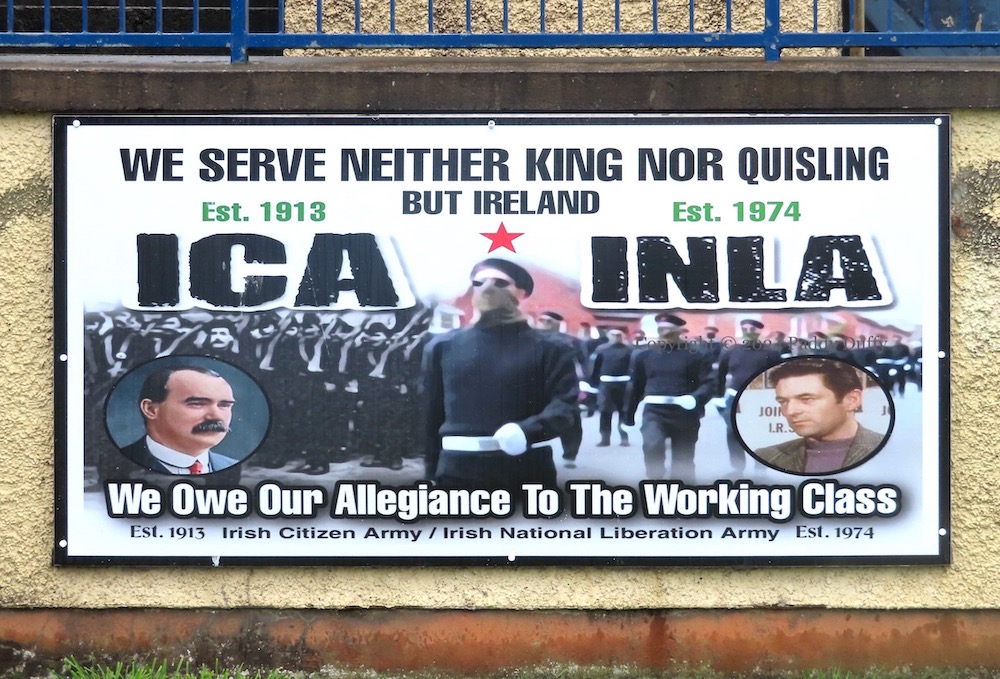
For the large Arm Saoırse Náısıúnta Na hÉıreann (INLA) board, see Serious Trouble.
Operation Motorman, the British Army’s retaking of ‘Free Derry’, took place on July 31st, 1972. This is a repainting; for the previous version, see T02079, and for the 2001 original, see M01426.
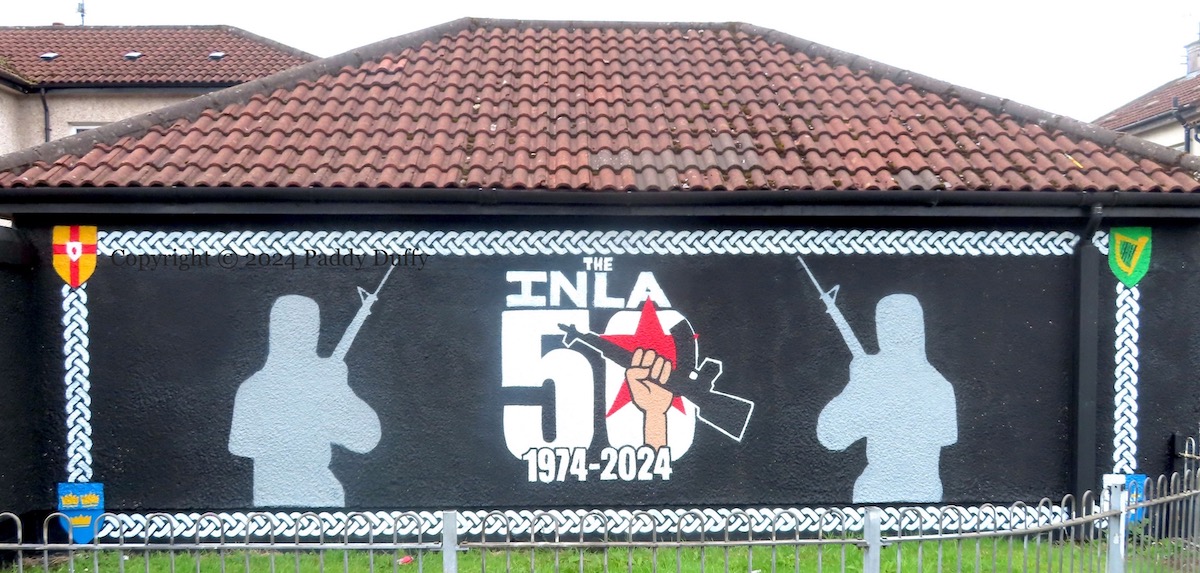
Commemorations of the INLA’s fiftieth anniversary have so far been limited to graffiti – see Saoırse Go Deo in Derry and Let The Fight Go On in Belfast – but here we have two deliberately painted panels in the Bogside (specifically Meenan Square) (one replacing The Way We Were).
The “hills” and “green fields” in which Kieran Doherty and Joe McDonnell grew up were the streets of the Falls and Andersonstown. By the age of 17 and 19, respectively, their tramping grounds were reduced by internment to cells in Long Kesh and HMS Maidstone; both of them were arrested in 1976 during (separate) IRA bombing missions and ultimately died in the 1981 hunger strike, McDonnell on July 8th, Doherty on August 2nd. (IRIS | Long Kesh)
This trio of RNU (Fb) boards commemorating the pair and the other 1981 hunger strikers is in Bingnian Drive, in Andersonstown – the ten deceased strikers are shown between the words to Luke Kelly’s poem For What Died The Sons Of Róısín (above | youtube) and Francie Brolly’s The H-Block Song (below | youtube).
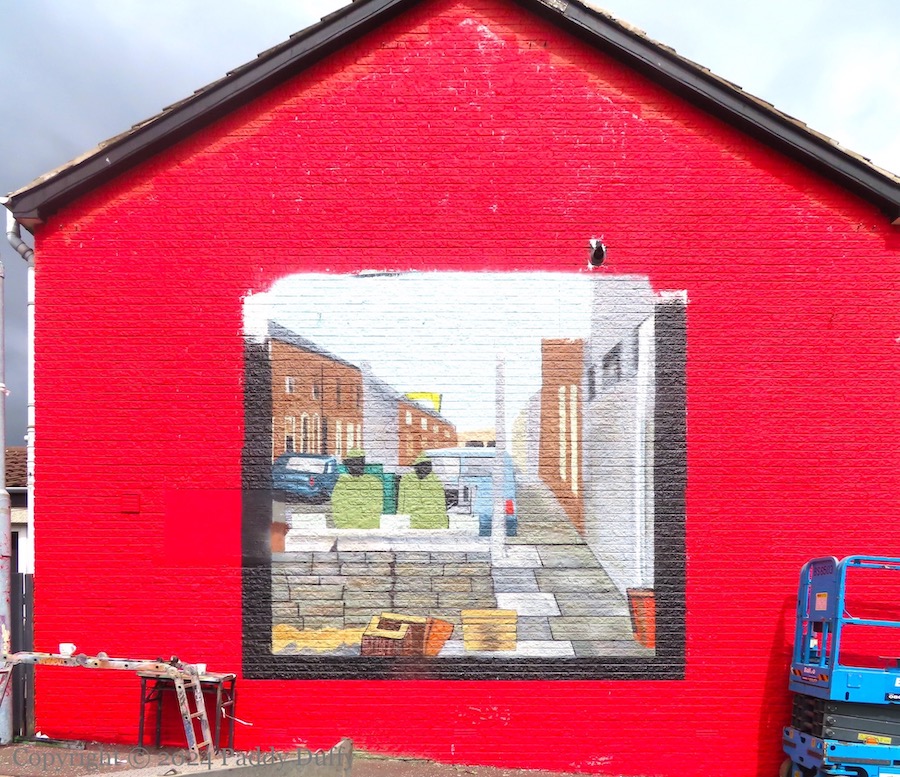
The scaffolding has been down from this obviously incomplete mural in Kilcooley, Bangor, and work on it seems to have ceased. The reasons for its abandonment are unclear.
A black street sign out of shot to the right (which can be seen in the third image, as well as a UDA emblem at the top) reads “Humber Street” – Humber Street was in east Belfast, at the top of Dee Street. We have not been able to locate this or other photographs of barricades in Humber Street. The period is presumably c. 1972, when the UDA set up no-go areas in Belfast (Pathé video; AP videos: one | two | three).
The other mural, on the left of the wide shots, is to East Belfast UDA brigadier Tommy Herron. As can be seen in the earliest in-progress image, below, the mural replaces the North Down Defenders mural.
The “completed” images, above, are from June 30th; work began at least two months previously.
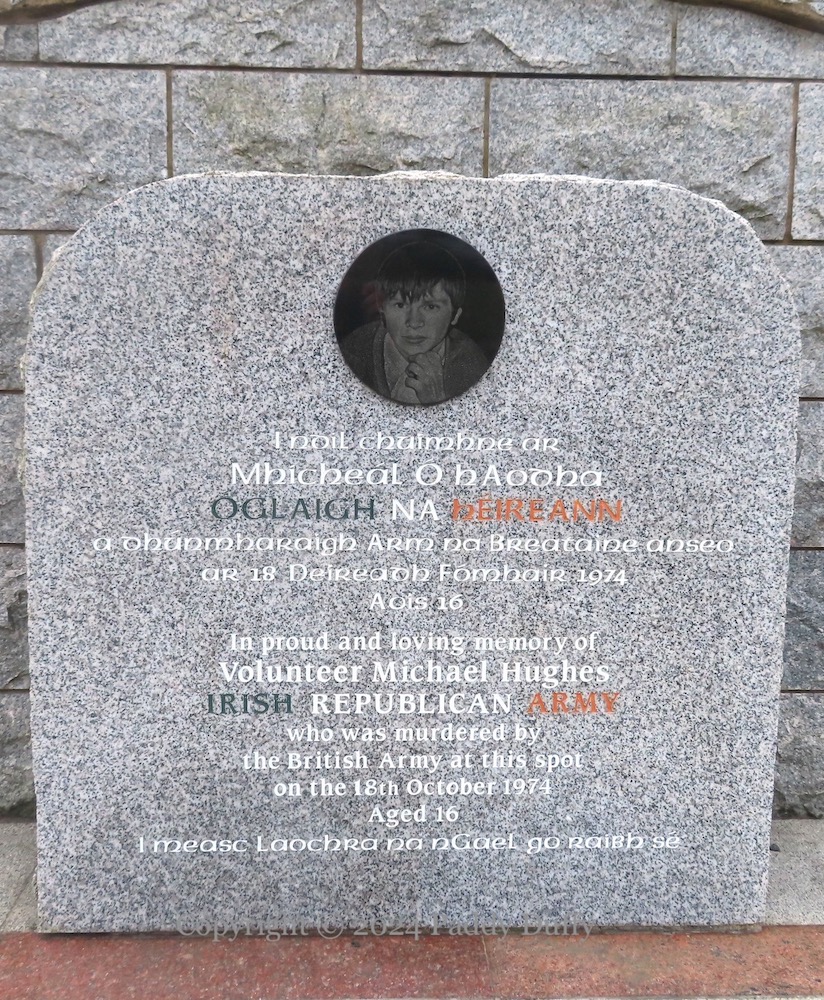
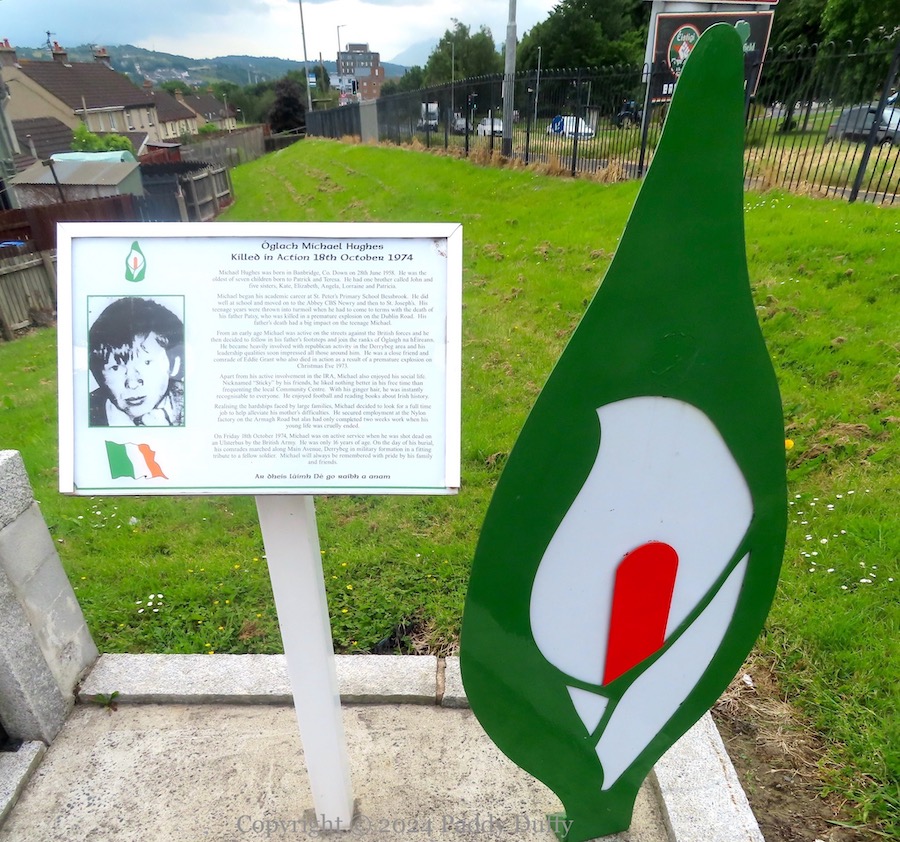
“I ndıl chuımhne ar Mhıcheál Ó hAodha, Óglaıgh na hÉıreann, a dhúnmharaıgh Arm na Breataıne anseo ar 18 Deıreadh Fómhaır 1974, aoıs 16. In proud and loving memory of Volunteer Michael Hughes, Irish Republican Army, who was murdered by the British Army at this spot on the 18th October 1974 aged 16. I measc laochra na nGael go raıbh sé.”
Hughes was shot when he and several other youths attempted to hijack a bus at the stop at the entrance to the area which was under observation by a Royal Marine unit; the soldier who fired the shot claimed that Hughes had pointed a pistol at him, but no weapon or forensic evidence was recovered (Lost Lives 1208).
This is an enlarged memorial to Hughes at the upper entrance to Derrybeg. For the previous memorial, see M08521); Peter also photographed the bus shelters (in 2002).
From the printed info board: “Michael Hughes was born in Banbridge, Co. Down on 28th June 1958. He was the oldest of seven children born to Patrick and Teresa. He had one brother called John and five sisters, Kate, Elizabeth, Angela, Lorraine and Patricia. Michael began his academic career at St. Peter’s Primary School Bessbrook. He did well at school and moved on to the Abbey CBS Newry and then to St. Joseph’s. His teenage years were thrown into turmoil when he had to come to terms with the death of his father Patsy, who was killed in a premature explosion on the Dublin Road. His father’s death had a big impact on the teenage Michael. From an early age Michael was active on the streets against the British forces and he then decided to follow in his father’s footsteps and join the ranks of Óglaıgh Na hÉıreann. He became heavily involved with republican activity in the Derrybeg area and his leadership qualities soon impressed all those around him. He was a close friend and comrade of Eddie Grant who also died in action as a result of a premature explosion on Christmas Eve 1973. Apart from his active involvement in the IRA, Michael also enjoyed his social life. Nicknamed “Sticky” by his friends, he liked nothing better in his free time than frequenting the local Community Centre. With his ginger hair, he was instantly recognisable to everyone. He enjoyed football and reading books about Irish history. Realising the hardships faced by large families, Michael decided to look for a full time job to help alleviate his mother’s difficulties. He secured employment at the Nylon factory on the Armagh Road but alas had only completed two weeks work when his young life was cruelly ended. On Friday 18th October 1974, Michael was on active service when he was shot dead on an Ulsterbus by the British Army. He was only 16 years of age. On the day of his burial, his comrades marched along Main Avenue, Derrybeg in military formation in a fitting tribute to a fellow soldier. Michael will always be remembered with pride by his family and friends. Ar dheıs láımh Dé go raıbh a anam.”
Nine people died in the 1972 blast that killed Patsy Hughes, at the customs station in Newry – two lorry-drivers, four customs officials, and three IRA volunteers (Lost Lives 551).
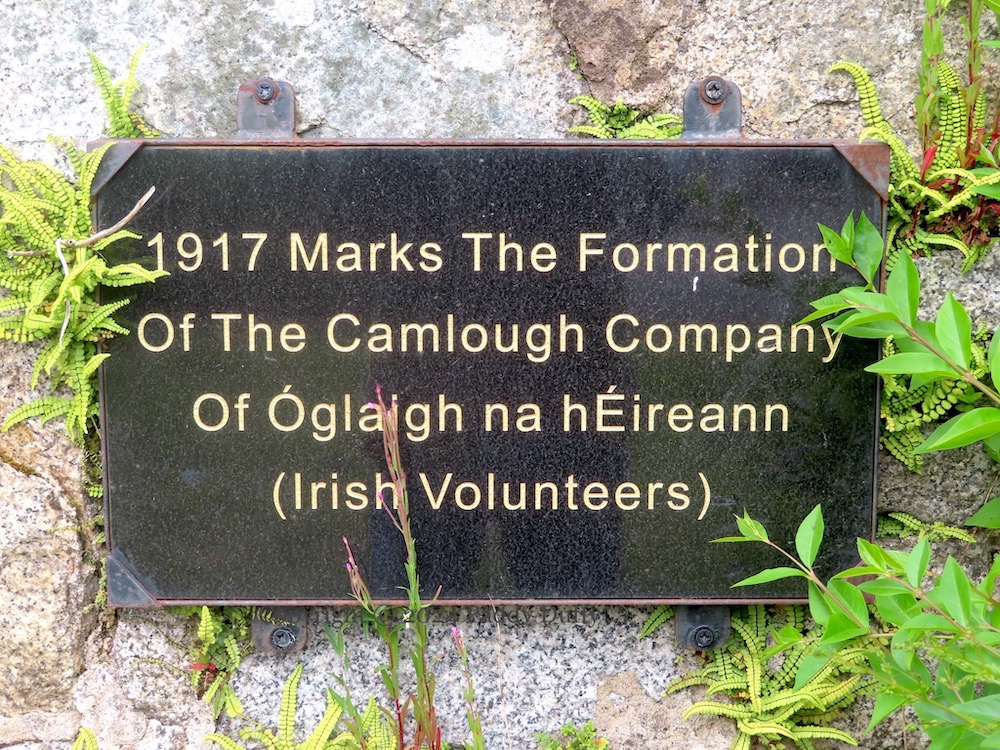
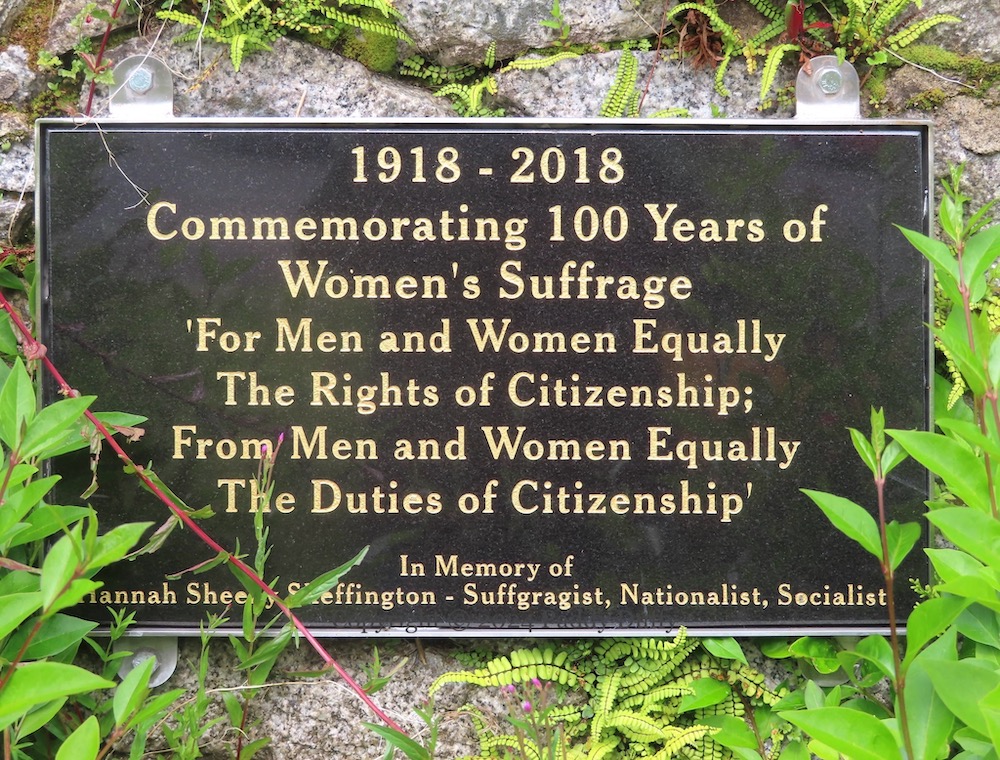
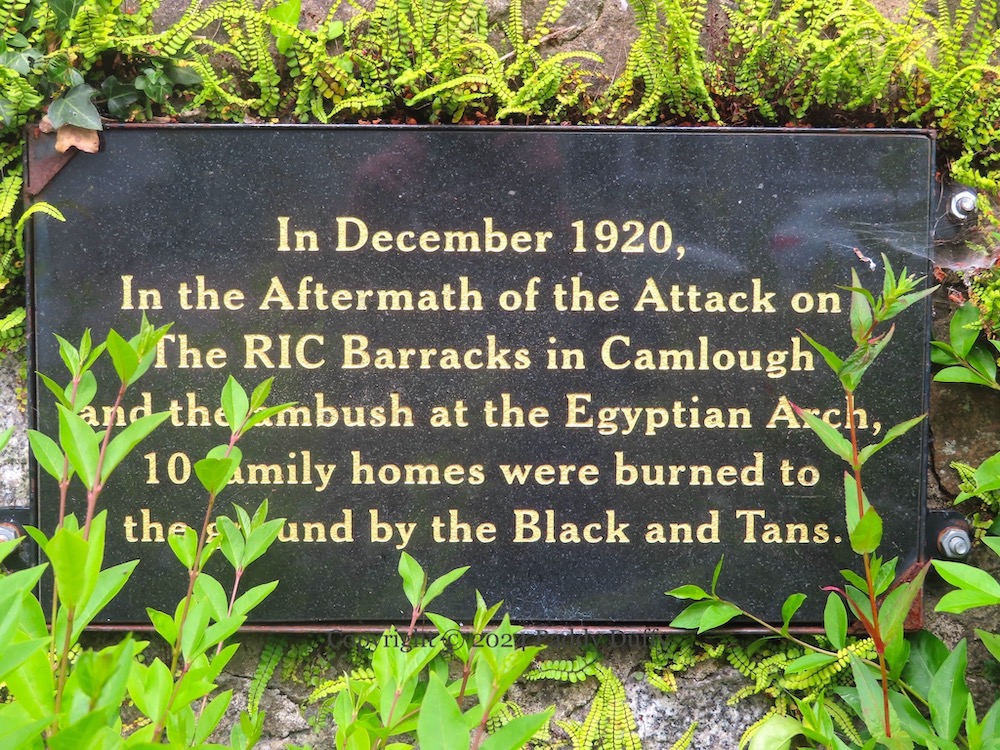
The memorial garden in Quarter Road, Camlough, commemorates deaths and events from 1916 to 1921:
“In memory of the Irish men and women who died in 1916 in conflicts both at home and abroad.”
“1917 marks the formation of the Camlough company of Óglaıgh Na hÉıreann (Irish Volunteers).”
“1917-2017 centenary of the Sınn Féın cumann, Camlough.”
“1918-2018 commemorating 100 years of women’s suffrage ‘For men and women equally the rights of citizenship; from men and women equally the duties of citizenship’. In memory of Hannah Sheehy-Skeffington – suffragist, nationalist, socialist.”
“December 1920, during the Tan War, the RIC barracks in Camlough was attacked by local volunteers of the Irish Republican Army.”
“In December 1920, in the aftermath of the attack on the RIC barracks in Camlough and the ambush at the Egyptian Arch, 10 family homes were burned to the ground by the Black And Tans.”
“In memory of Vol. Sean Doran and his sister Mary Ann Kearney, shot dead by the Black And Tans, 1921.”
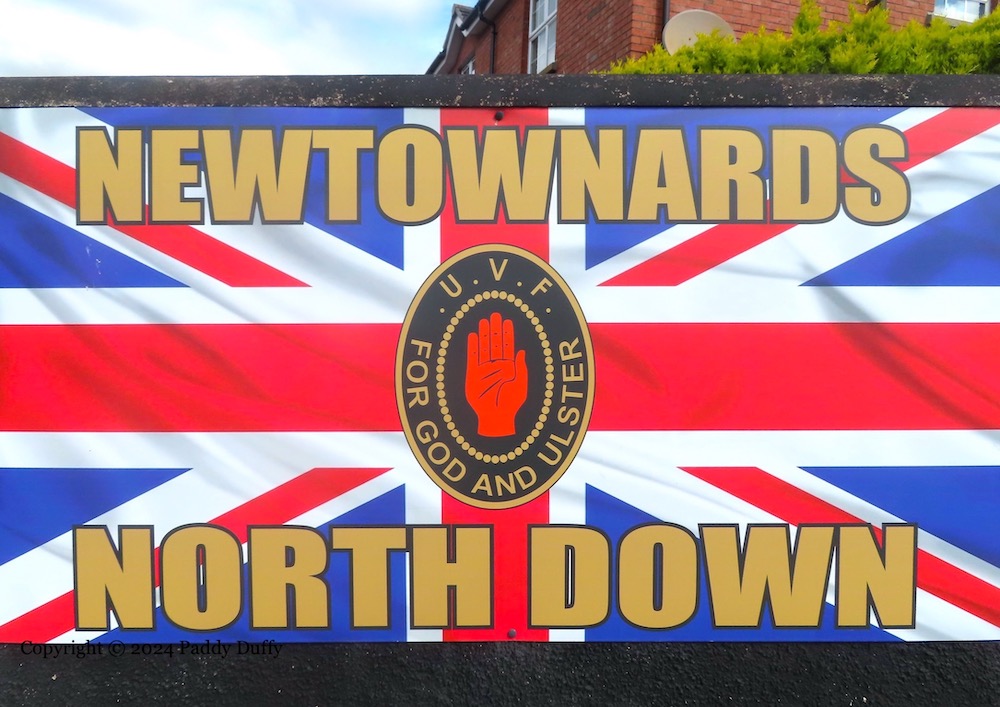
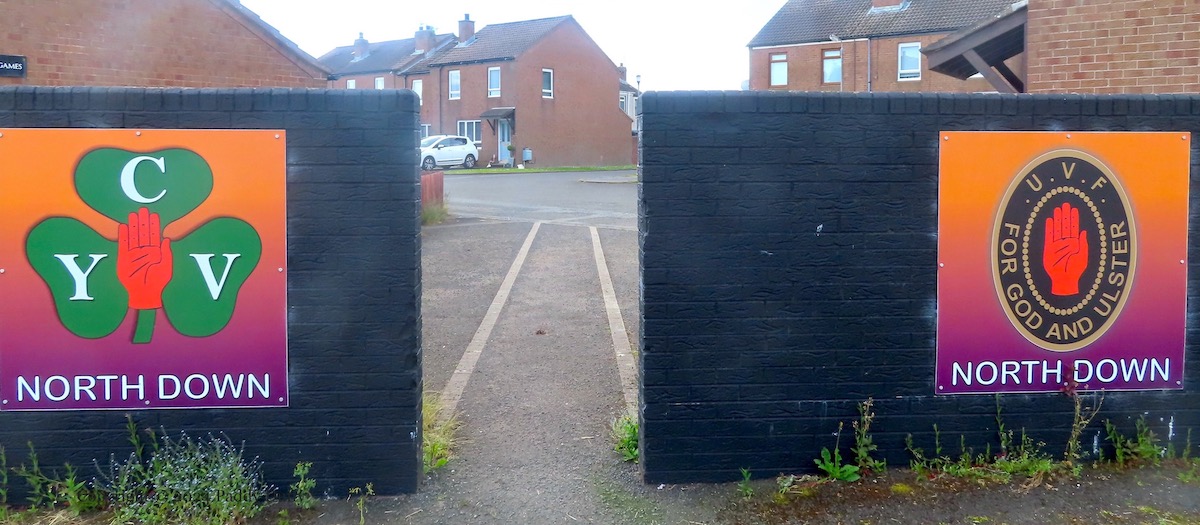
Here are some more UVF boards (in addition to those seen in 2022’s Bowtown UVF) that have been added along the length of Abbot Drive. Both “East Belfast” and “North Down” rival factions are included.
The “Lest we forget” board in the final image has been seen before, but has been moved to the location shown after being in the memorial garden.
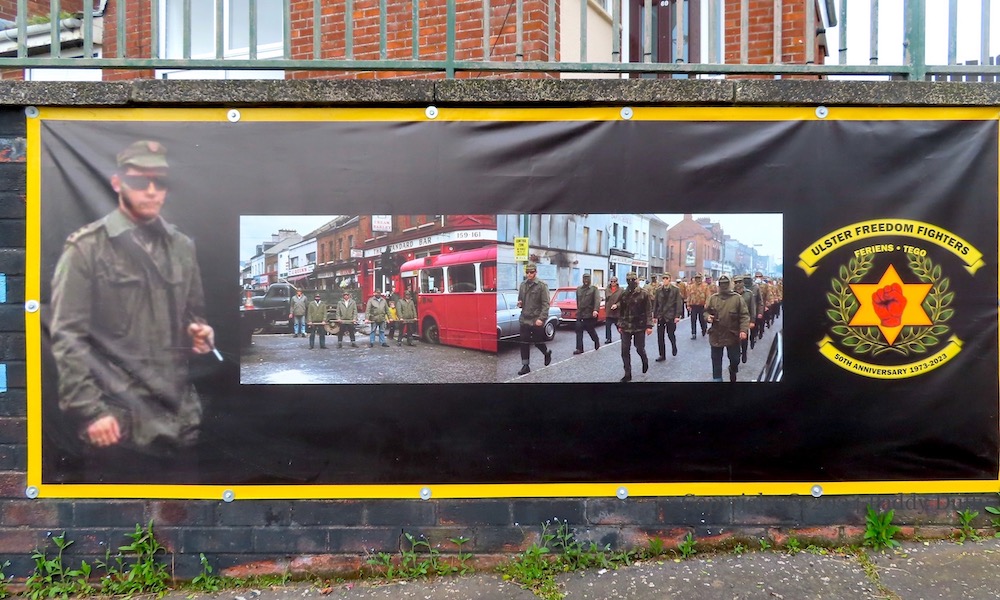
The UDA began using the “Ulster Freedom Fighters” name from February 1973 onwards in order to avoid the UDA becoming a proscribed organisation, though its members had already killed dozens of people in 1972 and January 1973 (WP timeline). (Fifty Years Of Service (in Ballymoney) marks the fiftieth anniversary – in 2021 – of the UDA.)
The tarp shown above likewise conflates the UDA and UFF, with two images from 1972, before the “UFF” name was used; on the left, the men marching behind a van marked “UDA Patrol” are on the Shankill Road (BelTel); on the right, four men stand at a barricade in the Woodvale (Victor Patterson).
The images in the second tarp show (left) a bus blocking Agnes Street and four men blocking the Shankill Road (Getty – no date given) and (right) a 1975 march in Belfast (Som Tribune).

















 Paddy Duffy Collection