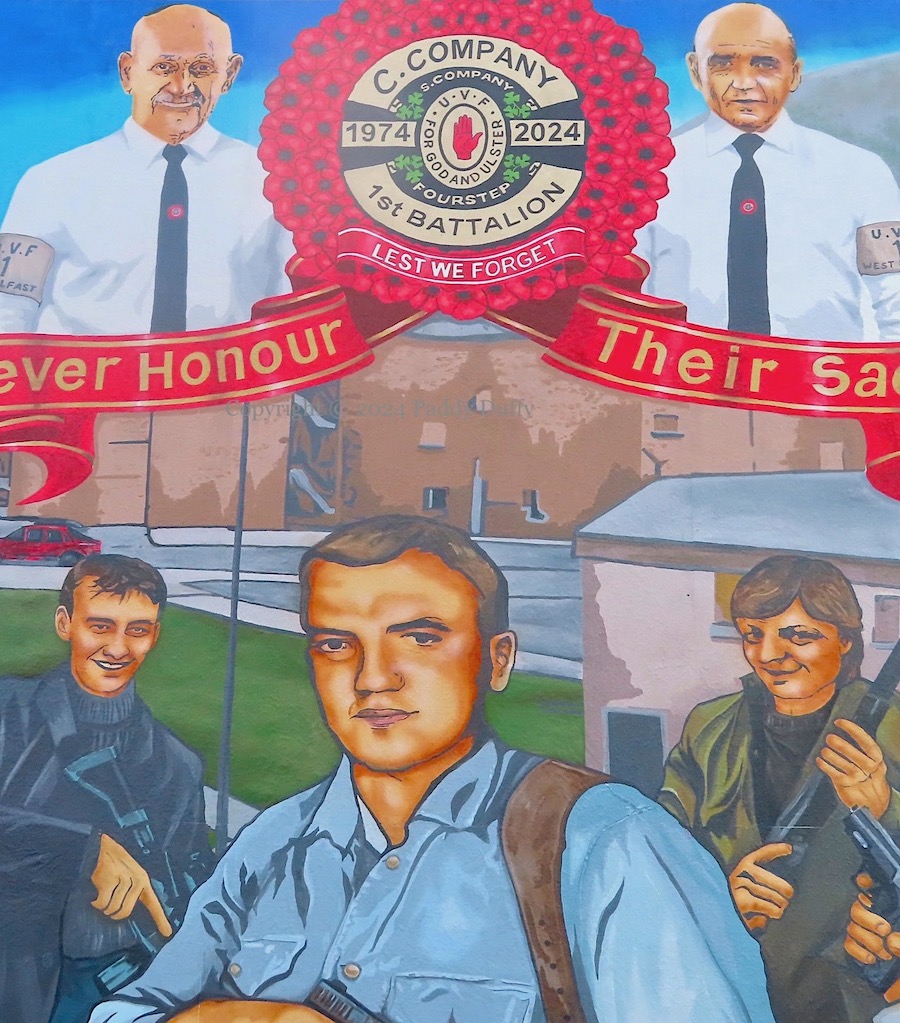
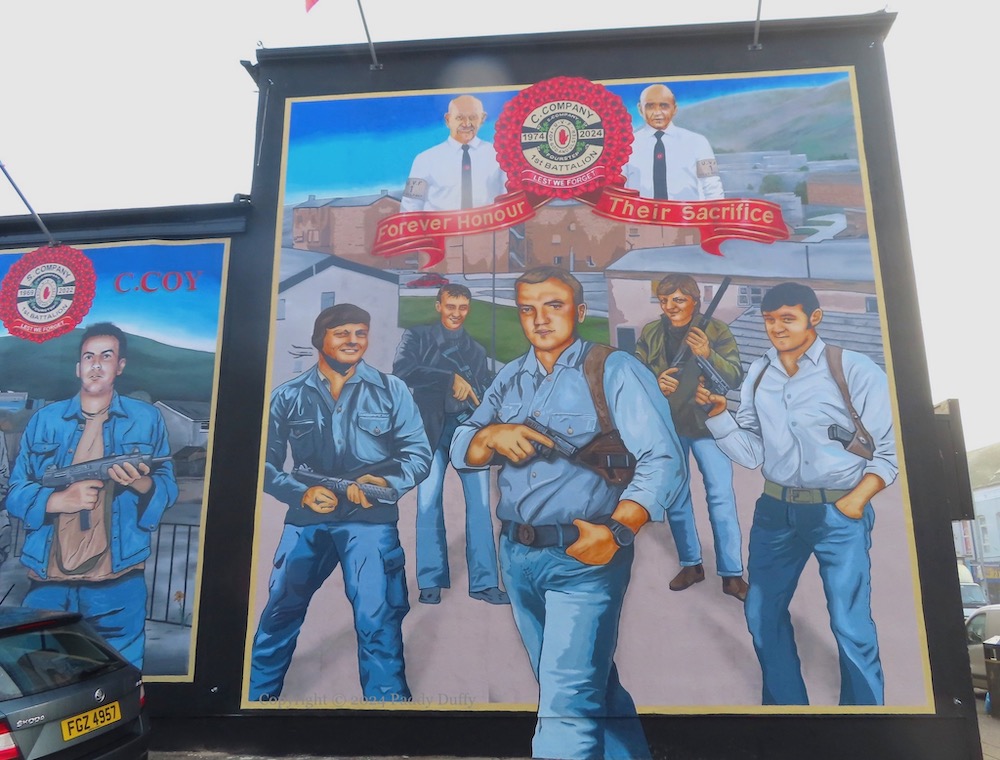
This is a new mural to UVF volunteers (l-r) Robert McIntyre, William Hannah, James McGregor, Robert Wadsworth, and Thomas Chapman, who were killed between 1973 and 1978. Compared to the previous mural, the volunteers generally present a more relaxed appearance, lacking their jackets and parkas, though still brandishing a wide variety of weapons.
It is not clear who the two gentlemen in the top, wearing vintage UVF arm-bands, are.
Carnan (or “C. Coy”) Street in the Shankill. For the mural to the left (to Joe Coggle and Paul McClelland) see S. Company, C. Company.
Prepped for the launch:
July 7th: The plaster was taken back to the brick and then re-plastered and painted before the mural was added.
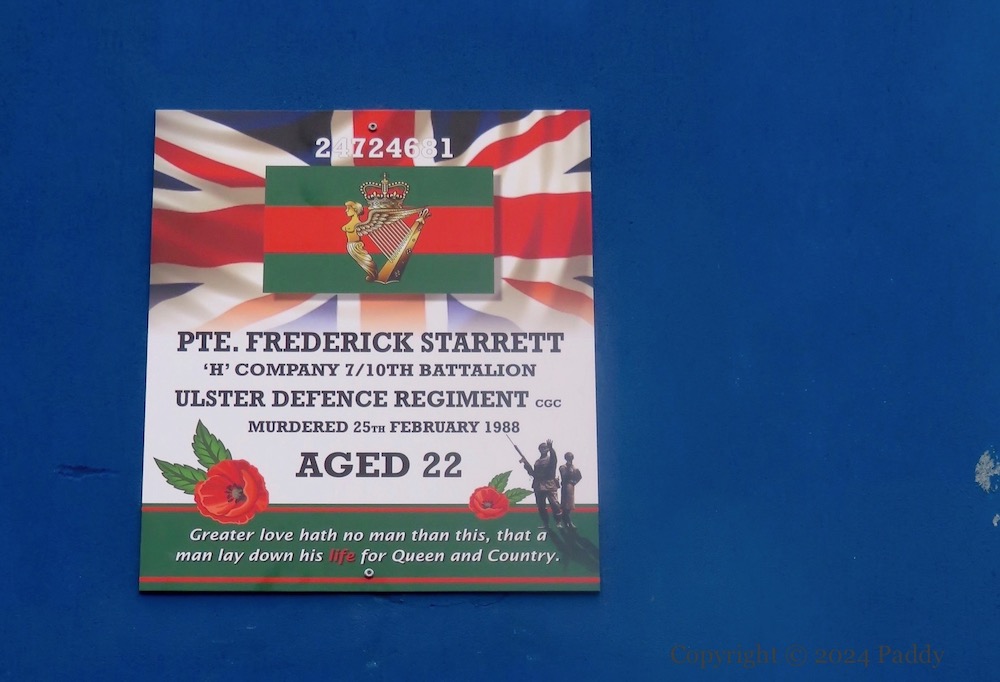
Privates Fred Starrett and James Cummings died in an IRA bombing on Belfast’s Royal Avenue on February 24th, 1988, two of the 197 UDR soldiers who died violently during the twenty-two year life-span of the regiment (UDR Association). The pair are also remembered in a UDR display in Thorndyke Street.
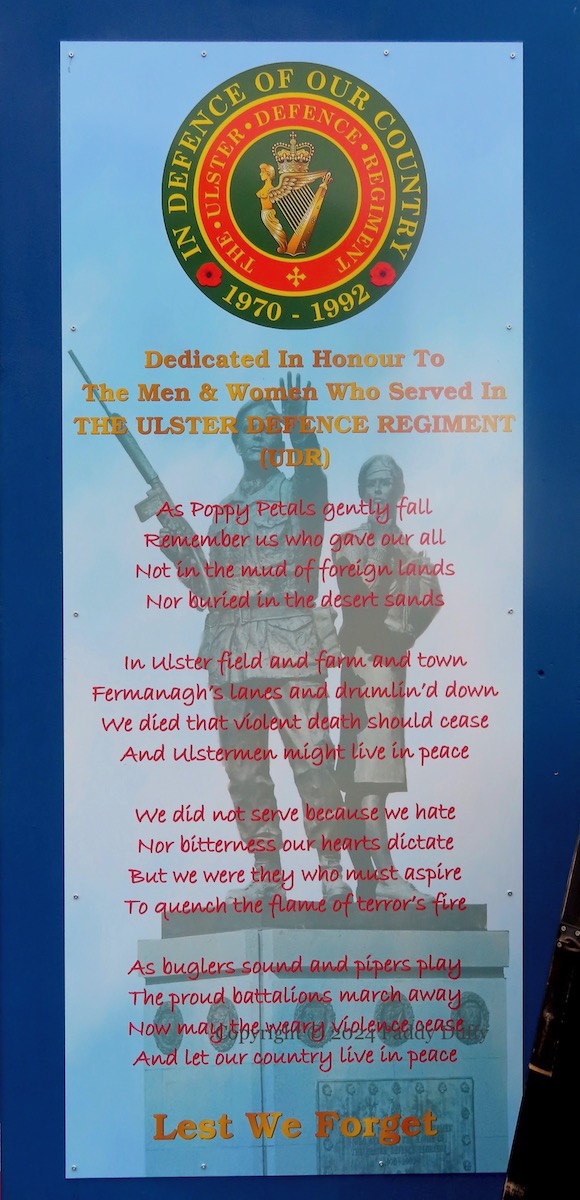
The poem on the right hand side (“as poppy petals gently fall …” by John Potter) is the same as on the Parkhall (Antrim) UDR board.
“This project was completed through Belfast City Council’s ‘Promoting the Positive Expression of Cultural Heritage’ Programme, with funding through the EU Programme for Peace & Reconciliation in Northern Ireland and the Border Region of Ireland (PEACE III) under Priority 1.1. Building Positive Relations at a local level.”
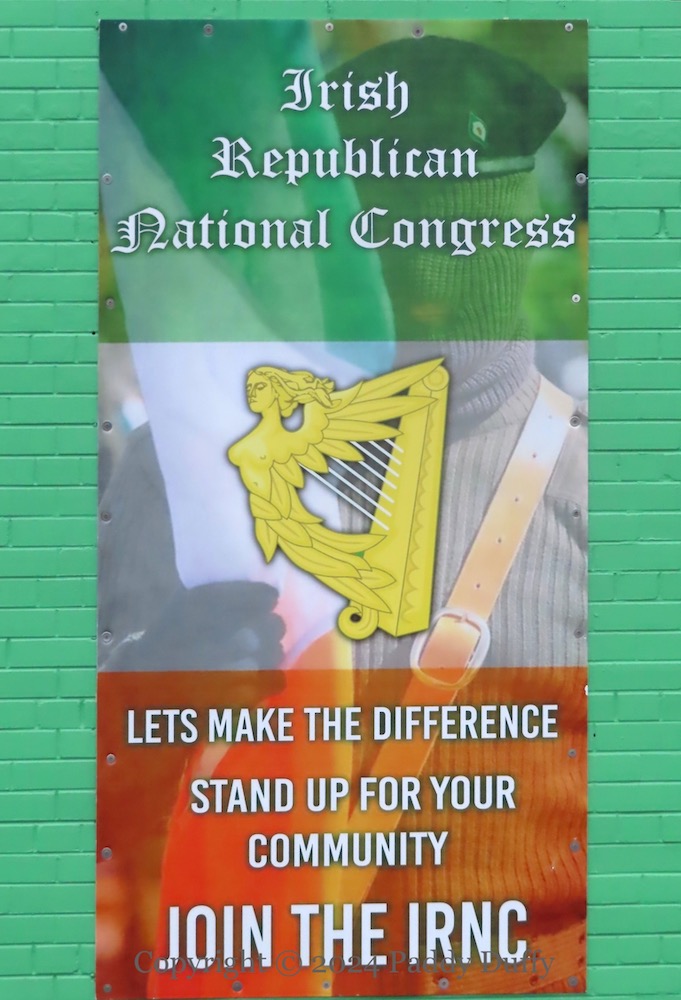
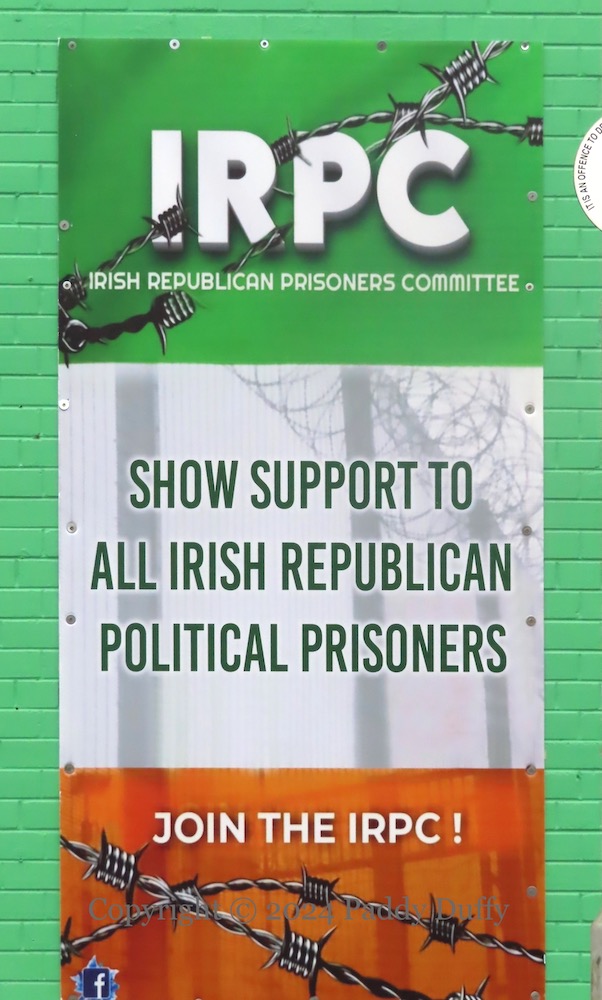
“Let’s make the difference – stand up for your community – join the IRNC”, “Show support to all Irish republican prisoners – join the IRPC”. These are new IRNC and IRPC (Fb) boards on Northumberland Street (Visual History), west Belfast. See previously on Northumberland Street: IRPC prisoner Niall Lehd | Join The IRNC
“In defence of the republic”, “Éıre aontaıthe, Gaelach, agus saor. Seasamh [“ag seasamh”? “seas”? “seasaıgí”?] le Poblacht Shóısıalach Dhaonlathach na hÉıreann 32 Contae.” “Nothing can alter the truth of it: Ireland belongs to the Irish” – Pádraıg Pearse. [from ‘To The Boys Of Ireland‘]”
[Ireland united, Gaelic, and free. Stand with a 32-county, democratic, socialist, Irish republic]
“Honour Ireland’s patriot dead – in our hearts your memory lives on. Irish Republican Martyrs Commemorative Committee [Fb]”
This board also serves to provide an end-of-life image of the piece behind it – Climate Change Affects Everyone But Not Equally – which is now 12 years old and has missing panels; since no one appears to be minding the space, the old board is simply being covered over.
“In proud memory of Ryan McCosh [and] Chris Hamilton, North Down battalion, Bangor”. The memorial board was officially dedicated on November 10th but was in place a month previously (Fb).
To the right of the wide shot, writing on side-walls can be seen that reads “Bangor Protestant Boys F[lute] B[and]” and “Did they beat the drum slowly? Did they play the fife lowly?”. The latter lines are from Eric Bogle’s song “No Man’s Land” which is about a young man (“Willie McBride”) dying on “the green fields of France” in WWI. (Here (youtube) is the recording by Tommy Makem and Liam Clancy.) McCosh and Hamilton appear to have been members of the flute band, rather than members of the Ulster Volunteers or the Troubles-era UVF.
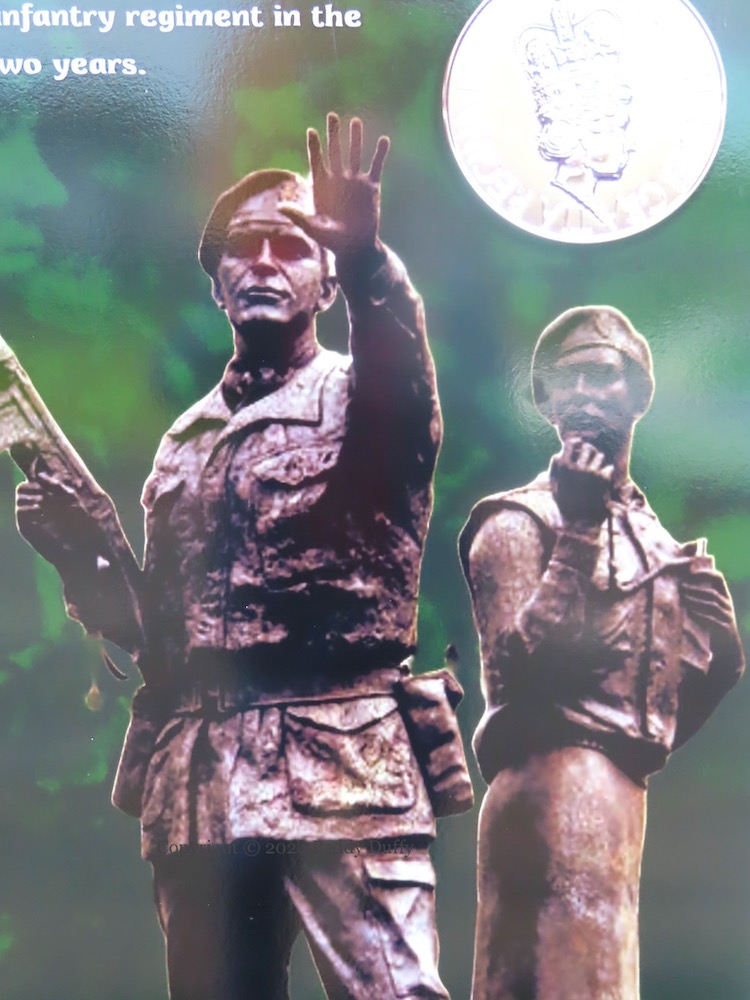
“The Ulster Defence Regiment (UDR) was an infantry regiment of the British Army established in 1970, with a comparatively short existence ending in 1992. Raised through public appeal, newspaper and television advertisements, their official role was the “defence of life or property in Northern Ireland against armed attack or sabotage” but unlike troops from Great Britain they were never used for “crowd control or riot duties in cities”. At the time the UDR was the largest infantry regiment in the British Army, formed with seven battalions plus another four added within two years.”
“The UDR Soldier: As poppy petals gently fall,/Remember us who gave our all,/Not in the mud of foreign lands,/Not buried in the dessert sands.//In Ulster field and farm and town,/Fermanagh’s lanes and drumlin’d Down,/An Ulsterman should live in peace//We did not serve because we hate,/Nor bitterness our hearts dictate,/But we were they who must aspire,/To quench the flame of terror’s fire.//As buglers sound and pipers play/The proud Battalions march away./Now may the weary violence cease,/And let our country live in peace. – By John Potter”. Potter (bio at Royal Irish) also wrote a history of the UDR called A Testimony To Courage.
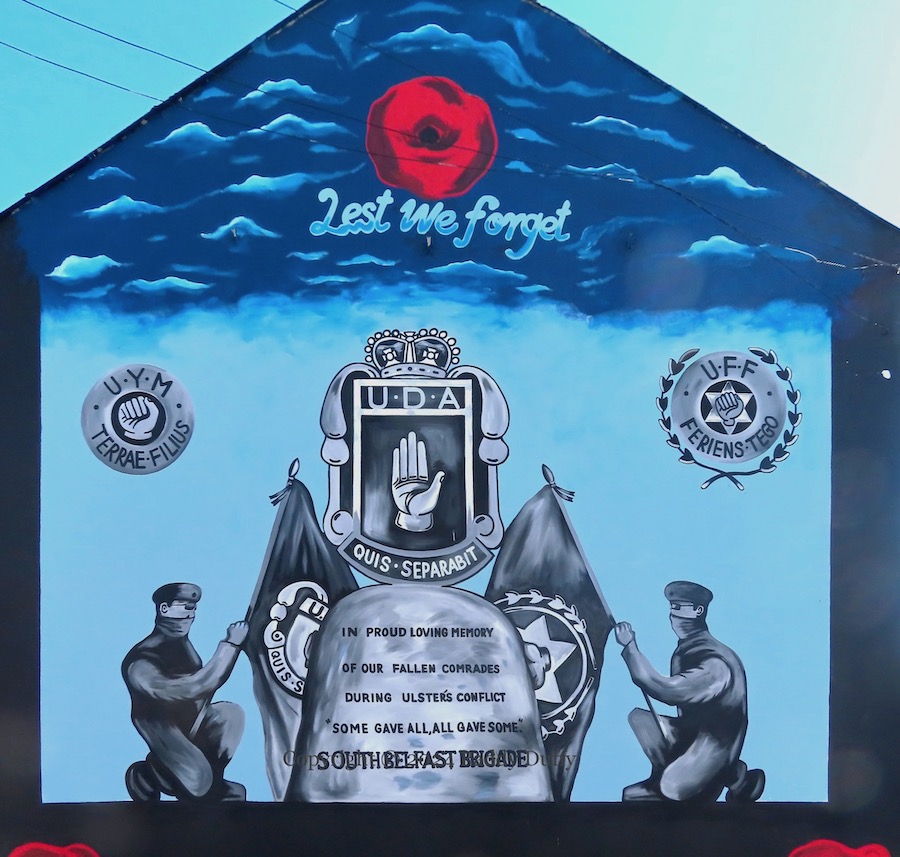
“In proud [and] loving memory of our fallen comrades during Ulster’s conflict. ‘Some gave all, all gave some.’ South Belfast Brigade.” According to Sutton, 91 UDA members died during the Troubles (CAIN).
The text on the side-wall reads, “Death is not an honour but a sacrifice and those who gave that sacrifice are remembered by those that followed. Quis separabit.”
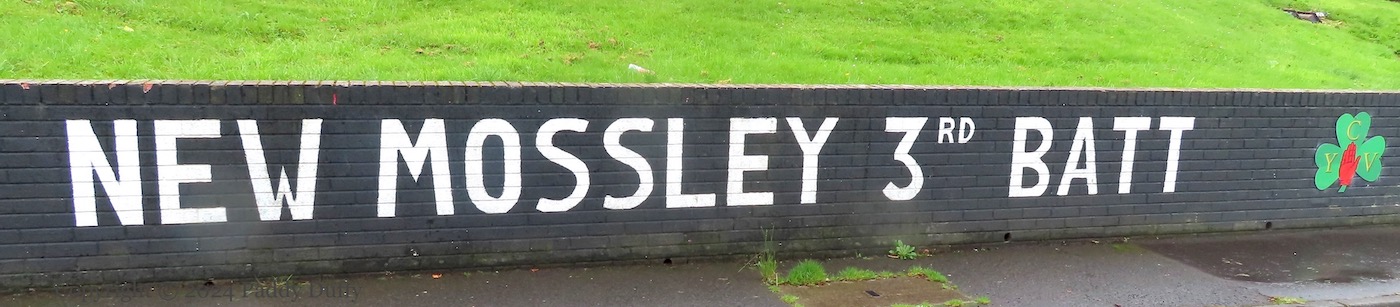
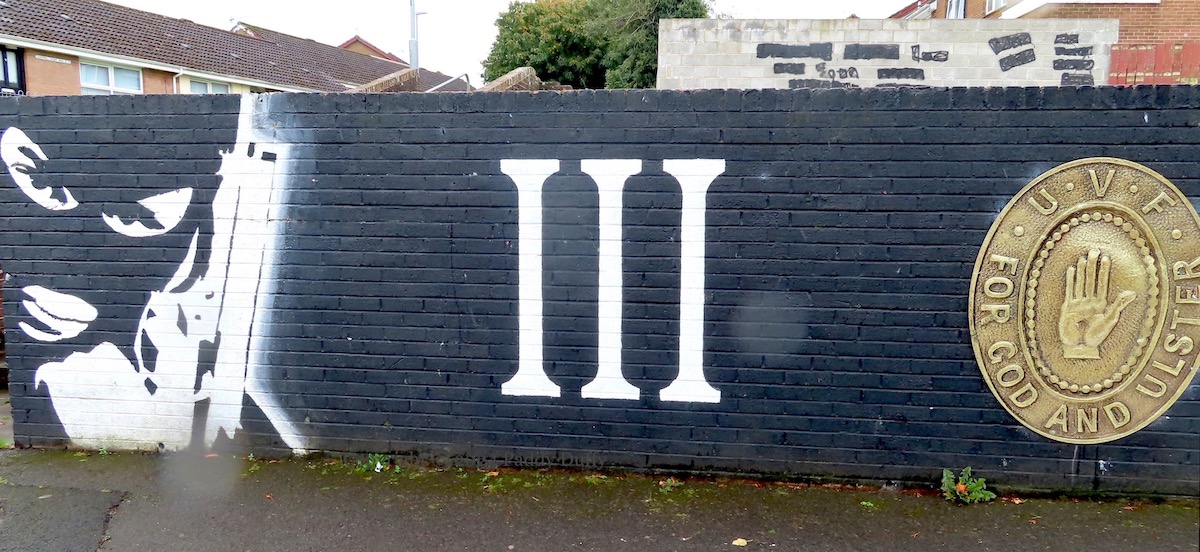
The hooded gunman at the New Mossley playground – seen previously in Welcome To New Mossley Play Area – has been upgraded with a golden UVF emblem (shown last, below), and has been joined by two new pieces: the printed board above and the low wall below. The 3rd battalion also includes Rathcoole, Mount Vernon, and Tiger’s Bay.
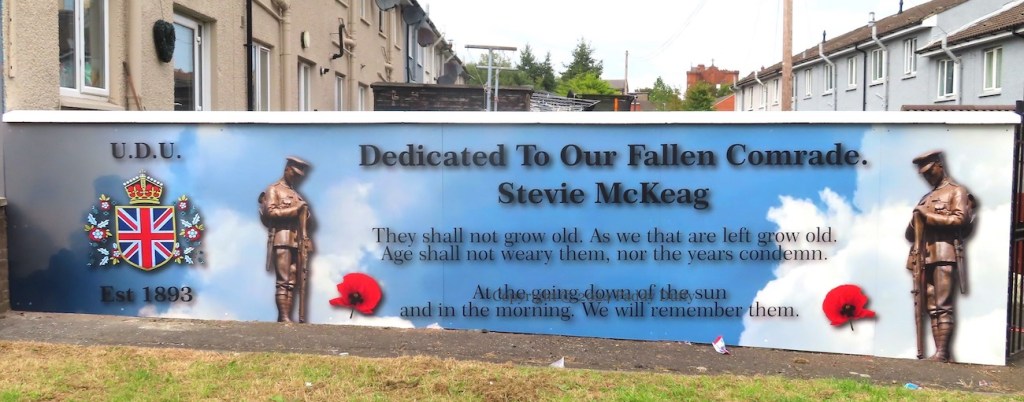
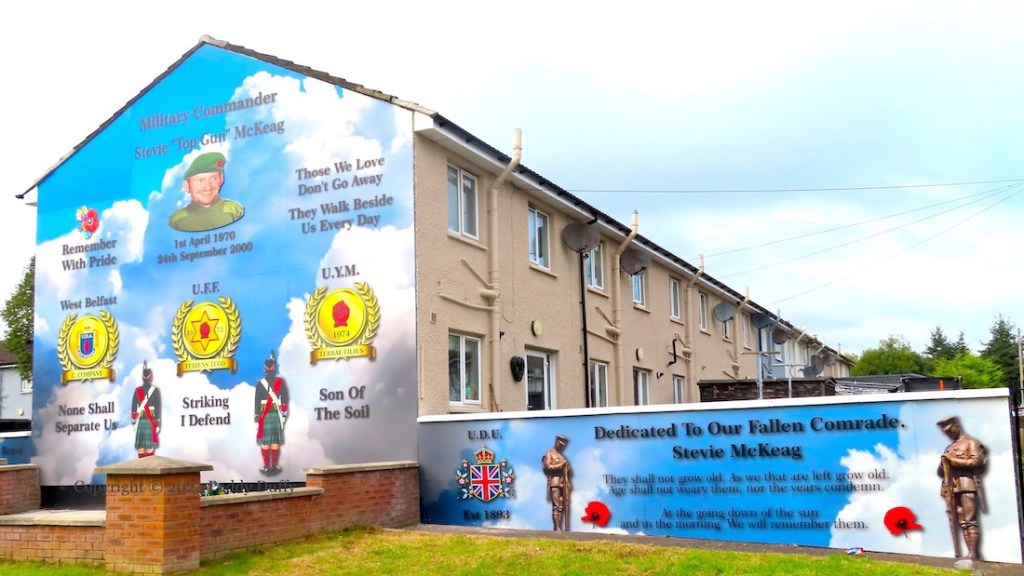
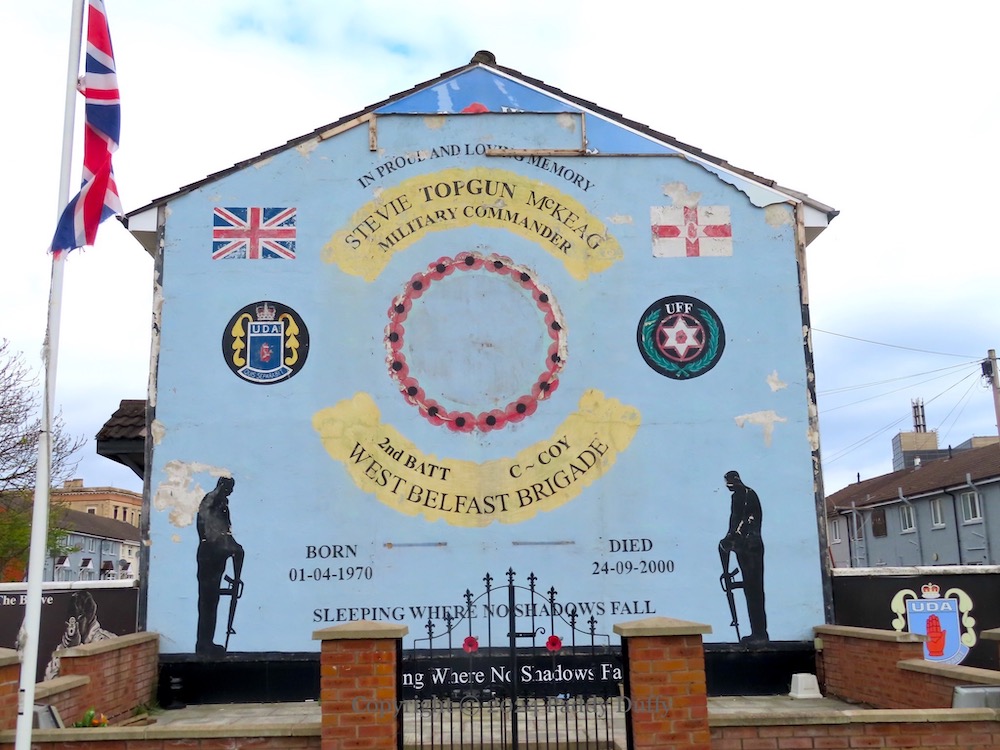
After a long spring and summer of inaction, a new tribute to UDA assassin Stevie “Top Gun” McKeag has been put in place in the lower Shankill, replacing the flat-capped version of 2016.
In Tolstoy’s War And Peace, the prince Andrei Bolkonsky at one early point remarks, “It is not given to people judge what’s right or wrong. People have eternally been mistaken and will be mistaken, and in nothing more so than in what they consider right and wrong.” But after he is wounded at the Battle Of Austerlitz in 1805 and again in 1812 at the Battle Of Borodino, he loses his admiration for the blood-thirsty Napoleon and for war in general, and comes to think that events are a function of many individual decisions.
Stevie McKeag, hit-man for the UDA’s second battalion (west Belfast) ‘C company’, killed at least a dozen Catholics between 1990 and 1998 (WP). The version presented on the left-hand side-wall (just below) begins, “It is not given to people to judge what’s right or wrong. People have internally been mistaken and will be mistaken …” which seems to be contradictory, and then continues “… and in nothing more than in what they consider right and wrong” which is difficult to parse so as to give the intended meaning.
The mirrored hooded gunmen on either side of the quote come from an old mural in the estate – see UDU-UFF-UDA.
The smiling McKeag is here shown in the main panel wearing a green beret (as is the anonymous volunteer in the side-wall) and commando jumper (with shoulder patches) as though he were a “military commander” in the Commandos or Royal Marines of the British Army. The UDU, the poppies, and the graveside mourners in the right-hand side-wall are used to put McKeag’s actions in the context of resistance to Home Rule and the British Army’s role in the Great War.
For the composition of the main panel, as well as its use of boards on top of the background, compare with the UDA piece in the Woodvale. The translation into English of the UDA’s, UFF’s, and UYM’s Latin mottos – [Quis separabit] / None shall separate us | Feriens tego / Striking I defend | Terrae Filius / Son Of The Soil – is unusual, as is the bouquet of flowers behind the poppy.
For more, including the mourning soldiers, see the entry at Extramural Activity.
“Land of the free because of the brave”. “Remember with pride”. “Those we love don’t go away/They walk beside us every day”. “Dedicated to our fallen comrade”.
April 25th, 2024: The boards were taken off, revealing an older version that stood 2010-2015.
[In the middle circle there were, over the years, a series of printed portraits of McKeag (and one painted version). For the version from 2014, see M11119; see also the image 2011, which links back to other versions from 2010, 2009, 2008, and 2007).]
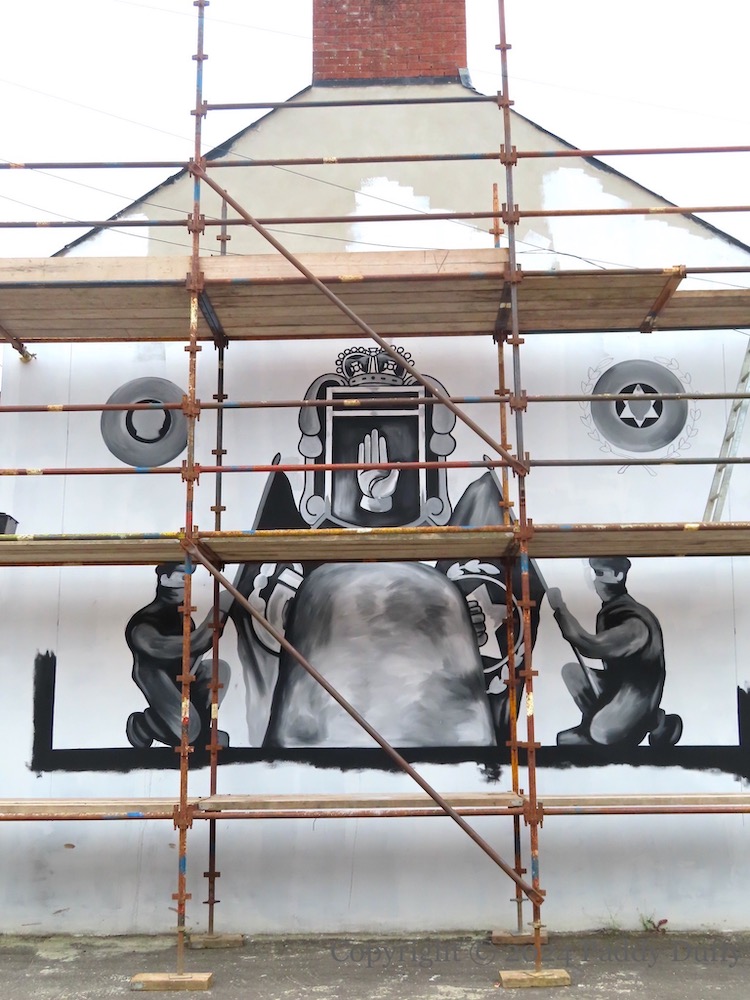
May 3rd, 2024: Scaffolding in front of the wall
This layer of paint (and plaster?) was also taken off, to reveal the remains of the original King Rat mural on the wall – see X15041 in the Seosamh Mac Coille collection.
Benjamin West painted The Battle Of The Boyne in 1778 and his composition – with William moving from left to right on a white horse and Marshal Schomberg dying in the bottom-right corner – has become the standard representation in loyalist culture, perhaps due to versions of it appearing on the covers of songbooks for the Orange Order and the Apprentice Boys soon after (Belinda Loftus 1982 Images In Conflict). It appears here on the wall of Whitehead Orange Hall, along with a board connecting service by Irish soldiers in British forces in WWI and Afghanistan (see previously: The Sacrifice Remains the Same in east Belfast).














 Paddy Duffy Collection