Freedom’s Sons

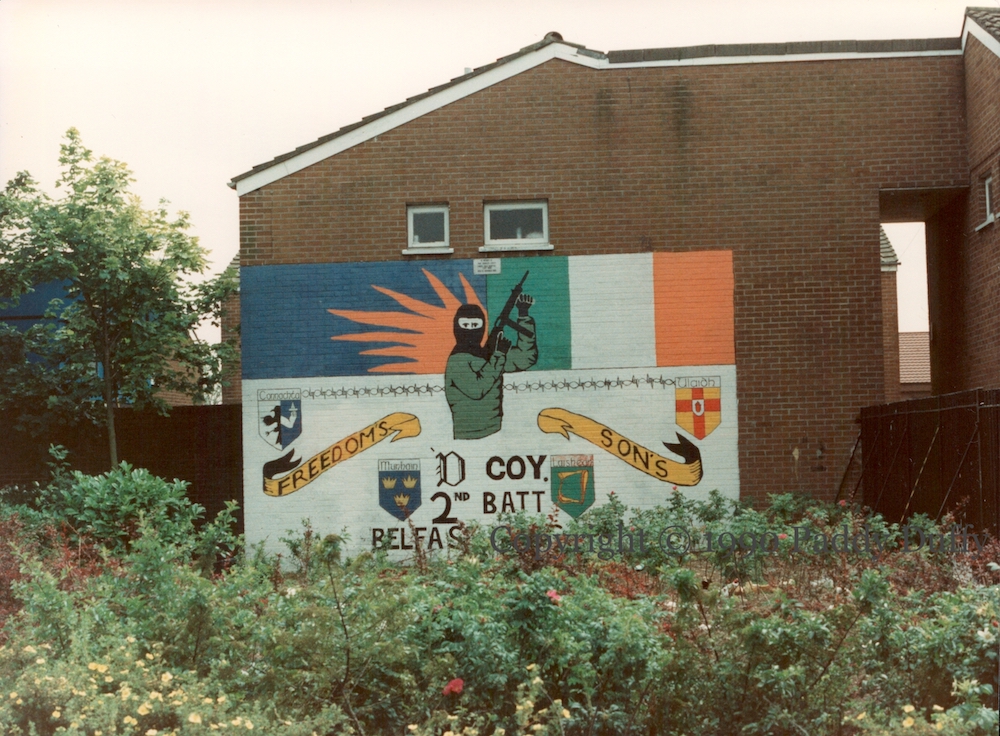
The writing – D coy, 2nd batt, Belfast Brigade [IRA] – has been added where the volunteer’s legs used to be – see the Peter Moloney Collection for the original. A small plaque has been added at the top. Otherwise, the mural remains as before, with a hooded volunteer raising an assault rifle in front of a sunburst and Tricolour, with a row of barbed wire and the four provinces named in Irish.

Falls Road, west Belfast, now the site of the Garden Of Remembrance

Click image to enlarge
Copyright © 1990 Paddy Duffy
T00088

Liberty

Both of these murals by Mo Chara Kelly in the old Linden Street remained unfinished. “I was doing one about the Falls Curfew [for the 20th anniversary march – shown above]. … It never got finished because we had to start Women Against Oppression. When you’re available, people just came up to you, “Mo Chara, we need a mural on this. Could you stop that one? We need to do this one. There’s a Nelson Mandela one needs doing, could you do that?” Everything was chopped and changed all the time, and I never got back to it.” (Painting My Community/An Pobal A Phéınteáıl – English-language version available for free)

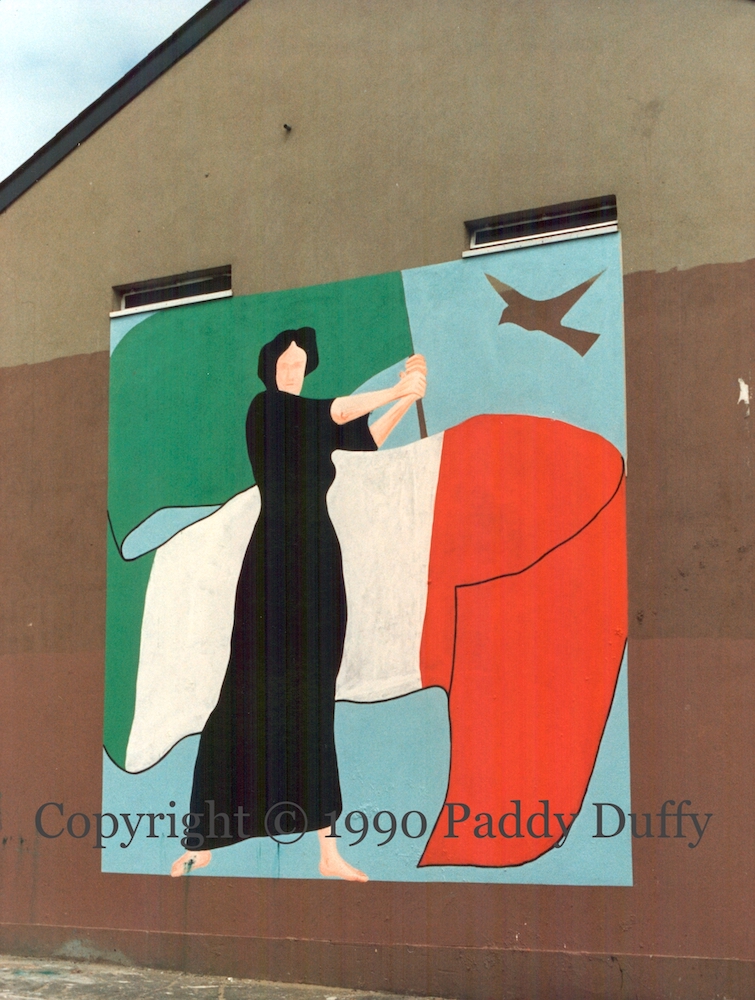
The second shows a barefoot woman carrying a large Tricolour and a lark overhead. It is based on the Women’s Day (“Frauen Tag”) poster from 1914. “Heraus mit dem Frauenwahlrecht” – “Forward with women’s suffrage”. German women were given the right to vote in 1918. This mural was replaced by Women Against Oppression.

Click image to enlarge
Copyright © 1990 Paddy Duffy
T00090 T00096

Free Ireland

Manacles “Made in Britain” constrain the republican desire for a united Ireland, contrary to the burning GPO and rising phoenix.

“Numerous foreign groups and delegations visited Ballymurphy and west Belfast during the troubles. I remember one meeting I was at in Conway Mill, I picked up a pamphlet with a drawing of a manacled fist. The caption read “Made in the USA.” So I just took the image and changed the slogan to “Made in Britain”.” (Painting My Community/An Pobal A Phéınteáıl – English-language version available for free)

The plaque – which pre-dates this mural – is to local (A Company 2nd Battalion) IRA volunteers Stan Carberry, Frankie Dodds, Paul Fox, Sean Bailey, Paul Marlowe, and Tony Campbell. “Fuaır sıad bás ar son na hÉıreann”, “Ireland unfree will never be at peace”. (See the Peter Moloney Collection.)

Painted by Mo Chara Kelly in Beechmount Avenue/RPG Avenue.

Click image to enlarge
Copyright © 1990 Paddy Duffy
T00097 T00098

Beıdh An Bua Agaınn

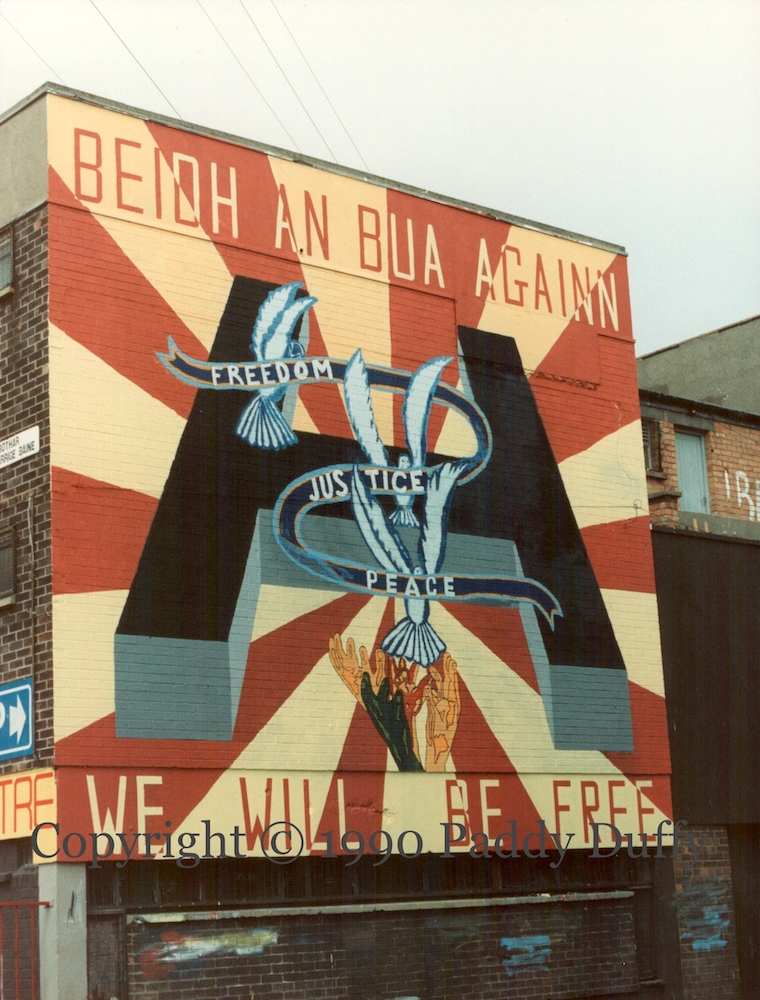
“Beıdh an bua agaınn” [victory will be ours] is a slogan that Mo Chara Kelly saw inside a cell in the H-Blocks. A circle of four hands – perhaps intended to be in the colours of humankind – releases three doves: “freedom, justice, peace”. “We will be free.”

Painted by Mo Chara Kelly at the top of the Whiterock Road, west Belfast.

Click image to enlarge
Copyright © 1990 Paddy Duffy
T00095

Ireland First, Ireland Last, And Ireland Over All

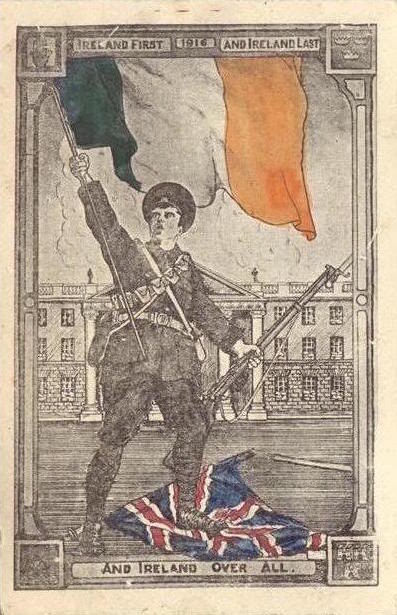
A revolutionary soldier raises the Irish Tricolour while trampling on a Union Flag on a broken mast that was perhaps attached to the poorly drawn GPO in the background. The card on which the image is based can be seen below.

On the right hand side are the Easter lily and halberds/pikes and an assault rifle, indicating the historical roots and present-day inheritors of the 1916 revolt.

Click image to enlarge
Copyright © 1990 Paddy Duffy
T00094

So I Always Looked The Other Way

A cartoon by ‘Cormac‘ (Brian Moore) is turned into a mural on Belfast’s Whiterock Road by Mo Chara Kelly. The mural satirizes the ad included below, which urges people to call the confidential telephone to report terrorist activity. Instead, the protagonist can no longer ignore the violence of the British Army (and RUC) and calls the Sınn Féın office.

1 When the Brits were having a go … “Who cares?” I thought.
2 And when something really rough happened I just trained harder to forget it … [Speech-bubble:] Anything for a quiet life, see.
3 But where’s it got me? What have these brave lads in khaki done for me? [British Army soldier:] We’re not here to do things for you; we’re here to do things to you.
4 [RUC commander:] Hey, don’t forget us. We’ve done our share of wrecking homes, harassing people. We’ve murdered and tortured and …
5 And when I saw their kind of justice I thought “There’s got to be something better than this.” [Judge:] You may think I’m a corrupt Orange bigot. But I know that I’m a very well-paid corrupt Orange bigot! And the only justice you’re going to get is British justice.
6 So I made up my mind. I wanted these thugs off our backs. [Thought-bubble:] Is it any wonder that the British tourist is the most despised person on earth?
7 You see I want a decent future, and it’s not going to happen while these “hero[e]s” are doing the dirty work of British imperialism. And it’s not going to happen if you’re waiting for someone else to do something.
8 622112. Hallo? Is that the Sınn Féın office?

Click image to enlarge
Copyright © 1990 Paddy Duffy
T00091

Éırí Na Gealaí

Bobby Sands’s prison diary (web) ends, on March 17th, 1981, with the words “Tıocfaıdh lá éıgın nuaır a bheıdh an fonn saoırse seo le taıspeáınt ag daoıne go léır na hÉıreann – ansın tchífıdh muıd éırí na gealaí.” [A day will come when this desire for freedom will be exhibited by all the people of Ireland – then we will see the rising of the moon].

The phrase “the rising of the moon” comes from the poem/song of the same name composed by fifteen-year-old John Casey in 1865 about the 1798 Rebellion. “Full bitter was their fate” but the desire for freedom was not extinguished with them: “… e’en still are beating/Hearts in manhood’s burning noon/Who would follow in their footsteps/At the rising of the moon.”

In this mural, just off Lenadoon Avenue, a larger-than-life prisoner stands in silhouette, with first defiantly raised, over the watch-towers of Long Kesh.

“Chífıdh muıd éırí na gealaí” – “chífıdh” and “tchífıdh” are variant spellings.

Click image to enlarge
Copyright © 1990 Paddy Duffy
T00068

Behind The Mask

Here is an instance of the ‘masked skull’ design produced by prisoners in Long Kesh (according to Mo Chara Kelly), seen also in Britains Death Squads. This version is simpler: it does not have any writing and there is no UDR emblem on the UDA-style hat.

The small boards above the mural declaring west Belfast an “apartheid-free zone”/”ceantar saor ó apartheıd” were mounted in 1986 along with the ANC mural.

Beechmount Avenue, west Belfast – this wall has its own Visual History page as it is the most-often painted wall in Belfast.

Click image to enlarge
Copyright © 1990 Paddy Duffy
T00040

Striking At Republican Targets

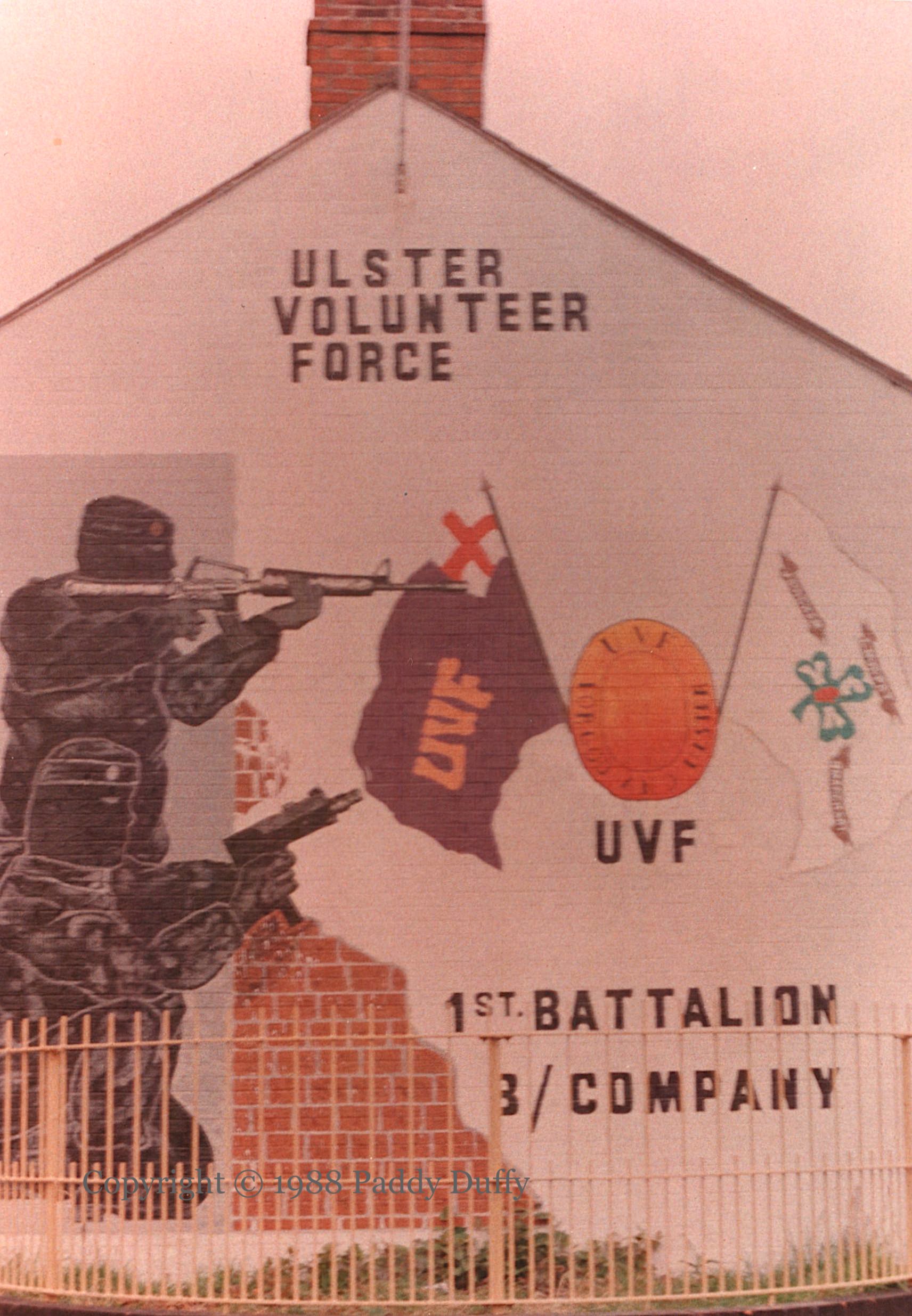
Hooded UVF volunteers from “1st battalion, B company” armed with an assault rifle and an Uzi take aim at unspecified targets.

On the side-wall to the left it reads, “The UVF reserve the right to strike at republican targets where and when the opportunity arises” – see also the Peter Moloney Collection.

Ohio Street, Woodvale, west Belfast

Click image to enlarge
Copyright © 1988 Paddy Duffy
T00146 T00229

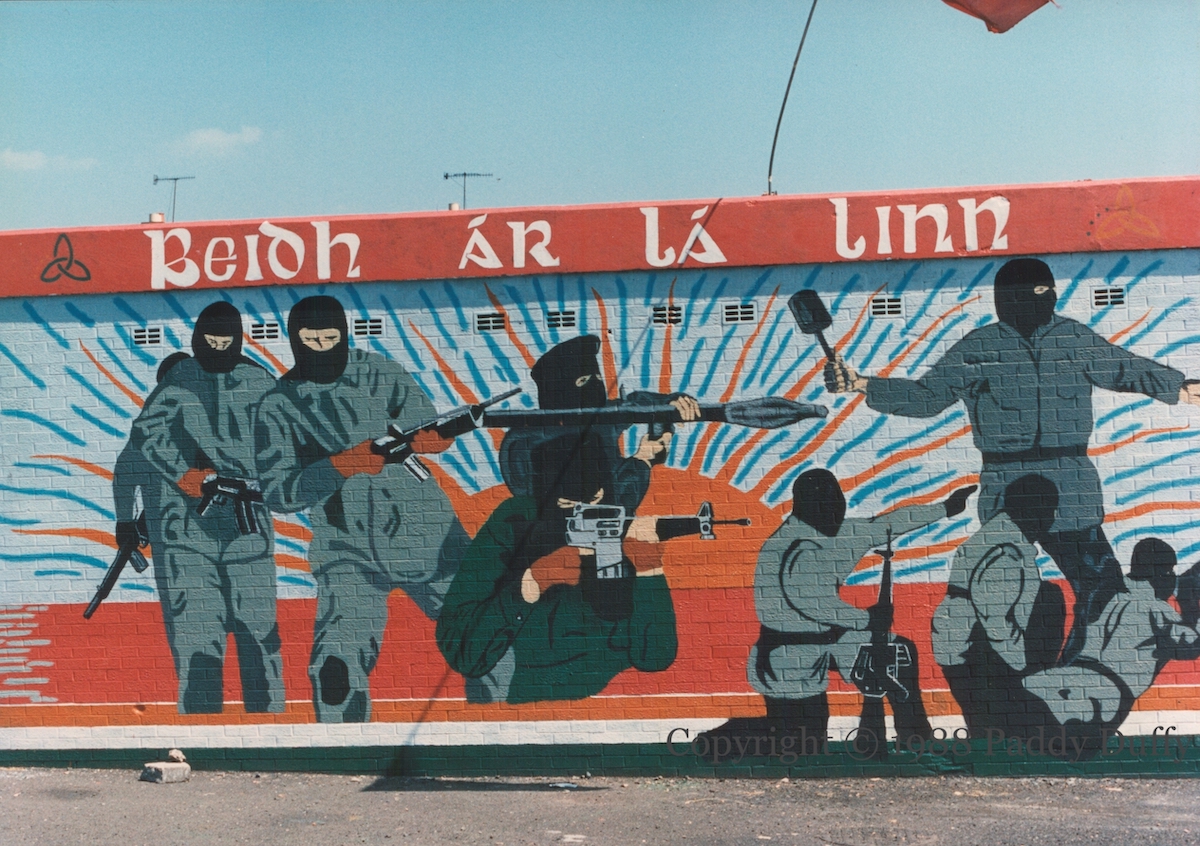
Beıdh Ár Lá Lınn

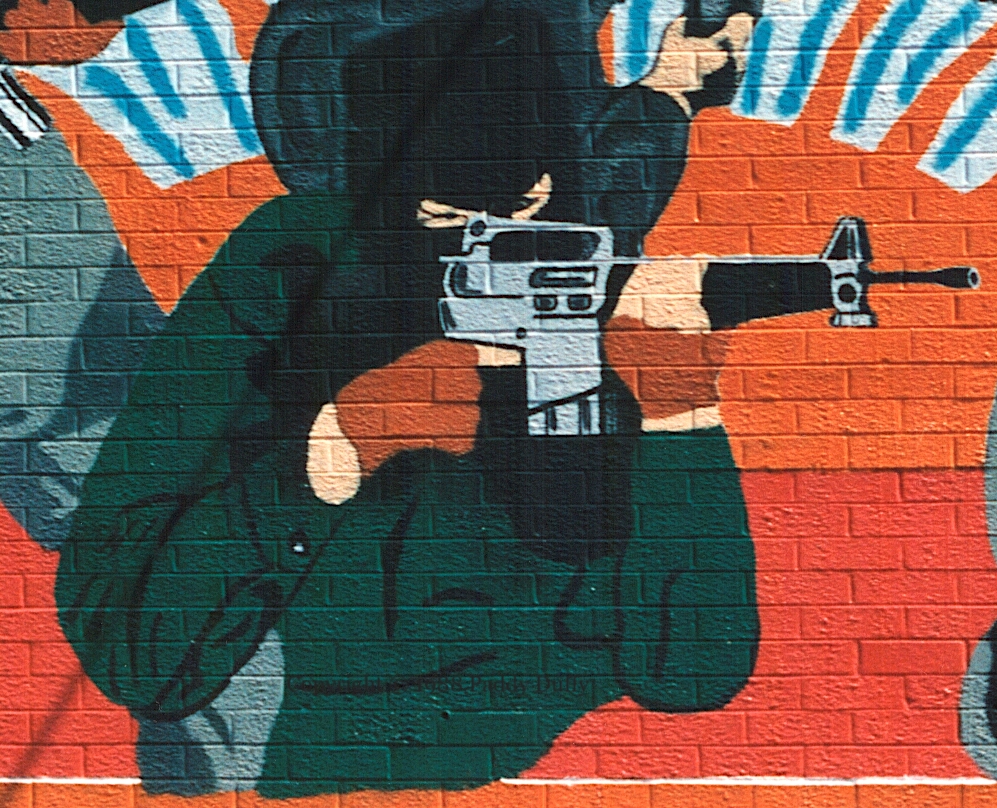
This mural shows nine hooded republican volunteers employing an assortment of weapons – rifles, RPG launcher, drogue bomb, machine gun – against a rising sun. “We will have our day.” The trio in the bottom right corner are familiar from other murals, such as this one in Strabane.

South Link, Andersonstown, west Belfast

Click image to enlarge
Copyright © 1988 Paddy Duffy
T00086 T00034