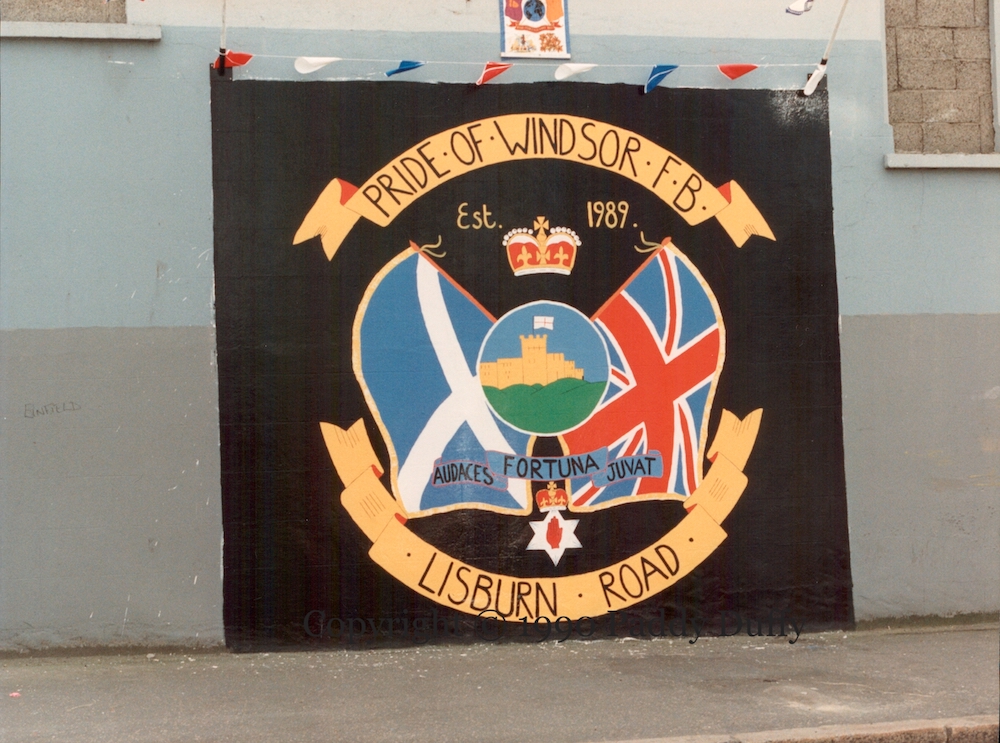
Pride Of Windsor was formed from members of the Donegall Road Protestant Boys (Belfast Forum). It’s not clear how long the band lasted after being formed in 1989 and this mural in 1990. The mural features Carrickfergus castle between St Andrew’s Saltire and Union Flag. “Audaces fortuna juvat” [fortune favours the bold] is the motto of Linfield FC.
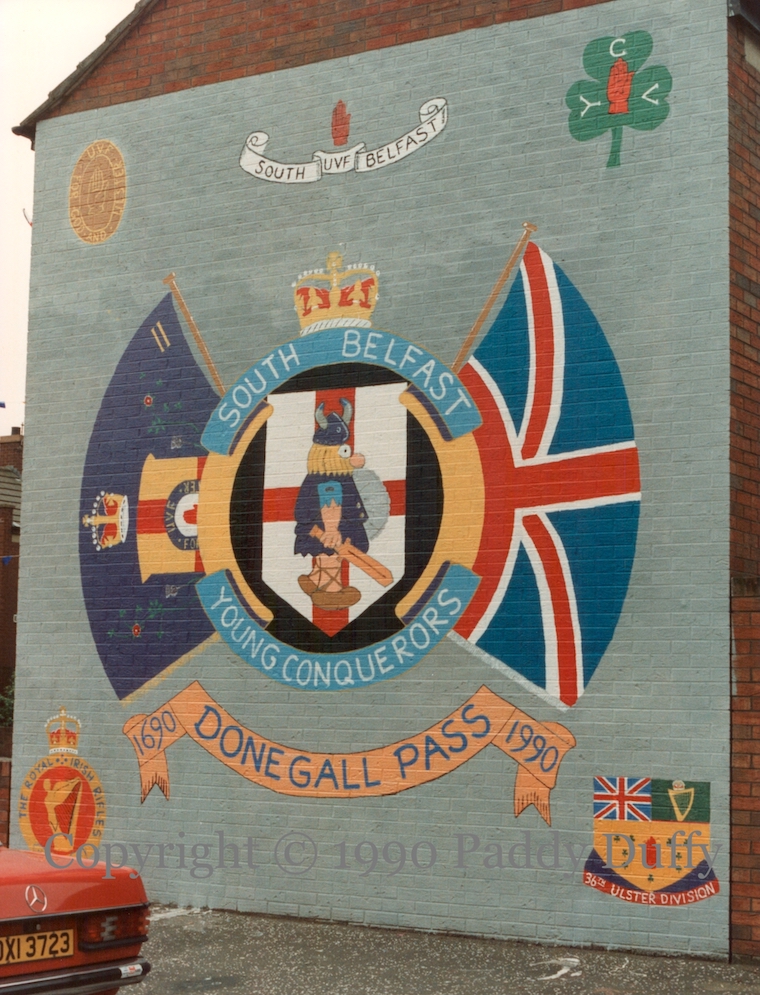
The Young Conquerors flute band (Fb) and the South Belfast UVF celebrate the 300th anniversary of the battle of the Boyne, with a new mural in Pine Street, Donegall Pass, south Belfast. The emblems of the RIR and 36th Division are in the bottom corners, and the flag on the left is a regimental flag of the Ulster Volunteers.
Núada and Morrígan (from Jim Fitzpatrick’s Beneath The Sky Of Stars) embrace below a ram (from Fitzpatrick’s Senach The Spectre) and between Celtic creatures inspired by the Book Of Kells.
This is a bright and colourful mural in stark contrast to the greys and browns of Unity flats, west Belfast
The mural of the Madonna and child on the side of the Morning Star hostel greeted travellers going up Divis Street from 1988 to (at least) 2002. It was, according to minutes of Belfast City Council’s Development Committee (2002-03-06 pdf), one of four religious murals painted in west Belfast in 1988. The other three are unknown – please get in touch if you can identify them.
The second mural, below, with similar figures and palette, was also extant in 1988, though might have been painted earlier. It was in Hillman Street in the New Lodge. It is entitled “Our Lady Of Medjugorje” despite the fact that the Medjugorje apparition (in 1981) was of Mary alone, without child.
There were two other vintage religious murals in the New Lodge, one of a paschal lamb in Lepper Street (C00111 | X05493) that was extant in 1988, and one of the 1879 apparition in Knock in Oceanic Street whose date of creation is unknown – it was visible in Street View in 2008. Of the same (1988) vintage seem to be murals of a shamrock (C04981), Gaelic games (C04977), a harpist (M01248), and doves (M01249).
Other visions of Our Lady Of Medjugorje occurred at the top of Springhill in 1990 (see the Gerard Kelly site) and in Ardoyne, painted c. 1993 (M01017) and repainted on various occasions since (possibly 2004, 2012, 2014, 2020).
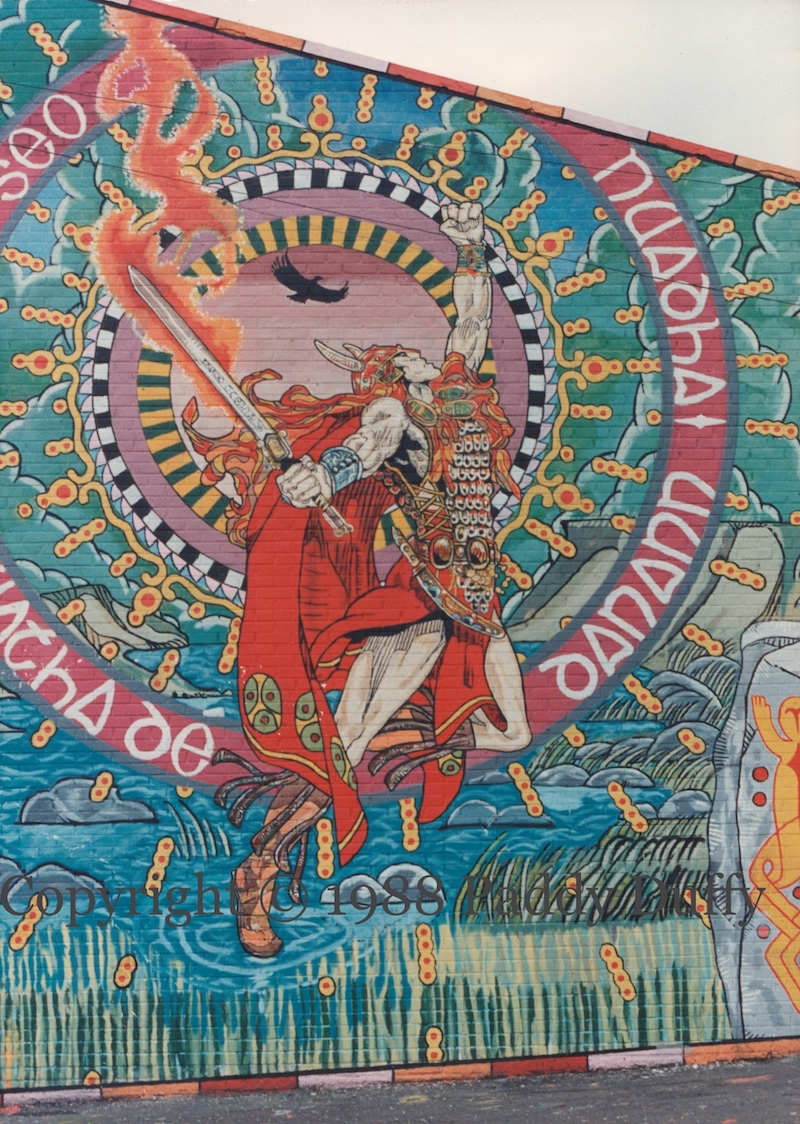
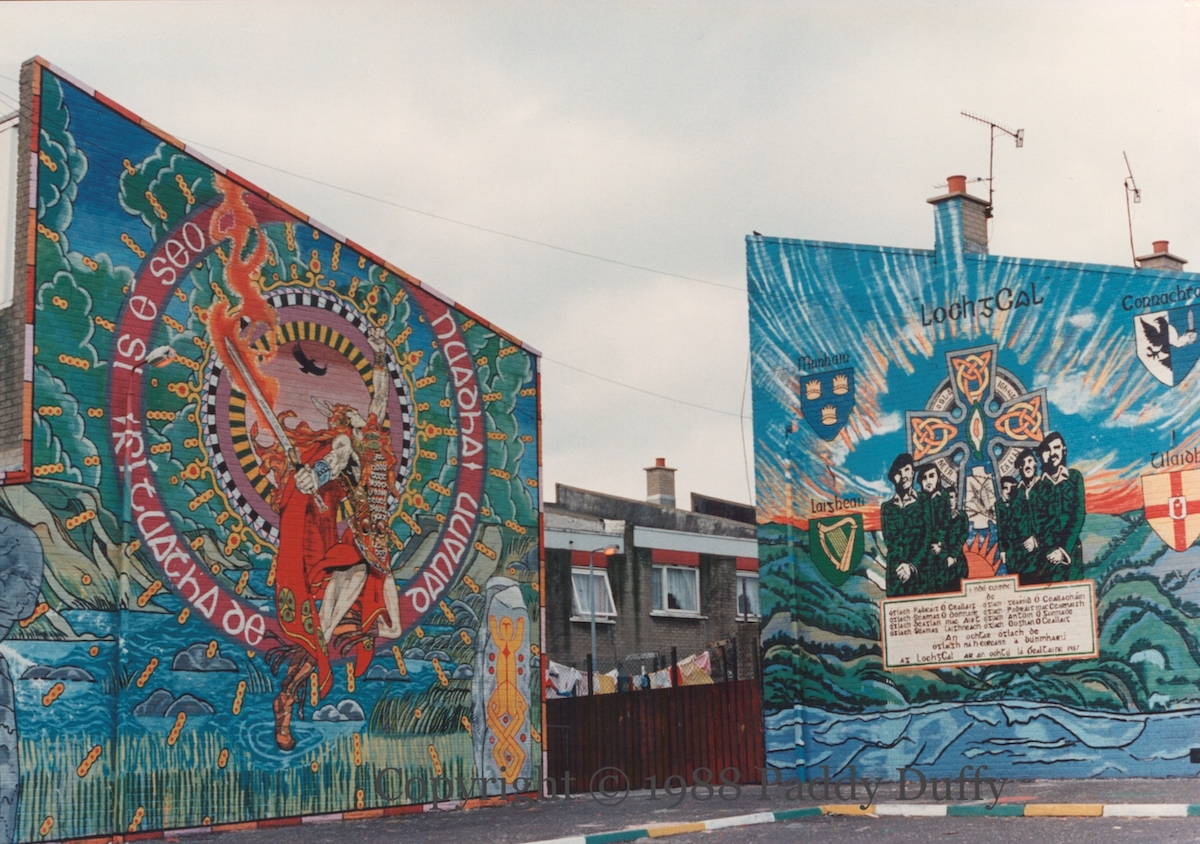
This pair of murals was painted by Mo Chara Kelly at the top of Springhill in 1987 after his release from prison. Both are inspired by the work of Jim Fitzpatrick. The central figure of the Rí Nuadha [King Nuada] mural above and immediately below comes from a painting of Fitzpatrick‘s called ‘Nuada Journeys To The Underworld’ while the background has a Fitzpatrick style and colour-scheme.
Of the myth of Nuada, Mo Chara said, “I had never heard the story of King Nuada before. Then I read the story. Wow! What a yarn! Nuada Of The Silver Arm is one of my favourite stories. As one of the Tuatha Dé Danann you had to be whole and physically perfect to hold the kingship. Nuada lost an arm in the first battle of Moy Tura and so he lost his kingship. He went into the other world, to middle earth, fought through trials and tribulations until Dıan Cécht made a silver arm for Nuada and he was restored to the kingship for another twenty years. But the moral of the story to me was that, no matter what happens, get up again and fight back. No matter how bad the situation you are in, you get back up and fight again. Do not let people isolate you. Get up and fight again. It was very inspiring!” (Painting My Community/An Pobal A Phéınteáıl – English-language version available for free.)
The Loch gCál/Loughgall mural likewise draws on Fitzpatrick for the landscape behind the Celtic cross and funeral guard in memory of the eight IRA volunteers from the East Tyrone brigade who were killed in an SAS ambush during an attack on an RUC base in May, 1987 (WP).
The names of the eight volunteers are given here in Irish and (partially) in the old script:
“I ndıl cuimh[n]e de [= ar] Óglach Pádraıg Ó Ceallaıġ [Patrick Kelly], Óglach Séamus Ó Donn[ġ]aıle [Seamus Donnelly], Óglach Deaglán Mac Aırt [Declan Arthurs], Óglach Séamus Laıghneach [Jim Lynagh], Óglach Gearóıd Ó Ceallacháın [Gerry O’Callaghan], Óglach Pádraıg Mac Cearnaıgh [Pádraıg McKearney], Óglach Antóın Ó Garmaıle [Ó Gormghaıle | Tony Gormley], Óglach Eoghan Ó Ceallaıġ [Eugene Kelly]
an ochtar óglach de óglaigh na hÉireann a dúnmharú ag Loch gCál ar an ochtú lá Bealtaine 1987.” [the eight volunteers from the Irish Volunteers [IRA] who were murdered at Loughgall on the eighth day of May, 1987]
The town (Loughgall) and the four provinces are also named in Irish. An Easter lily is at the centre of the Celtic cross in the middle of the image, above a lark in barbed wire and a gal gréıne/sunburst.
This is an interesting mural from North Queen Street, if only because of its psychedelic colour-scheme and composite style.
The two bulls (presumably from the Táın though they are not the classic brown and white bulls) provide a centre, on either side of which we find Cú Chulaınn dying (and Tuan the eagle) and a dolmen. The horse on the right is perhaps Galloper. There are four faces superimposed on flying geese. The cranes Samson and Goliath are on the left (which suggests a cross-community sponsorship) and a Pride rainbow is on the right.
A wide shot of the whole can be seen in the Peter Moloney Collection. If you have any information about the piece, please get in touch.
North Queen Street, presumably at the bottom of the New Lodge (either where the playing pitch opposite (what was then) Artillery House (now Teach Ghráınne) is, or on a wall of Gallagher’s factory, where the car park for the shopping centre now is?).






 Paddy Duffy Collection