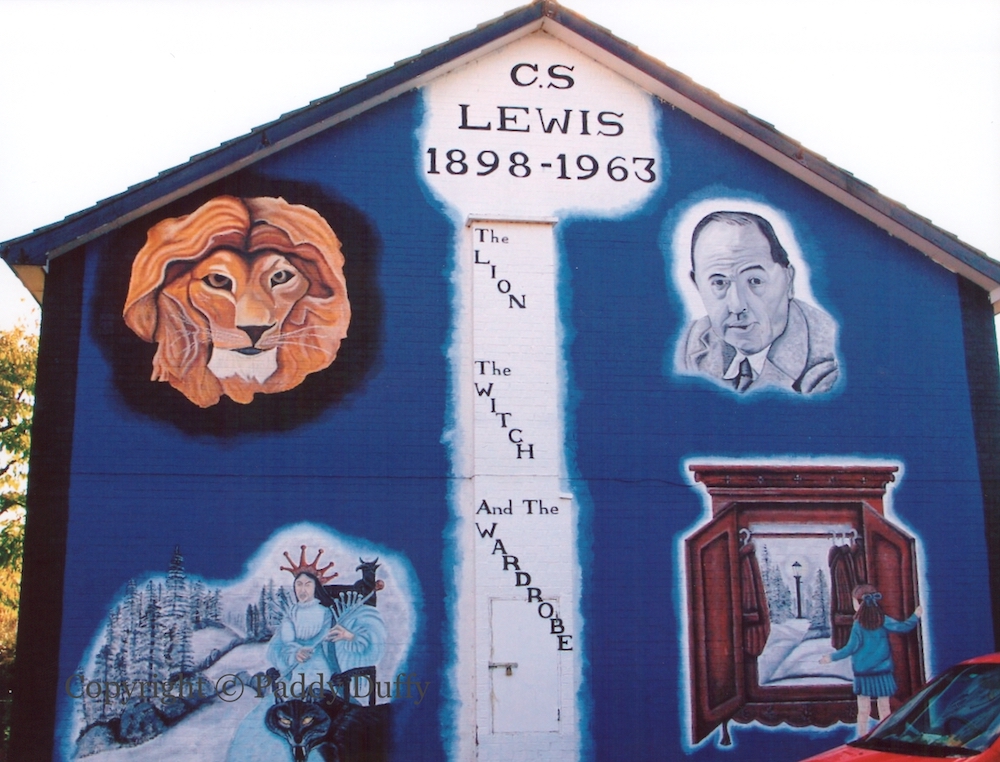
CS Lewis (1898-1963) was born and reared in Belfast until age 9. He was wounded at Arras in WWI and studied at Oxford after the war. He is most noted for work in Christian apologetics and children’s fiction, especially The Lion, The Witch, And The Wardrobe, written in 1950.
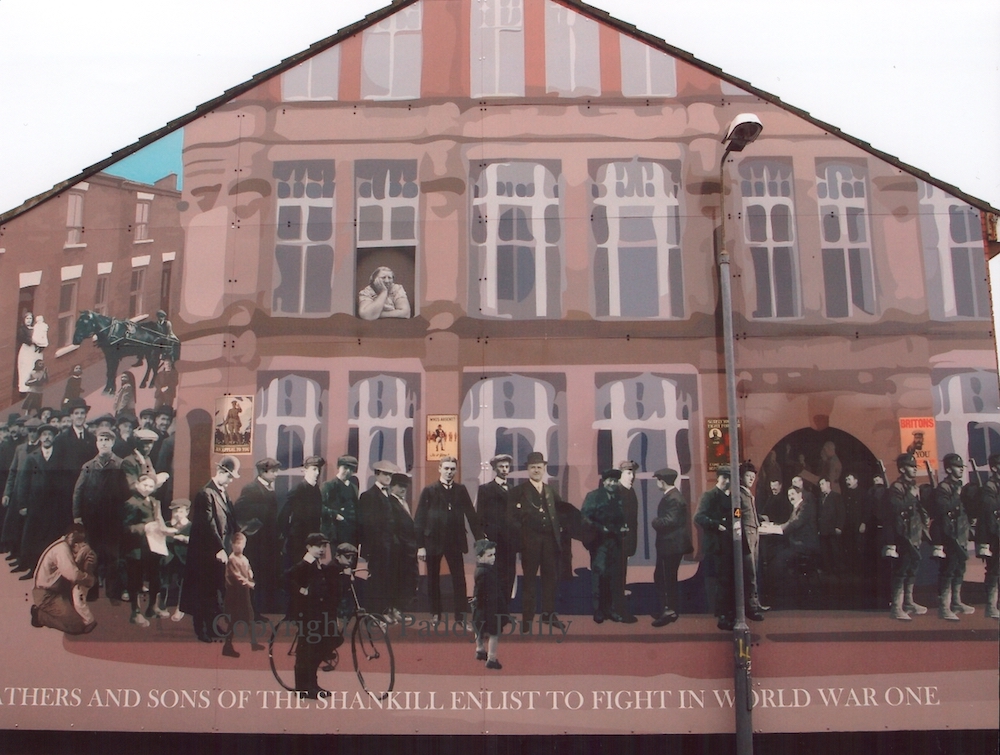
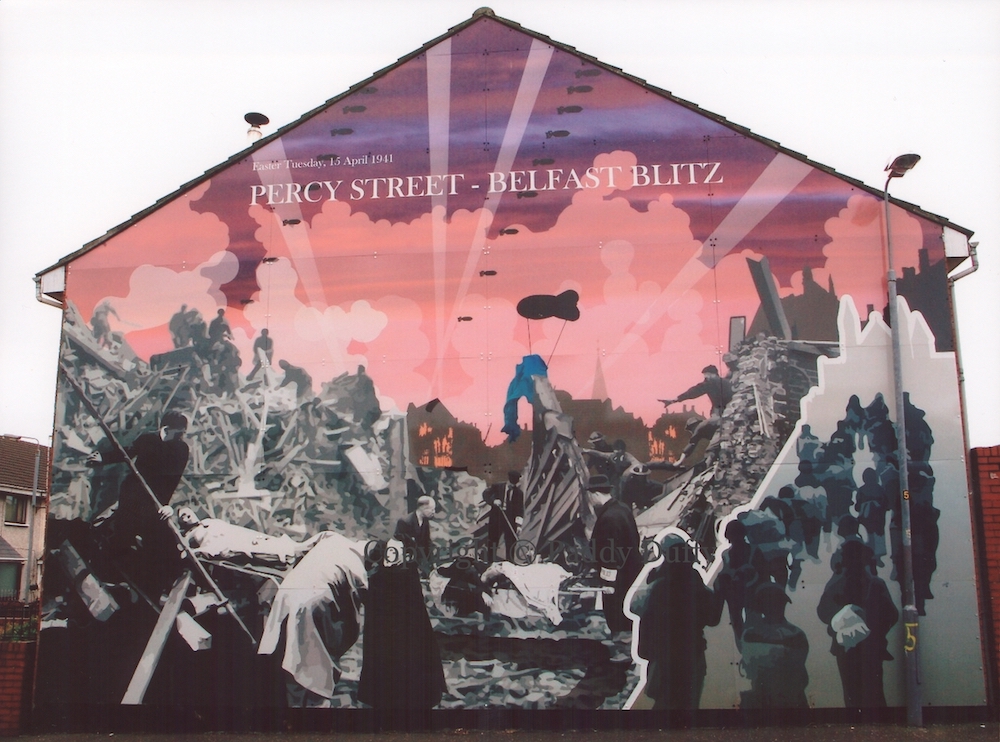
Here are three murals/boards by Steven Tunley for the Re-Imaging Communities programme in Dover Place, lower Shankill.
From left to right: “Fathers and sons of the Shankill enlist to fight in World War One”, “Belfast blitz – Easter Tuesday, 15 April 1941”, and “VE Day – 8th May 1945”.
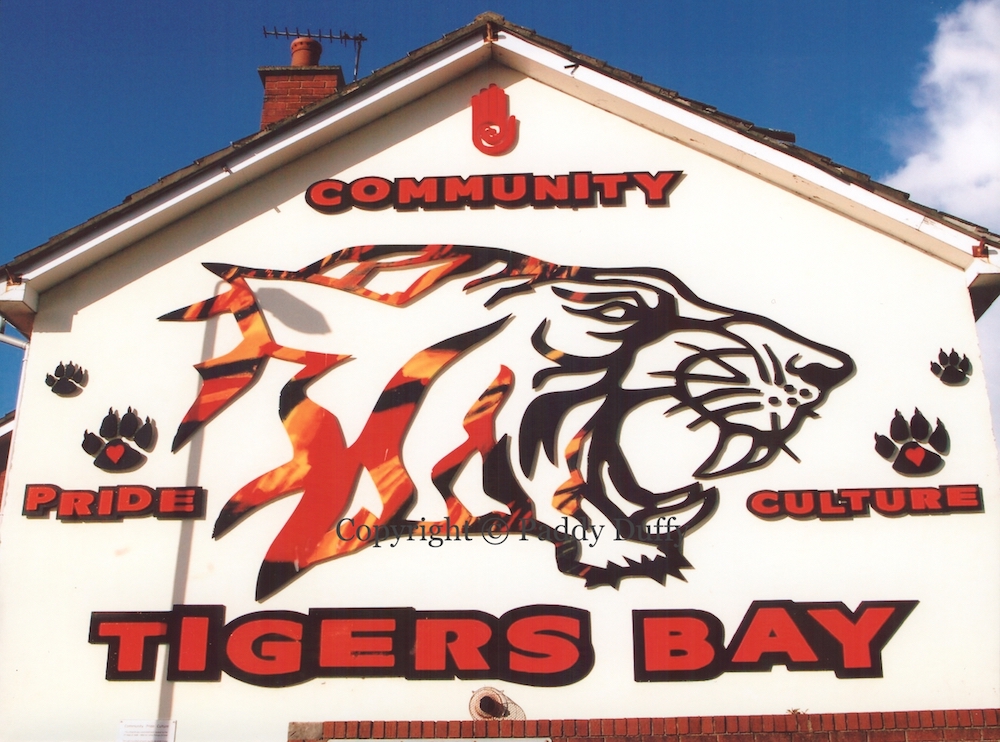
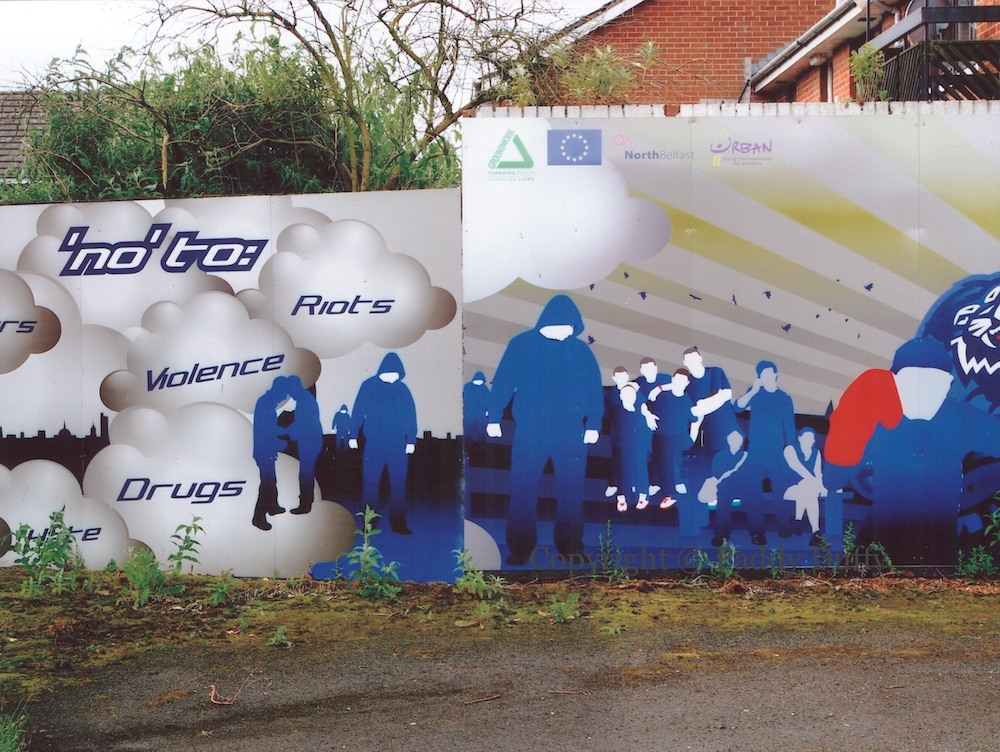
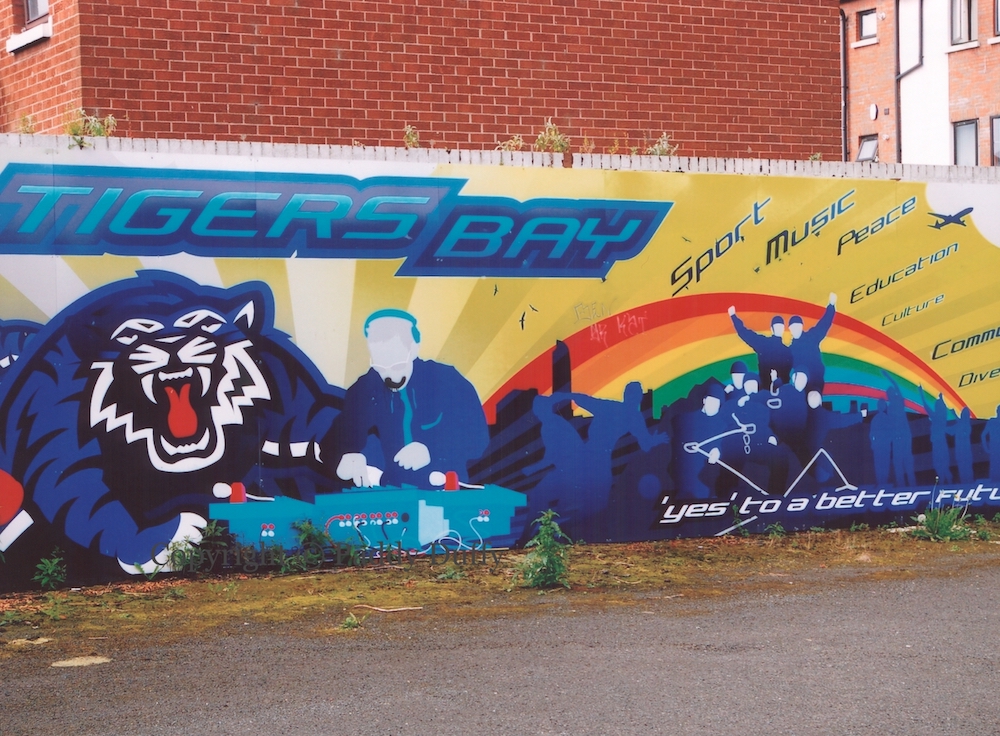
“Community. Pride. Culture.” As part of a 2009-2010 re-imaging program, the UDA mural on Cultra Street in Tiger’s Bay was replaced with this “cut-out” tiger.
Tiger’s Bay says “‘No’ to dealers, riots, violence, drugs, hate.” on the black-and-white left and, on the right, “‘Yes’ to a better future … sport, music, peace, education, culture, community, diversity.” With funding from Groundwork, the European Union, NorthBelfast, Urban [development? regeneration?].
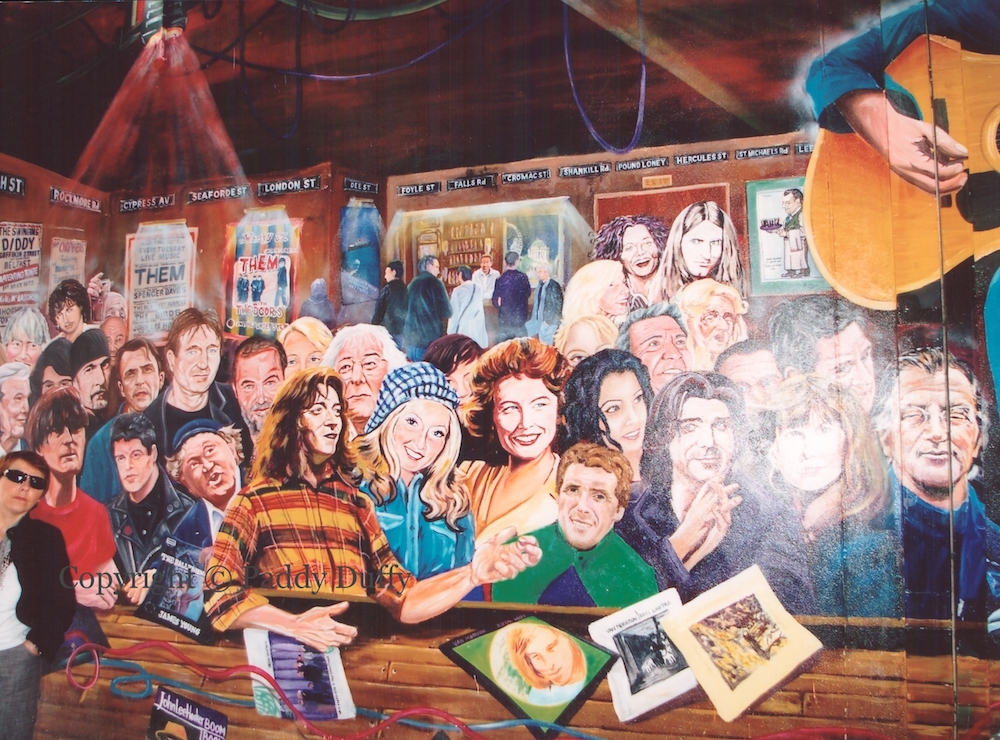
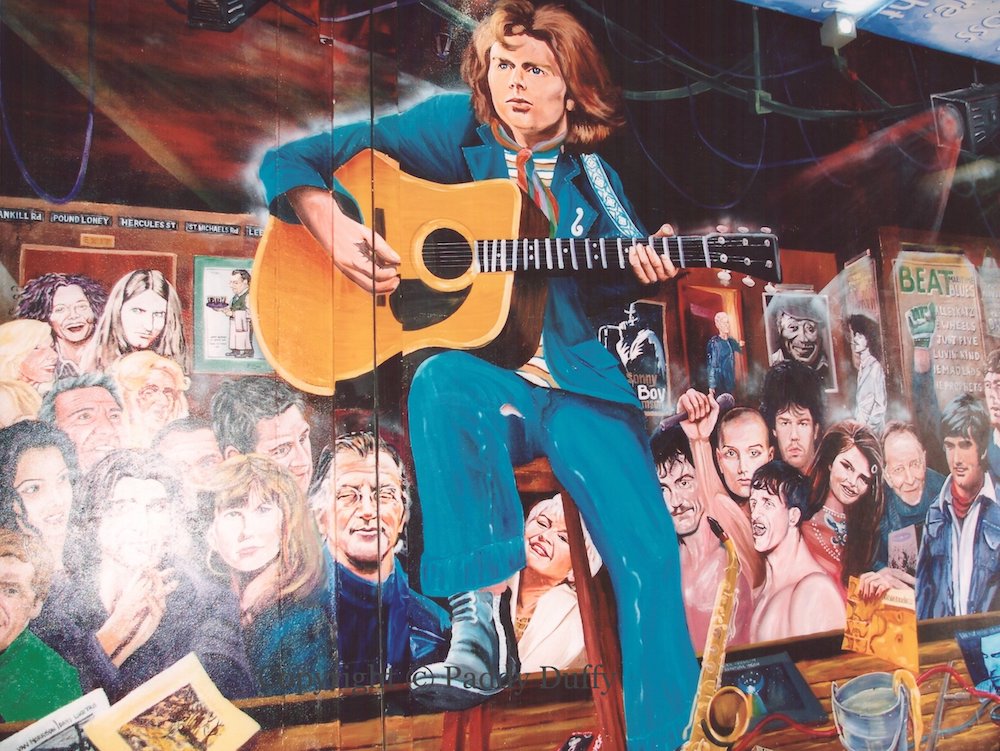
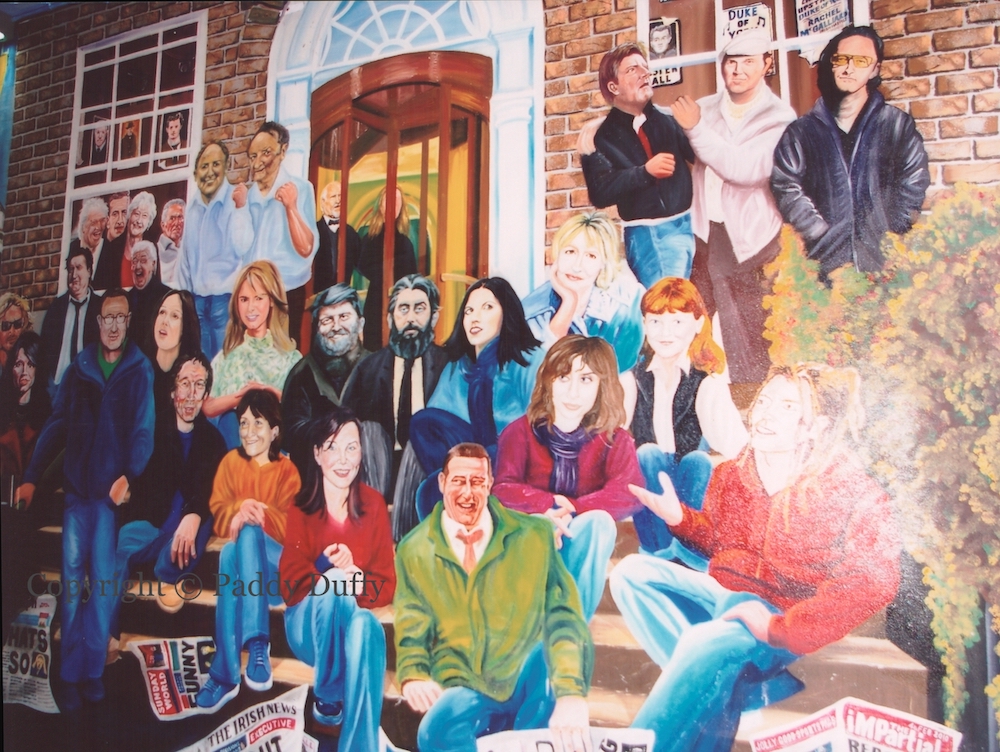
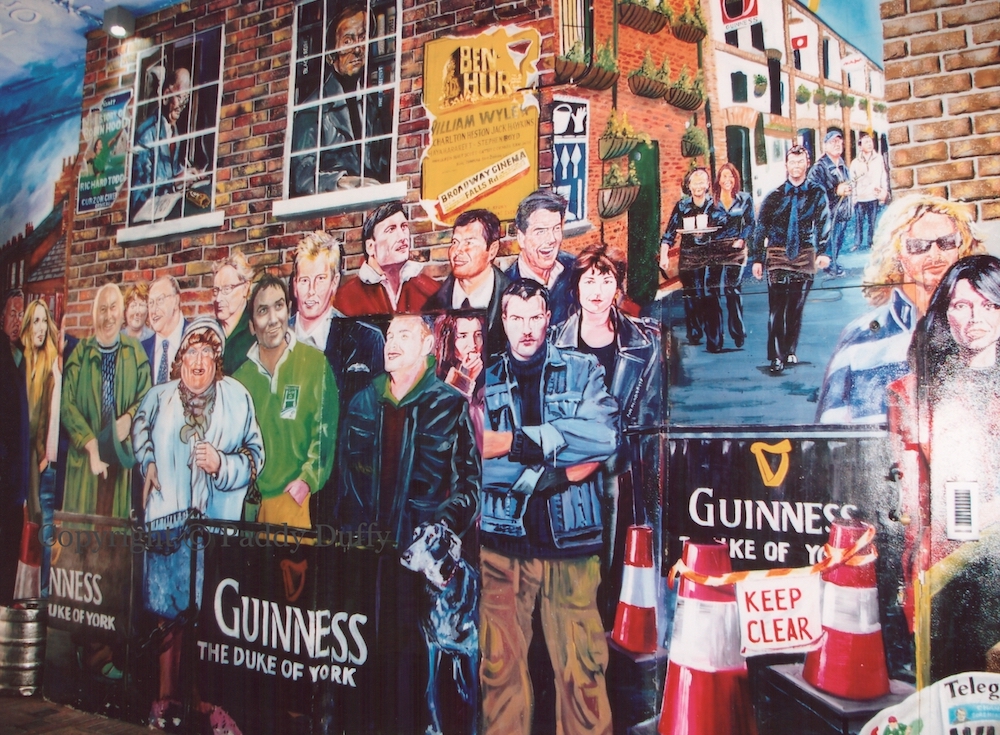
The entry-way to the courtyard of the Dark Horse is a dense gallery of famous faces from popular culture, both local and international.
Inside: David McWilliams, James Galway, Alex Higgins, Rab McCullough, Gary Lightbody, Barso, Joey Dunlop, Terri Hooley, Feargal Sharkey, John O’Neill, Big Jim McDowell, Mark O’Shea, The Edge, Sam Neill, Jimmy Reilly, James Young, Liam Neeson, Jimmy Nesbitt, Rory Gallagher, Seamus Heaney, Clodagh Rodgers, Ruby Murray, Tony McCoy, Katie Melua, Ann Marie, Geraldine Hughes, Cormac Neeson, Jackie Wright, Johnny Hero, Brian Kennedy, Darren, Juliet Turner, Dan Gordon, Gerry Anderson, Gloria Hunniford, Barry McGuigan, Sinead O’Connor, Rinty Monaghan, Gary Moore, Dana, Phil Coulter, Phil Lynott, George Best, Pat Jennings, Derek Bell, Jimmy Ellis, Bob Dylan, John Lennon, Neil Young, Willie Jack
Outside: Mark, Una Healey, Michael, Enya, Nick, Angela Feeney, CS Lewis, Dennis Taylor, May McFettridge, Paul Brady, Winston, Patrick Kielty, Brian Moore, Willie John McBride, Pearce Elliot, John Lynch, George Hamilton, Pierce Brosnan, Ciaran McMenamin, Maggie Cronin, Hammy, Lisa, Big William, Chris, Paddy, Eddie Irvine, Christine Bleakley, Brendan Behan, Derek Dougan, Patrick Kavanagh, Sir John Lavery, John McCormack, Danny Blanchflower, Mary Peters, Harry Gregg, Frank Carson, Martin O’Neill OBE, Dervla Kirwin, Stephen Rea, Hugh Russell, Wee John Caldwell, Nadine Coyle, Julie, Martin Lynch, Nee, Ronnie Drew, Dolores O’Riordan, Ciaran Hinds, Caron Keating, Kenneth Branagh, Alice, Liam Clancy, Duke Special, Bono
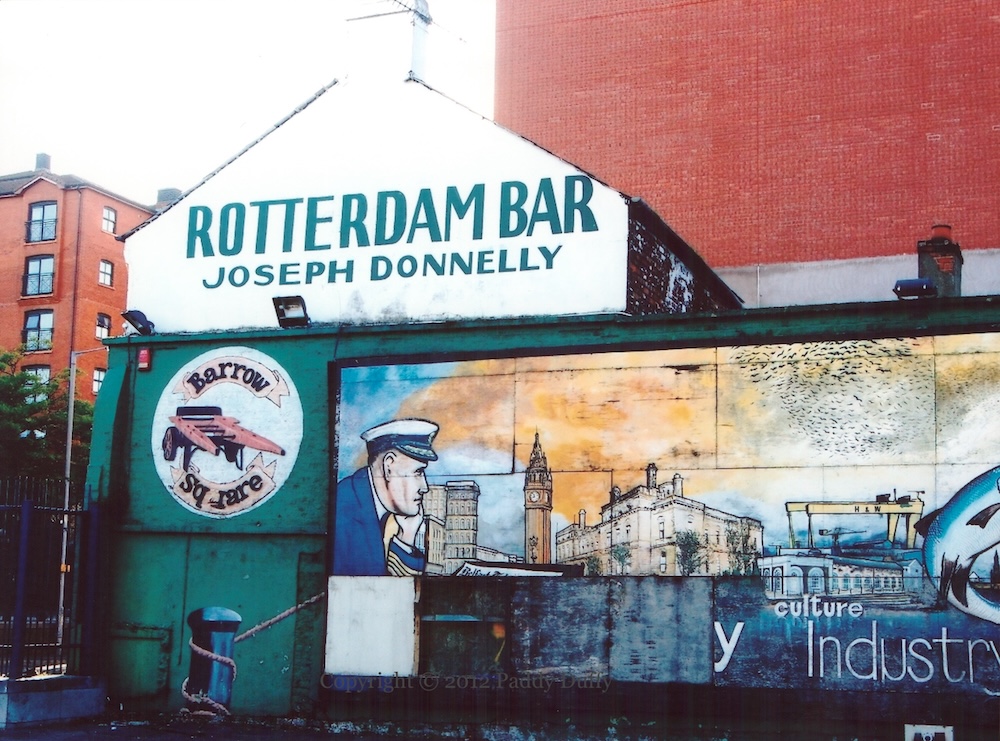
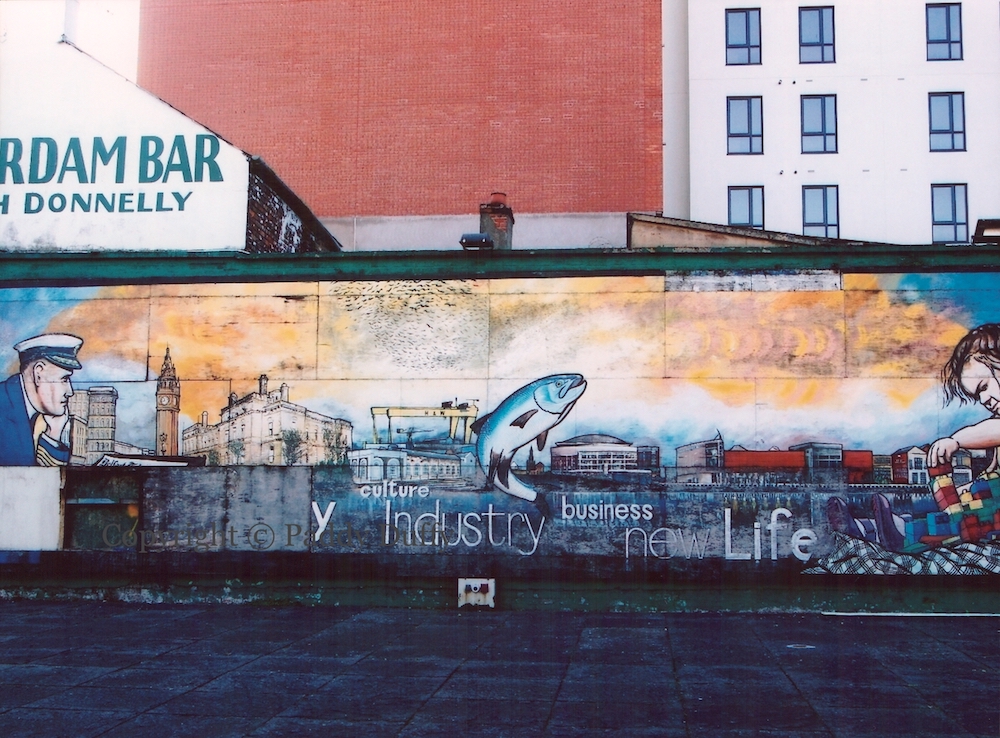
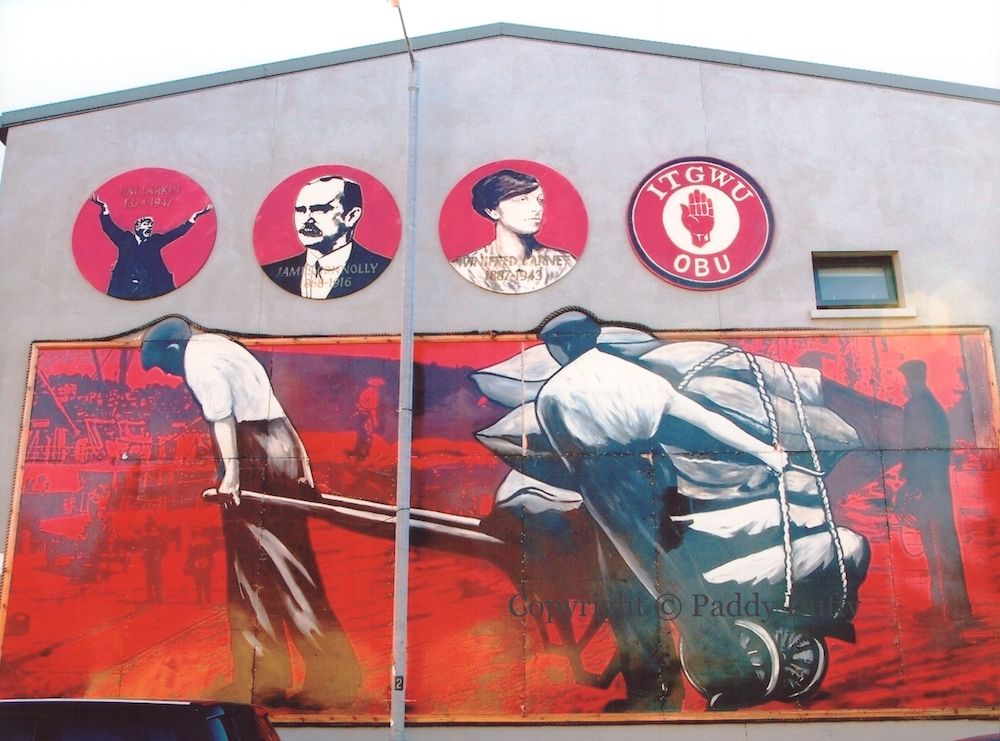
Barrow Square, in Sailortown between Clarendon dock and the Rotterdam bar, is named not for the carts used to unload and move goods along the docks, but for the Barrow Steam Navigation Company, which had a line of travel going between Belfast, Douglas (Isle Of Man), and Barrow (Cumbria, England), the peak of which appears to have been the 1890s (PaddleSteamers).
The mural, which was painted in 2004, features the “new life” coming to the broader docks area, though Sailortown itself has yet to see much investment. A Sailortown Regeneration Group (web) was formed in response to the closure of St Joseph’s in 2001. Both the Rotterdam and Pat’s are slated for demolition (BBC).
“Remembered with pride and affection our friends and fellow-dockers who were killed at work or suffered pain and premature death from unsafe and unhealthy working conditions in the port of Belfast. ‘On a ship’s dark deck a man is dead/wives, sisters, brothers, parents, shake heads and cry/as they knew not who to blame./An injustice has arrived/pain and anguish begins.’ Memories are everlasting. Ar dheıs Dé go raıbh siad. Erected by the Dockers Club and SHIP [Shared Heritage Interpretive Project] on International Workers Day, April 2007.” The plaque is on an exterior wall of the Dockers Club, adjacent to the mural. Above are portraits of Jim Larkin, James Connolly, Winifred Carney, with the emblem of the IGWU/OBU [One Big Union]. Larkin founded the ITGWU in 1909. It was led by Connolly from 1914 to 1916. Carney, from Bangor, founded the Irish Textile Workers’ Union in Belfast in 1912
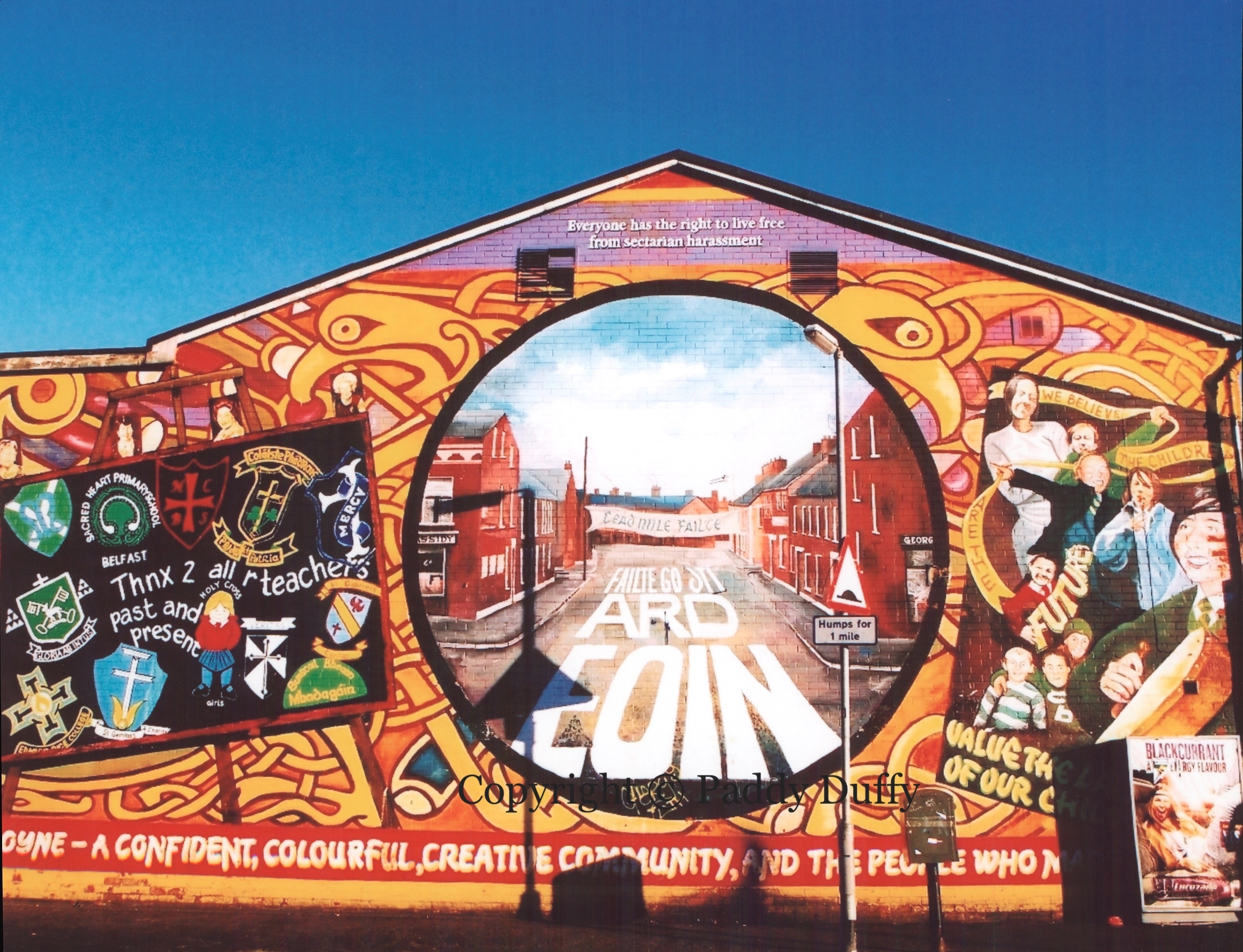
“Fáılte Go Dtí Ard Eoın. Ardoyne – a confident, colourful, creative community, and the people who made it so” particularly the local schools, whose insignia are shown on the left: “Thnx 2 all r teachers past and present.”
The previous mural in this spot (M01783) is invoked by the banner across the top: “Everyone has the right to live free from sectarian harassment” and the inclusion of Holy Cross Girls among the schools.
Whitney Houston and Bobby Sands are invoked on the right “We believe the children are the future – value the laughter of our children“.
These are new boards on Beechmount Avenue, alongside the many portraits of victims.
McGurk’s Bar: “At 8:47 pm on Saturday 4th December 1971, a no-warning bomb, planted by British terrorists, exploded on the doorstep of family-run McGurk’s Bar. Fifteen innocent men, women and children perished. Those who were not crushed or slowly asphyxiated by masonry where horrifically burned to death when shattered gas mains burst into flames beneath the rubble. Nearly the same again were dragged from the debris alive. In the aftermath of the atrocity, the British and Unionist Governments, RUC police force and British military disseminated disinformation that the bomb was in-transit and that the civilians guilty by association, if not complicit in this act of terrorism. This is despite a mountain of forensic evidence including a witness statement that saw the bomb being planted and lit before the British terrorists escaped into the night. From the moment the bomb exploded and for 40 years since, the families and friends of those murdered have campaigned constitutionally and with great dignity to clear the names of their lived ones. It is a Campaign for Truth that continues to this day. Join us at themcgurksbarmassacre.com” “
Springhill–Westrock Massacre: “Belfast’s Bloody Sunday. Time for truth! On the 9th July 1972 a team of British Army snipers took up firing positions in Corry’s timber yard overlooking the nationalist Springhill/Westrock estates. Within less than an hour five civilians lay dead and two critically wounded. Among the dead were three teenagers, a father of six and a priest on his way to administer the last rites to the dead and injured. There has never been a proper police investigation, and not one solider has spent a single day in prison in connection with their deaths. The families deserve, and demand the comprehensive facts be told by the British establishment. The truth costs nothing.”
Collusion: “Crime is crime is crime” said UK Prime Minister Margaret Thatcher in a 1981 news conference in Saudi Arabia. Her words are used against her and the UK government and armed forces: “We want you to tell us the truth [about collusion]”.
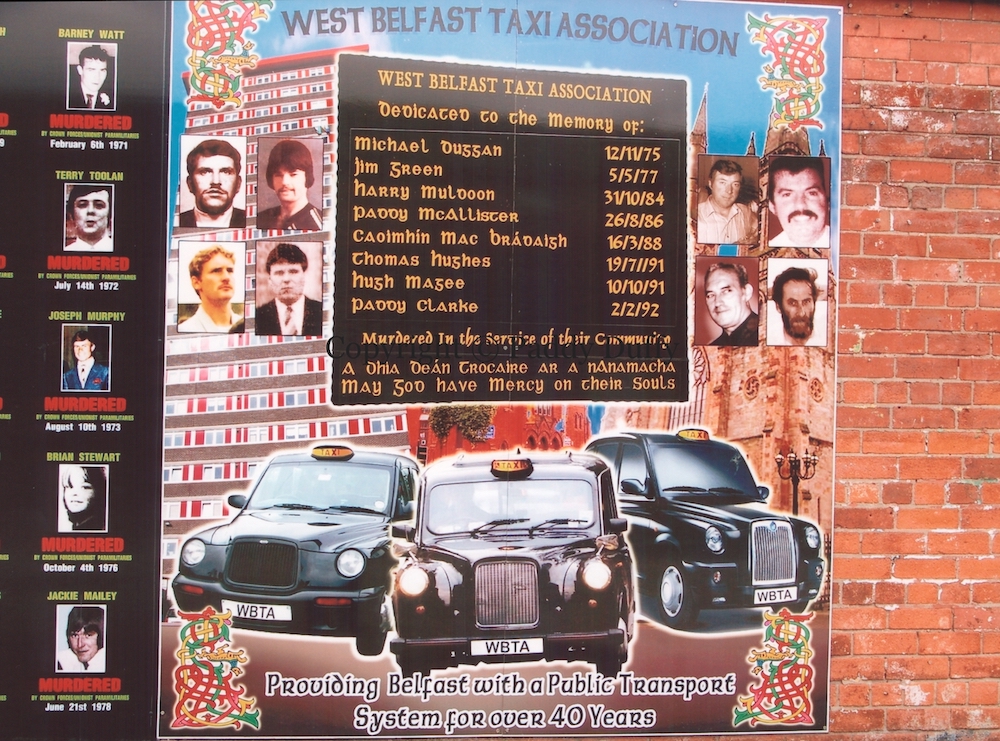
WBTA: Black taxis were first brought from England to Belfast in 1970 by locals who wanted to provide an alternative, and locally-based, transport system to augment the Citybuses which were sometimes cancelled and sometimes burned out. “West Belfast Taxi Association. Providing Belfast with a public transport system for over 40 years.”
The board commemorates eight drivers who were killed during the troubles: “Dedicated to the memory of Michael Duggan 12/11/75, Jim Green 5/5/77, Harry Muldoon 31/10/84, Paddy McAllister 26/8/86, Caoımhín Mac Brádaıgh 16/3/88, Thomas Hughes 19/7/91, Hugh Magee 10/10/91, Paddy Clarke 2/2/92. Murdered in the service of their community. A Dhıa deán trocaıre ar a nanamacha.” French documentary about black taxi drivers.
Beechmount Avenue/Ascaıll Ard Na bhFeá, west Belfast
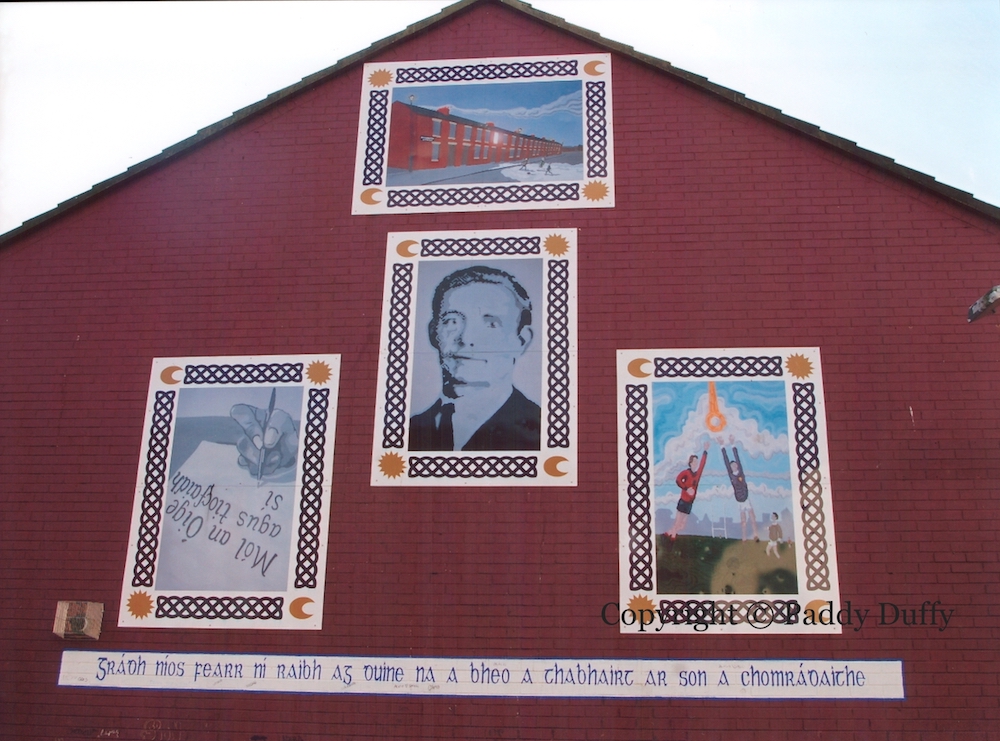
IRA Volunteer Sean Martin is at the centre of these panels in the Short Strand. The image in the apex of the house depicts his death in nearby Anderson Street (which no longer exists; roughly where Arran Street is).
milltowncemetery.com (link now dead) reports that Sean Martin “was killed in April 1940 during a lecture on arms and a Millis hand grenade in a small terrace house in Anderson Street. In the course of the lecture Sean, who was giving the instruction, had dismantled the grenade, and was putting it together again. The detonator which he was using was thought to have been a dud one. In demonstrating how to throw the grenade, he pulled out the pin and released the lever. Hearing the hissing sound of the fuse he realised that the detonator was live and that the grenade was about to explode. He rushed to the window with the intention of throwing it out on to the street, but some children were playing outside. In the few seconds left to him, Sean had to make that terrible choice; shouting to the others to get out of the house – he pulled the grenade into himself with his two hands and leaned over the kitchen table with the grenade covered by his whole body. The device exploded and blew him right across the kitchen, killing him instantly. All the others escaped uninjured.”
The Irish at the bottom reads “Grádh níos fearr ní raıbh ag duıne na a bheo a thabhaırt ar son a chomrádaıthe” – “A greater love no person has than to give his life for his comrades” (John 15:13)
Belfast Forum has some pictures of Anderson Street; according to the accompanying conversation, the Martins (might have) lived at no. 29. Sean Martin’s CLG/GAA club was named after Martin.