Gateway To West Belfast

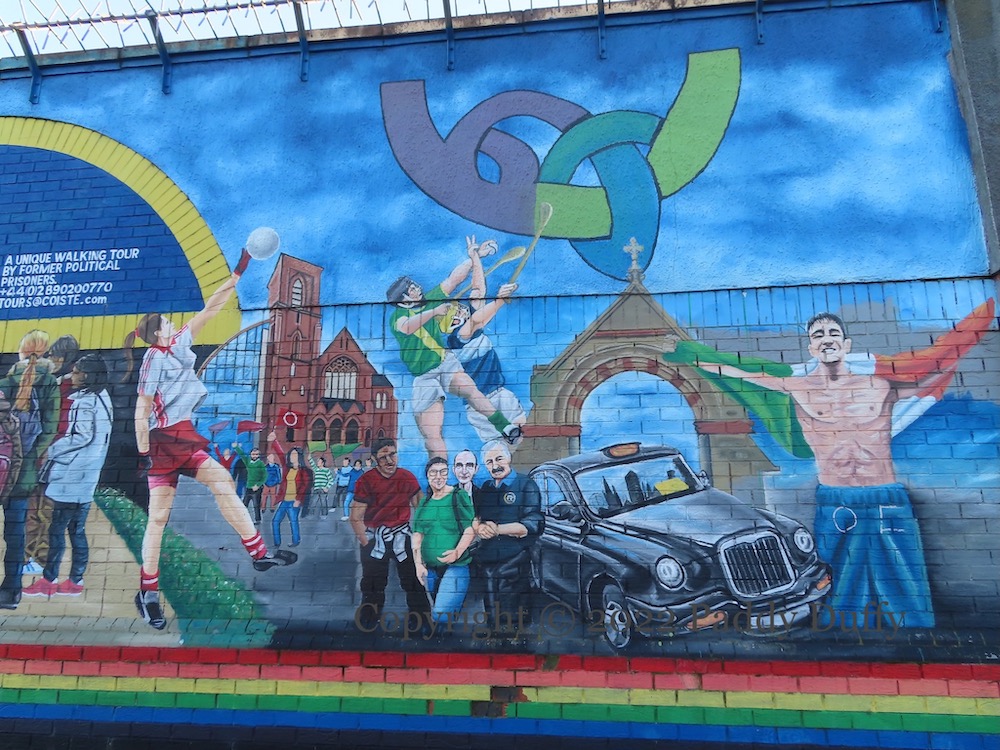
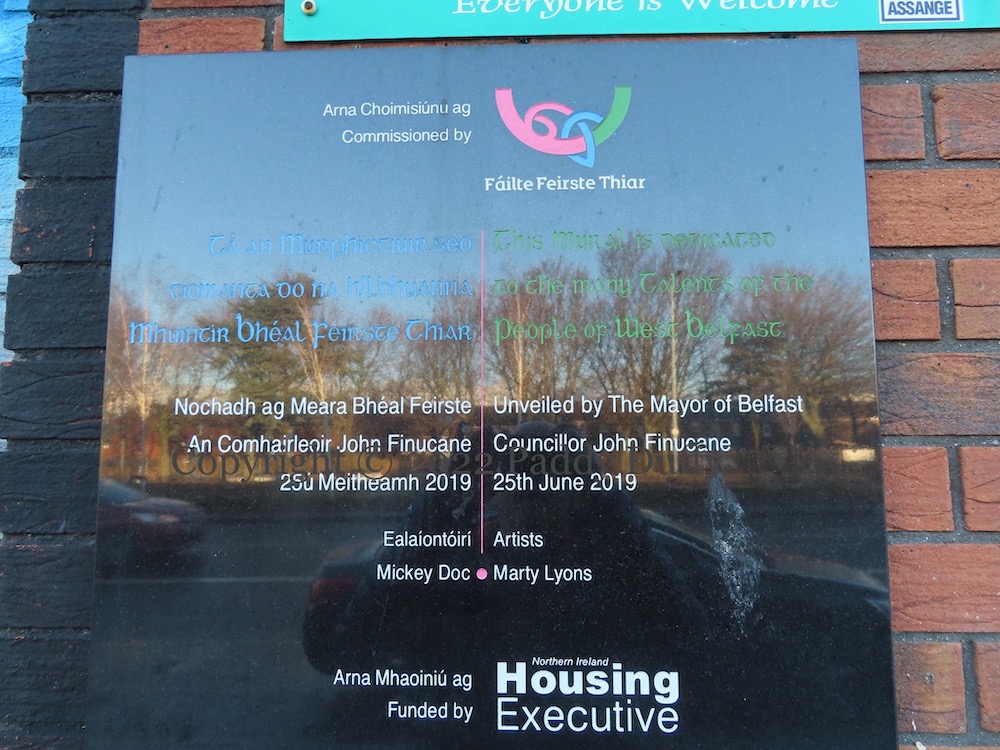
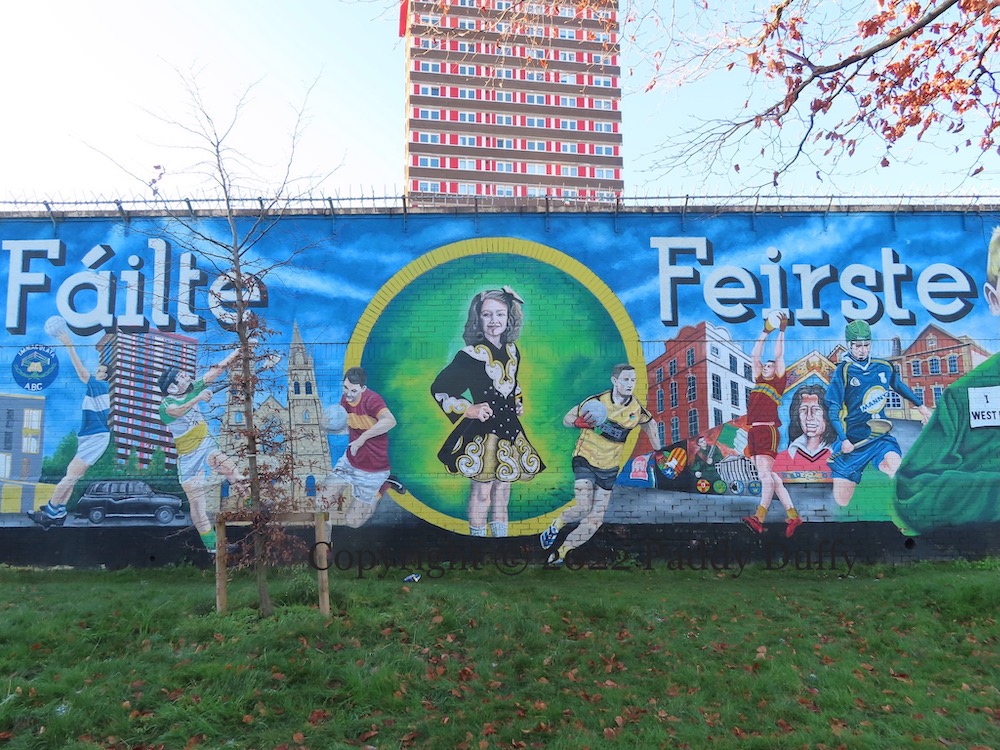
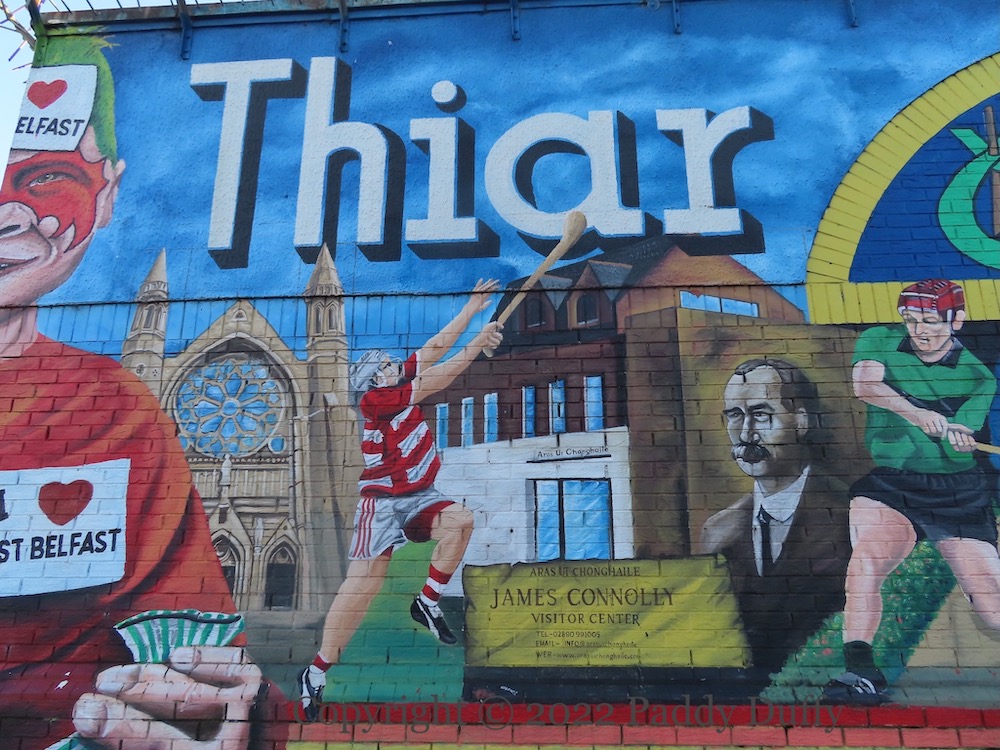
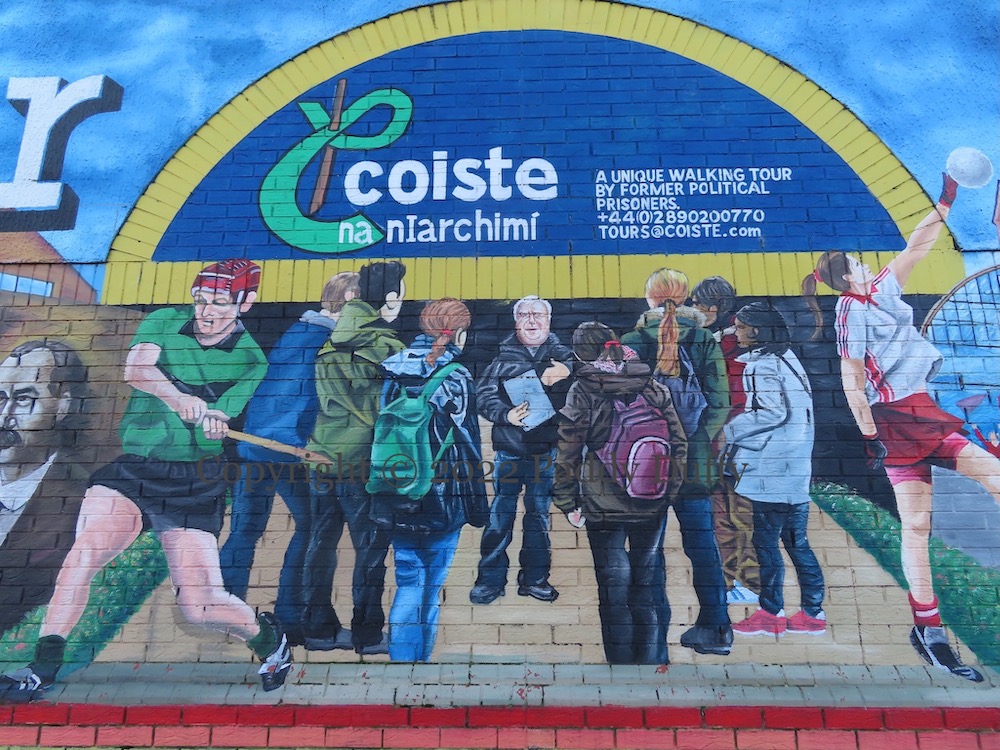
Fáılte Feırste Thıar‘s second mural (the first is outside its offices in the middle Falls – see Fáılte Feırste Thıar) reinforces the claim that (republican) west Belfast begins as soon as you cross the motorway, five minutes’ walk from the city centre. Coıste’s tour of republican murals begins at Divis Tower and the new mural already seems to be drawing tourists – see the final image, below. The previous Coıste mural (M04900) has been deleted and incorporated into the mural, promising tourists “a unique walking tour by former political prisoners”.

The mural is a mix of landmarks – the new Raıdıó Fáılte building (which is located just below the mural), Divis tower, St Peter’s, Conway Mill, the “international wall” of murals, the Bobby Sands mural, the Falls library, the new James Connolly centre, Cultúrlann, and Milltown cemetery – cultural images (Irish dancing and Féıle An Phobaıl) – and sporting images (clubs include Immaculata ABC, Gort Na Móna GAC, St Paul’s GAC). A gay pride ‘rainbow’ stripe runs below the Divis Street portion. Before the previous mural was painted (M07533), there was a Gateway To Belfast board at this spot.
Click image to enlarge
Copyright © 2022 Paddy Duffy
T01603 T01608 T01607 T01609 T01610
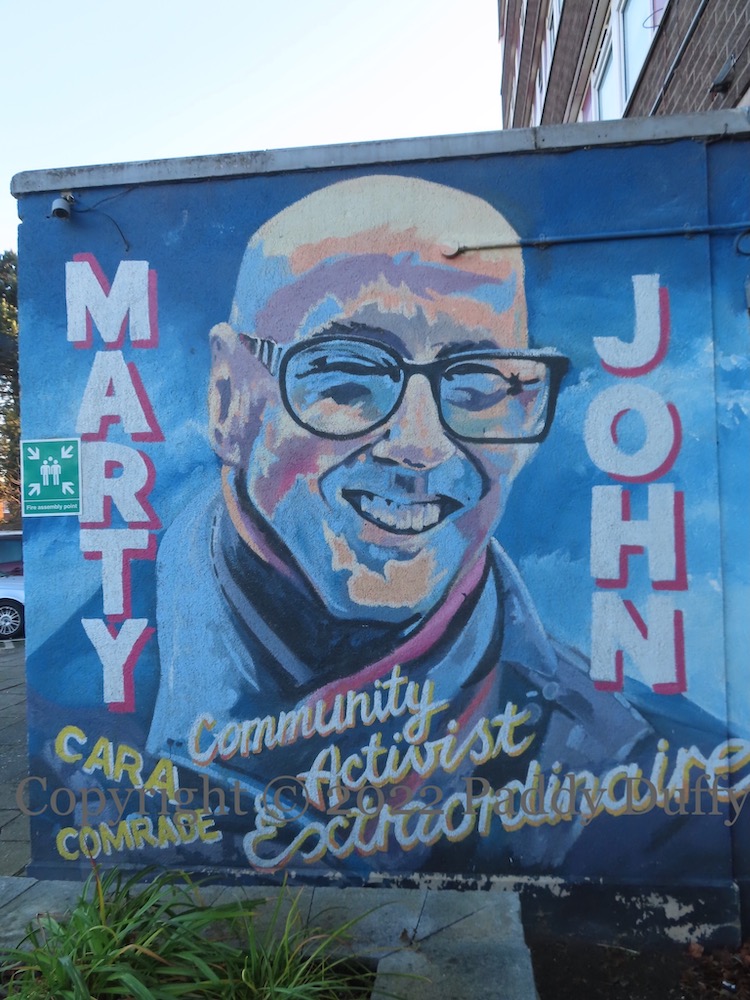
Community Activist Extraordinaire

John Leathem, chairman of the Divis Tower Falls Residents’ Association, died in his flat on the 19th floor of Divis Tower in August last year (2017), after returning to the Tower four years previously when he was diagnosed with cancer (Irish News | Tele). He was described by Sınn Féın MLA Fra McCann as “a champion for the people of no property” (An Phoblacht). This mural is outside his former office on the first floor.

Click image to enlarge
Copyright © 2022 Paddy Duffy
T01597

Old Carrick Hill

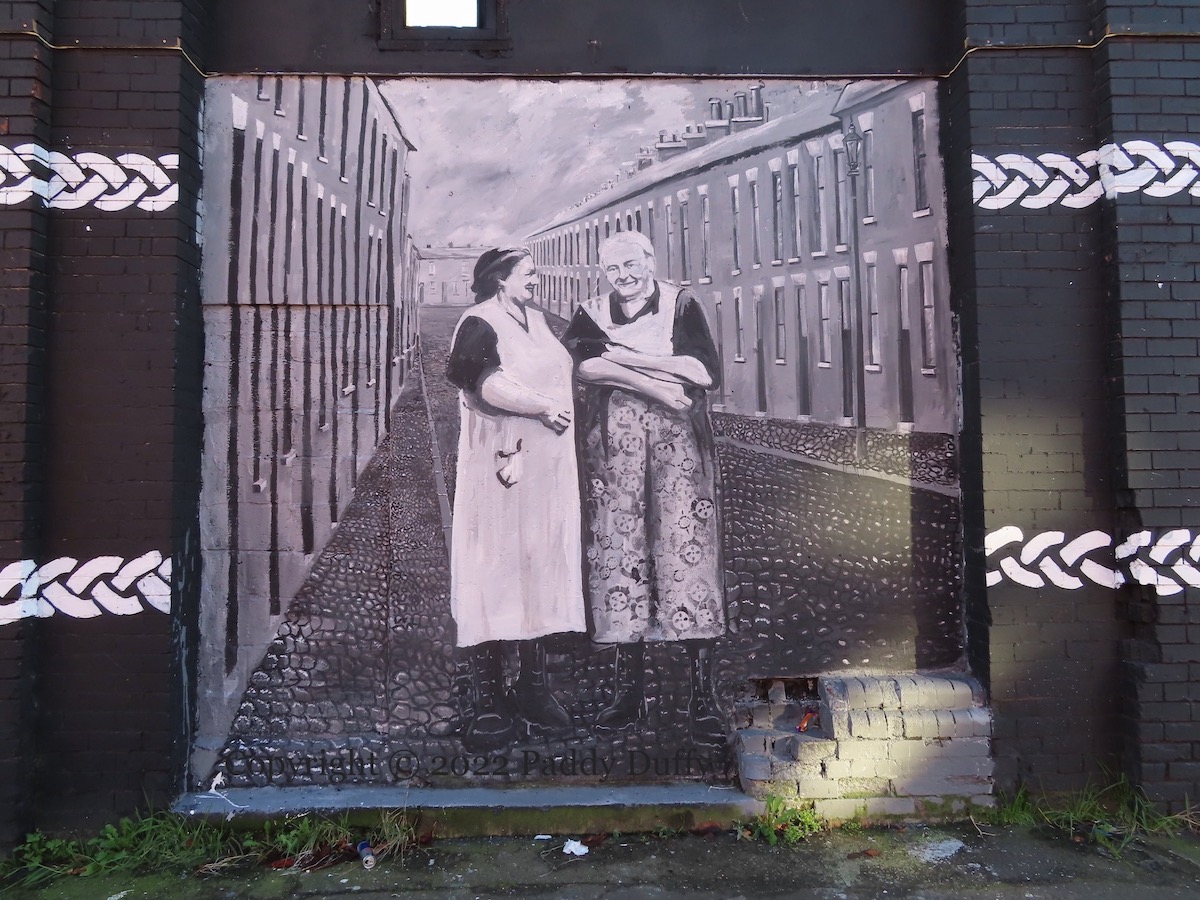
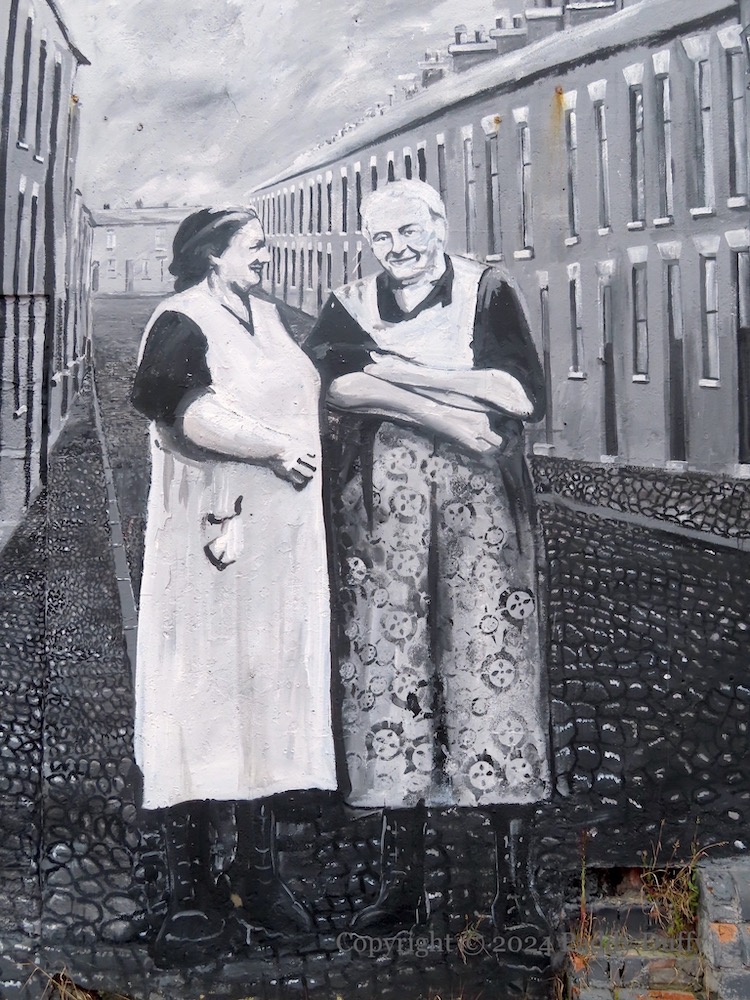
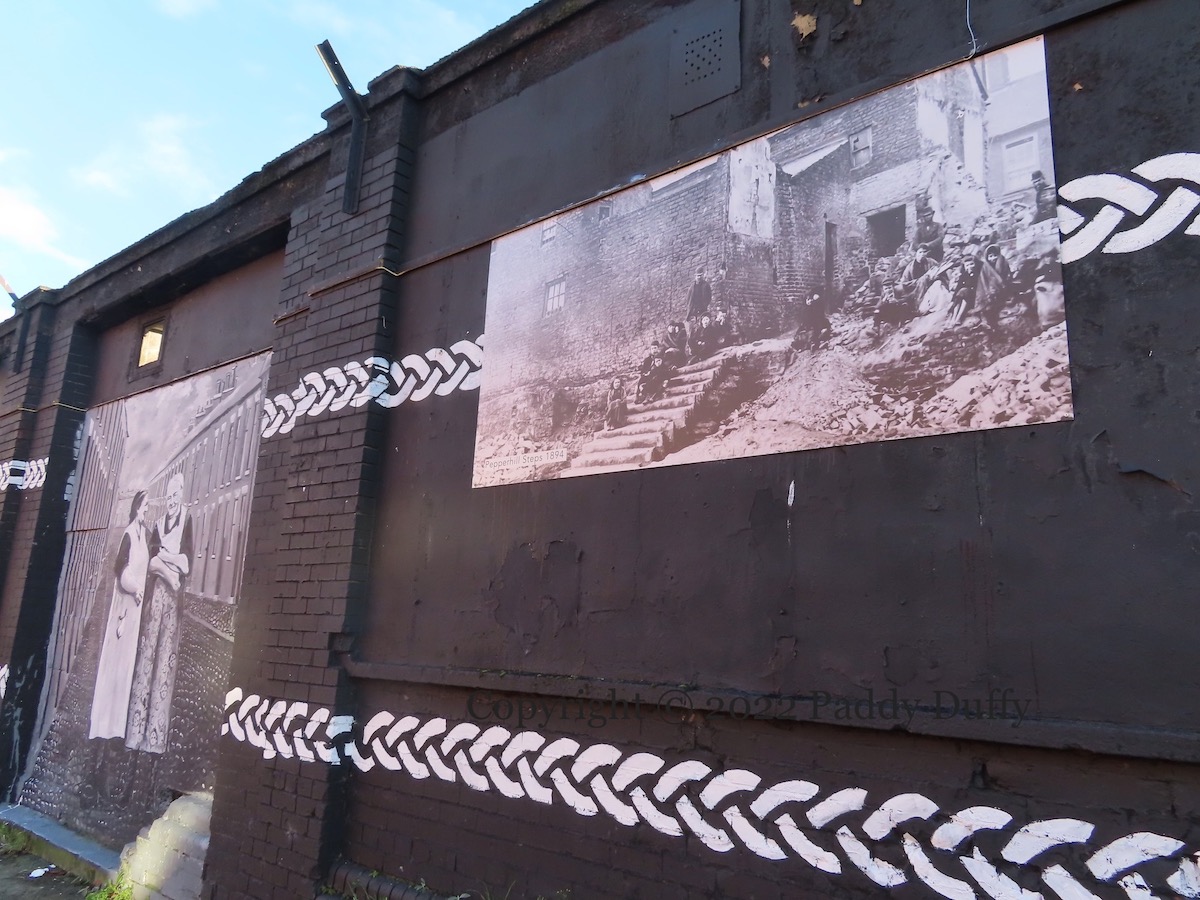
The collection of images showing “Carrick Hill in the old days” now includes a mural, of two women talking in the street.

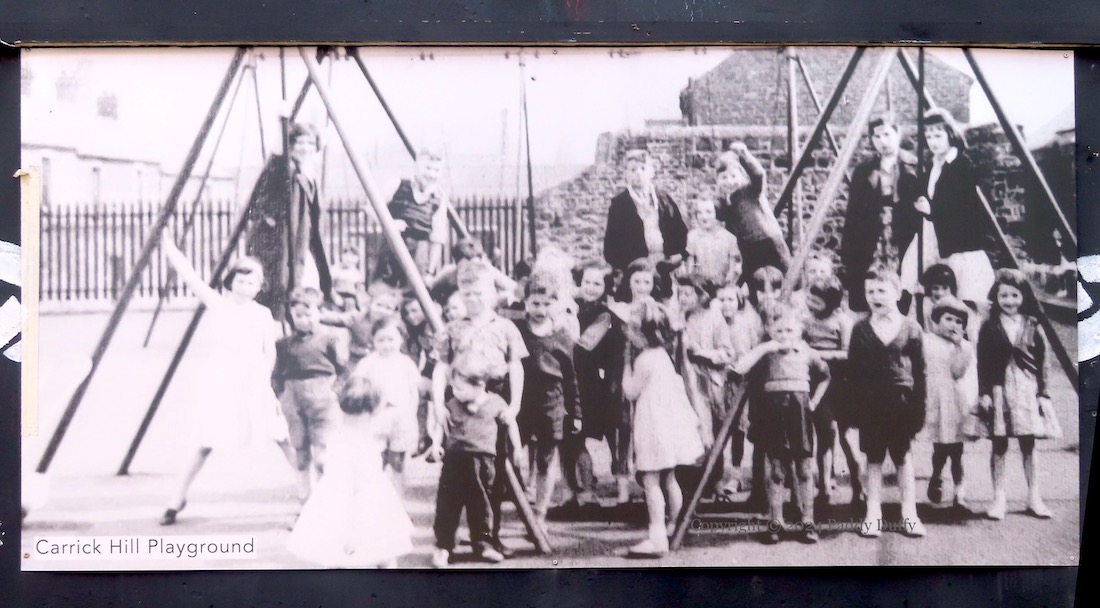
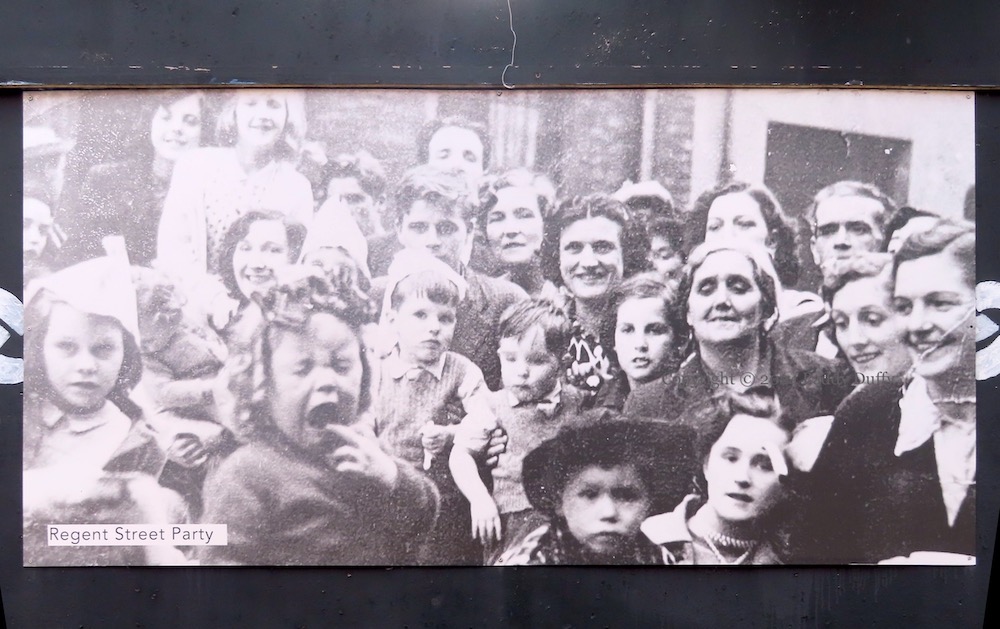
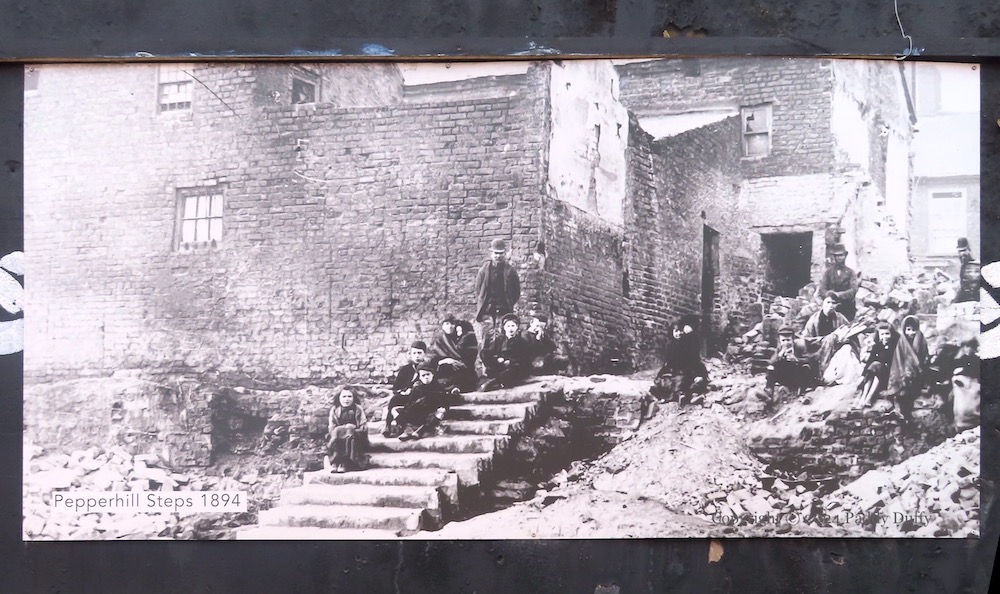
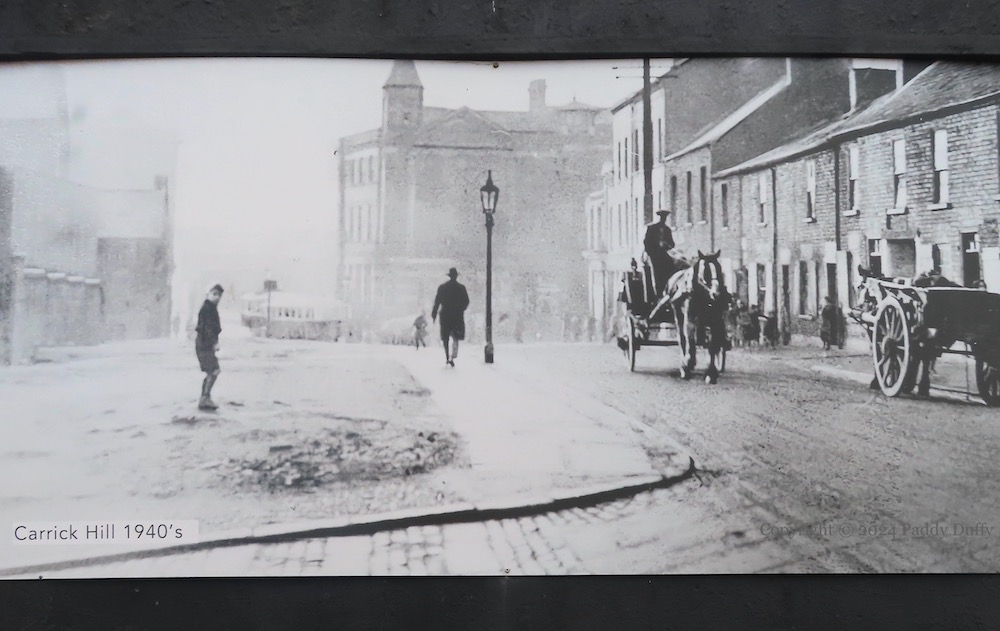
In addition to the mural, there are four boards, two on either side: Carrick Hill playground; Regent Street party; Pepper Hill steps, 1894; Carrick Hill 1940s.

There are eleven more boards in Regent Street. (Later increased to fifteen with the addition of 1976 Mandiville dart team; Mary McCusker & Kitty Spotwoods; Maggie Jane Largey & Mary Ann Largey; Richard & Alan Crean – see The Tea Bar for all fifteen.)

The board in the image below (from Stanhope Street) shows Pepper Hill Steps before the turn of the twentieth century. The steps used to lead from Mustard Street (which was what Library Street used to be) towards Upper Library Street (now Carrick Hill, the street).

Stanhope Street, Belfast

Click image to enlarge
Copyright © 2022/2024 Paddy Duffy
T01588 T05285 T05284 T05283 T05282 T01589 [T01590] [T01591] T05281 T05286

Stag Inn Shooting

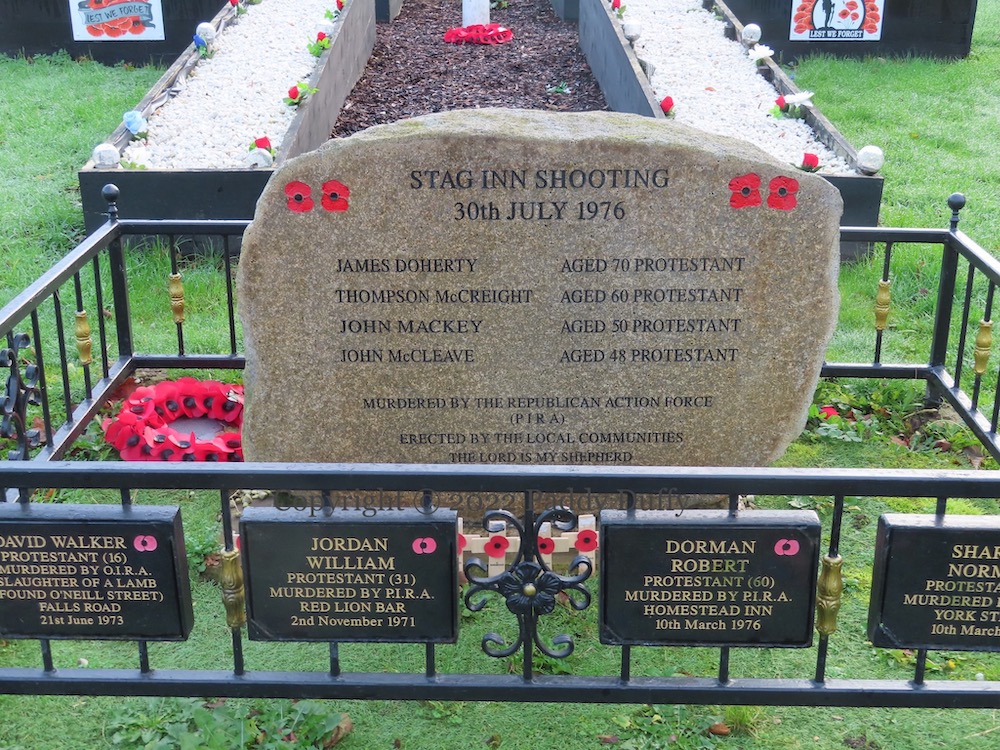
A long series of tit-for-tat shootings of pubs and clubs continued into the summer of 1976, with attacks on the Chlorane (June 5th), Walkers (June 25th), the Ramble (July 2nd), the Whitefort (July 29th), and then, on the 30th, The Stag at Shaws Bridge, Belfast, by the Republican Action Force (PIRA) (Sutton). John McCleave, John McKay, and James “Jimmy” Doherty died on the night of the attack, and Thompson McCreight died of his wounds nine days later. The memorial to them – “erected by the local communities” – is on Milltown Road, next to the Dreamscheme (web) mural.

Milltown Road, Belvoir, south Belfast

Click image to enlarge
Copyright © 2022 Paddy Duffy
T01530 [T01531] T01532 [T01533] T01534 T01535

Seymour Hill In WWII

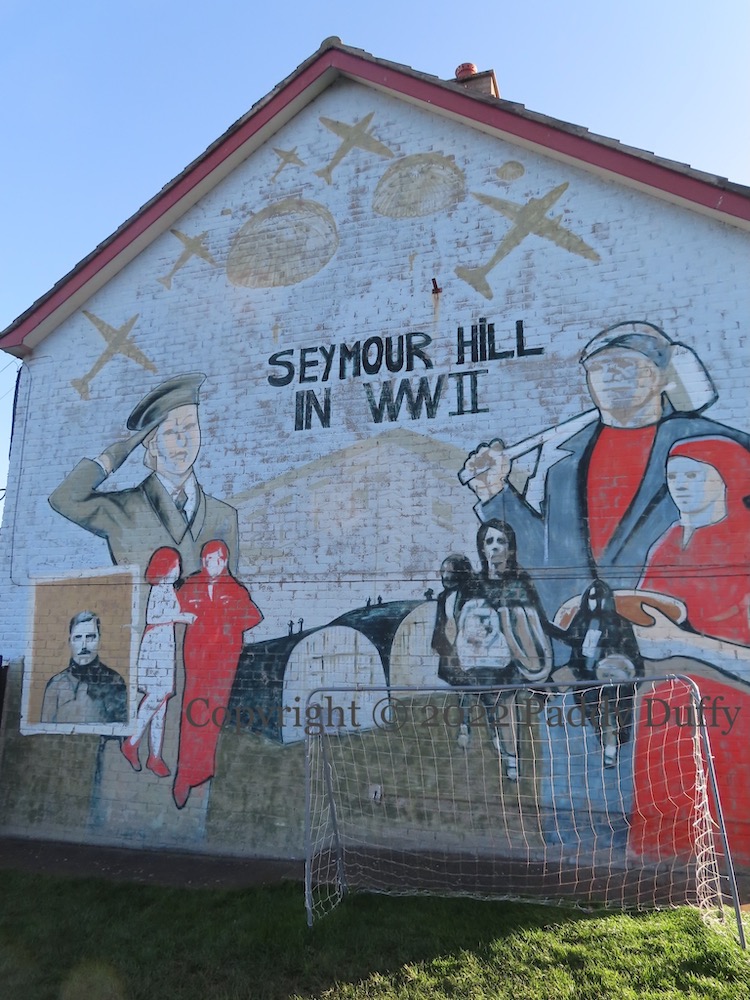
US forces were still segregated racially during WWII; “colored” soldiers (as they were then called) were housed in a camp at Ballybog Road (WW2NI) where Seymour Hill PS now is and just below Seymour Hill House which was used to house evacuees from Belfast after the blitz and which was formerly owned by the Charley family (Lisburn.com | Lord Belmont) – it is now administered by Radius (formerly the BIH Association).

The “framed” portrait on the left is of William “Billy” Harbinson, a member of the Royal Ulster Rifles who was a POW at Colditz (Lisburn.com | WW2NI); the photograph can be seen in the RUR museum.

There used to be a plaque on the wall which read, “This mural was dedicated by Col. Robin Charley on 1st July 2009 to the people from this area who contributed to the to the effort during World War II. Also our American allies who were based here and later contributed to the conflict.”

Painted by Tim McCarthy (“Verz” ig) for the Re-Imaging Programme; it replaced a UDA mural.

Hornbeam Walk, Dunmurry

Click image to enlarge
Copyright © 2022 Paddy Duffy
T01524

Pride Of Glencolin

Glencolin estate was built next to Moyard House (which in 1984 became home to the Roddy’s (web)) on the Glen Road in 1979 (Belfast Forums). For the fortieth anniversary of “eastát Ghleann Collaınn” the mural at the entrance to the estate was (belatedly) repainted. The composition of the mural remains as in the previous version, with the Roddy’s and Oliver Plunkett church in the shadow of Dubhaıs and Slıabh Dubh; they are now joined by images of Gaelic games. The Bobby Sands quote has been removed.

Click image to enlarge
Copyright © 2022 Paddy Duffy
T01499

Battle Of The Falls

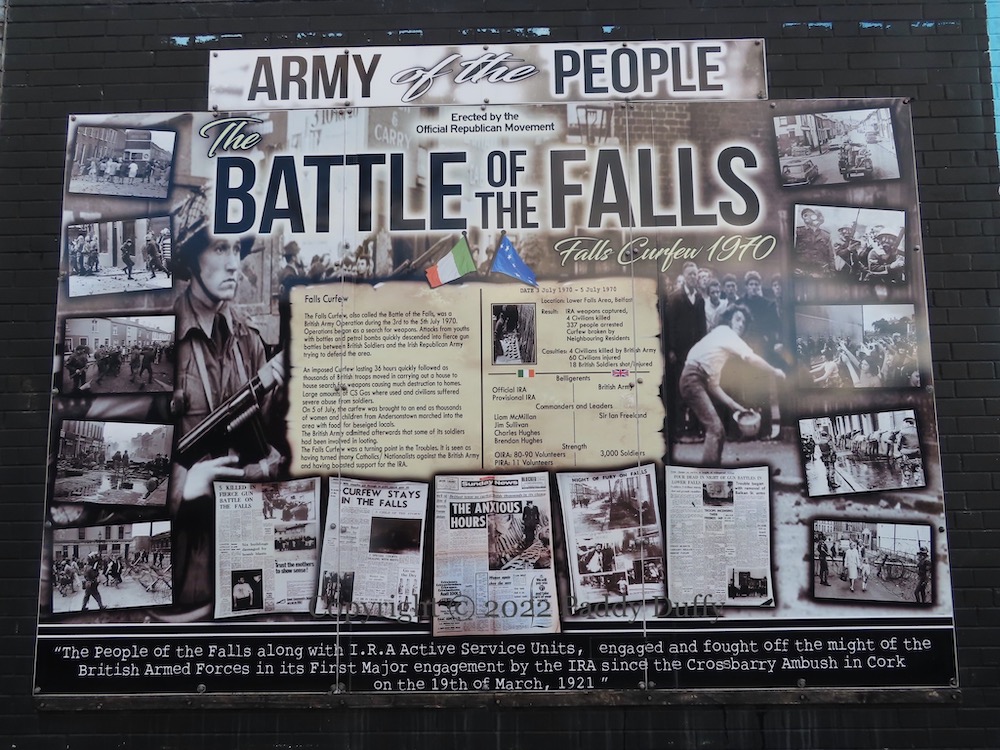
Four people were killed in the course of The Falls Curfew, the 36 hours from July 3rd to 5th in 1970 during which 3,000 houses on the lower Falls were cordoned off after a weapons search of the area devolved into a riot. The curfew ended with a march of women and children from Andersonstown bearing relief (represented in Falls Curfew 1970).

The information in the centre of the board includes an augmented version of the Wikipedia infobox on the event. Erected in the spot previously reserved by “the Official Republican Movement”.

Click image to enlarge
Copyright © 2022 Paddy Duffy
T01453

Sailortown Dockers

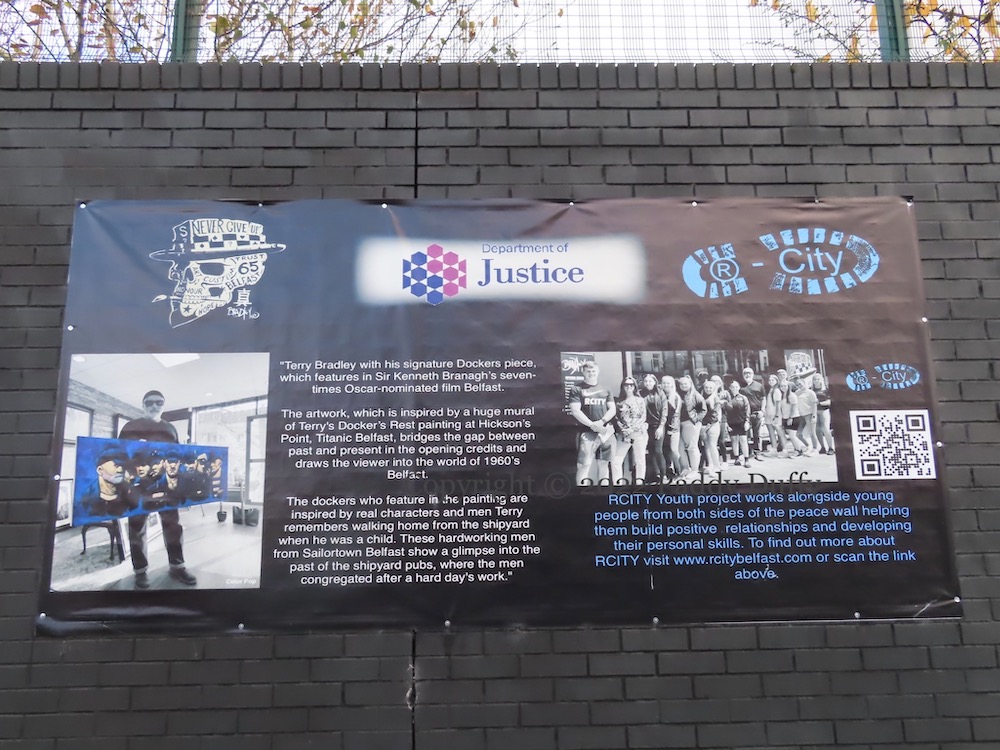
This is a mural of a painting of a mural of a mural. The original is the piece by Terry Bradley (web) and Friz (web) at the Titanic museum’s pub (see Dockers’ Rest), which was then reproduced in a different colour for the opening montage of the Kenneth Branagh film Belfast. The success of the film prompted the Department Of Justice to commission Bradley for a painting that could be turned into a mural and he reproduced the film version (BelTel). The mural that enlarges that painting was painted by DMC on Lanark Way, just above the security gates (Belfast Live).

“The dockers who feature in the painting are inspired by real characters and men Terry remembers walking home from the shipyard when he was a child. These hardworking men from Sailortown, Belfast, show a glimpse into the past of the shipyard pubs, where the men congregated after a hard day’s work.”

With support from R-City (web).

Click image to enlarge
Copyright © 2022 Paddy Duffy
[T01442] T01443 T01444 [T01445] T01446

Save The Shankill

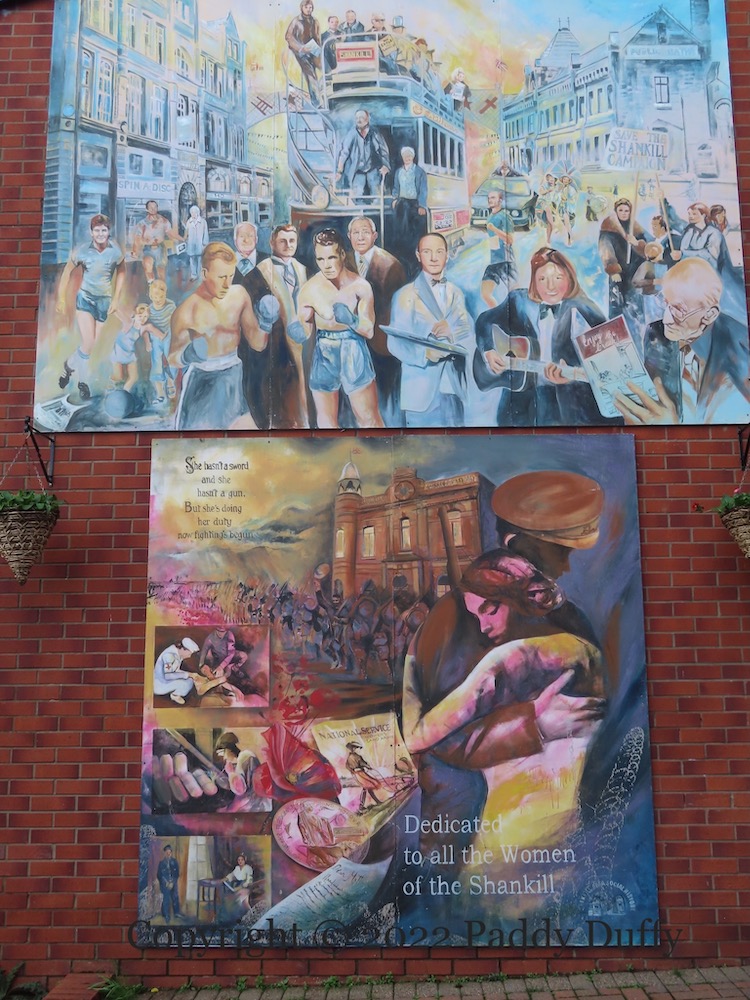
Here are two boards outside the Ulster Rangers Supporters Club (Fb) on the Shankill Road.

The upper one features a tram going under an Orange arch between the public baths on one side an Spin-A-Disc records on the other, surrounded by notable figures from the Shankill area.

Many thanks to Johnny Dougan of Shankill Area Social History (Fb) for the information below! Please e-mail or add a comment with additions or corrections.

Front, from left to right: Manchester United and Northern Ireland Soccer player Norman Whiteside (WP) and behind him boxer Davy Larmour and community worker Saidie Patterson (see WRDA), boxer Sammy (Cisco) Cosgrove, Senator Charlie McCullough (WP), Tommy Henderson, boxer Jimmy Warnock (original photograph here), Hugh Smyth (see previously Third Class Citizens), artist William Conor (see previously Conor’s Corner, Jack Henning (running), musician Belter Bell, writer Albert Haslett (Northern Visions interview).

Atop the tram: on the left is Jackie Redpath of the Save the Shankill Campaign (note other members of the group with placard on right; Northern Visions has a documentary about the Save The Shankill campaign) and Jack Higgins holding his book The Eagle Has Landed (WP). Up there too is Miss Sands, the music teacher in the Girls Model School, and historian Bobby Foster (Northern Visions interview). On the stairs are May Blood MBE and above her D.I. Nixon.

The lower board highlights the roles played by women during WWI as nurses and welders and in the Land Army. “She hasn’t a sword and she hasn’t a gun. But she’s doing her duty now fighting’s begun.” The forces are shown gathered outside the West Belfast Orange Hall, on the Shankill at Brookmount Street.

Click image to enlarge
Copyright © 2022 Paddy Duffy
T01441 [T01440]

The Woodvale Blitz

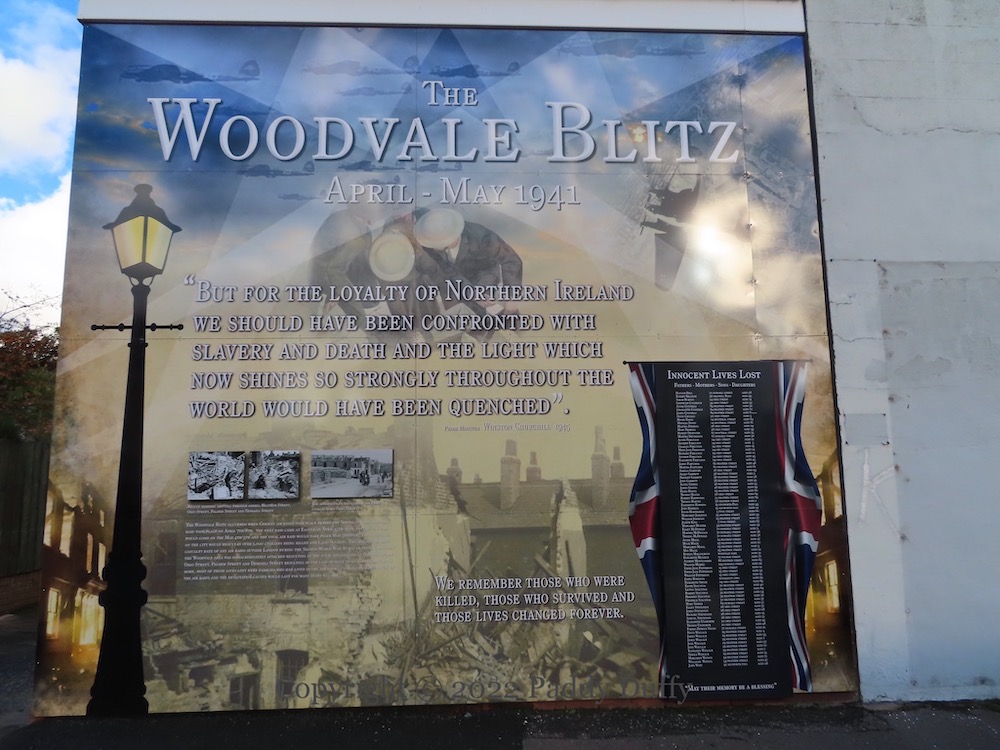
“The Woodvale Blitz occurred when German air raids took place during the spring of 1941. The first raid took place on April 7th/8th, the next raid came at Easter on April 15th/16th, the 3rd air raid would come on the May 4th/5th and the final air raid would take place May 5th/6th. These attacks on the city would result in over 1,000 civilians being killed and 1,5000 injured. This was the highest casualty rate of any air raids outside London during the Second World War. It was in these streets that the Woodvale area was indiscriminately attacked resulting in the total devastation of Heather Street, Ohio Street, Palmer Street and Disraeli Street resulting in the loss of many lives injuring 100’s more, most of those lives lost were families who had lived in the area for generations. The effects of the air raids and the devastation caused would last for many years to come.” The names of 79 victims are given on the right (see close-up below).

“The Woodvale Blitz April-May 1941. ‘But for the loyalty of Northern Ireland we should have been confronted with slavery and death and the light which now shines so strongly throughout the world would have been quenched’ – Prime Minister Winston Churchill 1945. We remember those who were killed, those who survived and those lives changed forever.”

Enfield Street, west Belfast

Click image to enlarge
Copyright © 2022 Paddy Duffy
T01417 [T01418]