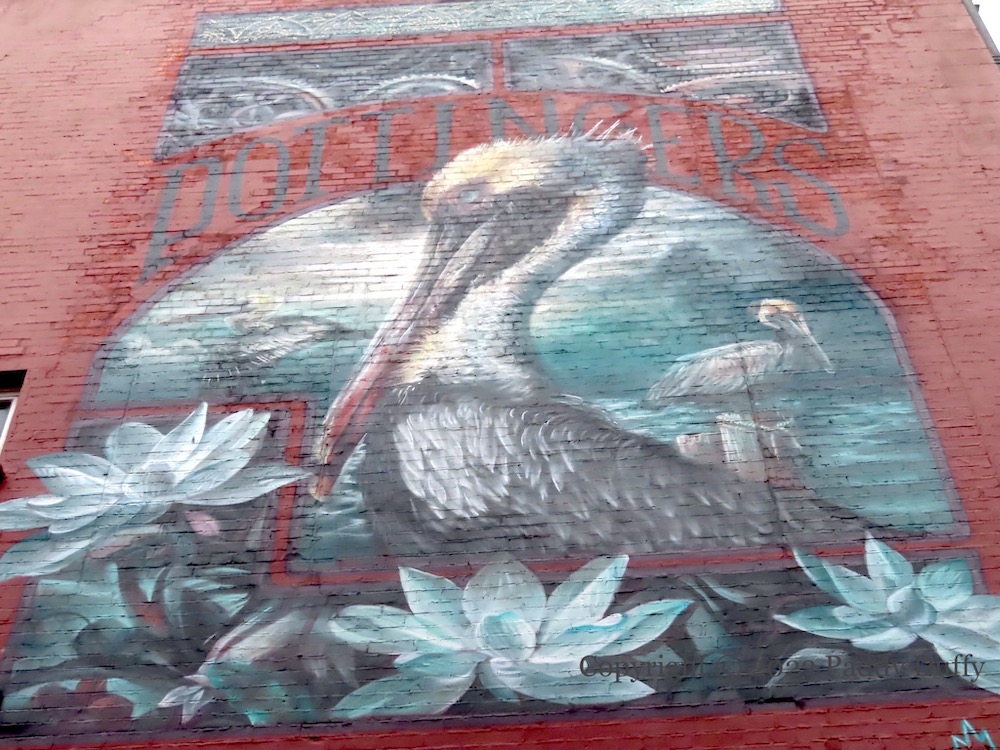
This giant pelican was painted by Nomad Clan (web) from Manchester, England, as part of the first year (2020) of the Belfast Entries Project (Visual History). According to ArtUK, the pelican is a reference to “the Pottinger’s family crest” (Lord Belmont) while the “east Asian flowers” along the bottom and the cogs at the top point “to Belfast’s rich industrial past.
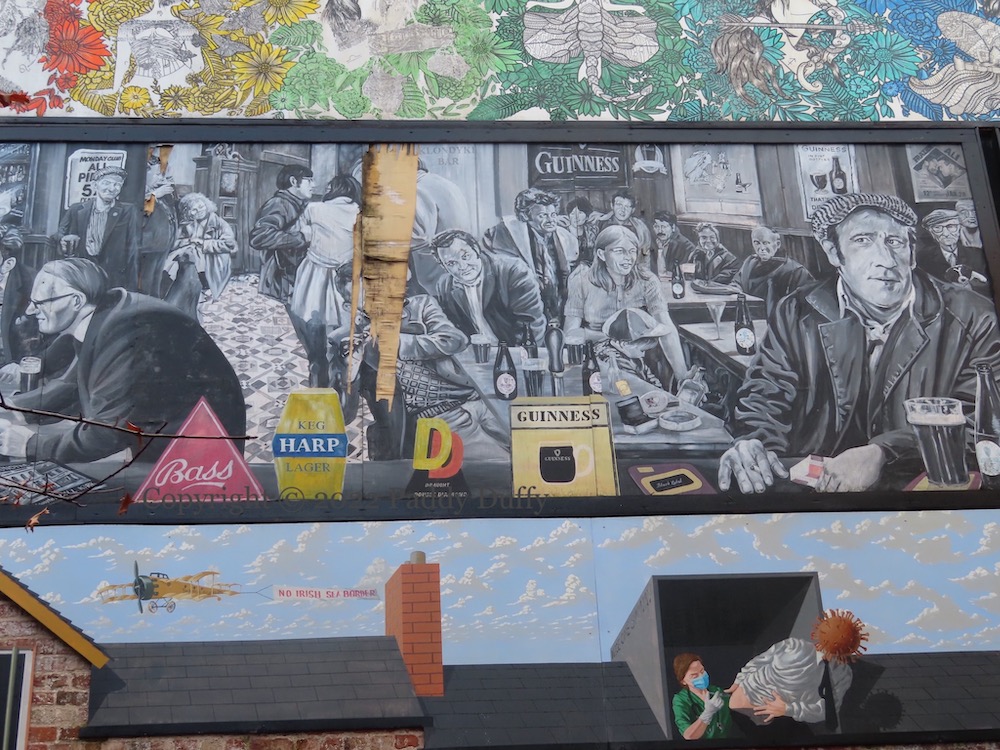
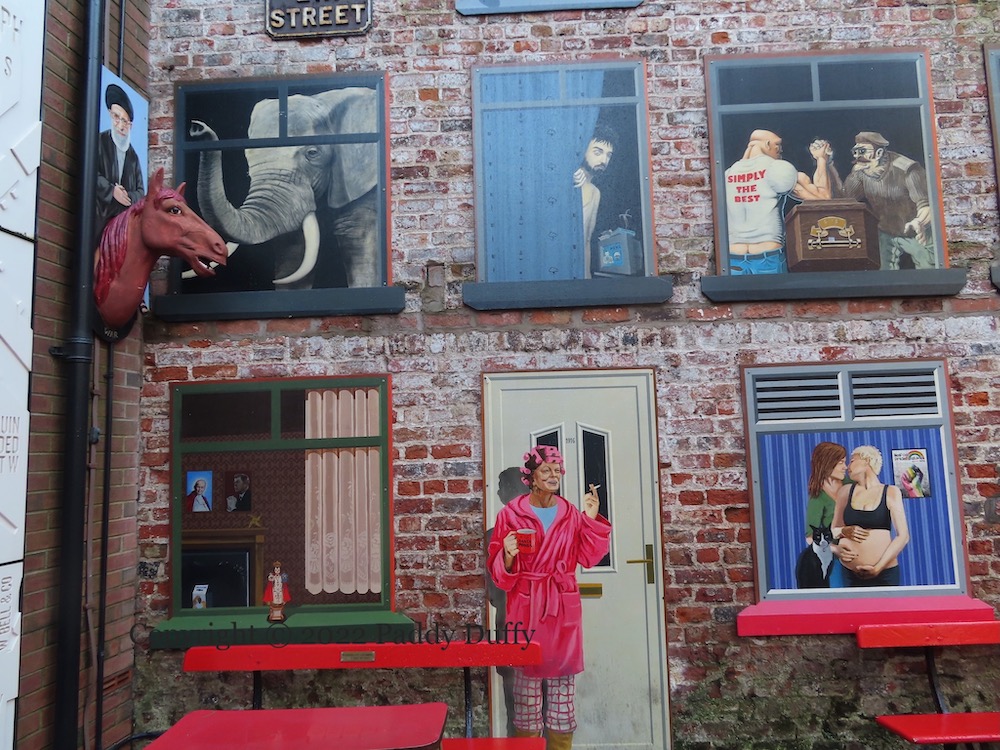
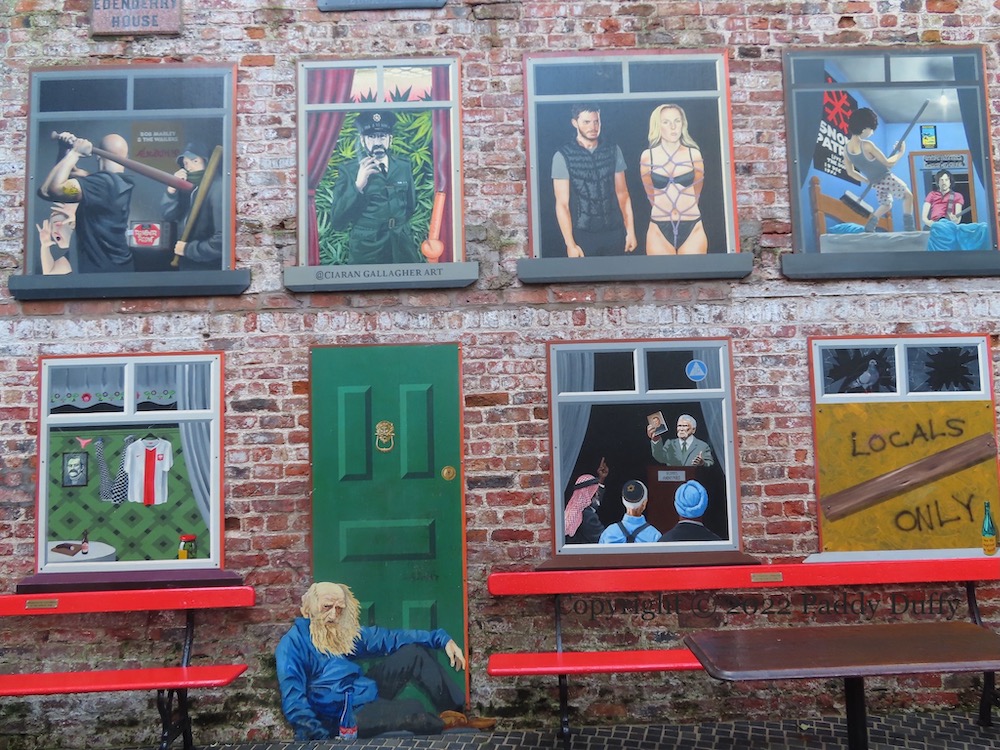
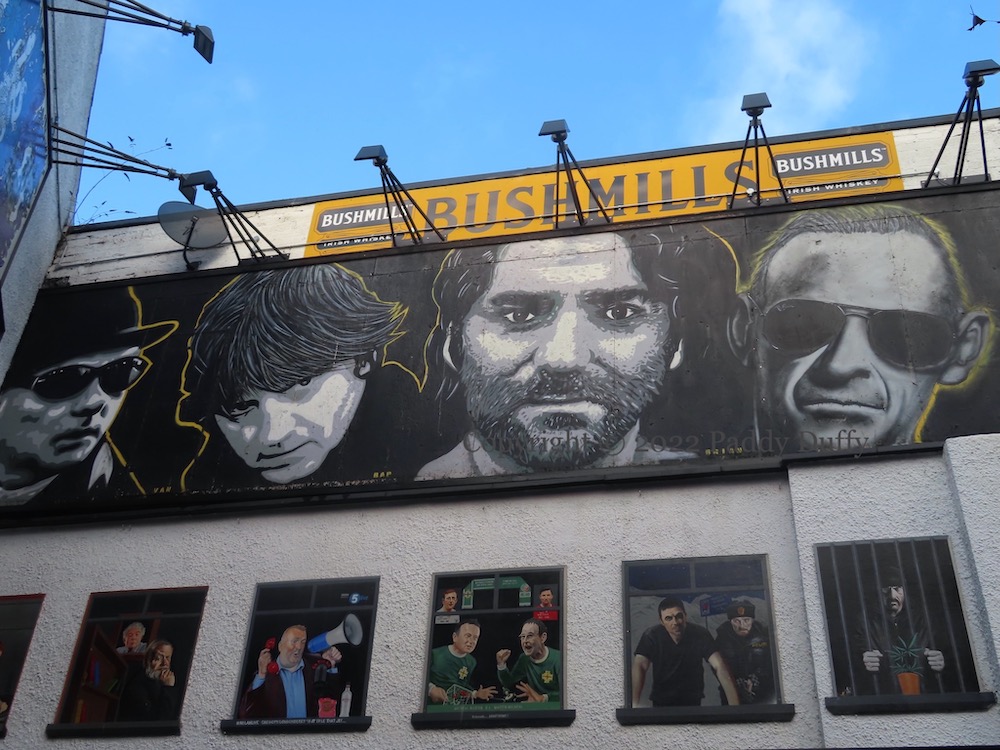
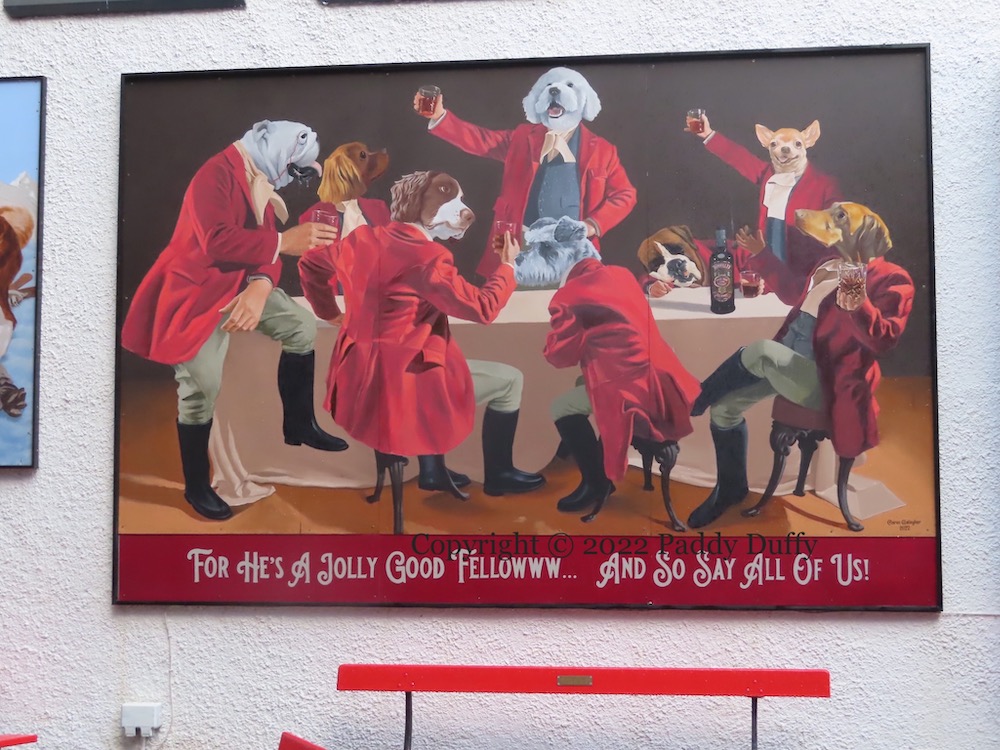
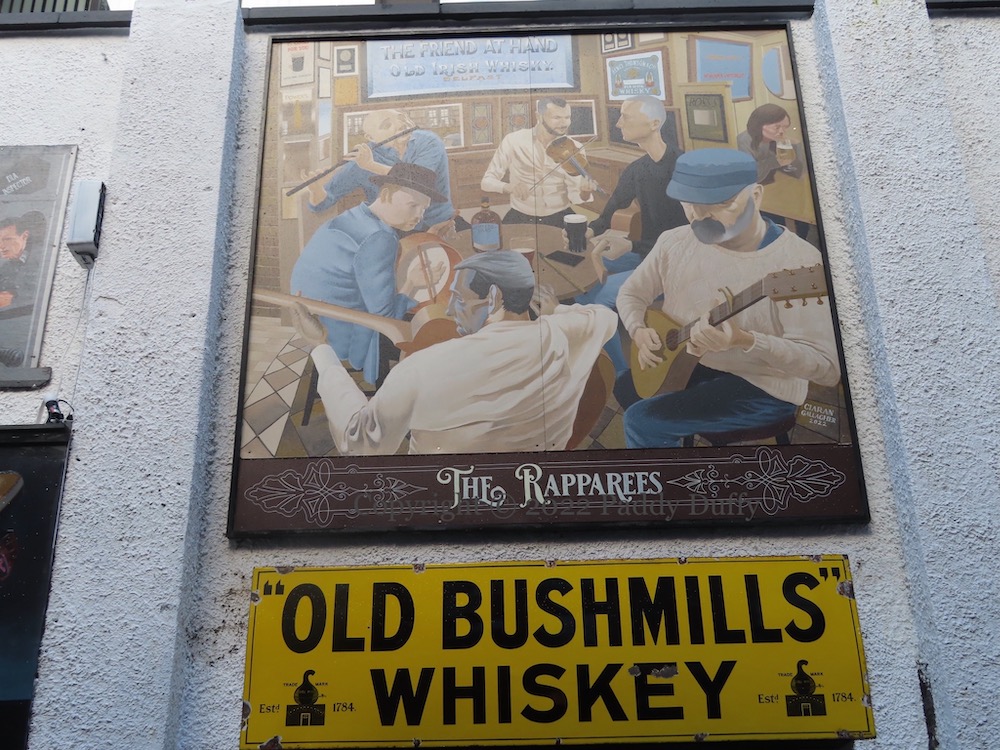
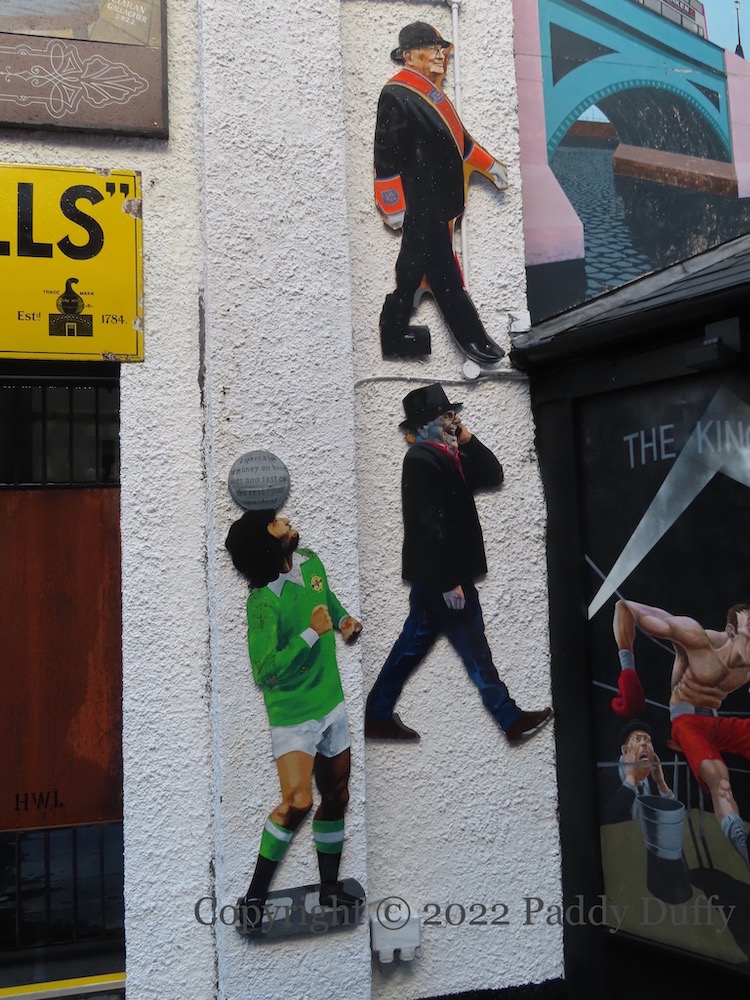
Here is a gallery of many of the pieces in the courtyard of the Dark Horse bar in Belfast city centre, presented in clockwise order from the entrance on Commercial Court.
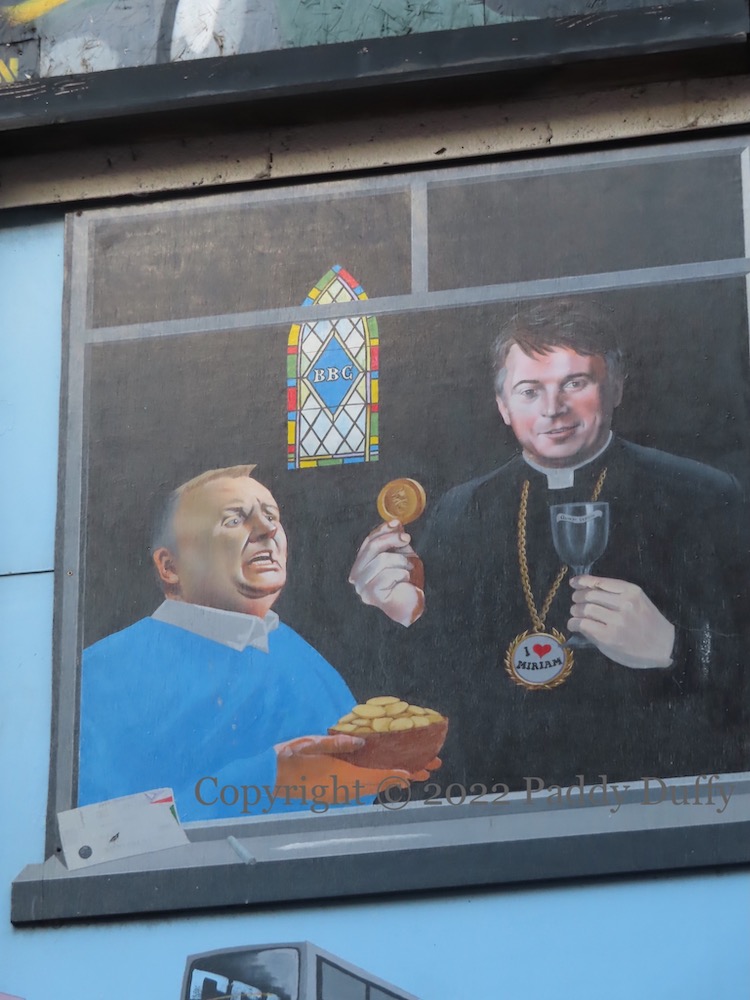
Above and immediately below: the scene in the Klondyke Bar. Links to additional pieces can be found at their appropriate places in the “rotation”, below.
Martin McGuinness and Ian Paisley in the clouds
Belfast Stripped Bare – a view into people’s houses by Ciaran Gallagher (web); many of the painted pieces in the yard are by Gallagher.
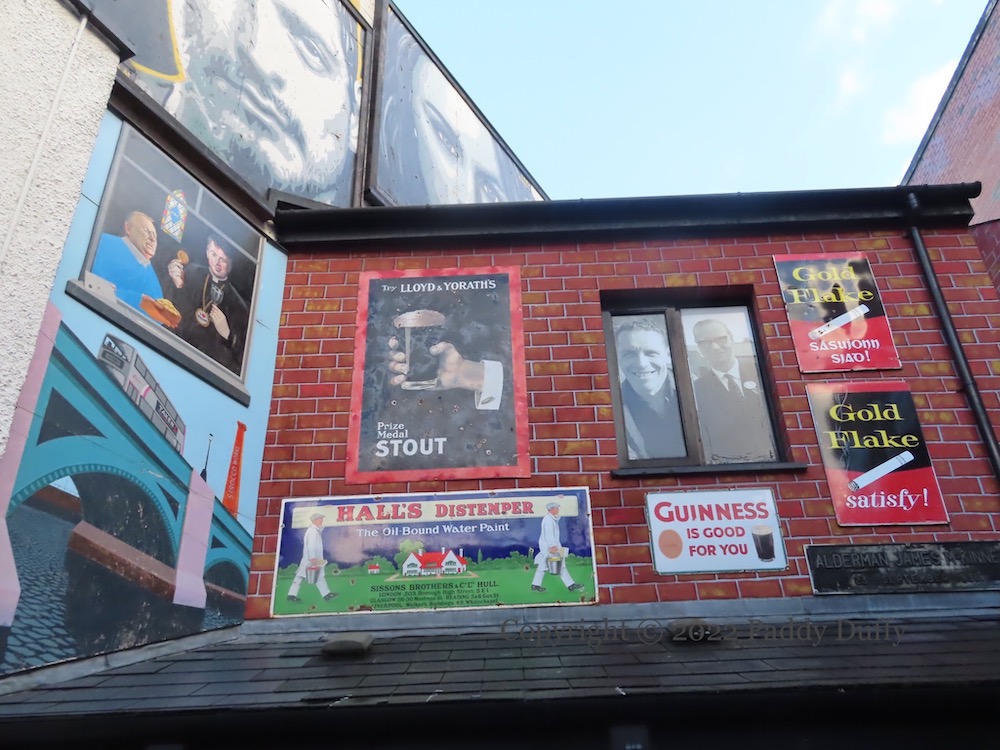
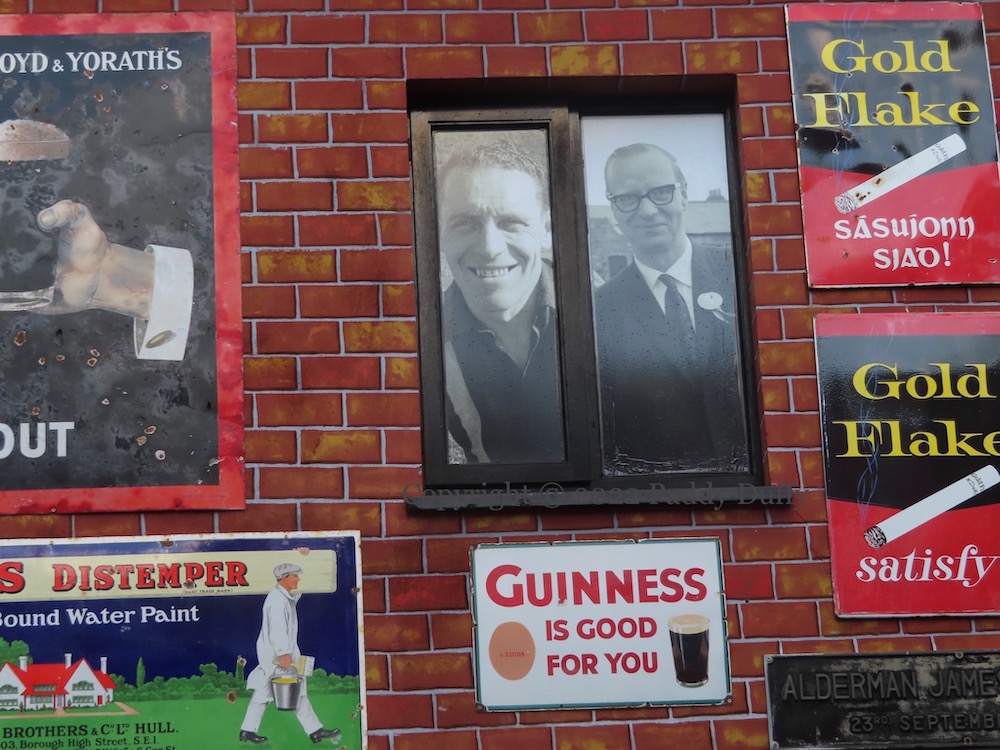
A variety of vintage advertisements from the late 1800s and early 1900s: Lloyd & Yorath’s stout (Newport, Wales), Hall’s paints (Hull), Guinness, Gold Flake tobacco (in both English and Irish: Sásuíonn sıad!), Batey’s ginger beer (London), Gilbey’s wines, Mew’s brewery (Isle of Wight).
“Ourma says if you stick t’herown diet of land-an-dairy prod you’ll be firmanna an’trim down” – a saying in which the names of all six Northern Irish counties are (phonetically) included.
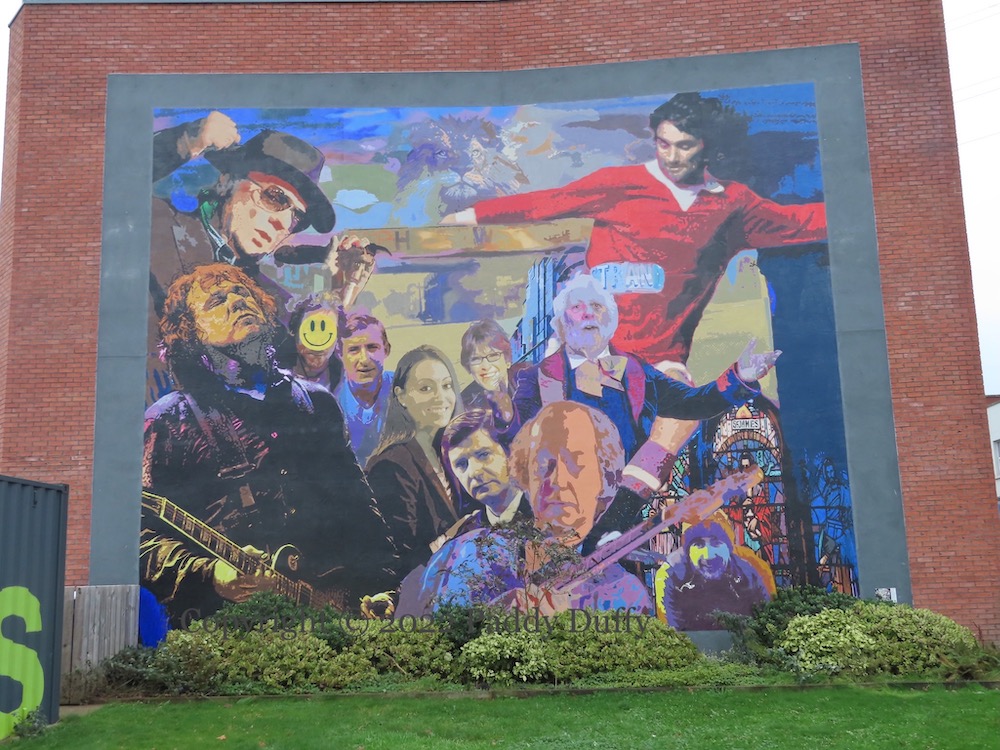
Famous faces and landmarks from east Belfast: Van Morrison, CS Lewis, George Best, David Holmes, Harland & Wolff, Holywood Arches, Strand Arts Centre, Danny Blanchflower, Lucy Caldwell, Marie Jones, Sam McCready, Gary Moore, James Ellis, St Mark’s Dundela, Eric Bell, Dee Craig (the artist).
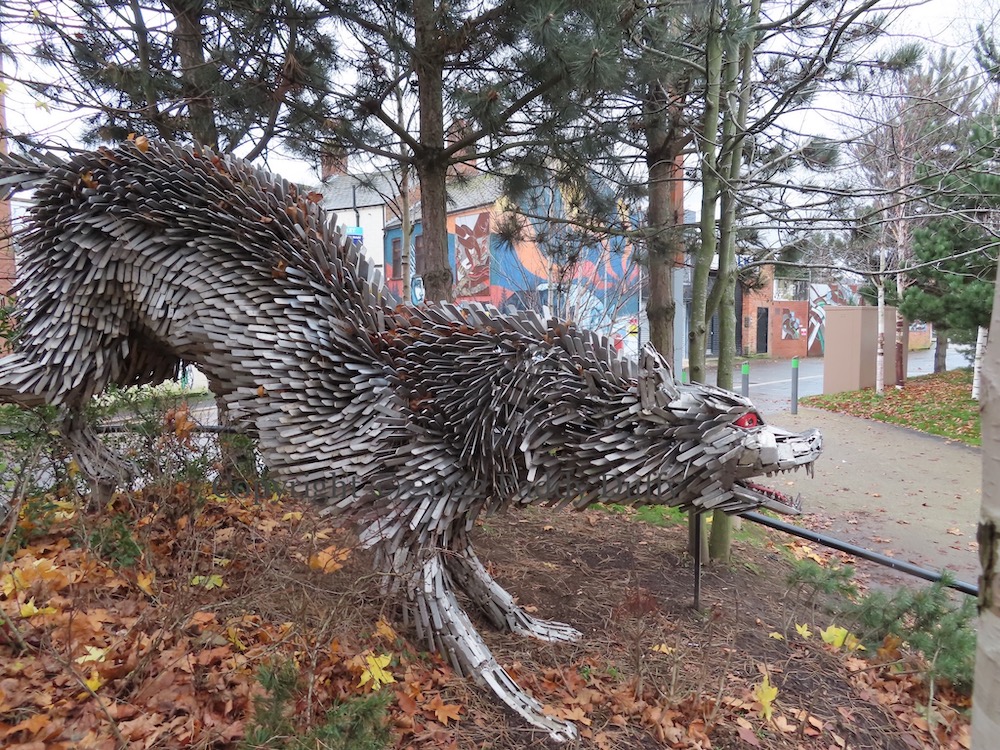
The statues in CS Lewis Square are by sculptor Maurice Harron (who also did the Hands Across The Divide statue in London-/Derry). The seven statues are of Aslan the lion, Mr. Tumnus, Jadis the White Witch, Mr. and Mrs. Beaver, the stone table (in granite), Robin Red Breast, and, Maugrim, the talking wolf who is head of the Witch’s secret police. Most of the figures are in bronze but Maugrim – shown above – is made of about 5,500 pieces of stainless steel welded to a steel frame (Loop).
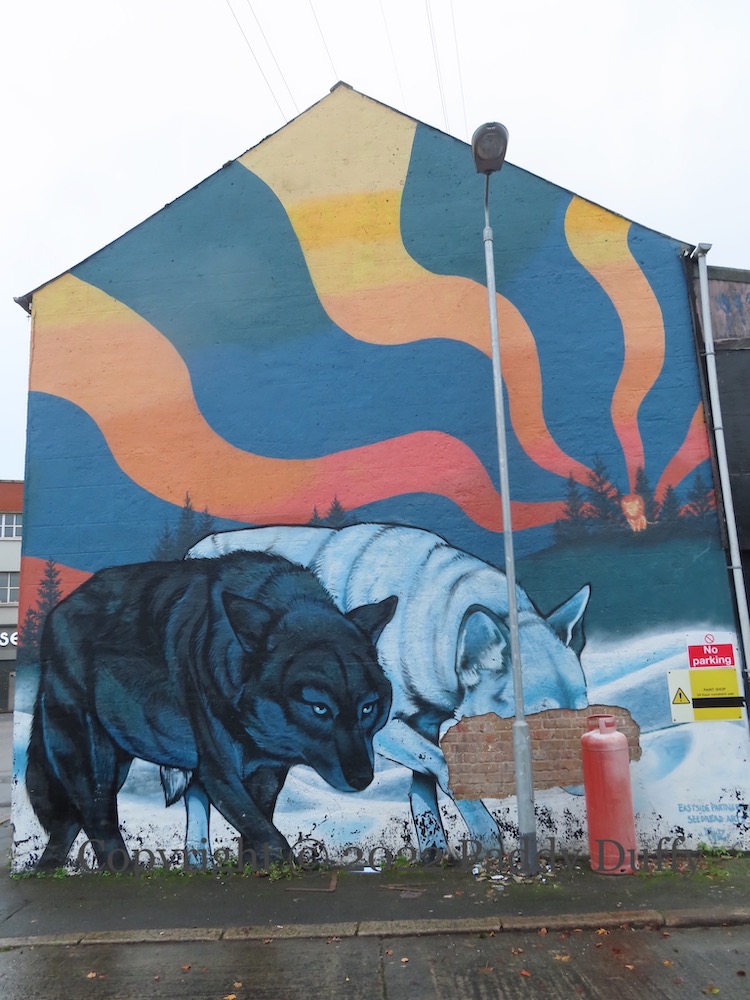
For images of the murals (by Friz – web | tw) in better condition, see Winter’s End; for the chain and ropes metal-work, see Of The River.
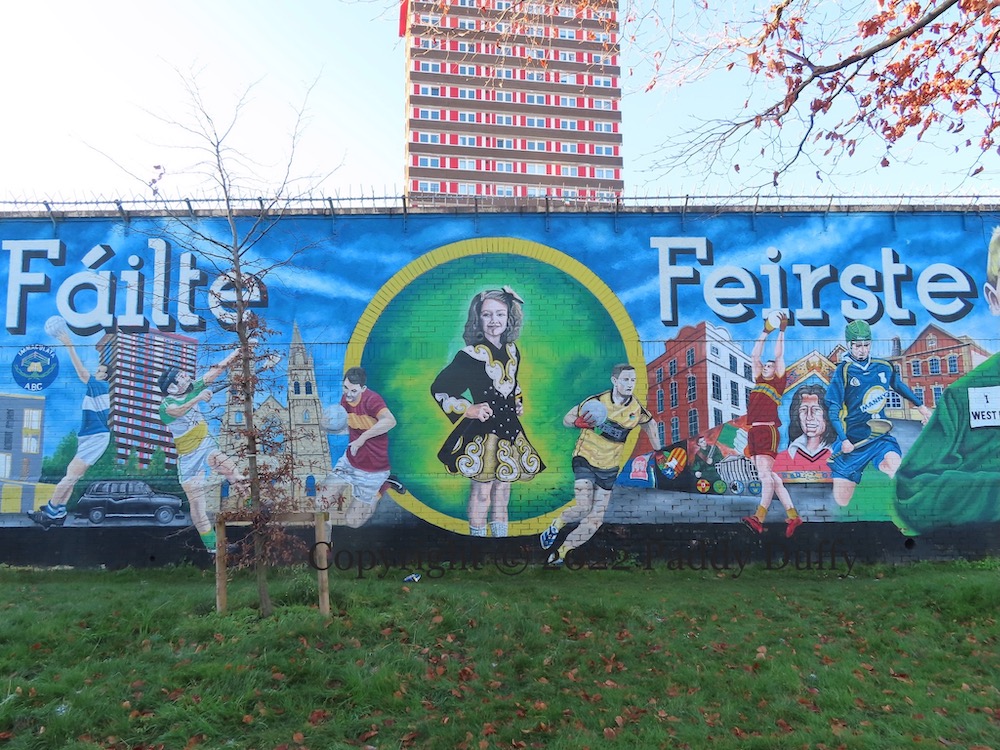
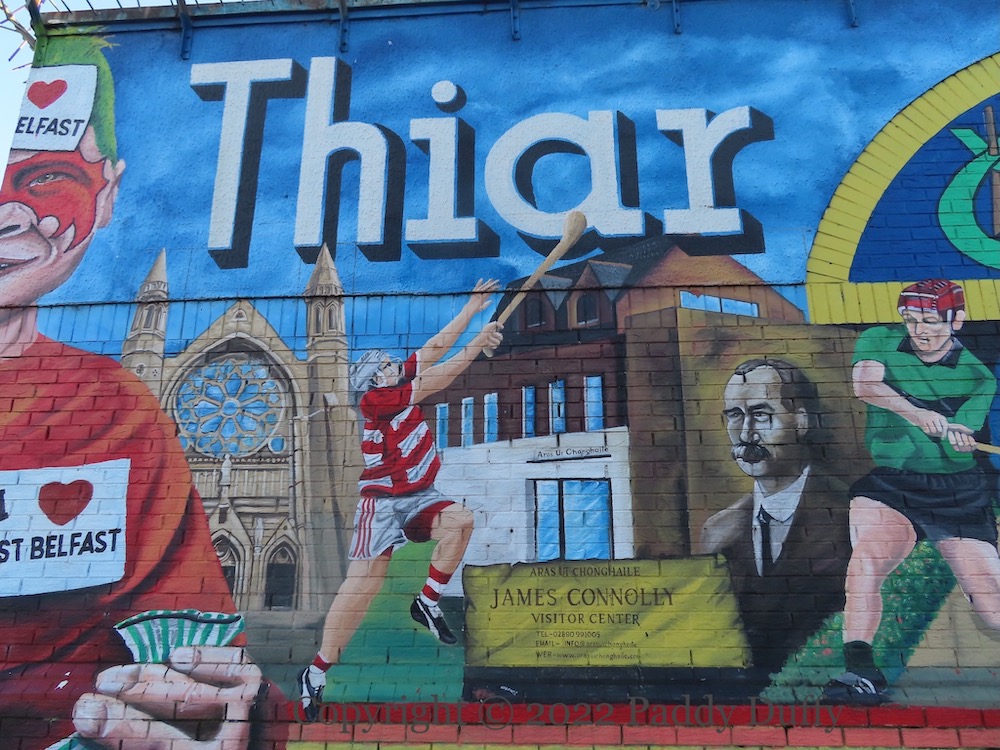
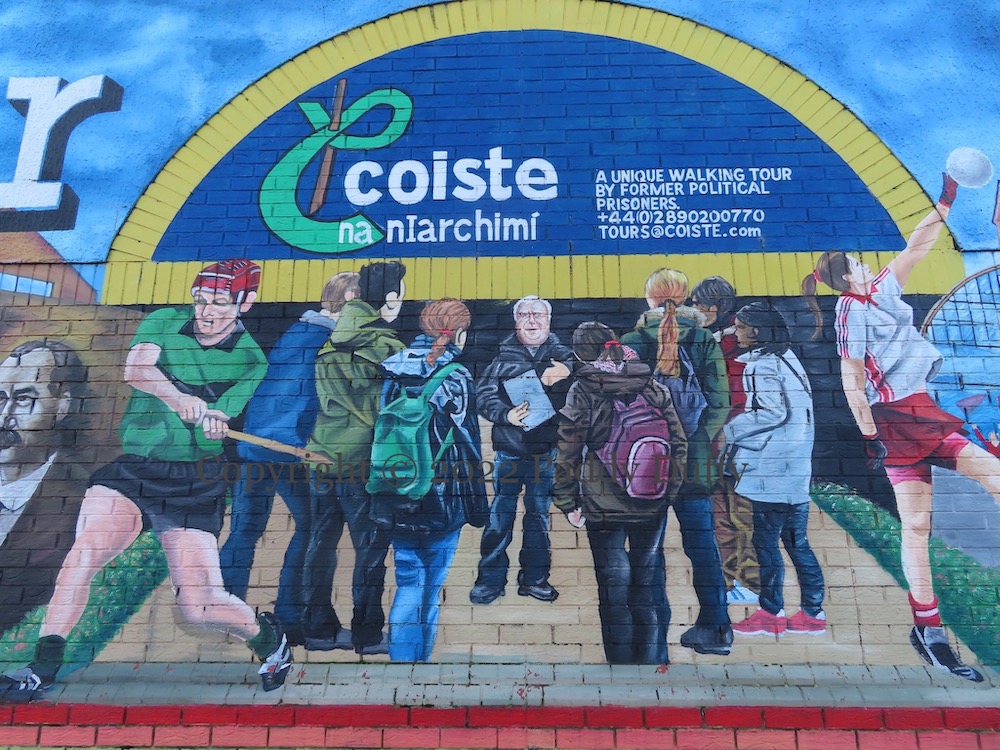
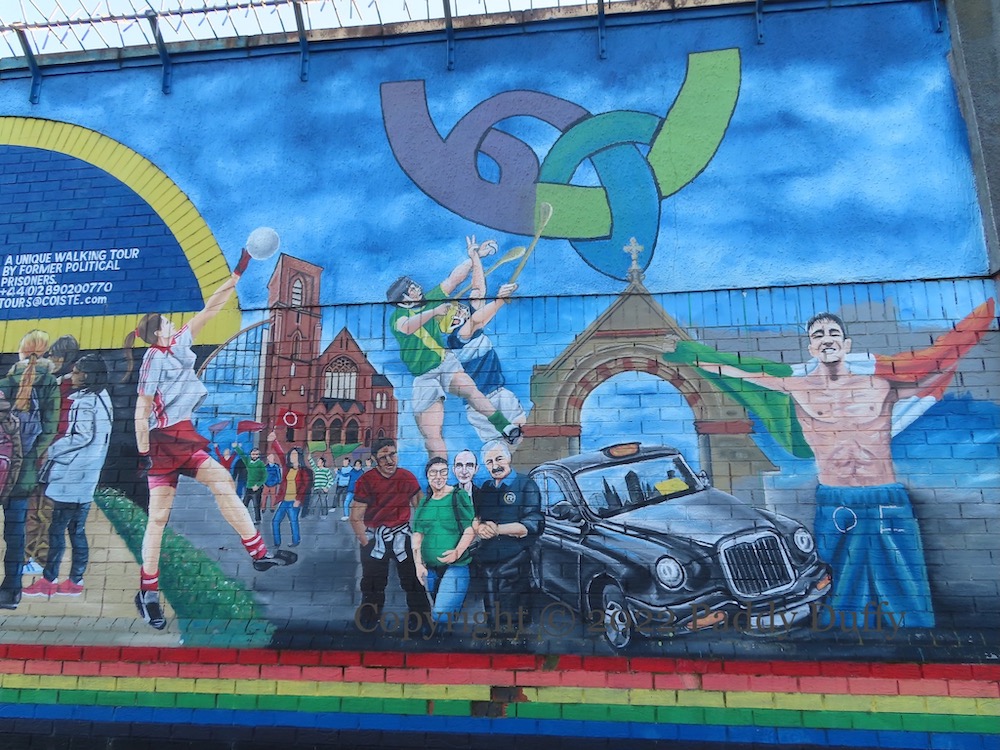
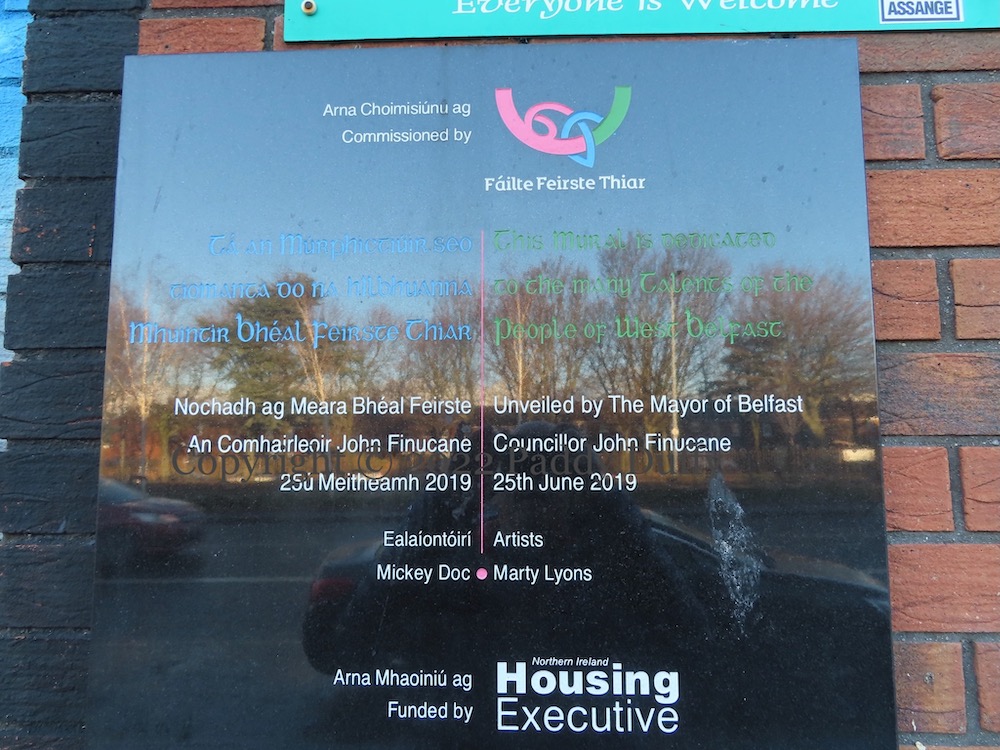
Fáılte Feırste Thıar‘s second mural (the first is outside its offices in the middle Falls – see Fáılte Feırste Thıar) reinforces the claim that (republican) west Belfast begins as soon as you cross the motorway, five minutes’ walk from the city centre. Coıste’s tour of republican murals begins at Divis Tower and the new mural already seems to be drawing tourists – see the final image, below. The previous Coıste mural (M04900) has been deleted and incorporated into the mural, promising tourists “a unique walking tour by former political prisoners”.
The mural is a mix of landmarks – the new Raıdıó Fáılte building (which is located just below the mural), Divis tower, St Peter’s, Conway Mill, the “international wall” of murals, the Bobby Sands mural, the Falls library, the new James Connolly centre, Cultúrlann, and Milltown cemetery – cultural images (Irish dancing and Féıle An Phobaıl) – and sporting images (clubs include Immaculata ABC, Gort Na Móna GAC, St Paul’s GAC). A gay pride ‘rainbow’ stripe runs below the Divis Street portion. Before the previous mural was painted (M07533), there was a Gateway To Belfast board at this spot.
John Leathem, chairman of the Divis Tower Falls Residents’ Association, died in his flat on the 19th floor of Divis Tower in August last year (2017), after returning to the Tower four years previously when he was diagnosed with cancer (Irish News | Tele). He was described by Sınn Féın MLA Fra McCann as “a champion for the people of no property” (An Phoblacht). This mural is outside his former office on the first floor.
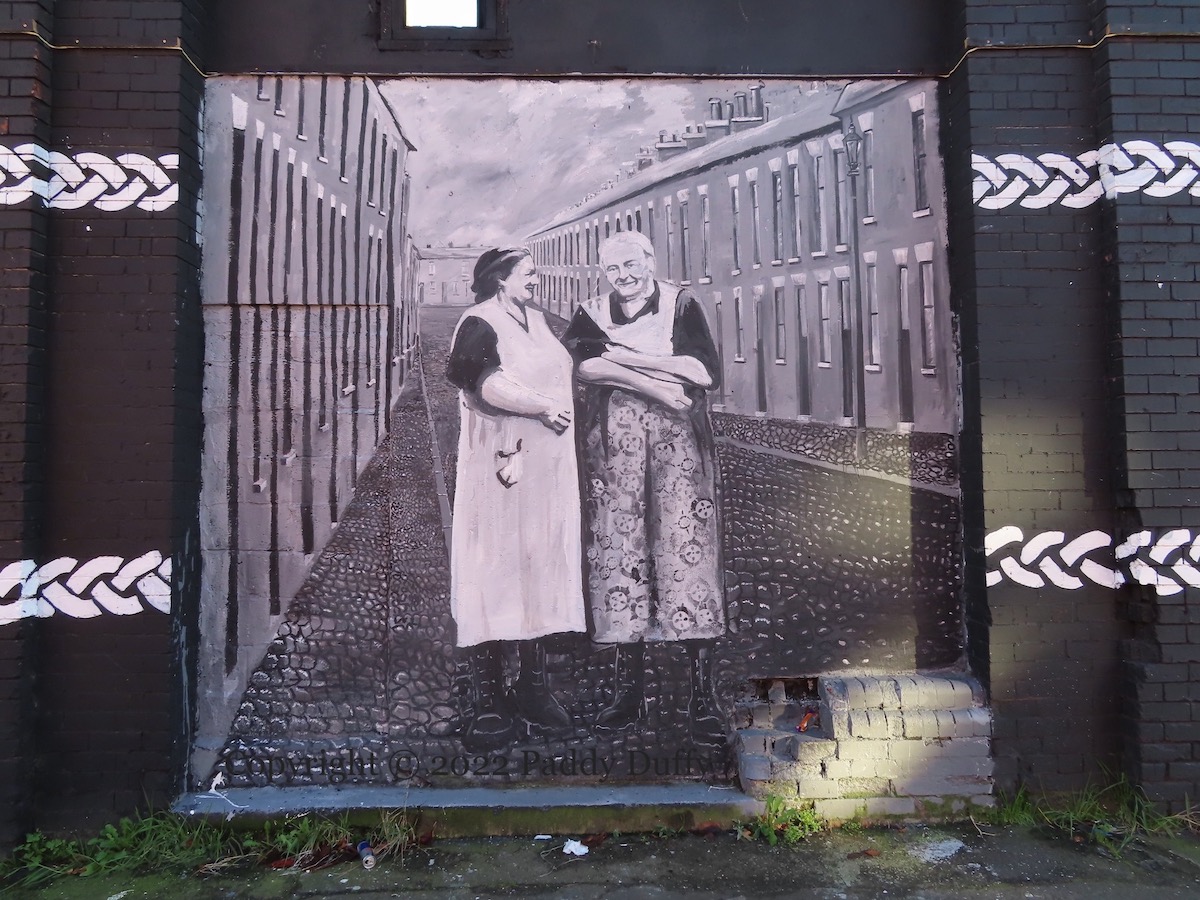
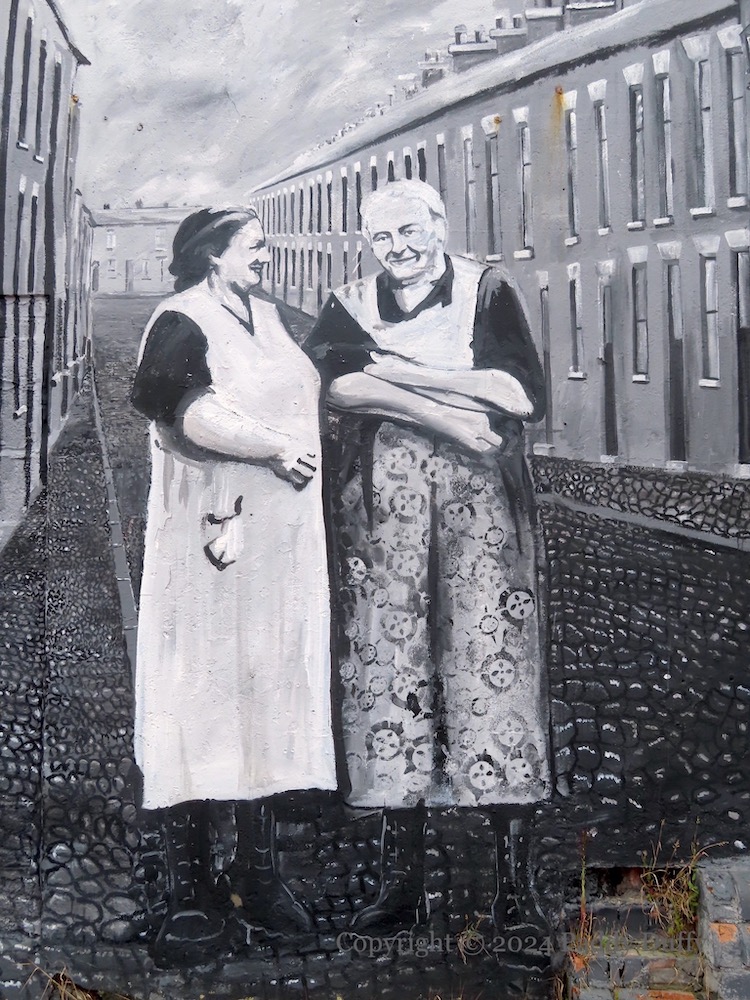
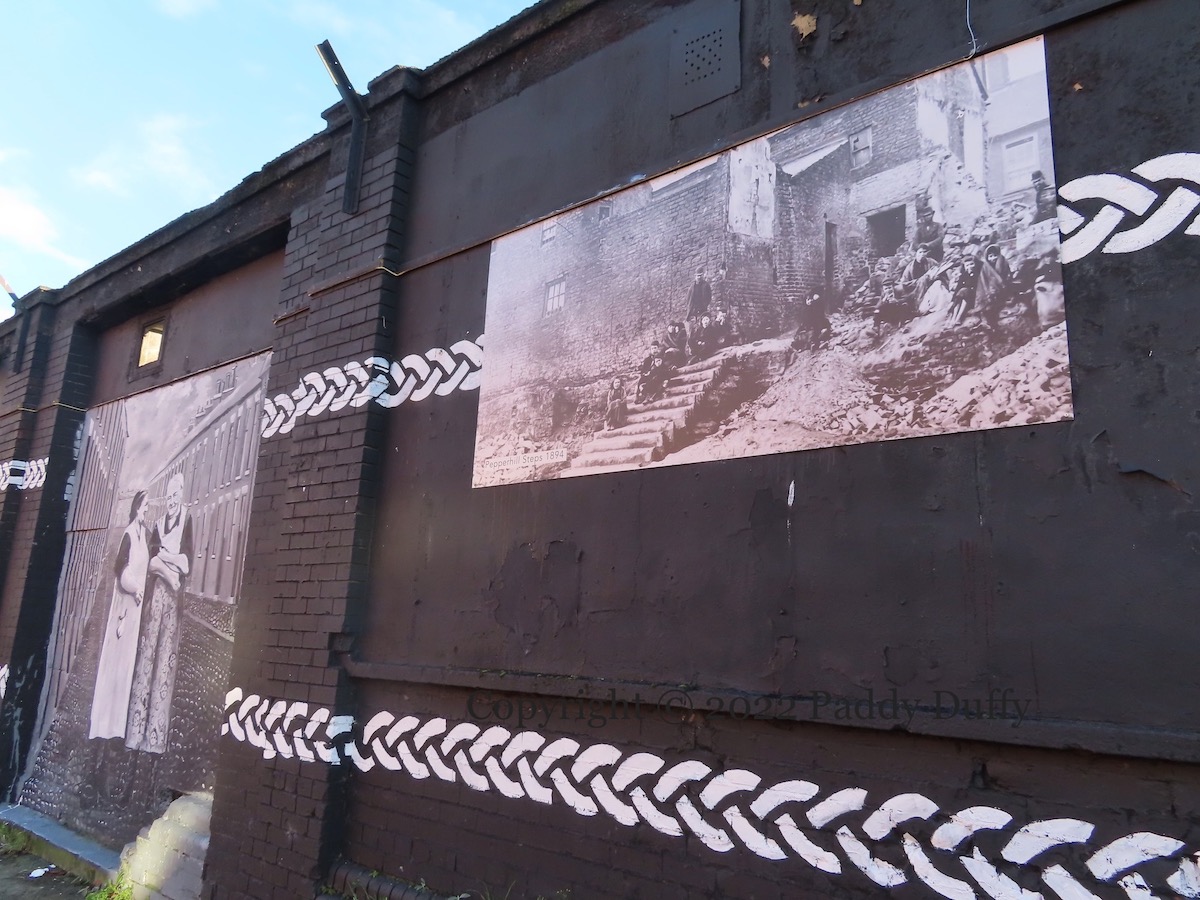
The collection of images showing “Carrick Hill in the old days” now includes a mural, of two women talking in the street.
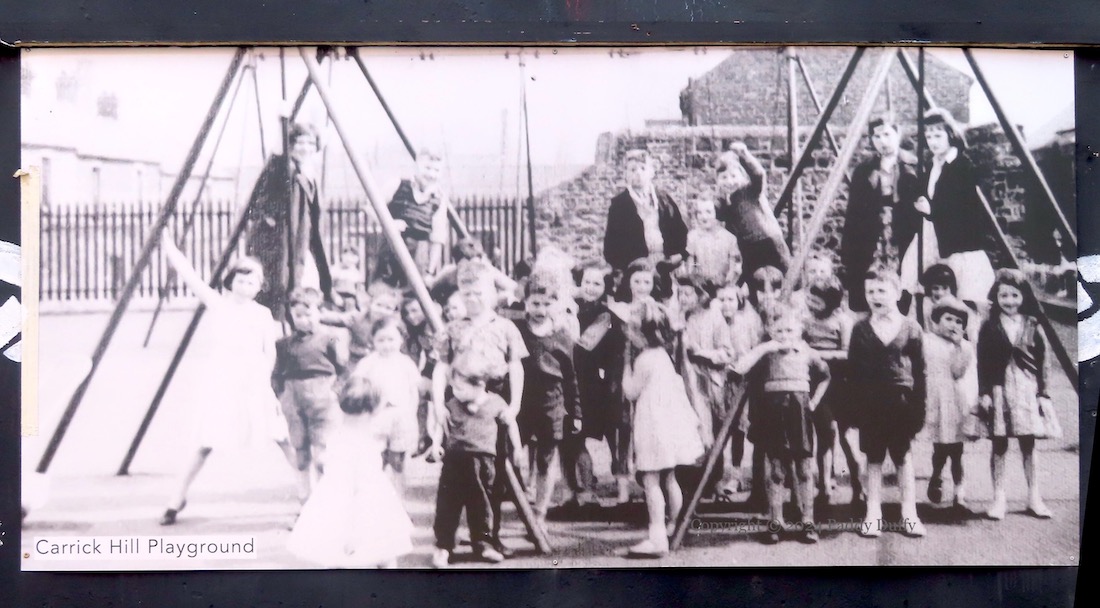
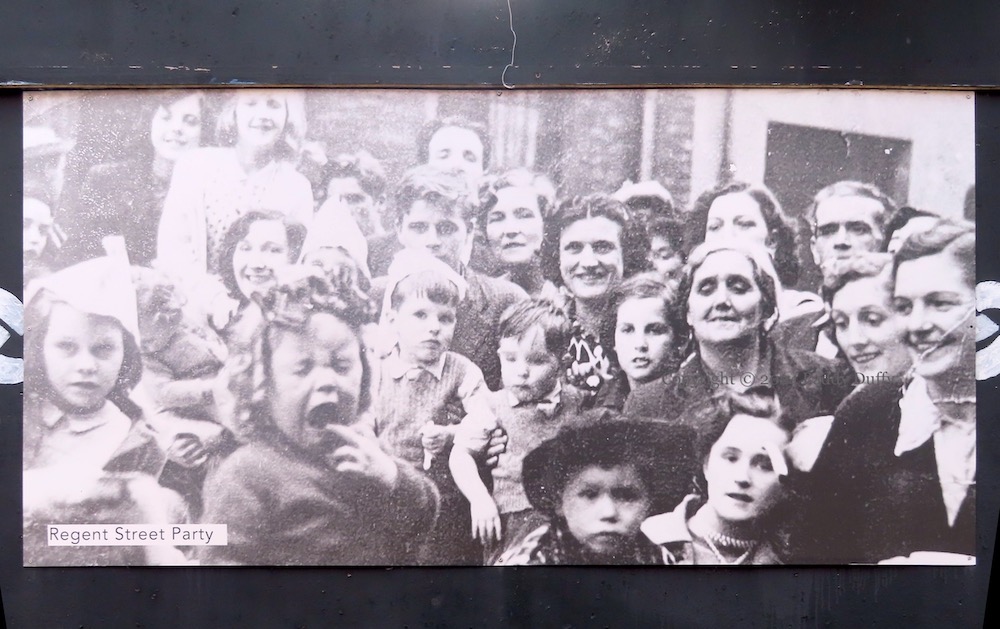
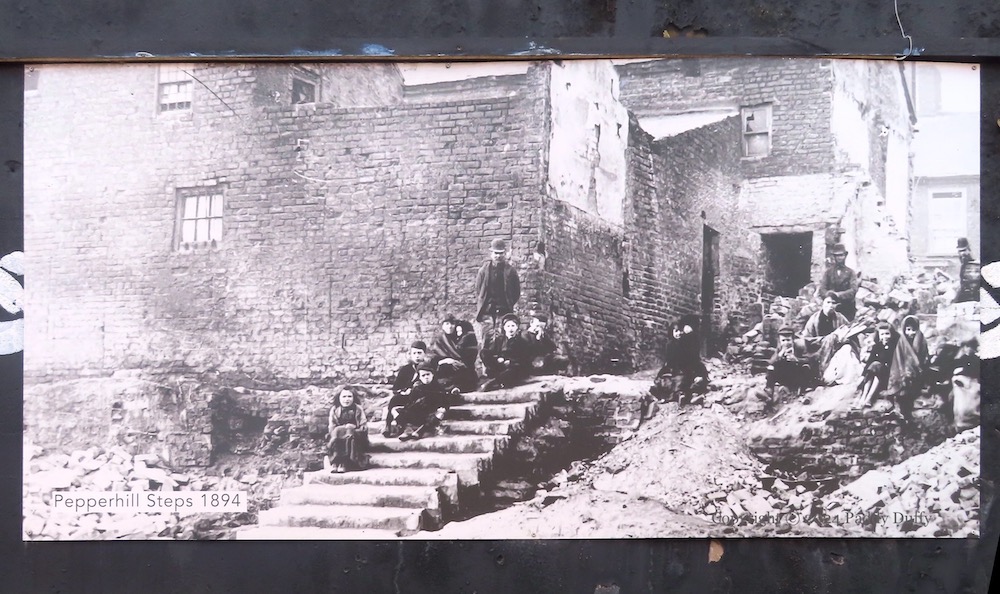
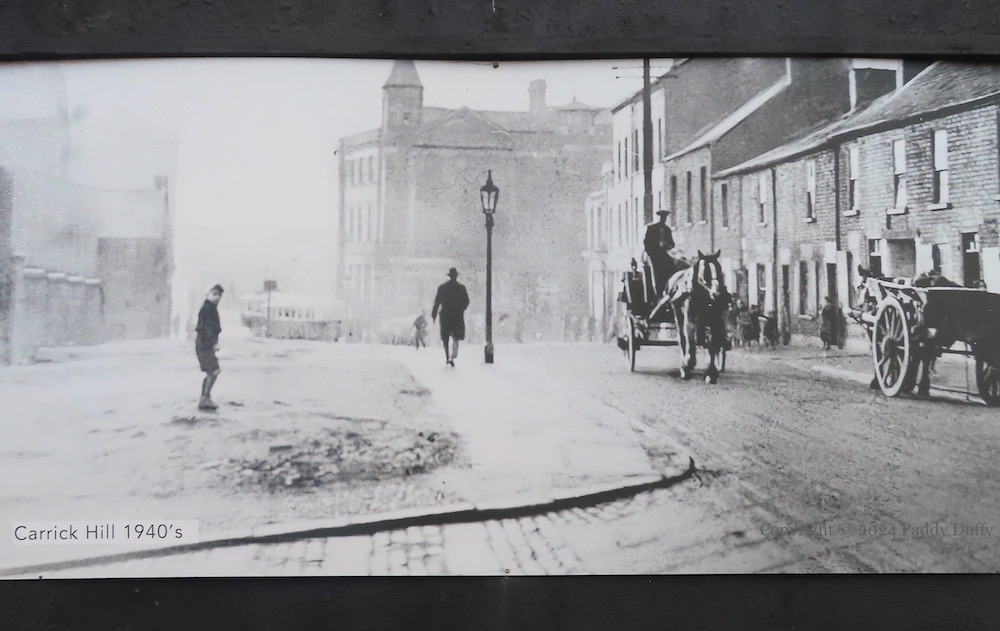
In addition to the mural, there are four boards, two on either side: Carrick Hill playground; Regent Street party; Pepper Hill steps, 1894; Carrick Hill 1940s.
There are eleven more boards in Regent Street. (Later increased to fifteen with the addition of 1976 Mandiville dart team; Mary McCusker & Kitty Spotwoods; Maggie Jane Largey & Mary Ann Largey; Richard & Alan Crean – see The Tea Bar for all fifteen.)
The board in the image below (from Stanhope Street) shows Pepper Hill Steps before the turn of the twentieth century. The steps used to lead from Mustard Street (which was what Library Street used to be) towards Upper Library Street (now Carrick Hill, the street).
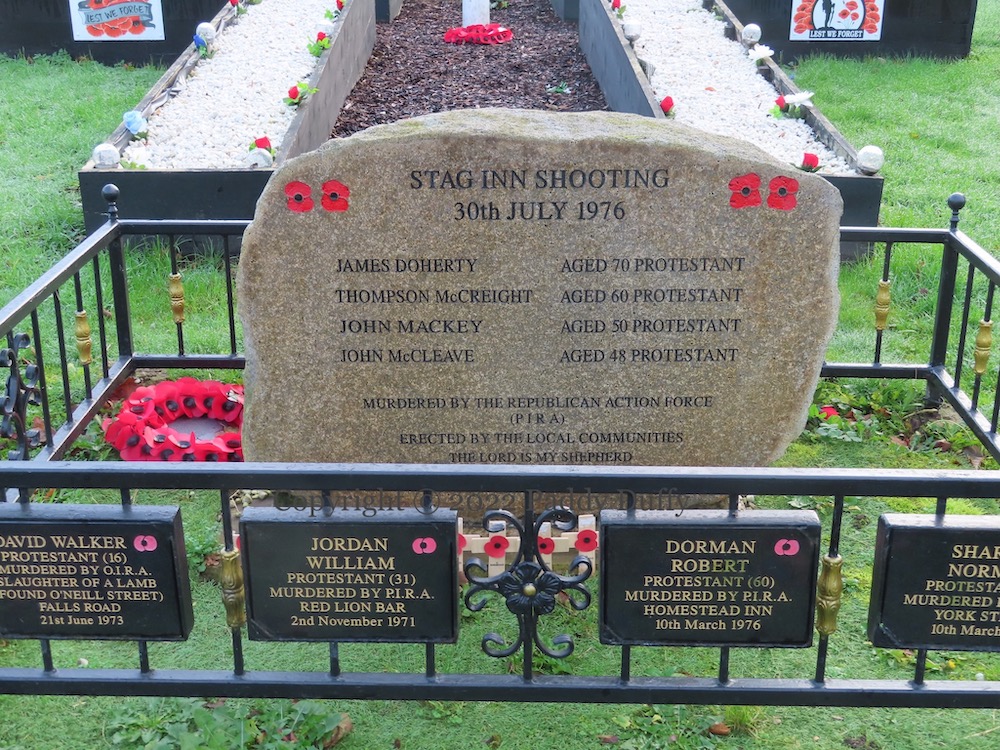
A long series of tit-for-tat shootings of pubs and clubs continued into the summer of 1976, with attacks on the Chlorane (June 5th), Walkers (June 25th), the Ramble (July 2nd), the Whitefort (July 29th), and then, on the 30th, The Stag at Shaws Bridge, Belfast, by the Republican Action Force (PIRA) (Sutton). John McCleave, John McKay, and James “Jimmy” Doherty died on the night of the attack, and Thompson McCreight died of his wounds nine days later. The memorial to them – “erected by the local communities” – is on Milltown Road, next to the Dreamscheme (web) mural.
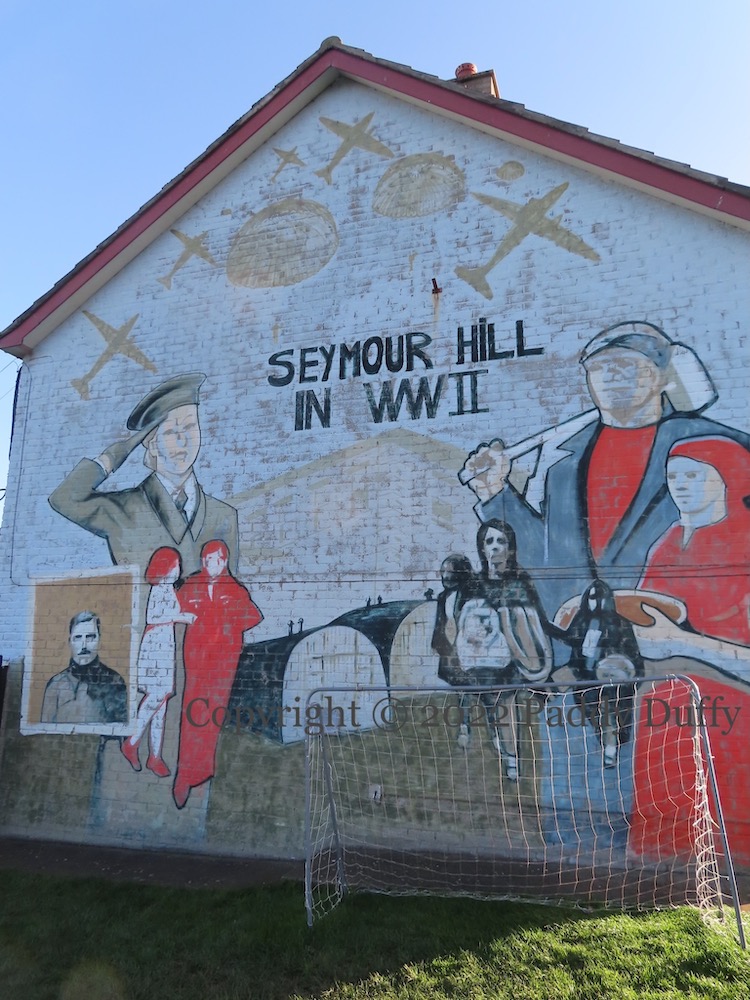
US forces were still segregated racially during WWII; “colored” soldiers (as they were then called) were housed in a camp at Ballybog Road (WW2NI) where Seymour Hill PS now is and just below Seymour Hill House which was used to house evacuees from Belfast after the blitz and which was formerly owned by the Charley family (Lisburn.com | Lord Belmont) – it is now administered by Radius (formerly the BIH Association).
The “framed” portrait on the left is of William “Billy” Harbinson, a member of the Royal Ulster Rifles who was a POW at Colditz (Lisburn.com | WW2NI); the photograph can be seen in the RUR museum.
There used to be a plaque on the wall which read, “This mural was dedicated by Col. Robin Charley on 1st July 2009 to the people from this area who contributed to the to the effort during World War II. Also our American allies who were based here and later contributed to the conflict.”
Painted by Tim McCarthy (“Verz” ig) for the Re-Imaging Programme; it replaced a UDA mural.
Glencolin estate was built next to Moyard House (which in 1984 became home to the Roddy’s (web)) on the Glen Road in 1979 (Belfast Forums). For the fortieth anniversary of “eastát Ghleann Collaınn” the mural at the entrance to the estate was (belatedly) repainted. The composition of the mural remains as in the previous version, with the Roddy’s and Oliver Plunkett church in the shadow of Dubhaıs and Slıabh Dubh; they are now joined by images of Gaelic games. The Bobby Sands quote has been removed.















 Paddy Duffy Collection