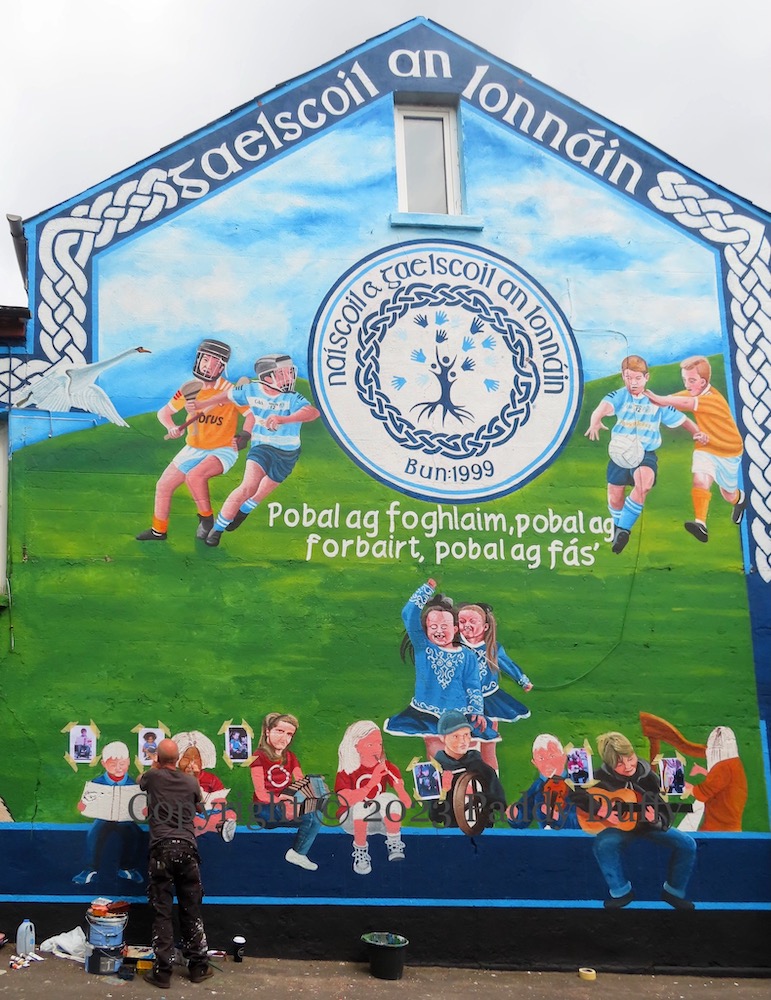
Pobal Ag Fás

“Pobal ag foghlaım, pobal ag forbaırt, pobal ag fás” [a community learning, developing, growing]

Students from “Naíscoıl & Gaelscoıl An Lonnáın (Fb) bun[aithe] 1999″ [Nursery-school and Irish-language [primary] school of the loney, founded 1999] are shown playing Gaelic games, Irish dancing, and playing traditional instruments (and the guitar). On the left are representations from Irish mythology: the Children Of Lear and Setanta killing Culann’s hound (and taking the name Cú Chulaınn in taking its place), along with hedge-row school (see Hedge Row School).

The origin of the name is unclear; the nearest loney [lane] was the “Pound” loney, so-called because of the animal pen just outside Barrack Street, used to store livestock before moving on to the markets the following day (Rushlight | Uachtar Na bhFál). (The Pound Loney is included in the mural in Durham Street – see Et In Arcadia Ego.)

The other well-known loney in Belfast is the “buttermilk loney” which was either/both what is now Ballysillan Park (that is, connecting Olpark with the horsehoe bend) or the top part of the loney that connected Wheatfield (the top of Ardoyne) to the Ligoniel junction and on towards the old Ligoneil House (there are a mixture of usages in this Belfast Forum thread); this image from the 1930s might show the lane in (what was still at the time) the hills above Oldpark; a new housing-development towards the top of the Ballysillan Park is euphemistically called “Buttermilk Loney”. (It is also said to have been a prior name of Skegoniell Avenue (Belfast History).)

(The Uachtar Na bhFál page also mentions “Turf” loney, “Mountain” loney, and “Killoney”.)

The history of the Irish word “lonnán” is unclear. Uachtar na bhFál says the word is of Scots origin (perhaps as “loanin”). (See this BelTel article on the opening of the Ulster-Scots centre in 2014.) Spelled “lonnen”, it is also a Geordie word (Heslop’s Northumberland Words | wiktionary). The Irish News and Belfast Live, working from the same (uncited) press-release about Páırc An Lonnáın (which is along the Westlink below Raıdıó Fáılte), state that “loney” comes from the English word “loaning”. The Irish word “lonnán” does not appear in Dinneen 1904; Dinneen 1953 defines it (hyper-specifically) as “a grassy recess running up into high basaltic cliffs”.

The image above and immediately below are from May 19th, as the mural was nearing completion; other ‘in-progress’ images are as dated below. See Extramural Activity for images of the completed work.

May 10th:

April 20th:

Click image to enlarge
Copyright © 2023 Paddy Duffy
May 19th T02755 [T02756] T02757
May 10th T02718 [T02717]
Apr 25th [T02579] [T02580]
Apr 20th T02558 [T02557]
Marty Lyons

Cú Chulaınn Please Protect These Things

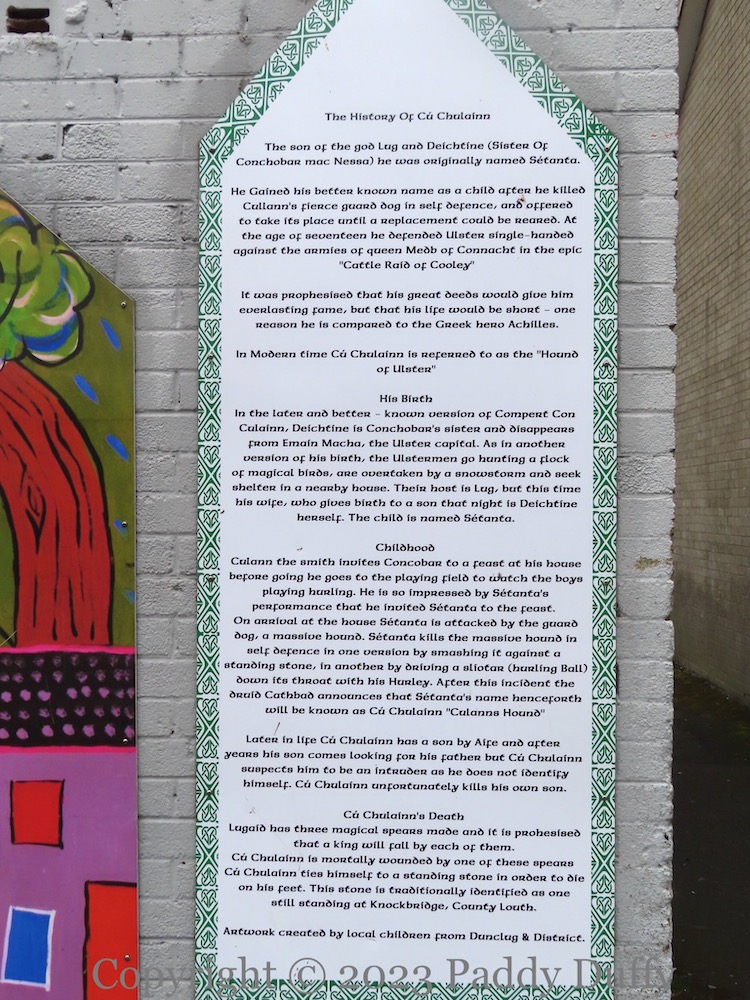
Cú Chulaınn is revered as a living god who might watch over children and their pets, homes, food, and toys in these devotional panels in Dunclug, Ballymena. As the info board says, “It was prophesied that his great deeds would give him everlasting fame.” Cú Chulaınn has his own Visual History page.

Dunclug Park, Ballymena.

Click image to enlarge
Copyright © 2023 Paddy Duffy
T02516r T02517

But What Do Dreams Know Of Boundaries?

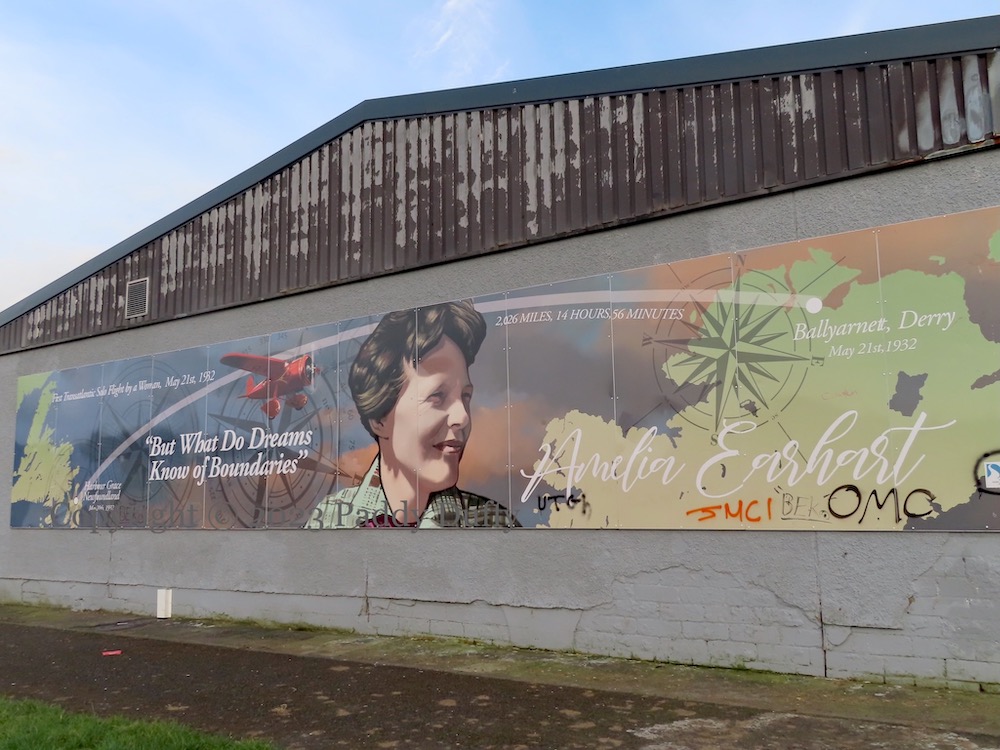
“Everyone has oceans to fly, if they have the heart to do it. Is it reckless? Maybe. But what do dreams know of boundaries?” When she left Harbour Grace, Newfoundland, on the evening of May 20th, 1932, Amelia Earhart’s intended destination for the first solo trans-Atlantic flight by a woman was Paris, France, but after various mechanical difficulties she landed instead in Ballyarnett, just outside Derry. For the 90th anniversary of her history-making flight, the artwork above was created by Joe Campbell (web), commissioned “by Community Restorative Justice in partnership with Derry & Strabane Distict Council’s Good Relations Programme and with the assistance of Greater Shantallow Community Arts.”

For the mosaic already mounted in 2010, see Flying Solo.

Fairview Walk, Derry.

Click image to enlarge
Copyright © 2023 Paddy Duffy
T02133 T02134 T02135 T02136

Gone Too Soon

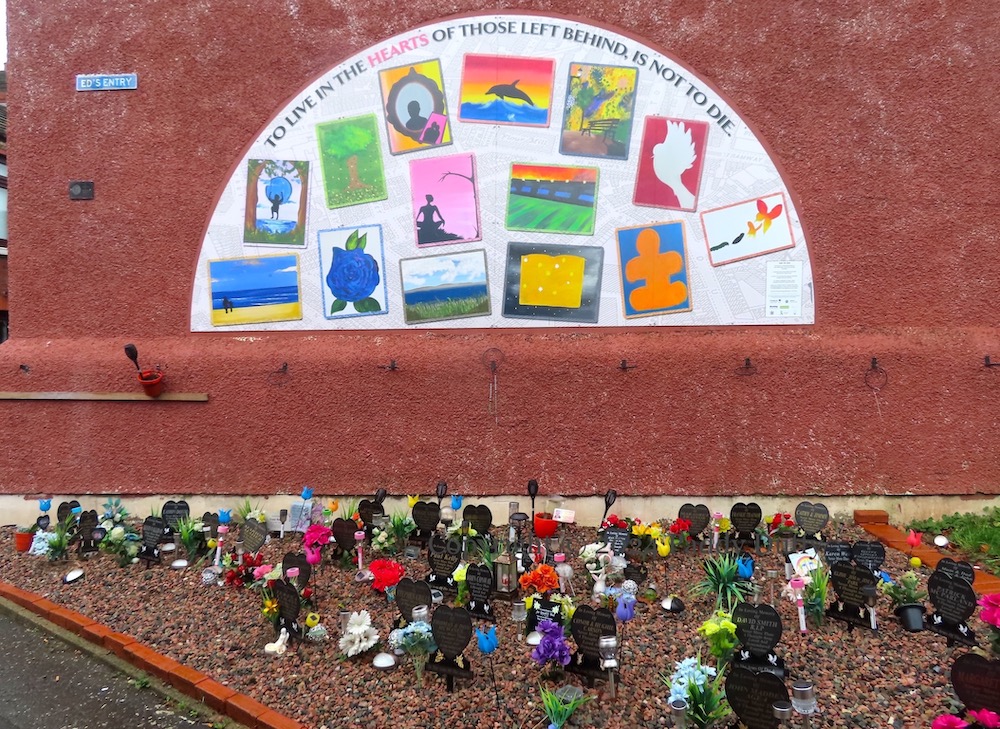
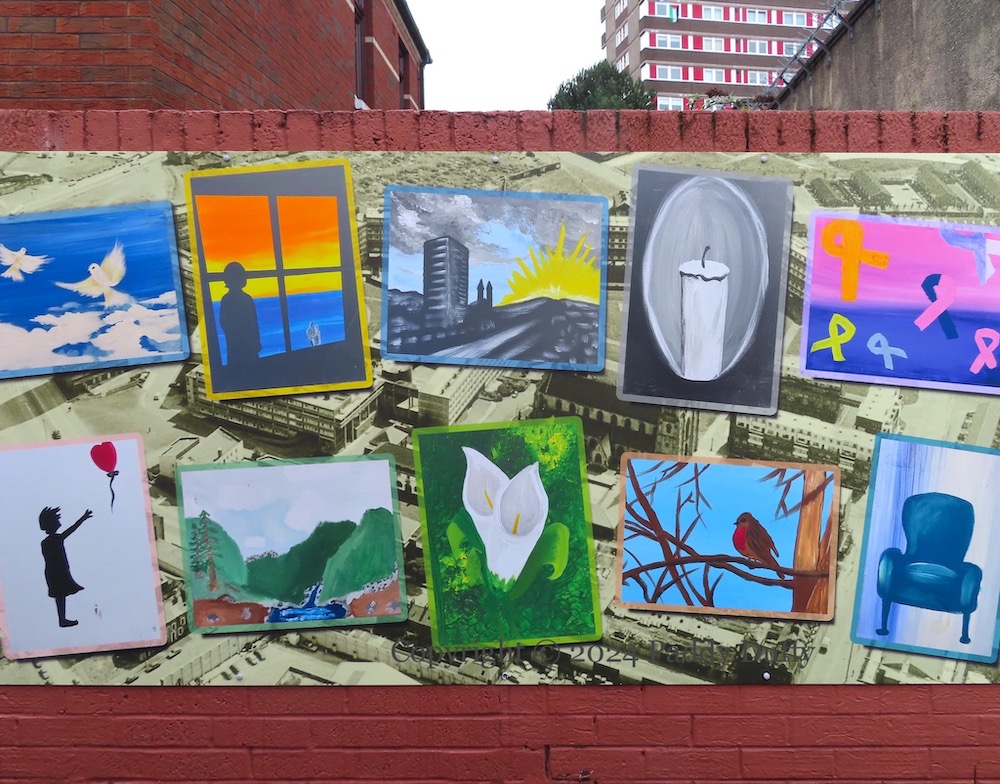
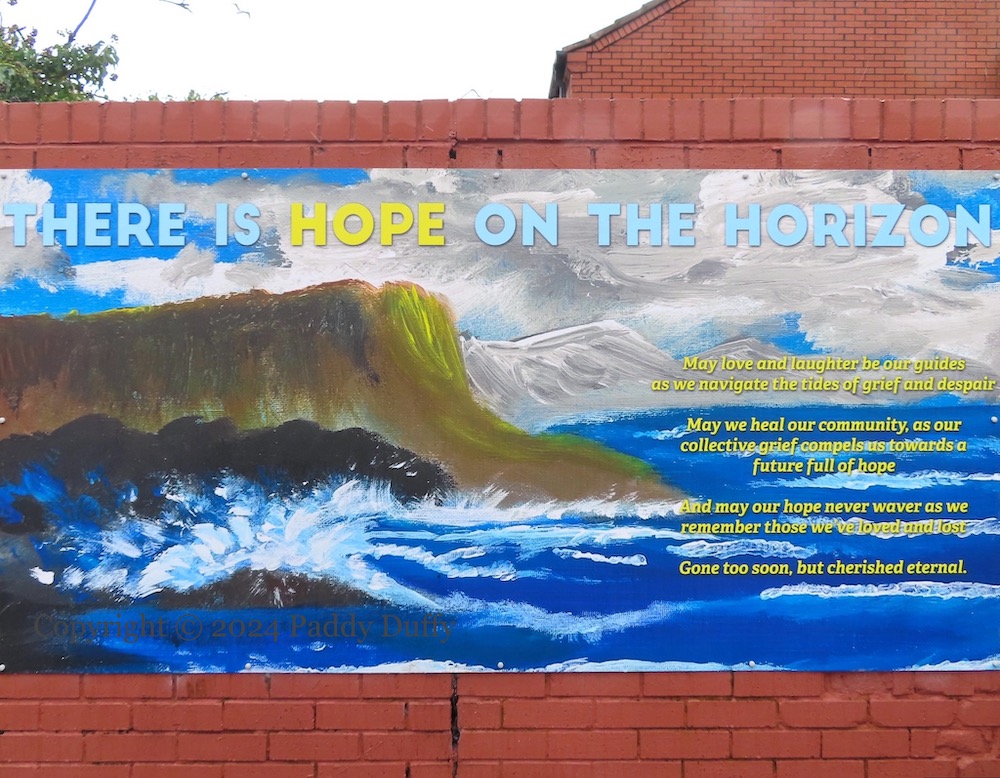
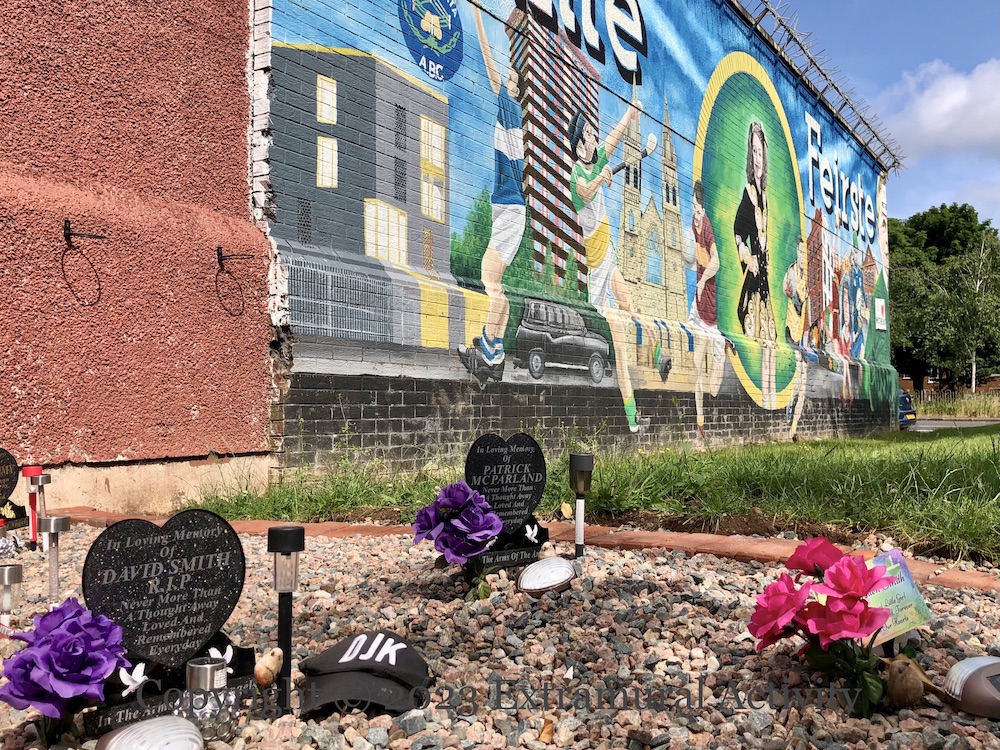
“To live in the hearts of those left behind is not to die.” Above is the main piece in a new (2022-11) memorial garden next to Fáılte Feırste Thıar dedicated to young people from the Divis area who have passed away (Belfast Media). There are two smaller pieces on the opposite wall and one next to the alley (immediately below), and together they form the space for a memorial garden. “There is hope on the horizon: May love and laughter be our guide as navigate the tides of grief and despair. … Gone too soon, but cherished eternal.”

With support from Peace IV, Belfast City Council, and the Housing Executive.

Click image to enlarge
Copyright © 2023 Paddy Duffy
T04005 [T01606] T04004 T04002 T04003
X12667 X12665 [X12666] courtesy of Extramural Activity

Tullycarnet Memorial

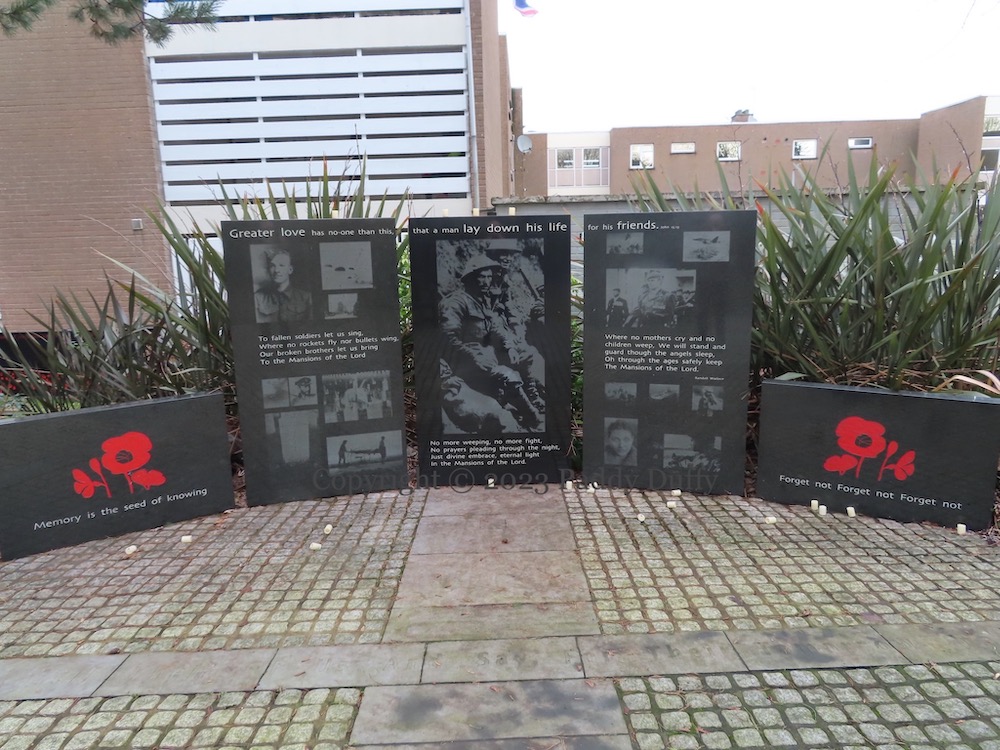
This is a three-stone memorial to army soldiers from both World Wars in Tullycarnet, featuring a line from the gospel of John (“Greater love has no-one than this, that a man lay down his life for his friends” 15:13) and a song by Randall Wallace for the 2002 movie We Were Soldiers called ‘The Mansions of the Lord’: To fallen soldiers let us sing, where no rockets fly nor bullets wing, our broken brothers let us bring, to the mansions of the Lord. No more weeping, no more fight, no prayers pleading through the night, just divine embrace, eternal light, in the mansions of the Lord. Where no mothers cry and no children weep, we will stand and guard though the angels sleep, Oh through the ages safely keep, the mansions of the Lord.”

By Ross Wilson with support from the International Fund For Ireland (IFI)

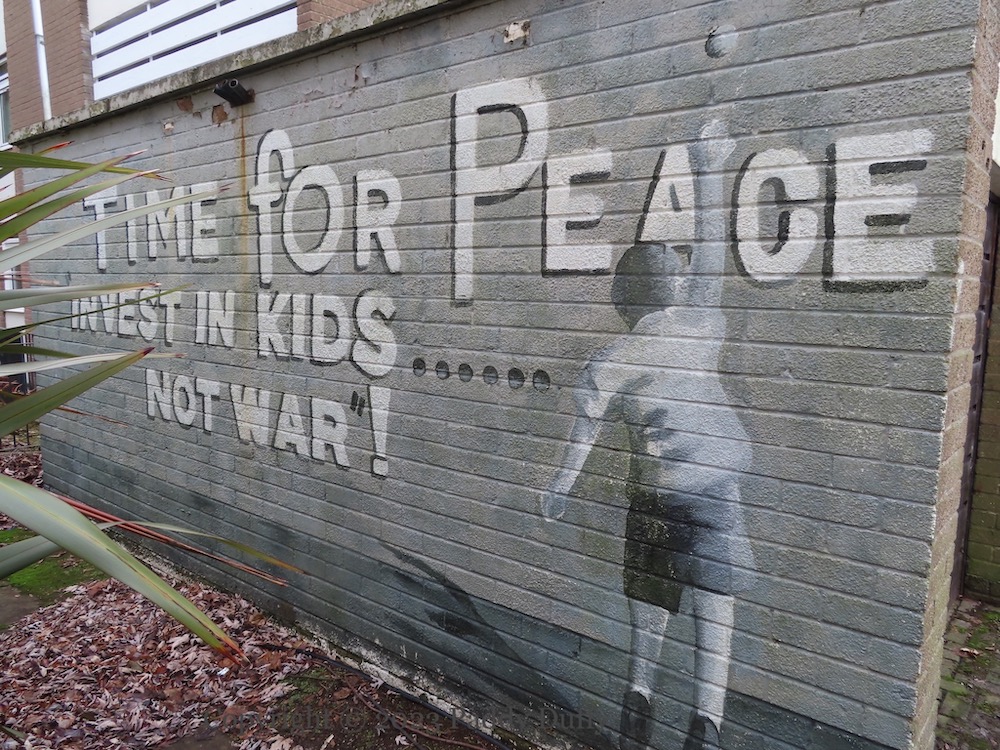
Behind the memorial is a mural reading “Time for peace – invest in kids …… not war!”

Click image to enlarge
Copyright © 2023 Paddy Duffy
T01781 [T01782] T01787

Bunscoıl Mhıc Reachtaın

Bunscoıl Mhıc Reachtaın (McCracken Primary) is an Irish-language school named after the famous Belfast family and in particular after Mary Anne McCracken, who was a campaigner in the 1800s for the education of children both male and female (among with many other causes – see previously the post on the bust of Mary Anne in Carrick Hill, opposite Clifton House: The World Affords No Enjoyment Equal To That Of Promoting The Happiness Of Others.

The bunscoil opened in 1999 in the New Lodge, before moving to its current location (and site of this mural) in Lancaster Street (Naíscoıl Mhıc Reachtaın). (Lancaster Street is itself named after the controversial Quaker educator, Joseph Lancaster (WP) – Joe Baker p. 72.) According to an Irish News report in 2020 on Irish-language schools, the bunscoıl at that time, at least, had more pupils than its approved maximum.

The school borrows from the teaching philosophy of Patrick Pearse (Belfast Media), discussed previously in connection with Coláıste Feırste in An Tusa An Chéad Laoch Eıle?

Also on the school wall is an Ed Reynolds piece from 2017: Civilisation Has Its Roots In The Soil.

Click image to enlarge
Copyright © 2022 Paddy Duffy
T01699

A Risen People

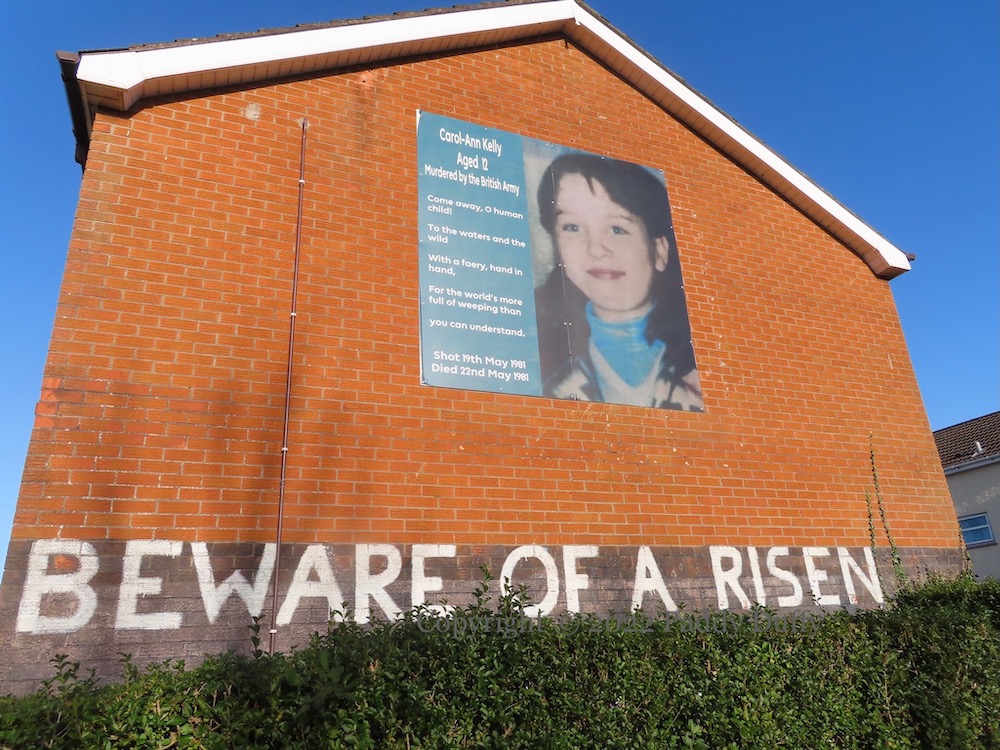
“Beware of a risen people” (or “beware the risen people”) comes from Patrick Pearse’s The Rebel: “And I say to my people’s masters: Beware/Beware of the thing that is coming, beware of the risen people/Who shall take what ye would not give.” The slogan dates back to at least 1987 on this wall (see M00511 and M00600 from 1998).

Carol Ann Kelly, aged 12, was hit by a plastic bullet fired by the Royal Fusiliers on May 19th, 1981, in Twinbrook, and died on the 22nd – one of seven people to die in the summer of 1981 (They Kill Children).

There was previously a mural to Carol Ann in Twinbrook: M01630.

Click image to enlarge
Copyright © 2022 Paddy Duffy
T01519 T01521 T01520 Come away o human child to the waters and the wild with a faery hand in hand for the world’s more full of weeping then you can understand