The Death Of Sean McCartney

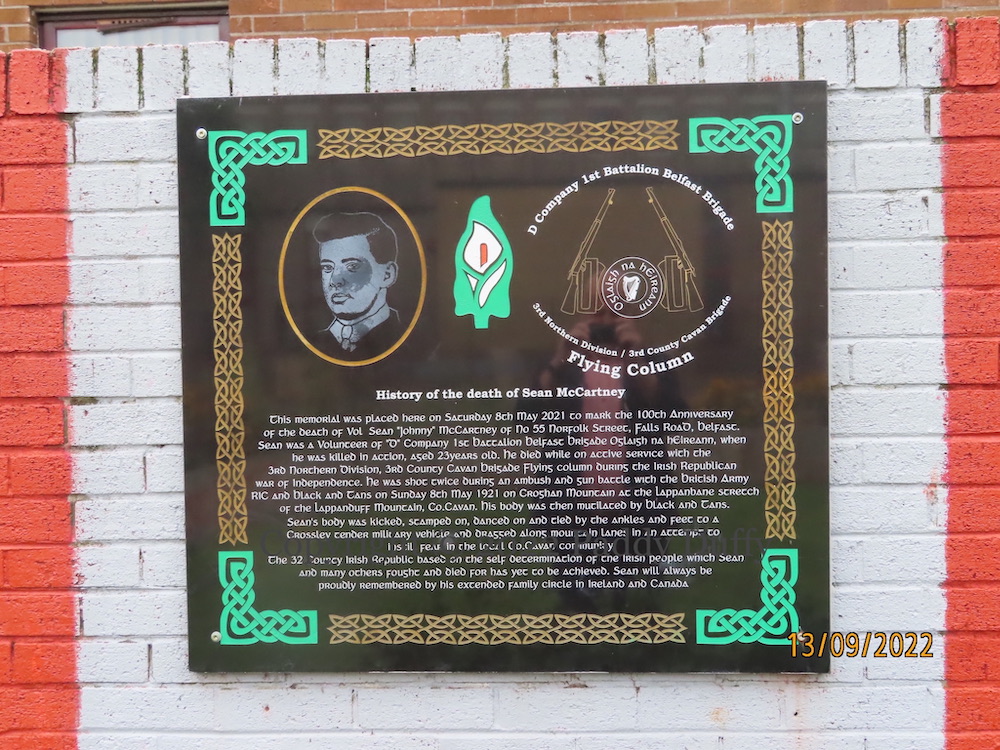
“History of the death of Sean McCartney. This memorial was placed here on Saturday 8th May 2021 to mark the 100th anniversary of the death of Vol Sean “Johnny” McCartney of no. 55 Norfolk Street, Falls Road, Belfast. Sean was a volunteer of “D” Company 1st battalion Belfast Brigade Oglaigh na hEireann, when he was killed in action, aged 23 years old. He died while on active service with the 3rd Northern Division, 3rd County Cavan Brigade flying column during the Irish Republican War of Independence. He was shot twice during an ambush and gun battle with the British Army RIC and Black and Tans on Sunday 8th May 1921 on Croghan Mountain at the Lappanbane stretch of the Lappanduff Mountain, Co. Cavan. His body was then mutilated by the Black and Tans. Sean’s body was kicked, stamped on, danced on and tied by the ankles and feet to a Crossley Tender military vehicle and dragged along mountain lanes in an attempt to instill fear in the local Co. Cavan community. The 32 county Irish republic based on the self determination of the Irish people which Sean and many others fought and died for has yet to be achieved. Sean will always be proudly remembered by his extended family circle in Ireland and Canada.” McCartney is buried in Milltown cemetery.

Click image to enlarge
Copyright © 2022 Paddy Duffy
T00848 [T00849]
We Bleed That The Nation May Live

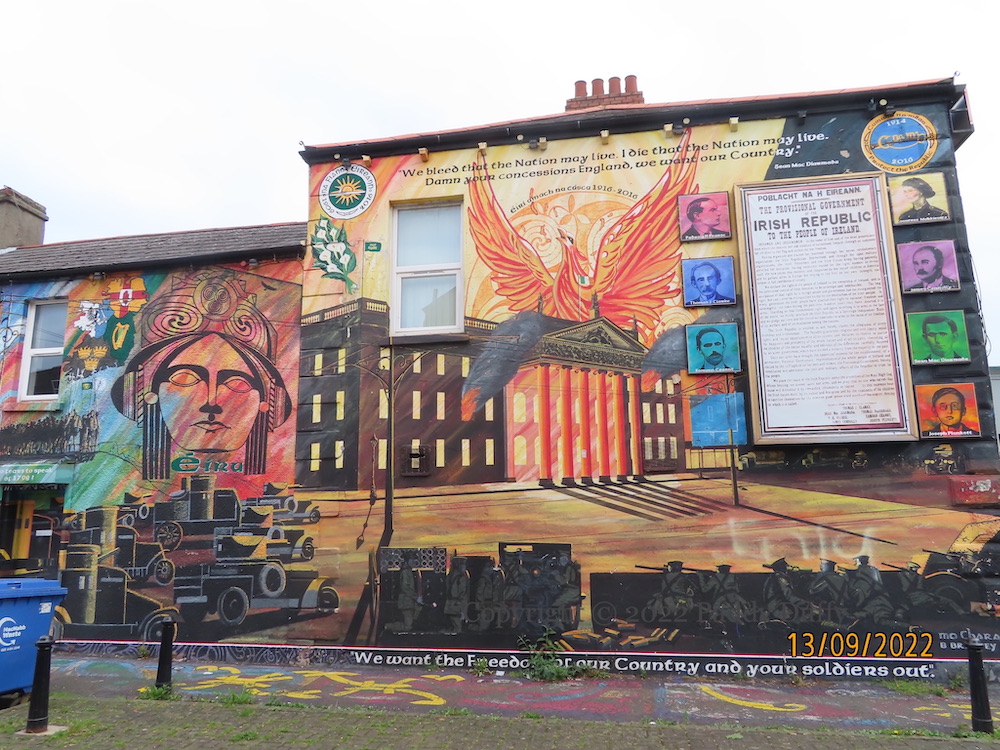
Arrayed against the forces of the British Army (which are shown in armoured cars and in sniping positions in the foreground of the mural, along the whole length of the wall) are various symbols of Irish nationalism: Oliver Sheppard‘s 1911 statue of Cú Chulaınn dying; the pikemen of the 1798 Rebellion (featured yesterday: Éırí Amach 1798); the four provinces of Ireland; Érıu the mythological queen of Ireland/Éıre as designed by Richard J King/Rísteard Ó Cíonga; Easter lilies; the emblems of Na Fıanna Éıreann and Cumann Na mBan on either side of a quote from (The Mainspring) Sean MacDiarmada “We bleed that the nation may live; I die that the nation may live. Damn your concessions, England: we want our country”; a phoenix rising from the flames of the burning Dublin GPO (inspired by Norman Teeling’s 1998 painting The GPO Burns In Dublin); the GPO flying an ‘Irish Republic’ flag; portraits of signatories and other rebels — (left) Padraig H. Pearse, Thomas J Clarke, Eamonn Ceannt, Thomas MacDonagh, (right) Countess Markievicz, James Connolly, Sean MacDiarmada, Thomas Plunkett; the declaration of independence, placed over the advertising box of AA Accountants – see the in-progress shot below. For more work-in-progess images, see yesterday’s post, Éırí Amach 1798. At the very bottom is a quote from the mother of Gerard ‘Mo Chara’ Kelly, Harriet Kelly: “We want the freedom of our country and your soldiers out.”

McQuillan Street, west Belfast

Click image to enlarge
Copyright © 2022 Paddy Duffy
T00821 [T00822] T00823

Live Free!

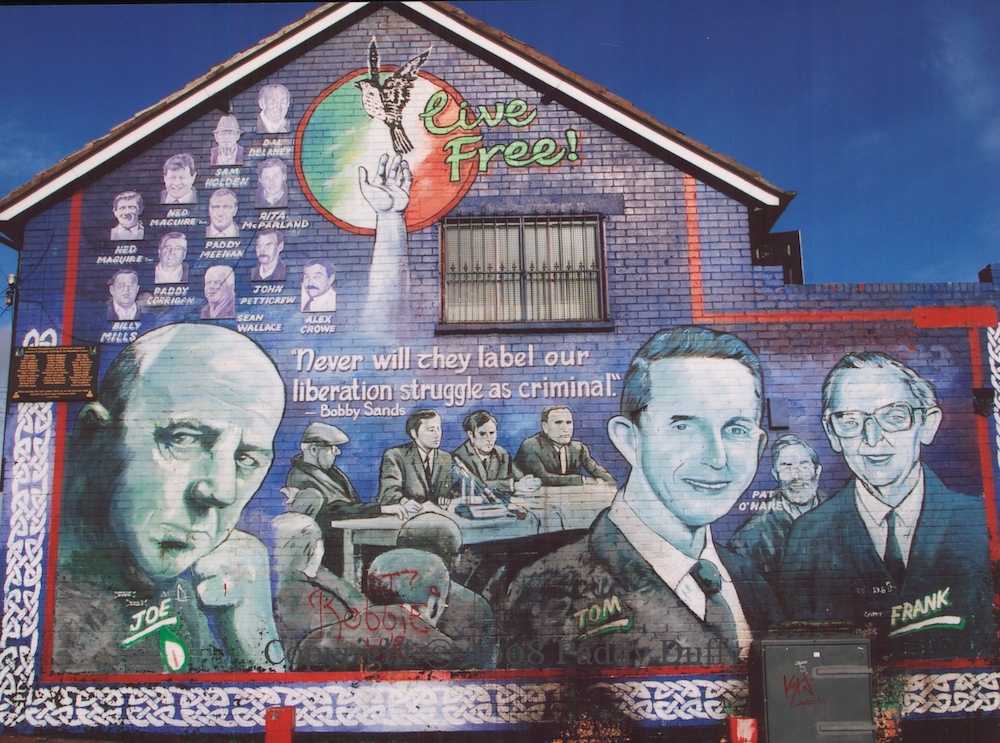
“Never will they label our struggle as criminal – Bobby Sands.” [March 6th Diary]

Joe Cahill joined Na Fıanna in 1937 and was involved in the republican movement from then until his death in 2004, including being in Tom Williams’s company in 1942 and later a founder member and Chief of Staff of the Provisional IRA. In the centre of the image he is at the end of the table at the August 13, 1971, press conference to comment on the introduction of internment (CAIN). He is honoured in the mural above alongside his brothers Tom and Frank Cahill. (Pat O’Hare is painted between Tom and Frank.)

In the top left are small boards with portraits of Ned Maguire Snr, Ned Maguire Jnr, Sam Holden, Dal Delaney, Rita McParland, Paddy Meenan, Paddy Corrigan, Sean Wallace, John Petticrew, Alex Crowe.

For a close-up of the plaque, see the Peter Moloney Collection.

Beechview Park, west Belfast

Click image to enlarge
Copyright © 2008 Paddy Duffy
T00387

H-Block/Armagh

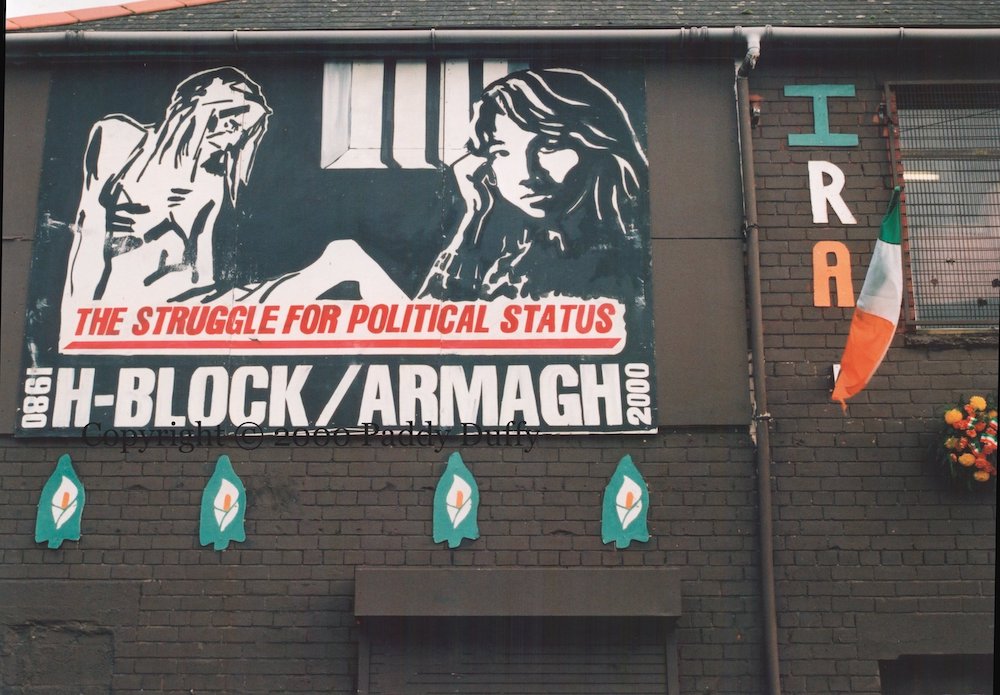
“The struggle for political status.” The twentieth anniversary of the hunger-strikes in Long Kesh and Armagh Women’s prison, 1980-2000, is commemorated. Seven men in Long Kesh and three women in Armagh went on strike, for fifty-three days and nineteen days, respectively.

The lilies are held over from the previous year – see The Final Salute.

Beechmount Avenue, west Belfast

Click image to enlarge
Copyright © 2000 Paddy Duffy (no date given)
T00338

The Final Salute

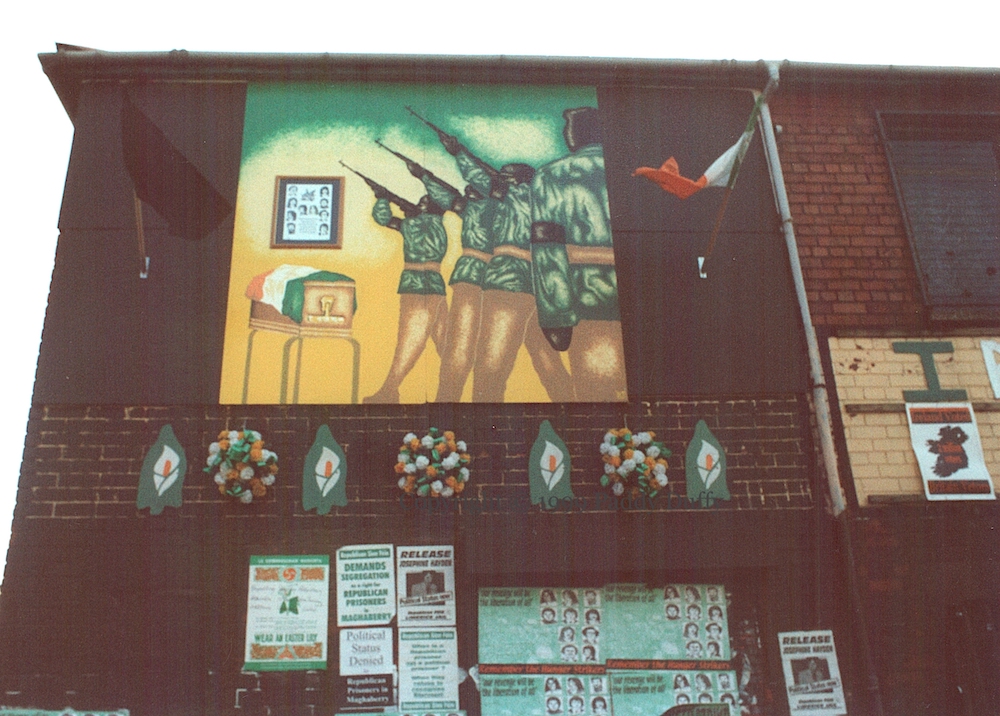
This is a display to republican dead, with a black flag, Easter lilies, and (on the main board) a funeral volley being fired over a coffin draped in a Tricolour, with a printed poster of the ten deceased 1981 hunger-strikers. The board was later moved to Clowney Street.

Among the posters below we see “Release Josephine Hayden”. Hayden was General Secretary of Republican Sınn Féın when she was sentenced to six years in jail in 1996 for weapons’ possession. She would be released in 2000. (Irish Times)

Beechmount Avenue, west Belfast

Click image to enlarge
Copyright © 1999 Paddy Duffy
T00421c

Free Ireland

Manacles “Made in Britain” constrain the republican desire for a united Ireland, contrary to the burning GPO and rising phoenix.

“Numerous foreign groups and delegations visited Ballymurphy and west Belfast during the troubles. I remember one meeting I was at in Conway Mill, I picked up a pamphlet with a drawing of a manacled fist. The caption read “Made in the USA.” So I just took the image and changed the slogan to “Made in Britain”.” (Painting My Community/An Pobal A Phéınteáıl – English-language version available for free)

The plaque – which pre-dates this mural – is to local (A Company 2nd Battalion) IRA volunteers Stan Carberry, Frankie Dodds, Paul Fox, Sean Bailey, Paul Marlowe, and Tony Campbell. “Fuaır sıad bás ar son na hÉıreann”, “Ireland unfree will never be at peace”. (See the Peter Moloney Collection.)

Painted by Mo Chara Kelly in Beechmount Avenue/RPG Avenue.

Click image to enlarge
Copyright © 1990 Paddy Duffy
T00097 T00098

Ireland First, Ireland Last, And Ireland Over All

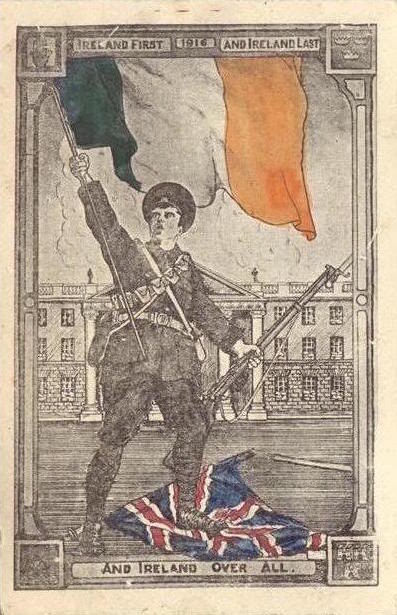
A revolutionary soldier raises the Irish Tricolour while trampling on a Union Flag on a broken mast that was perhaps attached to the poorly drawn GPO in the background. The card on which the image is based can be seen below.

On the right hand side are the Easter lily and halberds/pikes and an assault rifle, indicating the historical roots and present-day inheritors of the 1916 revolt.

Click image to enlarge
Copyright © 1990 Paddy Duffy
T00094

Rí Nuadha ⁊ Loch gCál

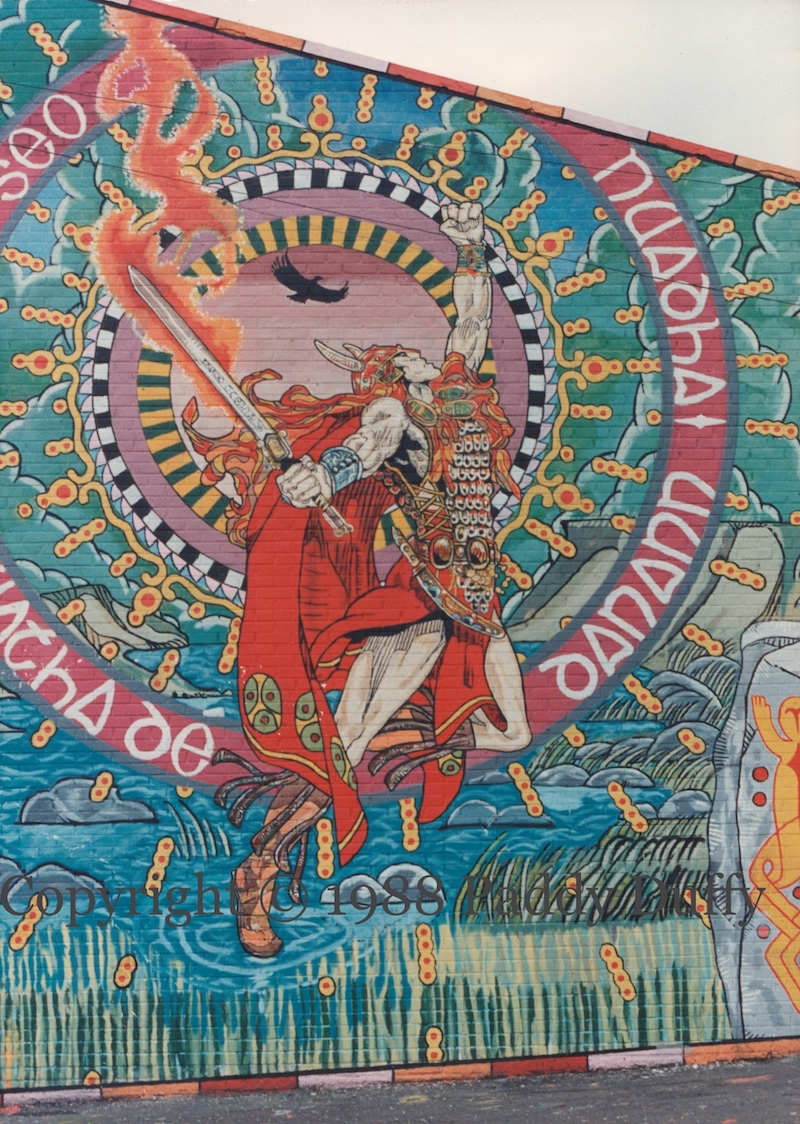
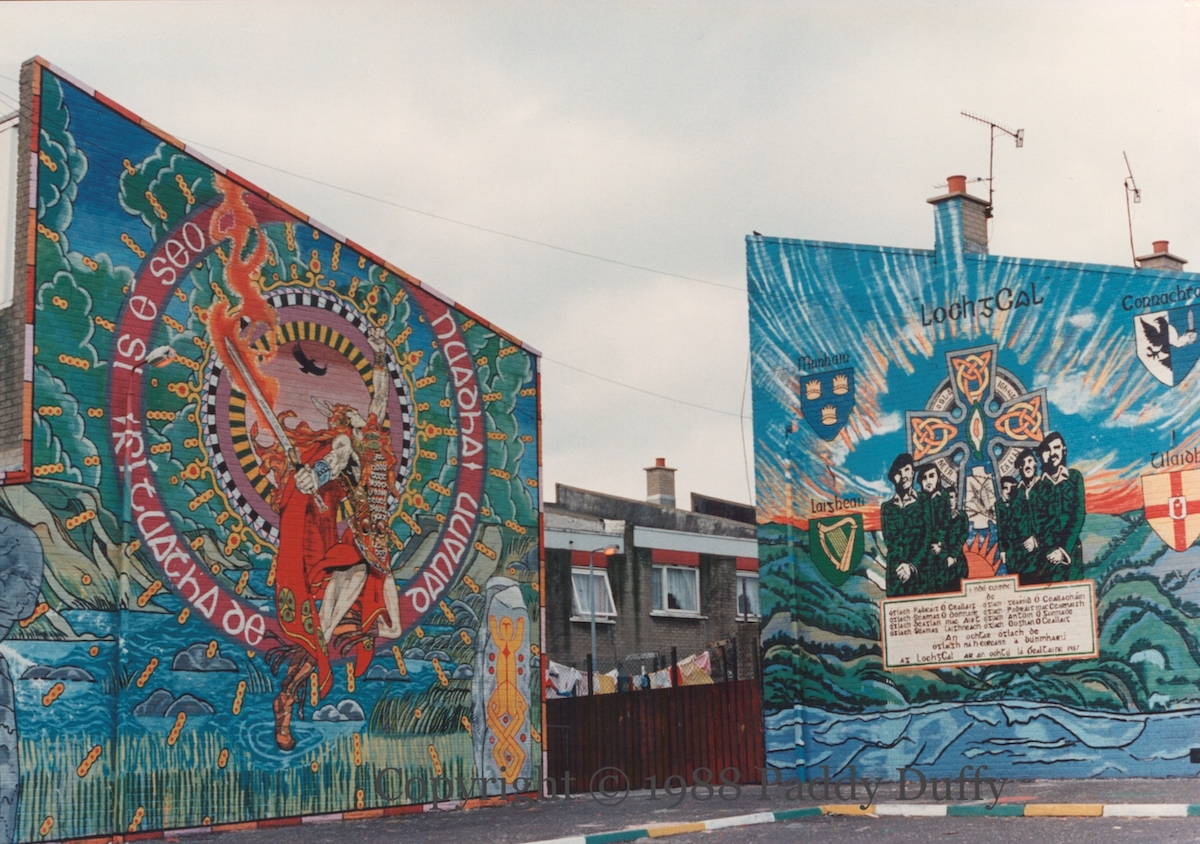
This pair of murals was painted by Mo Chara Kelly at the top of Springhill in 1987 after his release from prison. Both are inspired by the work of Jim Fitzpatrick. The central figure of the Rí Nuadha [King Nuada] mural above and immediately below comes from a painting of Fitzpatrick‘s called ‘Nuada Journeys To The Underworld’ while the background has a Fitzpatrick style and colour-scheme.

Of the myth of Nuada, Mo Chara said, “I had never heard the story of King Nuada before. Then I read the story. Wow! What a yarn! Nuada Of The Silver Arm is one of my favourite stories. As one of the Tuatha Dé Danann you had to be whole and physically perfect to hold the kingship. Nuada lost an arm in the first battle of Moy Tura and so he lost his kingship. He went into the other world, to middle earth, fought through trials and tribulations until Dıan Cécht made a silver arm for Nuada and he was restored to the kingship for another twenty years. But the moral of the story to me was that, no matter what happens, get up again and fight back. No matter how bad the situation you are in, you get back up and fight again. Do not let people isolate you. Get up and fight again. It was very inspiring!” (Painting My Community/An Pobal A Phéınteáıl – English-language version available for free.)

The Loch gCál/Loughgall mural likewise draws on Fitzpatrick for the landscape behind the Celtic cross and funeral guard in memory of the eight IRA volunteers from the East Tyrone brigade who were killed in an SAS ambush during an attack on an RUC base in May, 1987 (WP).

The names of the eight volunteers are given here in Irish and (partially) in the old script:

“I ndıl cuimh[n]e de [= ar]
Óglach Pádraıg Ó Ceallaıġ [Patrick Kelly],
Óglach Séamus Ó Donn[ġ]aıle [Seamus Donnelly],
Óglach Deaglán Mac Aırt [Declan Arthurs],
Óglach Séamus Laıghneach [Jim Lynagh],
Óglach Gearóıd Ó Ceallacháın [Gerry O’Callaghan],
Óglach Pádraıg Mac Cearnaıgh [Pádraıg McKearney],
Óglach Antóın Ó Garmaıle [Ó Gormghaıle | Tony Gormley],
Óglach Eoghan Ó Ceallaıġ [Eugene Kelly]

an ochtar óglach de óglaigh na hÉireann a dúnmharú ag Loch gCál ar an ochtú lá Bealtaine 1987.”
[the eight volunteers from the Irish Volunteers [IRA] who were murdered at Loughgall on the eighth day of May, 1987]

The town (Loughgall) and the four provinces are also named in Irish. An Easter lily is at the centre of the Celtic cross in the middle of the image, above a lark in barbed wire and a gal gréıne/sunburst.

Click image to enlarge
Copyright © 1988 Paddy Duffy
T00073 T00066 [T00074] T00075 T00065