“In loving memory South Belfast Brigadier John McMichael, South Belfast UFF commander Joe Bratty.” Listed on the tombstones are Steven Audley 17 Mar 91, Harry Black 30 Sep 92, Jim Kenna 25 Jul 72, Frankie Smith 31 Jan 73, William Kingsberry 13 Nov 91, Stephen Kingsberry 10 Mar 97, Ernie Dowds 10 Oct 95, Sammy Hunt 5 Sep 76, Raymie Elder 31 Jul 94, William Hamilton 9 Sep 94, Tommy Morgan 29 Aug 94.
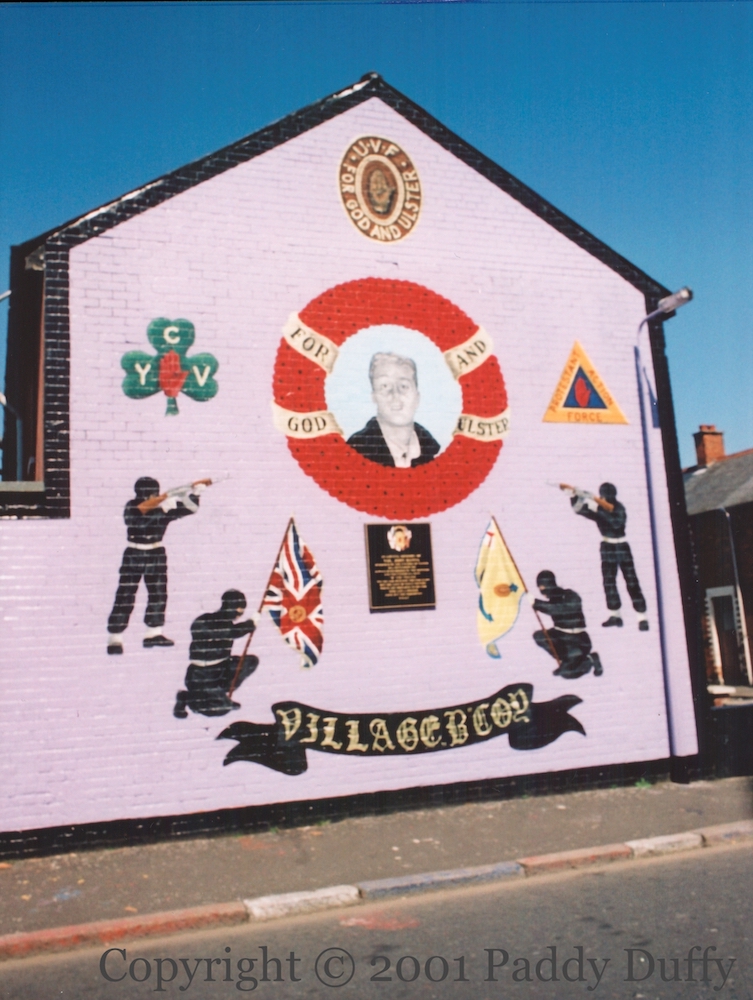
UVF volunteer John Hanna was 19 years old when he was killed by “the enemies of Ulster” (the IRA) at his home on Donegall Road in the Village. The kneeling volunteer on the left carries a WWI regimental flag, connecting the modern UVF to the Ulster Volunteers.
The plaque at the centre of the mural reads, “In loving memory of Vol. John Hanna, murdered by the enemies of Ulster 10th September 1991. Always remembered by the offices and volunteers of 2nd Batt. “B” Coy Village. Its [sic] not for riches nor for glory but the love of one’s country which [we] are prepared to die for. Here lies a soldier. Gone but not forgotten. FGAU.”
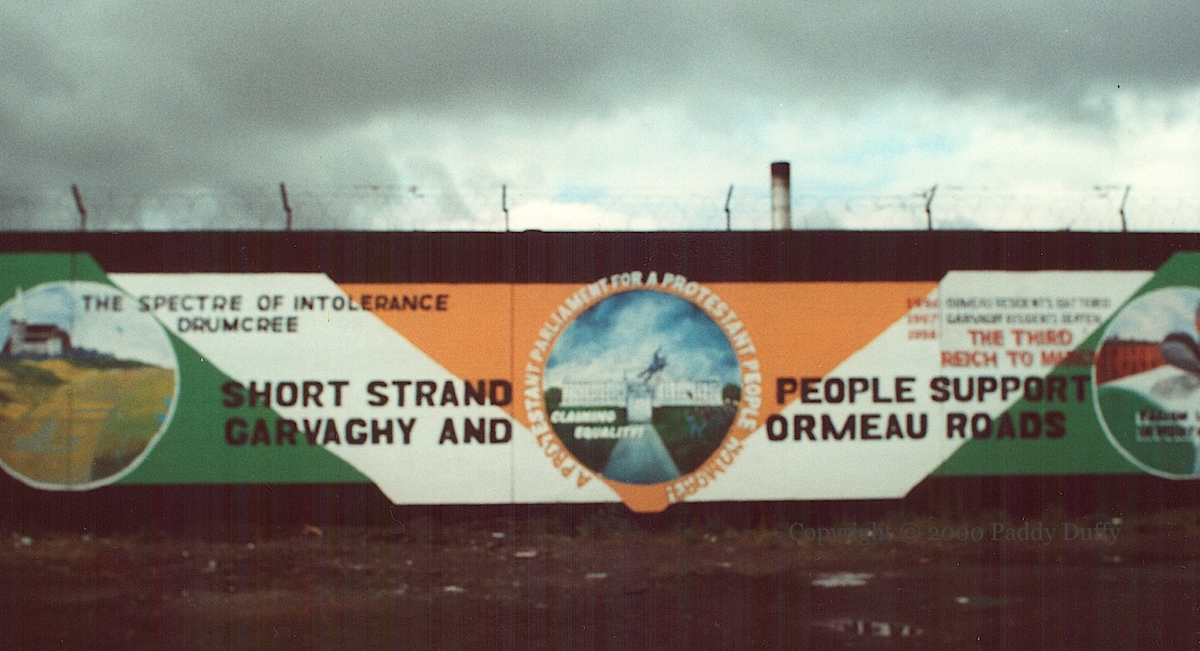
Northern Ireland’s first Prime Minister, James Craig, said in 1934, that Stormont was “carrying on a Protestant Government for a Protestant People” (NI Parliamentary Debates), though the phrase has now been transformed into the doubly alliterative “A Protestant parliament for a Protestant people”. In the centre of a long mural at the waste-ground at the top of Mountpottinger Road, people carrying Irish Tricolours tear down the statue to Northern Ireland’s most prominent leader, Sir Edward Carson, that stands outside Stormont, “claiming equality”.
The main issue that has tested the resolve of governments both local and national to the equality declared in the 1998 Belfast (Good Friday) Agreement is Orange Order parading through nationalist areas, such as the Garvaghy Road below Drumcree church in Portadown, and the Ormeau Road in south Belfast.
“Short Strand people support Garvaghy and Ormeau Roads.” On the left: The spectre of intolerance – Drumcree.” Centre: “A Protestant parliament for a Protestant people no more!” On the right “1996: Ormeau residents battered; 1997: Garvaghy residents beaten; 1998: The third reich to march.” and “Fascism lives! in Portadown”.
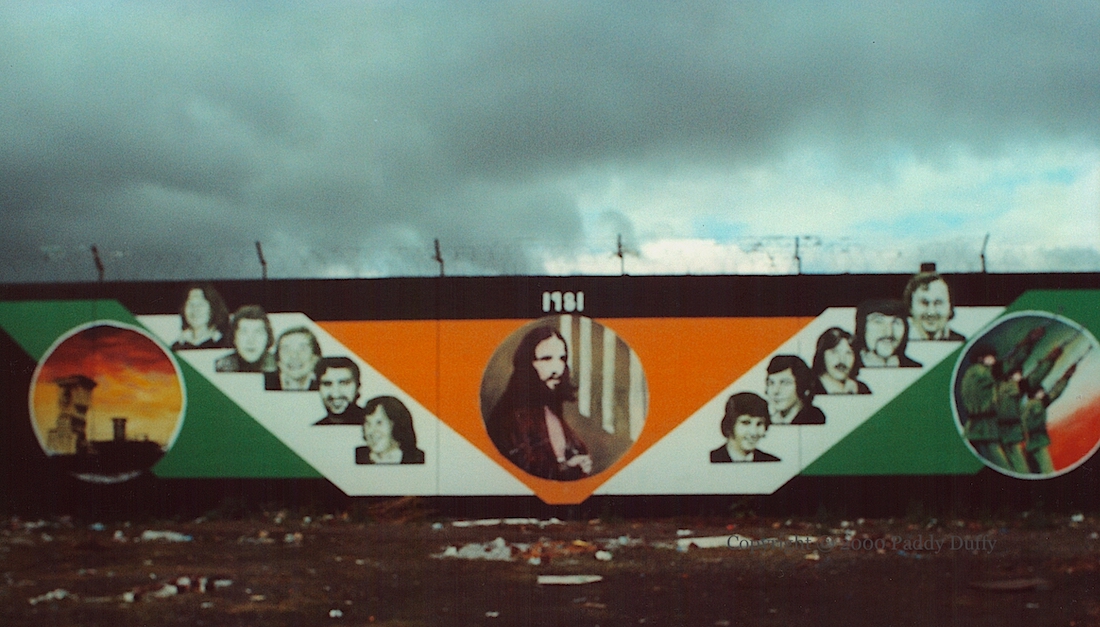
The piece is next to a hunger-strikers commemoration piece with ten portraits on shaped wooden boards against a painted background with blanket-man Hugh Rooney in the center. Between the two is a “spirit of freedom” lark and the names of the ten deceased 1981 strikers.
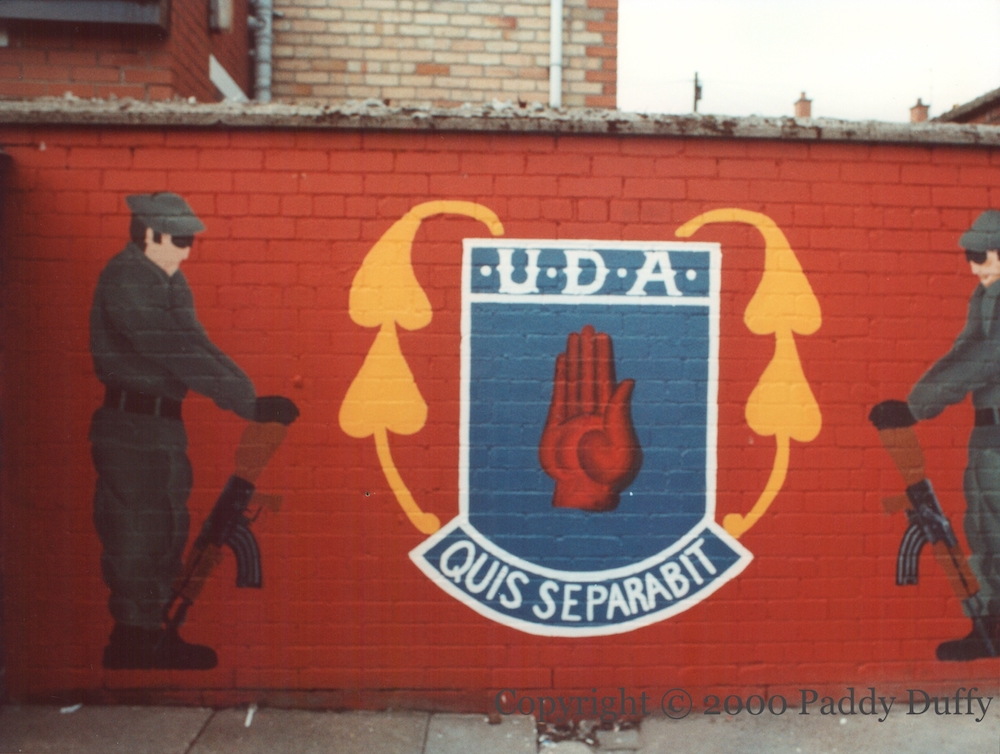
The Woodvale Defence Association (WDA) was the largest of the local associations which merged together in 1971 to form the Ulster Defence Association (UDA) and the WDA became B company of 2nd battalion (WP).
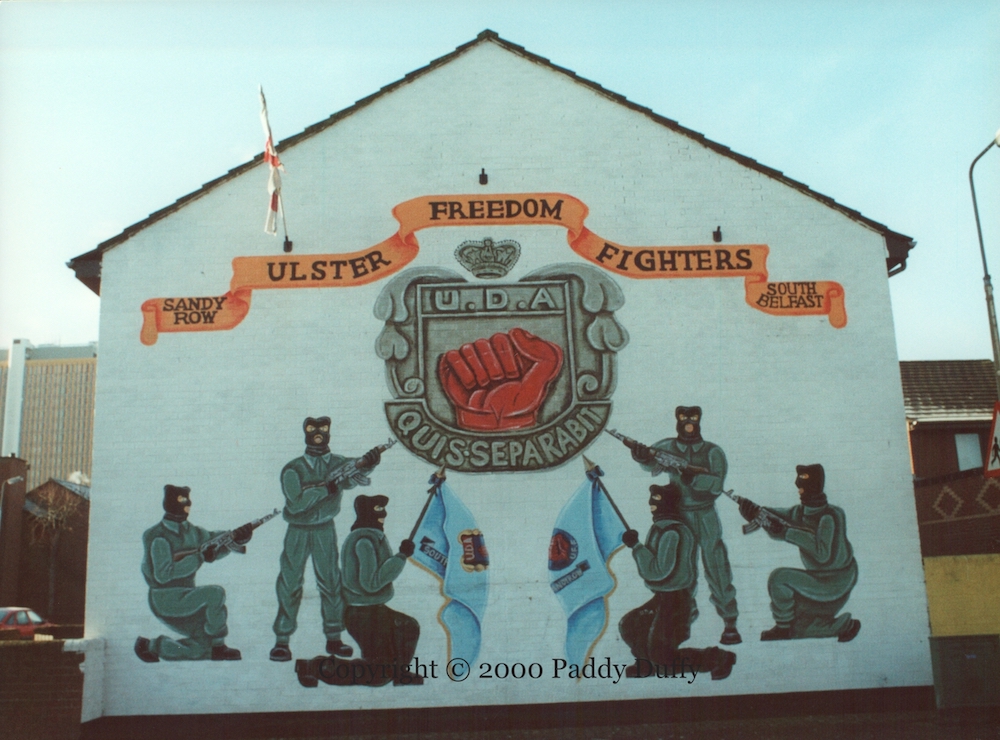
Both pieces are in Heather Street, Woodvale, west Belfast. Between the two are the words “Ulster Freedom Fighters” in large letters – see D00967.
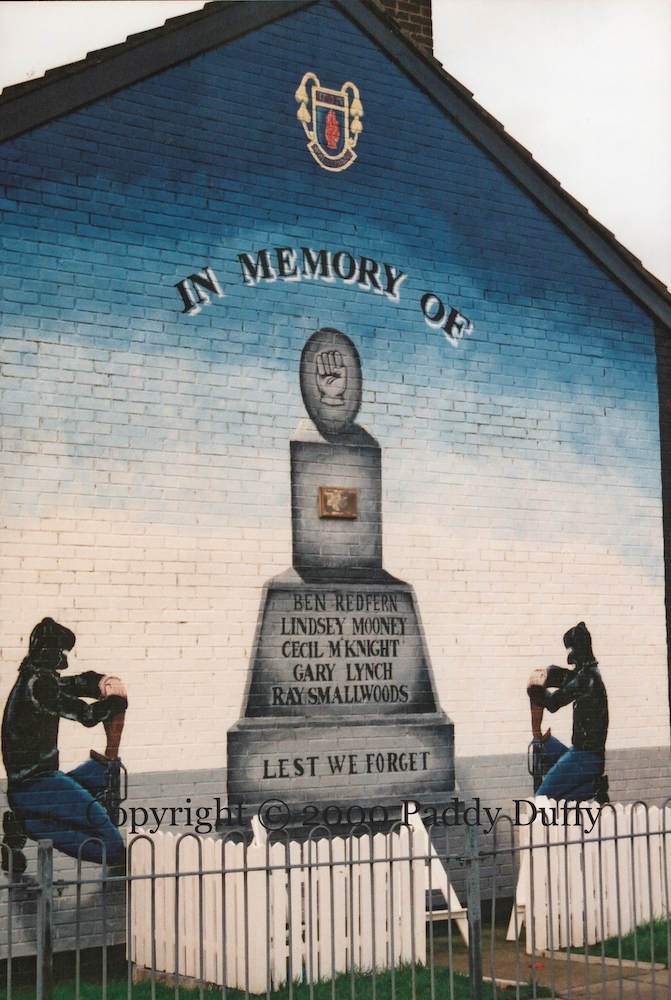
“In memory of Ben Redfern, Lindsay Mooney, Cecil McKnight, Gary Lynch, Ray Smallwoods, William Campbell. Lest we forget.” For Redfern and Lynch, see It’s Still Only Thursday; Smallwoods has a WP page; Campbell died in 2002 in a premature pipe-bomb explosion (Guardian).
“Free our prisoners o[f] w[ar]”, specifically prisoners from the South Belfast UFF/UDA. This pair of smaller murals is in the garden next to St Alban’s, and the gable mural is across the road.
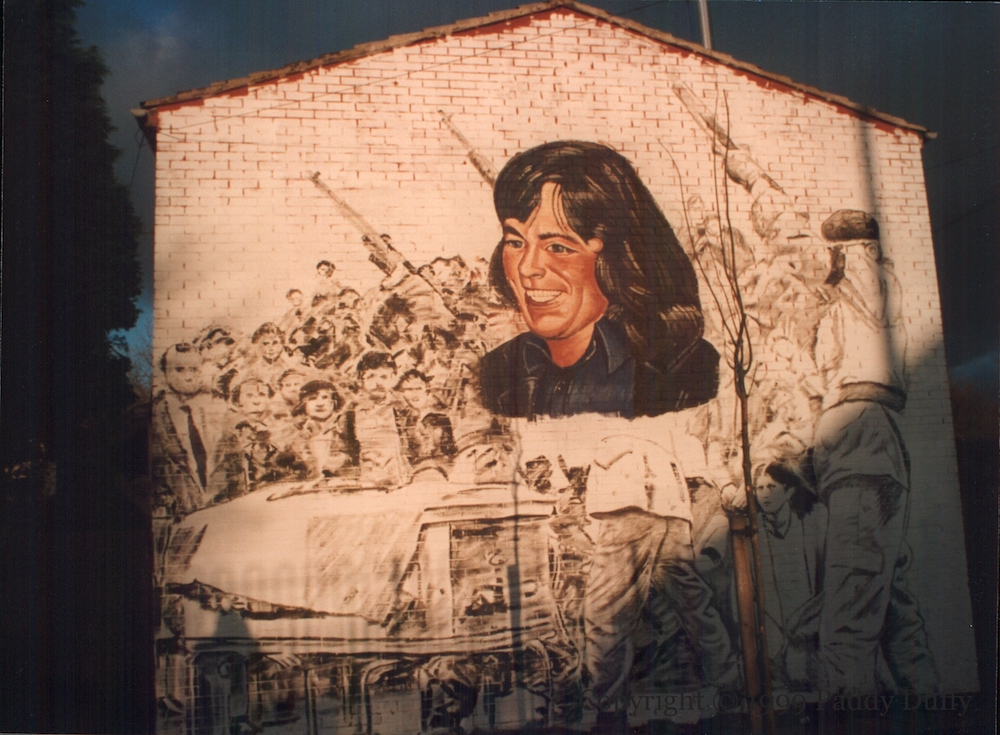
The IRA’s Joe McDonnell was the fifth of the 1981 hunger-strikers to die, on July 8th, after 61 days. McDonnell’s portrait is superimposed upon a sketch of a photograph of the funeral volley fired while his coffin was en route to Milltown cemetery (An Phoblacht).
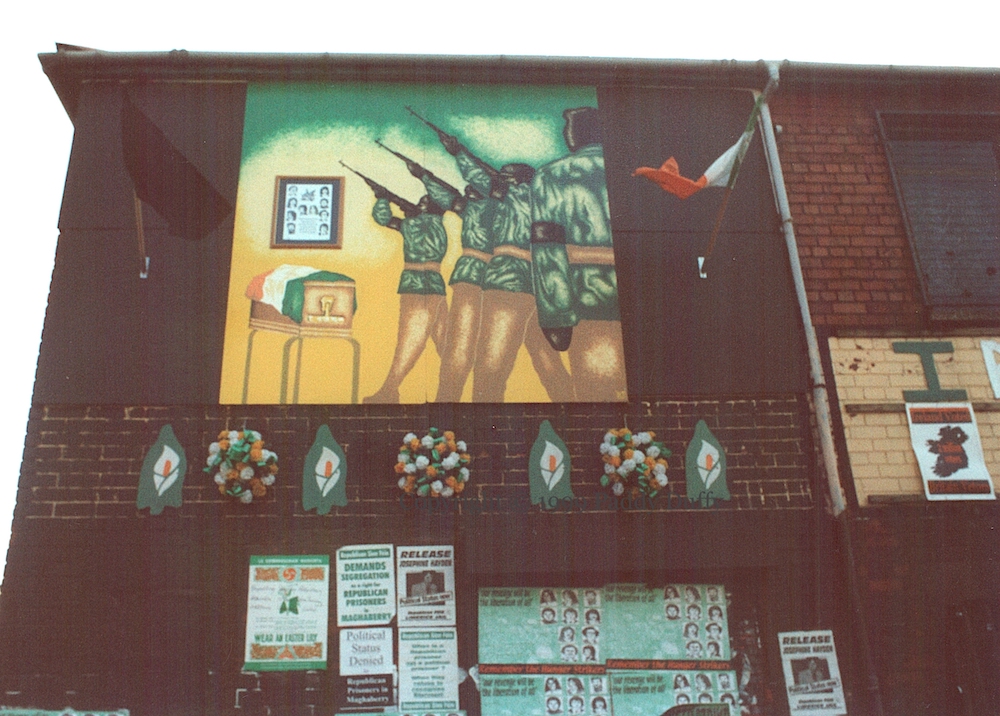
This is a display to republican dead, with a black flag, Easter lilies, and (on the main board) a funeral volley being fired over a coffin draped in a Tricolour, with a printed poster of the ten deceased 1981 hunger-strikers. The board was later moved to Clowney Street.
Among the posters below we see “Release Josephine Hayden”. Hayden was General Secretary of Republican Sınn Féın when she was sentenced to six years in jail in 1996 for weapons’ possession. She would be released in 2000. (Irish Times)
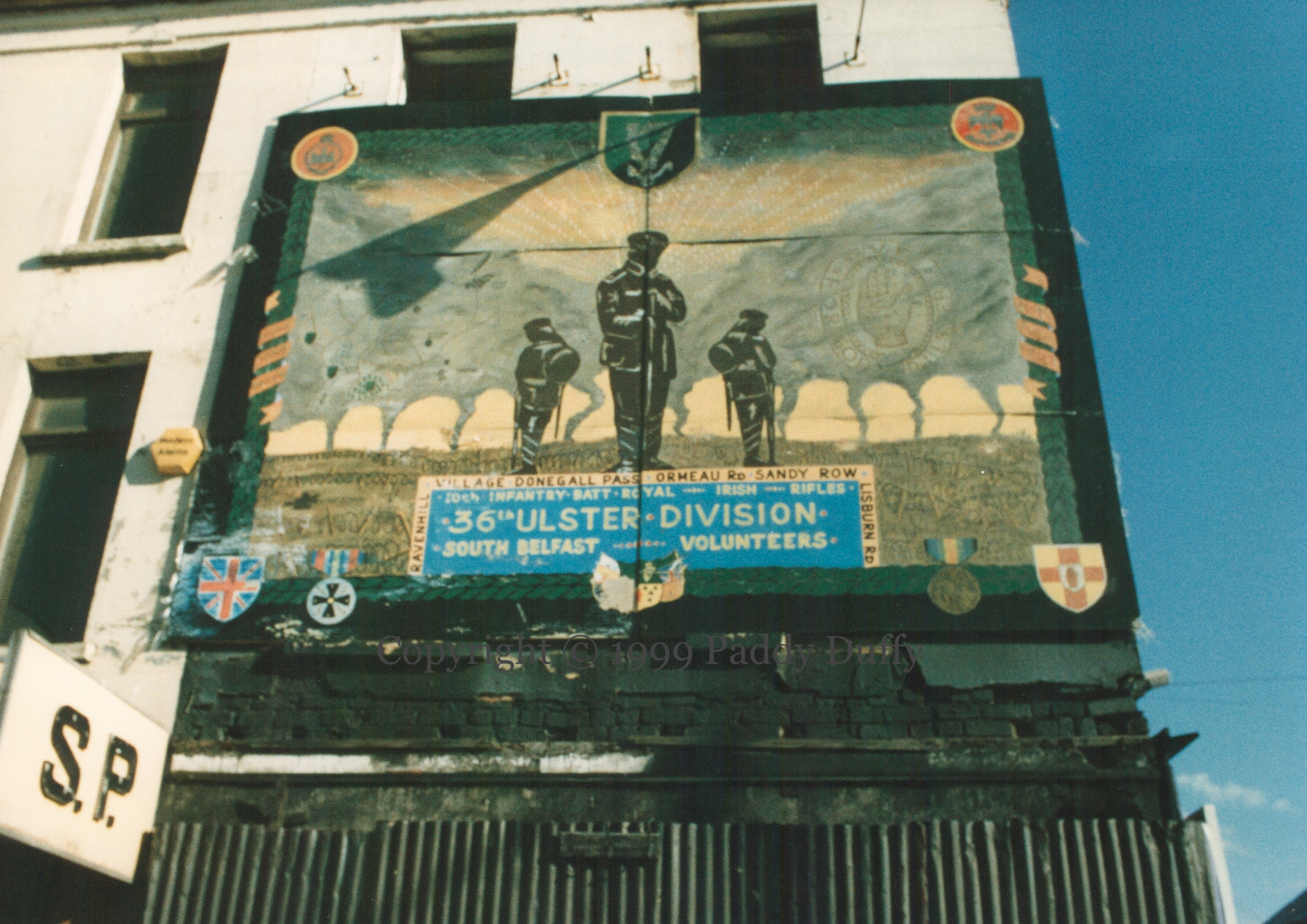
Along the top are the emblems of the Royal Inniskilling (27th) Fusiliers (featuring Crom castle), Royal Irish Rifles (featuring the Maid Of Erin harp), Royal Irish Fusiliers (featuring the barossa eagle).
Wrapped around the left column are “Ballykinler, Finner, Clandeboye” – three of the training camps of the 36th. Wrapped around the right column is “Lest we forget”.
The central text reads: “Ravenhill – Village – Donegall Pass – Ormeau Rd – Sandy Row – Lisburn Rd. 10th infantry battalion Royal Irish Rifles, 36th (Ulster) Division, South Belfast Volunteers”
The Union Flag appears in the lower left, next to an unidentified medal, while the flag of Ulster (rather than Northern Ireland, which did not yet exist) appears in the lower right, next to a Victory medal. (In a previous version of this painting, the Union Flag was a VC and the medal was a Distinguished Conduct Medal.) Between them is the emblem of the 36th Division.
The main image shows three graveside mourners standing in a field of barbed wire and in front of ?mis-shapen tombstones?, all against a background of sunrise over a mountain on which have been superimposed (left) a map of the Somme and (right) a large UVF emblem.
Painted by Ron McMurry on boards. Donegall Pass, south Belfast
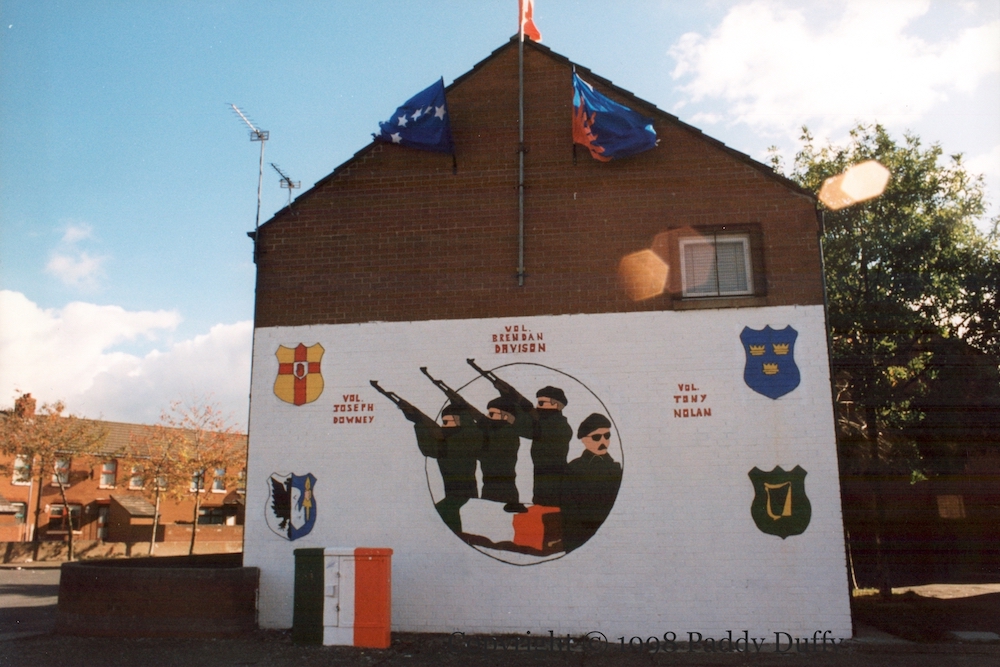
A funeral volley is fired in honour three IRA volunteers, Joseph Downey, Brendan Davison, and Tony Nolan. All three were from the Markets area.
Downey’s death is variously attributed to either side in a gun-battle between the British Army and IRA, but the most detailed account (by PaperTrail) says Downey was shot by a loyalist (UVF) gang on the night of Bloody Friday.
Davison was shot by the UVF at his Friendly Way home in 1988 (RTÉ video).
Nolan was accidentally shot in 1971 when a gun being loaded by a colleague went off (Lost Lives 208).







 Paddy Duffy Collection