“Vol. Brendan Burns, Vol. Brendan Moley, 29 February 1988.” Burns and Moley died “on active service”, meaning the premature explosion of a bomb they were loading into a van (RTÉ video | Sutton | RN). There is a plaque at the spot at which the pair was killed, on the nearby Donaldson’s Road – see M08795. Burns was wanted in connection with the Narrow Water ambush of 1979 (UPI).
“You were being oppressed by the political and military might of the foreign invader. We tried to protect you, we gave you the best that we could, but our time ran out, before the battle was won. Now it’s time for you to give the best you can. Stand together with your comrades we sadly left behind. Be proud to carry on the struggle for the freedom of our land.”
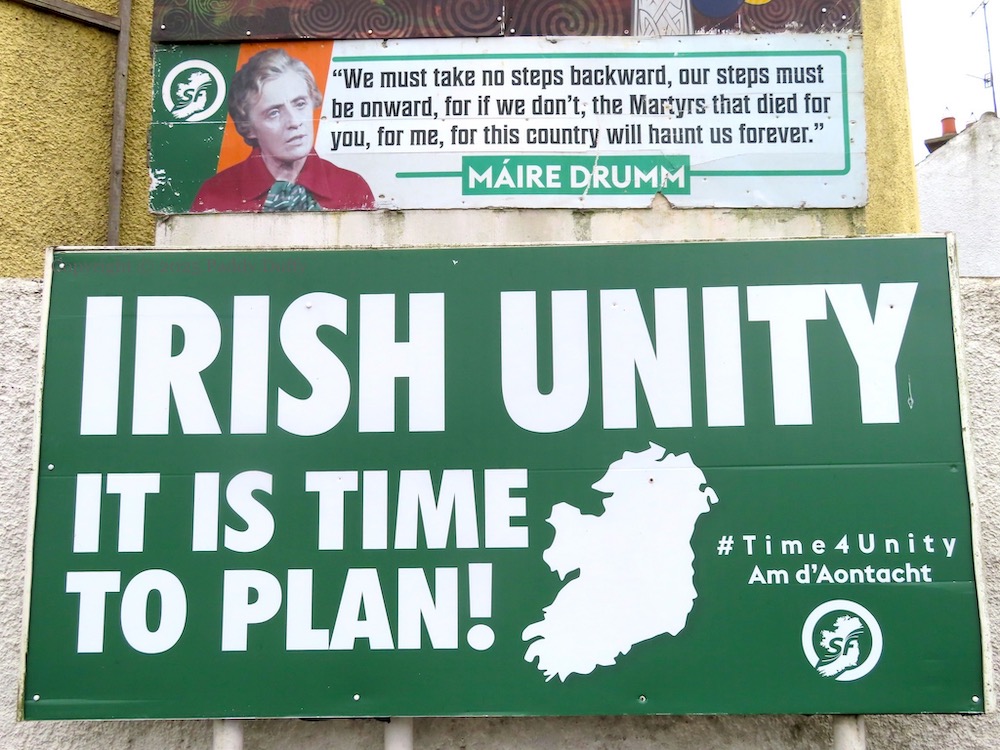
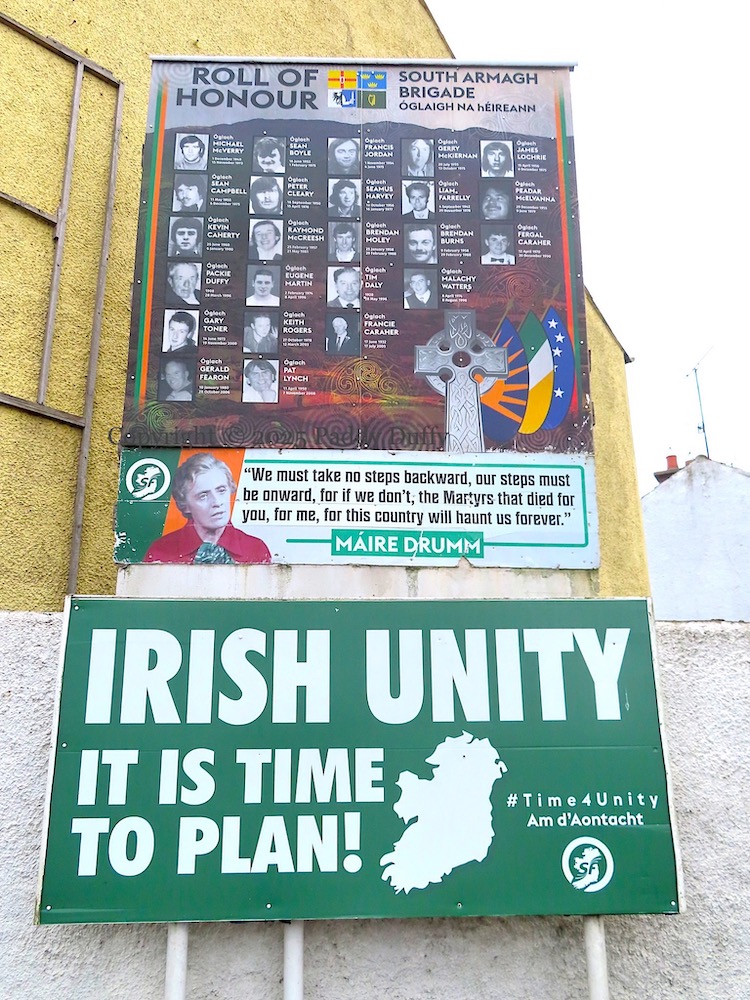
“We must take no steps backward, our steps must [or: will] be onward, for if we don’t, the [ghosts of the] martyrs that died for you, for me, for this country will haunt us forever [or: for eternity].” The words of Máıre Drumm (from an anti-internment rally in Dunville Park on 10th August, 1975 – RN p. 4) appear below a roll of honour for the IRA’s South Armagh Brigade. The list of volunteers is included below; in 1976 Drumm herself was shot dead in her bed by the RHC in the Mater hospital where she was a patient (WP) – she was Vice President of Sınn Féın at the time.
Michael McVerry, Sean Boyle, Francis Jordan, Gerry McKiernan, James Lochrie, Sean Campbell, Peter Cleary, Seamus Harvey, Liam Farrelly, Peadar McElvanna, Kevin Caherty, Raymond McCrees, Brendan Moley, Brendan Burns, Fergal Caraher, Packie Duffy, Eugene Martin, Tim Daly, Malachy Watters, Gary Toner, Keith Rogers, Francie Caraher, Gerald Fearon, Pat Lynch
Twelve more of the martyrs – the Troubles-era hunger-strikes – are on the stone across the street (for a close-up, see the Peter Moloney Collection).
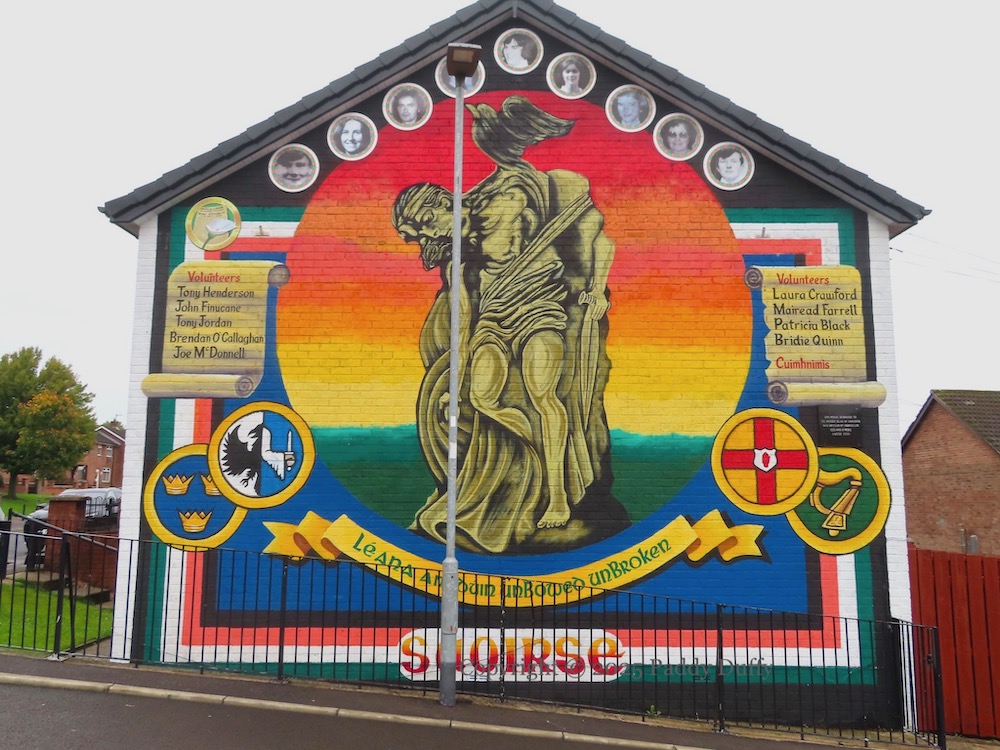
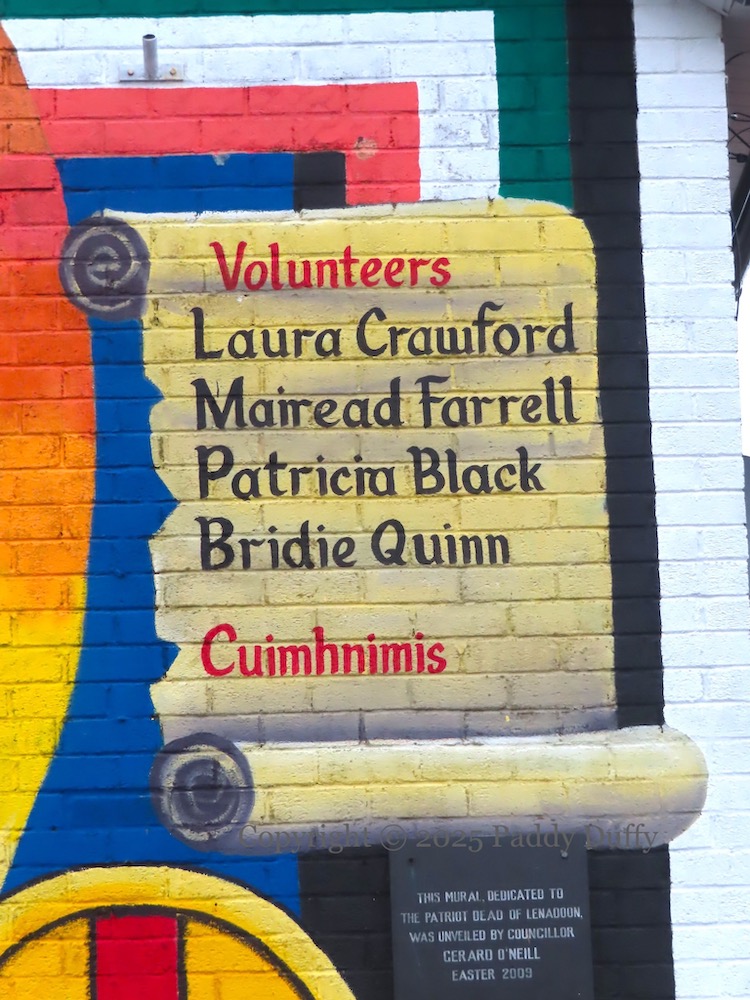
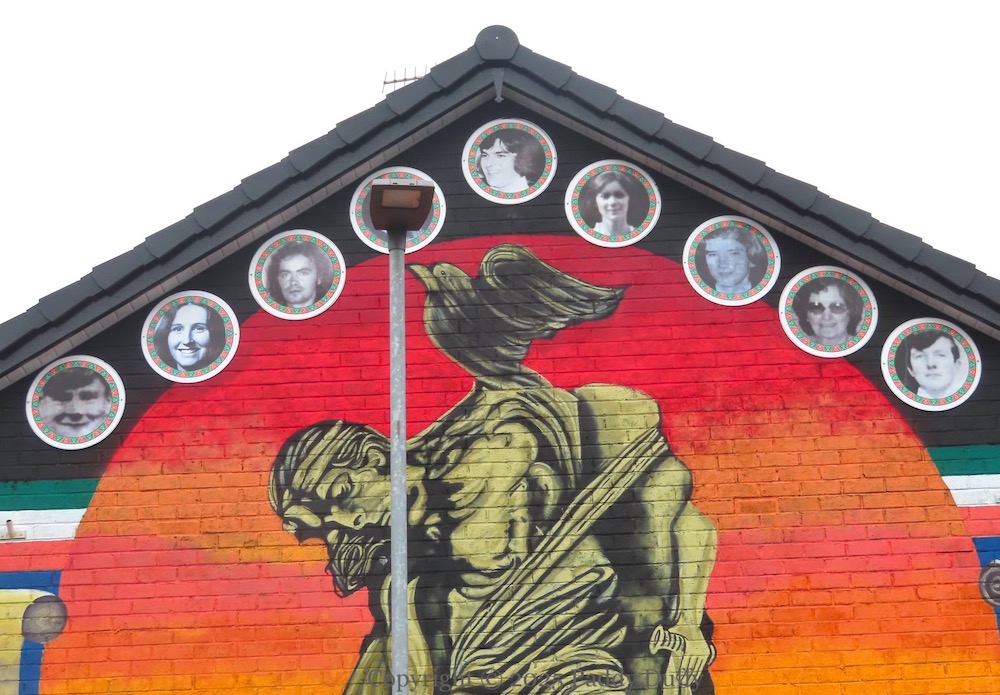
Oliver Sheppard’s statue of Cú Chulaınn dying – see the Cú Chulaınn Visual History page – memorialises nine IRA volunteers from the Lenadoon area, whose names are listed on the scrolls to each side and whose portraits appear in the apex: Tony Henderson, John Finucane, Brendan O’Callaghan, Joe McDonnell, Laura Crawford, Maıréad Farrell, Patricia Black, Bridie Quinn. Below the statue are the shields of the four provinces and the words “Léana An Dúın – unbowed, unbroken” and “saoırse” [freedom].
The mural dates back to 1996 (see T00160) and was repainted in 2009 (see M05134) and c. 2014 (see M11028, which includes a close-up of the plaque added in 2009.) In this version, nothing has changed in the composition of the mural and the photographic portraits and the Easter Rising centenary board have been retained.
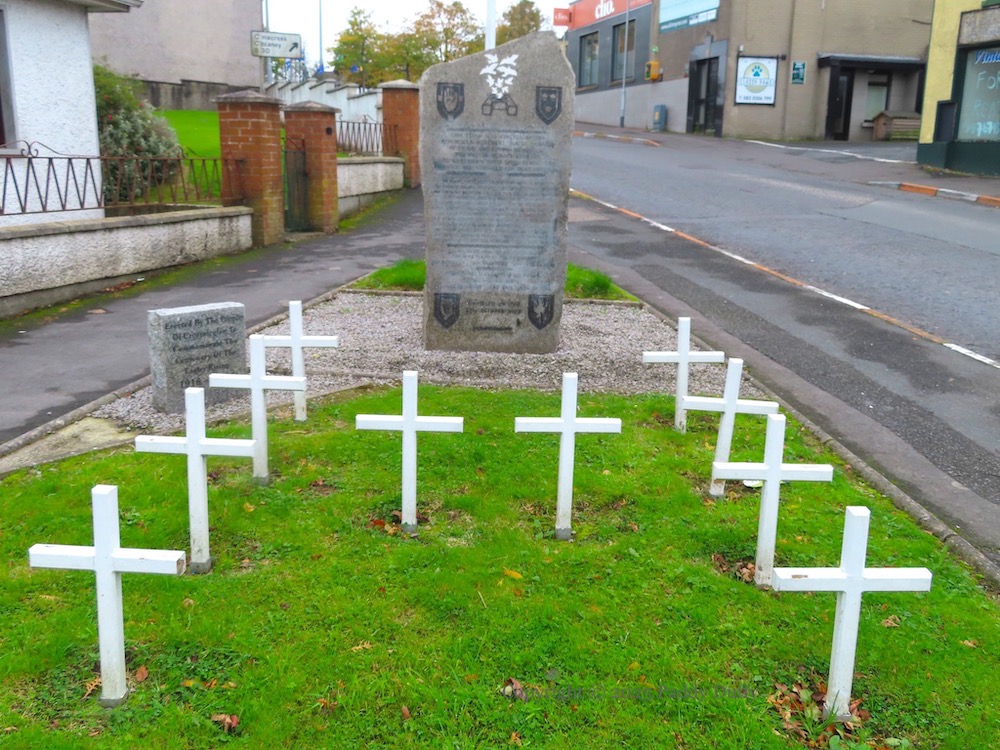
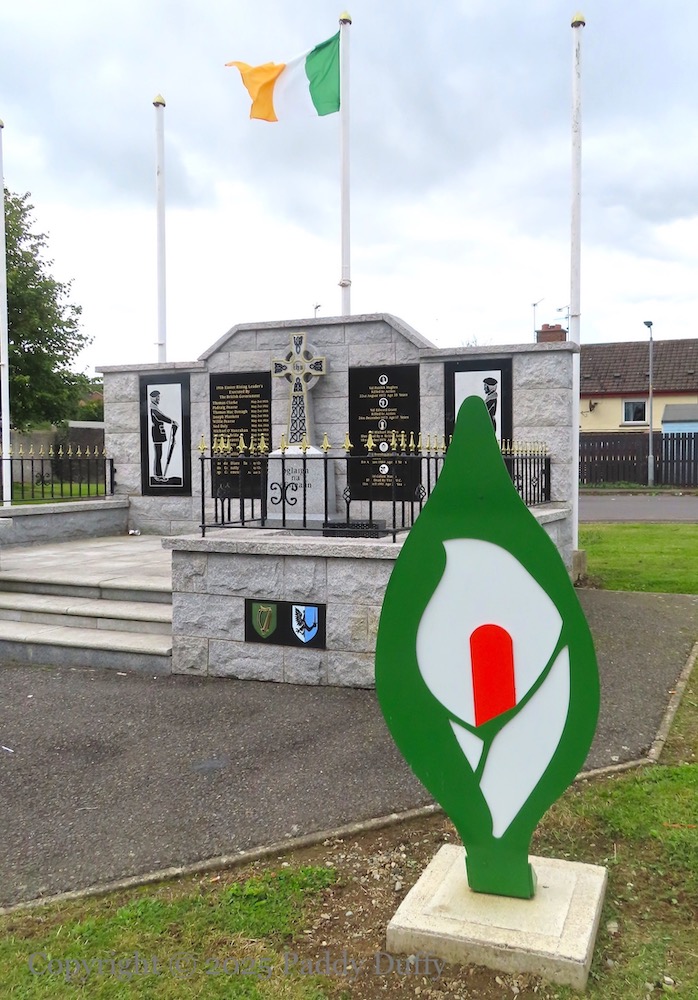
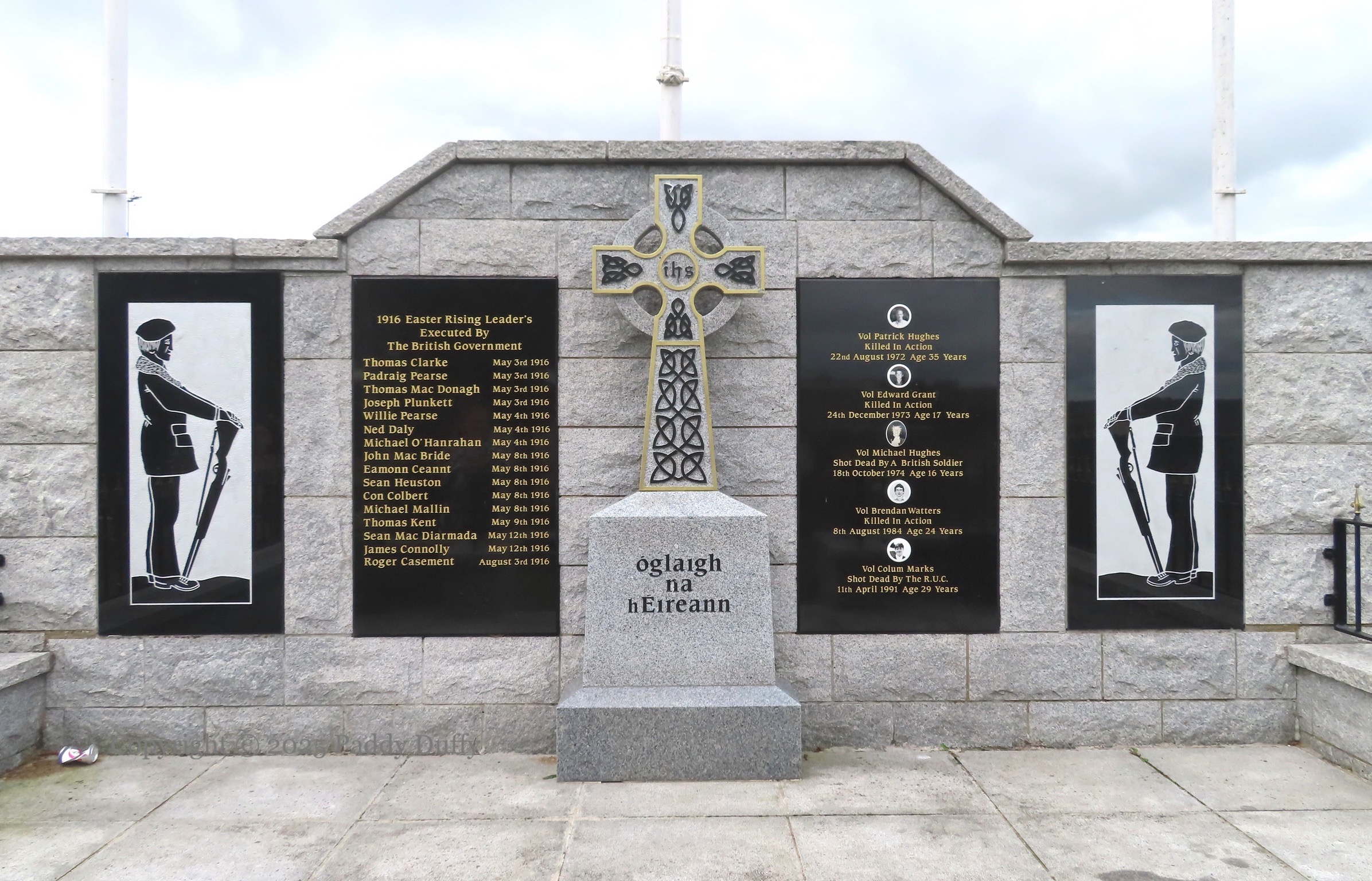
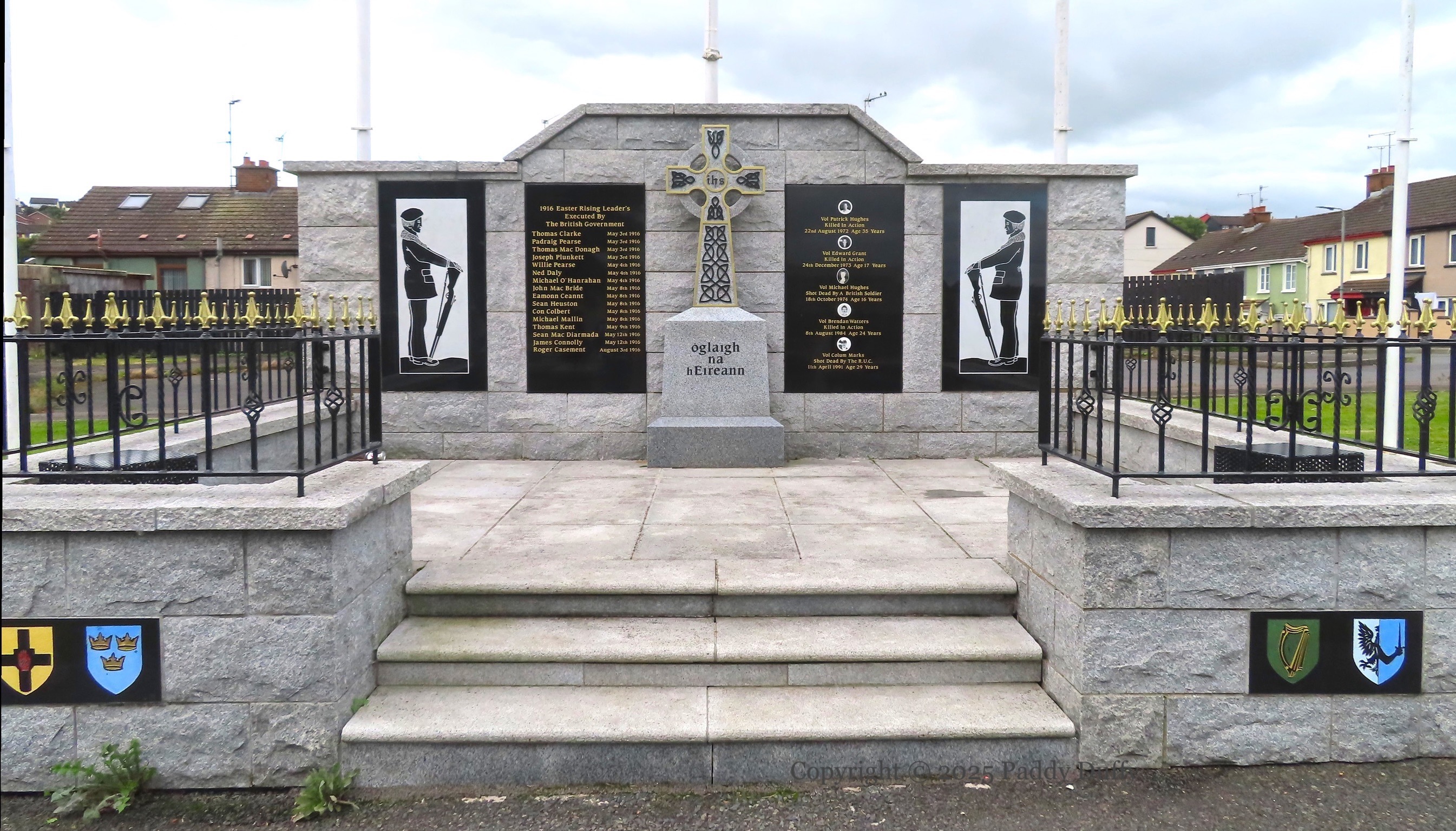
On the left of this Newry memorial is a list of the “1916 Easter Rising Leaders executed by the British government: Thomas Clarke, Padraig Pearse, Thomas Mac Donagh, Joseph Plunkett, Willie Pearse, Ned Daly, Michael O’Hanrahan John Mac Bride, Eamonn Ceannt, Sean Heuston, Con Colbert, Michael Mallin, Thomas Kent, Sean Mac Diarmada, James Connolly, Roger Casement.”
On the right are five members of the local Óglaıgh na hÉıreann: Patrick Hughes, Edward Grant, Michael Hughes, Brendan Watters, Colum Marks.” Michael Hughes/Mıcheál Ó hAodha is commemorated at the western entrance to the estate and the plaque also mentions the death of his father, Patsy, and the death by premature explosion of his friend Eddie Grant in 1973. Brendan Watters likewise died by premature explosion (UPI). There is a memorial stone in Downpatrick at the spot where Colum Marks was killed.
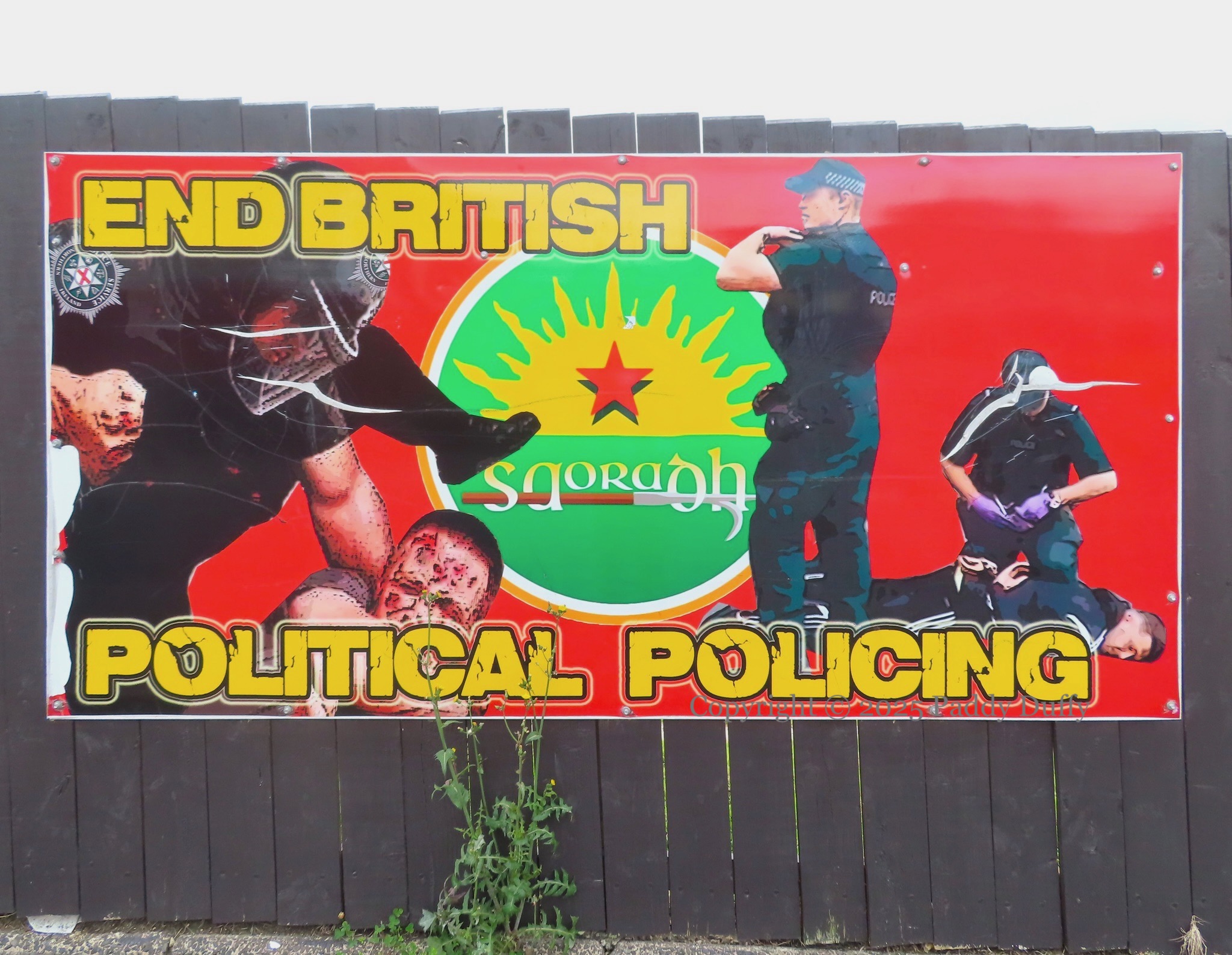
Included last below is a Saoradh (web) board: “End British political policing”.
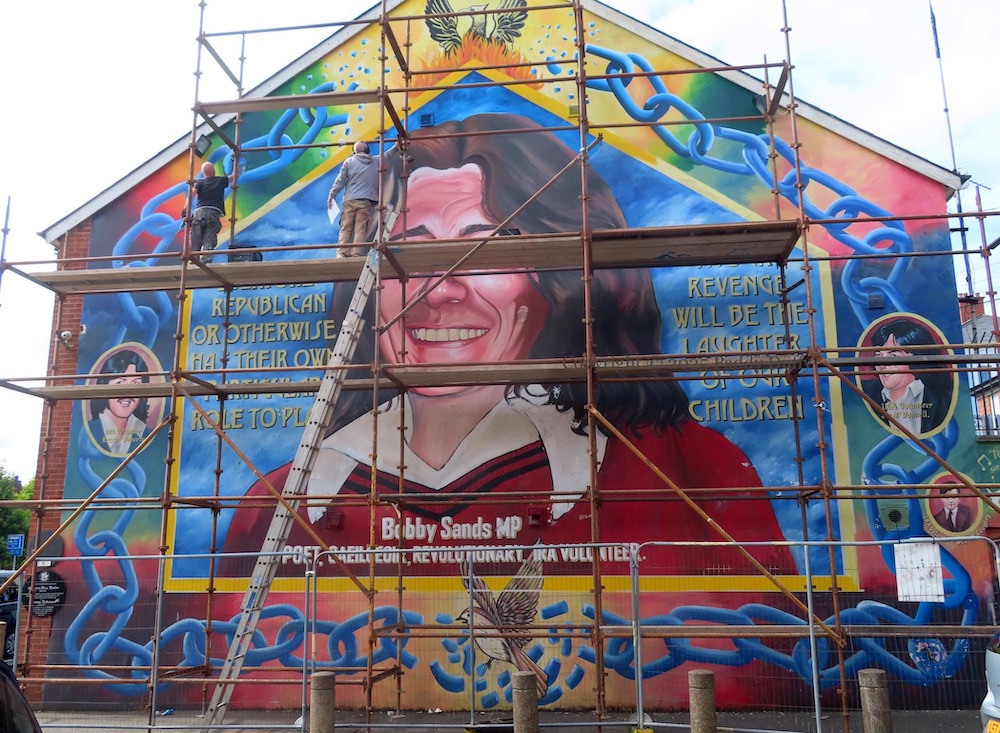
The Bobby Sands mural in Sevastopol Street, on the side of the Sınn Féın offices, is perhaps Belfast’s most famous mural and in general second only to Free Derry Corner in Derry. The main wall of the mural has just been touched up, in time for the march that took place in Belfast on August 24th as part of the national hunger-strike commemoration.
The first mural of Sands was painted on the wall in 1989 and the most recent re-painting prior to this one was in 2015 – see the wall’s Visual History page.
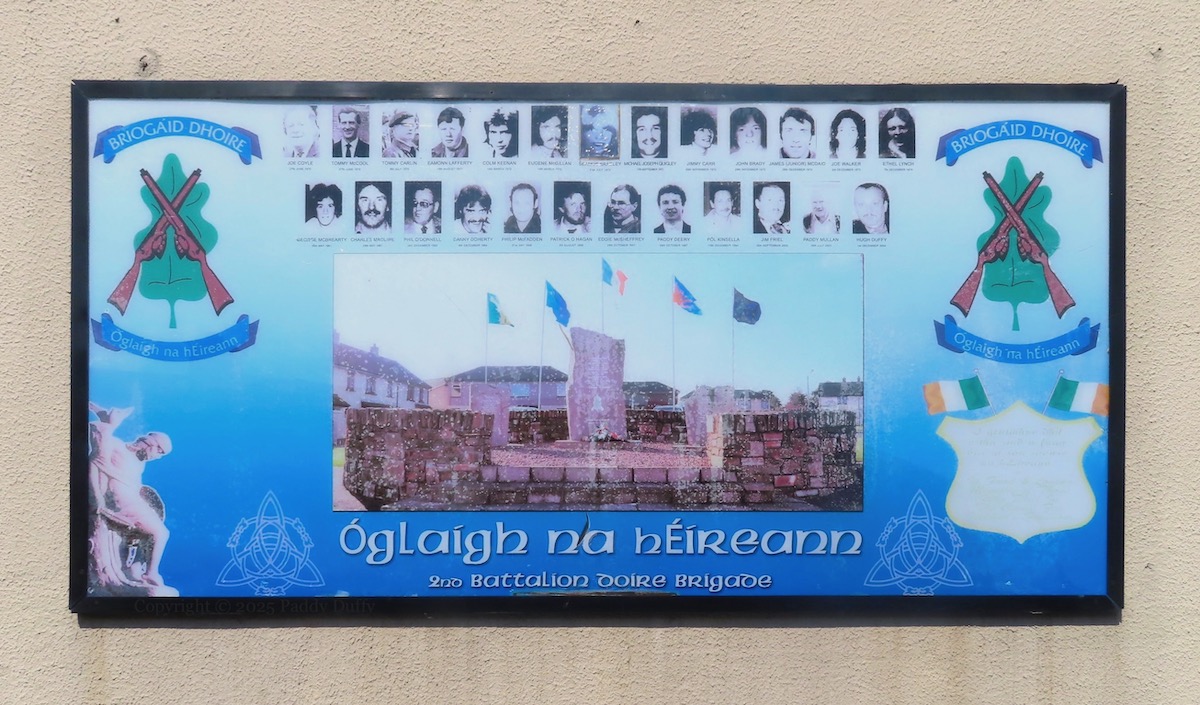
The Linsfort Drive (Creggan) memorial garden (see M02663 and M02775) is featured in the centre of this board of IRA volunteers from the 2nd battalion of the Derry Brigade. There are two similarly designed boards to the 1st battalion in Westland Street and in Lecky Road.
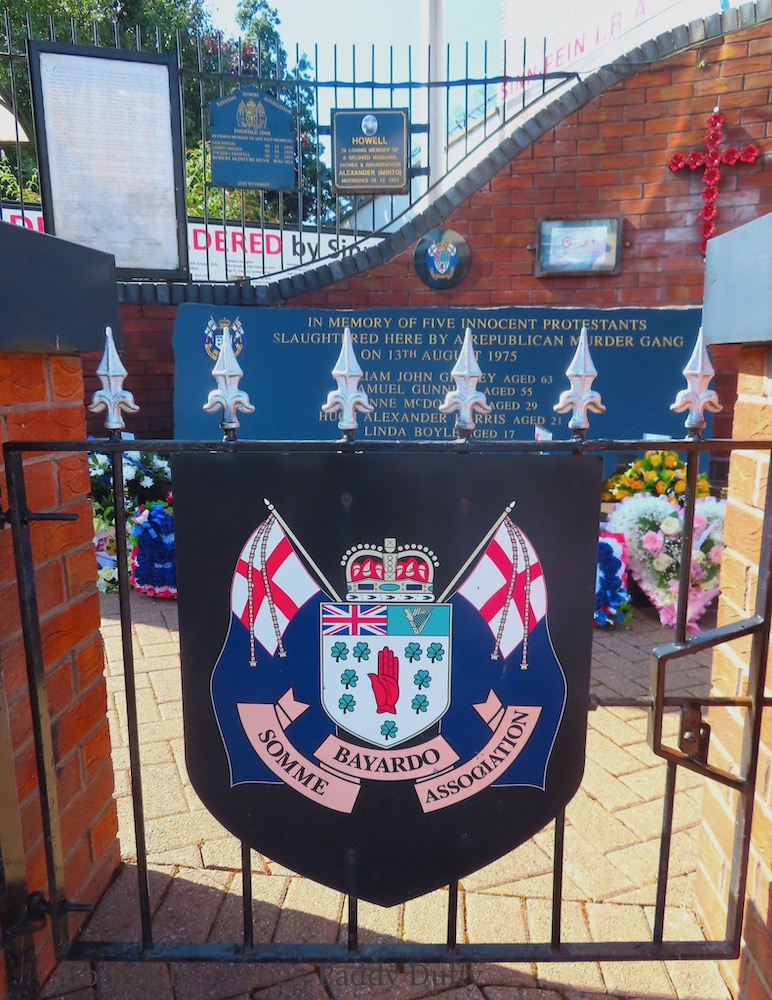
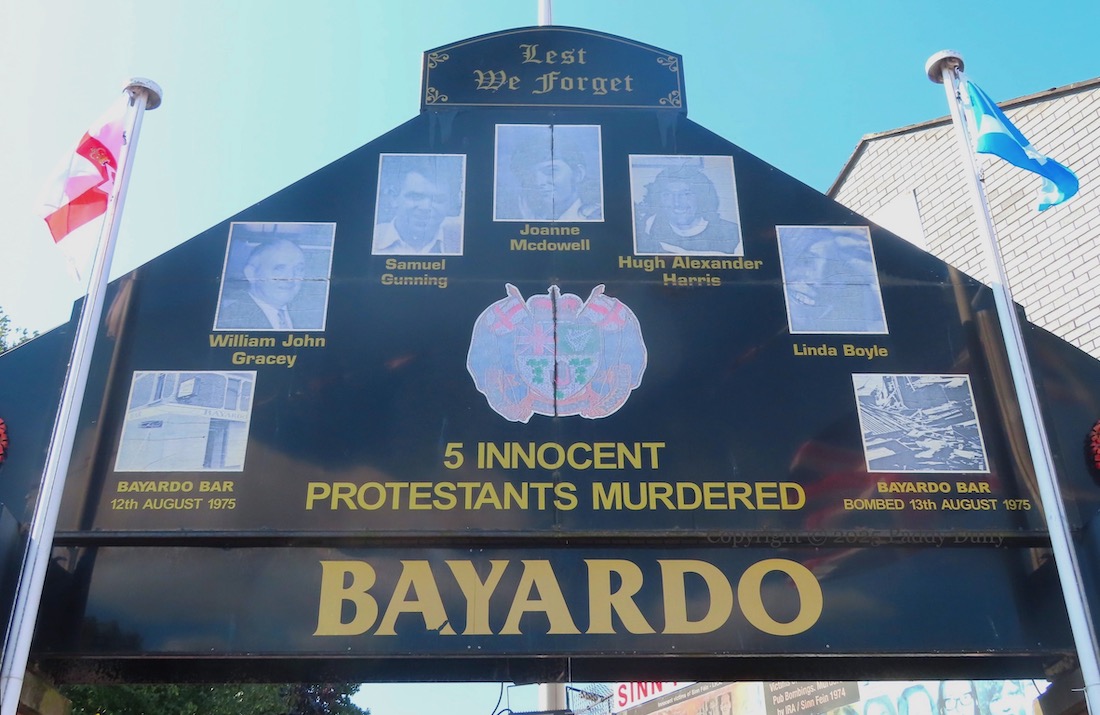
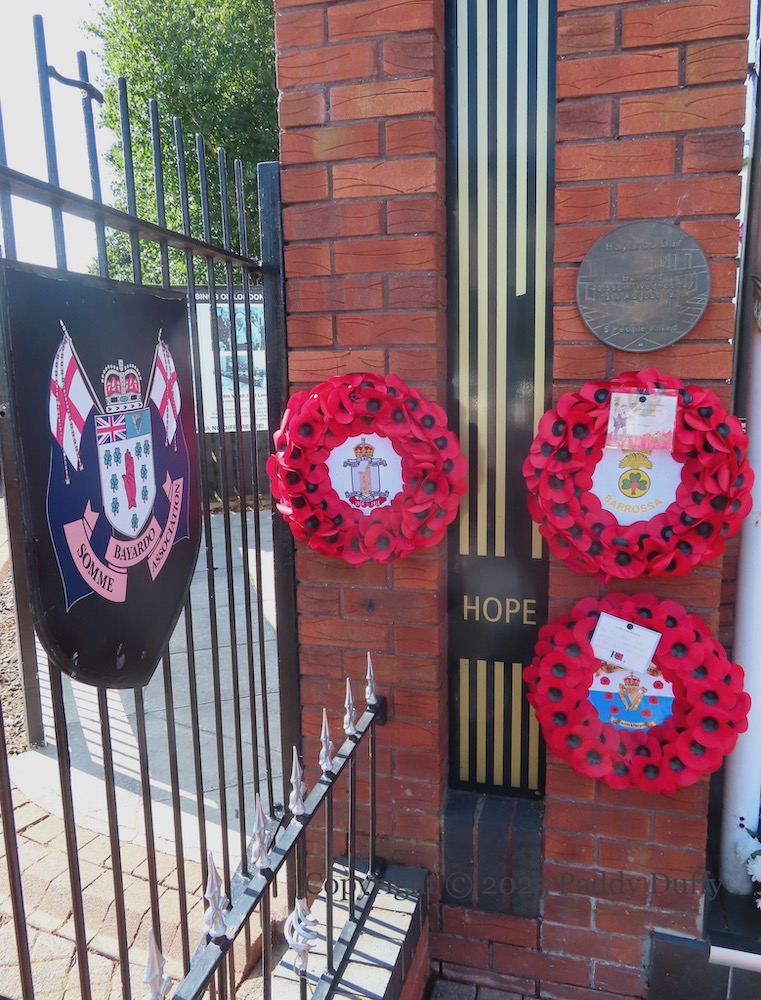
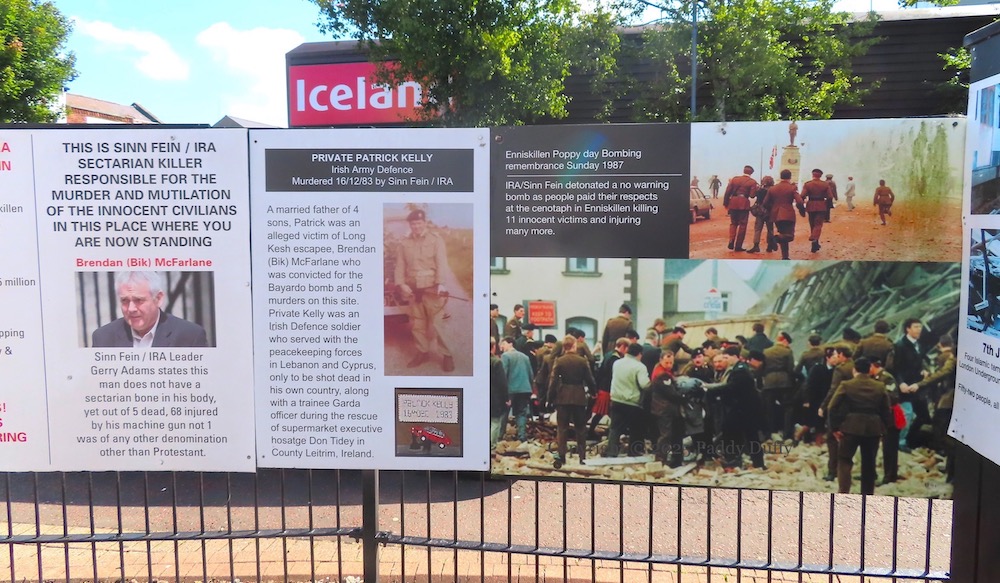
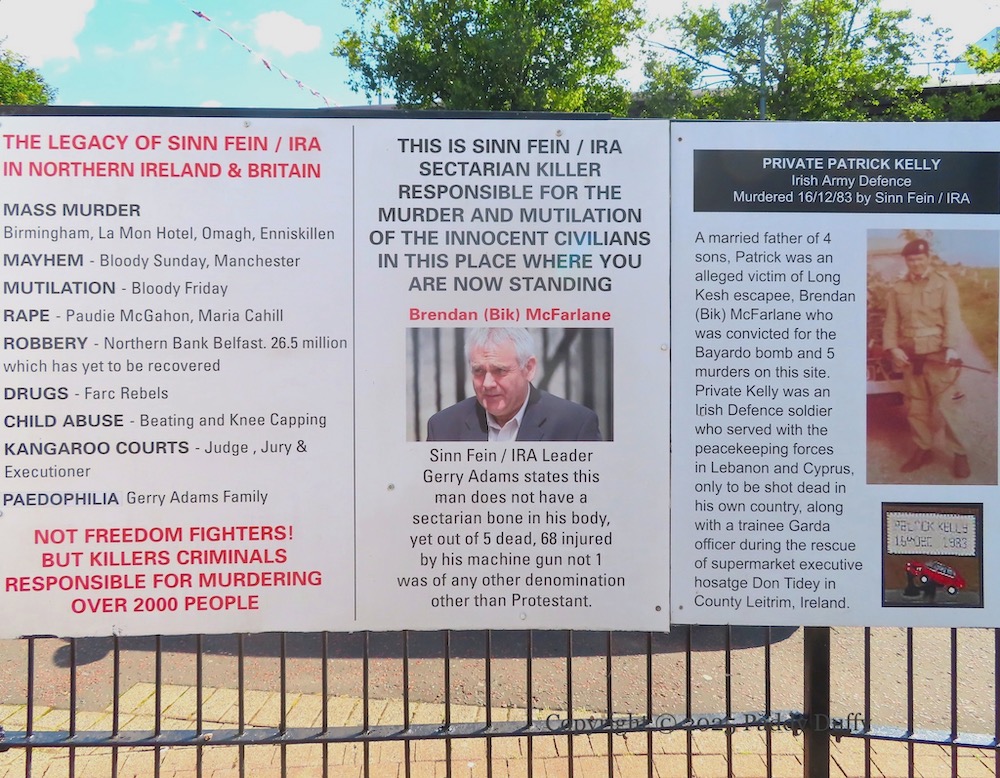
Wreaths are laid at the Bayardo Bar memorial on the Shankill Road on the fiftieth anniversary of the attack, which involved the shooting of two people at the door and the bomb being left at the entrance, which caused the deaths of a further three people: “In memory of five innocent Protestants slaughtered here by a republican murder gang on 13th August 1975. William John Gracey aged 63, Samuel Gunning aged 55, Joanne McDowell aged 29, Hugh Alexander Harris aged 21, Linda Boyle aged 17. Erected by the Bayardo Somme Association. “A forgotten atrocity”.” Fifty other people were injured in the attack.
Here is an opinion piece in the BelTel claiming that “republican communities … have been far more active not only in memorialising violent events impacting upon them, but also campaigning for the truth about those actions … the lack of balance in how the past is being investigated here has created a one-track, green-tinted narrative”.
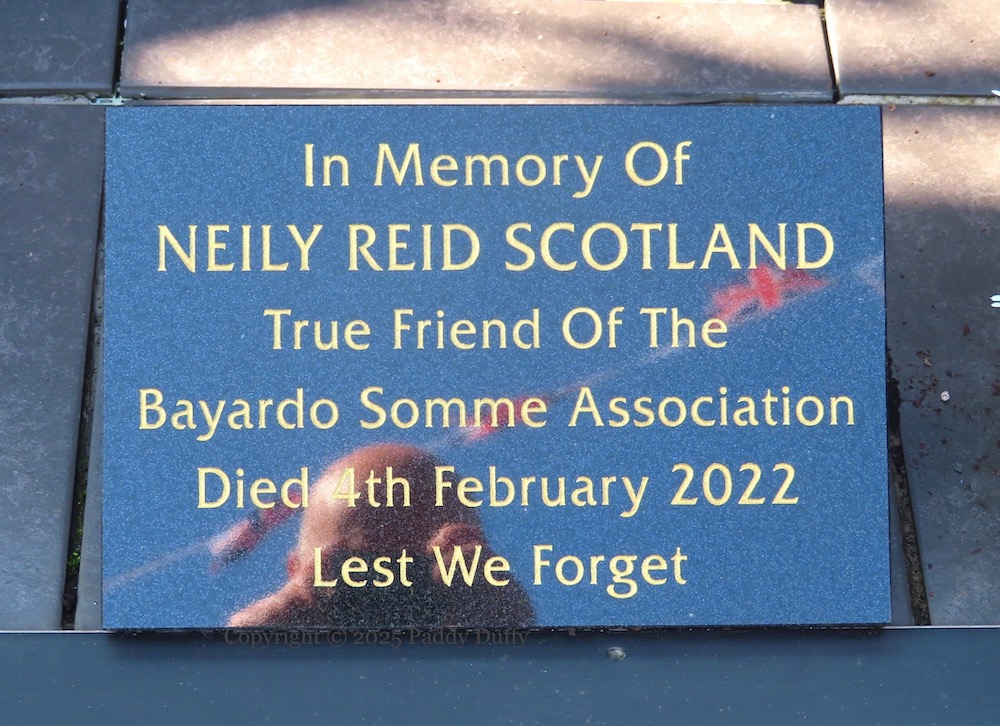
See also: the memorial in 2023. Included here are close-ups of two recent plaques, one “In memory of Neily Reid Scotland, true friend of the Bayardo Somme Association, died 4th February 2022. Lest we forget.” and the other “In memory of Billy Boyce, loyal friend of the Bayardo Somme, died 19-12-2018. Lest we forget.”
Féıle An Phobaıl (web) is now headquartered in the renovated (BCC) St Comgall’s on Divis Street in Ionad Eileen Howell, and during this year’s (2025) festival is home to an exhibition called “Vibrant Colours, Violent Past”, the centrepiece of which is a 20-foot-long panoramic history of republicanism, with Wolfe Tone, James Connolly, and Martin McGuinness as pivotal figures.
A leaflet distributed at the launch (on August 1st) explained the genesis of the project, as follows:
“A few years ago I met a great friend of Ireland and art collector Darius Anderson from California who was here on a trip with his wife Wendy and hoping to see some new work by Irish artists, not only work destined for gallery walls but having been fortunate to be included on one of local guide Dee Morgan’s tours he developed a love for and focus on our world-recognised mural art tradition.
“Then last year on another trip here I was able to introduce Darius to my life-long friends and probably the most prolific contributors to our local landscape.
“From a casual meeting alongside Marty and Micky at work repainting the Vol. Kieran Doherty mural in Andersonstown came an inspired suggestion that we accept a challenge from him to tell our story graphically on a canvas rather than the usual brick wall, not just on canvas to hang on a wall in his gallery in L.A. but a canvas to cover the entire wall 20ft x 7ft!
“Excited by our positive response Darius wondered could we invite some loyalist artist/activist to contribute a similar large canvas celebrating the history of the British, Unionist, Loyalist community here.
“That was last July. This exhibition is a result of that meeting but also a chance for the public to remind themselves of our often colourful and unfortunately violent past. – Danny D, Muralist/Activist”
“History is like a rearview mirror! You must always check back but you must keep focused on the road ahead, otherwise you are going to crash!” (Similar wording was used in a piece – Painting From The Same Palette – painted by Danny D and Mark Ervine in 2008.)
The exhibition was launched on August 1st and also included four display boards featuring murals by Danny D (CNR) and Dee Craig (PUL) (Fb).
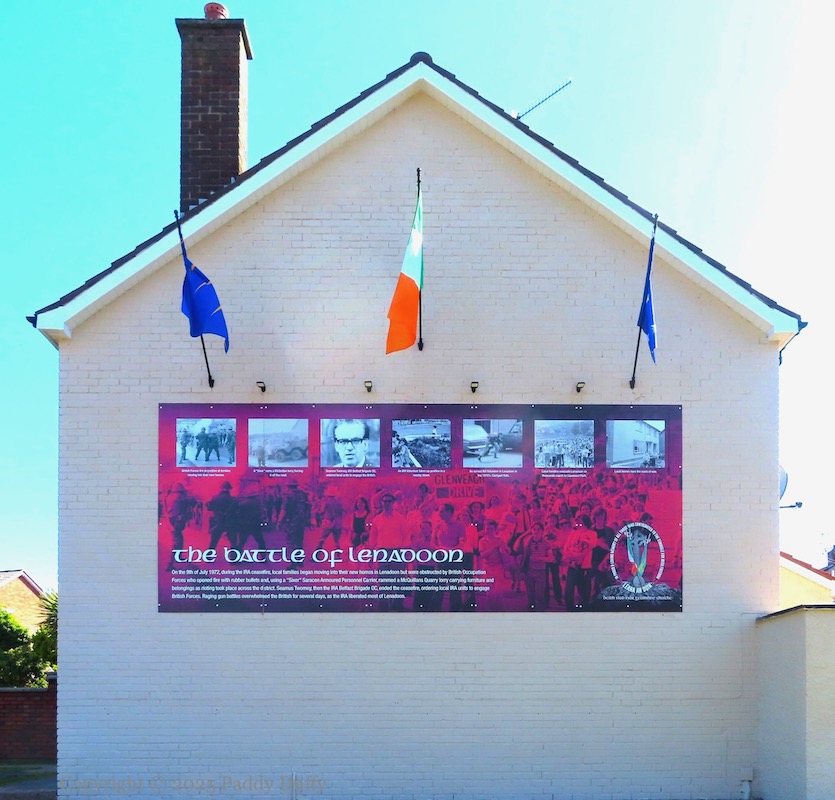
“On the 9th of July 1972, during the IRA ceasefire, local families began moving into their new homes in Lenadoon but were obstructed by British Occupation Forces who opened fire with rubber bullets and, using a “Sixer” Saracen Armoured Personnel Carrier, rammed a McQuillan’s Quarry lorry carrying furniture and belongings as rioting took place across the district. Seamus Twomey, then the IRA Belfast Brigade OC, ended the ceasefire, ordering local IRA units to engage British Forces. Raging gun battles overwhelmed the British for several days, as the IRA liberated most of Lenadoon.”
The captions to the photographs along the top read (l-r): “British Forces fire projectiles at families moving into their new homes”, “A “Sixer” rams a McQuillan lorry, forcing it off the road”, “Seamus Twomey, IRA Belfast Brigade OC, ordered local units to engage the British”, “An IRA Volunteer takes up position in a nearby street”, “An armed IRA volunteer in Lenadoon in the 1970s, Carrigart flats”, “Local families evacuate Lenadoon as thousands march to Casement Park”, “Local homes bare [bear] the scars of war”.
For background, see this 24 minute Thames TV report (on youtube) about the dispute over houses in Lenadoon; RTÉ also has footage (one | two) of the evacuation.
“In proud & loving memory of all those who contributed to the struggle for Irish freedom – Léana An Dúın – Beıdh sıad ınár gcuımhne choíche”
Lenadoon Avenue, west Belfast, replacing the 1995 Gorta Mór mural. Launched Sunday July 12th.
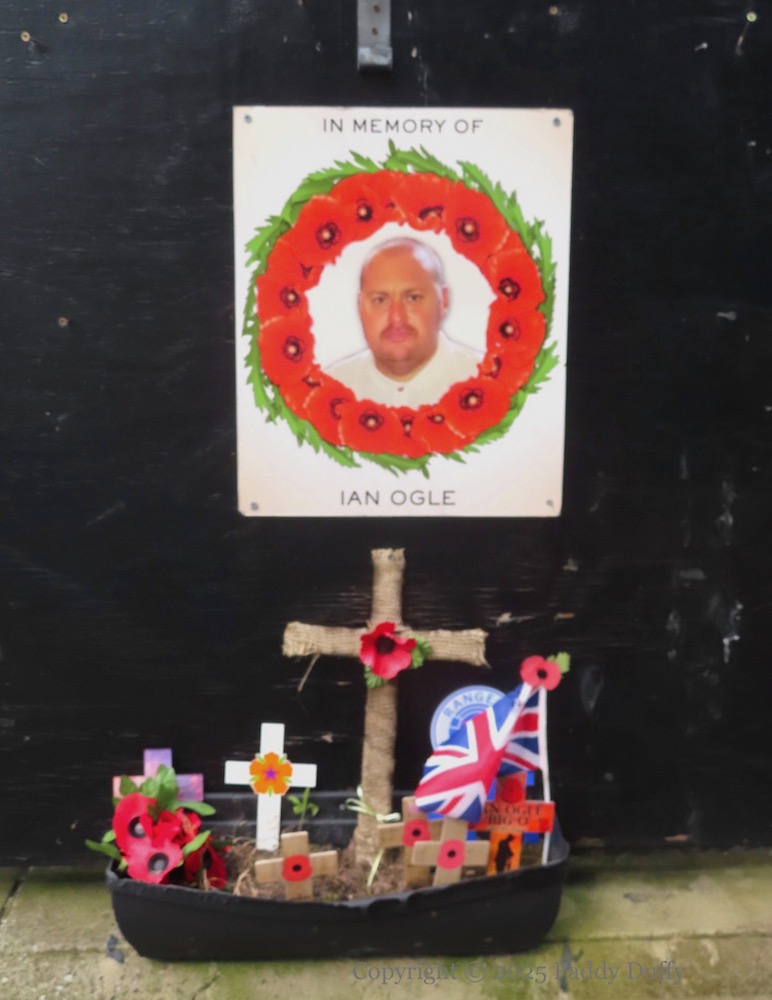
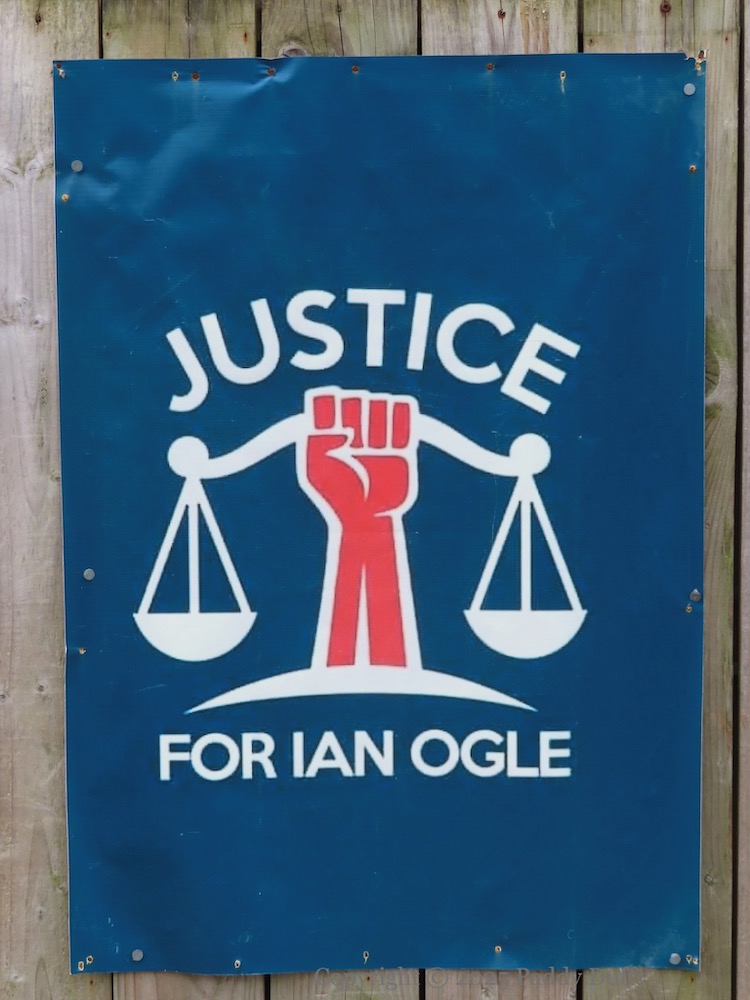
This is (at least) the third different tarp at the entrance to Cluan Place in memory of Ian Ogle, who was killed on the evening of January 27th, 2019. Five people have been found guilty of the murder and officially received their sentences in March; four others have been convicted of lesser charges (BBC | ITv | Belfast Media | Judiciary NI).
The small board “In memory of Ian Ogle” (immediately below) is also a recent addition.




















 Paddy Duffy Collection