Operation Motorman, the British Army’s retaking of ‘Free Derry’, took place on July 31st, 1972. This is a repainting; for the previous version, see T02079, and for the 2001 original, see M01426.
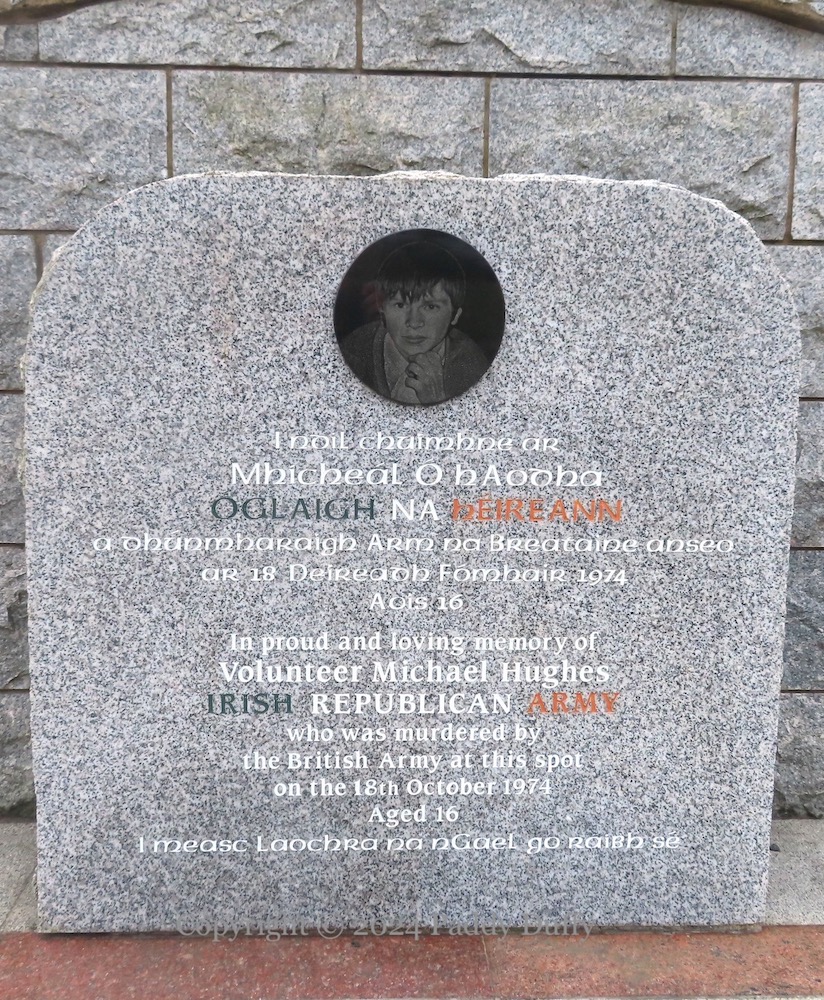
“I ndıl chuımhne ar Mhıcheál Ó hAodha, Óglaıgh na hÉıreann, a dhúnmharaıgh Arm na Breataıne anseo ar 18 Deıreadh Fómhaır 1974, aoıs 16. In proud and loving memory of Volunteer Michael Hughes, Irish Republican Army, who was murdered by the British Army at this spot on the 18th October 1974 aged 16. I measc laochra na nGael go raıbh sé.”
Hughes was shot when he and several other youths attempted to hijack a bus at the stop at the entrance to the area which was under observation by a Royal Marine unit; the soldier who fired the shot claimed that Hughes had pointed a pistol at him, but no weapon or forensic evidence was recovered (Lost Lives 1208).
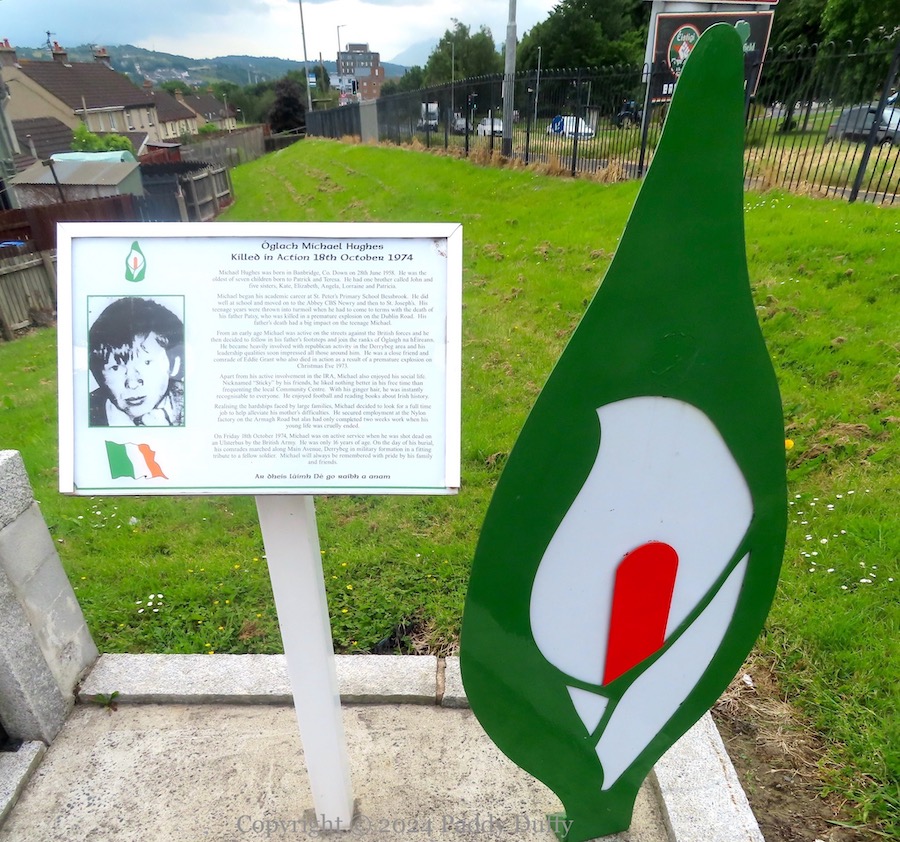
This is an enlarged memorial to Hughes at the upper entrance to Derrybeg. For the previous memorial, see M08521); Peter also photographed the bus shelters (in 2002).
From the printed info board: “Michael Hughes was born in Banbridge, Co. Down on 28th June 1958. He was the oldest of seven children born to Patrick and Teresa. He had one brother called John and five sisters, Kate, Elizabeth, Angela, Lorraine and Patricia. Michael began his academic career at St. Peter’s Primary School Bessbrook. He did well at school and moved on to the Abbey CBS Newry and then to St. Joseph’s. His teenage years were thrown into turmoil when he had to come to terms with the death of his father Patsy, who was killed in a premature explosion on the Dublin Road. His father’s death had a big impact on the teenage Michael. From an early age Michael was active on the streets against the British forces and he then decided to follow in his father’s footsteps and join the ranks of Óglaıgh Na hÉıreann. He became heavily involved with republican activity in the Derrybeg area and his leadership qualities soon impressed all those around him. He was a close friend and comrade of Eddie Grant who also died in action as a result of a premature explosion on Christmas Eve 1973. Apart from his active involvement in the IRA, Michael also enjoyed his social life. Nicknamed “Sticky” by his friends, he liked nothing better in his free time than frequenting the local Community Centre. With his ginger hair, he was instantly recognisable to everyone. He enjoyed football and reading books about Irish history. Realising the hardships faced by large families, Michael decided to look for a full time job to help alleviate his mother’s difficulties. He secured employment at the Nylon factory on the Armagh Road but alas had only completed two weeks work when his young life was cruelly ended. On Friday 18th October 1974, Michael was on active service when he was shot dead on an Ulsterbus by the British Army. He was only 16 years of age. On the day of his burial, his comrades marched along Main Avenue, Derrybeg in military formation in a fitting tribute to a fellow soldier. Michael will always be remembered with pride by his family and friends. Ar dheıs láımh Dé go raıbh a anam.”
Nine people died in the 1972 blast that killed Patsy Hughes, at the customs station in Newry – two lorry-drivers, four customs officials, and three IRA volunteers (Lost Lives 551).
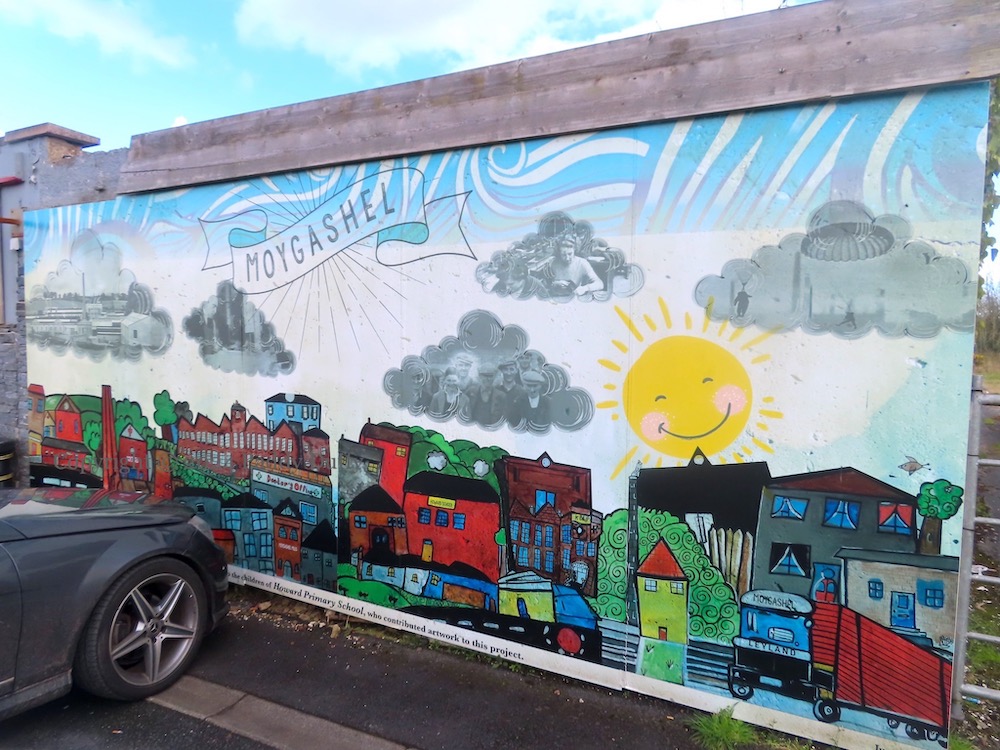
Here is a survey of PUL boards (from left to right) at the shops in the centre of the village of Moygashel, just south of Dungannon.
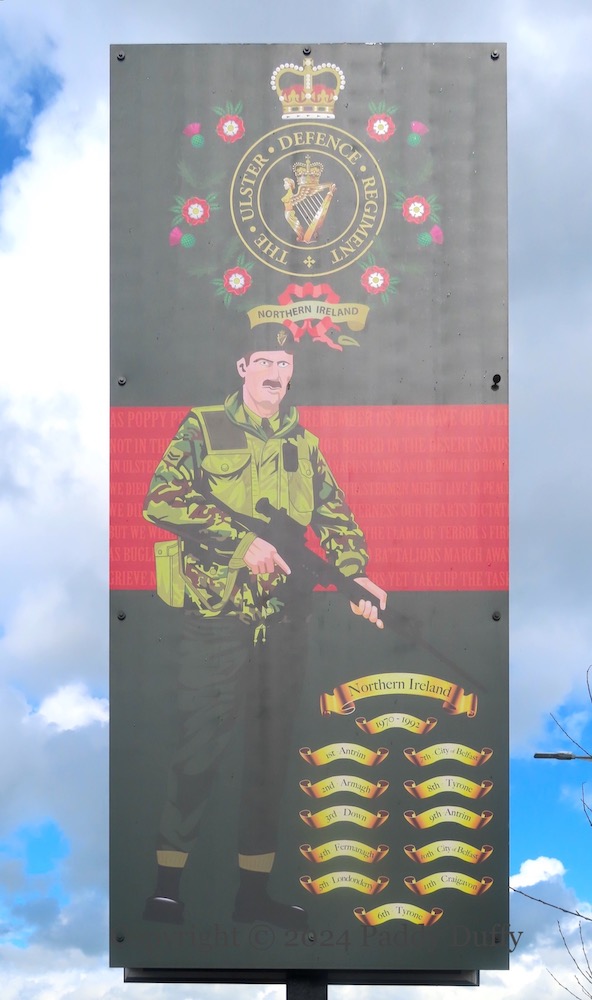
First is a British Army soldier in a firing position. Compare this board to Now Is The Time To Kneel in Clonduff, Castlereagh, which suggested that the time for soldiers to kneel was in mourning for Queen Elizabeth.
The subject of the second image is obscure. Vanguard as a political and activist group dissolved in 1977 (WP) and the name and emblem have been taken up by the Vanguard Bears, a Rangers supporters’ club (see e.g. Defending Our Traditions).
Third is a children’s mural, produced (in part) by children from Howard primary school.
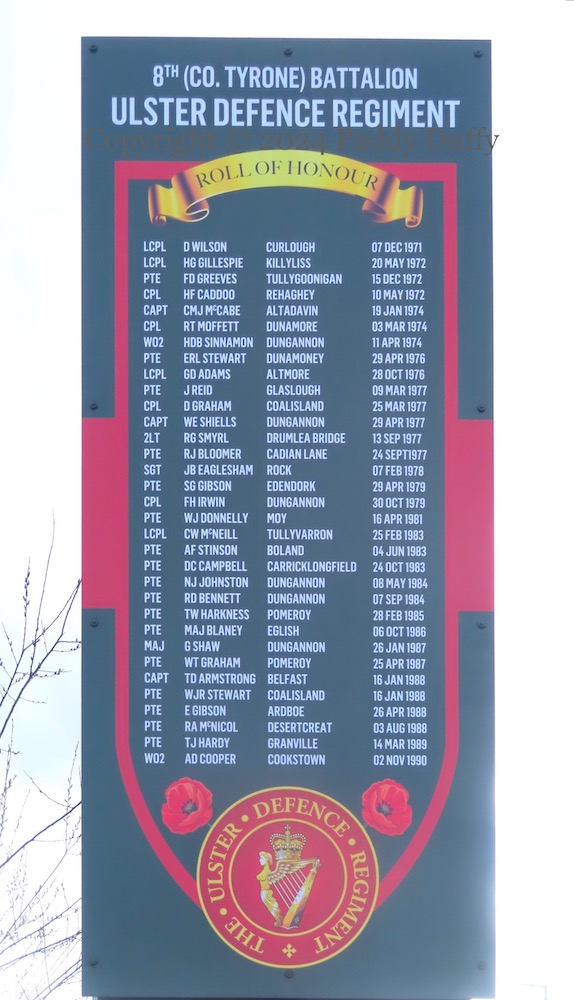
The ‘Time To Decide’ and UDR 8th (Co. Tyrone) battalion roll of honour were seen previously, alongside two others which are now absent, in Belfast Agreement Null & Void.
Beyond those is a tarp celebrating Queen Elizabeth II’s platinum jubilee, in 2022.
Finally, a Moygashel Youth Club (Fb) mural in disrepair.
March 10th was the 52nd anniversary of the killings of three Highland Fusiliers, Dougald McCaughey and teen-aged brothers Joseph and John McCaig, who were drinking in a city centre pub and lured to their deaths in north Belfast at the hands of the (Provisional) IRA. The killings led to the resignation of NI prime minister James Chichester-Clark and an increase, to 18, in the minimum age for service (WP).
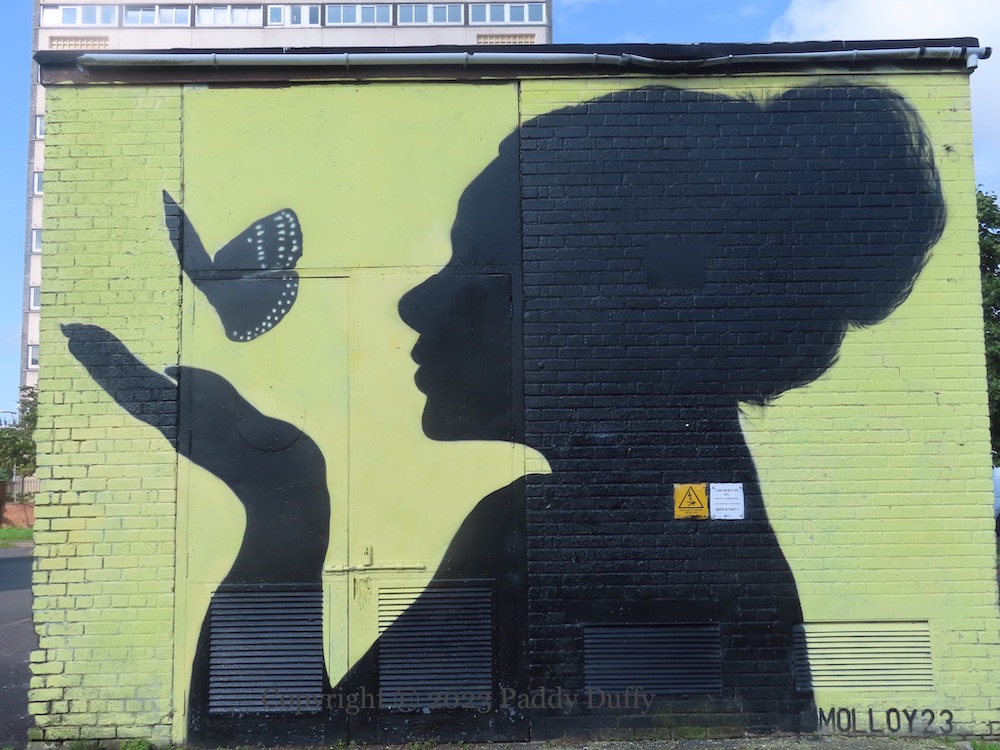
Here are five pieces of street art by Glen Molloy (ig) at Clarawood flats. The first three are new; the pair following is from earlier this year (Jan and Feb). The artist of the sixth piece is unknown. The seventh piece is by “The Spermer” (web) from 2020 and already in some disrepair – it was painted at the same time as Glen’s spitfire, shown last.
Demolition of the two blocks of flats was approved by the Housing Executive in May 2021 (Belfast Live) and by the Department Of Communities in September 2021 (Belfast Live). Demolition of Kilbroney is scheduled for the autumn and Clarawood (the tower block) for 2024 (Irish News).
(See also the Housing Executive’s ‘Action Plan’ for all tower blocks (pdf).)
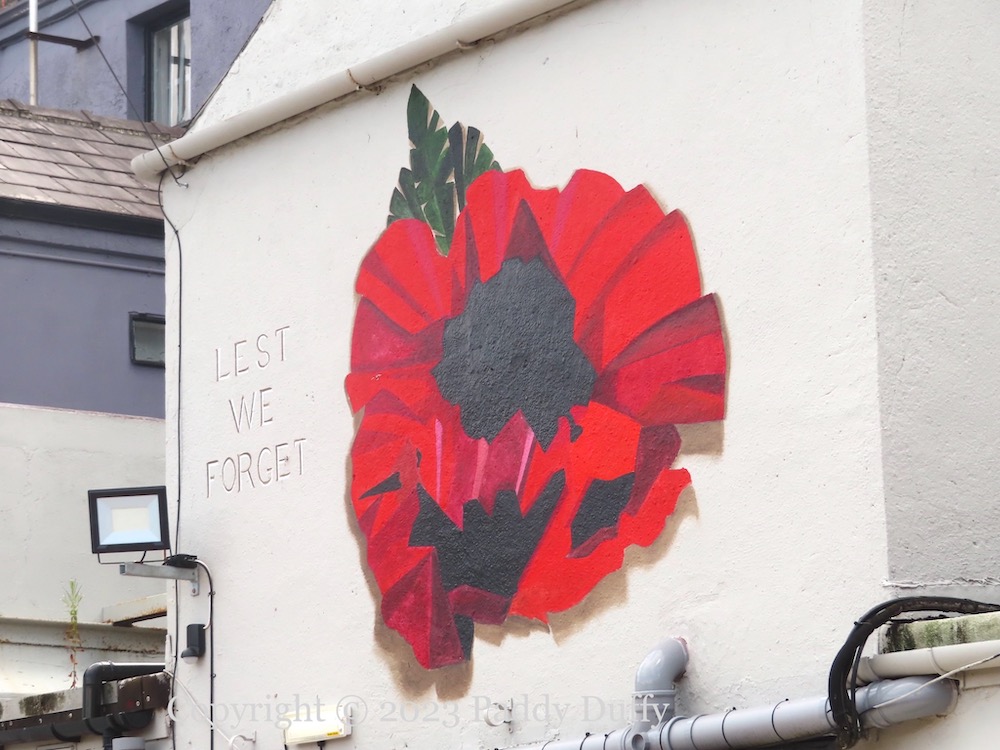
“Bangor Ex-Services Club have dedicated this “area” to the Peninsula Group for the Guide Dogs for the Blind Association. 26th August 2022.” With a large poppy on the adjacent wall.
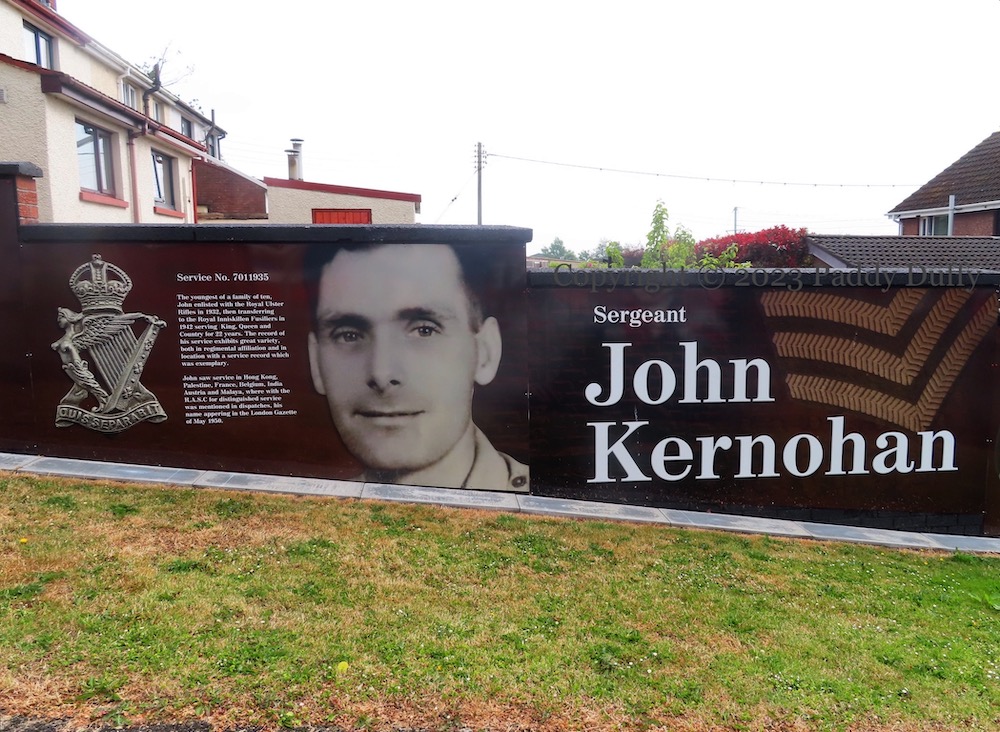
“Sergeant John Kernohan. Service No. 7011935. The youngest of a family of ten, John enlisted with the Royal Ulster Rifles in 1932, then transferring to the Royal Inniskillen Fusiliers in 1942 serving King, Queen and Country for 22 years. The record of his service exhibits great variety, both in regimental affiliation and in location with a service record which was exemplary. John saw service in Hong Kong, Palestine, France, Belgium, India[,] Austria and Malaya, where with the R.A.S.C. for distinguished service was mentioned in dispatches, his name appe[a]ring in the London Gazette of May 1950 [May 19th, 1950, page 2489, “in recognition of gallant and distinguished services in Malaya during the period 1st July 1949 to 31st December 1949″; Royal Army Service Corps, Corporal Kerohan].”
The medals from left to right are: General Service – Palestine ribbon, 1939-1945 Star, War Medal, Burma Star, Defence Medal
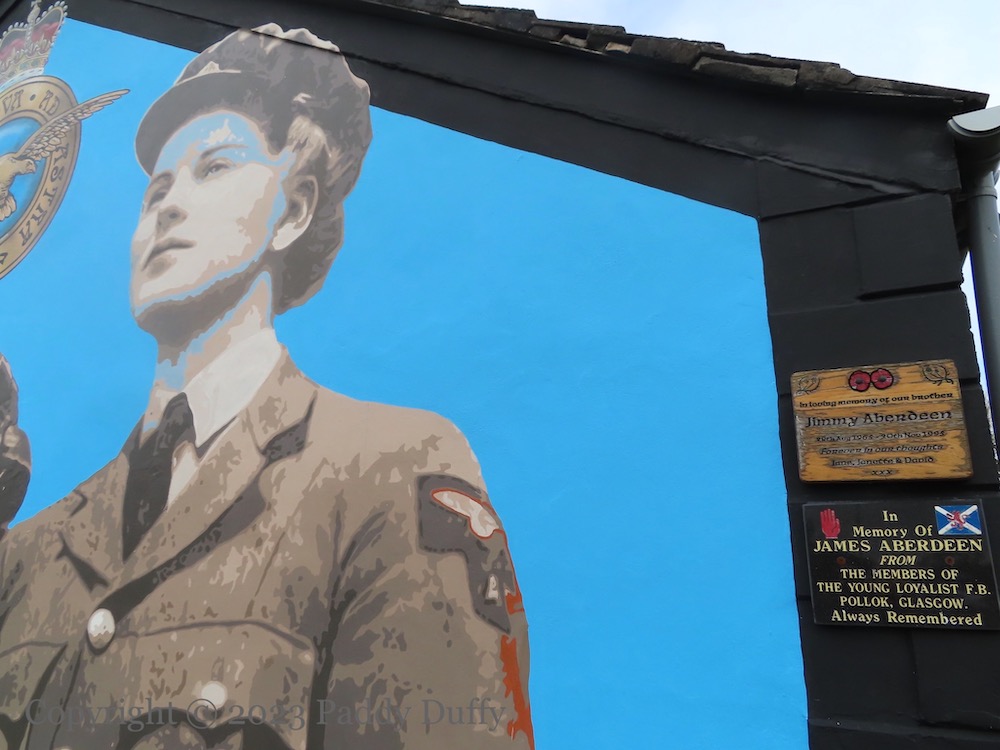
“Through adversity to the stars” – in WWII the Belfast Telegraph conducted a campaign to raise money for spitfire aircraft. 17 were purchased with the roughly 89 thousand pounds raised, and each of them was named for a city or area of Northern Ireland, including one named for Ballymena, which is the site of this new mural recalling the effort. (BelTel | NIWorld)
The plaques to Jimmy Aberdeen on the right-hand side of the second image date back to the previous mural, which is included last below; previously on the wall were Fight To A Finish and, before that, I Can Stand Alone.
“CR Gas & The Burning Of Long Kesh, 15th-16th October, 1974 in Long Kesh. Operation Pagoda – the British government authorised and sanctioned the use of a chemical weapon against Irish Republican prisoners. Members of the 22nd S.A.S. carried out the attack from a helicopter.”
Operation Pagoda was the name of the SAS’s counter-terrorism programme (WP). Its role in the ‘Battle Of Long Kesh’ in October 1974 and its alleged use of CR (dibenzoxazepine) powder – the successor to CS powder (and before that, CN or “tear” gas) (New Scientist) – remains a classified matter. CR had been authorised for use in 1973 (Guardian).















 Paddy Duffy Collection