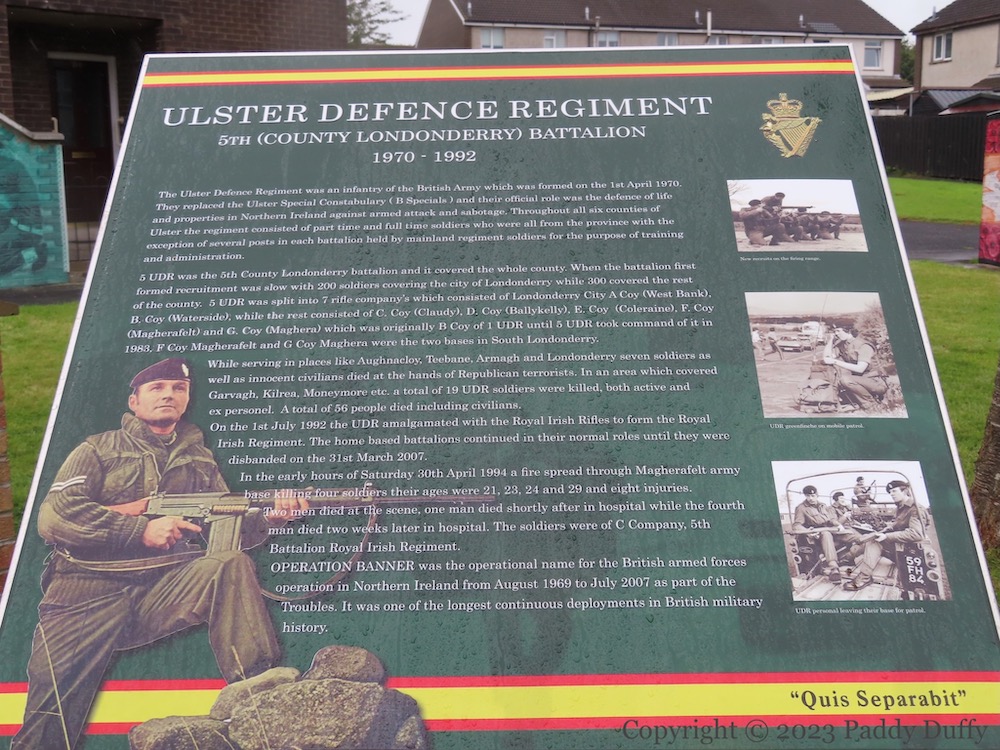
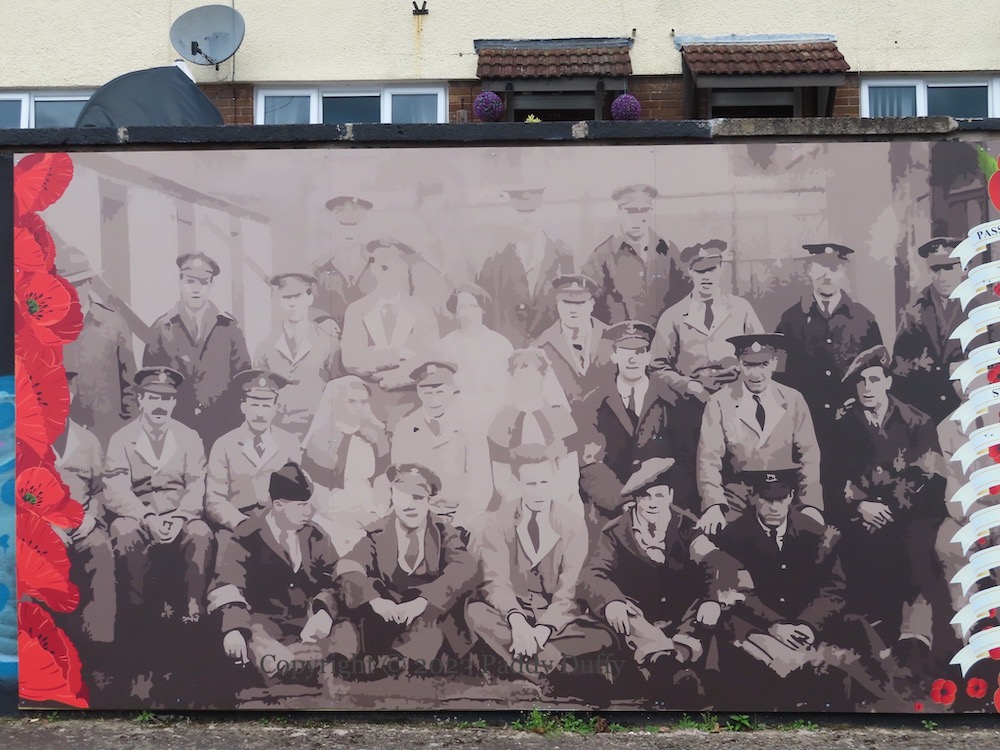
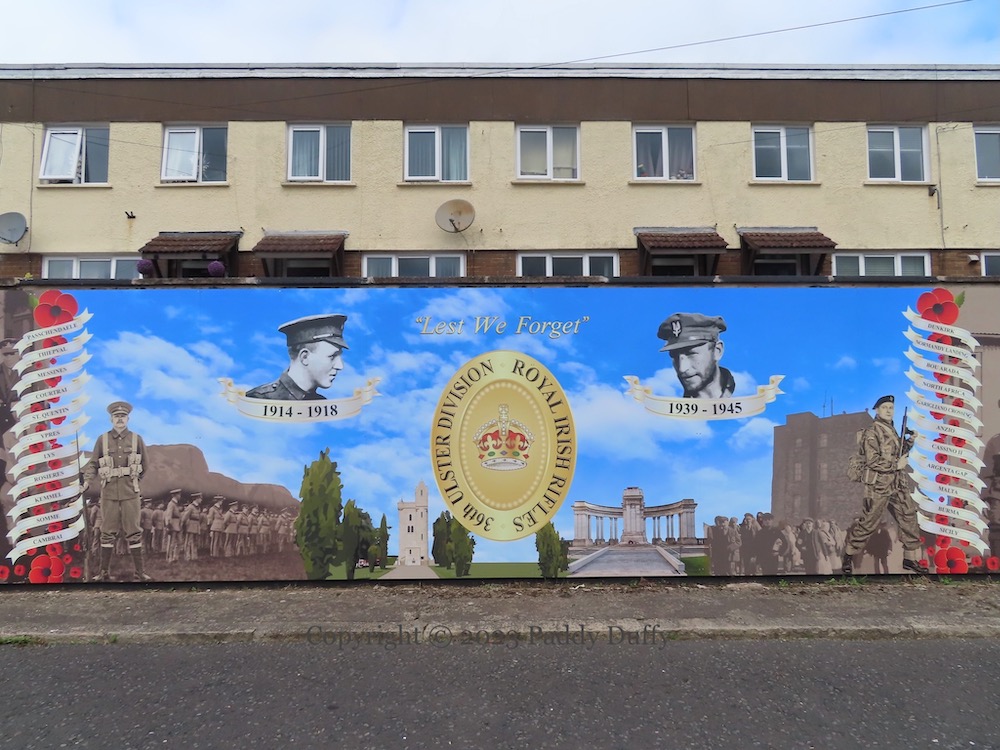
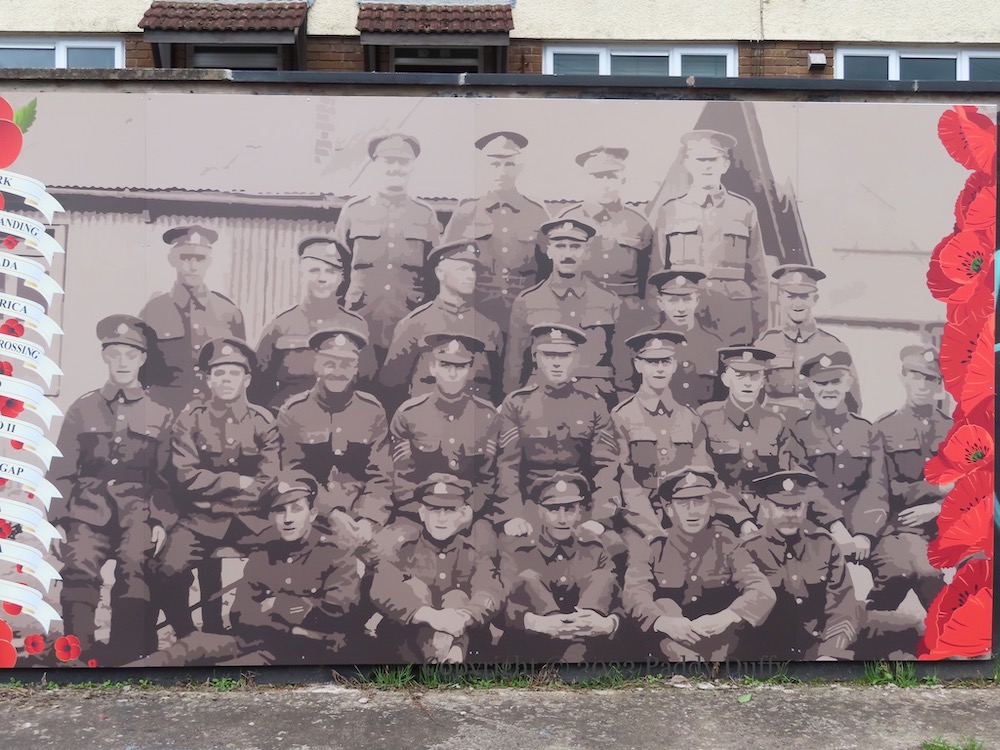
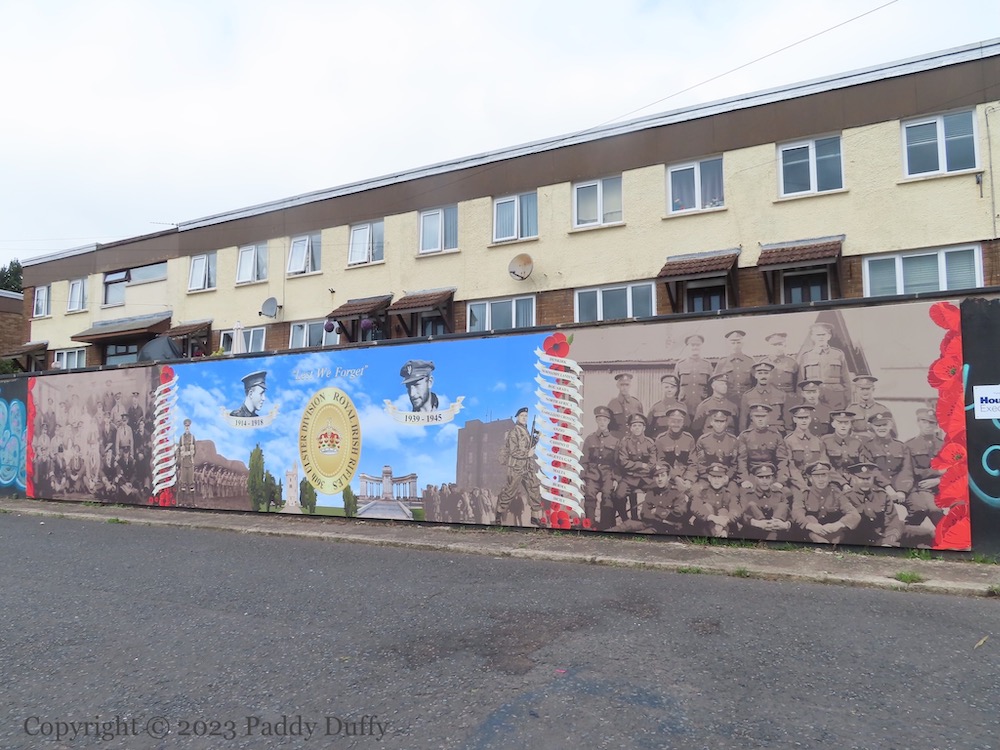
This selection of images from Leckagh Drive, Magherafelt, focuses on the memorials to the dead of WWI (and WWII in the mural above), with an additional board commemorating the UDR 5th (County Londonderry) battalion); there is also a mural and some plaques commemorating (modern-day) UVF volunteers, which will be in tomorrow’s post.
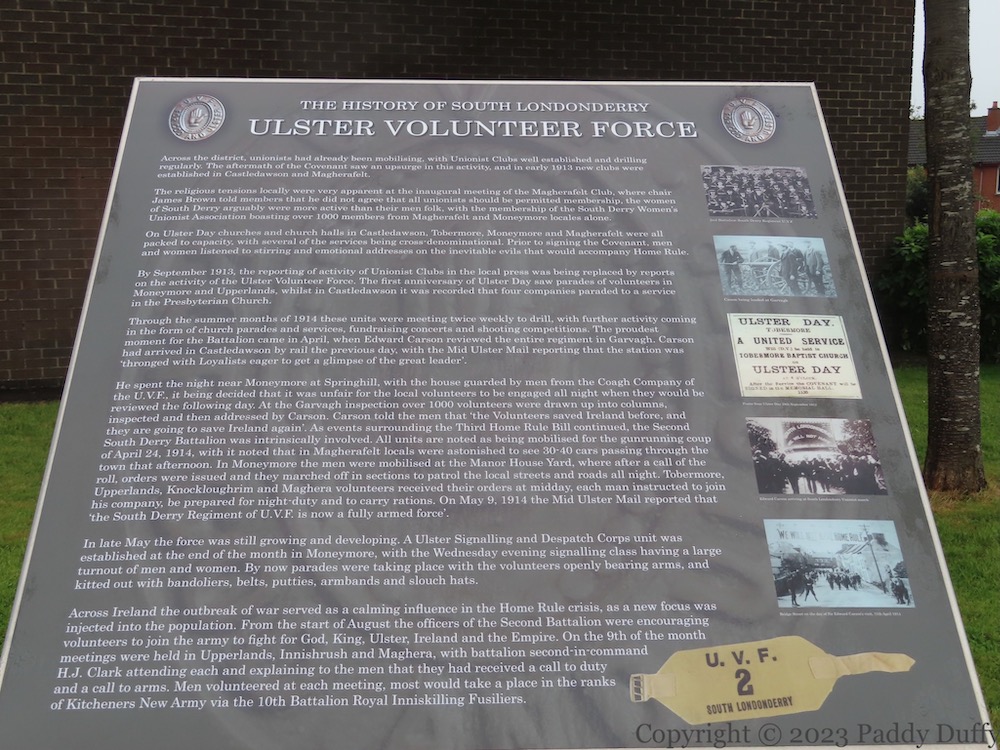
The board shown in the final image provides a history of the South Londonderry volunteers from towns such as Magherafelt, Castledawson, Moneymore, and Tobermore. Edward Carson reviewed the volunteers in April 1914. Later that same month, arms were received from the weapons landed in Larne. In the Great War, the men from the area served in the 10th battalion of the Royal Inniskilling Fusiliers in the 109th brigade of the 36th Division.
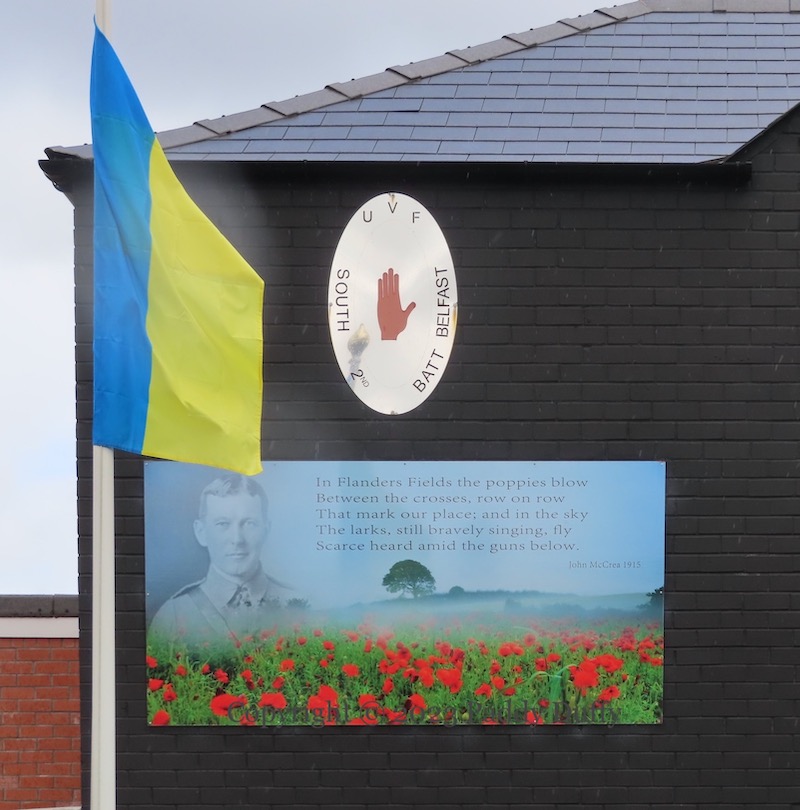
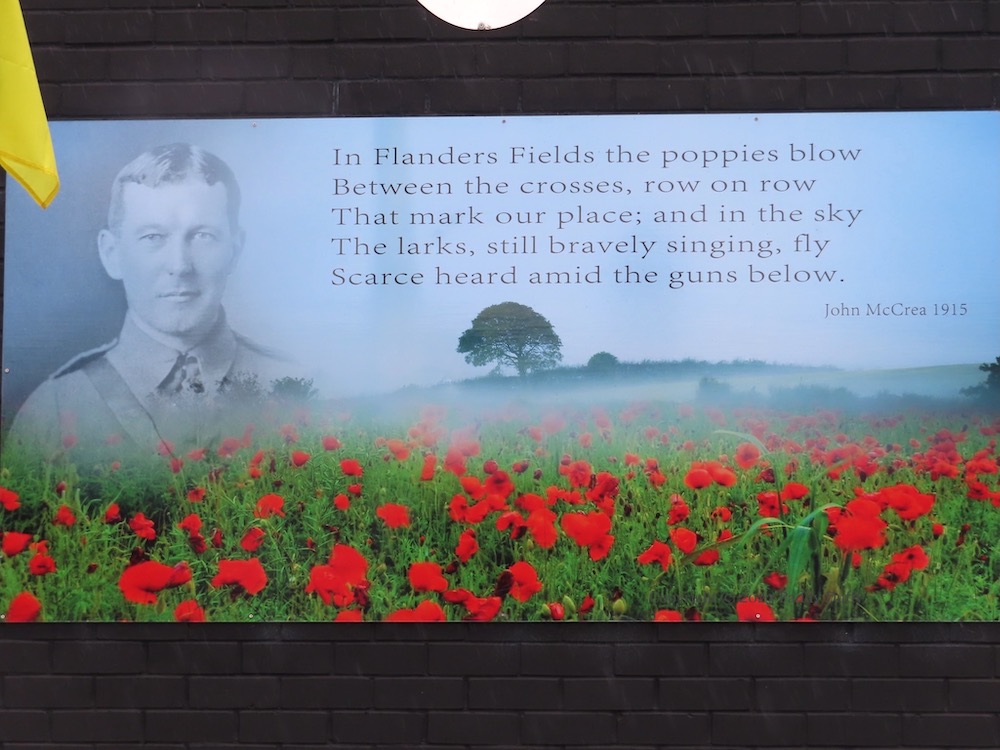
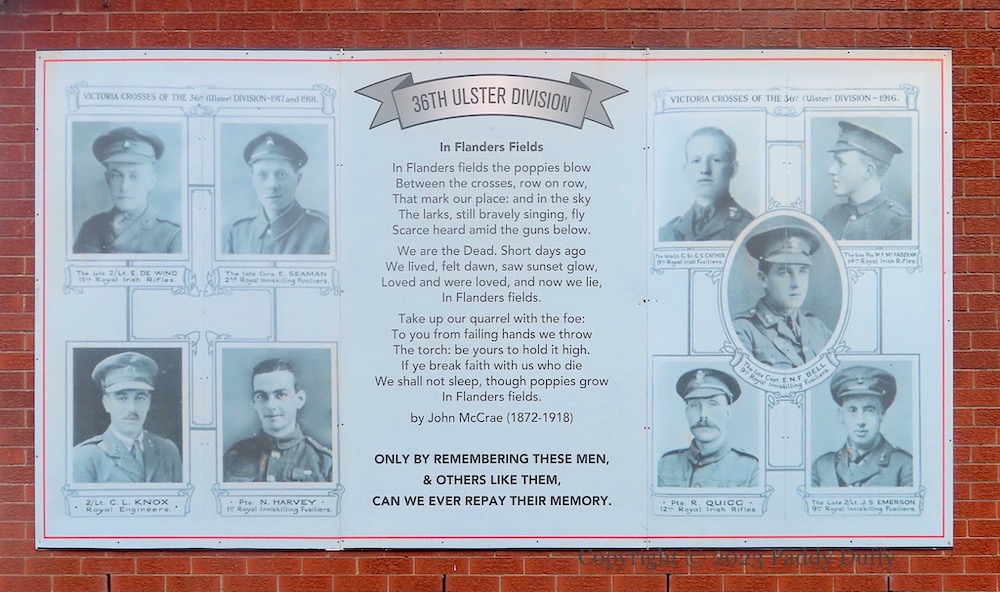
The house next to the Village memorial garden got an extension at the back in 2020 and with it the left-hand part of the house’s gable wall was extended upward (compare with the images from 2017 in Continuing Conflicts). The board with a verse from McCrea’s In Flanders Fields was present previously, but has been raised, and above it there now stands a red-hand emblem of the “UVF 2nd batt. south Belfast”.
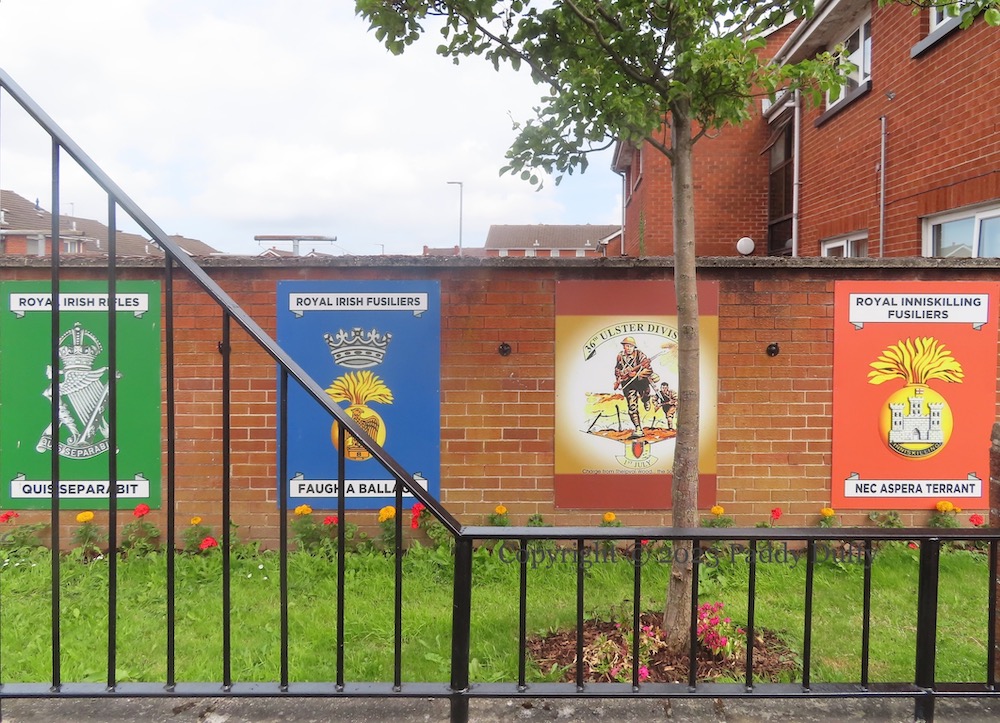
After WWI, the Royal Irish Rifles became the Royal Ulster Rifles (and later became part of the Royal Irish Rangers). This board prioritises WWI as the Rifles were part of the 36th Division. The hero of WWI portrayed in the central panel is William McFadzean, awarded the VC for falling on two live grenades in the trenches on July 1st, 1916. McFadzean is familiar from many previous murals both individually and in the company of other VC winners; for his family home in Cregagh, see Rubicon.
Alongside McFadzean, the hero of WWII is Blair “Paddy” Mayne, who was only briefly in the Ulster Rifles before making his name in the Parachute Unit (later, and better, known as the SAS). His many medals of honour are shown in an old Newtownards mural, though he was denied the VC.
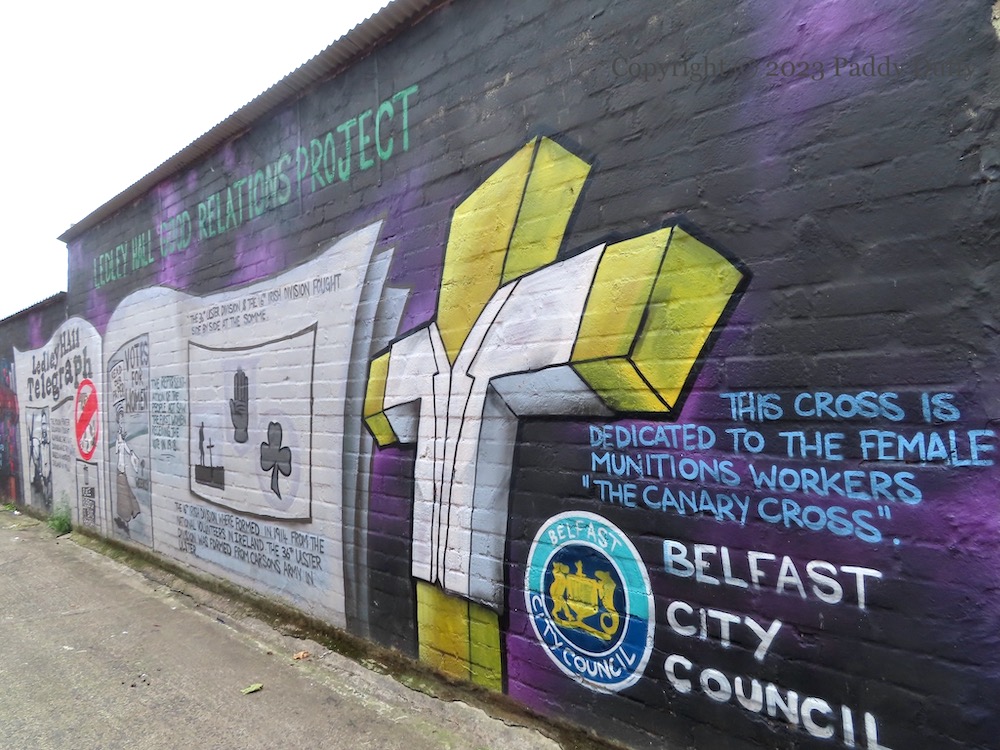
An imaginary newspaper called the “Ledley Hall Telegraph” includes stories on the 303 (Polish) RAF Squadron (which was stationed in Northern Ireland from 1943 to 1944), “Votes for women” (“the Representation Of The People Act saw the first women receiving the vote in 1918”), and the 16th and 36th Divisions (the mural says they “fought side by side at the Somme” – but the 36th was withdrawn on July 2nd after the Battle Of Albert and the 16th arrived in September and fought in the battles of Guillemont and Ginchy; both were withdrawn to Messines and both would take part in the Battle Of Messines in June 1917).
The “newspaper” is bookended by two painted crosses (for Row On Row), one for Guardsman Connor Lilley, a member of the Gertrude Star flute band, who was serving with the 1st battalion Royal Irish Guards when he was killed in an accident in Canada (Fb), and the other for WWI female munitions workers who, because of their work with TNT, risked yellowing skin both from direct exposure and from liver damage (“toxic jaundice”) (WP).
Also included is “The Kindness Hut”: “Be the reason someone smiles today”, “Kindness is free – please share”, “In a world where you can be anything, be kind”, “Take only what you need! If everyone shares there’s enough to go around”.
“O valiant hearts who to your glory came/Through dust of conflict and through battle flame//Tranquil you lie, your knightly virtue proved/Your memory hallowed [not “hollowed”] in the land you loved.” The hymn ‘O Valiant Hearts’ was a poem written during the first World War to commemorate the Allied dead, and was put to a variety of tunes during the 1920s, including arrangements by Vaughan Williams and Holst (WP); the most commonly sung tune, however, is that of Charles Harris (youtube, includes the full poem).
The memorial shown in the middle of the board is a Cross Of Sacrifice (see previously: One In Design And Intention) built on top of a German pill box at the centre of Tyne Cot cemetry, near Passchendaele, Belgium. The title of today’s post comes from remarks made by George V during a 1922 visit to the cemetery (History.org). The map in the background shows the area just south of Ypres (Canadian Soldiers).
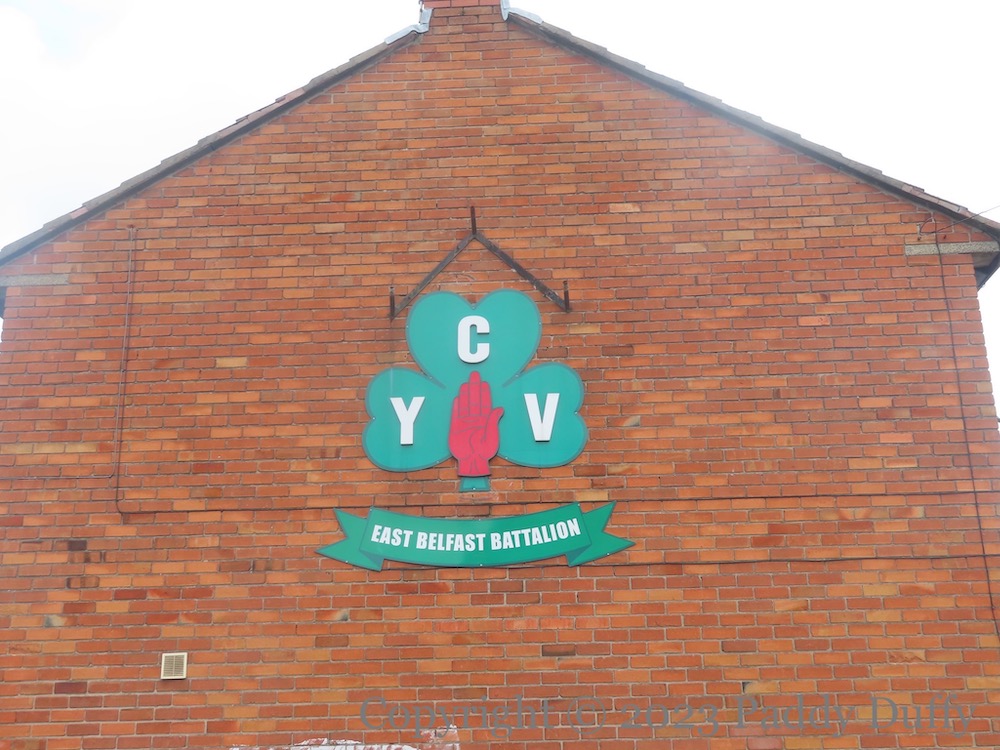
The board is in Pim’s Avenue, Belfast, opposite the older YCV emblem shown below.
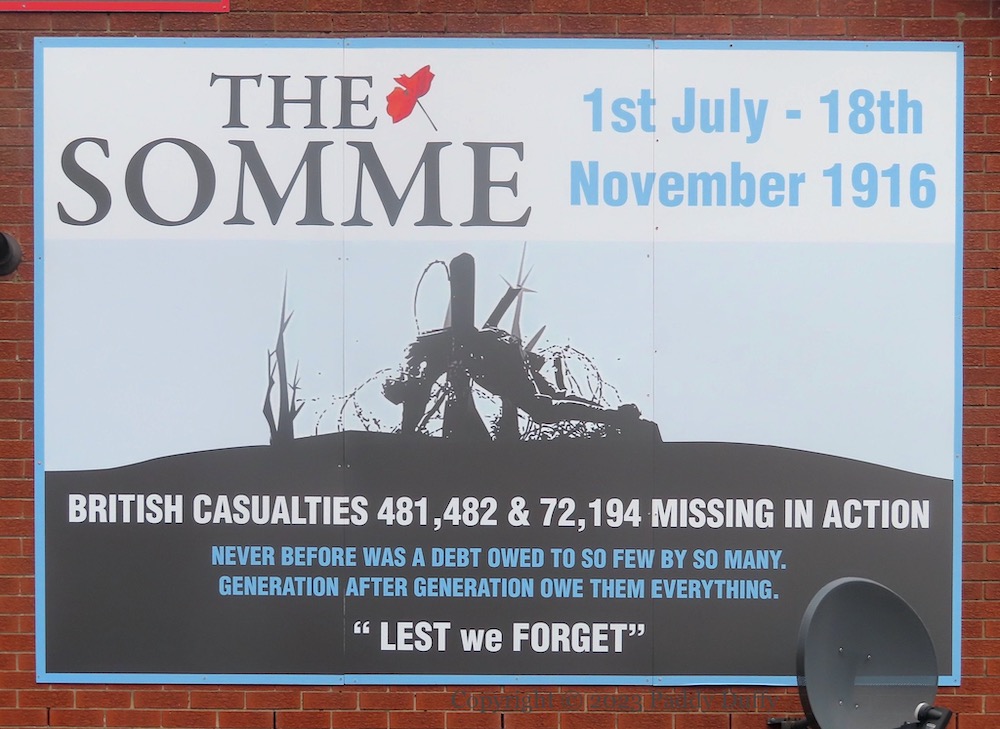
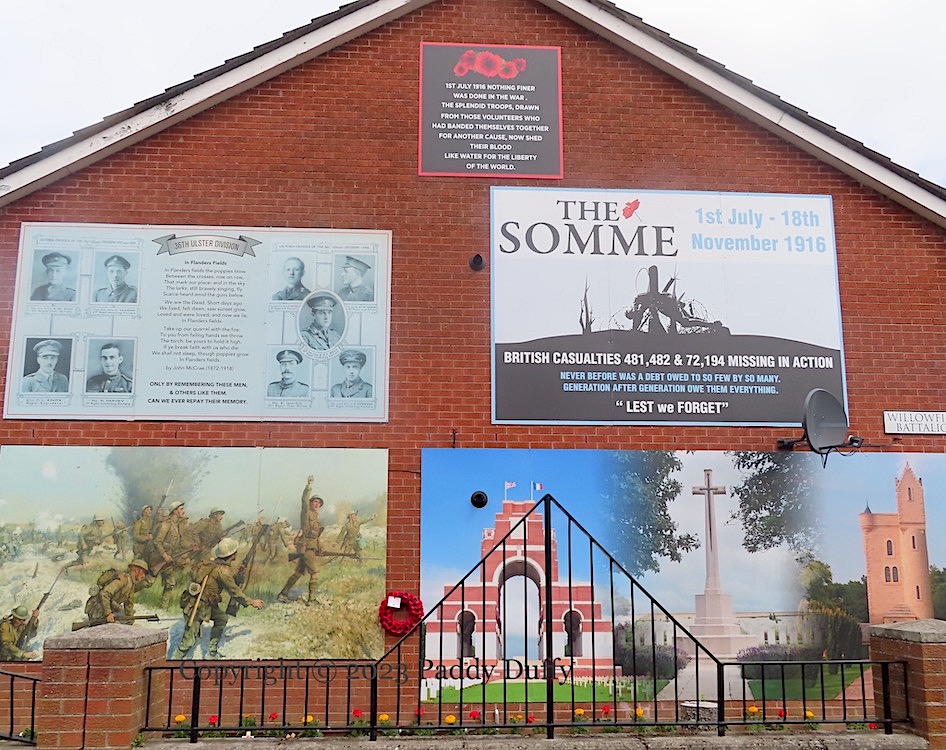
“Willowfield Battalion.” The building on the corner of Willowfield Street and the Woodstock Road was demolished and rebuilt with a building whose gable wall is full of windows. As a result, the display of Somme-related boards (see 2017’s Faugh-A-Ballagh in the Seosamh Mac Coılle collection) has moved a short distance down the street to a gable that has been revealed by taking down two large trees. The panels remain as before, though a new version of the Somme board renders the information horizontally rather than vertically (above).
Above: “Never before was a debt owed to so few by so many. Generation after generation owe them everything. Lest we forget.” Winston Churchill’s line about the British Air Force in WWII, that “Never in the field of human conflict was so much owed by so many to so few (youtube)“, is echoed in a board about the battles at the Somme between July 1st and November 18th, 1916. “The few” in this case, however, number nearly half a million dead and more than 72,000 missing.
Apex: “1st July 1916 nothing finer was done in the war. The splendid troops, drawn from those volunteers who had banded themselves together for another cause, now shed their blood like water for the liberty of the world.”
The “Shankill Boys” were the roughly 700 men of the West Belfast battalion of the Ulster Volunteers who were almost all killed at the Somme. (This board – or a previous copy of it – was previously in Carnan St.)
As with all of the Belfast battalions, West Belfast had a “USSF” [Ulster Special Service Force] – its emblem is in the top left of the second board, below. (See previously USSF and Carving Out A Place In History) The other emblem is that of the ‘Greengairs Thistle Flute Band’ (web). Although the background comes from WWI, the roll of honour lists modern-day volunteers from the UVF. Thomas Chapman, James McGregor, Robert McIntyre, William Hannah, and Robert Wadsworth are portrayed in Carnan Street – see C. Coy Street. The modern-day C Company, formed in 1974, is named after the Four Step Inn, which was bombed in September 1971 (see Four Step).
The stencil is in Mount Vernon, which is also home to a series of metalworks – see They Sleep Beyond Ulster’s Foam. That title, as well as the title of this entry, comes from Binyon’s poem For The Fallen, the fourth stanza of which is often cited in memorial for the dead of the Great War: “They shall grow not old, as we that are left grow old; / Age shall not weary them, nor the years condemn. / At the going down of the sun and in the morning / We will remember them.”
The stencil is perhaps not only a memorial to the dead of WWI – the planes appear to be WWII models such as the Hurricane or Spitfire (as on the box below, and in A Miracle of Deliverance); most WWI planes were biplanes.
Two poems of WWI in Ballykeel 2, Ballymena: above, “We are the Dead. Short days ago/We lived, felt dawn, saw sunset glow,/Loved and were loved, and now we lie/In Flanders fields.” from ‘In Flanders Fields’ by John McCrae.
Below: “They shall not grow old/As we that are left grow old/Age shall not weary them/Nor the years condemn/At the going down of the sun/And in the morning/We will remember them.” from ‘For The Fallen’ by Laurence Binyon.
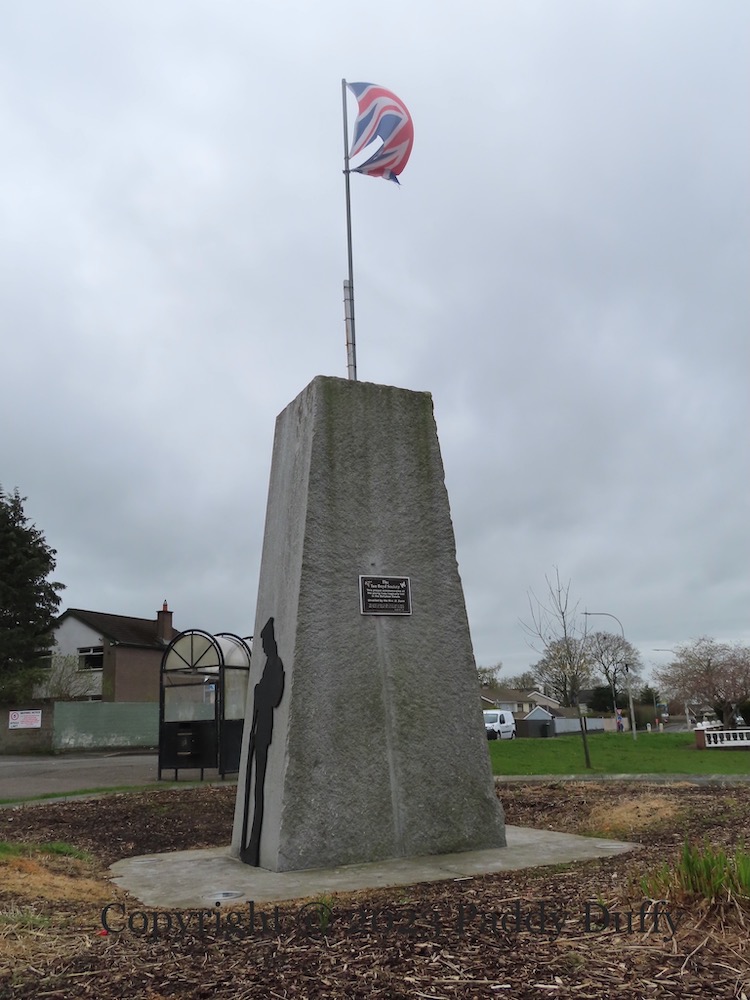
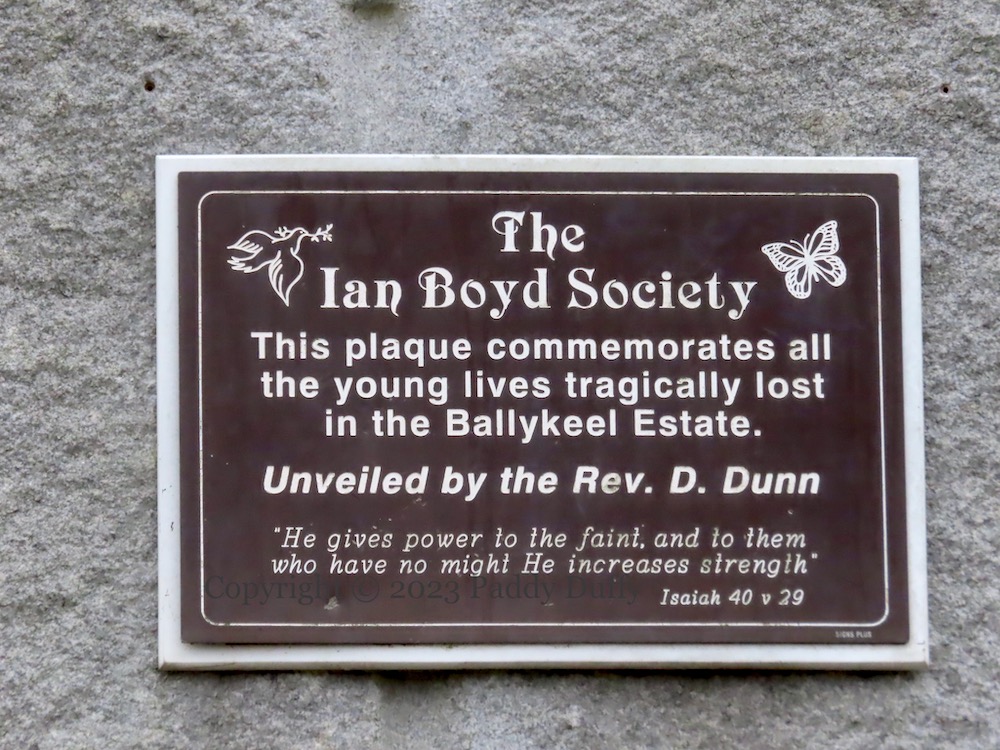
Ballykeel 2 remembers: 1690, VE Day (75th anniversary in 2020 – see also north Belfast | Caw, Londonderry), the Somme 1916, and “all the young lives tragically lost in the Ballykeel estate” (Ian Boyd took his own life in 2006 – anglican.org).







 Paddy Duffy Collection